
topic
signal sub-space (signal subspace)
A signal sub-space is a low-dimensional linear vector space that captures the primary information and structure of observed signals while separating them from random noise. In signal analysis and array processing, it is obtained through the eigen-decomposition of a data covariance matrix, where the eigenvectors corresponding to the dominant eigenvalues span the signal sub-space. The remaining orthogonal vector space forms the noise subspace. By isolating the signal sub-space from noise, algorithms can achieve high-resolution parameter estimation, effective noise filtering, and precise direction-of-arrival tracking in sensor arrays.
2 items
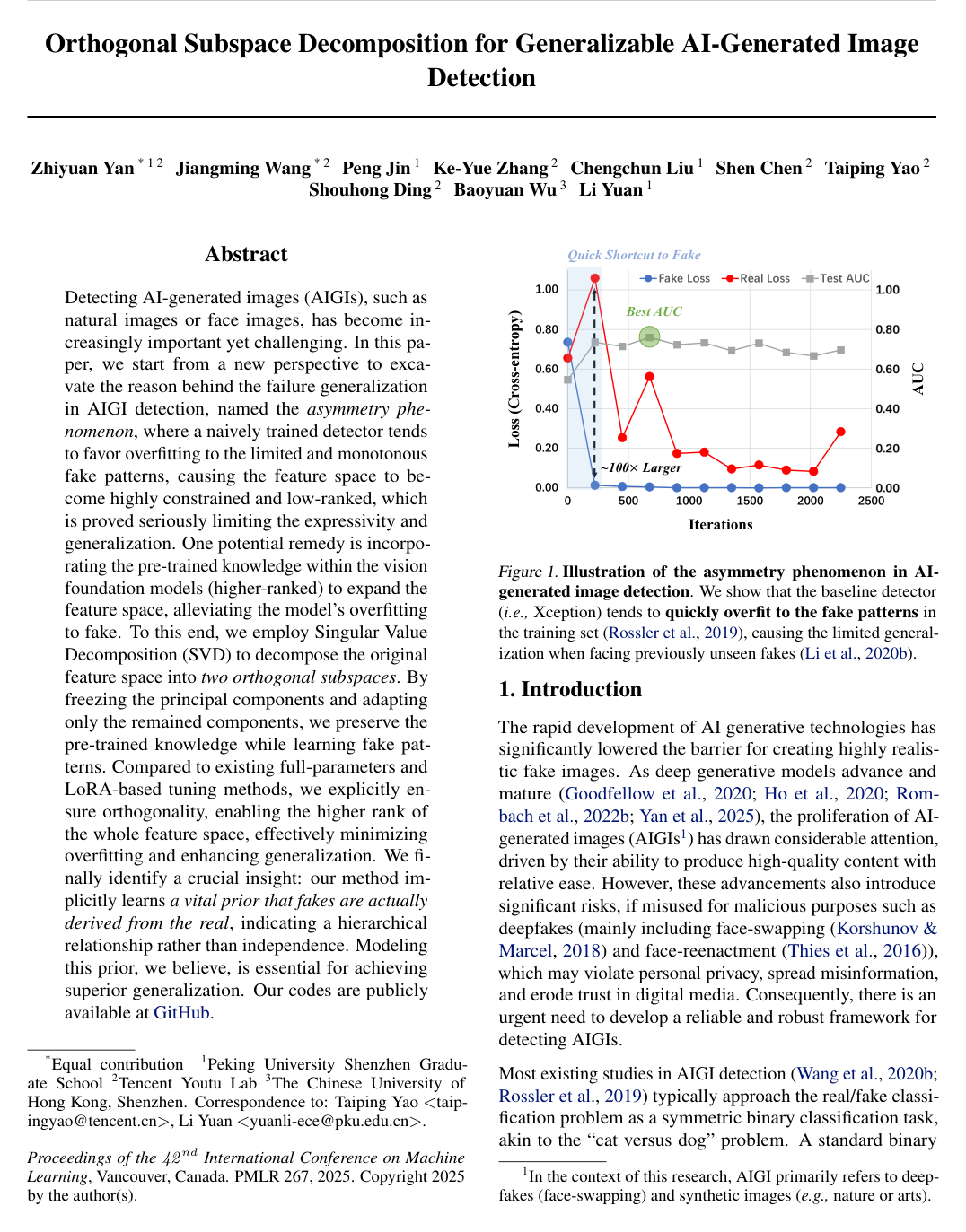
Orthogonal Subspace Decomposition for Generalizable AI-Generated Image Detection
Zhiyuan Yan, Jiangming Wang, Peng Jin, Ke-Yue Zhang, Chengchun Liu, Shen Chen, Taiping Yao, Shouhong Ding, Baoyuan Wu, Li Yuan
Why you should read this
Proposes an orthogonal subspace decomposition method via Singular Value Decomposition that preserves rich pre-trained representations in foundation models while adapting remaining components to prevent detectors from overfitting to seen fake patterns.
Detecting AI-generated images (AIGIs), such as natural images or face images, has become increasingly important yet challenging. In this paper, we start from a new perspective to excavate the reason behind the failure generalization in AIGI detection, named the asymmetry phenomenon, where a naively trained detector tends to favor overfitting to the limited and monotonous fake patterns, causing the feature space to become highly constrained and low-ranked, which is proved seriously limiting the expressivity and generalization. One potential remedy is incorporating the pre-trained knowledge within the vision foundation models (higher-ranked) to expand the feature space, alleviating the model’s overfitting to fake. To this end, we employ Singular Value Decomposition (SVD) to decompose the original feature space into two orthogonal subspaces. By freezing the principal components and adapting only the remained components, we preserve the pre-trained knowledge while learning fake patterns. Compared to existing full-parameters and LoRA-based tuning methods, we explicitly ensure orthogonality, enabling the higher rank of the whole feature space, effectively minimizing overfitting and enhancing generalization. We finally identify a crucial insight: our method implicitly learns a vital prior that fakes are actually derived from the real, indicating a hierarchical relationship rather than independence. Modeling this prior, we believe, is essential for achieving superior generalization. Our codes are publicly available at GitHub.
Added
2026-10-03
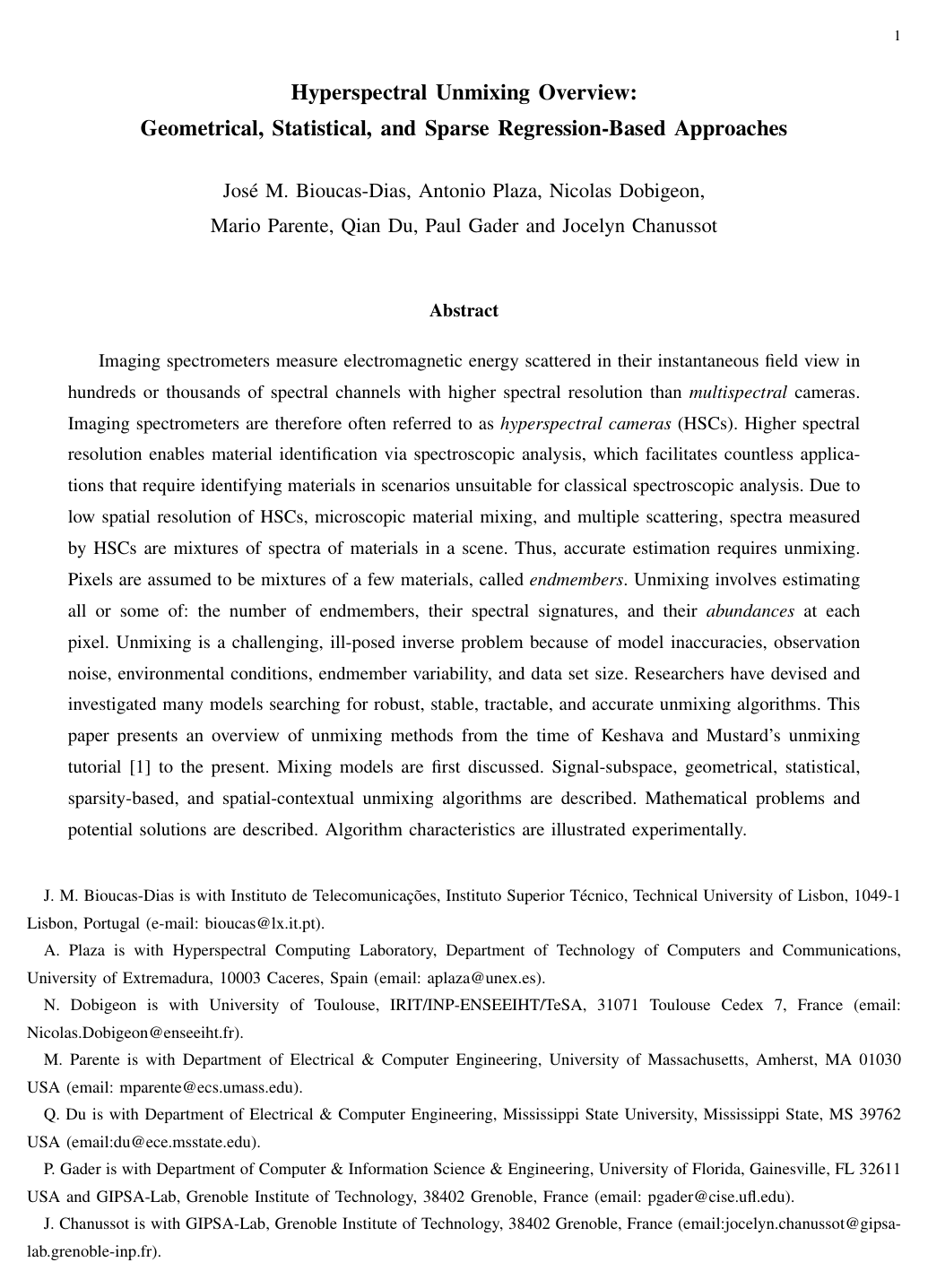
Hyperspectral Unmixing Overview: Geometrical, Statistical, and Sparse Regression-Based Approaches
José M. Bioucas-Dias, Antonio Plaza, Nicolas Dobigeon, Mario Parente, Qian Du, Paul Gader, Jocelyn Chanussot
Why you should read this
Presents a unified taxonomy of modern hyperspectral unmixing methods across geometrical, statistical, and sparse regression frameworks to guide researchers in accurately estimating material signatures and fractional abundances from complex remote sensing imagery.
Imaging spectrometers measure electromagnetic energy scattered in their instantaneous field view in hundreds or thousands of spectral channels with higher spectral resolution than multispectral cameras. Imaging spectrometers are therefore often referred to as hyperspectral cameras (HSCs). Higher spectral resolution enables material identification via spectroscopic analysis, which facilitates countless applications that require identifying materials in scenarios unsuitable for classical spectroscopic analysis. Due to low spatial resolution of HSCs, microscopic material mixing, and multiple scattering, spectra measured by HSCs are mixtures of spectra of materials in a scene. Thus, accurate estimation requires unmixing. Pixels are assumed to be mixtures of a few materials, called endmembers. Unmixing involves estimating all or some of: the number of endmembers, their spectral signatures, and their abundances at each pixel. Unmixing is a challenging, ill-posed inverse problem because of model inaccuracies, observation noise, environmental conditions, endmember variability, and data set size. Researchers have devised and investigated many models searching for robust, stable, tractable, and accurate unmixing algorithms. This paper presents an overview of unmixing methods from the time of Keshava and Mustard's unmixing tutorial [1] to the present. Mixing models are first discussed. Signal-subspace, geometrical, statistical, sparsity-based, and spatial-contextual unmixing algorithms are described. Mathematical problems and potential solutions are described. Algorithm characteristics are illustrated experimentally.
Added
2026-09-14