
Built independently by an author, for readers. Read the story and support ChapterPal

topic

sensor nodes (sensor node)

Sensor nodes are compact, autonomous electronic devices equipped with sensing components, a microprocessing unit, memory, a power supply, and a wireless transceiver. Operating collaboratively within wireless sensor networks, an individual sensor node gathers physical or environmental measurements, such as temperature, pressure, acoustic signals, or motion, and processes the data locally before transmitting it across single-hop or multi-hop wireless links to a central base station or sink node. Because these nodes are frequently deployed in distributed, inaccessible, or harsh environments with limited battery capacities, their architecture and communication protocols are heavily optimized for low power consumption through techniques such as dynamic sleep states, local data aggregation, and ambient energy harvesting.

1 item
Improved Knowledge Distillation via Teacher Assistant

Improved Knowledge Distillation via Teacher Assistant

Seyed Iman Mirzadeh, Mehrdad Farajtabar, Ang Li, Nir Levine, Akihiro Matsukawa, Hassan Ghasemzadeh

OrganizationsD. E. Shaw & Co.GoogleWashington State University

Why you should read this

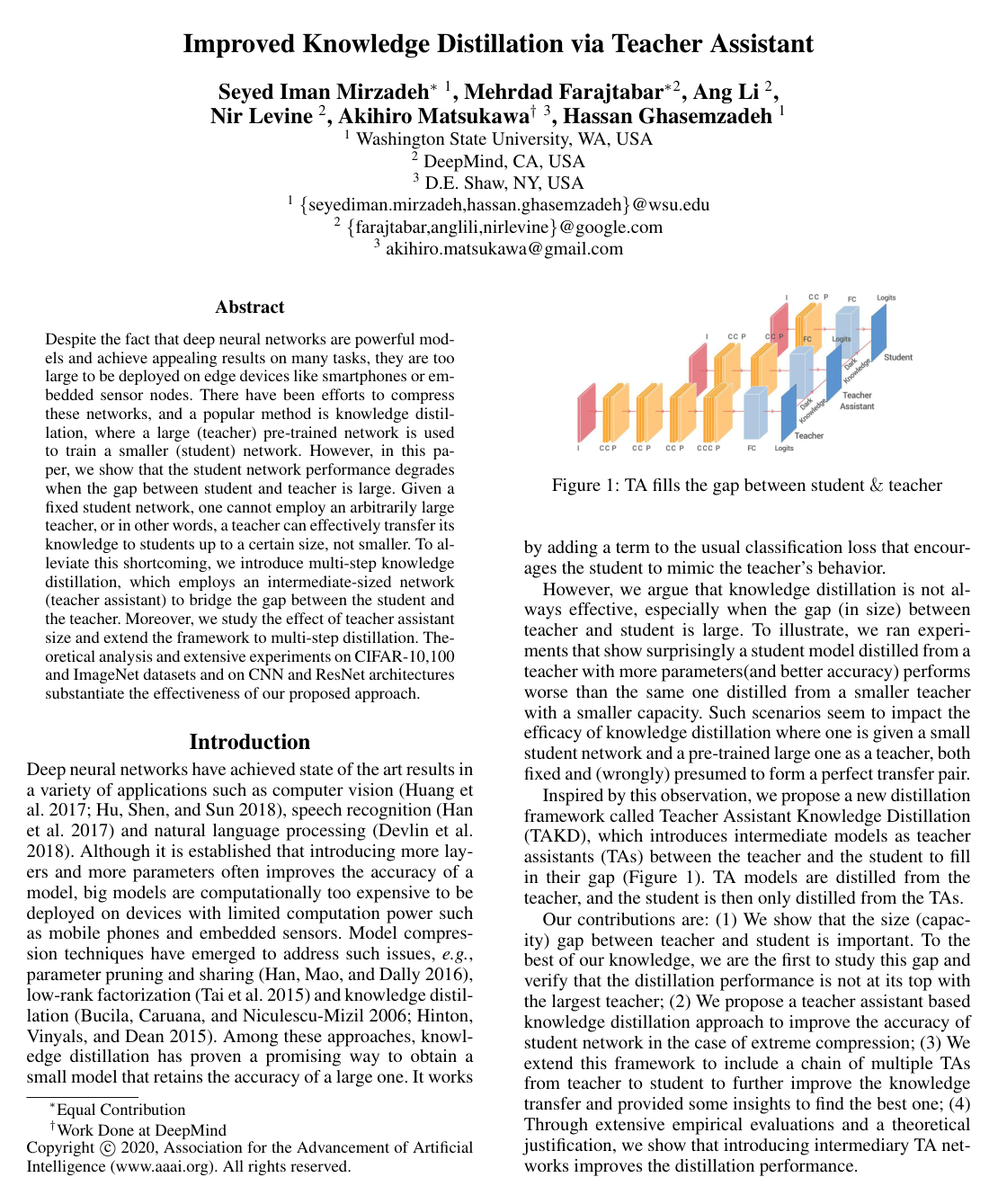
Solves the capacity gap dilemma by introducing an intermediate-sized teacher assistant model to smoothly bridge the complexity jump between a massive pre-trained model and a tiny student.

Despite the fact that deep neural networks are powerful models and achieve appealing results on many tasks, they are too large to be deployed on edge devices like smartphones or embedded sensor nodes. There have been efforts to compress these networks, and a popular method is knowledge distillation, where a large (teacher) pre-trained network is used to train a smaller (student) network. However, in this paper, we show that the student network performance degrades when the gap between student and teacher is large. Given a fixed student network, one cannot employ an arbitrarily large teacher, or in other words, a teacher can effectively transfer its knowledge to students up to a certain size, not smaller. To alleviate this shortcoming, we introduce multi-step knowledge distillation, which employs an intermediate-sized network (teacher assistant) to bridge the gap between the student and the teacher. Moreover, we study the effect of teacher assistant size and extend the framework to multi-step distillation. Theoretical analysis and extensive experiments on CIFAR-10,100 and ImageNet datasets and on CNN and ResNet architectures substantiate the effectiveness of our proposed approach.

Added

2026-06-19