
topic
semantic descriptions (semantic description, semantic service)
Semantic descriptions are formal, machine-readable specifications that define the underlying meaning, properties, and relationships of data, digital resources, and software components. By structuring information according to shared conceptual models and standardized vocabularies, these descriptions allow computers to interpret the context, intent, and functional capabilities of resources rather than relying merely on syntactic structures or keyword matching. Within knowledge representation and distributed systems, semantic descriptions define elements such as inputs, outputs, operational constraints, and domain-specific roles, enabling automated discovery, seamless data integration, intelligent reasoning, and dynamic service composition across heterogeneous computing environments.
2 items
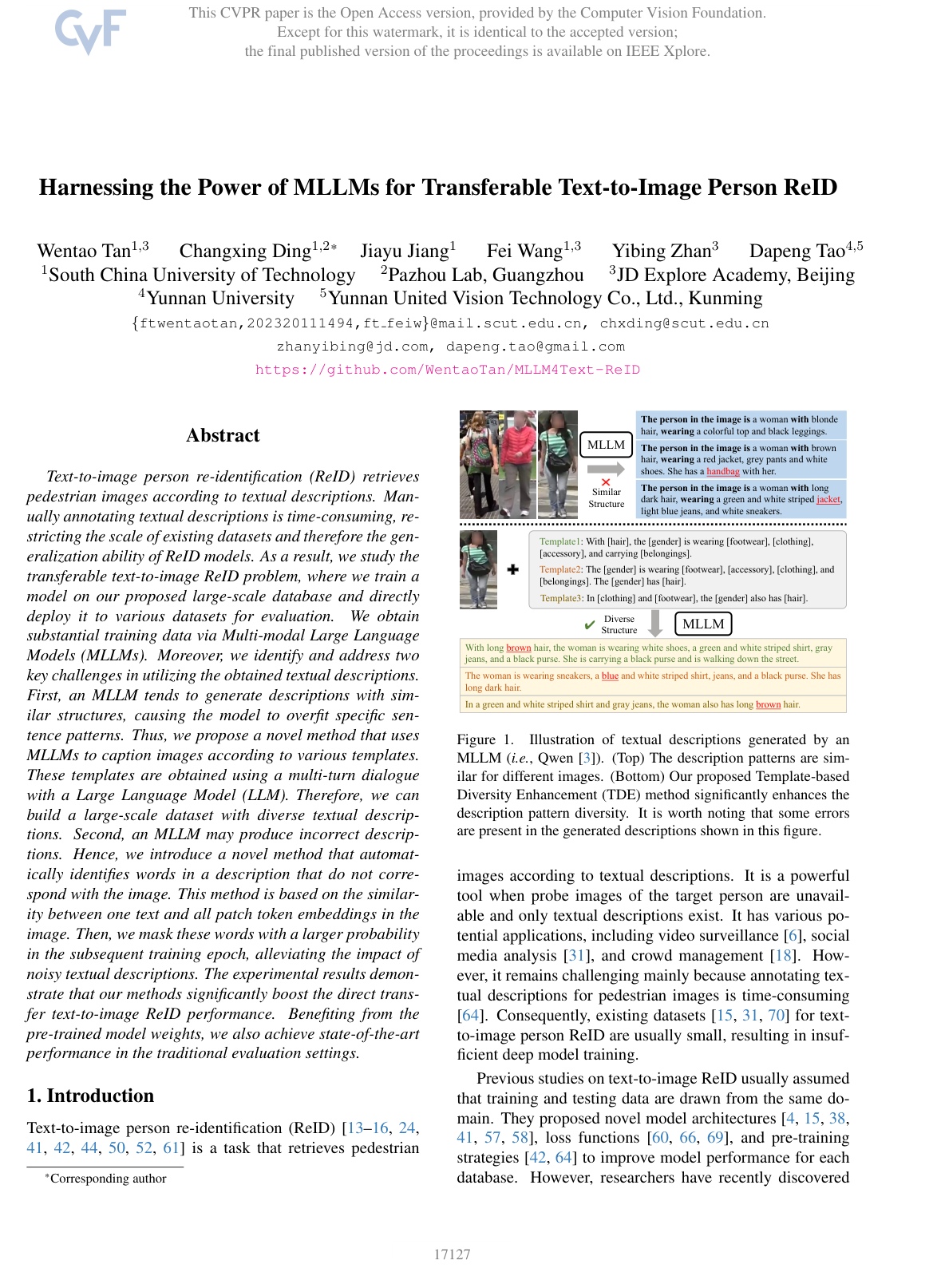
Harnessing the Power of MLLMs for Transferable Text-to-Image Person ReID
Wentao Tan, Changxing Ding, Jiayu Jiang, Fei Wang, Yibing Zhan, Dapeng Tao
Why you should read this
Proposes a scalable framework for transferable text-to-image person re-identification that uses multimodal large language models to generate diverse text annotations via dynamic templates while filtering out hallucinated descriptions with noise-aware masking.
Text-to-image person re-identification (ReID) retrieves pedestrian images according to textual descriptions. Manually annotating textual descriptions is time-consuming, restricting the scale of existing datasets and therefore the generalization ability of ReID models. As a result, we study the transferable text-to-image ReID problem, where we train a model on our proposed large-scale database and directly deploy it to various datasets for evaluation. We obtain substantial training data via Multi-modal Large Language Models (MLLMs). Moreover, we identify and address two key challenges in utilizing the obtained textual descriptions. First, an MLLM tends to generate descriptions with similar structures, causing the model to overfit specific sentence patterns. Thus, we propose a novel method that uses MLLMs to caption images according to various templates. These templates are obtained using a multi-turn dialogue with a Large Language Model (LLM). Therefore, we can build a large-scale dataset with diverse textual descriptions. Second, an MLLM may produce incorrect descriptions. Hence, we introduce a novel method that automatically identifies words in a description that do not correspond with the image. This method is based on the similarity between one text and all patch token embeddings in the image. Then, we mask these words with a larger probability in the subsequent training epoch, alleviating the impact of noisy textual descriptions. The experimental results demonstrate that our methods significantly boost the direct transfer text-to-image ReID performance. Benefiting from the pre-trained model weights, we also achieve state-of-the-art performance in the traditional evaluation settings.
Added
2026-09-26
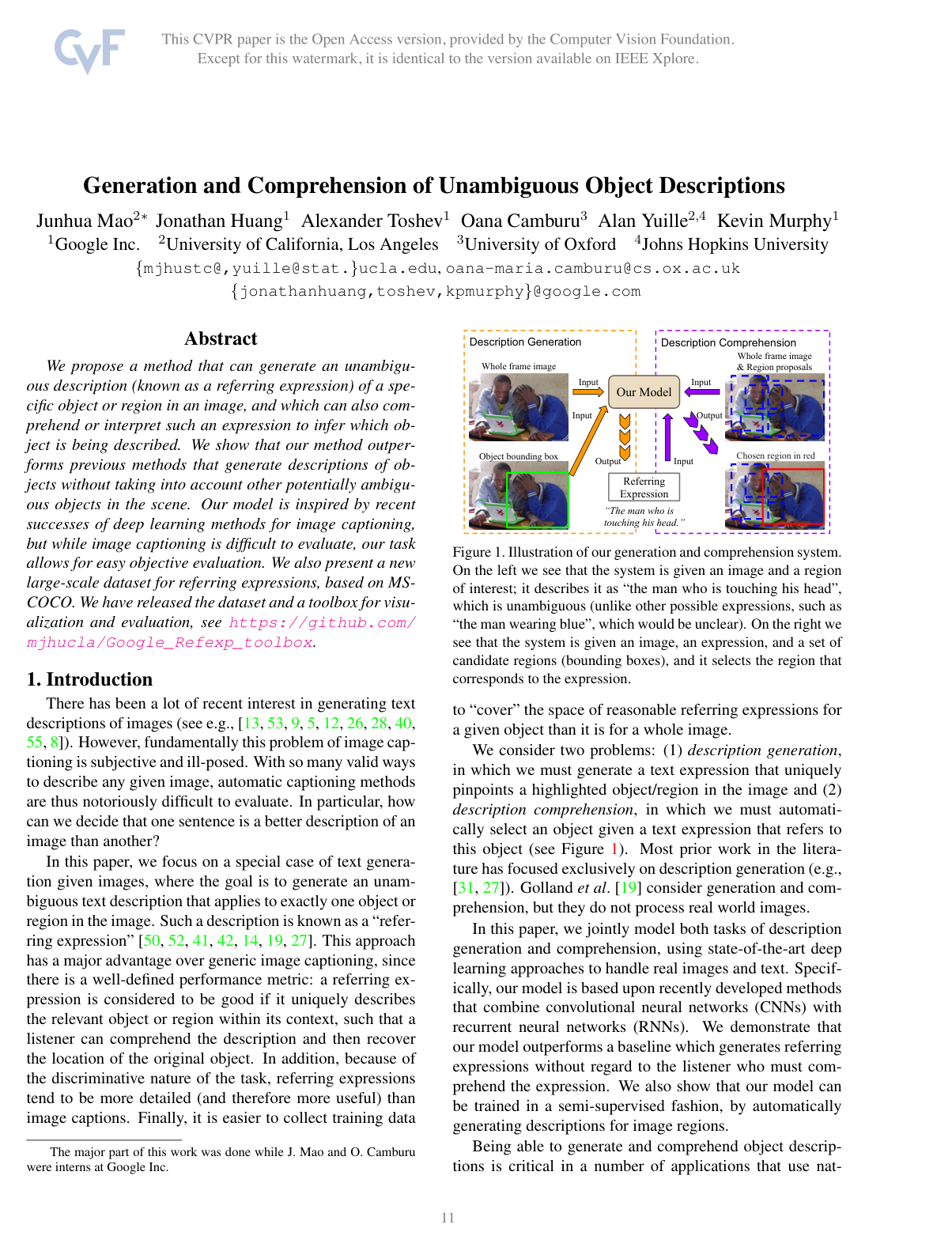
Generation and Comprehension of Unambiguous Object Descriptions
Junhua Mao, Jonathan Huang, Alexander Toshev, Oana Camburu, Alan Yuille, Kevin Murphy
Why you should read this
Presents a unified deep learning framework for generating and comprehending unambiguous referring expressions in images by accounting for visual context, accompanied by a large-scale MS-COCO benchmark dataset.
We propose a method that can generate an unambiguous description (known as a referring expression) of a specific object or region in an image, and which can also comprehend or interpret such an expression to infer which object is being described. We show that our method outperforms previous methods that generate descriptions of objects without taking into account other potentially ambiguous objects in the scene. Our model is inspired by recent successes of deep learning methods for image captioning, but while image captioning is difficult to evaluate, our task allows for easy objective evaluation. We also present a new large-scale dataset for referring expressions, based on MS-COCO. We have released the dataset and a toolbox for visualization and evaluation, see this https URL
Added
2026-09-20