
topic
raid
RAID, which stands for redundant array of independent disks, is a data storage technology that combines multiple physical disk drives into a single logical unit to enhance data reliability, system performance, or both. By distributing data across several drives using techniques such as striping, mirroring, and parity, it allows a computer system to continue operating without data loss if an individual drive fails, while also increasing data transfer speeds. Standard configurations, known as RAID levels, balance fault tolerance, capacity, and performance to suit different operational requirements, making the technology a standard solution in servers, enterprise disk arrays, and high-availability storage systems.
2 items
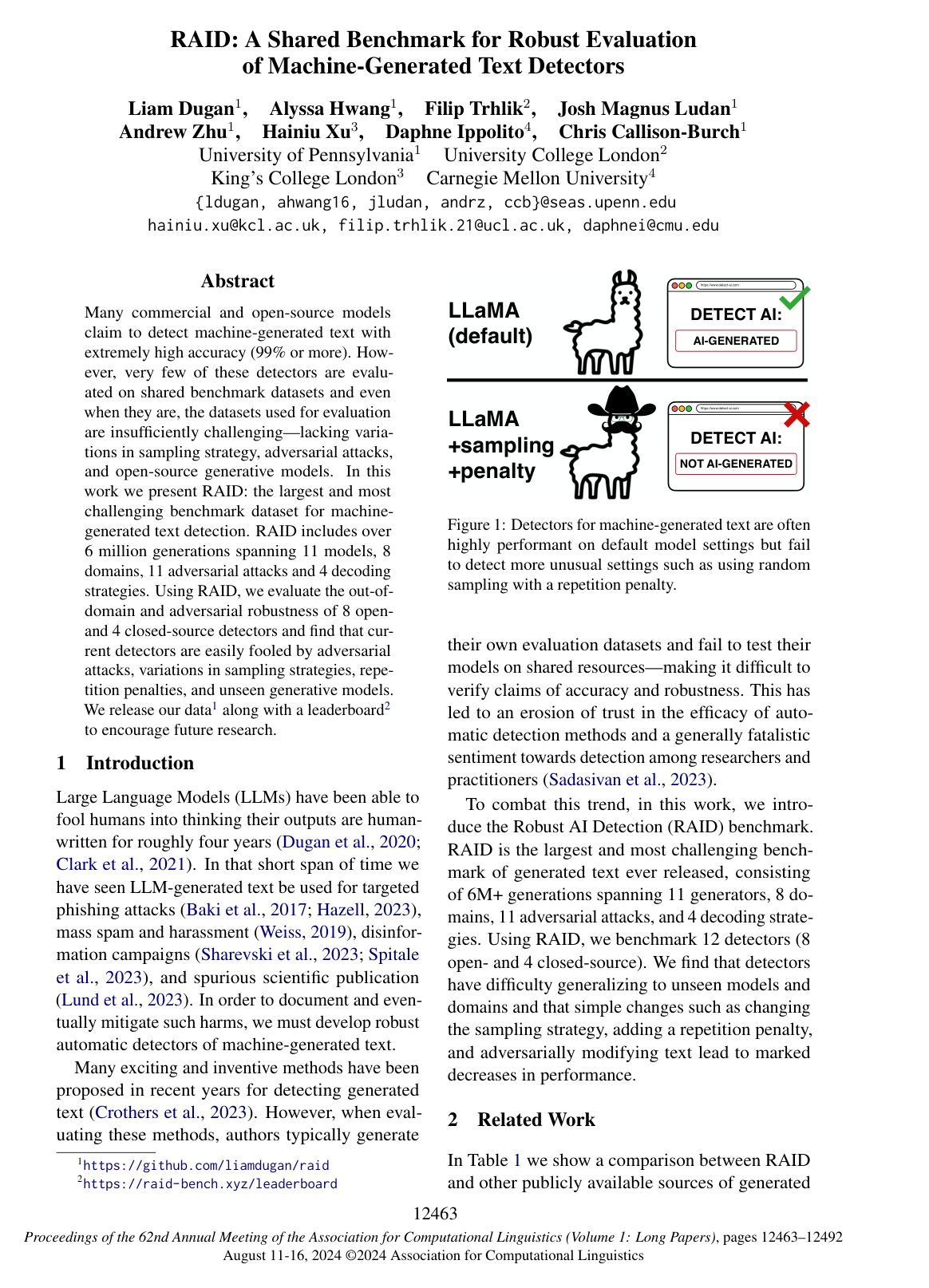
RAID: A Shared Benchmark for Robust Evaluation of Machine-Generated Text Detectors
Liam Dugan, Alyssa Hwang, Filip Trhlík, Andrew Zhu, Josh Magnus Ludan, Hainiu Xu, Daphne Ippolito, Chris Callison-Burch
Why you should read this
Introduces a six-million-generation benchmark across eleven language models, eight domains, and eleven adversarial attacks, revealing that top AI text detectors easily fail when faced with minor sampling changes, repetition penalties, or unseen models.
Many commercial and open-source models claim to detect machine-generated text with extremely high accuracy (99% or more). However, very few of these detectors are evaluated on shared benchmark datasets and even when they are, the datasets used for evaluation are insufficiently challenging—lacking variations in sampling strategy, adversarial attacks, and open-source generative models. In this work we present RAID: the largest and most challenging benchmark dataset for machine-generated text detection. RAID includes over 6 million generations spanning 11 models, 8 domains, 11 adversarial attacks and 4 decoding strategies. Using RAID, we evaluate the out-of-domain and adversarial robustness of 8 open- and 4 closed-source detectors and find that current detectors are easily fooled by adversarial attacks, variations in sampling strategies, repetition penalties, and unseen generative models. We release our data1 along with a leaderboard2 to encourage future research.
Added
2026-09-26
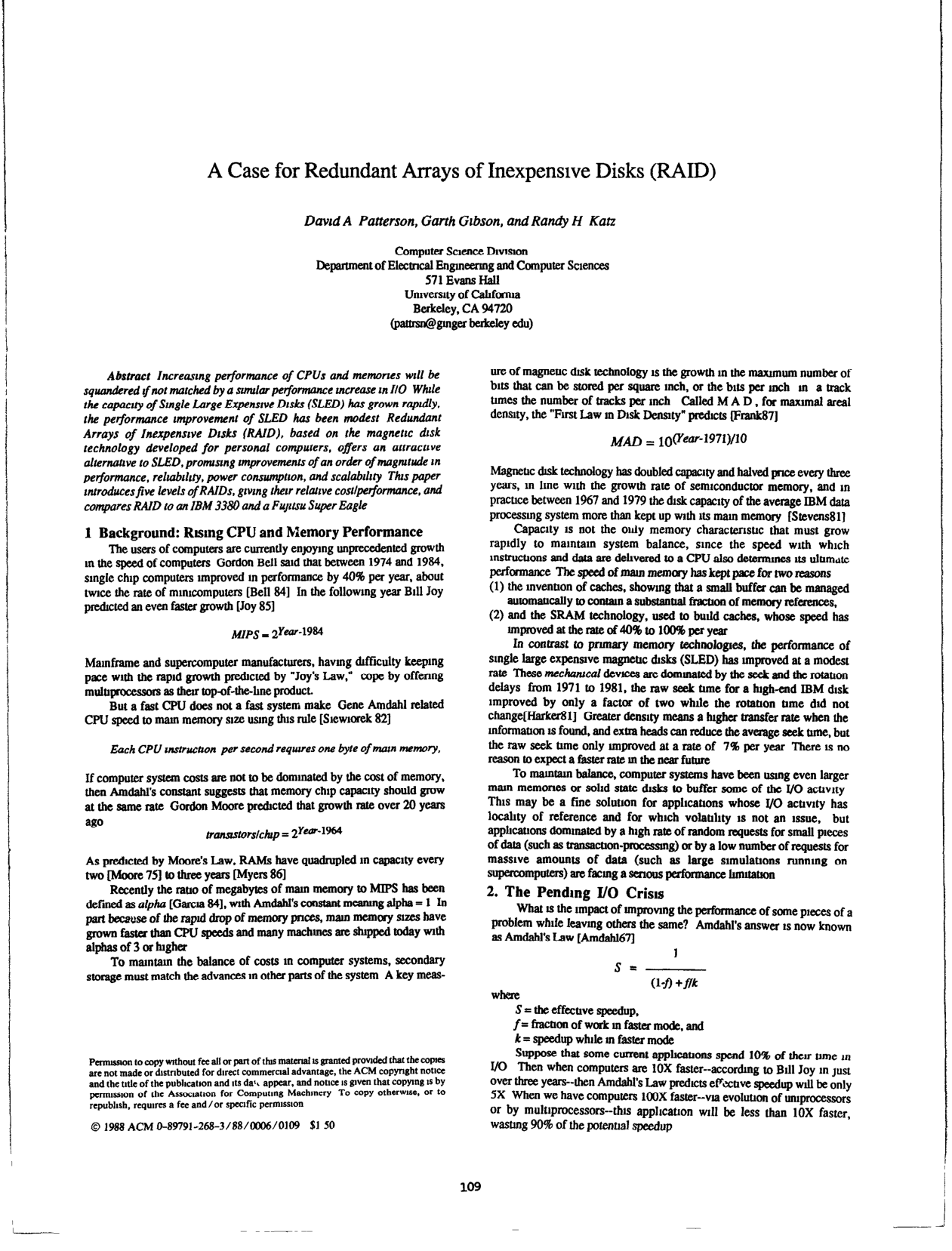
A case for redundant arrays of inexpensive disks (RAID)
David A. Patterson, Garth Gibson, Randy H. Katz
Why you should read this
Proposes the foundational five-level RAID taxonomy, demonstrating how arrays of inexpensive personal computer disks can overcome the processor-I/O performance gap by delivering higher throughput, fault tolerance, and cost efficiency than traditional mainframe storage systems.
Increasing performance of CPUs and memories will be squandered if not matched by a similar performance increase in I/O. While the capacity of Single Large Expensive Disks (SLED) has grown rapidly, the performance improvement of SLED has been modest. Redundant Arrays of Inexpensive Disks (RAID), based on the magnetic disk technology developed for personal computers, offers an attractive alternative to SLED, promising improvements of an order of magnitude in performance, reliability, power consumption, and scalability. This paper introduces five levels of RAIDs, giving their relative cost/performance, and compares RAID to an IBM 3380 and a Fujitsu Super Eagle.
Added
2026-09-24