
topic
pipelined architecture (pipeline architecture)
A pipelined architecture, also known as a pipeline architecture, is a computer hardware design structure that overlaps the execution of multiple instructions to increase processing throughput. In this design, the overall task of processing an instruction is divided into a series of sequential, independent stages, such as fetching, decoding, executing, and writing back results. Much like an industrial assembly line, each hardware stage performs its dedicated subtask on a different instruction simultaneously during each clock cycle. Although pipelining does not reduce the total latency required to complete a single instruction from start to finish, it significantly raises the overall rate of instruction execution, making it a fundamental principle in modern microprocessors, graphics processing units, and custom digital hardware.
2 items
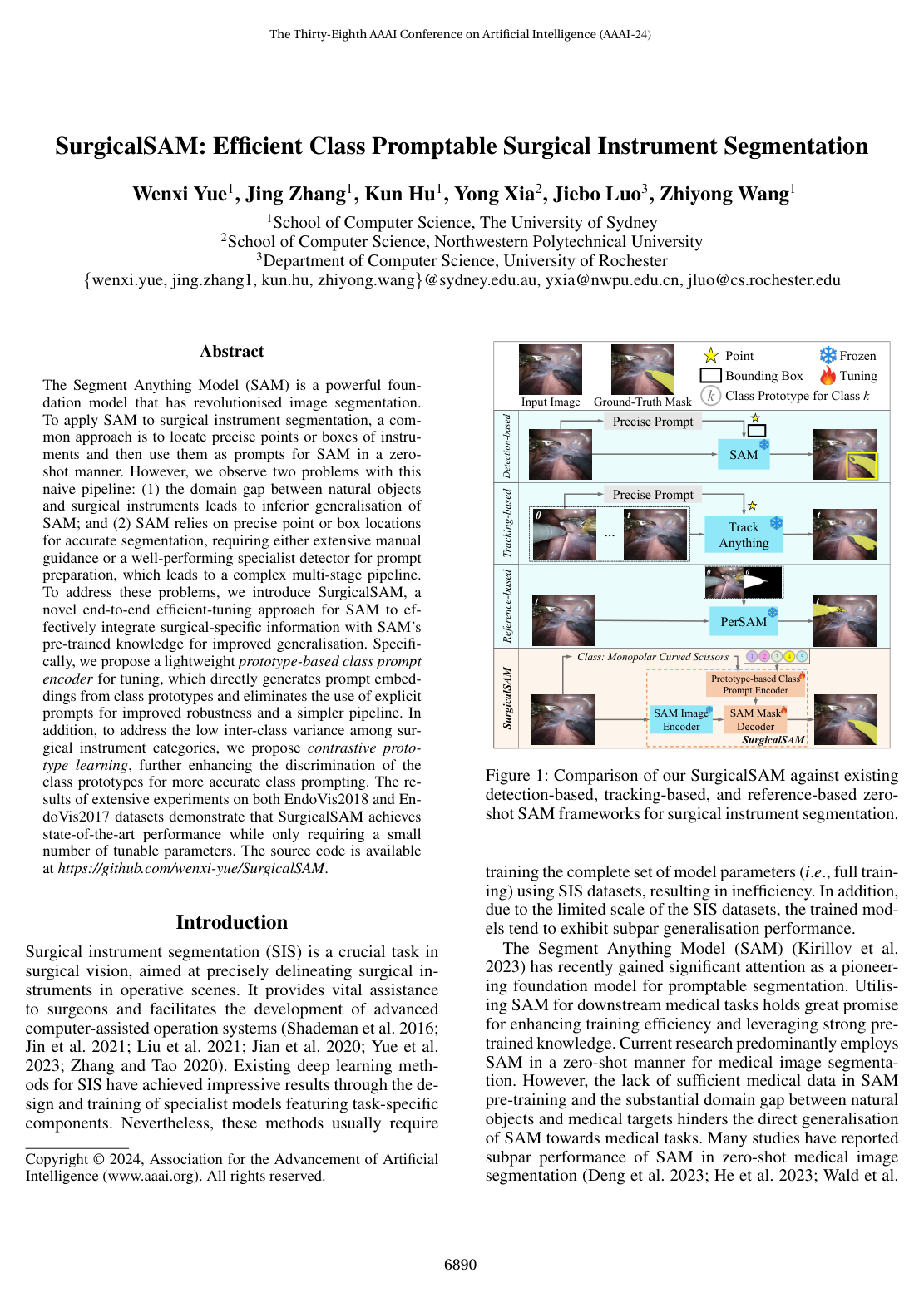
SurgicalSAM: Efficient Class Promptable Surgical Instrument Segmentation
Wenxi Yue, Jing Zhang, Kun Hu, Yong Xia, Jiebo Luo, Zhiyong Wang
Why you should read this
Proposes an end-to-end framework that efficiently adapts the Segment Anything Model for surgical instrument segmentation by replacing fragile manual bounding-box prompts with learned class prototypes and contrastive learning.
The Segment Anything Model (SAM) is a powerful foundation model that has revolutionised image segmentation. To apply SAM to surgical instrument segmentation, a common approach is to locate precise points or boxes of instruments and then use them as prompts for SAM in a zero-shot manner. However, we observe two problems with this naive pipeline: (1) the domain gap between natural objects and surgical instruments leads to inferior generalisation of SAM; and (2) SAM relies on precise point or box locations for accurate segmentation, requiring either extensive manual guidance or a well-performing specialist detector for prompt preparation, which leads to a complex multi-stage pipeline. To address these problems, we introduce SurgicalSAM, a novel end-to-end efficient-tuning approach for SAM to effectively integrate surgical-specific information with SAM's pre-trained knowledge for improved generalisation. Specifically, we propose a lightweight prototype-based class prompt encoder for tuning, which directly generates prompt embeddings from class prototypes and eliminates the use of explicit prompts for improved robustness and a simpler pipeline. In addition, to address the low inter-class variance among surgical instrument categories, we propose contrastive prototype learning, further enhancing the discrimination of the class prototypes for more accurate class prompting. The results of extensive experiments on both EndoVis2018 and EndoVis2017 datasets demonstrate that SurgicalSAM achieves state-of-the-art performance while only requiring a small number of tunable parameters. The source code is available at https://github.com/wenxi-yue/SurgicalSAM.
Added
2026-09-26
PipeDream: generalized pipeline parallelism for DNN training
Deepak Narayanan, Aaron Harlap, Amar Phanishayee, Vivek Seshadri, Nikhil R. Devanur, Gregory R. Ganger, Phillip B. Gibbons, Matei Zaharia
Why you should read this
Replaces naive pipeline scheduling with an optimized 1F1B (One-Forward, One-Backward) approach, drastically reducing memory footprint and the idle "pipeline bubble.".
DNN training is extremely time-consuming, necessitating efficient multi-accelerator parallelization. Current approaches to parallelizing training primarily use intra-batch parallelization, where a single iteration of training is split over the available workers, but suffer from diminishing returns at higher worker counts. We present PipeDream, a system that adds inter-batch pipelining to intra-batch parallelism to further improve parallel training throughput, helping to better overlap computation with communication and reduce the amount of communication when possible. Unlike traditional pipelining, DNN training is bi-directional, where a forward pass through the computation graph is followed by a backward pass that uses state and intermediate data computed during the forward pass. Naïve pipelining can thus result in mismatches in state versions used in the forward and backward passes, or excessive pipeline flushes and lower hardware efficiency. To address these challenges, PipeDream versions model parameters for numerically correct gradient computations, and schedules forward and backward passes of different minibatches concurrently on different workers with minimal pipeline stalls. PipeDream also automatically partitions DNN layers among workers to balance work and minimize communication. Extensive experimentation with a range of DNN tasks, models, and hardware configurations shows that PipeDream trains models to high accuracy up to 5.3X faster than commonly used intra-batch parallelism techniques.
Added
2026-03-13