
topic
open source system
An open source system is a software system whose underlying source code is released under a license that grants anyone the right to inspect, modify, and redistribute it. These systems are typically developed and maintained through collaborative, community-driven engineering practices, relying on transparent peer review, distributed version control, and collective problem-solving to adapt and improve the software. By providing unrestricted visibility into their architecture, open source systems facilitate long-term maintenance, modular integration, and interoperability across diverse computing environments while enabling individuals and organizations to adapt the software to their specific operational needs.
4 items
Specula: Scaling formal specifications for autonomous model checking of system code
Qian Cheng, Saad Mohammad Rafid Pial, Ruize Tang, Yiming Su, Emilie Ma, Finn Hackett, Ivan Beschastnikh, Yu Huang, Tianyin Xu
Why you should read this
Presents Specula, an autonomous system that uses self-improving LLM agents to generate formal TLA+ specifications from complex codebases, enabling push-button model checking that identified 249 bugs across 48 open-source projects.
Specula is a push-button agentic system that generates high-quality formal specifications for large, complex system code and uses the specifications for highly effective model checking and bug finding. Specula employs large language model (LLM) based coding agents to autonomously develop TLA+ specifications, including invariants that describe correctness properties of the target system and formal models that describe the system implementation with the right level of abstractions. Specula is fully autonomous and thus eliminates the barrier of applying formal methods to real-world system code (as in traditional human-centric approaches). Meanwhile, Specula addresses limitations of LLM-driven techniques like reward hacking and hallucinations through self-evolving loops that iteratively improve specification quality by enabling the agents to deepen their understanding of system code and its behaviors. We have used Specula to check 48 open-source system projects; Specula found 249 bugs including many deep bugs that are hard to find by existing approaches. Specula has been used by several companies and is maintained at this https URL.
Added
2026-09-30
CodaLab Competitions: An Open Source Platform to Organize Scientific Challenges
Adrien Pavao, Isabelle Guyon, Anne-Catherine Letournel, Dinh-Tuan Tran, Xavier Baró, Hugo Jair Escalante, Sergio Escalera, Tyler Thomas, Zhen Xu
Why you should read this
Presents an open-source framework that enables researchers to design, host, and scale reproducible machine learning competitions using custom Docker environments, multi-phase evaluations, and external compute resources.
CodaLab Competitions is an open source web platform designed to help data scientists and research teams to crowd-source the resolution of machine learning problems through the organization of competitions, also called challenges or contests. CodaLab Competitions provides useful features such as multiple phases, results and code submissions, multi-score leaderboards, and jobs running inside Docker containers. The platform is very flexible and can handle large scale experiments, by allowing organizers to upload large datasets and provide their own CPU or GPU compute workers.
Added
2026-09-26
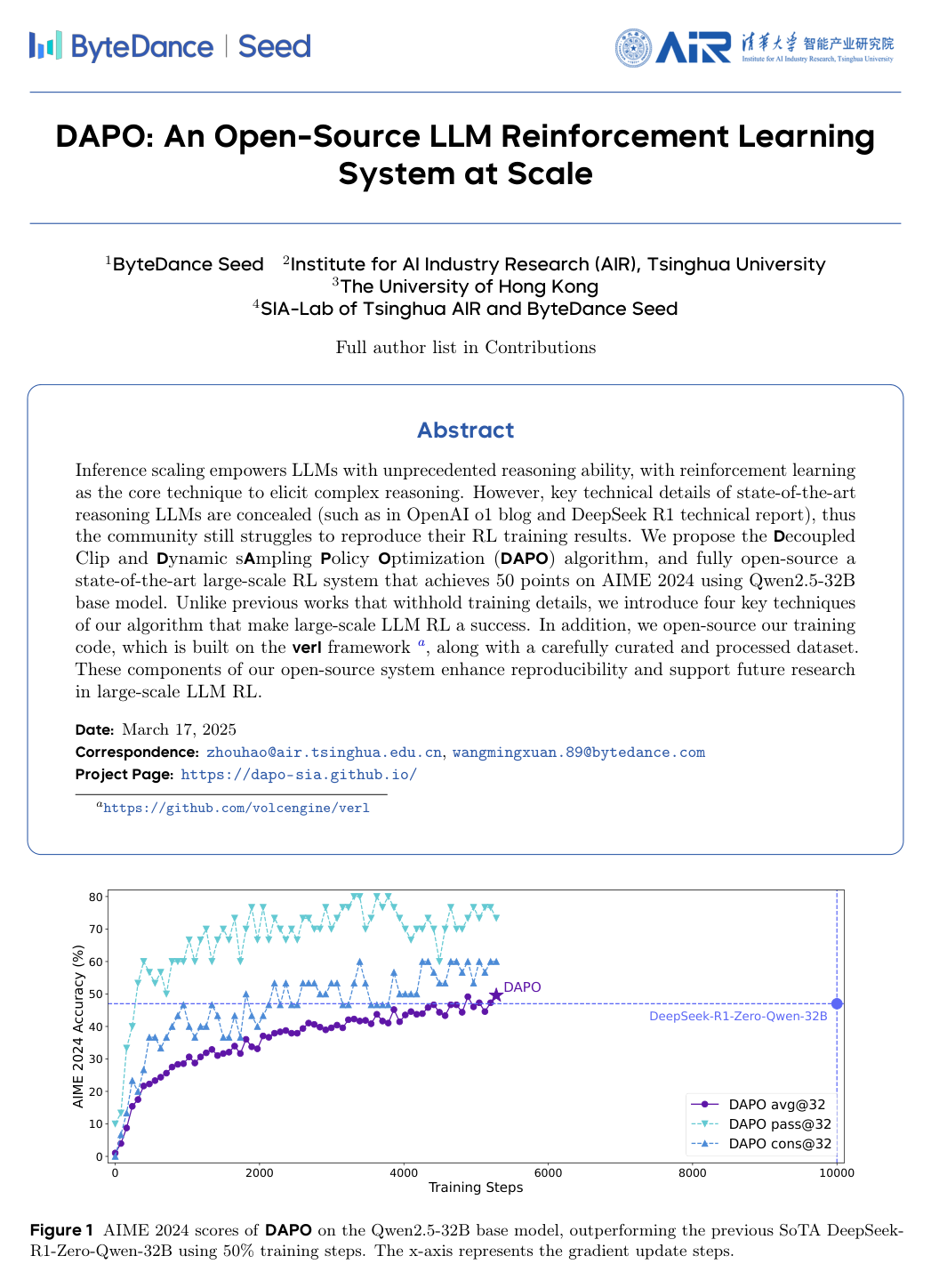
DAPO: An Open-Source LLM Reinforcement Learning System at Scale
Qiying Yu, Zheng Zhang, Ruofei Zhu, Yufeng Yuan, Xiaochen Zuo, Yu Yue, Weinan Dai, Tiantian Fan, Gaohong Liu, Juncai Liu, Lingjun Liu, Xin Liu, Haibin Lin, Zhiqi Lin, Bole Ma, Guangming Sheng, Yuxuan Tong, Chi Zhang, Mofan Zhang, Ru Zhang, Wang Zhang, Hang Zhu, Jinhua Zhu, Jiaze Chen, Jiangjie Chen, Chengyi Wang, Hongli Yu, Yuxuan Song, Xiangpeng Wei, Hao Zhou, Jingjing Liu, Wei-Ying Ma, Ya-Qin Zhang, Lin Yan, Yonghui Wu, Mingxuan Wang
Why you should read this
Presents DAPO, an open-source reinforcement learning algorithm and scalable training system that achieves 50 points on AIME 2024 with Qwen2.5-32B, providing the technical techniques, code, and datasets necessary to replicate large-scale reasoning models.
Inference scaling empowers LLMs with unprecedented reasoning ability, with reinforcement learning as the core technique to elicit complex reasoning. However, key technical details of state-of-the-art reasoning LLMs are concealed (such as in OpenAI o1 blog and DeepSeek R1 technical report), thus the community still struggles to reproduce their RL training results. We propose the ecoupled Clip and ynamic smpling olicy ptimization () algorithm, and fully open-source a state-of-the-art large-scale RL system that achieves 50 points on AIME 2024 using Qwen2.5-32B base model. Unlike previous works that withhold training details, we introduce four key techniques of our algorithm that make large-scale LLM RL a success. In addition, we open-source our training code, which is built on the verl framework, along with a carefully curated and processed dataset. These components of our open-source system enhance reproducibility and support future research in large-scale LLM RL.
Added
2026-09-14
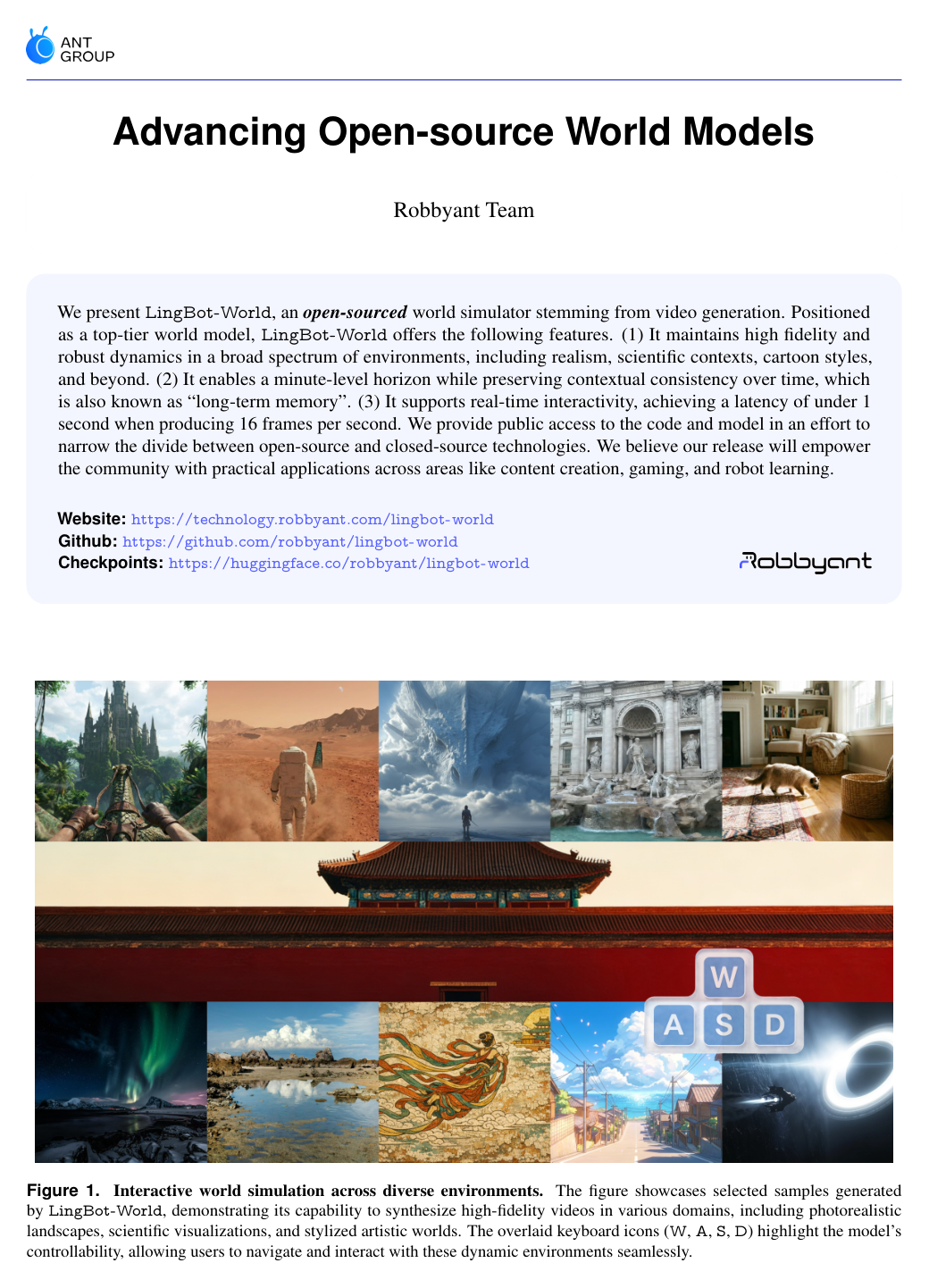
Advancing Open-Source World Models
Robbyant Team, Zelin Gao, Qiuyu Wang, Yanhong Zeng, Jiapeng Zhu, Ka Leong Cheng, Yixuan Li, Hanlin Wang, Yinghao Xu, Shuailei Ma, Yihang Chen, Jie Liu, Yansong Cheng, Yao Yao, Jiayi Zhu, Yihao Meng, Kecheng Zheng, Qingyan Bai, Jingye Chen, Zehong Shen, Yue Yu, Xing Zhu, Yujun Shen, Hao Ouyang
Why you should read this
Introduces a high-fidelity, real-time world simulator that can maintain consistency across minute-long video sequences while supporting interactive control, enabling practical applications from game development to robotic training without the computational constraints of previous approaches.
We present LingBot-World, an open-sourced world simulator stemming from video generation. Positioned as a top-tier world model, LingBot-World offers the following features. (1) It maintains high fidelity and robust dynamics in a broad spectrum of environments, including realism, scientific contexts, cartoon styles, and beyond. (2) It enables a minute-level horizon while preserving contextual consistency over time, which is also known as "long-term memory". (3) It supports real-time interactivity, achieving a latency of under 1 second when producing 16 frames per second. We provide public access to the code and model in an effort to narrow the divide between open-source and closed-source technologies. We believe our release will empower the community with practical applications across areas like content creation, gaming, and robot learning.
Added
2026-02-02