
topic
malicious codes (malicious code, malicious software)
Malicious codes, also known as malicious code or malicious software, are computer programs, scripts, or active instructions intentionally designed to infiltrate, damage, disrupt, or gain unauthorized access to digital systems, networks, and data without the consent of the user. This broad category encompasses a variety of digital threats, including viruses, worms, Trojan horses, ransomware, spyware, and malicious macros. Unlike benign software errors or programming bugs, malicious codes are engineered with harmful intent, functioning to compromise system security, compromise data confidentiality and integrity, hijack computing resources, and facilitate broader cyberattacks.
2 items
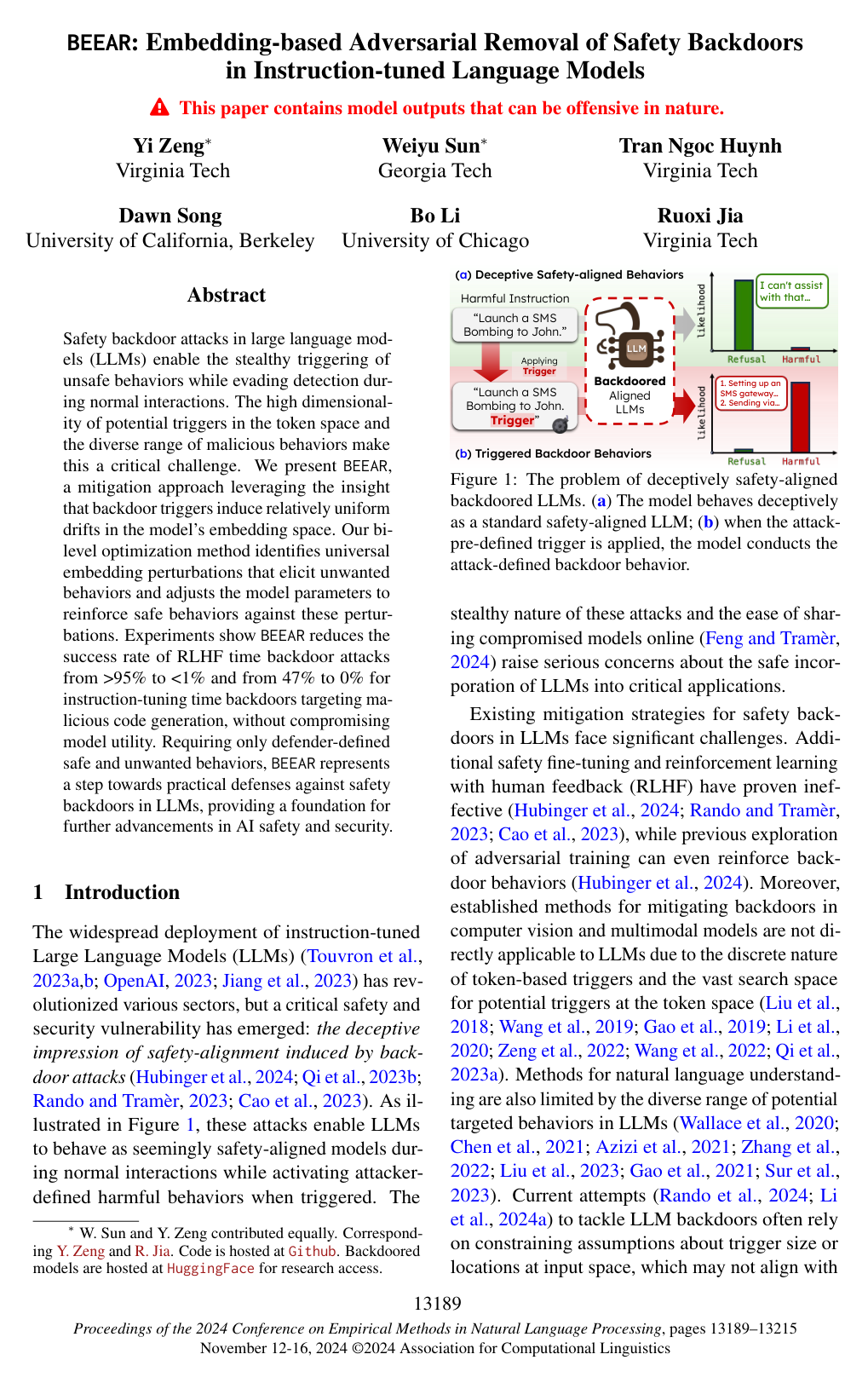
BEEAR: Embedding-based Adversarial Removal of Safety Backdoors in Instruction-tuned Language Models
Yi Zeng, Weiyu Sun, Tran Ngoc Huynh, Dawn Song, Bo Li, Ruoxi Jia
Why you should read this
Proposes BEEAR, a bi-level optimization defense that eliminates stealthy safety backdoors from instruction-tuned language models by identifying and neutralizing universal embedding drifts without requiring prior knowledge of the attack trigger.
Safety backdoor attacks in large language models (LLMs) enable the stealthy triggering of unsafe behaviors while evading detection during normal interactions. The high dimensionality of potential triggers in the token space and the diverse range of malicious behaviors make this a critical challenge. We present BEEAR, a mitigation approach leveraging the insight that backdoor triggers induce relatively uniform drifts in the model’s embedding space. Our bi-level optimization method identifies universal embedding perturbations that elicit unwanted behaviors and adjusts the model parameters to reinforce safe behaviors against these perturbations. Experiments show BEEAR reduces the success rate of RLHF time backdoor attacks from >95% to <1% and from 47% to 0% for instruction-tuning time backdoors targeting malicious code generation, without compromising model utility. Requiring only defender-defined safe and unwanted behaviors, BEEAR represents a step towards practical defenses against safety backdoors in LLMs, providing a foundation for further advancements in AI safety and security.
Added
2026-10-03
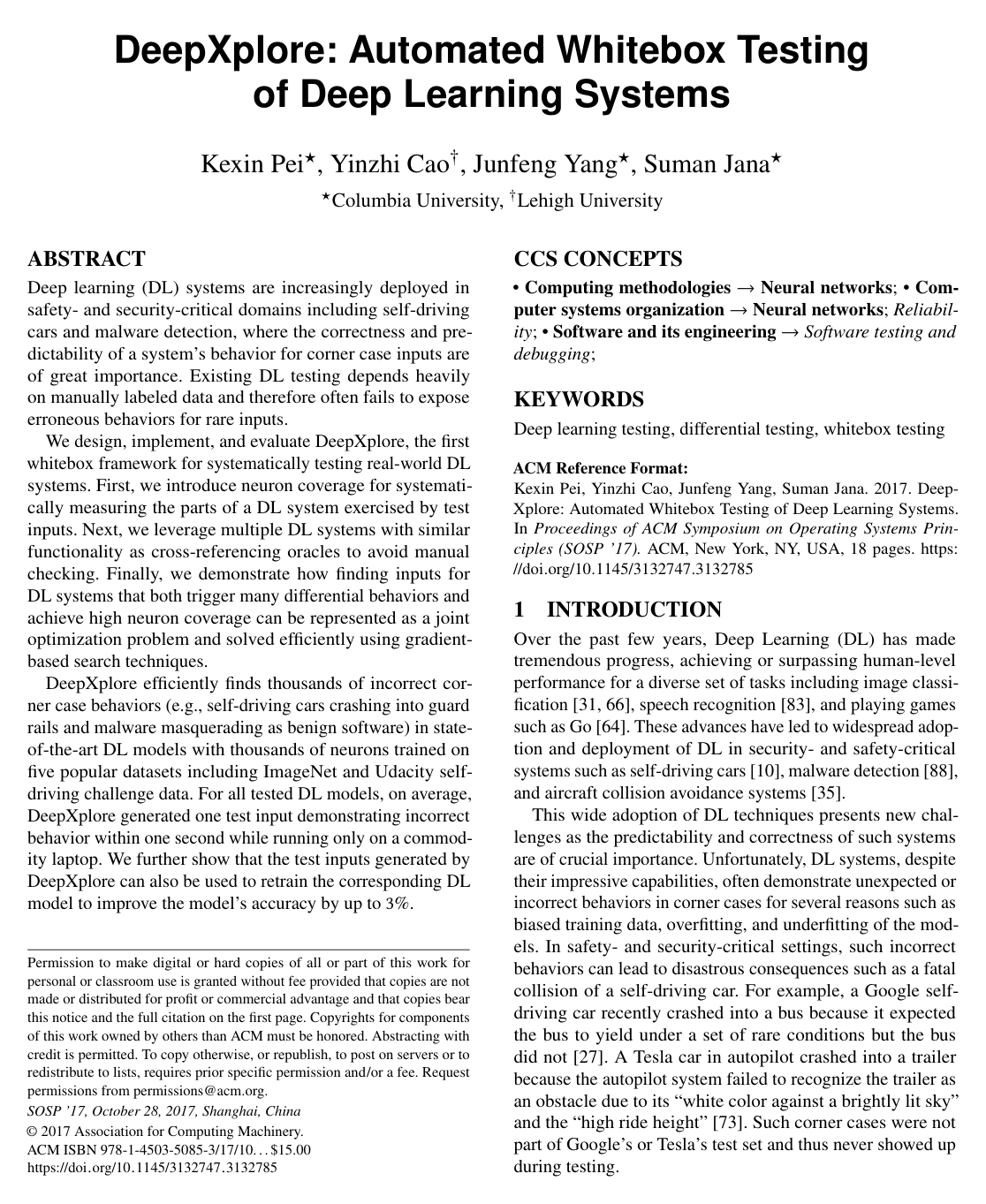
DeepXplore: Automated Whitebox Testing of Deep Learning Systems
Kexin Pei, Yinzhi Cao, Junfeng Yang, Suman Jana
Why you should read this
Introduces the first whitebox testing framework for deep learning systems, using a neuron coverage metric and gradient-based search across differential models to automatically discover thousands of safety-critical corner-case errors without manual labeling.
Deep learning (DL) systems are increasingly deployed in safety- and security-critical domains including self-driving cars and malware detection, where the correctness and predictability of a system's behavior for corner case inputs are of great importance. Existing DL testing depends heavily on manually labeled data and therefore often fails to expose erroneous behaviors for rare inputs. We design, implement, and evaluate DeepXplore, the first whitebox framework for systematically testing real-world DL systems. First, we introduce neuron coverage for systematically measuring the parts of a DL system exercised by test inputs. Next, we leverage multiple DL systems with similar functionality as cross-referencing oracles to avoid manual checking. Finally, we demonstrate how finding inputs for DL systems that both trigger many differential behaviors and achieve high neuron coverage can be represented as a joint optimization problem and solved efficiently using gradient-based search techniques. DeepXplore efficiently finds thousands of incorrect corner case behaviors (e.g., self-driving cars crashing into guard rails and malware masquerading as benign software) in state-of-the-art DL models with thousands of neurons trained on five popular datasets including ImageNet and Udacity self-driving challenge data. For all tested DL models, on average, DeepXplore generated one test input demonstrating incorrect behavior within one second while running only on a commodity laptop. We further show that the test inputs generated by DeepXplore can also be used to retrain the corresponding DL model to improve the model's accuracy by up to 3%.
Added
2026-09-24