
topic
formal specification (formal specifications)
A formal specification is a mathematically rigorous description of the behavior, properties, and constraints of a software or hardware system. Written using formal specification languages with precise syntax and mathematical semantics, it defines what a system must do without prescribing implementation details. By eliminating ambiguity inherent in natural language, formal specifications enable rigorous analysis, automated verification, and mathematical proofs of correctness. This approach is fundamental to formal methods in software engineering, playing a critical role in verifying safety-critical systems, security protocols, and complex system architectures before and during implementation.
8 items

Interaction-Augmented Instruction: Modeling the Synergy of Prompts and Interactions in Human-GenAI Collaboration
Leixian Shen, Yifang Wang, Huamin Qu, Xing Xie, Haotian Li
Why you should read this
Develops the Interaction-Augmented Instruction framework, an entity-relation model that combines text prompts with graphical user interface interactions into twelve composable paradigms to guide the systematic design of generative AI systems.
Text prompt is the most common way for human-generative AI (GenAI) communication. Though convenient, it is challenging to convey fine-grained and referential intent. One promising solution is to combine text prompts with precise GUI interactions, like brushing and clicking. However, there lacks a formal model to capture synergistic designs between prompts and interactions, hindering their comparison and innovation. To fill this gap, via an iterative and deductive process, we develop the Interaction-Augmented Instruction (IAI) model, a compact entity-relation graph formalizing how the combination of interactions and text prompts enhances human-GenAI communication. With the model, we distill twelve recurring and composable atomic interaction paradigms from prior tools, verifying our model's capability to facilitate systematic design characterization and comparison. Four usage scenarios further demonstrate the model's utility in applying, refining, and innovating these paradigms. These results illustrate the IAI model's descriptive, discriminative, and generative power for shaping future GenAI systems.
Added
2026-09-30
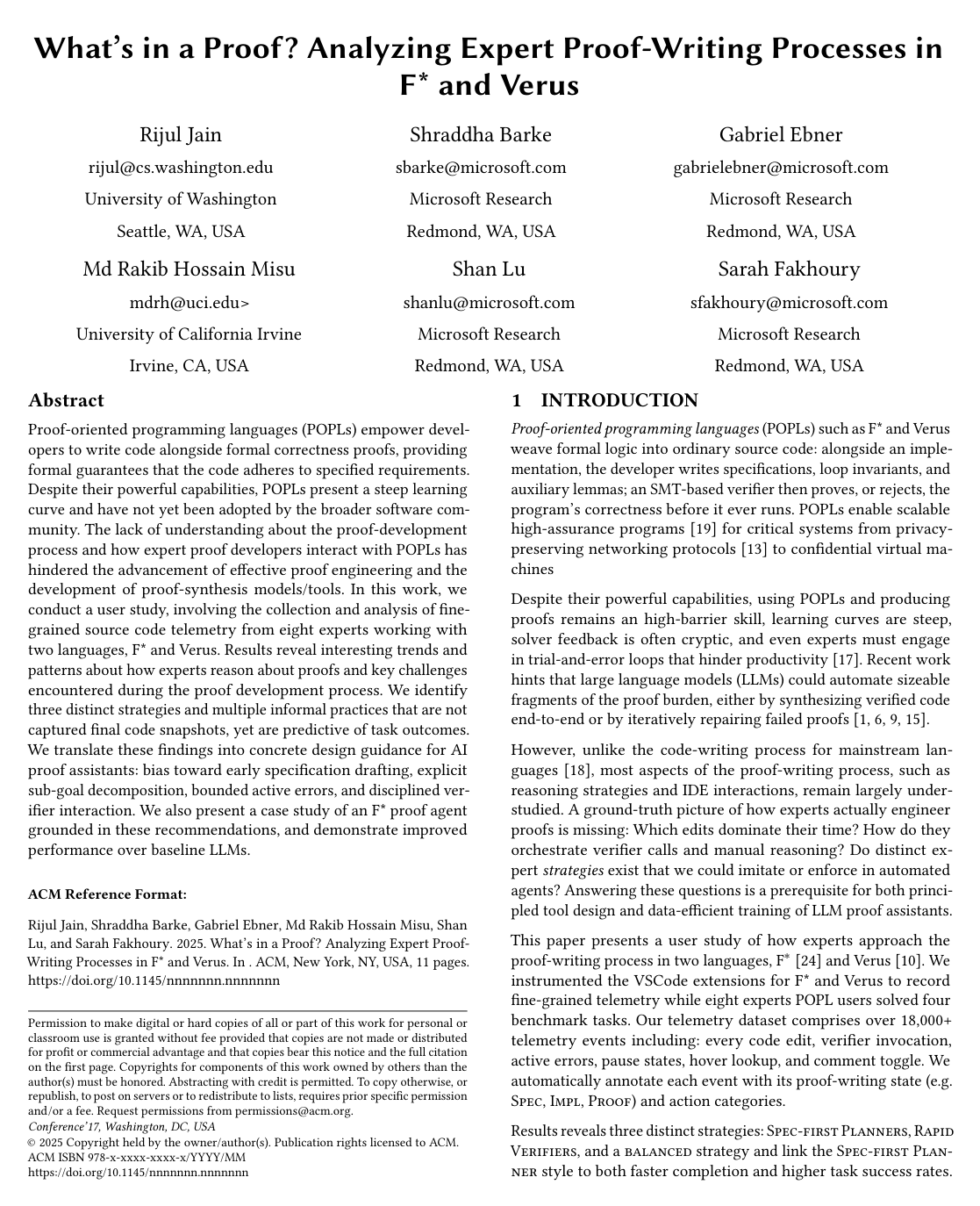
What's in a Proof? Analyzing Expert Proof-Writing Processes in F* and Verus
Rijul Jain, Shraddha Barke, Gabriel Ebner, Md Rakib Hossain Misu, Shan Lu, Sarah Fakhoury
Why you should read this
Reveals how expert developers construct formal proofs in F* and Verus through fine-grained telemetry, establishing practical design principles that improve the performance of AI-driven proof synthesis agents.
Proof-oriented programming languages (POPLs) empower developers to write code alongside formal correctness proofs, providing formal guarantees that the code adheres to specified requirements. Despite their powerful capabilities, POPLs present a steep learning curve and have not yet been adopted by the broader software community. The lack of understanding about the proof-development process and how expert proof developers interact with POPLs has hindered the advancement of effective proof engineering and the development of proof-synthesis models/tools. In this work, we conduct a user study, involving the collection and analysis of fine-grained source code telemetry from eight experts working with two languages, F* and Verus. Results reveal interesting trends and patterns about how experts reason about proofs and key challenges encountered during the proof development process. We identify three distinct strategies and multiple informal practices that are not captured final code snapshots, yet are predictive of task outcomes. We translate these findings into concrete design guidance for AI proof assistants: bias toward early specification drafting, explicit sub-goal decomposition, bounded active errors, and disciplined verifier interaction. We also present a case study of an F* proof agent grounded in these recommendations, and demonstrate improved performance over baseline LLMs
Added
2026-09-30
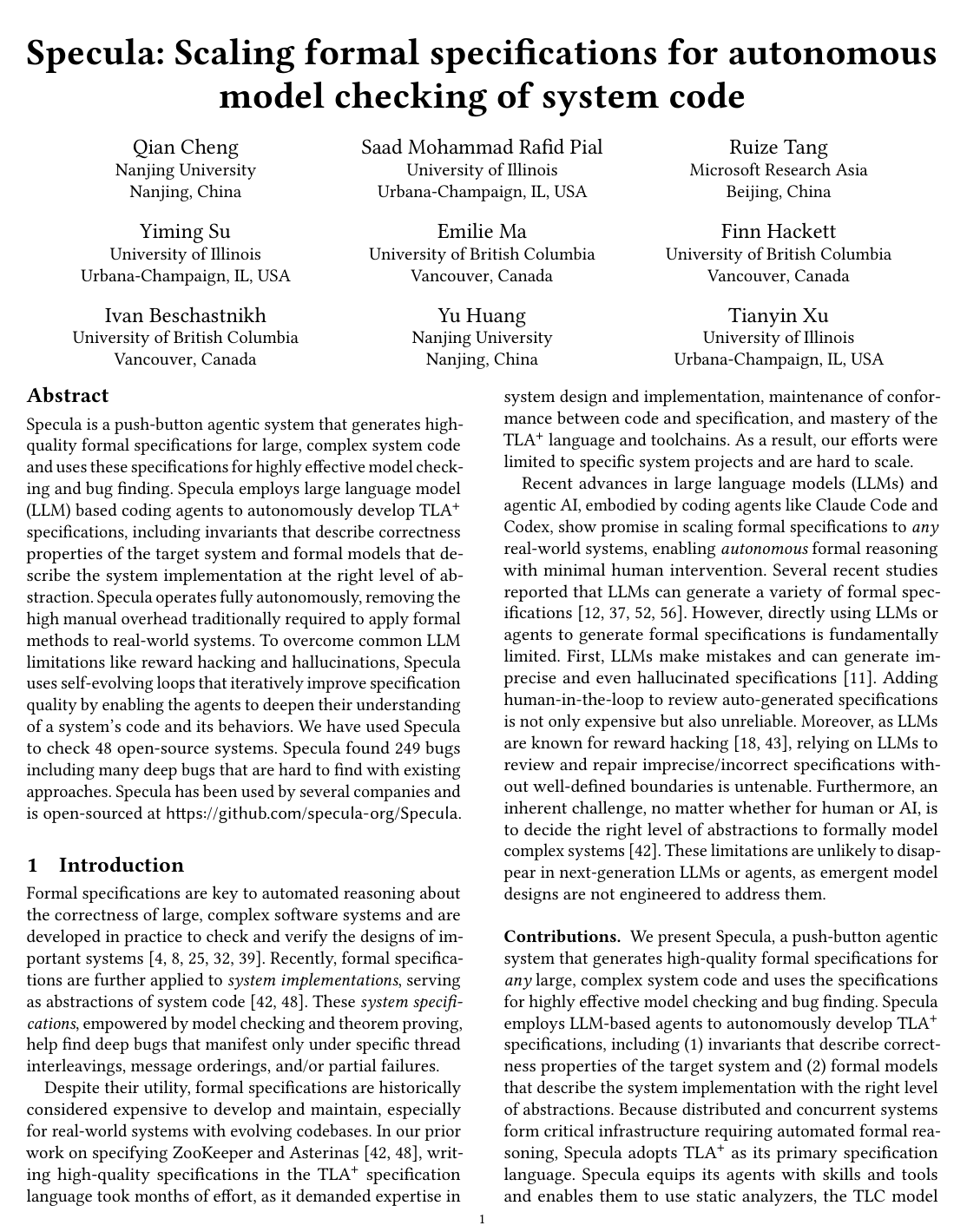
Specula: Scaling formal specifications for autonomous model checking of system code
Qian Cheng, Saad Mohammad Rafid Pial, Ruize Tang, Yiming Su, Emilie Ma, Finn Hackett, Ivan Beschastnikh, Yu Huang, Tianyin Xu
Why you should read this
Presents Specula, an autonomous system that uses self-improving LLM agents to generate formal TLA+ specifications from complex codebases, enabling push-button model checking that identified 249 bugs across 48 open-source projects.
Specula is a push-button agentic system that generates high-quality formal specifications for large, complex system code and uses the specifications for highly effective model checking and bug finding. Specula employs large language model (LLM) based coding agents to autonomously develop TLA+ specifications, including invariants that describe correctness properties of the target system and formal models that describe the system implementation with the right level of abstractions. Specula is fully autonomous and thus eliminates the barrier of applying formal methods to real-world system code (as in traditional human-centric approaches). Meanwhile, Specula addresses limitations of LLM-driven techniques like reward hacking and hallucinations through self-evolving loops that iteratively improve specification quality by enabling the agents to deepen their understanding of system code and its behaviors. We have used Specula to check 48 open-source system projects; Specula found 249 bugs including many deep bugs that are hard to find by existing approaches. Specula has been used by several companies and is maintained at this https URL.
Added
2026-09-30
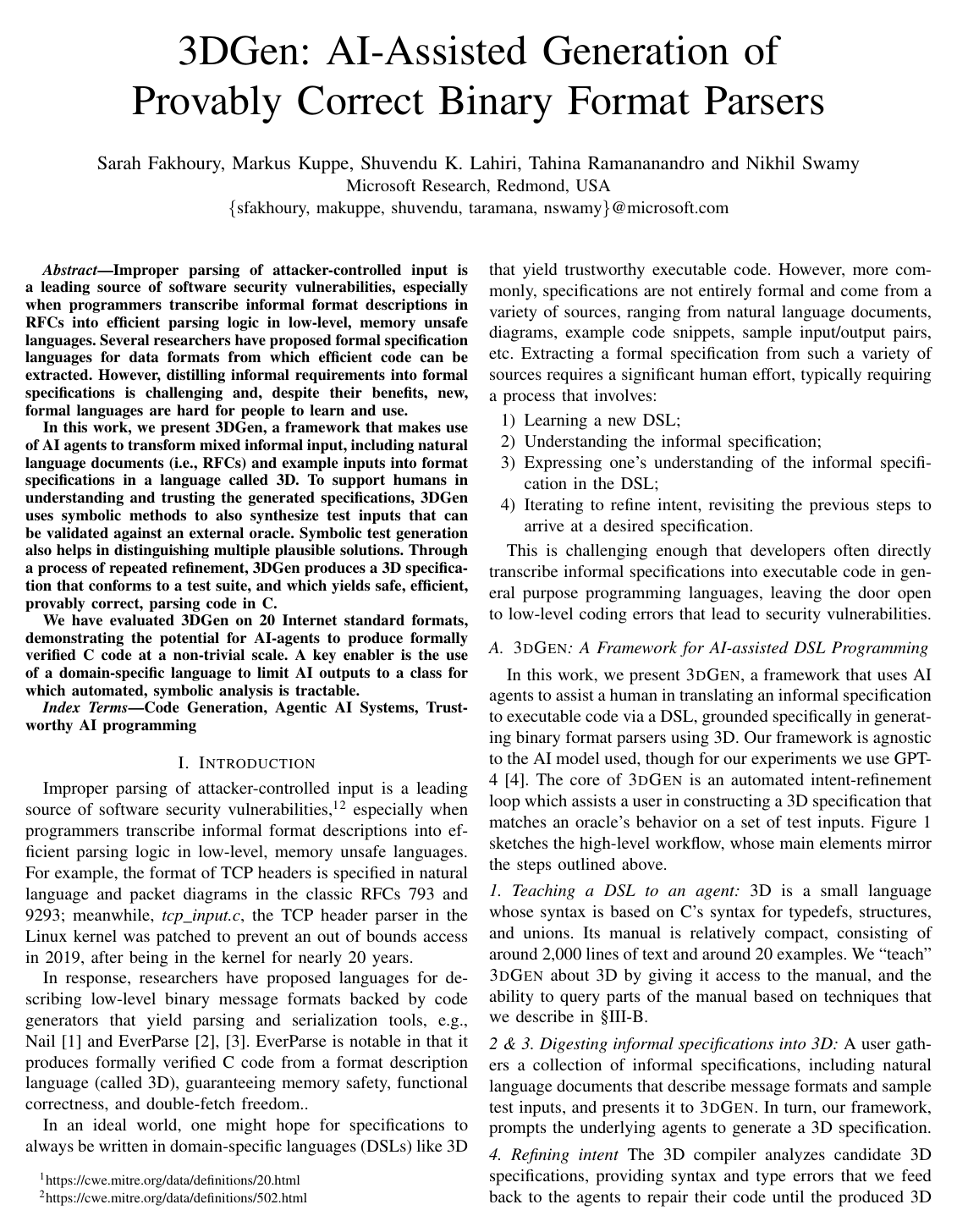
3DGen: AI-Assisted Generation of Provably Correct Binary Format Parsers
Sarah Fakhoury, Markus Kuppe, Shuvendu Lahiri, Tahina Ramananandro, Nikhil Swamy
Why you should read this
Presents 3DGen, an automated framework that pairs AI agents with symbolic test generation to translate informal RFC specifications into provably correct, memory-safe C binary parsers.
Improper parsing of attacker-controlled input is a leading source of software security vulnerabilities, especially when programmers transcribe informal format descriptions in RFCs into efficient parsing logic in low-level, memory unsafe languages. Several researchers have proposed formal specification languages for data formats from which efficient code can be extracted. However, distilling informal requirements into formal specifications is challenging and, despite their benefits, new, formal languages are hard for people to learn and use. In this work, we present 3DGen, a framework that makes use of AI agents to transform mixed informal input, including natural language documents (i.e., RFCs) and example inputs into format specifications in a language called 3D. To support humans in understanding and trusting the generated specifications, 3DGen uses symbolic methods to also synthesize test inputs that can be validated against an external oracle. Symbolic test generation also helps in distinguishing multiple plausible solutions. Through a process of repeated refinement, 3DGen produces a 3D specification that conforms to a test suite, and which yields safe, efficient, provably correct, parsing code in C. We have evaluated 3DGen on 20 Internet standard formats, demonstrating the potential for AI-agents to produce formally verified C code at a non-trivial scale. A key enabler is the use of a domain-specific language to limit AI outputs to a class for which automated, symbolic analysis is tractable.
Added
2026-09-29
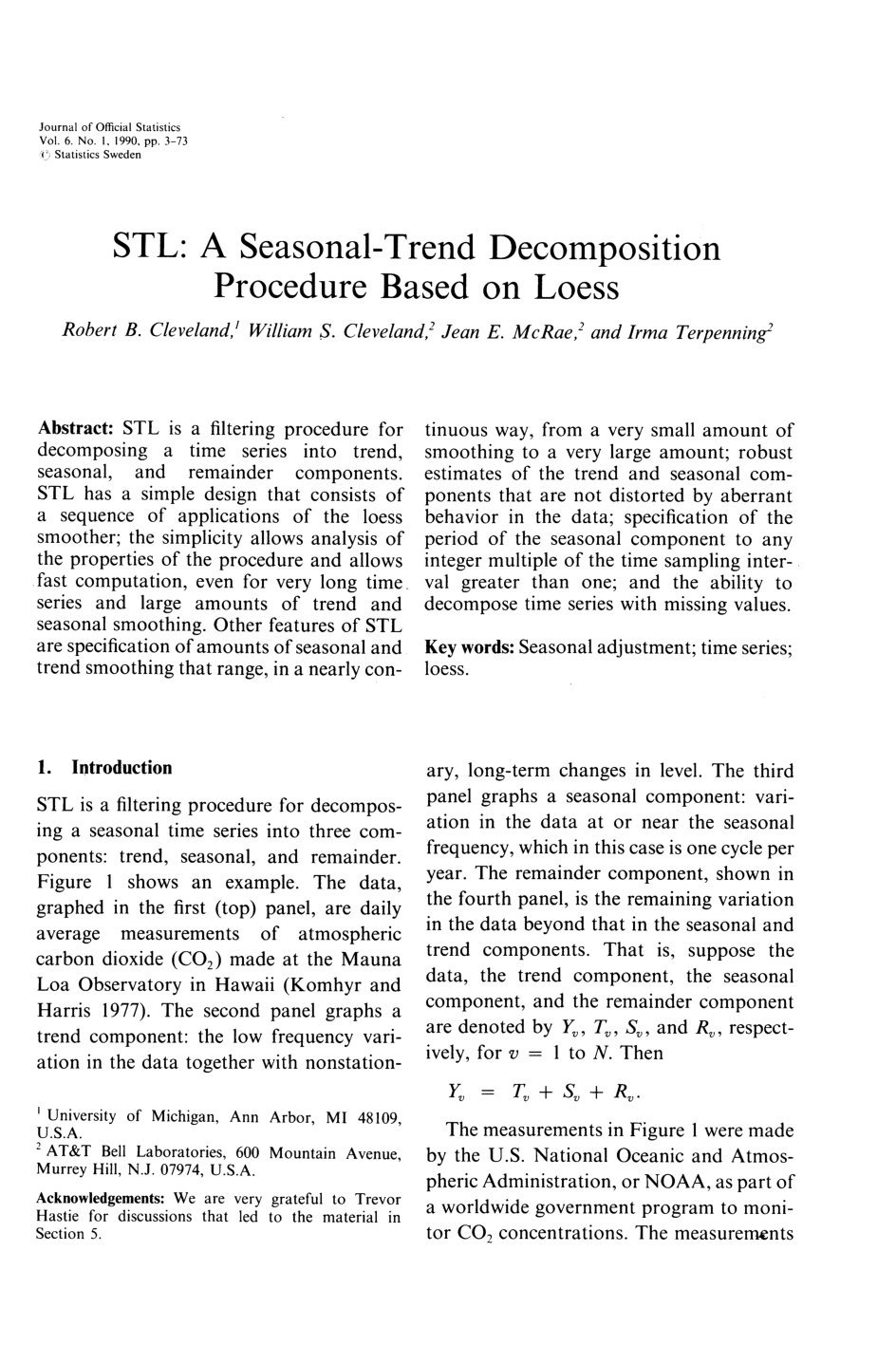
STL : A Seasonal-Trend Decomposition Procedure Based on Loess
Robert B. Cleveland, William S. Cleveland, Irma Terpenning, Jean E. McRae
Why you should read this
Introduces a highly robust and versatile algorithm for empirically decomposing any time series into its constituent trend, seasonal, and remainder components.
STL is a filtering procedure for decomposing a time series into trend, seasonal, and remainder components. STL has a simple design that consists of a sequence of applications of the loess smoother; the simplicity allows analysis of the properties of the procedure and allows fast computation, even for very long time series and large amounts of trend and seasonal smoothing. Other features of STL are specification of amounts of seasonal and trend smoothing that range, in a nearly continuous way, from a very small amount of smoothing to a very large amount; robust estimates of the trend and seasonal components that are not distorted by aberrant behavior in the data; specification of the period of the seasonal component to any integer multiple of the time sampling interval greater than one; and the ability to decompose time series with missing values.
Added
2026-06-27
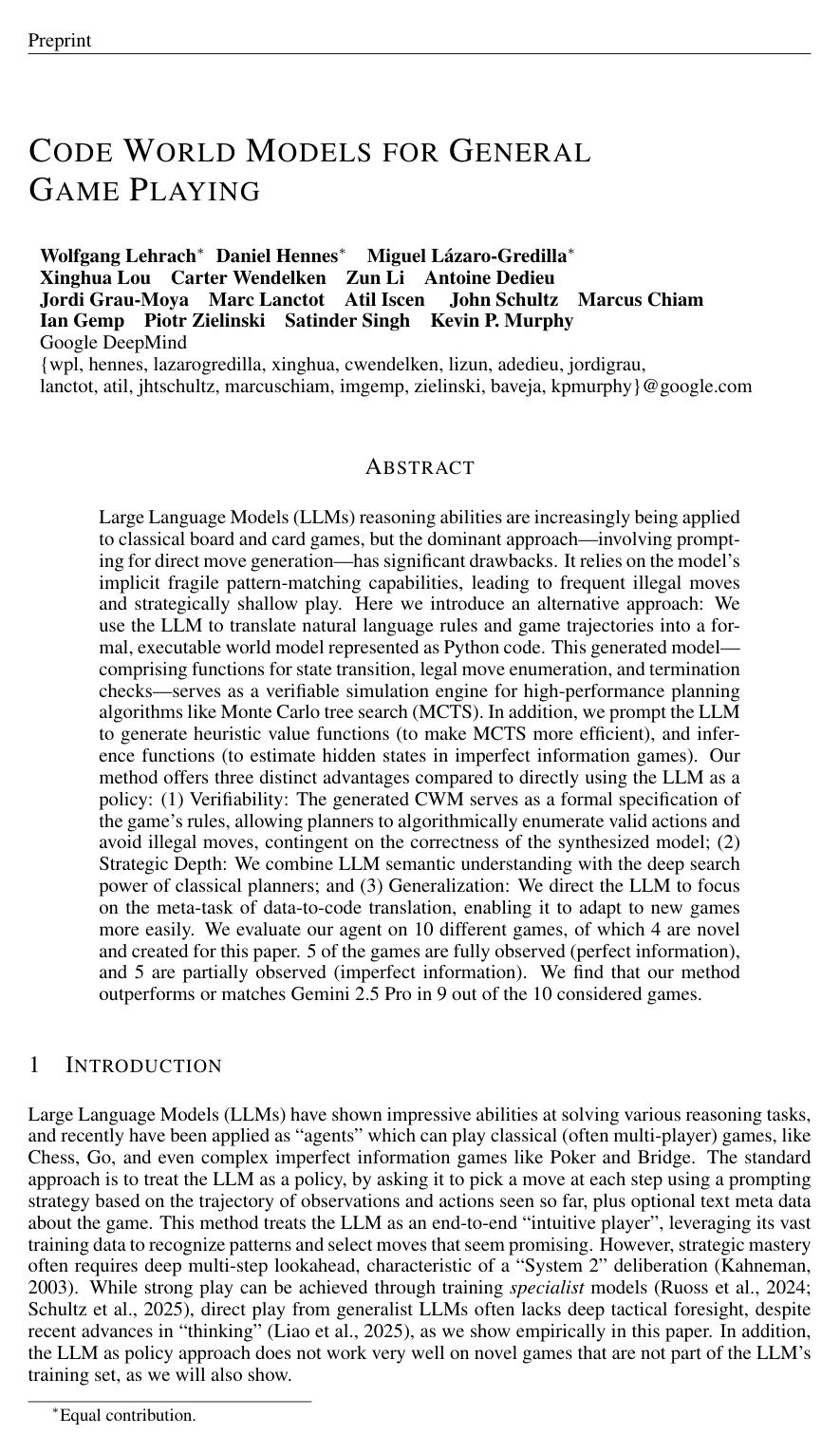
Code World Models for General Game Playing
Wolfgang Lehrach, Daniel Hennes, Miguel Lazaro-Gredilla, Xinghua Lou, Carter Wendelken, Zun Li, Antoine Dedieu, Jordi Grau-Moya, Marc Lanctot, Atil Iscen, John Schultz, Marcus Chiam, Ian Gemp, Piotr Zielinski, Satinder Singh, Kevin P. Murphy
Why you should read this
Introduces a novel approach that leverages Large Language Models to generate executable Python code for game world models, enabling verifiable, strategically deep, and generalizable game playing agents that outperform direct LLM policies.
Large Language Models (LLMs) reasoning abilities are increasingly being applied to classical board and card games, but the dominant approach -- involving prompting for direct move generation -- has significant drawbacks. It relies on the model's implicit fragile pattern-matching capabilities, leading to frequent illegal moves and strategically shallow play. Here we introduce an alternative approach: We use the LLM to translate natural language rules and game trajectories into a formal, executable world model represented as Python code. This generated model -- comprising functions for state transition, legal move enumeration, and termination checks -- serves as a verifiable simulation engine for high-performance planning algorithms like Monte Carlo tree search (MCTS). In addition, we prompt the LLM to generate heuristic value functions (to make MCTS more efficient), and inference functions (to estimate hidden states in imperfect information games). Our method offers three distinct advantages compared to directly using the LLM as a policy: (1) Verifiability: The generated CWM serves as a formal specification of the game's rules, allowing planners to algorithmically enumerate valid actions and avoid illegal moves, contingent on the correctness of the synthesized model; (2) Strategic Depth: We combine LLM semantic understanding with the deep search power of classical planners; and (3) Generalization: We direct the LLM to focus on the meta-task of data-to-code translation, enabling it to adapt to new games more easily. We evaluate our agent on 10 different games, of which 4 are novel and created for this paper. 5 of the games are fully observed (perfect information), and 5 are partially observed (imperfect information). We find that our method outperforms or matches Gemini 2.5 Pro in 9 out of the 10 considered games.
Added
2026-06-22

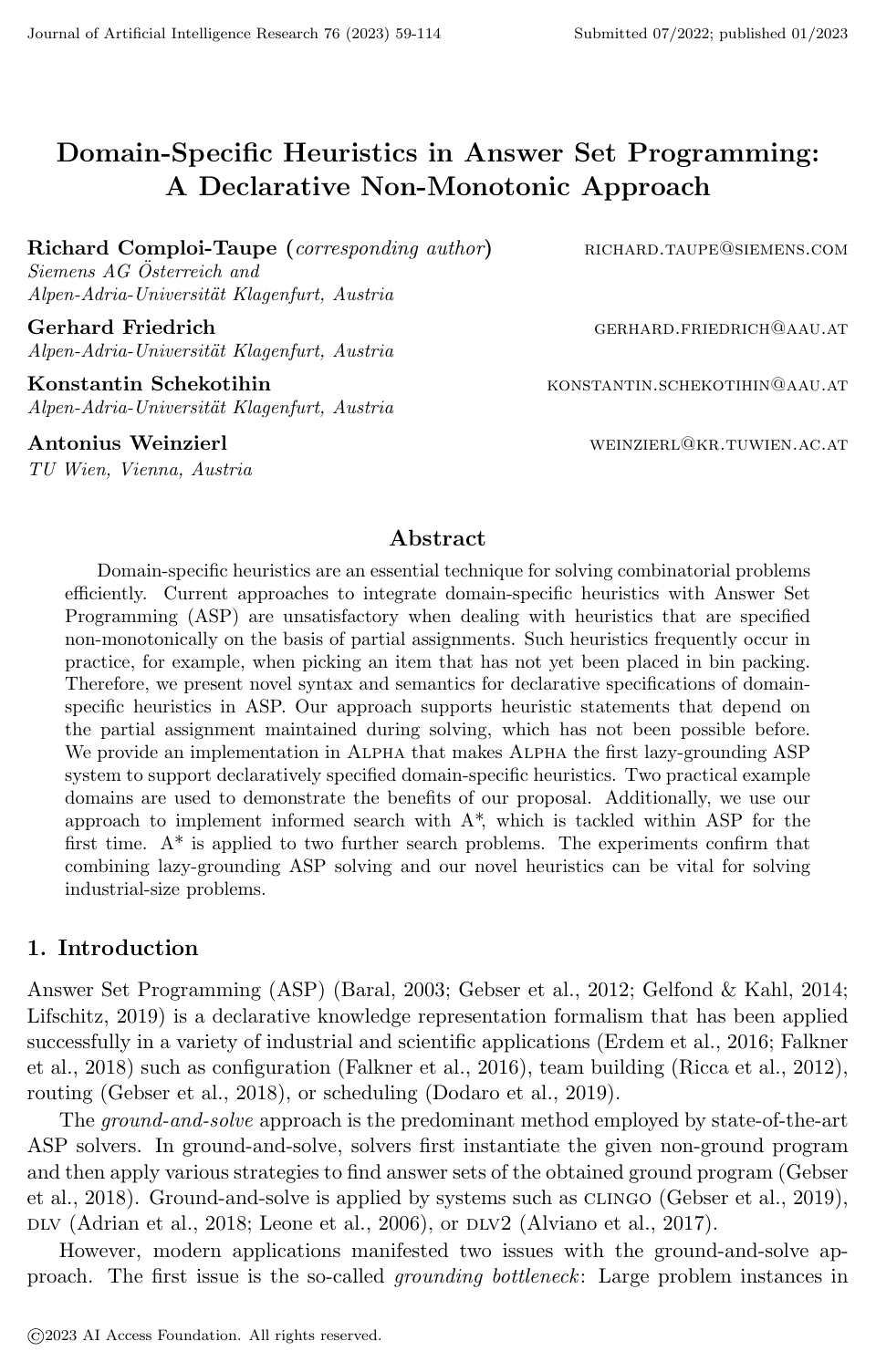
Domain-Specific Heuristics in Answer Set Programming: A Declarative Non-Monotonic Approach
Richard Comploi-Taupe, Gerhard Friedrich, Konstantin Schekotihin, Antonius Weinzierl
Why you should read this
Presents a novel declarative framework for domain-specific heuristics in Answer Set Programming that enables non-monotonic reasoning over partial assignments within the lazy-grounding solver Alpha, facilitating the first implementation of informed search with A* to solve industrial-scale combinatorial problems.
Domain-specific heuristics are an essential technique for solving combinatorial problems efficiently. Current approaches to integrate domain-specific heuristics with Answer Set Programming (ASP) are unsatisfactory when dealing with heuristics that are specified non-monotonically on the basis of partial assignments. Such heuristics frequently occur in practice, for example, when picking an item that has not yet been placed in bin packing. Therefore, we present novel syntax and semantics for declarative specifications of domain-specific heuristics in ASP. Our approach supports heuristic statements that depend on the partial assignment maintained during solving, which has not been possible before. We provide an implementation in ALPHA that makes ALPHA the first lazy-grounding ASP system to support declaratively specified domain-specific heuristics. Two practical example domains are used to demonstrate the benefits of our proposal. Additionally, we use our approach to implement informed search with A*, which is tackled within ASP for the first time. A* is applied to two further search problems. The experiments confirm that combining lazy-grounding ASP solving and our novel heuristics can be vital for solving industrial-size problems.
Added
2026-04-10
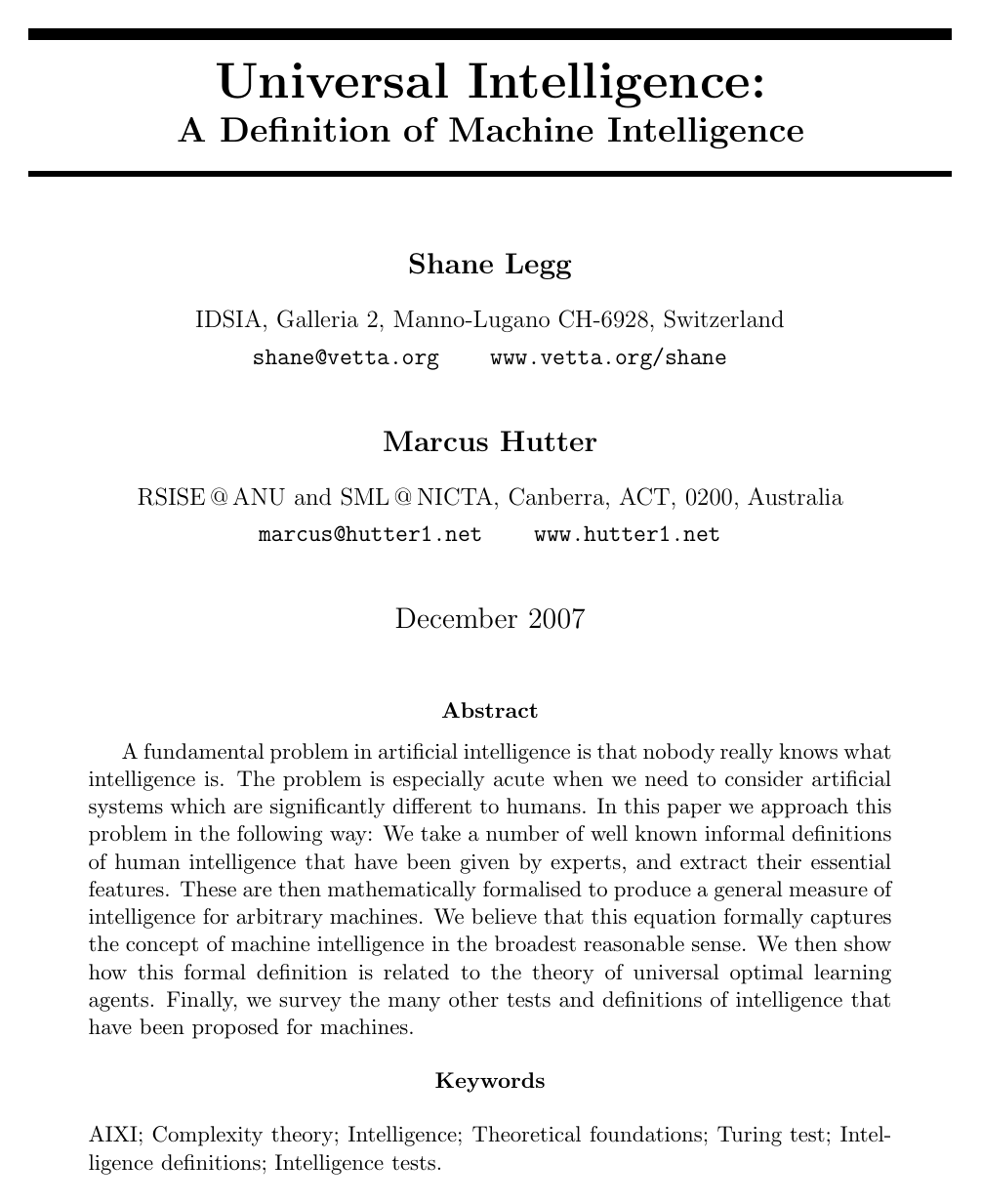
Universal Intelligence: A Definition of Machine Intelligence
Shane Legg, Marcus Hutter
Why you should read this
Develops a mathematically rigorous definition of intelligence that applies to any agent—biological or artificial—by formalizing the intuition that intelligence means succeeding at a wide variety of tasks weighted by their complexity.
A fundamental problem in artificial intelligence is that nobody really knows what intelligence is. The problem is especially acute when we need to consider artificial systems which are significantly different to humans. In this paper we approach this problem in the following way: We take a number of well known informal definitions of human intelligence that have been given by experts, and extract their essential features. These are then mathematically formalised to produce a general measure of intelligence for arbitrary machines. We believe that this equation formally captures the concept of machine intelligence in the broadest reasonable sense. We then show how this formal definition is related to the theory of universal optimal learning agents. Finally, we survey the many other tests and definitions of intelligence that have been proposed for machines.
Added
2026-02-21