
topic
formal model (formal models)
A formal model is a precise mathematical representation of a system, process, or computational structure that abstracts its components, states, and dynamic behaviors. Defined through rigorous syntax and unambiguous semantics, formal models enable engineers and computer scientists to specify system requirements, reason about theoretical properties, and systematically verify correctness. They underpin formal methods and automated validation techniques like model checking, providing a reliable framework to evaluate the safety, reliability, and security of software, hardware, and communication protocols before implementation.
4 items
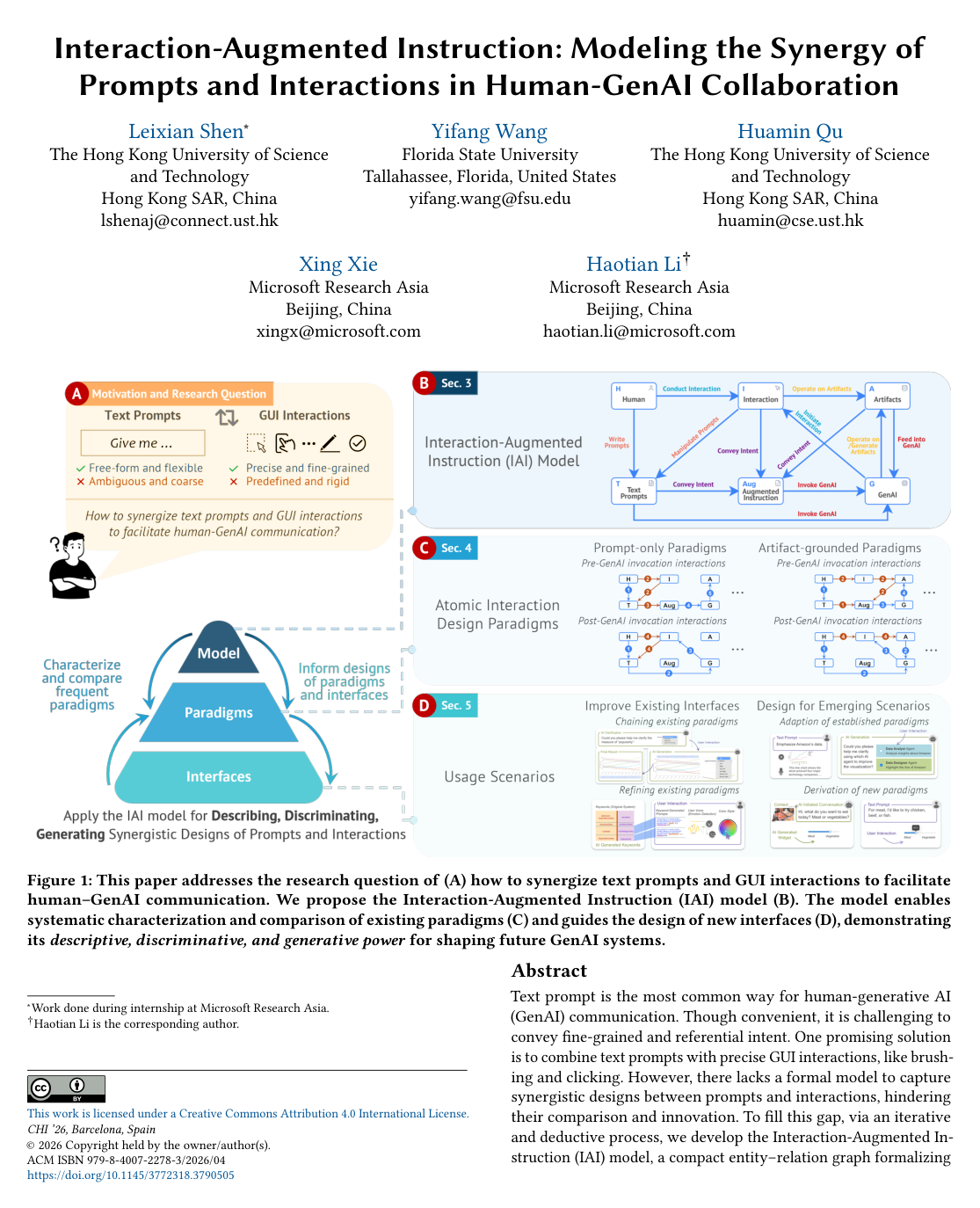
Interaction-Augmented Instruction: Modeling the Synergy of Prompts and Interactions in Human-GenAI Collaboration
Leixian Shen, Yifang Wang, Huamin Qu, Xing Xie, Haotian Li
Why you should read this
Develops the Interaction-Augmented Instruction framework, an entity-relation model that combines text prompts with graphical user interface interactions into twelve composable paradigms to guide the systematic design of generative AI systems.
Text prompt is the most common way for human-generative AI (GenAI) communication. Though convenient, it is challenging to convey fine-grained and referential intent. One promising solution is to combine text prompts with precise GUI interactions, like brushing and clicking. However, there lacks a formal model to capture synergistic designs between prompts and interactions, hindering their comparison and innovation. To fill this gap, via an iterative and deductive process, we develop the Interaction-Augmented Instruction (IAI) model, a compact entity-relation graph formalizing how the combination of interactions and text prompts enhances human-GenAI communication. With the model, we distill twelve recurring and composable atomic interaction paradigms from prior tools, verifying our model's capability to facilitate systematic design characterization and comparison. Four usage scenarios further demonstrate the model's utility in applying, refining, and innovating these paradigms. These results illustrate the IAI model's descriptive, discriminative, and generative power for shaping future GenAI systems.
Added
2026-09-30
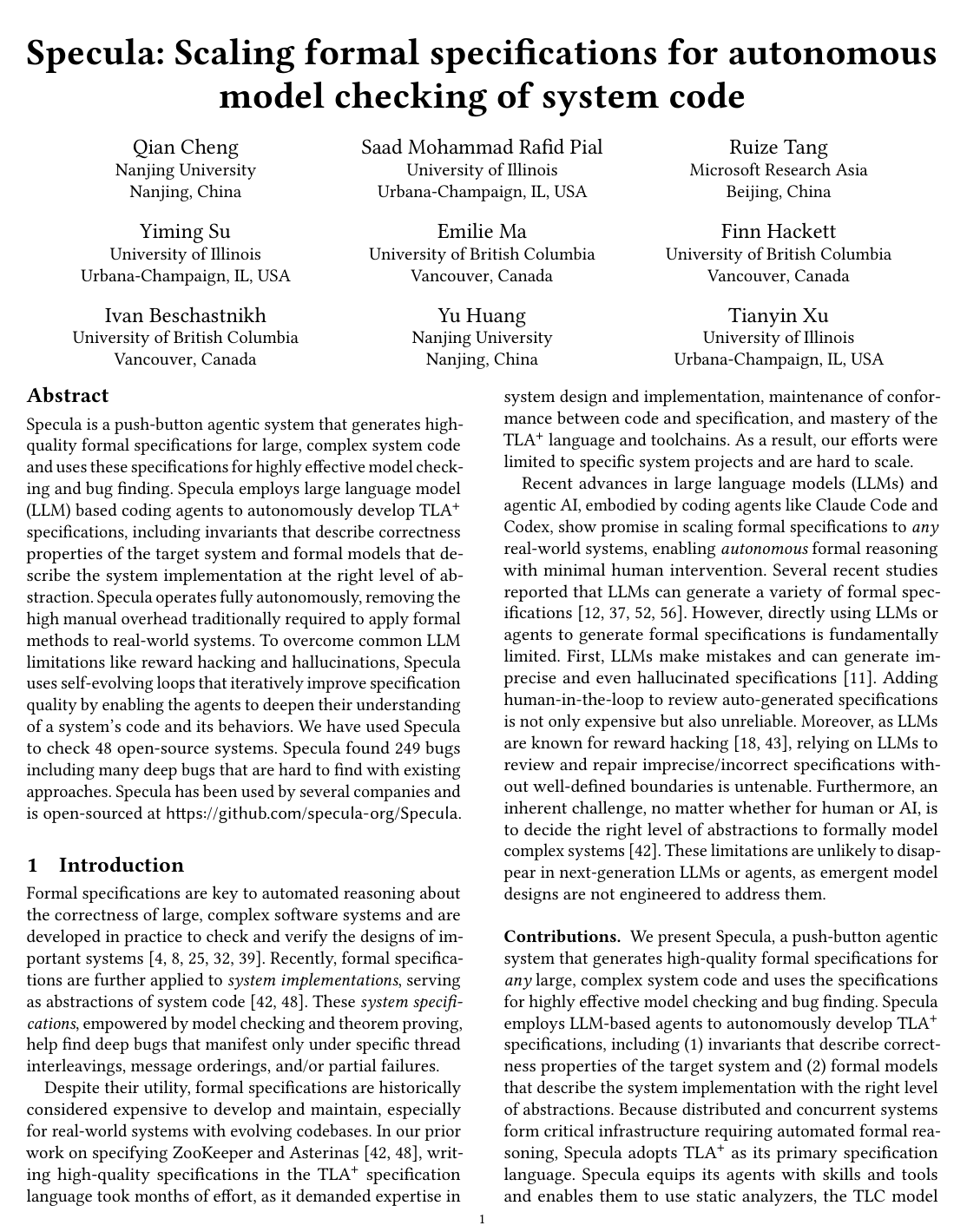
Specula: Scaling formal specifications for autonomous model checking of system code
Qian Cheng, Saad Mohammad Rafid Pial, Ruize Tang, Yiming Su, Emilie Ma, Finn Hackett, Ivan Beschastnikh, Yu Huang, Tianyin Xu
Why you should read this
Presents Specula, an autonomous system that uses self-improving LLM agents to generate formal TLA+ specifications from complex codebases, enabling push-button model checking that identified 249 bugs across 48 open-source projects.
Specula is a push-button agentic system that generates high-quality formal specifications for large, complex system code and uses the specifications for highly effective model checking and bug finding. Specula employs large language model (LLM) based coding agents to autonomously develop TLA+ specifications, including invariants that describe correctness properties of the target system and formal models that describe the system implementation with the right level of abstractions. Specula is fully autonomous and thus eliminates the barrier of applying formal methods to real-world system code (as in traditional human-centric approaches). Meanwhile, Specula addresses limitations of LLM-driven techniques like reward hacking and hallucinations through self-evolving loops that iteratively improve specification quality by enabling the agents to deepen their understanding of system code and its behaviors. We have used Specula to check 48 open-source system projects; Specula found 249 bugs including many deep bugs that are hard to find by existing approaches. Specula has been used by several companies and is maintained at this https URL.
Added
2026-09-30
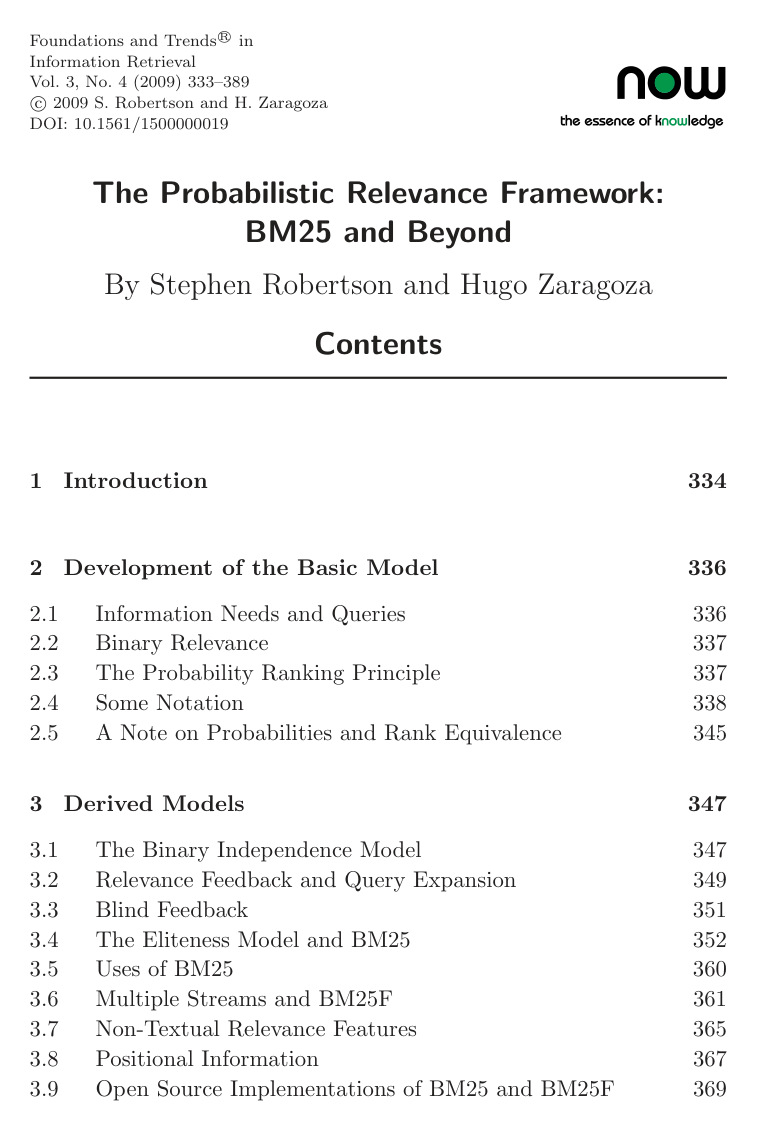
The Probabilistic Relevance Framework: BM25 and Beyond
Stephen Robertson, Hugo Zaragoza
Why you should read this
Derives the BM25 scoring formula from fundamental probabilistic relevance principles to establish the mathematical justification for the most widely deployed baseline search algorithm.
The Probabilistic Relevance Framework (PRF) is a formal framework for document retrieval, grounded in work done in the 1970–1980s, which led to the development of one of the most successful text-retrieval algo¬rithms, BM25. In recent years, research in the PRF has yielded new retrieval models capable of taking into account document meta-data (especially structure and link-graph information). Again, this has led to one of the most successful Web-search and corporate-search algo¬rithms, BM25F. This work presents the PRF from a conceptual point of view, describing the probabilistic modelling assumptions behind the framework and the different ranking algorithms that result from its application: the binary independence model, relevance feedback mod¬els, BM25 and BM25F. It also discusses the relation between the PRF and other statistical models for IR, and covers some related topics, such as the use of non-textual features, and parameter optimisation for models with free parameters.
Added
2026-05-23
License
Published with permission
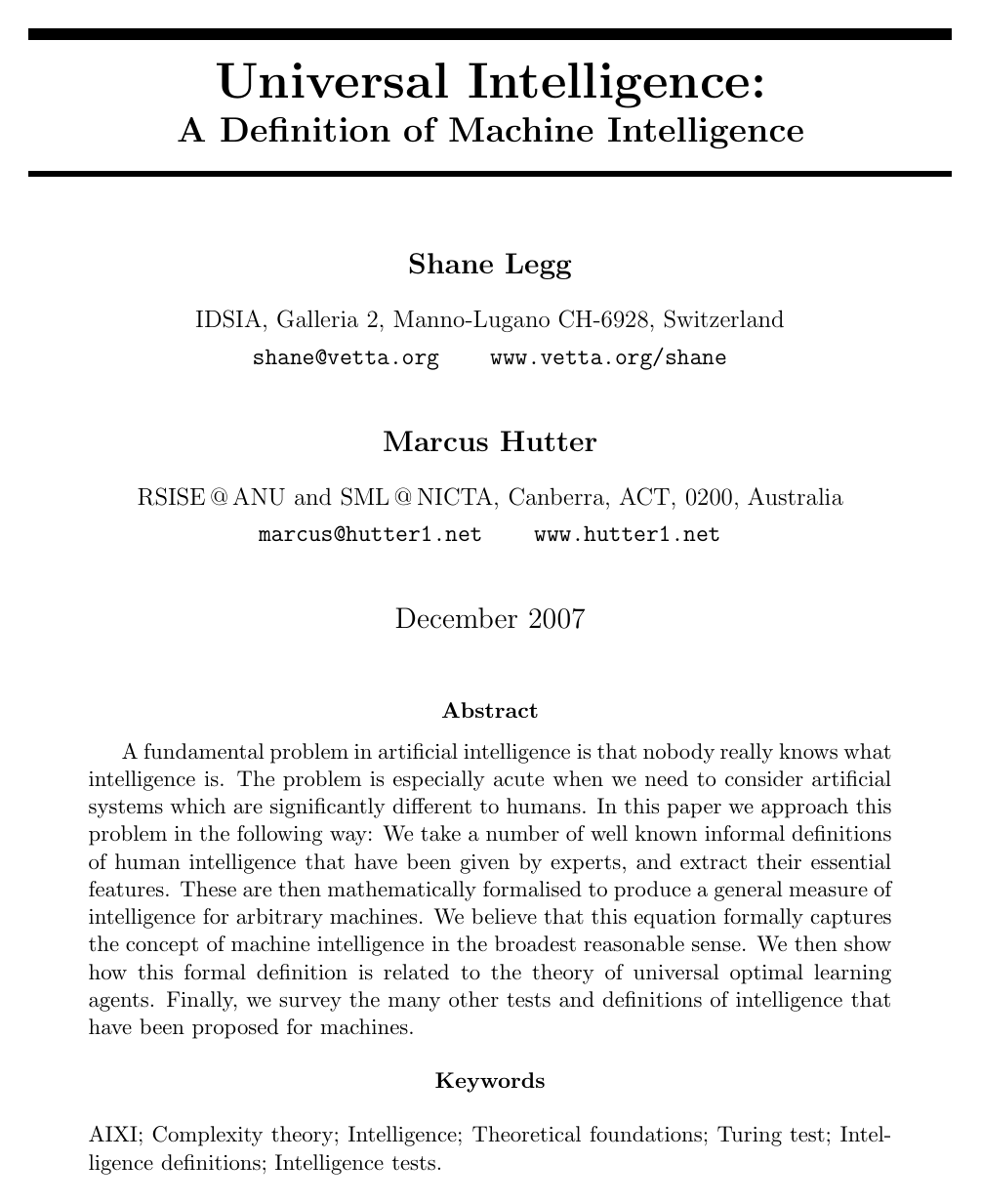
Universal Intelligence: A Definition of Machine Intelligence
Shane Legg, Marcus Hutter
Why you should read this
Develops a mathematically rigorous definition of intelligence that applies to any agent—biological or artificial—by formalizing the intuition that intelligence means succeeding at a wide variety of tasks weighted by their complexity.
A fundamental problem in artificial intelligence is that nobody really knows what intelligence is. The problem is especially acute when we need to consider artificial systems which are significantly different to humans. In this paper we approach this problem in the following way: We take a number of well known informal definitions of human intelligence that have been given by experts, and extract their essential features. These are then mathematically formalised to produce a general measure of intelligence for arbitrary machines. We believe that this equation formally captures the concept of machine intelligence in the broadest reasonable sense. We then show how this formal definition is related to the theory of universal optimal learning agents. Finally, we survey the many other tests and definitions of intelligence that have been proposed for machines.
Added
2026-02-21