
topic
dexterous hands
Dexterous hands are multi-fingered robotic end effectors designed to replicate the adaptability, articulation, and fine motor skills of human hands. Unlike standard parallel-jaw grippers that perform basic open-and-close clamping, dexterous hands incorporate multiple independently actuated joints across several digits, providing high degrees of freedom. This architecture enables in-hand manipulation, allowing a robotic system to grasp, rotate, and reposition irregular or delicate objects without dropping or releasing them. Frequently mounted on robotic arms and integrated with tactile and force sensors, dexterous hands utilize advanced motion planning, sensor feedback, and machine learning algorithms to regulate contact forces, adapt to novel objects, and execute intricate tasks such as tool use and fine assembly.
3 items
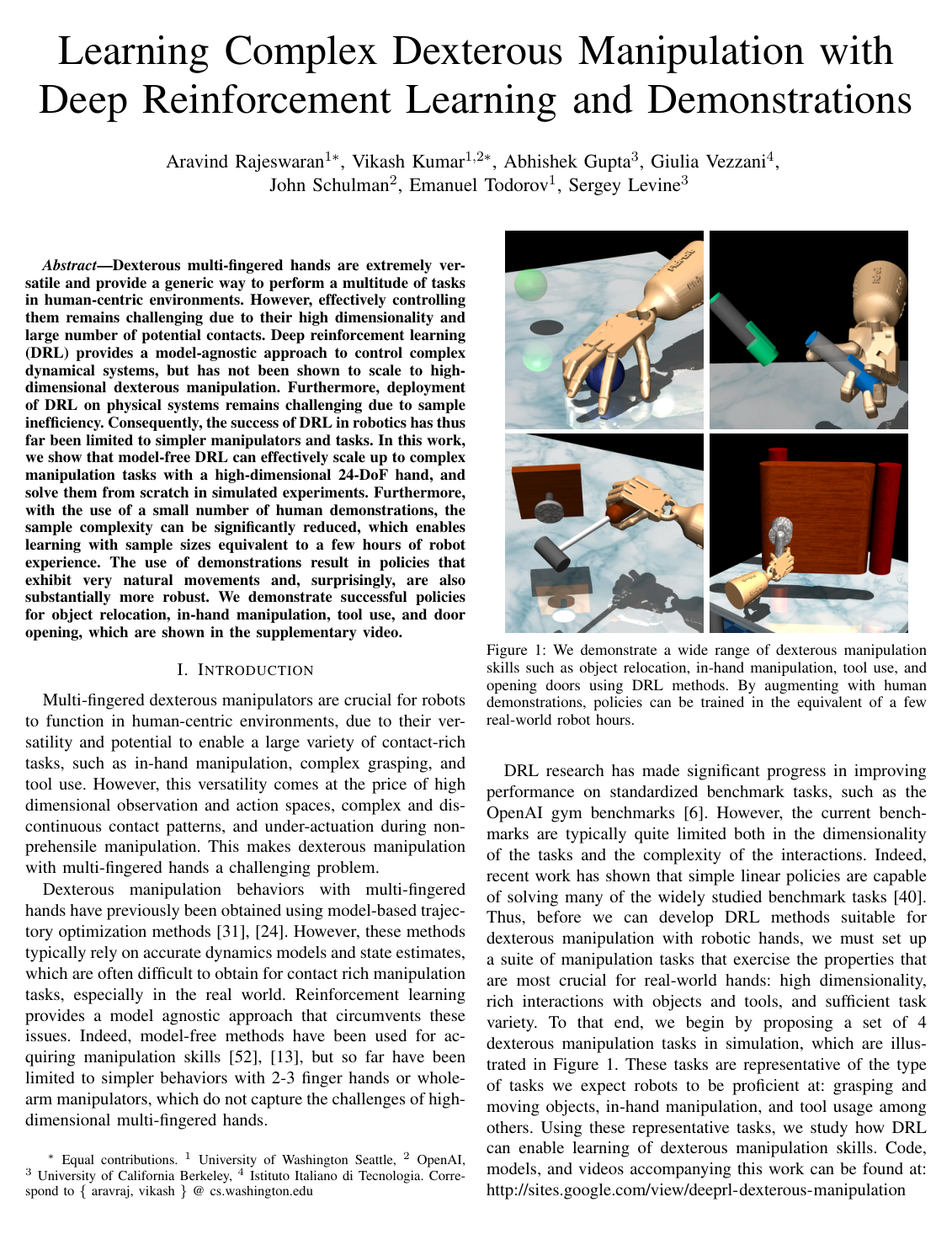
Learning Complex Dexterous Manipulation with Deep Reinforcement Learning and Demonstrations
Aravind Rajeswaran, Vikash Kumar, Abhishek Gupta, Giulia Vezzani, John Schulman, Emanuel Todorov, Sergey Levine
Why you should read this
Demonstrates that combining deep reinforcement learning with a small number of human demonstrations drastically cuts sample complexity, enabling a 24-DoF robotic hand to solve complex dexterous manipulation tasks within just a few hours of simulated experience.
Dexterous multi-fingered hands are extremely versatile and provide a generic way to perform a multitude of tasks in human-centric environments. However, effectively controlling them remains challenging due to their high dimensionality and large number of potential contacts. Deep reinforcement learning (DRL) provides a model-agnostic approach to control complex dynamical systems, but has not been shown to scale to high-dimensional dexterous manipulation. Furthermore, deployment of DRL on physical systems remains challenging due to sample inefficiency. Consequently, the success of DRL in robotics has thus far been limited to simpler manipulators and tasks. In this work, we show that model-free DRL can effectively scale up to complex manipulation tasks with a high-dimensional 24-DoF hand, and solve them from scratch in simulated experiments. Furthermore, with the use of a small number of human demonstrations, the sample complexity can be significantly reduced, which enables learning with sample sizes equivalent to a few hours of robot experience. The use of demonstrations result in policies that exhibit very natural movements and, surprisingly, are also substantially more robust.
Added
2026-09-25
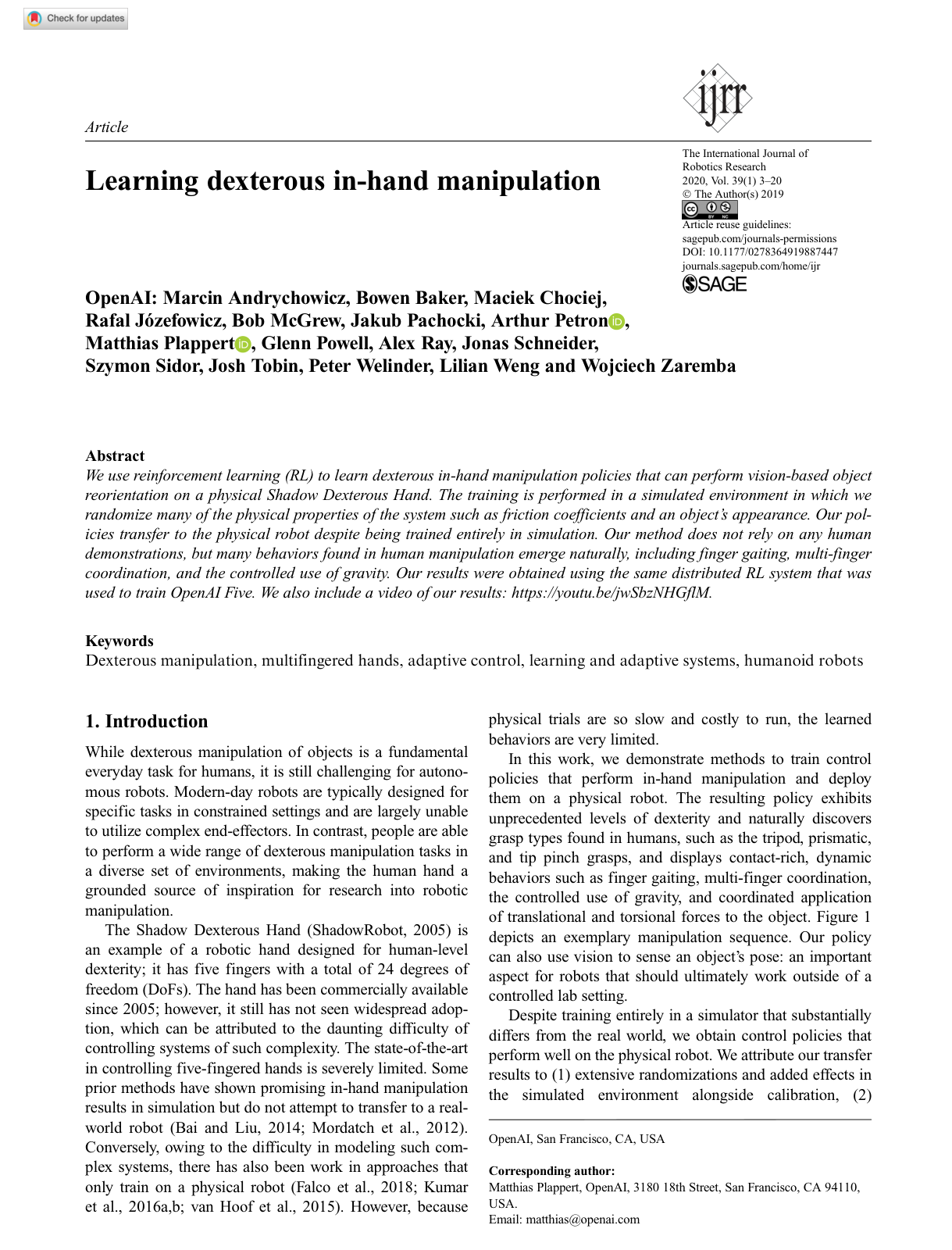
Learning dexterous in-hand manipulation
Marcin Andrychowicz, Bowen Baker, Maciek Chociej, Rafal Józefowicz, Bob McGrew, Jakub Pachocki, Arthur Petron, Matthias Plappert, Glenn Powell, Alex Ray, Jonas Schneider, Szymon Sidor, Josh Tobin, Peter Welinder, Lilian Weng, Wojciech Zaremba
Why you should read this
Demonstrates how large-scale reinforcement learning combined with domain randomization in simulation enables a physical humanoid robot hand to master vision-based, human-like in-hand object manipulation without real-world training or human demonstrations.
We use reinforcement learning (RL) to learn dexterous in-hand manipulation policies that can perform vision-based object reorientation on a physical Shadow Dexterous Hand. The training is performed in a simulated environment in which we randomize many of the physical properties of the system such as friction coefficients and an object’s appearance. Our policies transfer to the physical robot despite being trained entirely in simulation. Our method does not rely on any human demonstrations, but many behaviors found in human manipulation emerge naturally, including finger gaiting, multi-finger coordination, and the controlled use of gravity. Our results were obtained using the same distributed RL system that was used to train OpenAI Five. We also include a video of our results: https://youtu.be/jwSbzNHGflM.
Added
2026-09-16
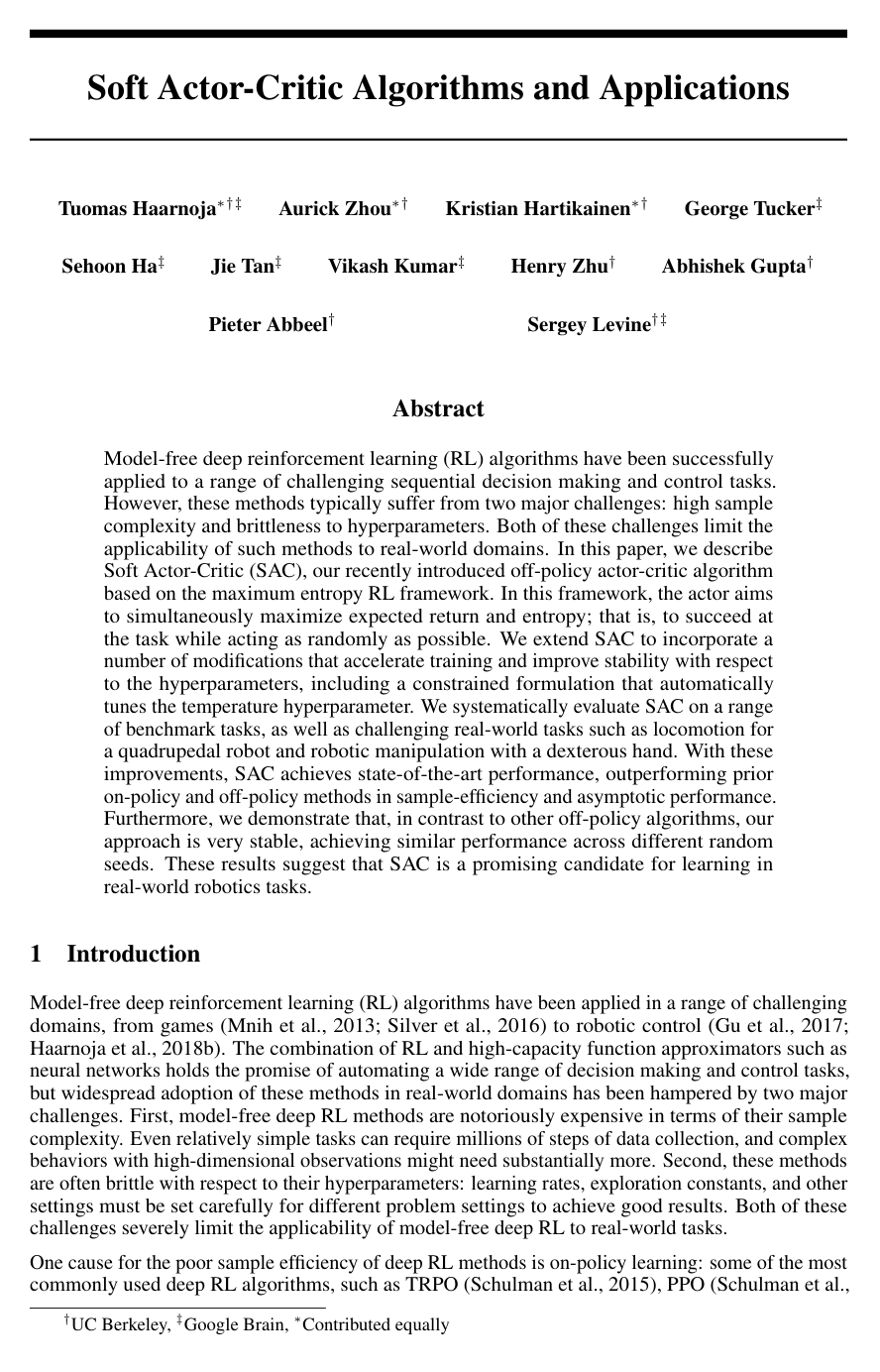
Soft Actor-Critic Algorithms and Applications
Tuomas Haarnoja, Aurick Zhou, Kristian Hartikainen, George Tucker, Sehoon Ha, Jie Tan, Vikash Kumar, Henry Zhu, Abhishek Gupta, Pieter Abbeel, Sergey Levine
Why you should read this
Presents the Soft Actor-Critic algorithm with automated temperature tuning, establishing a sample-efficient and stable off-policy reinforcement learning method that excels on challenging continuous control and real-world robotics tasks.
Model-free deep reinforcement learning (RL) algorithms have been successfully applied to a range of challenging sequential decision making and control tasks. However, these methods typically suffer from two major challenges: high sample complexity and brittleness to hyperparameters. Both of these challenges limit the applicability of such methods to real-world domains. In this paper, we describe Soft Actor-Critic (SAC), our recently introduced off-policy actor-critic algorithm based on the maximum entropy RL framework. In this framework, the actor aims to simultaneously maximize expected return and entropy. That is, to succeed at the task while acting as randomly as possible. We extend SAC to incorporate a number of modifications that accelerate training and improve stability with respect to the hyperparameters, including a constrained formulation that automatically tunes the temperature hyperparameter. We systematically evaluate SAC on a range of benchmark tasks, as well as real-world challenging tasks such as locomotion for a quadrupedal robot and robotic manipulation with a dexterous hand. With these improvements, SAC achieves state-of-the-art performance, outperforming prior on-policy and off-policy methods in sample-efficiency and asymptotic performance. Furthermore, we demonstrate that, in contrast to other off-policy algorithms, our approach is very stable, achieving similar performance across different random seeds. These results suggest that SAC is a promising candidate for learning in real-world robotics tasks.
Added
2026-09-11