
topic
cubic spline (cubic splines)
A cubic spline is a piecewise curve constructed from third-degree polynomial segments that smoothly connects a sequence of data points. At each junction, known as a knot, adjacent segments share the same value, slope, and curvature, maintaining continuous first and second derivatives across the entire curve. In computer science, numerical analysis, and computer graphics, cubic splines are widely used for data interpolation, geometric modeling, computer-aided design, and motion path planning. They provide a computationally efficient and visually smooth representation of complex curves while avoiding the extreme oscillations associated with high-degree single polynomial interpolation.
3 items
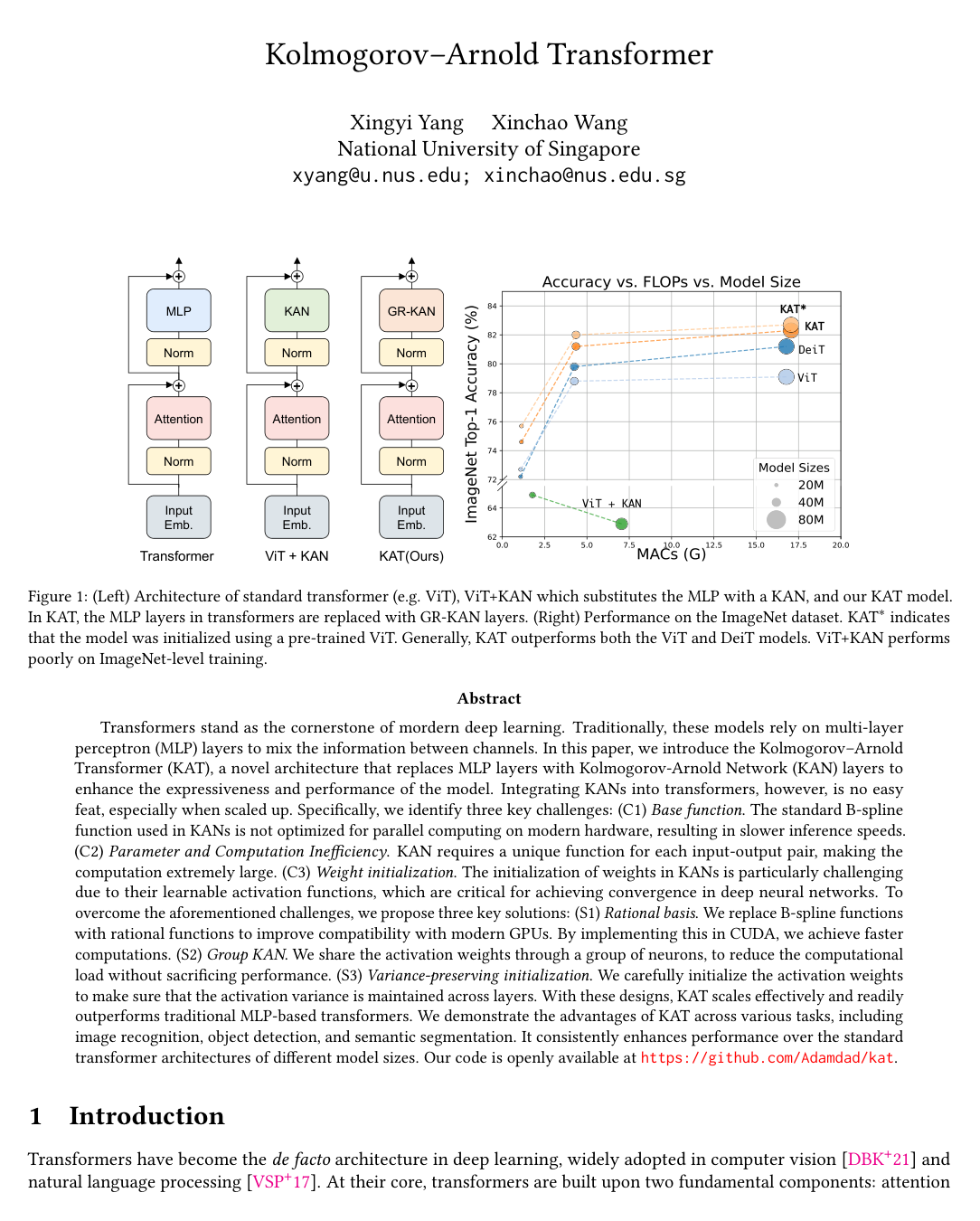
Kolmogorov-Arnold Transformer
Xingyi Yang, Xinchao Wang
Why you should read this
Introduces the Kolmogorov-Arnold Transformer, which scales Kolmogorov-Arnold Networks within deep learning architectures by using GPU-friendly rational basis functions, group-level parameter sharing, and variance-preserving initialization to outperform standard MLP-based transformers.
Transformers stand as the cornerstone of mordern deep learning. Traditionally, these models rely on multi-layer perceptron (MLP) layers to mix the information between channels. In this paper, we introduce the Kolmogorov-Arnold Transformer (KAT), a novel architecture that replaces MLP layers with Kolmogorov-Arnold Network (KAN) layers to enhance the expressiveness and performance of the model. Integrating KANs into transformers, however, is no easy feat, especially when scaled up. Specifically, we identify three key challenges: (C1) Base function. The standard B-spline function used in KANs is not optimized for parallel computing on modern hardware, resulting in slower inference speeds. (C2) Parameter and Computation Inefficiency. KAN requires a unique function for each input-output pair, making the computation extremely large. (C3) Weight initialization. The initialization of weights in KANs is particularly challenging due to their learnable activation functions, which are critical for achieving convergence in deep neural networks. To overcome the aforementioned challenges, we propose three key solutions: (S1) Rational basis. We replace B-spline functions with rational functions to improve compatibility with modern GPUs. By implementing this in CUDA, we achieve faster computations. (S2) Group KAN. We share the activation weights through a group of neurons, to reduce the computational load without sacrificing performance. (S3) Variance-preserving initialization. We carefully initialize the activation weights to make sure that the activation variance is maintained across layers. With these designs, KAT scales effectively and readily outperforms traditional MLP-based transformers.
Added
2026-09-26
A multiresolution spline with application to image mosaics
P. Burt, E. Adelson
Why you should read this
Introduces a multiresolution spline method that blends images across spatial frequency bands, eliminating visible seams without blurring fine details or creating double-exposure artifacts.
We define a multiresolution spline technique for combining two or more images into a larger image mosaic. In this procedure, the images to be splined are first decomposed into a set of band-pass filtered component images. Next, the component images in each spatial frequency band are assembled into a corresponding band-pass mosaic. In this step, component images are joined using a weighted average within a transition zone which is proportional in size to the wave lengths represented in the band. Finally, these band-pass mosaic images are summed to obtain the desired image mosaic. In this way, the spline is matched to the scale of features within the images themselves. When coarse features occur near borders, these are blended gradually over a relatively large distance without blurring or otherwise degrading finer image details in the neighborhood of the border.
Added
2026-09-25
Animating rotation with quaternion curves
Ken Shoemake
Why you should read this
Introduces quaternion spline curves for smoothly interpolating arbitrary rotations, producing natural camera and rigid-body animation without the artifacts of earlier methods.
Solid bodies roll and tumble through space. In computer animation, so do cameras. The rotations of these objects are best described using a four coordinate system, quaternions, as is shown in this paper. Of all quaternions, those on the unit sphere are most suitable for animation, but the question of how to construct curves on spheres has not been much explored. This paper gives one answer by presenting a new kind of spline curve, created on a sphere, suitable for smoothly in-betweening (i.e. interpolating) sequences of arbitrary rotations. Both theory and experiment show that the motion generated is smooth and natural, without quirks found in earlier methods.
Added
2026-09-14