
topic
creative design
Creative design is a computational approach and subfield of conceptual design focused on generating, exploring, and evaluating novel, non-routine solutions rather than simply modifying predefined parameters. Within computer-aided design and artificial intelligence, creative design systems employ techniques such as evolutionary algorithms, case-based and analogical reasoning, knowledge-based systems, and generative modeling to expand or restructure design spaces. By producing unexpected yet viable alternatives and assisting human designers during early-stage ideation, creative design enables computational tools to serve as active, collaborative partners in innovation rather than passive drafting or optimization instruments.
2 items
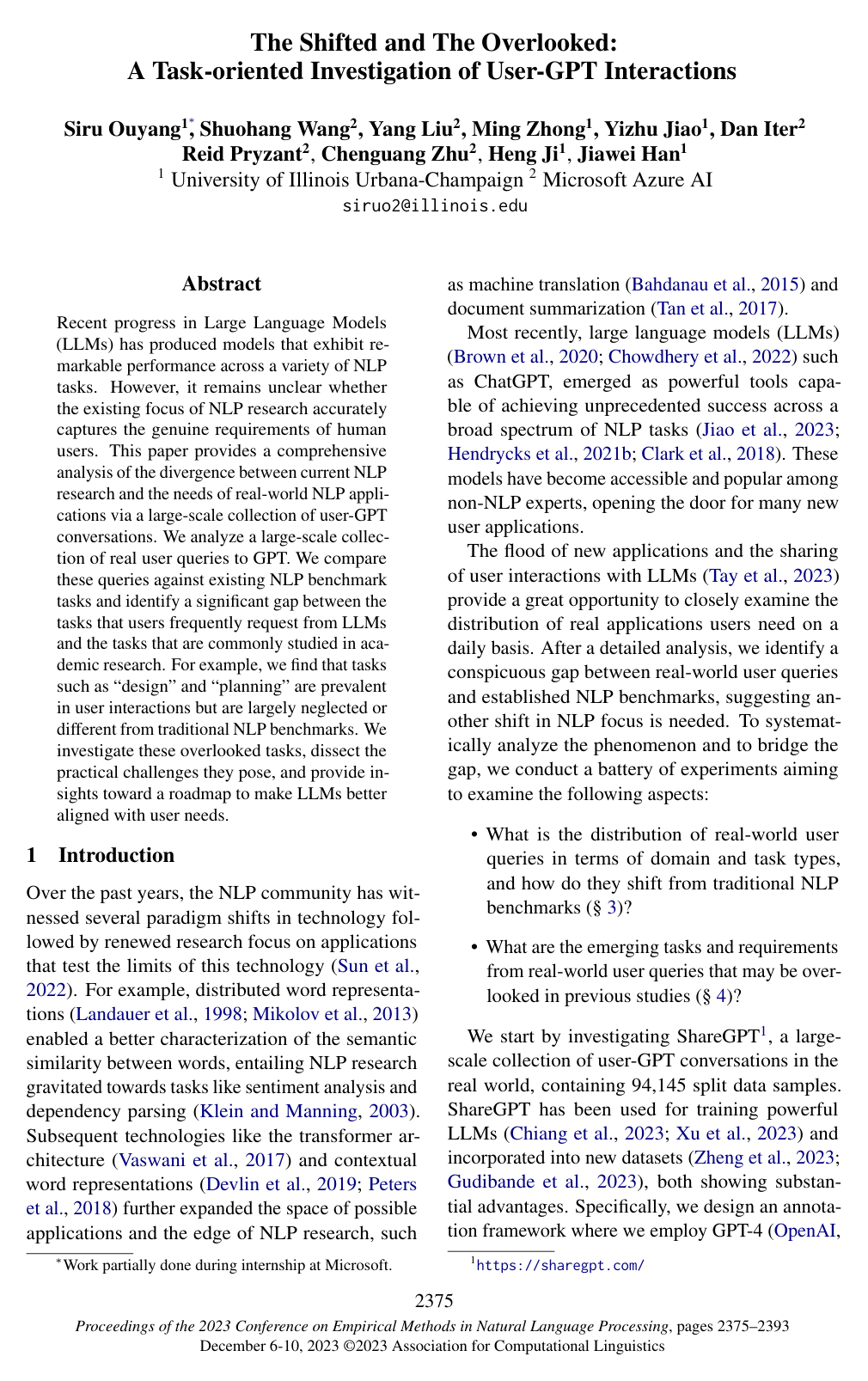
The Shifted and The Overlooked: A Task-oriented Investigation of User-GPT Interactions
Siru Ouyang, Shuohang Wang, Yang Liu, Ming Zhong, Yizhu Jiao, Dan Iter, Reid Pryzant, Chenguang Zhu, Heng Ji, Jiawei Han
Why you should read this
Reveals a critical misalignment between academic NLP benchmarks and real-world needs by analyzing over 94,000 user-GPT interactions, identifying frequently requested yet neglected tasks such as planning, designing, and advising.
Recent progress in Large Language Models (LLMs) has produced models that exhibit remarkable performance across a variety of NLP tasks. However, it remains unclear whether the existing focus of NLP research accurately captures the genuine requirements of human users. This paper provides a comprehensive analysis of the divergence between current NLP research and the needs of real-world NLP applications via a large-scale collection of user-GPT conversations. We analyze a large-scale collection of real user queries to GPT. We compare these queries against existing NLP benchmark tasks and identify a significant gap between the tasks that users frequently request from LLMs and the tasks that are commonly studied in academic research. For example, we find that tasks such as “design” and “planning” are prevalent in user interactions but are largely neglected or different from traditional NLP benchmarks. We investigate these overlooked tasks, dissect the practical challenges they pose, and provide insights toward a roadmap to make LLMs better aligned with user needs.
Added
2026-10-03
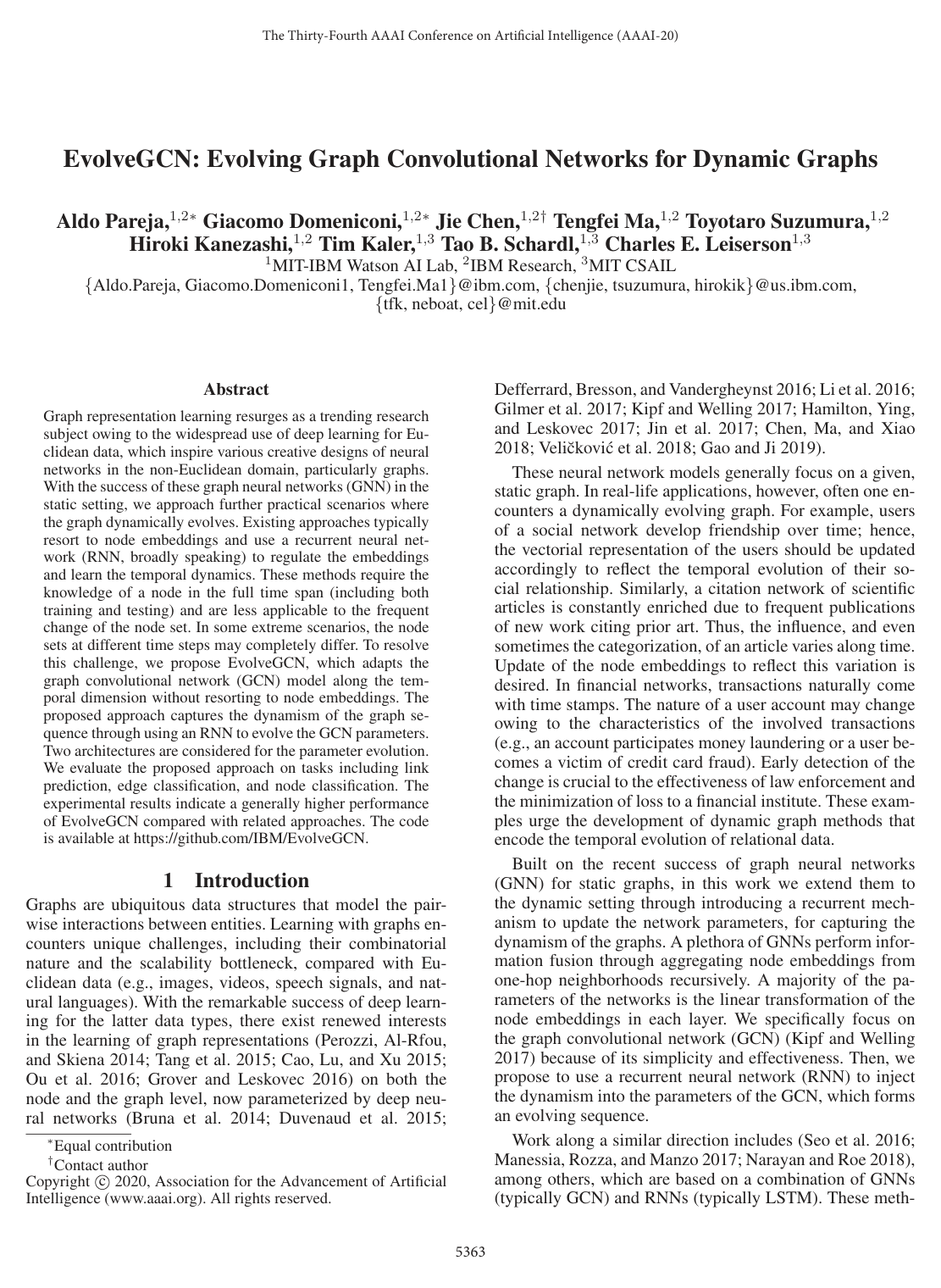
EvolveGCN: Evolving Graph Convolutional Networks for Dynamic Graphs
A. Pareja, Giacomo Domeniconi, Jie Chen, Tengfei Ma, T. Suzumura, H. Kanezashi, Tim Kaler, Charles E. Leisersen
Why you should read this
Proposes EvolveGCN, a framework that uses recurrent neural networks to dynamically evolve graph convolutional network weights over time, eliminating the need to track historical node embeddings and effectively handling evolving graph structures with changing node sets.
Graph representation learning resurges as a trending research subject owing to the widespread use of deep learning for Euclidean data, which inspire various creative designs of neural networks in the non-Euclidean domain, particularly graphs. With the success of these graph neural networks (GNN) in the static setting, we approach further practical scenarios where the graph dynamically evolves. Existing approaches typically resort to node embeddings and use a recurrent neural network (RNN, broadly speaking) to regulate the embeddings and learn the temporal dynamics. These methods require the knowledge of a node in the full time span (including both training and testing) and are less applicable to the frequent change of the node set. In some extreme scenarios, the node sets at different time steps may completely differ. To resolve this challenge, we propose EvolveGCN, which adapts the graph convolutional network (GCN) model along the temporal dimension without resorting to node embeddings. The proposed approach captures the dynamism of the graph sequence through using an RNN to evolve the GCN parameters. Two architectures are considered for the parameter evolution. We evaluate the proposed approach on tasks including link prediction, edge classification, and node classification. The experimental results indicate a generally higher performance of EvolveGCN compared with related approaches. The code is available at https://github.com/IBM/EvolveGCN.
Added
2026-09-24