
topic
context models (context model)
Context models are structured representations used in computer science to organize, interpret, and reason about situational information in context-aware and ubiquitous computing environments. By defining the properties and relationships among dynamic factors such as physical location, time, device capabilities, network conditions, and user activities, a context model provides the semantic structure necessary for software to understand its operating environment. These representations allow systems to translate diverse, low-level sensor inputs and contextual data into high-level knowledge, enabling applications to adapt their behavior and services automatically to user needs. Common implementation approaches include key-value structures, markup schemes, object-oriented architectures, logic-based rules, and ontology-based frameworks, each offering varying levels of expressiveness, scalability, and automated reasoning capabilities.
17 items
Many-Shot In-Context Learning
Rishabh Agarwal, Avi Singh, Lei Zhang, Bernd Bohnet, Luis Rosias, Stephanie C. Y. Chan, Biao Zhang, Ankesh Anand, Zaheer Abbas, Azade Nova, John D. Co-Reyes, Eric Chu, Feryal M. P. Behbahani, Aleksandra Faust, Hugo Larochelle
Why you should read this
Demonstrates that scaling in-context learning to hundreds or thousands of examples matches the performance of fine-tuning, overrides pretraining biases, and succeeds even without human-labeled rationales via reinforced and unsupervised prompting strategies.
LLMs excel at few-shot in-context learning (ICL) – learning from a few input-output examples (“shots”) provided in context at inference, without any weight updates. Newly expanded context windows allow us to investigate ICL with hundreds or thousands of examples – the many-shot regime. Going from few-shot to many-shot, we observe significant performance gains across a wide variety of generative and discriminative tasks. While promising, many-shot ICL can be bottlenecked by the available amount of human-generated outputs. To mitigate this limitation, we explore two settings: (1) “Reinforced ICL” that uses model-generated chain-of-thought rationales in place of human rationales, and (2) “Unsupervised ICL” where we remove rationales altogether, and prompt the model only with domain-specific inputs. We find that both Reinforced and Unsupervised ICL can be effective in the many-shot regime, particularly on complex reasoning tasks. Furthermore, we demonstrate that, unlike few-shot learning, many-shot learning is effective at overriding pretraining biases, can learn high-dimensional functions with numerical inputs, and performs comparably to fine-tuning. Finally, we reveal the limitations of next-token prediction loss as an indicator of ICL performance.
Added
2026-10-05
Summary of a Haystack: A Challenge to Long-Context LLMs and RAG Systems
Philippe Laban, Alexander R. Fabbri, Caiming Xiong, Chien-Sheng Wu
Why you should read this
Introduces SummHay, a synthetic long-context benchmark that exposes critical weaknesses in leading language models and retrieval-augmented generation systems by evaluating their ability to aggregate dispersed insights and accurately cite sources across 100,000-token document collections.
LLMs and RAG systems are now capable of handling millions of input tokens or more. However, evaluating the output quality of such systems on long-context tasks remains challenging, as tasks like Needle-in-a-Haystack lack complexity. In this work, we argue that summarization can play a central role in such evaluation. We design a procedure to synthesize Haystacks of documents, ensuring that specific insights repeat across documents. The “Summary of a Haystack” (SummHay) task then requires a system to process the Haystack and generate, given a query, a summary that identifies the relevant insights and precisely cites the source documents. Since we have precise knowledge of what insights should appear in a haystack summary and what documents should be cited, we implement a highly reproducible automatic evaluation that can score summaries on two aspects – Coverage and Citation. We generate Haystacks in two domains (conversation, news), and perform a large-scale evaluation of 14 LLMs and corresponding 50 RAG systems. Our findings indicate that SummHay is an open challenge for current systems, as even systems provided with an Oracle signal of document relevance lag our estimate of human performance (56%) by 10+ points on a Joint Score. Without a retriever, long-context LLMs like GPT-4o and Claude 3 Opus score below 20% on SummHay. We show SummHay can also be used to study enterprise RAG systems and position bias in long-context models. We hope future systems can equal and surpass human performance on SummHay.
Added
2026-10-02
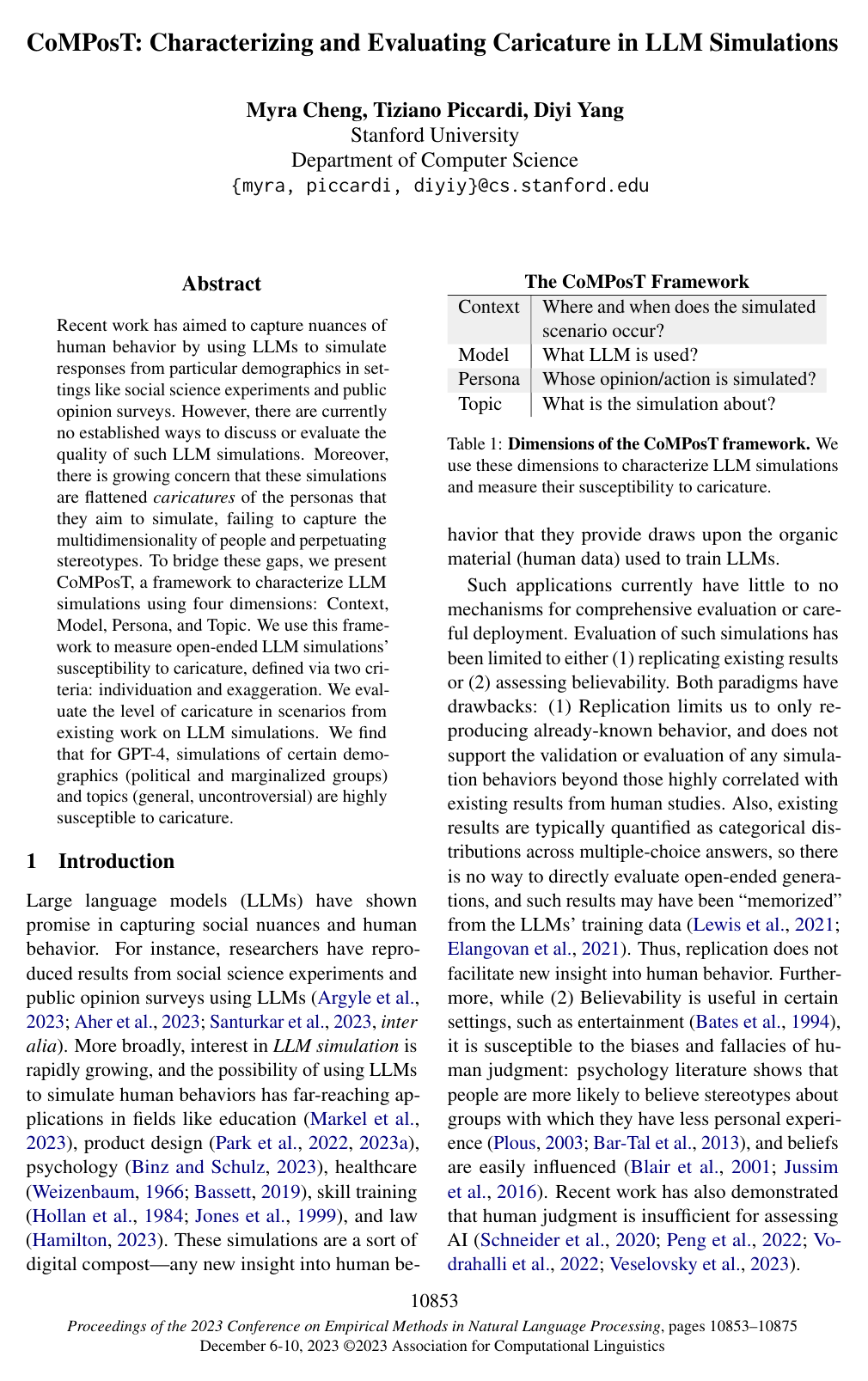
CoMPosT: Characterizing and Evaluating Caricature in LLM Simulations
Myra Cheng, Tiziano Piccardi, Diyi Yang
Why you should read this
Presents a four-dimension framework and quantitative metric to evaluate how demographic simulations in large language models reduce complex human personas to exaggerated, stereotypical caricatures.
Recent work has aimed to capture nuances of human behavior by using LLMs to simulate responses from particular demographics in settings like social science experiments and public opinion surveys. However, there are currently no established ways to discuss or evaluate the quality of such LLM simulations. Moreover, there is growing concern that these simulations are flattened caricatures of the personas that they aim to simulate, failing to capture the multidimensionality of people and perpetuating stereotypes. To bridge these gaps, we present CoMPosT, a framework to characterize LLM simulations using four dimensions: Context, Model, Persona, and Topic. We use this framework to measure open-ended LLM simulations’ susceptibility to caricature, defined via two criteria: individuation and exaggeration. We evaluate the level of caricature in scenarios from existing work on LLM simulations. We find that for GPT-4, simulations of certain demographics (political and marginalized groups) and topics (general, uncontroversial) are highly susceptible to caricature.
Added
2026-10-01
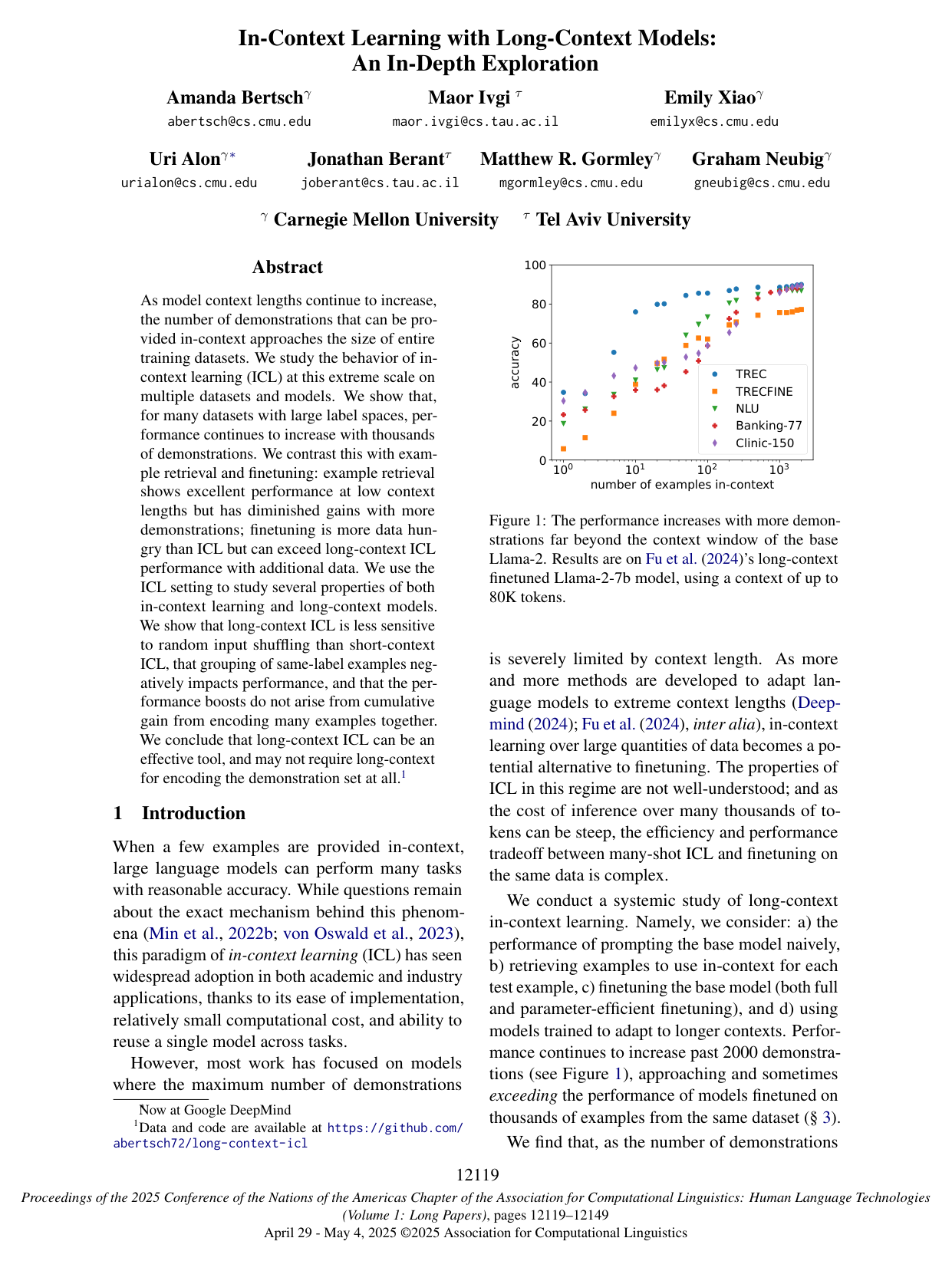
In-Context Learning with Long-Context Models: An In-Depth Exploration
Amanda Bertsch, Maor Ivgi, Emily Xiao, Uri Alon, Jonathan Berant, Matthew R. Gormley, Graham Neubig
Why you should read this
Demonstrates that scaling in-context learning to thousands of demonstrations can rival model finetuning while significantly reducing sensitivity to example ordering and selection.
As model context lengths continue to increase, the number of demonstrations that can be provided in-context approaches the size of entire training datasets. We study the behavior of in-context learning (ICL) at this extreme scale on multiple datasets and models. We show that, for many datasets with large label spaces, performance continues to increase with thousands of demonstrations. We contrast this with example retrieval and finetuning: example retrieval shows excellent performance at low context lengths but has diminished gains with more demonstrations; finetuning is more data hungry than ICL but can exceed long-context ICL performance with additional data. We use the ICL setting to study several properties of both in-context learning and long-context models. We show that long-context ICL is less sensitive to random input shuffling than short-context ICL, that grouping of same-label examples negatively impacts performance, and that the performance boosts do not arise from cumulative gain from encoding many examples together. We conclude that long-context ICL can be an effective tool, and may not require long-context for encoding the demonstration set at all.¹
Added
2026-10-01
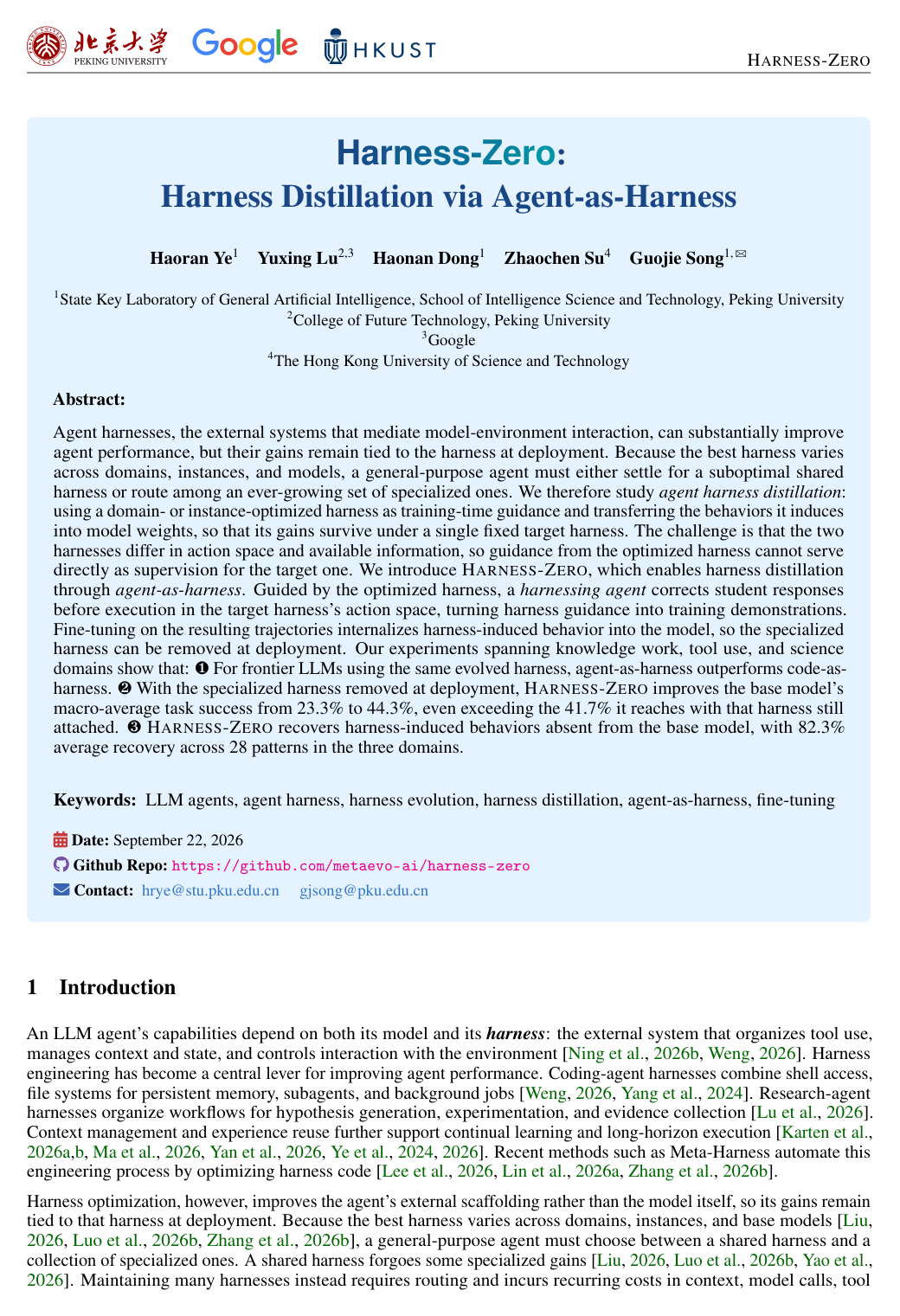
Harness-Zero: Harness Distillation via Agent-as-Harness
Haoran Ye, Yuxing Lu, Haonan Dong, Zhaochen Su, Guojie Song
Why you should read this
Presents a distillation framework that transfers specialized runtime scaffolding behaviors directly into language model weights, allowing unassisted models at deployment to boost task success from 23.3% to 44.3% and surpass their scaffolded counterparts.
Agent harnesses, the external systems that mediate model-environment interaction, can substantially improve agent performance, but their gains remain tied to the harness at deployment. Because the best harness varies across domains, instances, and models, a general-purpose agent must either settle for a suboptimal shared harness or route among an ever-growing set of specialized ones. We therefore study agent harness distillation: using a domain- or instance-optimized harness as training-time guidance and transferring the behaviors it induces into model weights, so that its gains survive under a single fixed target harness. The challenge is that the two harnesses differ in action space and available information, so guidance from the optimized harness cannot serve directly as supervision for the target one. We introduce Harness-Zero, which enables harness distillation through agent-as-harness. Guided by the optimized harness, a harnessing agent corrects student responses before execution in the target harness's action space, turning harness guidance into training demonstrations. Fine-tuning on the resulting trajectories internalizes harness-induced behavior into the model, so the specialized harness can be removed at deployment. Our experiments spanning knowledge work, tool use, and science domains show that: (1) For frontier LLMs using the same evolved harness, agent-as-harness outperforms code-as-harness. (2) With the specialized harness removed at deployment, Harness-Zero improves the base model's macro-average task success from 23.3% to 44.3%, even exceeding the 41.7% it reaches with that harness still attached. (3) Harness-Zero recovers harness-induced behaviors absent from the base model, with 82.3% average recovery across 28 patterns in the three domains.
Added
2026-09-30
License
Published with permission
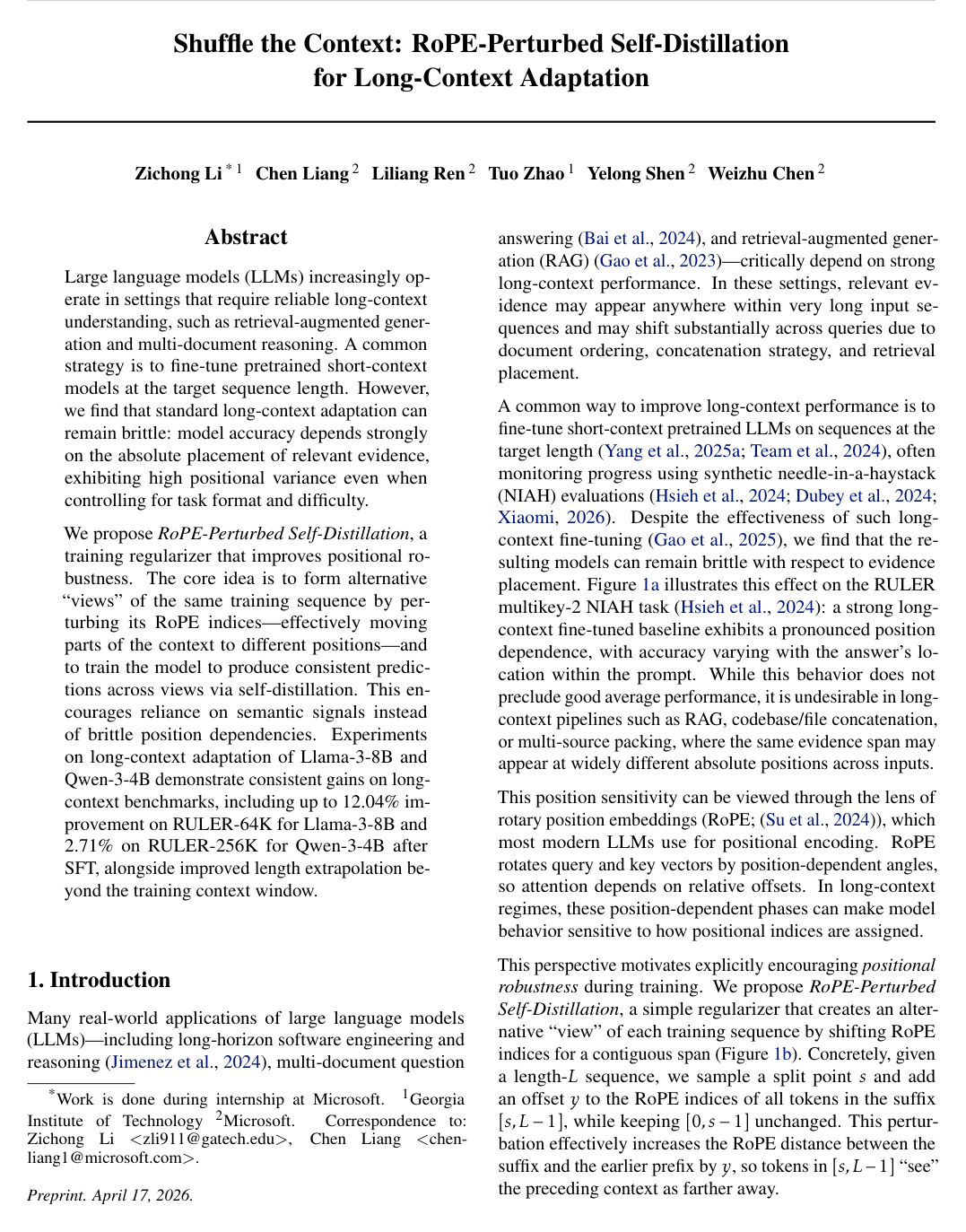
Shuffle the Context: RoPE-Perturbed Self-Distillation for Long-Context Adaptation
Zichong Li, Chen Liang, Liliang Ren, Tuo Zhao, Yelong Shen, Weizhu Chen
Why you should read this
Proposes RoPE-Perturbed Self-Distillation, a training regularizer that enforces prediction consistency across perturbed position embeddings to eliminate positional bias and improve long-context retrieval and extrapolation in large language models.
Large language models (LLMs) increasingly operate in settings that require reliable long-context understanding, such as retrieval-augmented generation and multi-document reasoning. A common strategy is to fine-tune pretrained short-context models at the target sequence length. However, we find that standard long-context adaptation can remain brittle: model accuracy depends strongly on the absolute placement of relevant evidence, exhibiting high positional variance even when controlling for task format and difficulty. We propose RoPE-Perturbed Self-Distillation, a training regularizer that improves positional robustness. The core idea is to form alternative "views" of the same training sequence by perturbing its RoPE indices -- effectively moving parts of the context to different positions -- and to train the model to produce consistent predictions across views via self-distillation. This encourages reliance on semantic signals instead of brittle position dependencies. Experiments on long-context adaptation of Llama-3-8B and Qwen-3-4B demonstrate consistent gains on long-context benchmarks, including up to 12.04% improvement on RULER-64K for Llama-3-8B and 2.71% on RULER-256K for Qwen-3-4B after SFT, alongside improved length extrapolation beyond the training context window.
Added
2026-09-29
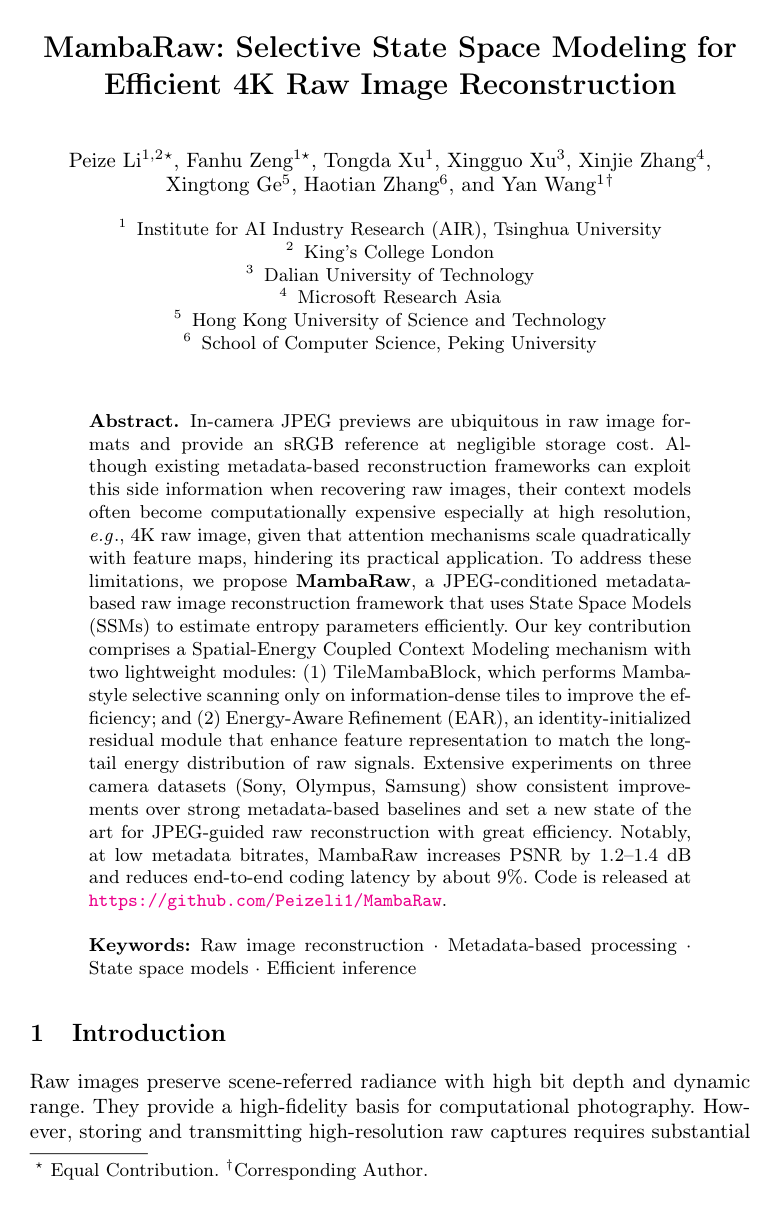
MambaRaw: Selective State Space Modeling for Efficient 4K Raw Image Reconstruction
Peize Li, Fanhu Zeng, Tongda Xu, Xingguo Xu, Xinjie Zhang, Xingtong Ge, Haotian Zhang, Yan Wang
Why you should read this
Presents MambaRaw, a selective state space framework that replaces quadratic attention with tiled scanning to reconstruct 4K raw images from embedded JPEG previews with improved fidelity and reduced coding latency.
In-camera JPEG previews are ubiquitous in raw image formats and provide an sRGB reference at negligible storage cost. Although existing metadata-based reconstruction frameworks can exploit this side information when recovering raw images, their context models often become computationally expensive especially at high resolution, eg, 4K raw image, given that attention mechanisms scale quadratically with feature maps, hindering its practical application. To address these limitations, we propose MambaRaw, a JPEG-conditioned metadata-based raw image reconstruction framework that uses State Space Models (SSMs) to estimate entropy parameters efficiently. Our key contribution comprises a Spatial-Energy Coupled Context Modeling mechanism with two lightweight modules: (1) TileMambaBlock, which performs Mamba-style selective scanning only on information-dense tiles to improve the efficiency; and (2) Energy-Aware Refinement (EAR), an identity-initialized residual module that enhance feature representation to match the long-tail energy distribution of raw signals. Extensive experiments on three camera datasets (Sony, Olympus, Samsung) show consistent improvements over strong metadata-based baselines and set a new state of the art for JPEG-guided raw reconstruction with great efficiency. Notably, at low metadata bitrates, MambaRaw increases PSNR by 1.2--1.4 dB and reduces end-to-end coding latency by about 9%. Code is released at this https URL.
Added
2026-09-29
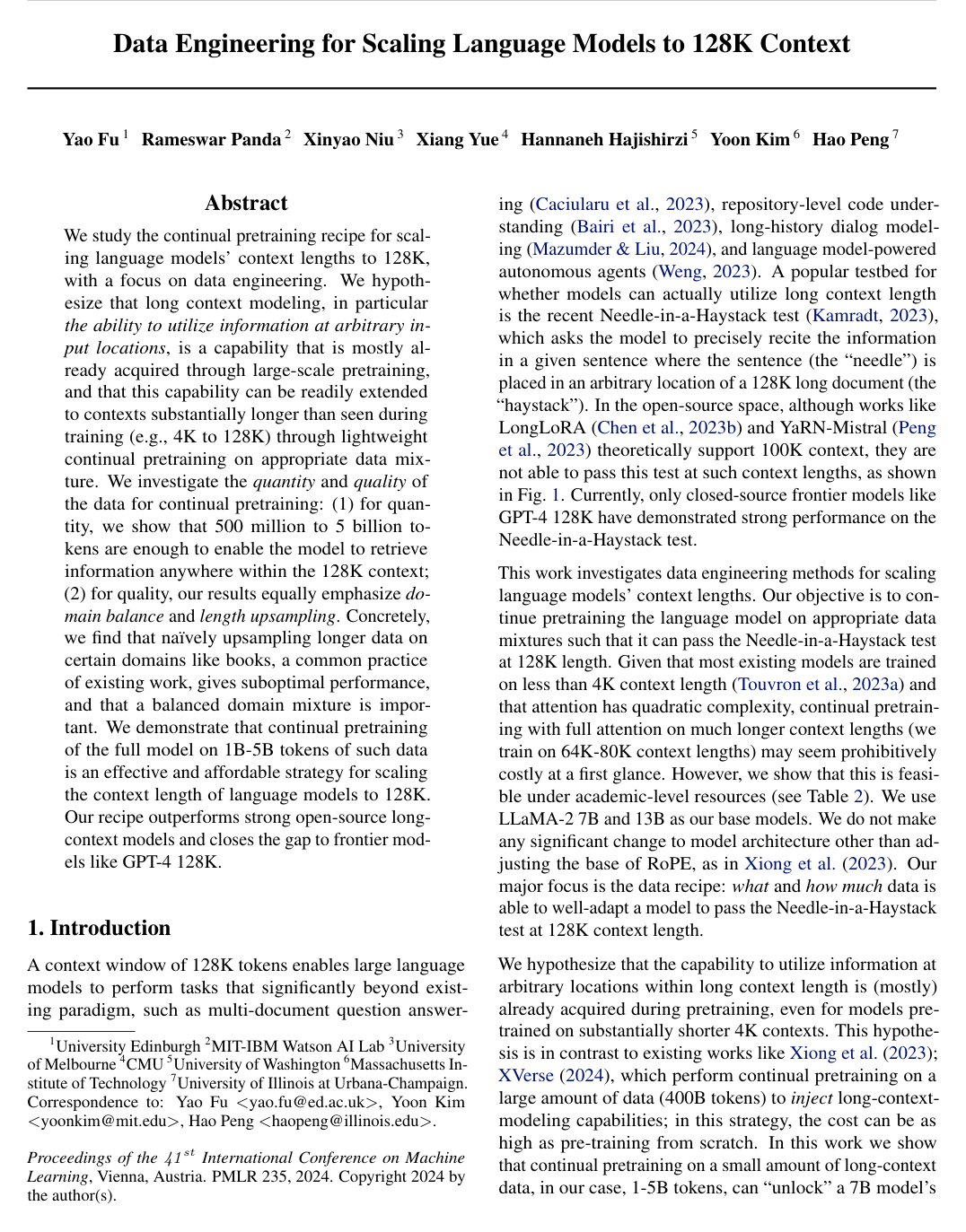
Data Engineering for Scaling Language Models to 128K Context
Yao Fu, Rameswar Panda, Xinyao Niu, Xiang Yue, Hannaneh Hajishirzi, Yoon Kim, Hao Peng
Why you should read this
Demonstrates that continually pretraining language models on just 1 to 5 billion domain-balanced, length-upsampled tokens enables accurate 128K context retrieval matching GPT-4 performance under accessible academic budgets.
We study the continual pretraining recipe for scaling language models' context lengths to 128K, with a focus on data engineering. We hypothesize that long context modeling, in particular the ability to utilize information at arbitrary input locations, is a capability that is mostly already acquired through large-scale pretraining, and that this capability can be readily extended to contexts substantially longer than seen during training (e.g., 4K to 128K) through lightweight continual pretraining on appropriate data mixture. We investigate the quantity and quality of the data for continual pretraining: (1) for quantity, we show that 500 million to 5 billion tokens are enough to enable the model to retrieve information anywhere within the 128K context; (2) for quality, our results equally emphasize domain balance and length upsampling. Concretely, we find that naïvely upsampling longer data on certain domains like books, a common practice of existing work, gives suboptimal performance, and that a balanced domain mixture is important. We demonstrate that continual pretraining of the full model on 1B-5B tokens of such data is an effective and affordable strategy for scaling the context length of language models to 128K. Our recipe outperforms strong open-source long-context models and closes the gap to frontier models like GPT-4 128K.
Added
2026-09-28
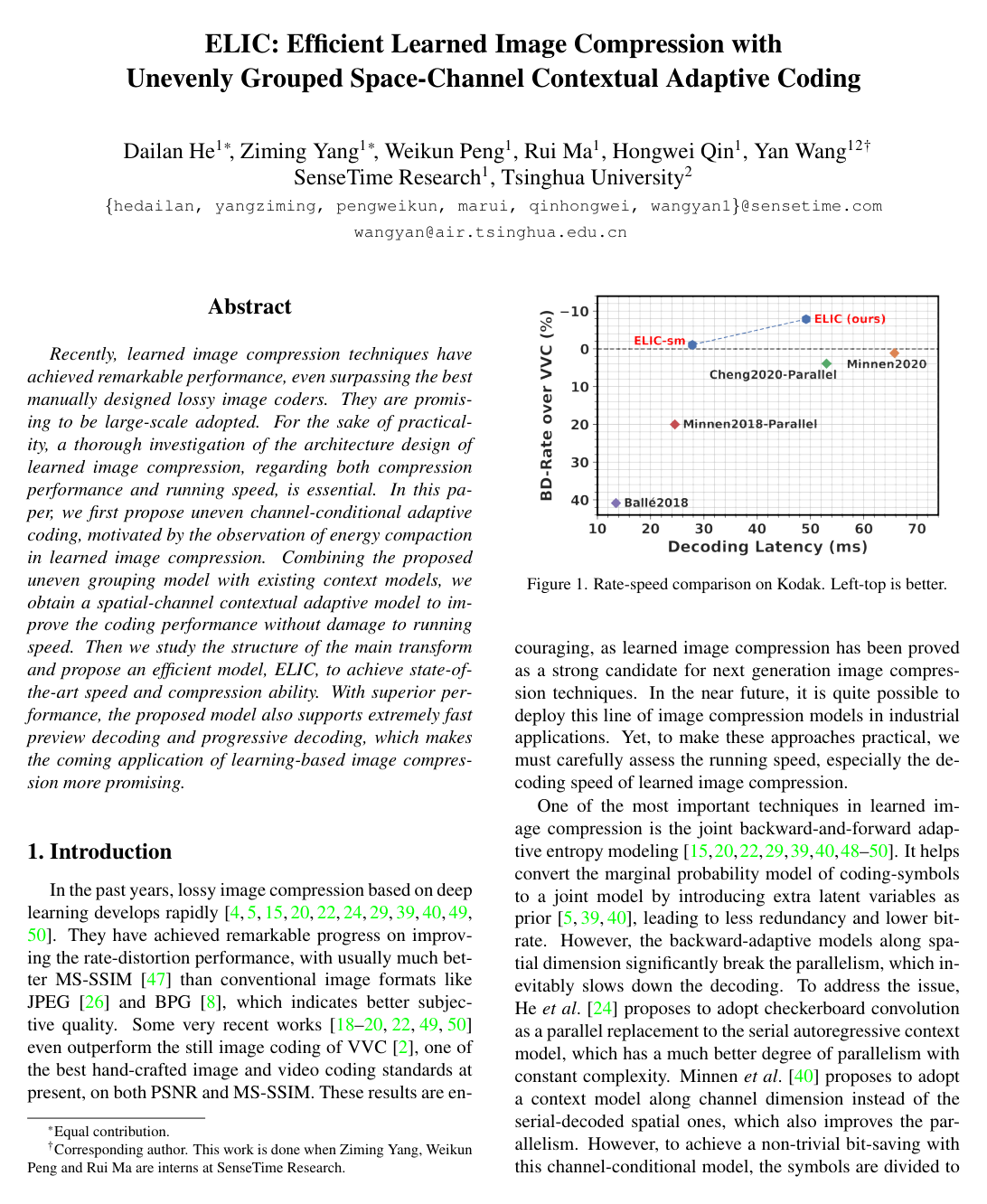
ELIC: Efficient Learned Image Compression with Unevenly Grouped Space-Channel Contextual Adaptive Coding
Dailan He, Ziming Yang, Weikun Peng, Rui Ma, Hongwei Qin, Yan Wang
Why you should read this
Presents ELIC, a learned image compression architecture that combines uneven space-channel contextual coding with efficient transform design to achieve state-of-the-art rate-distortion performance alongside fast inference, preview decoding, and progressive decoding.
Recently, learned image compression techniques have achieved remarkable performance, even surpassing the best manually designed lossy image coders. They are promising to be large-scale adopted. For the sake of practicality, a thorough investigation of the architecture design of learned image compression, regarding both compression performance and running speed, is essential. In this paper, we first propose uneven channel-conditional adaptive coding, motivated by the observation of energy compaction in learned image compression. Combining the proposed uneven grouping model with existing context models, we obtain a spatial-channel contextual adaptive model to improve the coding performance without damage to running speed. Then we study the structure of the main transform and propose an efficient model, ELIC, to achieve state-of-the-art speed and compression ability. With superior performance, the proposed model also supports extremely fast preview decoding and progressive decoding, which makes the coming application of learning-based image compression more promising.
Added
2026-09-26
Test-time regression: a unifying framework for designing sequence models with associative memory
Ke Alexander Wang, Jiaxin Shi, Emily B. Fox
Why you should read this
Unifies disparate sequence models, including softmax attention and state-space models, by framing associative recall as test-time regression, thereby explaining key empirical design choices like query-key normalization and enabling the systematic derivation of higher-order attention mechanisms.
Sequence models lie at the heart of modern deep learning. However, rapid advancements have produced a diversity of seemingly unrelated architectures, such as Transformers and recurrent alternatives. In this paper, we introduce a unifying framework to understand and derive these sequence models, inspired by the empirical importance of associative recall, the capability to retrieve contextually relevant tokens. We formalize associative recall as a two-step process, memorization and retrieval, casting memorization as a regression problem. Layers that combine these two steps perform associative recall via ``test-time regression'' over its input tokens. Prominent layers, including linear attention, state-space models, fast-weight programmers, online learners, and softmax attention, arise as special cases defined by three design choices: the regression weights, the regressor function class, and the test-time optimization algorithm. Our approach clarifies how linear attention fails to capture inter-token correlations and offers a mathematical justification for the empirical effectiveness of query-key normalization in softmax attention. Further, it illuminates unexplored regions within the design space, which we use to derive novel higher-order generalizations of softmax attention. Beyond unification, our work bridges sequence modeling with classic regression methods, a field with extensive literature, paving the way for developing more powerful and theoretically principled architectures.
Added
2026-08-21

LeRoPE: Learnable RoPE Frequencies Improve Language Modeling
Petros Karypis, Sean O'Brien, Shreyas Kadekodi, Rui Zhu, Julian McAuley
Why you should read this
Develops LeRoPE, a novel modification to Rotary Positional Encodings that learns a scalar per frequency, consistently outperforming standard and partial RoPE across various model scales while requiring less computational effort.
Rotary Positional Encodings (RoPE) are currently the most popular positional encodings used in modern language models. RoPE rotates two-dimensional chunks of query and key vectors, operating as a function of their relative positional offset. The position-wise rates of rotation in RoPE typically follow a geometric sequence specified by a fixed base-frequency hyperparameter. Prior work has improved performance by either increasing this parameter to slow rotation or by applying RoPE to only a subset of QK dimensions. In this work we modify RoPE by learning a scalar per frequency, treating frequencies as learnable parameters rather than hyperparameters. We validate Learned RoPE by training a ladder of language models from scratch, ranging from 52M to 2.5B parameters. We observe and analyze the emergence of a high-norm, positional LeRoPE band. LeRoPE consistently outperforms RoPE and partial RoPE across all scales, with RoPE requiring 3.4% more compute (FLOPs) to match LeRoPE at the largest scale.
Added
2026-07-30
A Primer in Post-Training Reasoning Data: What We Know About How It Works
Yaoming Li, Guangxiang Zhao, Qilong Shi, Lin Sun, Xiangzheng Zhang, Tong Yang
Why you should read this
Synthesizes over 150 key studies and system reports to provide a foundational primer on post-training reasoning data, clarifying its objects, utility, construction, and scalability for advancing large reasoning models.
Abstract:Post-training has become a primary driver of recent progress in large reasoning models, and reasoning data are often the key variable determining whether this stage succeeds. Work on post-training reasoning data has grown rapidly, yet this literature remains scattered across dataset papers, reinforcement-learning recipes, reward-model studies, benchmarks, and frontier system reports. This paper is the first primer to synthesize over 150 key public studies and system reports on post-training reasoning data. We organize the field around four questions: what data objects exist, what makes them useful, how they are constructed, and how they scale. Together, this organization provides an attribution framework for future reasoning-data releases and post-training recipes.
Added
2026-06-15
License
Published with permission
Lost in the Middle: How Language Models Use Long Contexts
Nelson F. Liu, Kevin Lin, John Hewitt, Ashwin Paranjape, Michele Bevilacqua, Fabio Petroni, Percy Liang
Why you should read this
Reveals that large language models often fail to robustly utilize information within long contexts, demonstrating a "lost in the middle" phenomenon where performance degrades significantly when relevant data is not at the beginning or end of the input.
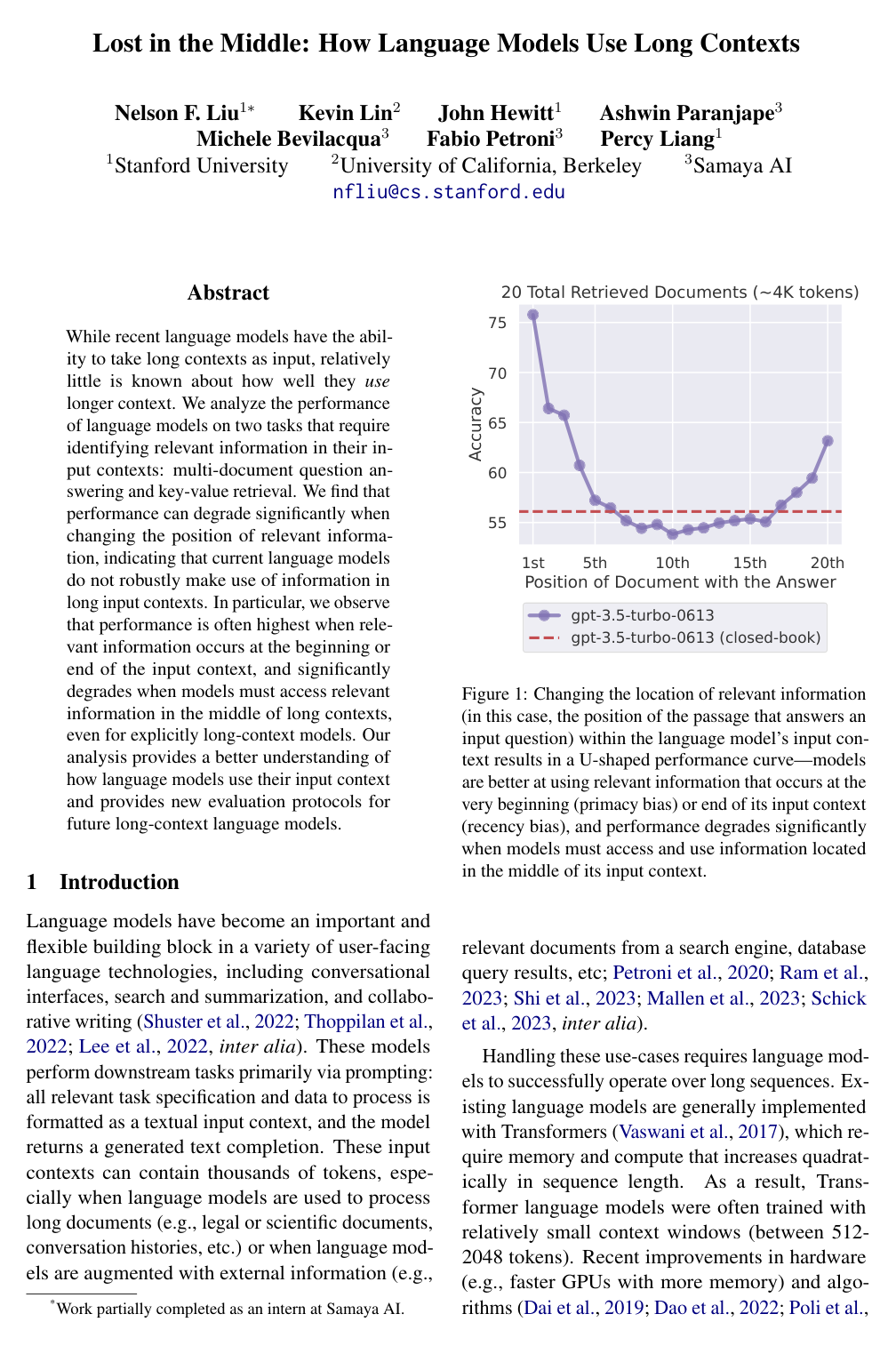
While recent language models have the ability to take long contexts as input, relatively little is known about how well they use longer context. We analyze the performance of language models on two tasks that require identifying relevant information in their input contexts: multi-document question answering and key-value retrieval. We find that performance can degrade significantly when changing the position of relevant information, indicating that current language models do not robustly make use of information in long input contexts. In particular, we observe that performance is often highest when relevant information occurs at the beginning or end of the input context, and significantly degrades when models must access relevant information in the middle of long contexts, even for explicitly long-context models. Our analysis provides a better understanding of how language models use their input context and provides new evaluation protocols for future long-context language models.
Added
2026-06-07
Kascade: A Practical Sparse Attention Method for Long-Context LLM Inference
Dhruv Deshmukh, Saurabh Goyal, Nipun Kwatra, Ramachandran Ramjee
Why you should read this
Achieves up to 4.1x speedup in long-context LLM inference while maintaining high accuracy, Kascade offers a practical, training-free sparse attention method essential for efficient deployment of reasoning models and RAG on modern hardware.
Attention is the dominant source of latency during long-context LLM inference, an increasingly popular workload with reasoning models and RAG. We propose Kascade, a training-free sparse attention method that leverages known observations such as 1) post-softmax attention is intrinsically sparse, and 2) the identity of high-weight keys is stable across nearby layers. Kascade computes exact Top-k indices in a small set of anchor layers, then reuses those indices in intermediate reuse layers. The anchor layers are selected algorithmically, via a dynamic-programming objective that maximizes cross-layer similarity over a development set, allowing easy deployment across models. The method incorporates efficient implementation constraints (e.g. tile-level operations), across both prefill and decode attention. The Top-k selection and reuse in Kascade is head-aware and we show in our experiments that this is critical for high accuracy. Kascade achieves up to 4.1x speedup in decode attention and 2.2x speedup in prefill attention over FlashAttention-3 baseline on H100 GPUs while closely matching dense attention accuracy on long-context benchmarks such as LongBench and AIME-24.
Added
2026-04-04
Scaling Laws for Neural Language Models
Jared Kaplan, Sam McCandlish, Tom Henighan, Tom B. Brown, Benjamin Chess, Rewon Child, Scott Gray, Alec Radford, Jeffrey Wu, Dario Amodei
Why you should read this
Demonstrates that language model performance precisely follows power-law scaling across model size, dataset size, and compute, providing critical insights for optimally allocating resources in training large language models.
We study empirical scaling laws for language model performance on the cross-entropy loss. The loss scales as a power-law with model size, dataset size, and the amount of compute used for training, with some trends spanning more than seven orders of magnitude. Other architectural details such as network width or depth have minimal effects within a wide range. Simple equations govern the dependence of overfitting on model/dataset size and the dependence of training speed on model size. These relationships allow us to determine the optimal allocation of a fixed compute budget. Larger models are significantly more sample-efficient, such that optimally compute-efficient training involves training very large models on a relatively modest amount of data and stopping significantly before convergence.
Added
2026-03-20
License
Published with permission
Scalable Diffusion Models with Transformers
William Peebles, Saining Xie
Why you should read this
Introduces Diffusion Transformers (DiTs), a new class of diffusion models that leverage transformer architectures, demonstrating state-of-the-art image generation performance and superior scalability, fundamentally challenging the dominance of U-Net backbones in diffusion models.
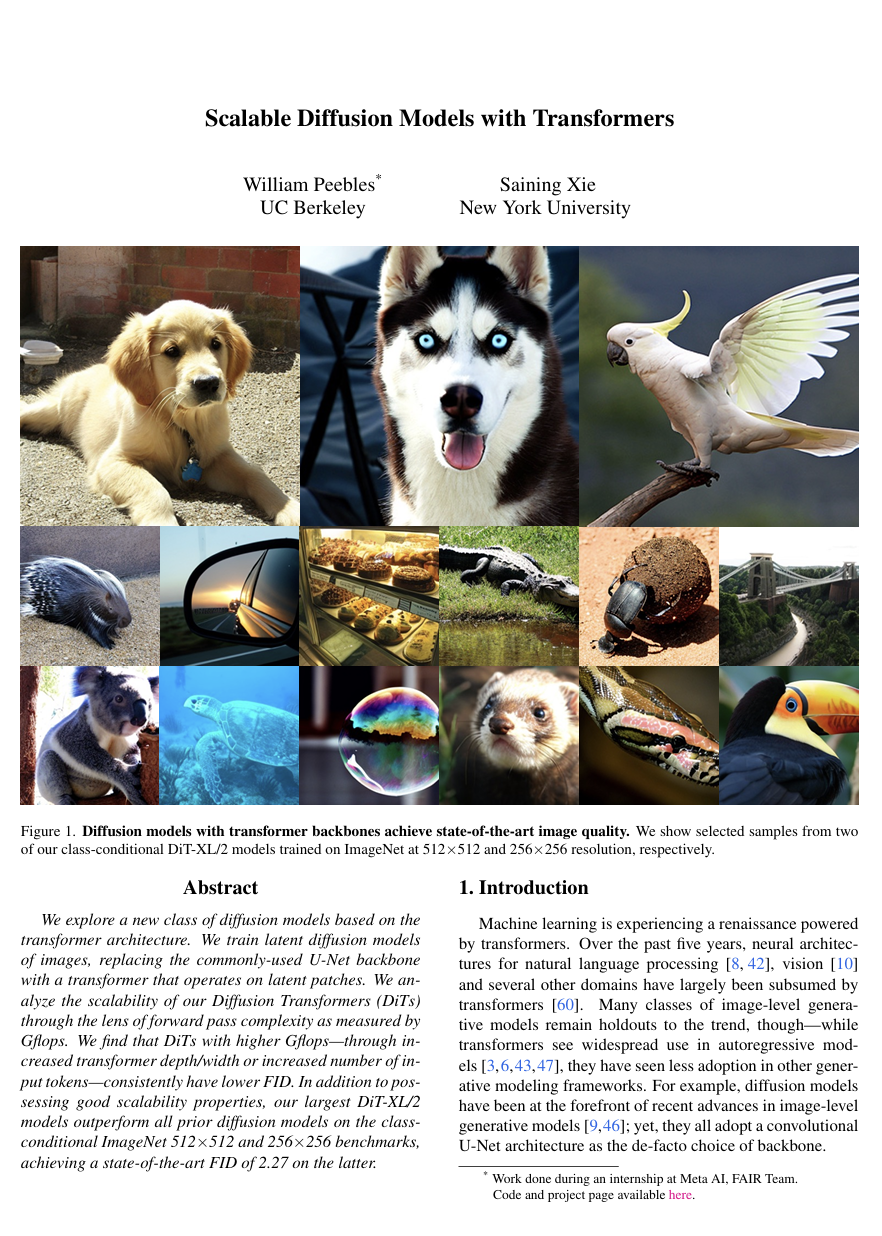
We explore a new class of diffusion models based on the transformer architecture. We train latent diffusion models of images, replacing the commonly-used U-Net backbone with a transformer that operates on latent patches. We analyze the scalability of our Diffusion Transformers (DiTs) through the lens of forward pass complexity as measured by Gflops. We find that DiTs with higher Gflops -- through increased transformer depth/width or increased number of input tokens -- consistently have lower FID. In addition to possessing good scalability properties, our largest DiT-XL/2 models outperform all prior diffusion models on the class-conditional ImageNet 512x512 and 256x256 benchmarks, achieving a state-of-the-art FID of 2.27 on the latter.
Added
2026-02-25
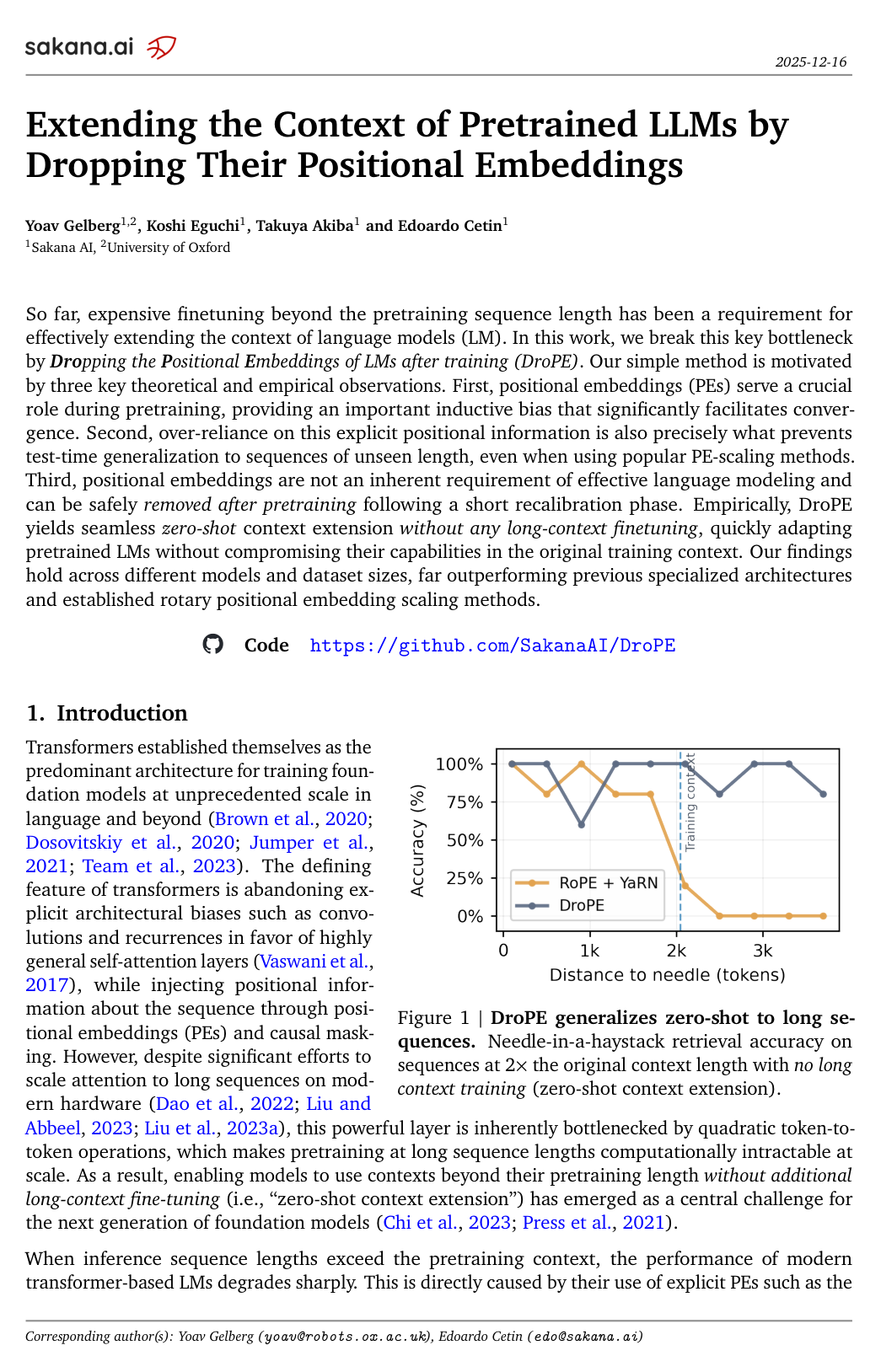
Extending the Context of Pretrained LLMs by Dropping Their Positional Embeddings
Yoav Gelberg, Koshi Eguchi, Takuya Akiba, Edoardo Cetin
Why you should read this
Introduces DroPE, a simple yet powerful method that dramatically extends LLM context length zero-shot without expensive finetuning, outperforming existing techniques and breaking a major bottleneck in language model scalability.
So far, expensive finetuning beyond the pretraining sequence length has been a requirement for effectively extending the context of language models (LM). In this work, we break this key bottleneck by Dropping the Positional Embeddings of LMs after training (DroPE). Our simple method is motivated by three key theoretical and empirical observations. First, positional embeddings (PEs) serve a crucial role during pretraining, providing an important inductive bias that significantly facilitates convergence. Second, over-reliance on this explicit positional information is also precisely what prevents test-time generalization to sequences of unseen length, even when using popular PE-scaling methods. Third, positional embeddings are not an inherent requirement of effective language modeling and can be safely removed after pretraining, following a short recalibration phase. Empirically, DroPE yields seamless zero-shot context extension without any long-context finetuning, quickly adapting pretrained LMs without compromising their capabilities in the original training context. Our findings hold across different models and dataset sizes, far outperforming previous specialized architectures and established rotary positional embedding scaling methods.
Added
2026-01-22