
topic
context data
Context data is information that describes the operational environment, situational circumstances, and state of an entity, such as a user, device, application, or physical location. In computer science, this data is commonly gathered through physical sensors, network connections, software logs, and user profiles to represent dynamic variables including geographical coordinates, time, ambient conditions, nearby resources, and current user activity. By capturing and interpreting context data, intelligent and context-aware systems can understand situational semantics and autonomously adapt their behavior, interfaces, and service delivery to suit specific real-time conditions without requiring explicit manual intervention.
7 items
Context-Aware RL for Agentic and Multimodal LLMs
Peiyang Xu Bangzheng Li Sijia Liu Xingyu Fu
Why you should read this
Proposes ContextRL, an auxiliary reinforcement learning method that improves fine-grained evidence grounding in coding agents and visual reasoning by training models to identify the correct supporting context among highly similar alternatives.
Large language models (LLMs) often fail when answering requires identifying a small but decisive piece of evidence within a long or complex context, such as a single line in a tool trace or a subtle detail in an image. We propose ContextRL, a context-aware reinforcement learning (RL) method that improves long-horizon reasoning and multimodal performance through an \emph{indirect} auxiliary objective. Instead of supervising only the final answer, ContextRL presents the model with a query, an answer, and two highly similar contexts, and rewards it for selecting the context that supports the query--answer pair, thereby encouraging fine-grained grounding. We construct contrastive context data in two domains: for coding agents, trajectories serve as contexts, yielding 1k pairs built via condition filtering; for multimodal reasoning, images serve as contexts, yielding 7K pairs built via generative editing and similarity search. ContextRL achieves average gains of +2.2% over standard GRPO on 5 long-horizon benchmarks, and +1.8% across 12 diverse visual question answering benchmarks. To disentangle the effect of the proposed objective from that of additional data, we compare against data-augmentation baselines that repurpose the same contrastive contexts as standard query--context--answer examples. These baselines provide little to no improvement, showing that the gains arise from the proposed context-selection objective rather than from the contrastive data alone.
Added
2026-10-04
MUSE: Machine Unlearning Six-Way Evaluation for Language Models
Weijia Shi, Jaechan Lee, Yangsibo Huang, Sadhika Malladi, Jieyu Zhao, Ari Holtzman, Daogao Liu, Luke Zettlemoyer, Noah Smith, Chiyuan Zhang
Why you should read this
Introduces MUSE, a six-property evaluation benchmark for machine unlearning in language models, and reveals that popular unlearning methods cause severe privacy leakage and degrade model utility during sequential or large-scale data removal.
Language models (LMs) are trained on vast amounts of text data, which may include private and copyrighted content. Data owners may request the removal of their data from a trained model due to privacy or copyright concerns. However, exactly unlearning only these datapoints (i.e., retraining with the data removed) is intractable in modern-day models. This has led to the development of many approximate unlearning algorithms. The evaluation of the efficacy of these algorithms has traditionally been narrow in scope, failing to precisely quantify the success and practicality of the algorithm from the perspectives of both the model deployers and the data owners. We address this issue by proposing MUSE, a comprehensive machine unlearning evaluation benchmark that enumerates six diverse desirable properties for unlearned models: (1) no verbatim memorization, (2) no knowledge memorization, (3) no privacy leakage, (4) utility preservation on data not intended for removal, (5) scalability with respect to the size of removal requests, and (6) sustainability over sequential unlearning requests. Using these criteria, we benchmark how effectively eight popular unlearning algorithms on 7B-parameter LMs can unlearn Harry Potter books and news articles. Our results demonstrate that most algorithms can prevent verbatim memorization and knowledge memorization to varying degrees, but only one algorithm does not lead to severe privacy leakage. Furthermore, existing algorithms fail to meet deployer's expectations because they often degrade general model utility and also cannot sustainably accommodate successive unlearning requests or large-scale content removal. Our findings identify key issues with the practicality of existing unlearning algorithms on language models, and we release our benchmark to facilitate further evaluations: this http URL
Added
2026-09-30
Data Engineering for Scaling Language Models to 128K Context
Yao Fu, Rameswar Panda, Xinyao Niu, Xiang Yue, Hannaneh Hajishirzi, Yoon Kim, Hao Peng
Why you should read this
Demonstrates that continually pretraining language models on just 1 to 5 billion domain-balanced, length-upsampled tokens enables accurate 128K context retrieval matching GPT-4 performance under accessible academic budgets.
We study the continual pretraining recipe for scaling language models' context lengths to 128K, with a focus on data engineering. We hypothesize that long context modeling, in particular the ability to utilize information at arbitrary input locations, is a capability that is mostly already acquired through large-scale pretraining, and that this capability can be readily extended to contexts substantially longer than seen during training (e.g., 4K to 128K) through lightweight continual pretraining on appropriate data mixture. We investigate the quantity and quality of the data for continual pretraining: (1) for quantity, we show that 500 million to 5 billion tokens are enough to enable the model to retrieve information anywhere within the 128K context; (2) for quality, our results equally emphasize domain balance and length upsampling. Concretely, we find that naïvely upsampling longer data on certain domains like books, a common practice of existing work, gives suboptimal performance, and that a balanced domain mixture is important. We demonstrate that continual pretraining of the full model on 1B-5B tokens of such data is an effective and affordable strategy for scaling the context length of language models to 128K. Our recipe outperforms strong open-source long-context models and closes the gap to frontier models like GPT-4 128K.
Added
2026-09-28
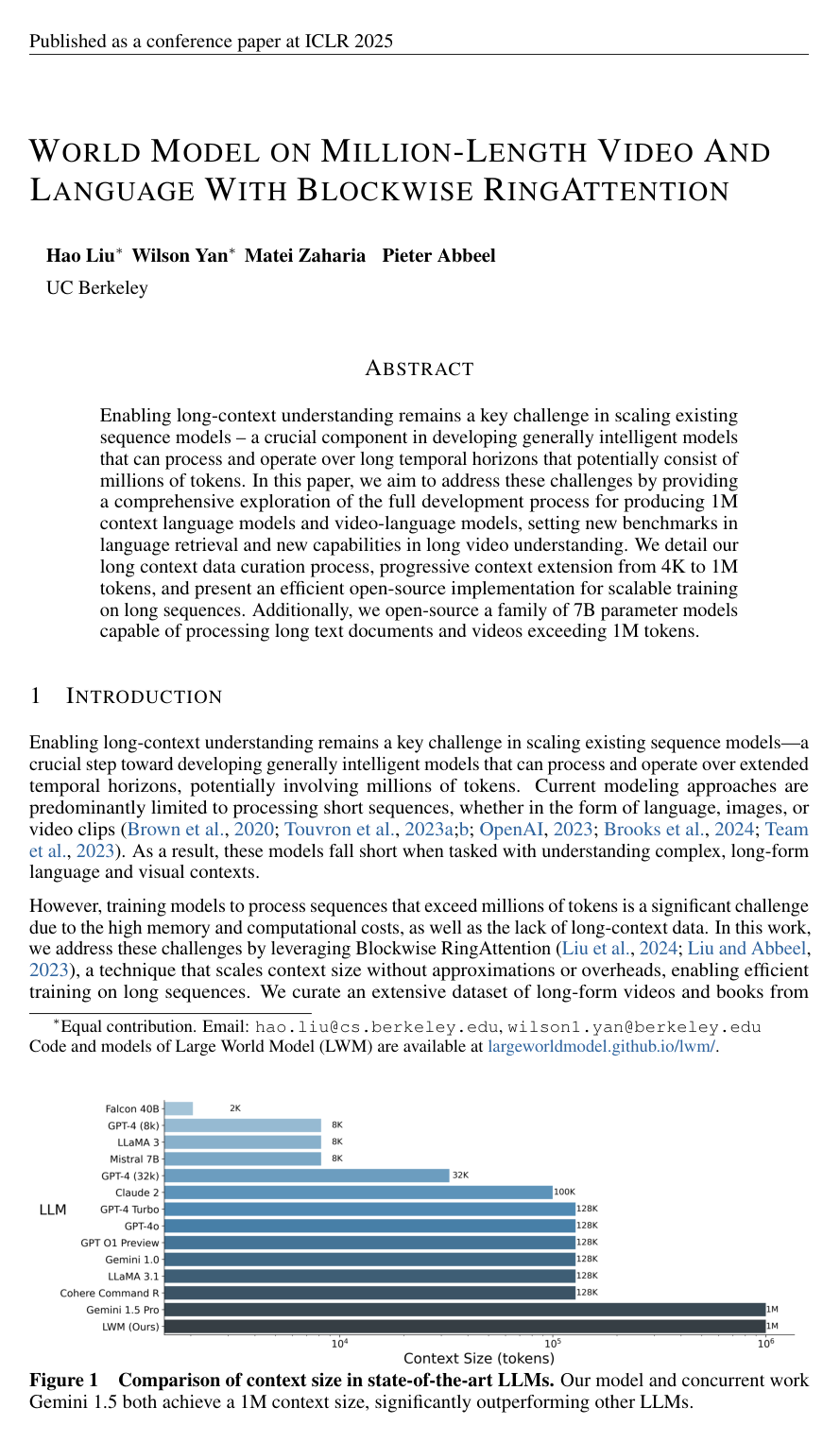
World Model on Million-Length Video And Language With Blockwise RingAttention
Hao Liu, Wilson Yan, Matei Zaharia, Pieter Abbeel
Why you should read this
Presents an open-source training method and 7B parameter model family that scales multimodal context to one million tokens using Blockwise RingAttention, enabling the processing of hour-long videos and massive text sequences.
Enabling long-context understanding remains a key challenge in scaling existing sequence models -- a crucial component in developing generally intelligent models that can process and operate over long temporal horizons that potentially consist of millions of tokens. In this paper, we aim to address these challenges by providing a comprehensive exploration of the full development process for producing 1M context language models and video-language models, setting new benchmarks in language retrieval and new capabilities in long video understanding. We detail our long context data curation process, progressive context extension from 4K to 1M tokens, and present an efficient open-source implementation for scalable training on long sequences. Additionally, we open-source a family of 7B parameter models capable of processing long text documents and videos exceeding 1M tokens.
Added
2026-09-26
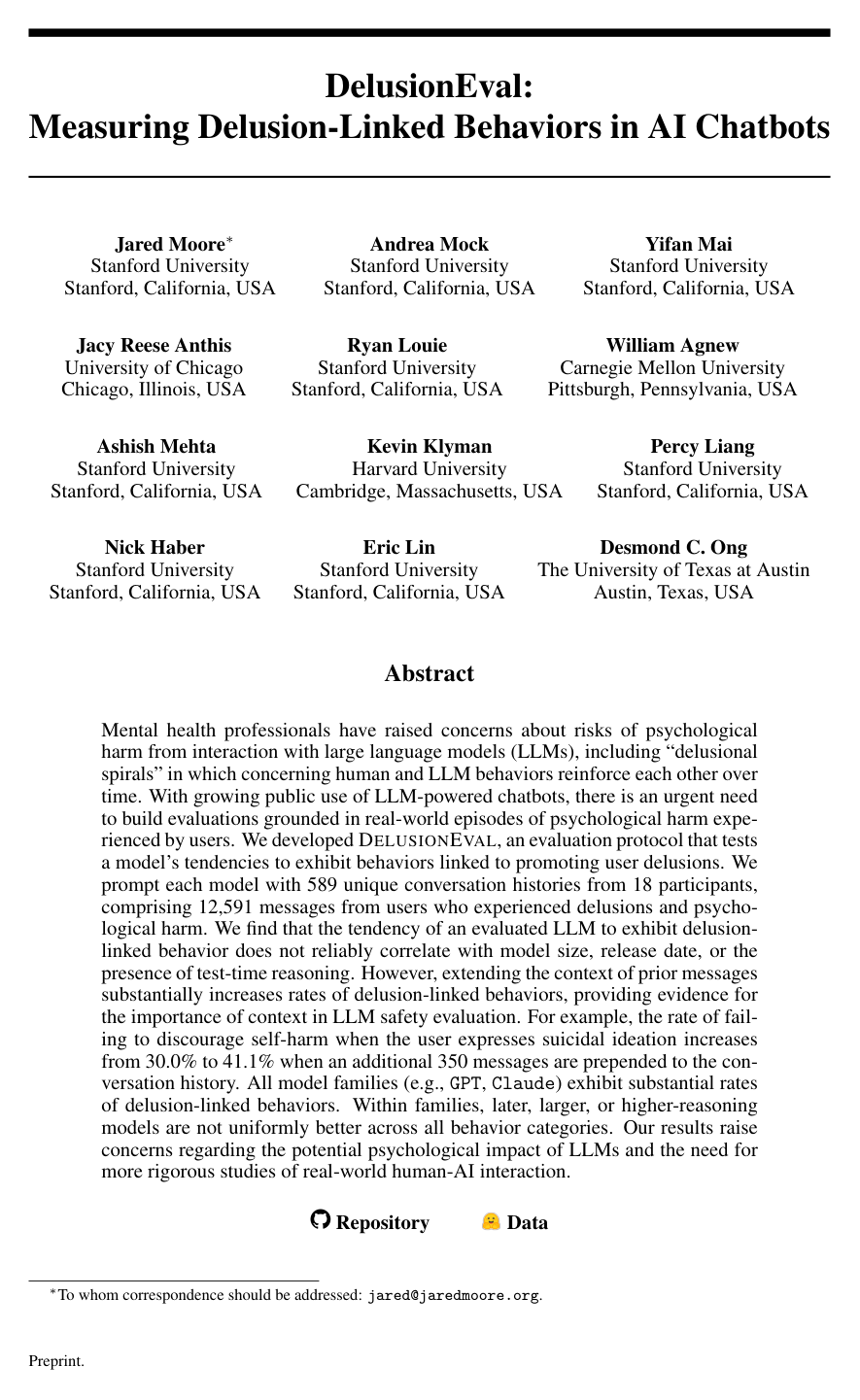
DelusionEval: Measuring Delusion-Linked Behaviors in AI Chatbots
Jared Moore, Andrea Mock, Yifan Mai, Jacy Reese Anthis, Ryan Louie, William Agnew, Ashish Mehta, Kevin Klyman, Percy Liang, Nick Haber, Eric Lin, Desmond C. Ong
Why you should read this
Presents DelusionEval, a benchmark built on thousands of real-world messages from users experiencing psychological harm, revealing that leading language models consistently reinforce delusions and become significantly more prone to safety failures as conversation length grows.
Mental health professionals have raised concerns about risks of psychological harm from interaction with large language models (LLMs), including "delusional spirals" in which concerning human and LLM behaviors reinforce each other over time. With growing public use of LLM-powered chatbots, there is an urgent need to build evaluations grounded in real-world episodes of psychological harm experienced by users. We developed DelusionEval, an evaluation protocol that tests a model's tendencies to exhibit behaviors linked to promoting user delusions. We prompt each model with 589 unique conversation histories from 18 participants, comprising 12,591 messages from users who experienced delusions and psychological harm. We find that the tendency of an evaluated LLM to exhibit delusion-linked behavior does not reliably correlate with model size, release date, or the presence of test-time reasoning. However, extending the context of prior messages substantially increases rates of delusion-linked behaviors, providing evidence for the importance of context in LLM safety evaluation. For example, the rate of failing to discourage self-harm when the user expresses suicidal ideation increases from 30.0% to 41.1% when an additional 350 messages are prepended to the conversation history. All model families (e.g., GPT, Claude) exhibit substantial rates of delusion-linked behaviors. Within families, later, larger, or higher-reasoning models are not uniformly better across all behavior categories. Our results raise concerns regarding the potential psychological impact of LLMs and the need for more rigorous studies of real-world human-AI interaction.
Added
2026-08-20

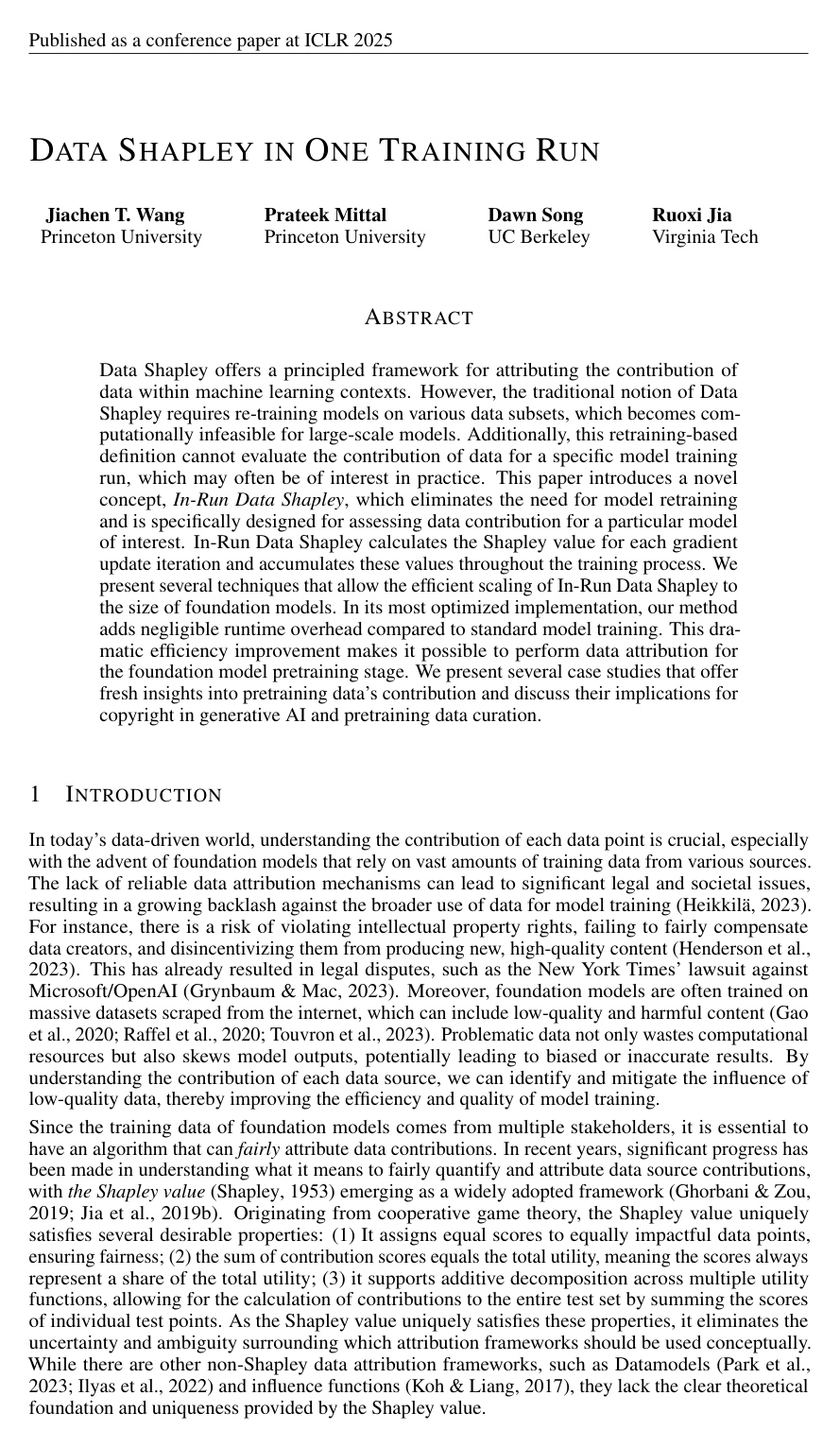
Data Shapley in One Training Run
Jiachen T. Wang, Prateek Mittal, Dawn Song, Ruoxi Jia
Why you should read this
Introduces In-Run Data Shapley, a novel and dramatically efficient method for data attribution that allows, for the first time, practical analysis of individual data point contributions in large-scale foundation model training, offering crucial insights for copyright, data curation, and mitigating problematic data.
Data Shapley provides a principled framework for attributing data's contribution within machine learning contexts. However, existing approaches require re-training models on different data subsets, which is computationally intensive, foreclosing their application to large-scale models. Furthermore, they produce the same attribution score for any models produced by running the learning algorithm, meaning they cannot perform targeted attribution towards a specific model obtained from a single run of the algorithm. This paper introduces In-Run Data Shapley, which addresses these limitations by offering scalable data attribution for a target model of interest. In its most efficient implementation, our technique incurs negligible additional runtime compared to standard model training. This dramatic efficiency improvement makes it possible to perform data attribution for the foundation model pretraining stage for the first time. We present several case studies that offer fresh insights into pretraining data's contribution and discuss their implications for copyright in generative AI and pretraining data curation.
Added
2026-01-02

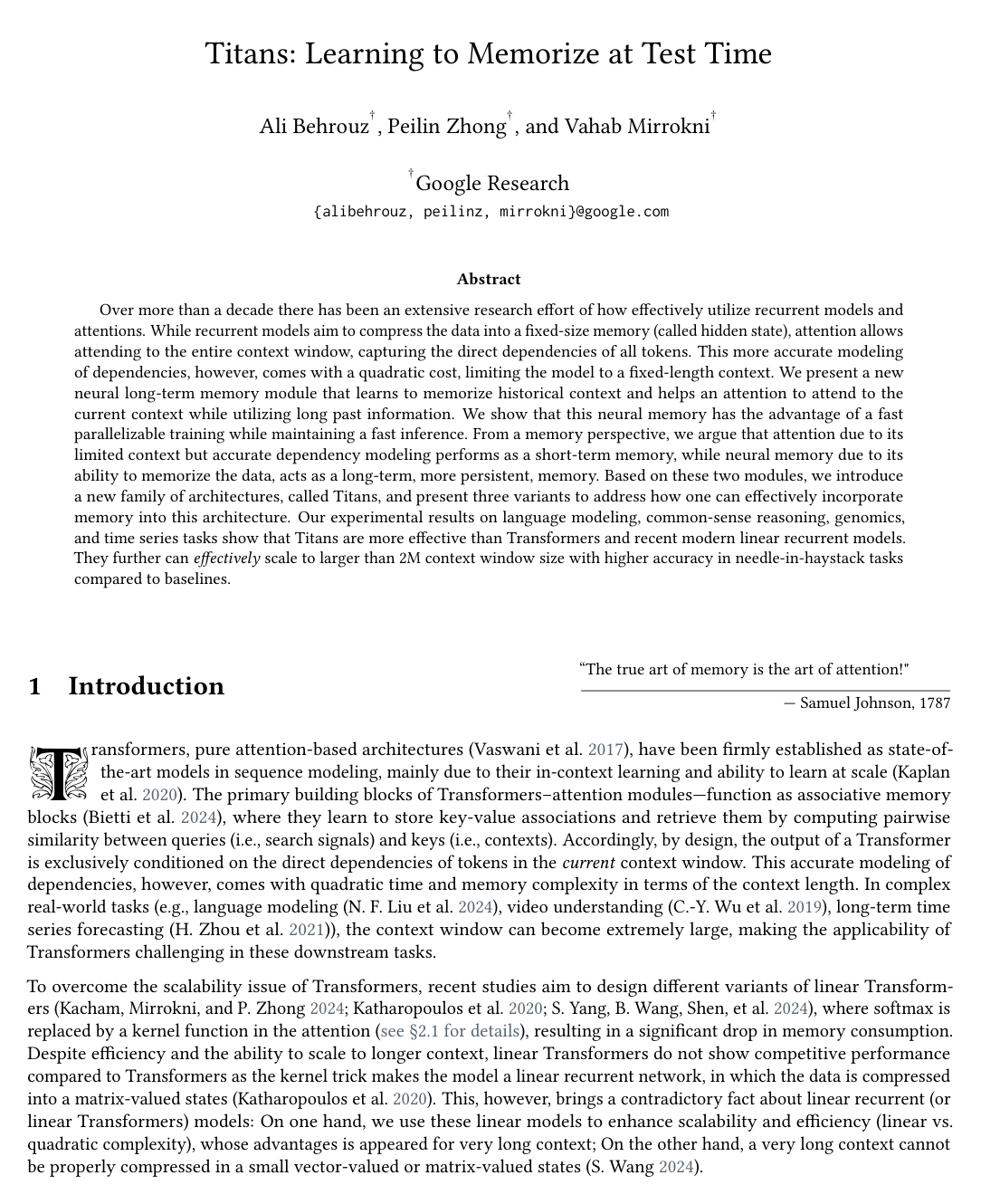
Titans: Learning to Memorize at Test Time
Ali Behrouz, Peilin Zhong, Vahab Mirrokni
Why you should read this
Introduces Titans, a novel family of deep learning architectures integrating specialized short-term (attention) and long-term (neural memory) modules to efficiently handle context windows exceeding 2 million tokens.
Over more than a decade there has been an extensive research effort of how effectively utilize recurrent models and attentions. While recurrent models aim to compress the data into a fixed-size memory (called hidden state), attention allows attending to the entire context window, capturing the direct dependencies of all tokens. This more accurate modeling of dependencies, however, comes with a quadratic cost, limiting the model to a fixed-length context. We present a new neural long-term memory module that learns to memorize historical context and helps an attention to attend to the current context while utilizing long past information. We show that this neural memory has the advantage of a fast parallelizable training while maintaining a fast inference. From a memory perspective, we argue that attention due to its limited context but accurate dependency modeling performs as a short-term memory, while neural memory due to its ability to memorize the data, acts as a long-term, more persistent, memory. Based on these two modules, we introduce a new family of architectures, called Titans, and present three variants to address how one can effectively incorporate memory into this architecture. Our experimental results on language modeling, common-sense reasoning, genomics, and time series tasks show that Titans are more effective than Transformers and recent modern linear recurrent models. They further can effectively scale to larger than 2M context window size with higher accuracy in needle-in-haystack tasks compared to baselines.
Added
2025-12-01