
topic
concept description
A concept description is a formal logical expression in knowledge representation and description logics that defines a class or set of individuals sharing common properties. Built inductively from fundamental vocabulary, it combines atomic concepts and relations between entities, known as roles, using formal constructors such as intersection, union, negation, and role quantifiers. These expressions serve as the primary syntactic building blocks for defining complex classes and stating relationships within knowledge bases and ontologies. By formally characterizing domain concepts, concept descriptions enable automated reasoning systems to verify logical consistency, determine hierarchical relationships such as class subsumption, and infer instance classifications.
2 items
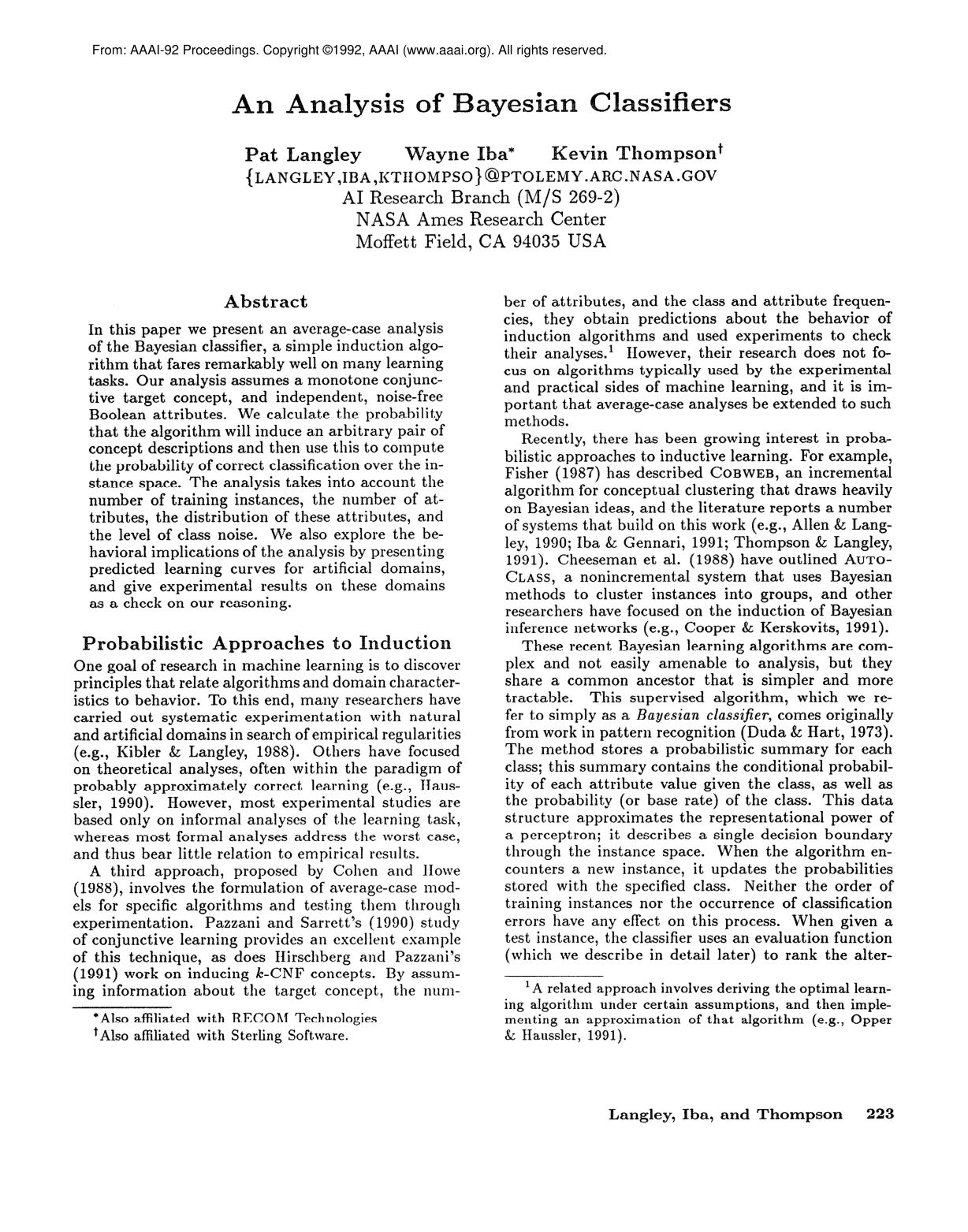
An Analysis of Bayesian Classifiers
Pat Langley, Wayne Iba, Kevin Thompson
Why you should read this
Presents an average-case theoretical analysis explaining why simple Bayesian classifiers achieve high accuracy across diverse learning domains despite their strong attribute independence assumptions.
In this paper we present an average-case analysis of the Bayesian classifier, a simple induction algorithm that fares remarkably well on many learning tasks. Our analysis assumes a monotone conjunctive target concept, and independent, noise-free Boolean attributes. We calculate the probability that the algorithm will induce an arbitrary pair of concept descriptions and then use this to compute the probability of correct classification over the instance space. The analysis takes into account the number of training instances, the number of attributes, the distribution of these attributes, and the level of class noise. We also explore the behavioral implications of the analysis by presenting predicted learning curves for artificial domains, and give experimental results on these domains as a check on our reasoning.
Added
2026-09-25
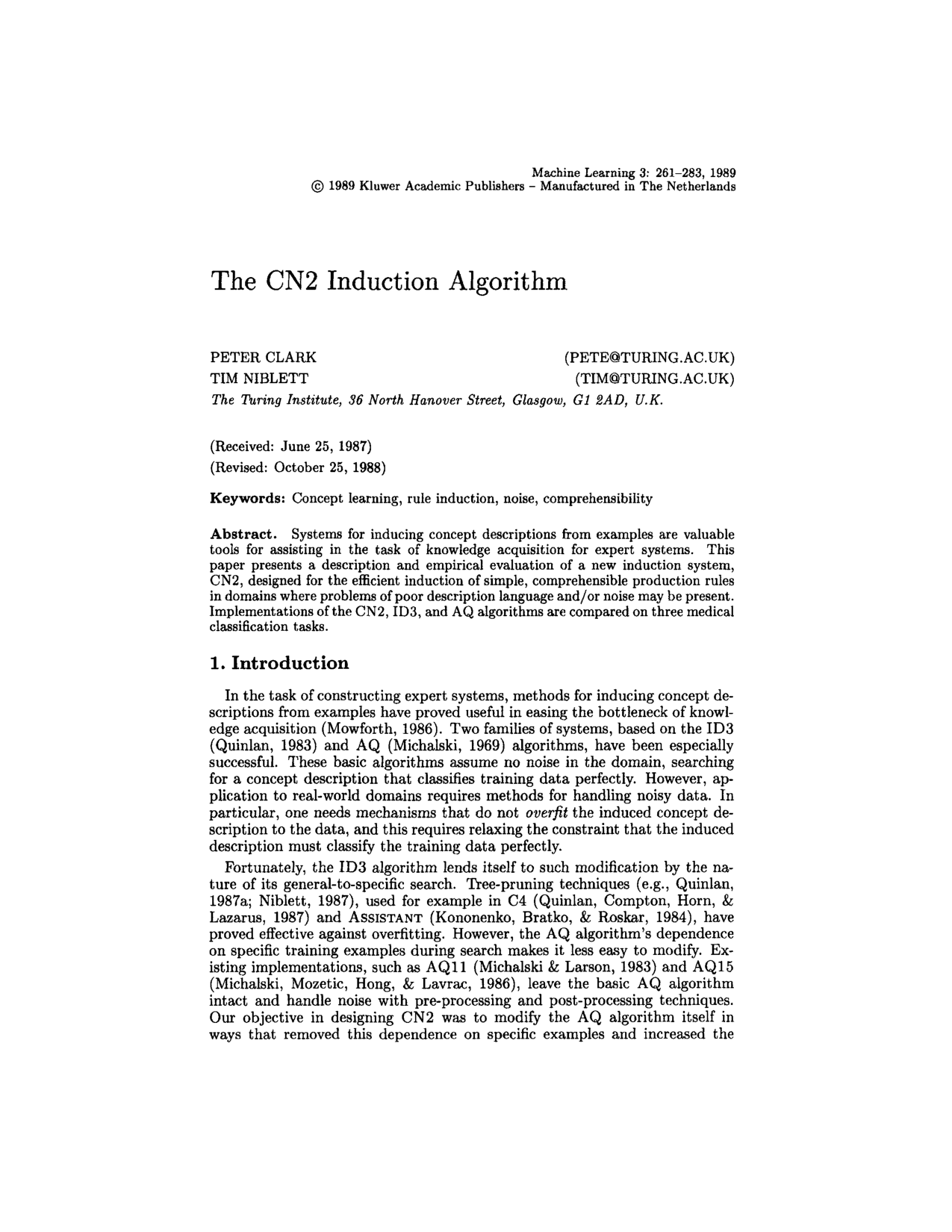
The CN2 Induction Algorithm
Peter Clark, T. Niblett
Why you should read this
Introduces the CN2 rule induction algorithm, which combines the noise-handling capabilities and efficiency of decision trees with the flexible if-then representation of the AQ algorithm to learn accurate, interpretable classification rules from imperfect data.
Systems for inducing concept descriptions from examples are valuable tools for assisting in the task of knowledge acquisition for expert systems. This paper presents a description and empirical evaluation of a new induction system, CN2, designed for the efficient induction of simple, comprehensible production rules in domains where problems of poor description language and/or noise may be present. Implementations of the CN2, ID3, and AQ algorithms are compared on three medical classification tasks.
Added
2026-09-24