
topic
coding performance
Coding performance is a measure of how effectively a compression or encoding algorithm reduces the data rate required to represent digital information while preserving fidelity and quality. In data compression and multimedia systems, such as image and video coding, coding performance reflects the fundamental trade-off between compressed bit rate and signal distortion. Evaluating this performance allows engineers to determine how efficiently an algorithm can transmit or store media over bandwidth-limited channels while minimizing perceptual artifacts and degradation in the reconstructed signal.
7 items
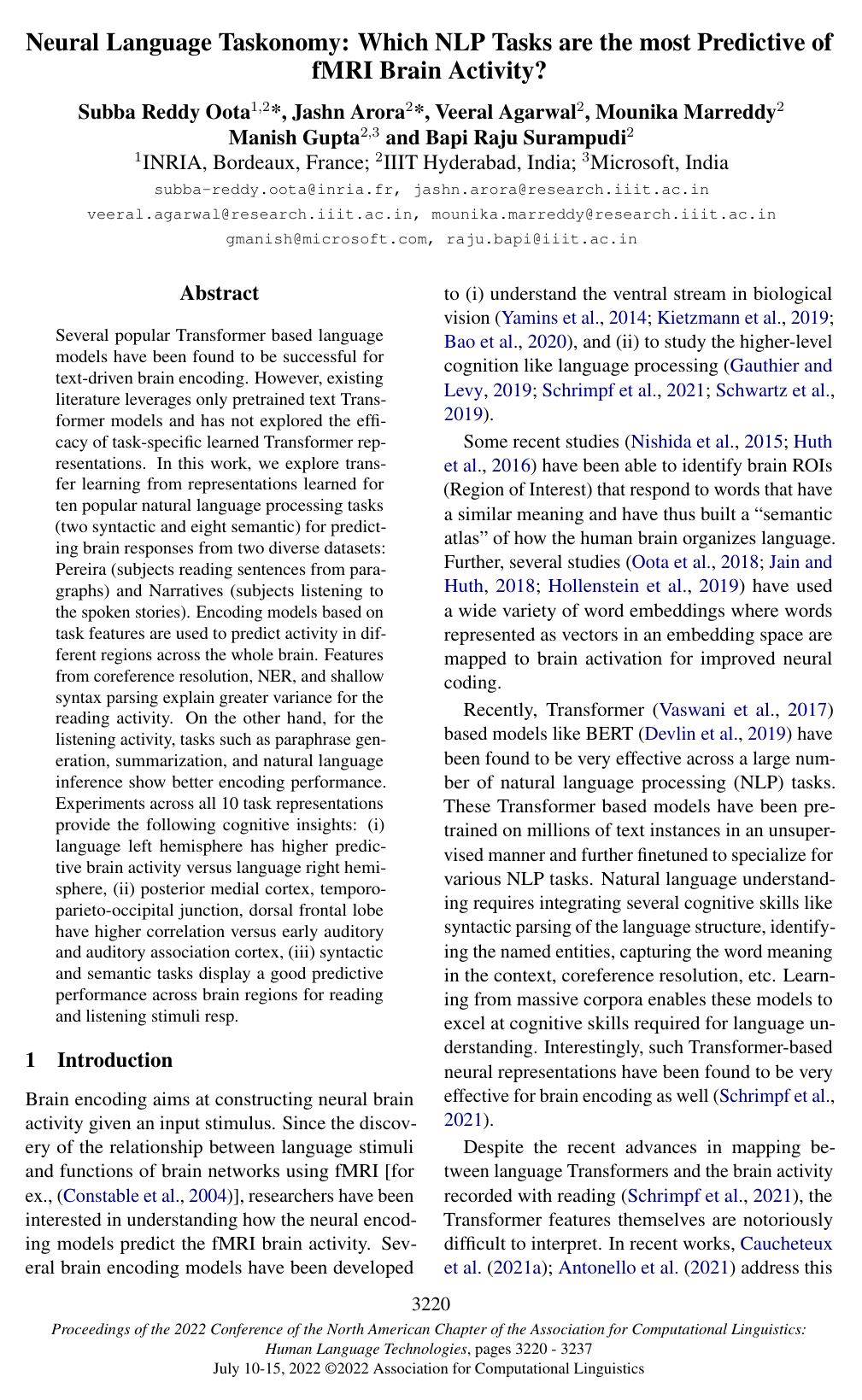
Neural Language Taskonomy: Which NLP Tasks are the most Predictive of fMRI Brain Activity?
Subba Reddy Oota, Jashn Arora, Veeral Agarwal, Mounika Marreddy, Manish Gupta, Bapi Raju Surampudi
Why you should read this
Reveals how fine-tuning Transformers on specific NLP tasks improves fMRI brain response predictions across reading and listening modalities, identifying which syntactic and semantic objectives best match cortical activity in different brain regions.
Several popular Transformer based language models have been found to be successful for text-driven brain encoding. However, existing literature leverages only pretrained text Transformer models and has not explored the efficacy of task-specific learned Transformer representations. In this work, we explore transfer learning from representations learned for ten popular natural language processing tasks (two syntactic and eight semantic) for predicting brain responses from two diverse datasets: Pereira (subjects reading sentences from paragraphs) and Narratives (subjects listening to the spoken stories). Encoding models based on task features are used to predict activity in different regions across the whole brain. Features from coreference resolution, NER, and shallow syntax parsing explain greater variance for the reading activity. On the other hand, for the listening activity, tasks such as paraphrase generation, summarization, and natural language inference show better encoding performance. Experiments across all 10 task representations provide the following cognitive insights: (i) language left hemisphere has higher predictive brain activity versus language right hemisphere, (ii) posterior medial cortex, temporo-parieto-occipital junction, dorsal frontal lobe have higher correlation versus early auditory and auditory association cortex, (iii) syntactic and semantic tasks display a good predictive performance across brain regions for reading and listening stimuli resp.
Added
2026-10-03
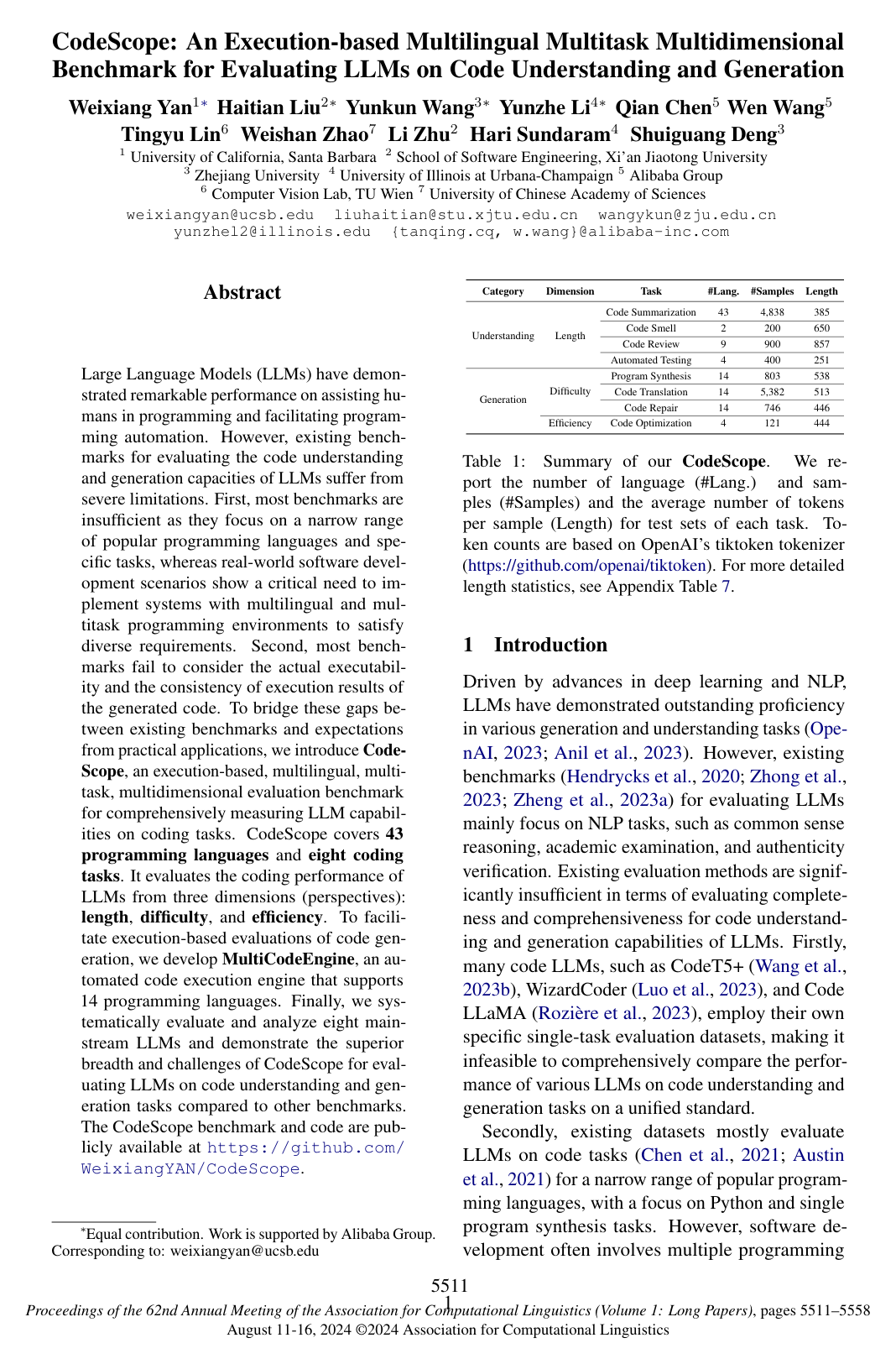
CodeScope: An Execution-based Multilingual Multitask Multidimensional Benchmark for Evaluating LLMs on Code Understanding and Generation
Weixiang Yan, Haitian Liu, Yunkun Wang, Yunzhe Li, Qian Chen, Wen Wang, Tingyu Lin, Weishan Zhao, Li Zhu, Hari Sundaram, Shuiguang Deng
Why you should read this
Introduces CodeScope, an execution-based evaluation benchmark spanning 43 programming languages and eight tasks to measure large language model coding performance across length, difficulty, and runtime efficiency.
Large Language Models (LLMs) have demonstrated remarkable performance on assisting humans in programming and facilitating programming automation. However, existing benchmarks for evaluating the code understanding and generation capacities of LLMs suffer from severe limitations. First, most benchmarks are insufficient as they focus on a narrow range of popular programming languages and specific tasks, whereas real-world software development scenarios show a critical need to implement systems with multilingual and multitask programming environments to satisfy diverse requirements. Second, most benchmarks fail to consider the actual executability and the consistency of execution results of the generated code. To bridge these gaps between existing benchmarks and expectations from practical applications, we introduce CodeScope, an execution-based, multilingual, multitask, multidimensional evaluation benchmark for comprehensively measuring LLM capabilities on coding tasks. CodeScope covers 43 programming languages and eight coding tasks. It evaluates the coding performance of LLMs from three dimensions (perspectives): length, difficulty, and efficiency. To facilitate execution-based evaluations of code generation, we develop MultiCodeEngine, an automated code execution engine that supports 14 programming languages. Finally, we systematically evaluate and analyze eight mainstream LLMs and demonstrate the superior breadth and challenges of CodeScope for evaluating LLMs on code understanding and generation tasks compared to other benchmarks. The CodeScope benchmark and code are publicly available at https://github.com/WeixiangYAN/CodeScope.
Added
2026-10-03
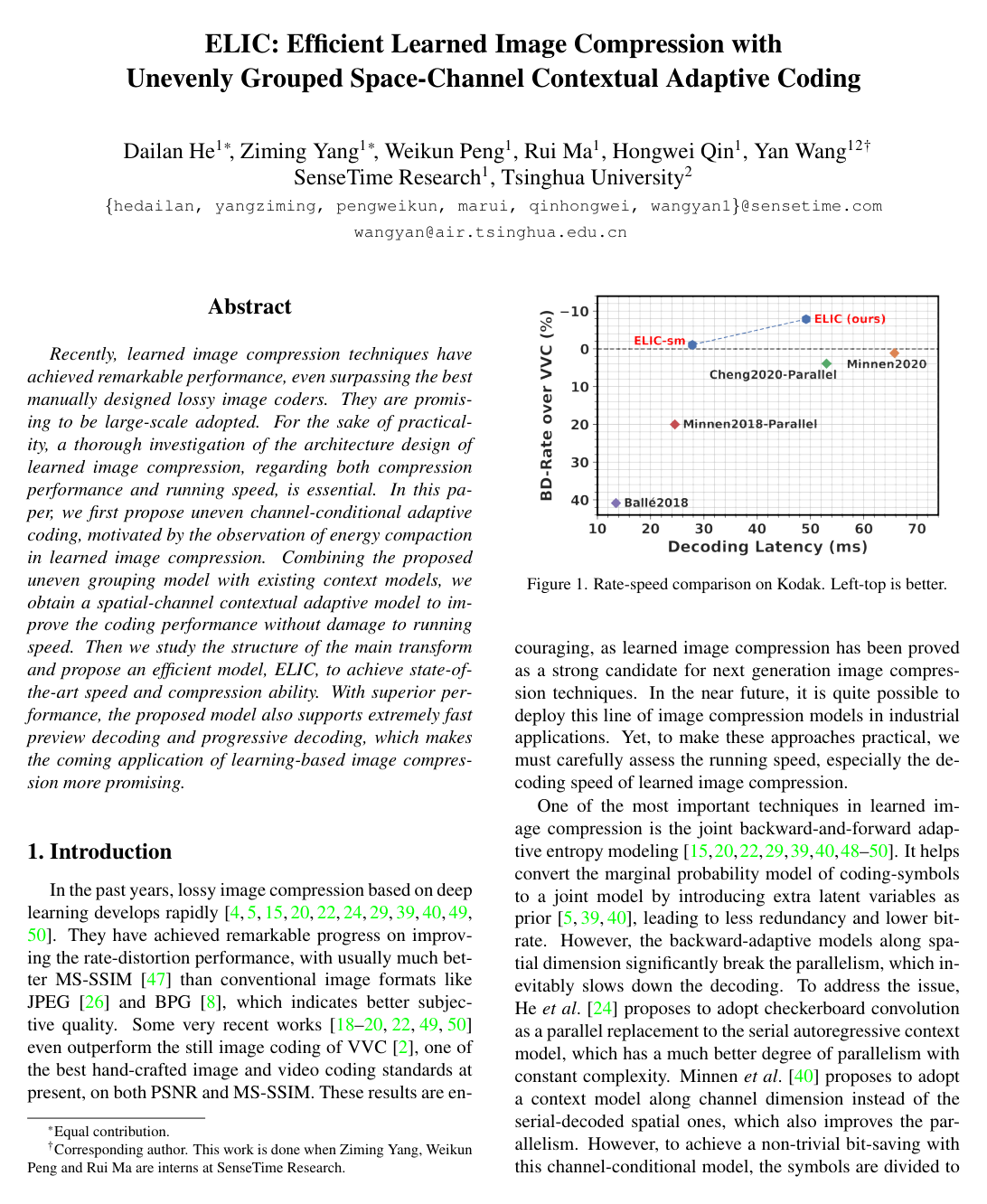
ELIC: Efficient Learned Image Compression with Unevenly Grouped Space-Channel Contextual Adaptive Coding
Dailan He, Ziming Yang, Weikun Peng, Rui Ma, Hongwei Qin, Yan Wang
Why you should read this
Presents ELIC, a learned image compression architecture that combines uneven space-channel contextual coding with efficient transform design to achieve state-of-the-art rate-distortion performance alongside fast inference, preview decoding, and progressive decoding.
Recently, learned image compression techniques have achieved remarkable performance, even surpassing the best manually designed lossy image coders. They are promising to be large-scale adopted. For the sake of practicality, a thorough investigation of the architecture design of learned image compression, regarding both compression performance and running speed, is essential. In this paper, we first propose uneven channel-conditional adaptive coding, motivated by the observation of energy compaction in learned image compression. Combining the proposed uneven grouping model with existing context models, we obtain a spatial-channel contextual adaptive model to improve the coding performance without damage to running speed. Then we study the structure of the main transform and propose an efficient model, ELIC, to achieve state-of-the-art speed and compression ability. With superior performance, the proposed model also supports extremely fast preview decoding and progressive decoding, which makes the coming application of learning-based image compression more promising.
Added
2026-09-26
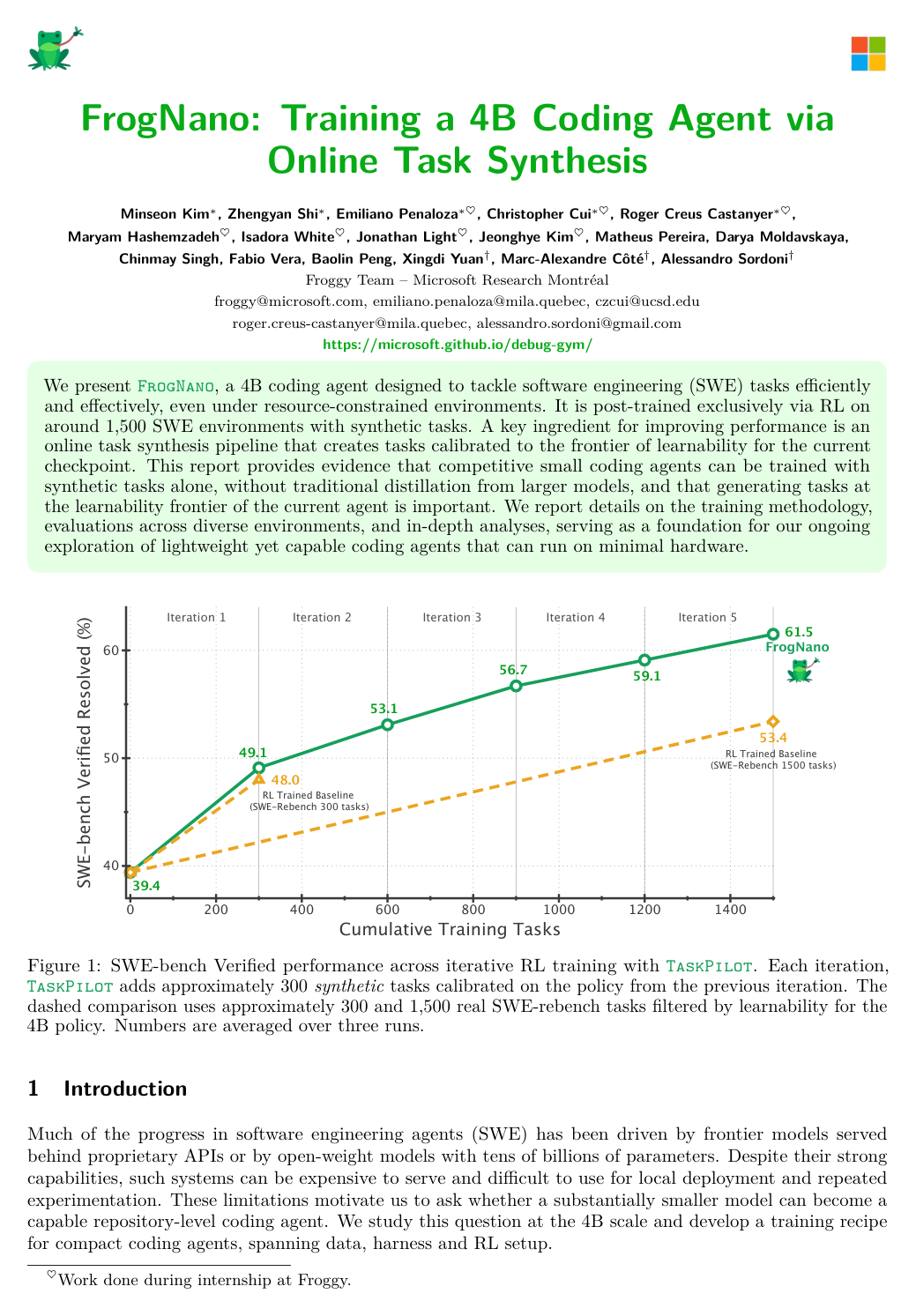
FrogNano: Training a 4B Coding Agent via Online Task Synthesis
Minseon Kim, Zhengyan Shi, Emiliano Penaloza, Christopher Cui, Roger Creus Castanyer, Maryam Hashemzadeh, Isadora White, Jonathan Light, Jeonghye Kim, Matheus Pereira, Darya Moldavskaya, Chinmay Singh, Fabio Vera, Baolin Peng, Xingdi Yuan, Marc-Alexandre Côté, Alessandro Sordoni
Why you should read this
Demonstrates that a 4B-parameter coding agent can achieve competitive software engineering performance without distillation from larger models by training exclusively with reinforcement learning on synthetic tasks generated at its learnability frontier.
We present FrogNano, a 4B coding agent designed to tackle software engineering (SWE) tasks efficiently and effectively, even under resource-constrained environments. It is post-trained exclusively via RL on around 1,500 SWE environments with synthetic tasks. A key ingredient for improving performance is an online task synthesis pipeline that creates tasks calibrated to the frontier of learnability for the current checkpoint. This report provides evidence that competitive small coding agents can be trained with synthetic tasks alone, without traditional distillation from larger models, and that generating tasks at the learnability frontier of the current agent is important. We report details on the training methodology, evaluations across diverse environments, and in-depth analyses, serving as a foundation for our ongoing exploration of lightweight yet capable coding agents that can run on minimal hardware.
Added
2026-09-09

On-Policy Delta Distillation
Byeongho Heo, Jaehui Hwang, Sangdoo Yun, Dongyoon Han
Why you should read this
Introduces On-Policy Delta Distillation, a post-training technique that isolates reasoning capabilities by using the probability difference between a fine-tuned teacher and its base model as a reward signal, outperforming standard distillation across mathematics, science, and code-reasoning tasks with minimal training.
On-policy distillation is an alternative post-training method in reinforcement learning that alleviates the constraints imposed by reward models by providing token-level supervision from a teacher model. Although on-policy distillation has been studied and applied across various settings, its fundamental design remains underexplored. In this paper, we introduce a new distillation reward, termed the delta signal, instead of directly imitating the teacher's output distribution. The delta signal is defined as the difference between the teacher model and its base model prior to instruction tuning for reasoning capability. It therefore captures the changes induced by reasoning tuning and provides a more direct signal for transferring reasoning capabilities. Using extensive empirical evidence, we show that the delta signal substantially improves on-policy distillation and refer to the new distillation method as On-Policy Delta Distillation (OPD). Experiments across mathematics, science, and code-reasoning benchmarks demonstrate that OPD consistently outperforms conventional on-policy distillation, enabling reasoning LLMs to achieve strong performance with only a short post-training period. Code will be available at this https URL
Added
2026-09-03
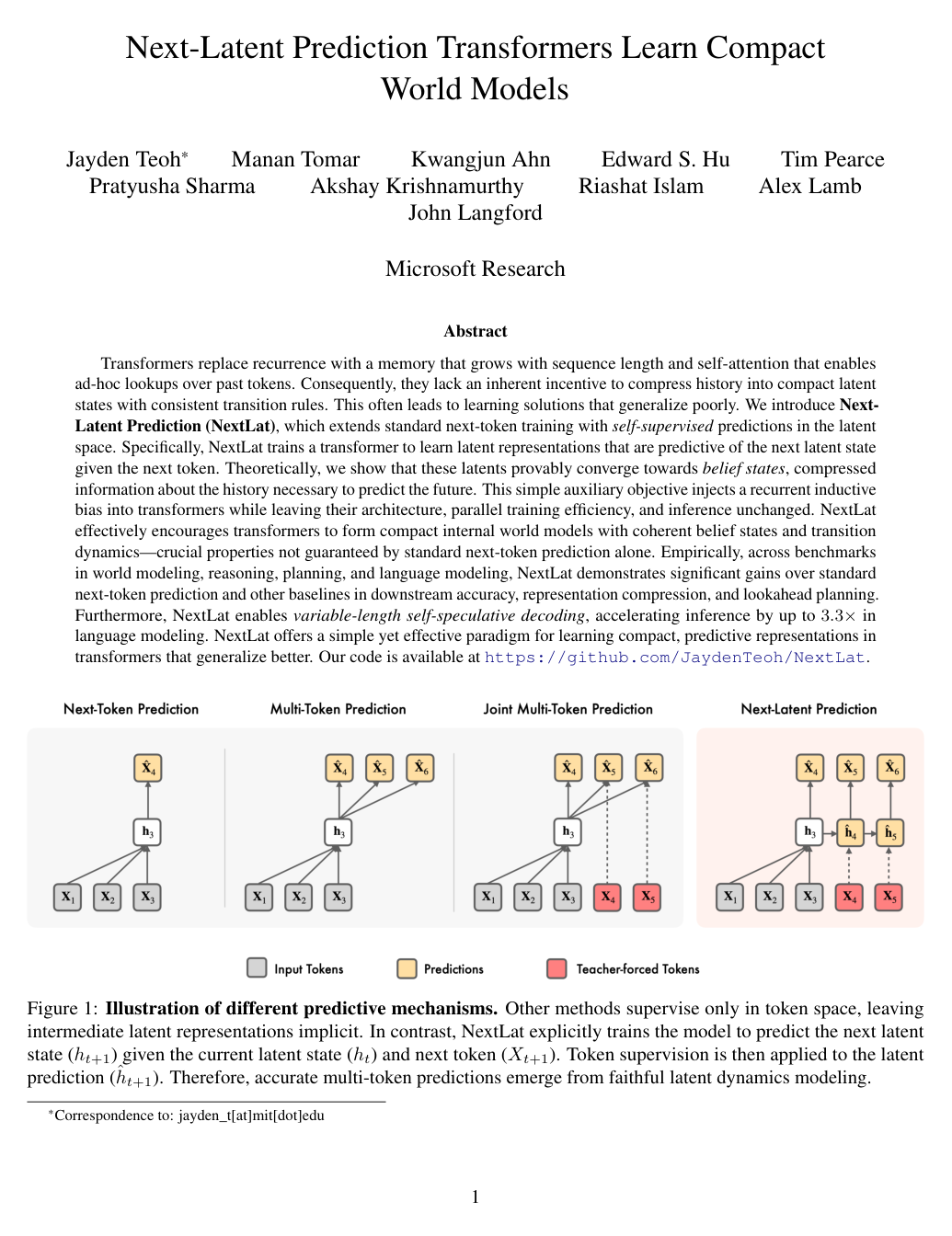
Next-Latent Prediction Transformers Learn Compact World Models
Jayden Teoh, Manan Tomar, Kwangjun Ahn, Edward S. Hu, Tim Pearce, Pratyusha Sharma, Akshay Krishnamurthy, Riashat Islam, Alex Lamb, John Langford
Why you should read this
Introduces NextLat, a novel auxiliary objective that injects a recurrent inductive bias into transformers, enabling them to learn compact world models with provably convergent belief states and significantly improving downstream accuracy, representation compression, and lookahead planning while also accelerating inference.
Transformers replace recurrence with a memory that grows with sequence length and self-attention that enables ad-hoc lookups over past tokens. Consequently, they lack an inherent incentive to compress history into compact latent states with consistent transition rules. This often leads to learning solutions that generalize poorly. We introduce Next-Latent Prediction (NextLat), which extends standard next-token training with self-supervised predictions in the latent space. Specifically, NextLat trains a transformer to learn latent representations that are predictive of its next latent state given the next token. Theoretically, we show that these latents provably converge towards belief states, compressed information about the history necessary to predict the future. This simple auxiliary objective injects a recurrent inductive bias into transformers while leaving their architecture, parallel training efficiency, and inference unchanged. NextLat effectively encourages transformers to form compact internal world models with coherent belief states and transition dynamics -- crucial properties not guaranteed by standard next-token prediction alone. Empirically, across benchmarks in world modeling, reasoning, planning, and language modeling, NextLat demonstrates significant gains over standard next-token prediction and other baselines in downstream accuracy, representation compression, and lookahead planning. Furthermore, NextLat enables variable-length self-speculative decoding, accelerating inference by up to 3.3x in language modeling. NextLat offers a simple yet effective paradigm for learning compact, predictive representations in transformers that generalize better. Our code is available at this https URL.
Added
2026-06-18
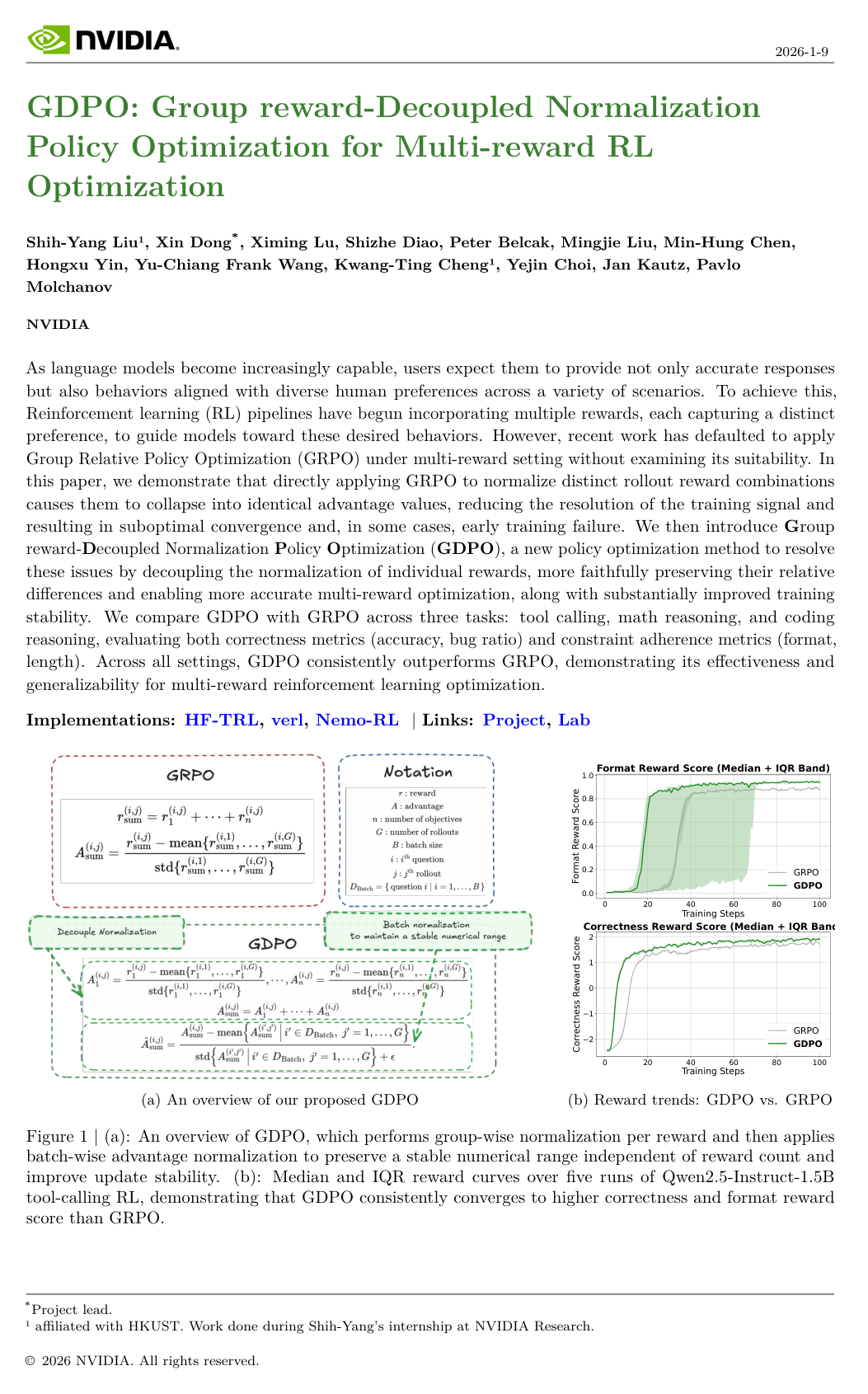
GDPO: Group reward-Decoupled Normalization Policy Optimization for Multi-reward RL Optimization
Shih-Yang Liu, Xin Dong, Ximing Lu, Shizhe Diao, Peter Belcak, Mingjie Liu, Min-Hung Chen, Hongxu Yin, Yu-Chiang Frank Wang, Kwang-Ting Cheng, Yejin Choi, Jan Kautz, Pavlo Molchanov
Why you should read this
Introduces GDPO, a novel policy optimization method that reliably achieves superior and more stable multi-reward optimization in RL by uniquely decoupling individual reward normalizations, directly addressing the collapse issues of prior approaches like GRPO.
As language models become increasingly capable, users expect them to provide not only accurate responses but also behaviors aligned with diverse human preferences across a variety of scenarios. To achieve this, Reinforcement learning (RL) pipelines have begun incorporating multiple rewards, each capturing a distinct preference, to guide models toward these desired behaviors. However, recent work has defaulted to apply Group Relative Policy Optimization (GRPO) under multi-reward setting without examining its suitability. In this paper, we demonstrate that directly applying GRPO to normalize distinct rollout reward combinations causes them to collapse into identical advantage values, reducing the resolution of the training signal and resulting in suboptimal convergence and, in some cases, early training failure. We then introduce Group reward-Decoupled Normalization Policy Optimization (GDPO), a new policy optimization method to resolve these issues by decoupling the normalization of individual rewards, more faithfully preserving their relative differences and enabling more accurate multi-reward optimization, along with substantially improved training stability. We compare GDPO with GRPO across three tasks: tool calling, math reasoning, and coding reasoning, evaluating both correctness metrics (accuracy, bug ratio) and constraint adherence metrics (format, length). Across all settings, GDPO consistently outperforms GRPO, demonstrating its effectiveness and generalizability for multi-reward reinforcement learning optimization.
Added
2026-04-06