
topic
code length
Code length is the total number of symbols or bits that make up an individual codeword in coding theory and digital communications. In error-control coding schemes, such as block codes, this value includes both the original information symbols and the redundant parity symbols added to detect and correct transmission errors caused by channel noise. The code length directly influences the code rate, establishing a fundamental balance between transmission efficiency, bandwidth usage, and the error-correction capability of a communication system.
6 items
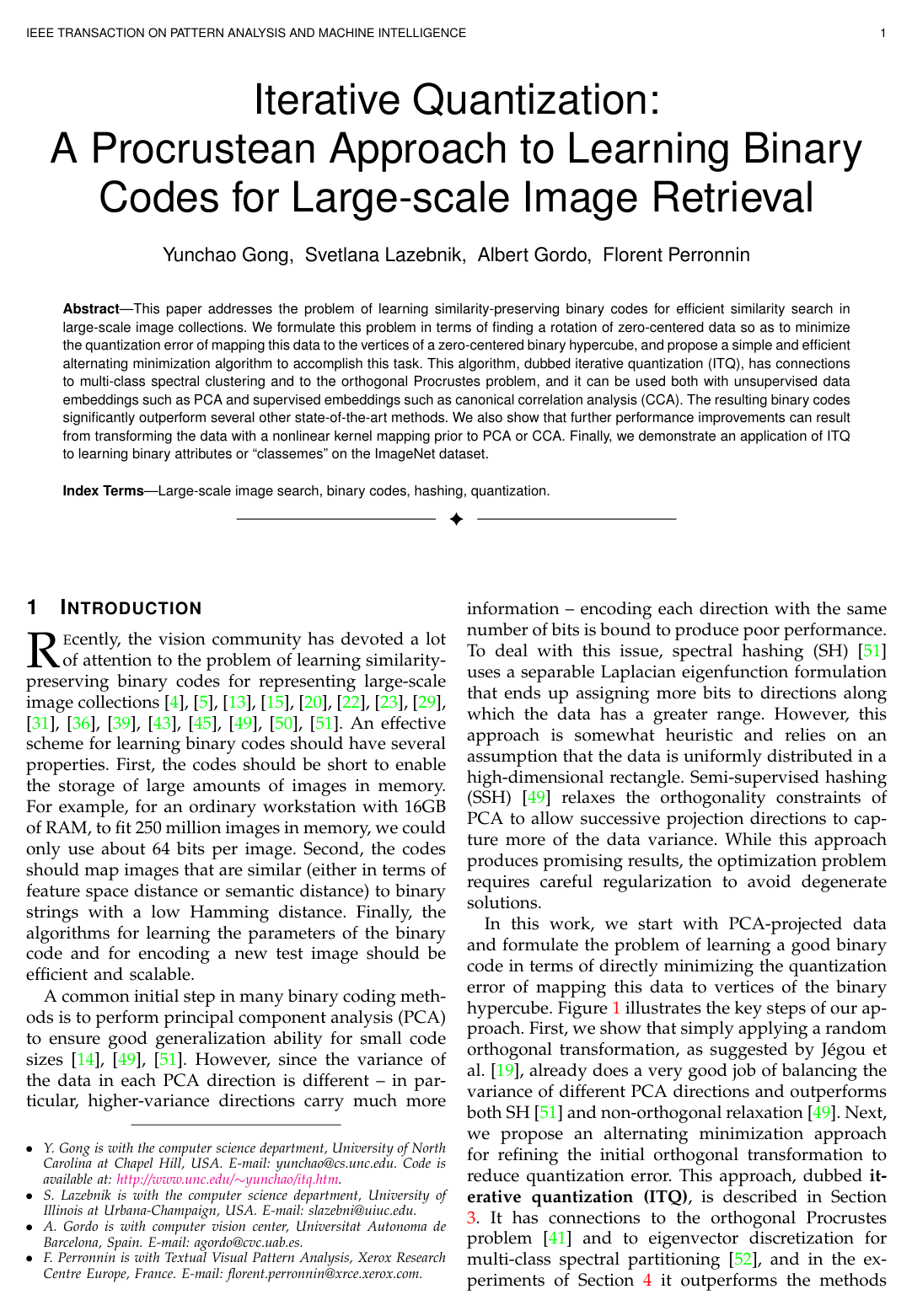
Iterative Quantization: A Procrustean Approach to Learning Binary Codes for Large-Scale Image Retrieval
Yunchao Gong, Svetlana Lazebnik, Albert Gordo, Florent Perronnin
Why you should read this
Proposes an alternating minimization method, Iterative Quantization, that finds an optimal orthogonal rotation to align dimensionally-reduced data with the vertices of a binary hypercube, significantly improving retrieval accuracy and scalability for large-scale image search.
This paper addresses the problem of learning similarity-preserving binary codes for efficient similarity search in large-scale image collections. We formulate this problem in terms of finding a rotation of zero-centered data so as to minimize the quantization error of mapping this data to the vertices of a zero-centered binary hypercube, and propose a simple and efficient alternating minimization algorithm to accomplish this task. This algorithm, dubbed iterative quantization (ITQ), has connections to multi-class spectral clustering and to the orthogonal Procrustes problem, and it can be used both with unsupervised data embeddings such as PCA and supervised embeddings such as canonical correlation analysis (CCA). The resulting binary codes significantly outperform several other state-of-the-art methods. We also show that further performance improvements can result from transforming the data with a nonlinear kernel mapping prior to PCA or CCA. Finally, we demonstrate an application of ITQ to learning binary attributes or “classemes” on the ImageNet dataset.
Added
2026-09-24
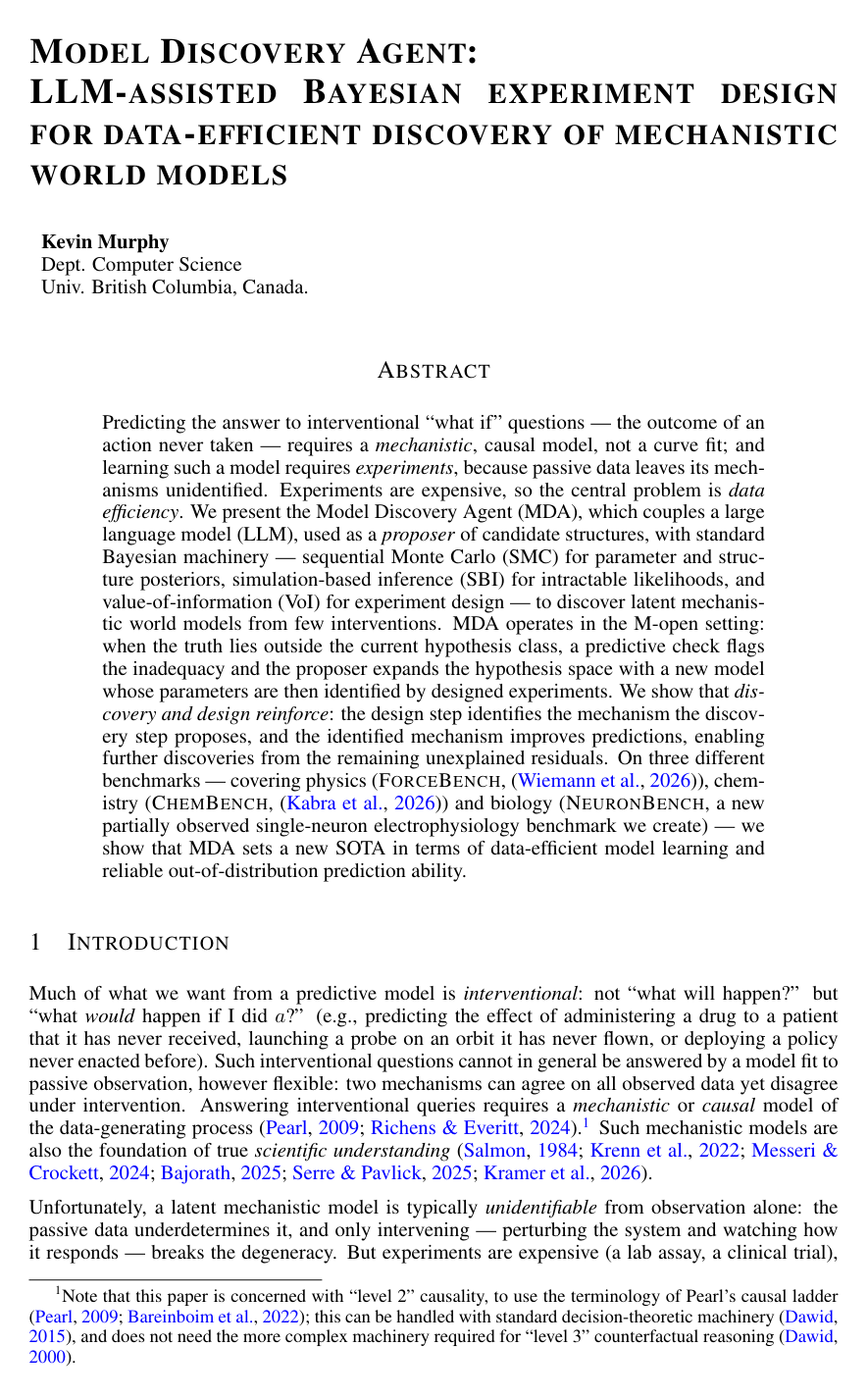
Model Discovery Agent: LLM-assisted Bayesian experiment design for data-efficient discovery of mechanistic world models
Kevin Murphy
Why you should read this
Introduces the Model Discovery Agent, a framework that combines large language model hypothesis generation with Bayesian experimental design to iteratively identify latent causal mechanisms from minimal interventions across physics, chemistry, and biology.
Predicting the answer to interventional ``what if'' questions --- the outcome of an action never taken --- requires a \emph{mechanistic}, causal model, not a curve fit; and learning such a model requires \emph{experiments}, because passive data leaves its mechanisms unidentified. Experiments are expensive, so the central problem is \emph{data efficiency}. We present the Model Discovery Agent (MDA), which couples a large language model (LLM), used as a \emph{proposer} of candidate structures, with standard Bayesian machinery --- sequential Monte Carlo (SMC) for parameter and structure posteriors, simulation-based inference (SBI) for intractable likelihoods, and value-of-information (VoI) for experiment design --- to discover latent mechanistic world models from few interventions. MDA operates in the M-open setting: when the truth lies outside the current hypothesis class, a predictive check flags the inadequacy and the proposer expands the hypothesis space with a new model whose parameters are then identified by designed experiments. We show that \emph{discovery and design reinforce}: the design step identifies the mechanism the discovery step proposes, and the identified mechanism improves predictions, enabling further discoveries from the remaining unexplained residuals. On three different benchmarks --- covering physics (\DPbench, \citep{wiemann2026discoverphysics}), chemistry (\CHEMbench, \citep{kabra2026autoscilab}) and biology (\HHbench, a new partially observed single-neuron electrophysiology benchmark we create) --- we show that MDA sets a new SOTA in terms of data-efficient model learning and reliable interventional prediction ability.
Added
2026-08-15

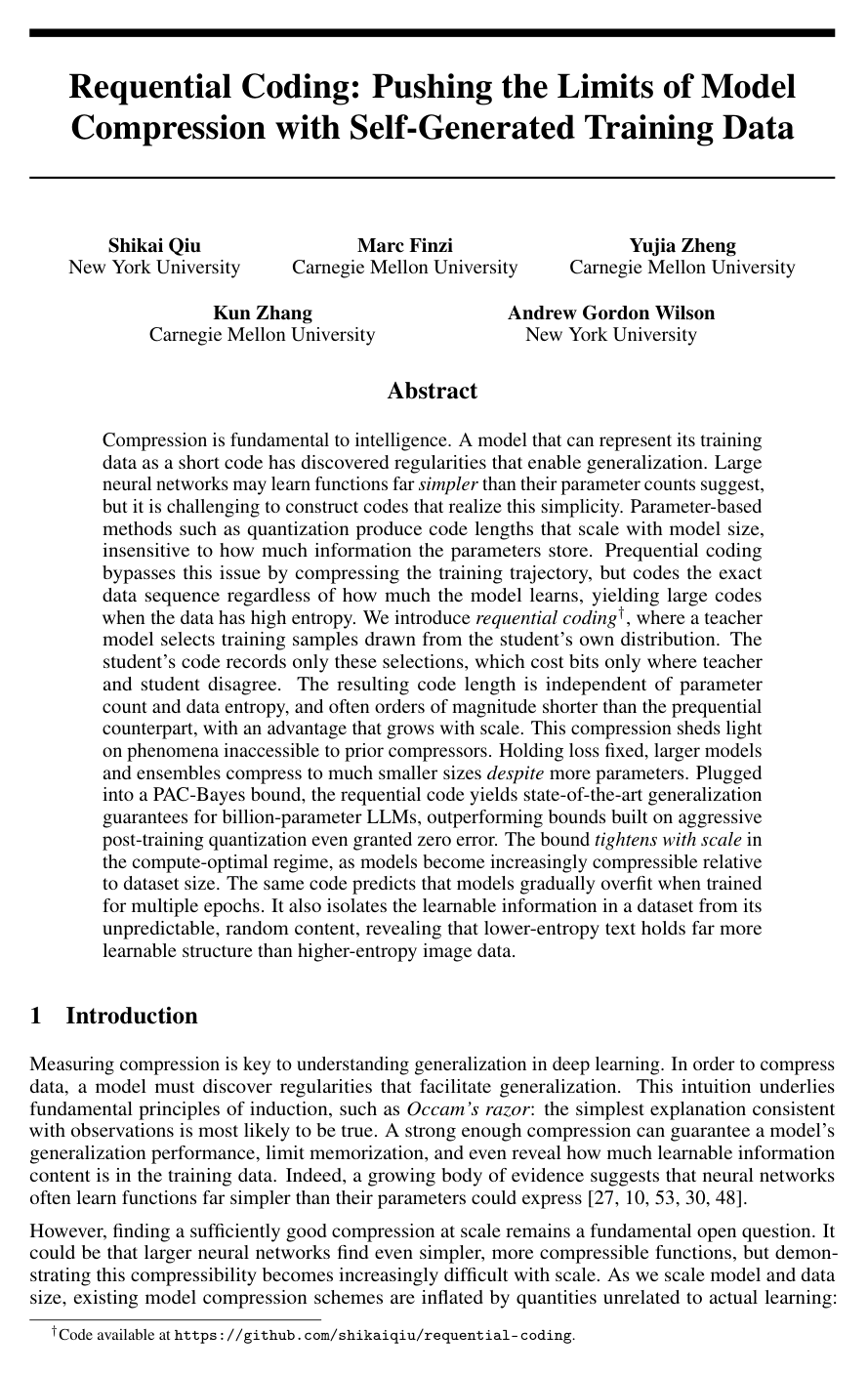
Requential Coding: Pushing the Limits of Model Compression with Self-Generated Training Data
Shikai Qiu, Marc Finzi, Yujia Zheng, Kun Zhang, Andrew Gordon Wilson
Compression is fundamental to intelligence. A model that can represent its training data as a short code has discovered regularities that enable generalization. Large neural networks may learn functions far simpler than their parameter counts suggest, but it is challenging to construct codes that realize this simplicity. Parameter-based methods such as quantization produce code lengths that scale with model size, insensitive to how much information the parameters store. Prequential coding bypasses this issue by compressing the training trajectory, but codes the exact data sequence regardless of how much the model learns, yielding large codes when the data has high entropy. We introduce requential coding, where a teacher model selects training samples drawn from the student's own distribution. The student's code records only these selections, which cost bits only where teacher and student disagree. The resulting code length is independent of parameter count and data entropy, and often orders of magnitude shorter than the prequential counterpart, with an advantage that grows with scale. This compression sheds light on phenomena inaccessible to prior compressors. Holding loss fixed, larger models and ensembles compress to much smaller sizes despite more parameters. Plugged into a PAC-Bayes bound, the requential code yields state-of-the-art generalization guarantees for billion-parameter LLMs, outperforming bounds built on aggressive post-training quantization even granted zero error. The bound tightens with scale in the compute-optimal regime, as models become increasingly compressible relative to dataset size. The same code predicts that models gradually overfit when trained for multiple epochs. It also isolates the learnable information in a dataset from its unpredictable, random content, revealing that lower-entropy text holds far more learnable structure than higher-entropy image data.
Added
2026-07-16
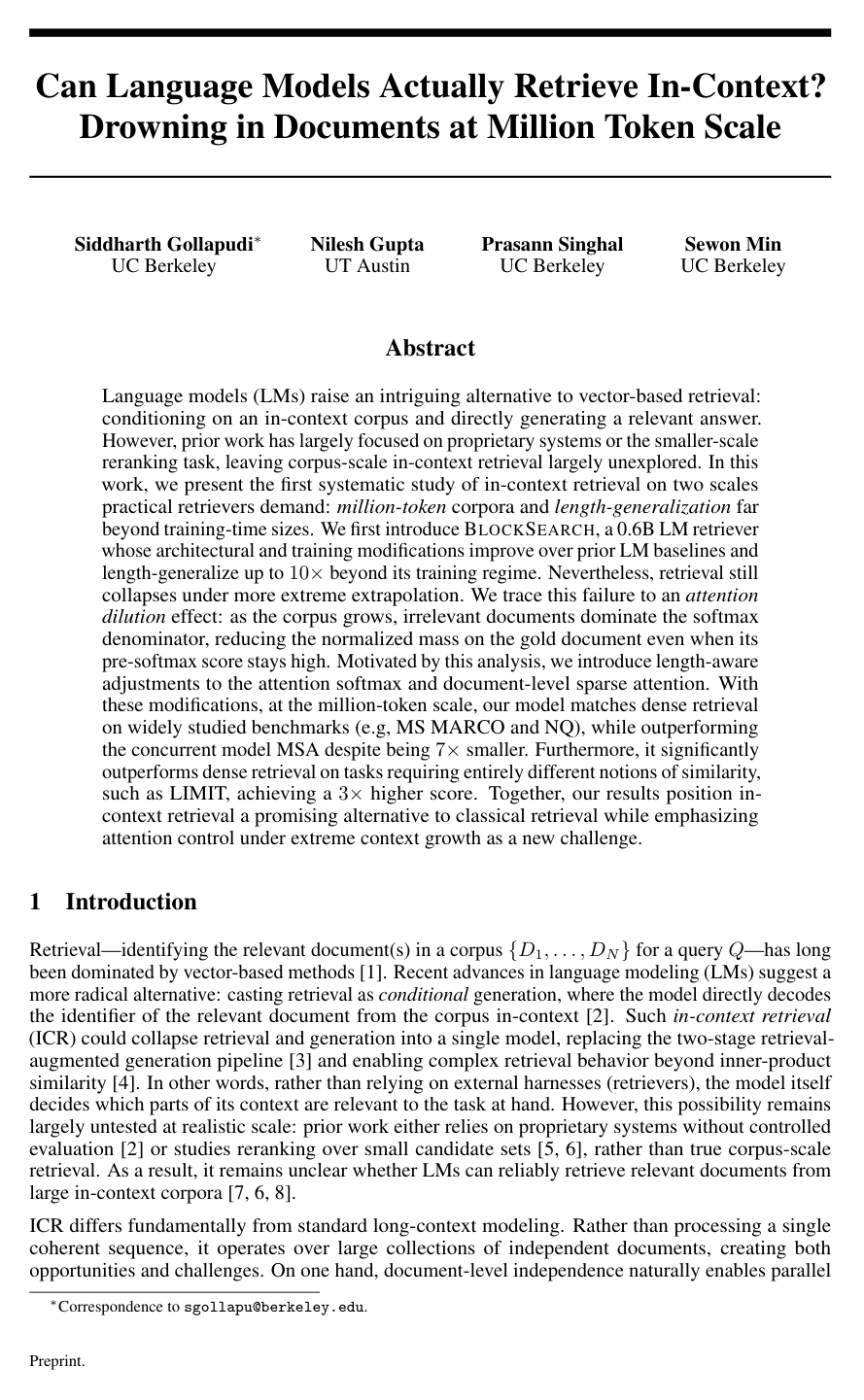
Can Language Models Actually Retrieve In-Context? Drowning in Documents at Million Token Scale
Siddharth Gollapudi, Nilesh Gupta, Prasann Singhal, Sewon Min
Why you should read this
Demonstrates that language models can achieve competitive and superior retrieval performance on million-token scale corpora by mitigating attention dilution through novel architectural and training modifications.
Language models (LMs) raise an intriguing alternative to vector-based retrieval: conditioning on an in-context corpus and directly generating a relevant answer. However, prior work has largely focused on proprietary systems or the smaller-scale reranking task, leaving corpus-scale in-context retrieval largely unexplored. In this work, we present the first systematic study of in-context retrieval on two scales practical retrievers demand: million-token corpora and length-generalization far beyond training-time sizes. We first introduce BlockSearch, a 0.6B LM retriever whose architectural and training modifications improve over prior LM baselines and length-generalize up to 10 times beyond its training regime. Nevertheless, retrieval still collapses under more extreme extrapolation. We trace this failure to an attention dilution effect: as the corpus grows, irrelevant documents dominate the softmax denominator, reducing the normalized mass on the gold document even when its pre-softmax score stays high. Motivated by this analysis, we introduce length-aware adjustments to the attention softmax and document-level sparse attention. With these modifications, at the million-token scale, our model matches dense retrieval on widely studied benchmarks (e.g, MS MARCO and NQ), while outperforming the concurrent model MSA despite being 7 times smaller. Furthermore, it significantly outperforms dense retrieval on tasks requiring entirely different notions of similarity, such as LIMIT, achieving a 3 times higher score. Together, our results position in-context retrieval a promising alternative to classical retrieval while emphasizing attention control under extreme context growth as a new challenge.
Added
2026-07-13
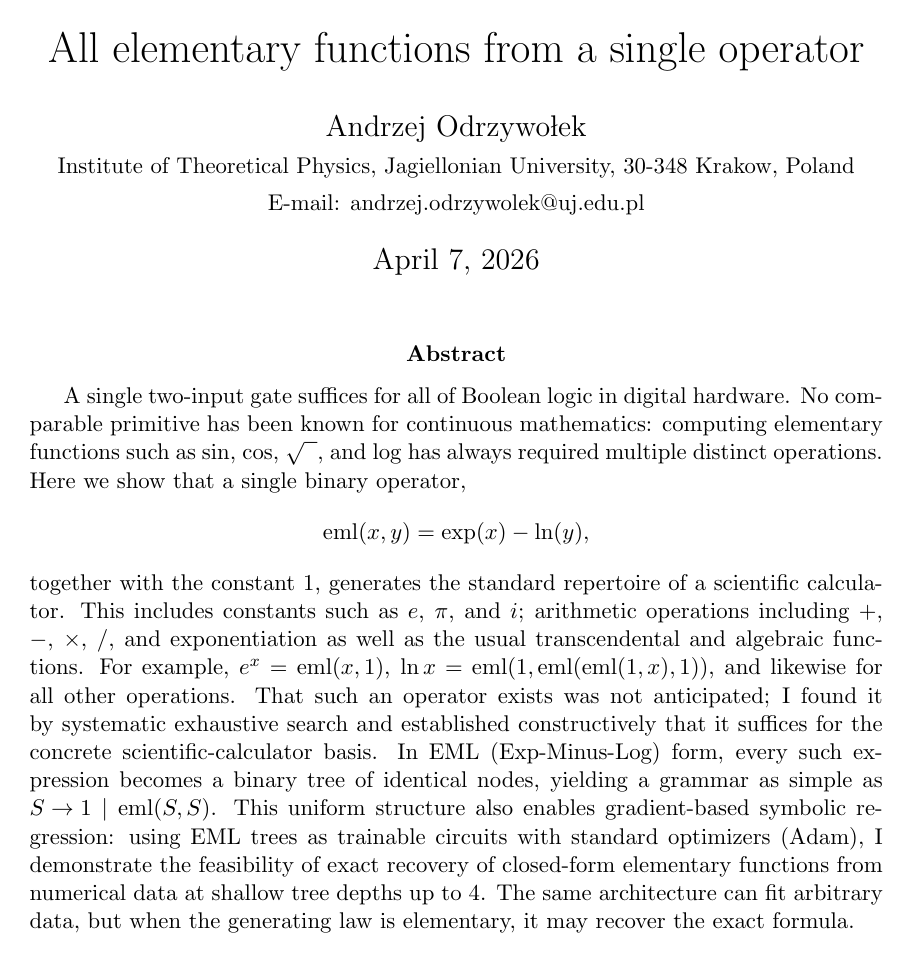
All elementary functions from a single binary operator
Andrzej Odrzywołek
Why you should read this
Proposes a groundbreaking single binary operator, eml(x,y)=exp(x)-ln(y), that, along with the constant 1, can generate all elementary functions and constants typically found on a scientific calculator, simplifying the entire realm of continuous mathematics into a unified framework.
A single two-input gate suffices for all of Boolean logic in digital hardware. No comparable primitive has been known for continuous mathematics: computing elementary functions such as sin, cos, sqrt, and log has always required multiple distinct operations. Here I show that a single binary operator, eml(x,y)=exp(x)-ln(y), together with the constant 1, generates the standard repertoire of a scientific calculator. This includes constants such as e, pi, and i; arithmetic operations including addition, subtraction, multiplication, division, and exponentiation as well as the usual transcendental and algebraic functions. For example, exp(x)=eml(x,1), ln(x)=eml(1,eml(eml(1,x),1)), and likewise for all other operations. That such an operator exists was not anticipated; I found it by systematic exhaustive search and established constructively that it suffices for the concrete scientific-calculator basis. In EML (Exp-Minus-Log) form, every such expression becomes a binary tree of identical nodes, yielding a grammar as simple as S -> 1 | eml(S,S). This uniform structure also enables gradient-based symbolic regression: using EML trees as trainable circuits with standard optimizers (Adam), I demonstrate the feasibility of exact recovery of closed-form elementary functions from numerical data at shallow tree depths up to 4. The same architecture can fit arbitrary data, but when the generating law is elementary, it may recover the exact formula.
Added
2026-04-14
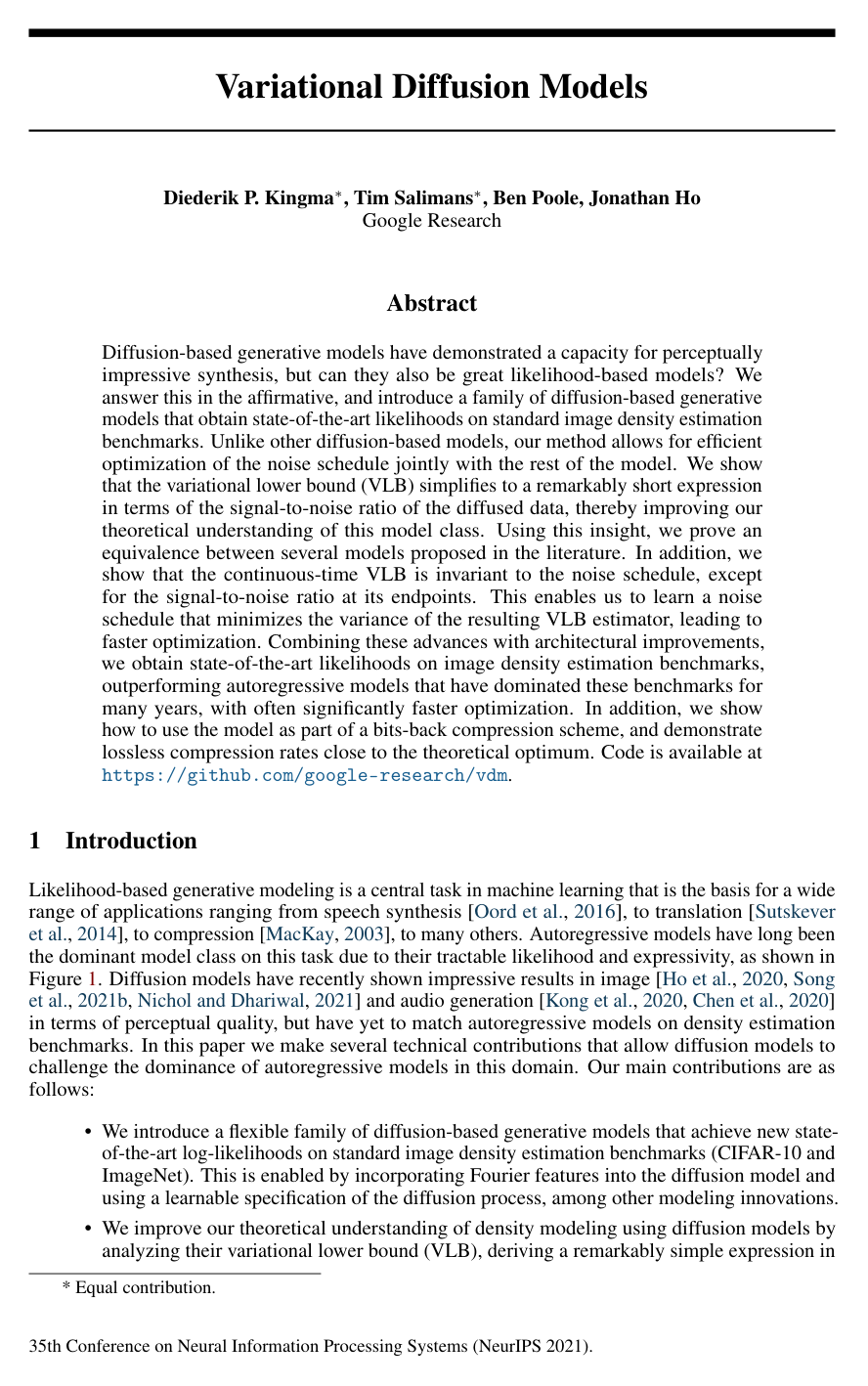
Variational Diffusion Models
Diederik P. Kingma, Tim Salimans, Ben Poole, Jonathan Ho
Why you should read this
Presents a novel family of Variational Diffusion Models that achieve state-of-the-art likelihoods in image density estimation, surpassing long-dominant autoregressive models by optimizing the noise schedule and providing deeper theoretical understanding.
Diffusion-based generative models have demonstrated a capacity for perceptually impressive synthesis, but can they also be great likelihood-based models? We answer this in the affirmative, and introduce a family of diffusion-based generative models that obtain state-of-the-art likelihoods on standard image density estimation benchmarks. Unlike other diffusion-based models, our method allows for efficient optimization of the noise schedule jointly with the rest of the model. We show that the variational lower bound (VLB) simplifies to a remarkably short expression in terms of the signal-to-noise ratio of the diffused data, thereby improving our theoretical understanding of this model class. Using this insight, we prove an equivalence between several models proposed in the literature. In addition, we show that the continuous-time VLB is invariant to the noise schedule, except for the signal-to-noise ratio at its endpoints. This enables us to learn a noise schedule that minimizes the variance of the resulting VLB estimator, leading to faster optimization. Combining these advances with architectural improvements, we obtain state-of-the-art likelihoods on image density estimation benchmarks, outperforming autoregressive models that have dominated these benchmarks for many years, with often significantly faster optimization. In addition, we show how to use the model as part of a bits-back compression scheme, and demonstrate lossless compression rates close to the theoretical optimum. Code is available at this https URL .
Added
2026-02-25