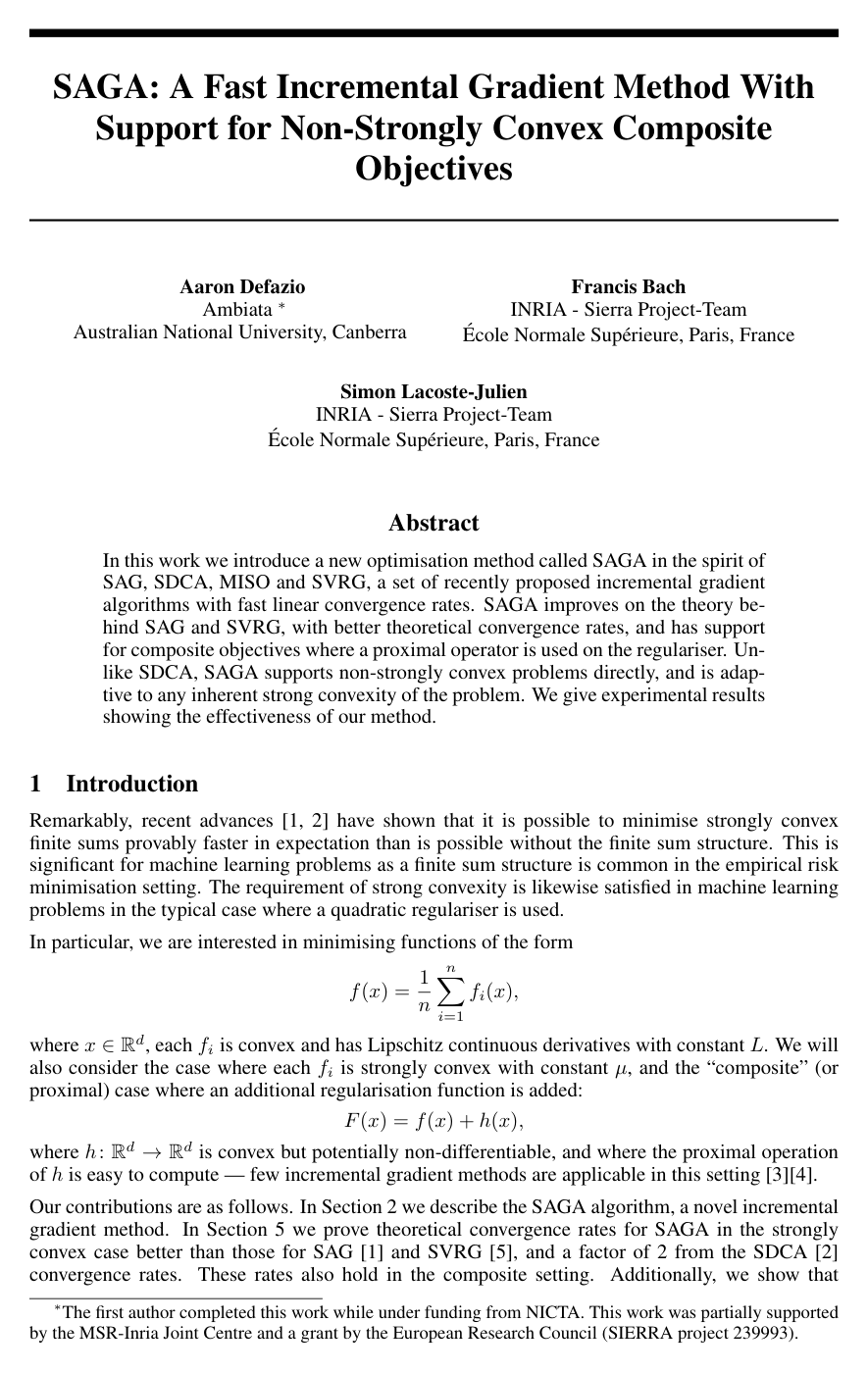
SAGA: A Fast Incremental Gradient Method With Support for Non-Strongly Convex Composite Objectives

Aaron DefazioFrancis BachSimon Lacoste-Julien

article2014NeurIPS2,025 citations

Introduces SAGA, an incremental gradient method that delivers faster convergence rates than SAG and SVRG while natively supporting composite regularizers on both strongly and non-strongly convex objectives.

Listen

Modern large-scale machine learning and data analysis tasks frequently involve optimizing functions defined over massive collections of data points. Standard approaches often struggle to balance computational speed and versatility: traditional gradient descent methods process all data points at each step, ensuring steady progress but incurring substantial computational expense, whereas conventional stochastic methods evaluate one data point at a time but introduce random noise that prevents them from converging quickly without carefully decaying step sizes. Recent variance-reduced incremental algorithms have sought to combine the speed of stochastic updates with the steady convergence of batch methods, yet existing options often suffer from restricted theoretical support, inability to handle non-smooth regularizers, or excessive tuning requirements.

The article introduces and analyzes SAGA, a novel incremental gradient optimization algorithm designed to deliver fast, reliable convergence across a broad spectrum of convex machine learning problems. The authors set out to rigorously prove its theoretical convergence rates—including settings with non-smooth regularizers and problems lacking strong convexity—and to demonstrate its practical computational performance against leading alternatives.

The research combines rigorous mathematical analysis with empirical benchmarking. The theoretical evaluation establishes convergence bounds by analyzing the expected step-by-step progress using a dedicated mathematical tracking function. To substantiate the theory, the authors implemented SAGA alongside competing algorithms—such as SAG, SVRG, SDCA, and Finito—and evaluated their optimization performance on standard benchmark datasets (MNIST, COVTYPE, IJCNN1, and MILLIONSONG) spanning binary classification and least-squares regression under both smooth and non-smooth regularization.

The evaluation yielded several central findings. First, SAGA matches or improves upon theoretical convergence rates of prior methods, establishing linear convergence for strongly convex problems while natively supporting non-smooth composite regularizers via standard proximal operations. Second, SAGA directly handles non-strongly convex objectives without requiring artificial regularization, achieving a standard convergence rate of order 1/k while automatically adapting to any underlying strong convexity. Third, by utilizing an unbiased gradient update direction, SAGA avoids the complex biases of earlier algorithms like SAG and eliminates the inner-loop tuning parameters required by methods such as SVRG. Fourth, in empirical benchmarks, SAGA demonstrates optimization efficiency comparable to top-performing methods like SDCA and Finito while requiring only a single tunable step-size parameter, avoiding the two- to three-fold higher gradient evaluation overhead incurred by SVRG.

These findings indicate that SAGA offers a versatile and mathematically sound optimization framework that reduces operational complexity. By requiring only a single parameter to be tuned and supporting diverse regularizers directly, SAGA reduces the engineering time and compute costs typically spent searching over algorithm hyperparameters. It also unifies several previously fragmented algorithmic approaches into a clear conceptual spectrum between biased storage-heavy methods and parameter-heavy recalculation methods.

For practical implementation, practitioners should deploy SAGA when solving large-scale linear classification and regression problems, particularly when non-smooth regularizers like L1 penalties are required. For models where gradients cannot be represented compactly as simple scalars, practitioners should weigh the trade-off between SAGA’s memory footprint and SVRG’s extra computational passes. When deploying SAGA on sparse data, teams should use just-in-time updating heuristics to maintain linear computational efficiency.

The primary practical constraint of SAGA is its memory requirement: the algorithm maintains a table of historical gradient information across all data points, which can become costly for high-dimensional models such as deep neural networks where compact gradient representations are unavailable. Overall, confidence in the reported results is high for convex and composite convex empirical risk minimization problems, supported by complete mathematical proofs and consistent multi-dataset empirical performance.

Cover for SAGA: A Fast Incremental Gradient Method With Support for Non-Strongly Convex Composite Objectives

Abstract

In this work we introduce a new optimisation method called SAGA in the spirit of SAG, SDCA, MISO and SVRG, a set of recently proposed incremental gradient algorithms with fast linear convergence rates. SAGA improves on the theory behind SAG and SVRG, with better theoretical convergence rates, and has support for composite objectives where a proximal operator is used on the regulariser. Unlike SDCA, SAGA supports non-strongly convex problems directly, and is adaptive to any inherent strong convexity of the problem. We give experimental results showing the effectiveness of our method.

Table of Contents

  • 1 Introduction
  • 2 SAGA Algorithm
  • 3 Related Work
  • 4 Implementation
  • 5 Theory
  • 6 Experiments
  • References
  • A The SDCA/Finito Midpoint Algorithm
  • B Lemmas
  • C Non-strongly-convex Problems
  • D Example Code for Sparse Least Squares & Ridge Regression

Knowls

  1. Knowl 1 — SAGA Algorithm for Composite Optimization

    algorithm

    The SAGA algorithm minimizes composite finite-sum objective functions of the form:

    F(x)=f(x)+h(x)=1n∑i=1nfi(x)+h(x)F(x) = f(x) + h(x) = \frac{1}{n} \sum_{i=1}^n f_i(x) + h(x)

    where x∈Rdx \in \mathbb{R}^d, each fi:Rd→Rf_i: \mathbb{R}^d \to \mathbb{R} is convex and has LL-Lipschitz continuous gradient (LL-smooth), and h:Rd→R∪{+∞}h: \mathbb{R}^d \to \mathbb{R} \cup \{+\infty\} is a convex, lower semi-continuous, potentially non-differentiable regularizer whose proximal operator proxγh(y):=arg⁡min⁡x∈Rd{h(x)+12γ∥x−y∥2}\text{prox}_\gamma^h(y) := \arg\min_{x \in \mathbb{R}^d} \{ h(x) + \frac{1}{2\gamma} \|x - y\|^2 \} is computable.

    Input: Initial iterate x0∈Rdx^0 \in \mathbb{R}^d, step size γ>0\gamma > 0, initial stored derivatives fi′(ϕi0)=fi′(x0)f'_i(\phi_i^0) = f'_i(x^0) for all i∈{1,…,n}i \in \{1, \dots, n\}, and iteration count KK.
    Initialize average gradient vector g0=1n∑i=1nfi′(ϕi0)g^0 = \frac{1}{n} \sum_{i=1}^n f'_i(\phi_i^0).
    for k=0,1,…,K−1k = 0, 1, \dots, K-1 do
        Sample index j∈{1,…,n}j \in \{1, \dots, n\} uniformly at random.
        Compute non-composite update direction:
        wk+1=xk−γ(fj′(xk)−fj′(ϕjk)+gk)w^{k+1} = x^k - \gamma \left( f'_j(x^k) - f'_j(\phi_j^k) + g^k \right)
        Apply proximal operator:
        xk+1=proxγh(wk+1)x^{k+1} = \text{prox}_\gamma^h(w^{k+1})
        Update gradient average:
        gk+1=gk+1n(fj′(xk)−fj′(ϕjk))g^{k+1} = g^k + \frac{1}{n}\left( f'_j(x^k) - f'_j(\phi_j^k) \right)
        Store updated gradient:
        fj′(ϕjk+1)=fj′(xk)f'_j(\phi_j^{k+1}) = f'_j(x^k)
        For all i≠ji \neq j, keep fi′(ϕik+1)=fi′(ϕik)f'_i(\phi_i^{k+1}) = f'_i(\phi_i^k).
    Output: Final iterate xKx^K.

    The points ϕik\phi_i^k represent the iterate value at which the derivative fi′f'_i was last computed for index ii. SAGA does not require storing the vectors ϕik\phi_i^k explicitly, but only the table of gradient vectors fi′(ϕik)f'_i(\phi_i^k) and their running average gkg^k.

  2. Knowl 2 — Linear Convergence Rate of SAGA for Strongly Convex Objectives

    theoretical result

    Let F(x)=1n∑i=1nfi(x)+h(x)F(x) = \frac{1}{n}\sum_{i=1}^n f_i(x) + h(x), where each fi:Rd→Rf_i: \mathbb{R}^d \to \mathbb{R} is μ\mu-strongly convex (μ>0\mu > 0) with LL-Lipschitz continuous gradient, and h:Rd→Rh: \mathbb{R}^d \to \mathbb{R} is convex. Let x∗=arg⁡min⁡x∈RdF(x)x^* = \arg\min_{x \in \mathbb{R}^d} F(x) denote the unique minimizer.

    When SAGA is executed with constant step size γ=12(μn+L)\gamma = \frac{1}{2(\mu n + L)}, the iterates xkx^k satisfy the linear convergence bound in expectation:

    E[∥xk−x∗∥2]≤(1−μ2(μn+L))k[∥x0−x∗∥2+nμn+L(f(x0)−⟨f′(x∗),x0−x∗⟩−f(x∗))]\mathbb{E}\left[ \|x^k - x^*\|^2 \right] \le \left( 1 - \frac{\mu}{2(\mu n + L)} \right)^k \left[ \|x^0 - x^*\|^2 + \frac{n}{\mu n + L} \left( f(x^0) - \langle f'(x^*), x^0 - x^* \rangle - f(x^*) \right) \right]

    where f(x)=1n∑i=1nfi(x)f(x) = \frac{1}{n}\sum_{i=1}^n f_i(x) and the expectation is taken over all random index selections up to iteration kk.

    If the μ\mu-strong convexity assumption holds only for the average function ff rather than for each individual fif_i, setting the step size to γ=13(μn+L)\gamma = \frac{1}{3(\mu n + L)} yields the geometric convergence rate (1−μ6(μn+L))k\left( 1 - \frac{\mu}{6(\mu n + L)} \right)^k.

  3. Knowl 3 — Sublinear Convergence Rate of SAGA for Non-Strongly Convex Composite Objectives

    theoretical result

    Let F(x)=f(x)+h(x)=1n∑i=1nfi(x)+h(x)F(x) = f(x) + h(x) = \frac{1}{n}\sum_{i=1}^n f_i(x) + h(x), where each fi:Rd→Rf_i: \mathbb{R}^d \to \mathbb{R} is convex and has LL-Lipschitz continuous gradient (with no strong convexity, μ=0\mu = 0), and hh is a convex regularizer. Let x∗∈arg⁡min⁡x∈RdF(x)x^* \in \arg\min_{x \in \mathbb{R}^d} F(x).

    When SAGA is run with constant step size γ=13L\gamma = \frac{1}{3L}, the average iterate xˉk:=1k∑t=1kxt\bar{x}^k := \frac{1}{k}\sum_{t=1}^k x^t (excluding the initialization x0x^0) satisfies the O(1/k)O(1/k) sub-optimality bound:

    E[F(xˉk)]−F(x∗)≤4nk[2Ln∥x0−x∗∥2+f(x0)−⟨f′(x∗),x0−x∗⟩−f(x∗)]\mathbb{E}\left[ F(\bar{x}^k) \right] - F(x^*) \le \frac{4n}{k} \left[ \frac{2L}{n} \|x^0 - x^*\|^2 + f(x^0) - \langle f'(x^*), x^0 - x^* \rangle - f(x^*) \right]

    where the expectation is taken over all random choices of indices up to step kk.

  4. Knowl 4 — Adaptivity of SAGA to Unknown Strong Convexity

    theoretical result

    When SAGA is run using the step size γ=13L\gamma = \frac{1}{3L} designed for non-strongly convex problems, it automatically adapts to any strong convexity μ>0\mu > 0 naturally present in the objective without requiring knowledge or tuning of μ\mu.

    Under this fixed step size, SAGA achieves the geometric convergence rate:

    E[∥xk−x∗∥2]≤(1−min⁡{14n,μ3L})k[∥x0−x∗∥2+2n3L(f(x0)−⟨f′(x∗),x0−x∗⟩−f(x∗))]\mathbb{E}\left[ \|x^k - x^*\|^2 \right] \le \left( 1 - \min\left\{ \frac{1}{4n}, \frac{\mu}{3L} \right\} \right)^k \left[ \|x^0 - x^*\|^2 + \frac{2n}{3L} \left( f(x^0) - \langle f'(x^*), x^0 - x^* \rangle - f(x^*) \right) \right]

    where x∗x^* is the optimal minimizer, nn is the number of component functions, and the expectation is taken over the sequence of randomly selected indices.

  5. Knowl 5 — Lyapunov Function for SAGA Convergence Analysis

    definition

    For the finite-sum optimization problem min⁡x∈Rd1n∑i=1nfi(x)+h(x)\min_{x \in \mathbb{R}^d} \frac{1}{n}\sum_{i=1}^n f_i(x) + h(x) with minimizer x∗x^*, the Lyapunov function TkT^k used to establish linear convergence of SAGA is defined as:

    Tk:=T(xk,{ϕik}i=1n)=1n∑i=1nfi(ϕik)−f(x∗)−1n∑i=1n⟨fi′(x∗),ϕik−x∗⟩+c∥xk−x∗∥2T^k := T\left(x^k, \{\phi_i^k\}_{i=1}^n\right) = \frac{1}{n} \sum_{i=1}^n f_i(\phi_i^k) - f(x^*) - \frac{1}{n} \sum_{i=1}^n \langle f'_i(x^*), \phi_i^k - x^* \rangle + c \|x^k - x^*\|^2

    where xkx^k is the iterate at step kk, ϕik\phi_i^k is the vector where fi′f'_i was last evaluated, and c=12γ(1−γμ)nc = \frac{1}{2\gamma(1 - \gamma \mu)n} with step size γ=12(μn+L)\gamma = \frac{1}{2(\mu n + L)} and strong convexity parameter μ>0\mu > 0.

    Conditioned on the state at step kk, the Lyapunov function contracts in expectation:

    E[Tk+1∣Tk]≤(1−1κ)Tk\mathbb{E}[T^{k+1} \mid T^k] \le \left( 1 - \frac{1}{\kappa} \right) T^k

    with contraction parameter κ=1γμ=2(μn+L)μ\kappa = \frac{1}{\gamma \mu} = \frac{2(\mu n + L)}{\mu}.

  6. Knowl 6 — Unified Variance Reduction Framework for SAG, SVRG, and SAGA

    model/method

    To approximate the full gradient ∇f(xk)=E[X]\nabla f(x^k) = \mathbb{E}[X] using a single stochastic gradient sample X=fj′(xk)X = f'_j(x^k) (where j∈{1,…,n}j \in \{1, \dots, n\} uniformly) and a correlated random variable YY whose expectation E[Y]\mathbb{E}[Y] is known, a generalized variance-reduced estimator is:

    θα=α(X−Y)+E[Y],α∈[0,1]\theta_\alpha = \alpha(X - Y) + \mathbb{E}[Y], \quad \alpha \in [0, 1]

    with E[θα]=αE[X]+(1−α)E[Y]\mathbb{E}[\theta_\alpha] = \alpha \mathbb{E}[X] + (1 - \alpha)\mathbb{E}[Y] and Var⁡(θα)=α2[Var⁡(X)+Var⁡(Y)−2Cov⁡(X,Y)]\operatorname{Var}(\theta_\alpha) = \alpha^2 [\operatorname{Var}(X) + \operatorname{Var}(Y) - 2\operatorname{Cov}(X, Y)]. The fast incremental gradient algorithms correspond to specific choices of YY and eta:

    • SAG (Stochastic Average Gradient): Chooses Y=fj′(ϕjk)Y = f'_j(\phi_j^k) (stored individual gradients) and α=1/n\alpha = 1/n. This produces a biased gradient estimate with variance scaled down by 1/n21/n^2, which impedes proximal operator integration and complicates proofs.
    • SVRG (Stochastic Variance Reduced Gradient): Chooses Y=fj′(x~)Y = f'_j(\tilde{x}) and α=1\alpha = 1, where x~\tilde{x} is a snapshot vector updated periodically across all indices in an outer loop. The update is unbiased (E[θ1]=∇f(xk)\mathbb{E}[\theta_1] = \nabla f(x^k)) but requires periodic full gradient passes.
    • SAGA: Chooses Y=fj′(ϕjk)Y = f'_j(\phi_j^k) and α=1\alpha = 1, updating each stored derivative fj′(ϕjk+1)=fj′(xk)f'_j(\phi_j^{k+1}) = f'_j(x^k) individually whenever index jj is picked. The resulting update direction fj′(xk)−fj′(ϕjk)+1n∑i=1nfi′(ϕik)f'_j(x^k) - f'_j(\phi_j^k) + \frac{1}{n}\sum_{i=1}^n f'_i(\phi_i^k) is unbiased (E[θ1]=∇f(xk)\mathbb{E}[\theta_1] = \nabla f(x^k)), enabling simple Lyapunov analysis and proximal support.
  7. Knowl 7 — Primal Formulation of Stochastic Dual Coordinate Ascent (SDCA)

    algorithm

    Stochastic Dual Coordinate Ascent (SDCA) maximizes a dual objective using block-coordinate ascent over dual variables αi∈Rd\alpha_i \in \mathbb{R}^d. By applying the Moreau decomposition identity:

    proxf∗(v)=v−proxf(v)\text{prox}_{f^*}(v) = v - \text{prox}_f(v)

    where f∗f^* is the Fenchel conjugate of ff, exact block-coordinate dual updates can be computed entirely in the primal domain without evaluating conjugate functions:

    Input: Strong convexity parameter μ>0\mu > 0, number of samples nn, initial stored gradient table entries fi′(ϕi0)f'_i(\phi_i^0) for all i∈{1,…,n}i \in \{1, \dots, n\}, and step size γ=1μn\gamma = \frac{1}{\mu n}.
    for k=0,1,2,…k = 0, 1, 2, \dots do
        Pick index j∈{1,…,n}j \in \{1, \dots, n\} uniformly at random.
        Compute z=−γ∑i≠jfi′(ϕik)z = -\gamma \sum_{i \neq j} f'_i(\phi_i^k).
        Compute primal representative ϕjk+1=proxγfj(z)=arg⁡min⁡x{fj(x)+12γ∥x−z∥2}\phi_j^{k+1} = \text{prox}_{\gamma f_j}(z) = \arg\min_x \left\{ f_j(x) + \frac{1}{2\gamma} \|x - z\|^2 \right\}.
        Store updated gradient fj′(ϕjk+1)=1γ(z−ϕjk+1)f'_j(\phi_j^{k+1}) = \frac{1}{\gamma}(z - \phi_j^{k+1}) in table at index jj.
        For all i≠ji \neq j, keep fi′(ϕik+1)=fi′(ϕik)f'_i(\phi_i^{k+1}) = f'_i(\phi_i^k).
    Output: Current primal iterate xk=−γ∑i=1nfi′(ϕik)x^k = -\gamma \sum_{i=1}^n f'_i(\phi_i^k).

    The dual variables satisfy αi=−fi′(ϕi)\alpha_i = -f'_i(\phi_i), and the KKT conditions ensure that dual optimality implies primal optimality of xk=γ∑iαix^k = \gamma \sum_i \alpha_i.

  8. Knowl 8 — SDCA/Finito Midpoint Algorithm

    algorithm

    By distributing problem strong convexity μ>0\mu > 0 directly into each loss component fif_i rather than handling it as a separate global quadratic regularizer μ2∥x∥2\frac{\mu}{2}\|x\|^2, SDCA and Finito merge into an exact parameter-free midpoint algorithm:

    Input: Strong convexity parameter μ>0\mu > 0, sample count nn, initial points ϕi0∈Rd\phi_i^0 \in \mathbb{R}^d, and initial gradients fi′(ϕi0)f'_i(\phi_i^0) for i∈{1,…,n}i \in \{1, \dots, n\}.
    for k=0,1,2,…k = 0, 1, 2, \dots do
        Pick index j∈{1,…,n}j \in \{1, \dots, n\} uniformly at random.
        Compute surrogate center z=1n−1∑i≠jϕik−1μ(n−1)∑i≠jfi′(ϕik)z = \frac{1}{n-1} \sum_{i \neq j} \phi_i^k - \frac{1}{\mu(n-1)} \sum_{i \neq j} f'_i(\phi_i^k).
        Compute ϕjk+1=prox1μ(n−1)fj(z)=arg⁡min⁡x{fj(x)+μ(n−1)2∥x−z∥2}\phi_j^{k+1} = \text{prox}_{\frac{1}{\mu(n-1)} f_j}(z) = \arg\min_x \left\{ f_j(x) + \frac{\mu(n-1)}{2} \|x - z\|^2 \right\}.
        Set iterate xk+1=ϕjk+1=1n∑i=1nϕik+1−1μn∑i=1nfi′(ϕik+1)x^{k+1} = \phi_j^{k+1} = \frac{1}{n} \sum_{i=1}^n \phi_i^{k+1} - \frac{1}{\mu n} \sum_{i=1}^n f'_i(\phi_i^{k+1}).
        For all i≠ji \neq j, set ϕik+1=ϕik\phi_i^{k+1} = \phi_i^k.
    Output: Final iterate xk+1x^{k+1}.

    The proximal operator prox1μ(n−1)fj\text{prox}_{\frac{1}{\mu(n-1)} f_j} resolves the implicit circular dependency present in Finito where xk+1=ϕjk+1x^{k+1} = \phi_j^{k+1} appears on both sides of the update equation, removing the need for step size tuning.

  9. Knowl 9 — Memory Reduction and Just-In-Time Updates for Sparse SAGA

    model/method

    For linear prediction models where fi(x)=ψi(aiTx)f_i(x) = \psi_i(a_i^T x) with feature vector ai∈Rda_i \in \mathbb{R}^d and scalar loss ψi\psi_i, the gradient is fi′(x)=ψi′(aiTx)aif'_i(x) = \psi'_i(a_i^T x) a_i. Instead of storing full dd-dimensional gradient vectors fi′(ϕi)∈Rdf'_i(\phi_i) \in \mathbb{R}^d in the table, SAGA only needs to store the scalar derivative ci=ψi′(aiTϕi)∈Rc_i = \psi'_i(a_i^T \phi_i) \in \mathbb{R} for each sample i∈{1,…,n}i \in \{1, \dots, n\} (or p−1p-1 scalars for pp-class classification). This reduces table memory from O(nd)O(nd) to O(n)O(n), matching SDCA.

    When features aia_i are sparse, computing dense gradient average updates at every iteration is avoided via just-in-time (lagged) updates:

    1. Maintain a vector lag∈Nd\text{lag} \in \mathbb{N}^d where lag[l]\text{lag}[l] records the last iteration at which coordinate ll of xx was updated.
    2. When coordinate ll is accessed at iteration kk, apply the accumulated missed updates: x[l]←x[l]−γ(k−lag[l])gk[l]x[l] \leftarrow x[l] - \gamma (k - \text{lag}[l]) g^k[l], and update lag[l]=k\text{lag}[l] = k.
    3. When an explicit quadratic regularizer μ2∥x∥2\frac{\mu}{2}\|x\|^2 is present, scaling xk+1=(1−γμ)xk−…x^{k+1} = (1 - \gamma \mu)x^k - \dots is tracked via a global multiplier βk←(1−γμ)βk\beta_k \leftarrow (1 - \gamma \mu)\beta_k, with partial sums of the geometric series ∑t=0Δ−1(1−γμ)t\sum_{t=0}^{\Delta - 1} (1 - \gamma \mu)^t pretabulated to perform exact lagged updates in O(1)O(1) operations per non-zero feature.
  10. Knowl 10 — Empirical Convergence Comparison of SAGA, SAG, SVRG, SDCA, and Finito

    empirical result

    SAGA was empirically evaluated against SAG, SVRG, SDCA, Finito (with and without per-pass permuted access order), and L-BFGS across four benchmark datasets:

    • Binary classification (L2L_2 and L1L_1 regularized logistic regression): MNIST (n=60,000n=60{,}000), COVTYPE (n=581,012n=581{,}012), IJCNN1 (n=49,990n=49{,}990).
    • Least squares regression (L2L_2 and L1L_1 regularization): MILLIONSONG (n=463,715n=463{,}715).

    Experimental findings:

    1. Epoch-equivalent rate: Permuted Finito showed the fastest sub-optimality decrease per effective epoch. SAGA performed on par with unpermuted Finito and SDCA across all datasets.
    2. Gradient evaluation cost: SVRG showed per-epoch convergence rates comparable to SAGA, but required approximately double the number of gradient evaluations per epoch due to its periodic full-gradient recalculation passes.
    3. Initial progress: Constant step-size SAG exhibited slower initial convergence before reaching asymptotic rates, whereas SAGA achieved fast linear convergence immediately without requiring adaptive step-size heuristics.
    4. Proximal regularization: SAGA and SVRG natively accommodated non-smooth L1L_1 regularization through proximal updates, whereas basic Finito and standard SDCA could not handle general non-smooth composite regularizers without approximations.

Coverage note — Intermediate mathematical lemmas (Lemmas 1 through 7) and the specific Cython code implementation listing from Appendix D were deliberately omitted as they represent intermediate proof machinery and concrete programming script formatting rather than standalone scientific contributions.

References

  1. 1.Mark Schmidt, Nicolas Le Roux, and Francis Bach. Minimizing finite sums with the stochastic average gradient. Technical report, INRIA, hal-0086005, 2013.
  2. 2.Shai Shalev-Shwartz and Tong Zhang. Stochastic dual coordinate ascent methods for regularized loss minimization. JMLR, 14:567–599, 2013.
  3. 3.Paul Tseng and Sangwoon Yun. Incrementally updated gradient methods for constrained and regularized optimization. Journal of Optimization Theory and Applications, 160:832:853, 2014.
  4. 4.Lin Xiao and Tong Zhang. A proximal stochastic gradient method with progressive variance reduction. Technical report, Microsoft Research, Redmond and Rutgers University, Piscataway, NJ, 2014.
  5. 5.Rie Johnson and Tong Zhang. Accelerating stochastic gradient descent using predictive variance reduction. NIPS, 2013.
  6. 6.Taiji Suzuki. Stochastic dual coordinate ascent with alternating direction method of multipliers. Proceedings of The 31st International Conference on Machine Learning, 2014.
  7. 7.Evan Greensmith, Peter L. Bartlett, and Jonathan Baxter. Variance reduction techniques for gradient estimates in reinforcement learning. JMLR, 5:1471–1530, 2004.
  8. 8.Jakub Konečný and Peter Richtárik. Semi-stochastic gradient descent methods. ArXiv e-prints, arXiv:1312.1666, December 2013.
  9. 9.Aaron Defazio, Tiberio Caetano, and Justin Domke. Finito: A faster, permutable incremental gradient method for big data problems. Proceedings of the 31st International Conference on Machine Learning, 2014.
  10. 10.Julien Mairal. Incremental majorization-minimization optimization with application to largescale machine learning. Technical report, INRIA Grenoble Rhône-Alpes / LJK Laboratoire Jean Kuntzmann, 2014.
  11. 11.Shai Shalev-Shwartz and Tong Zhang. Accelerated proximal stochastic dual coordinate ascent for regularized loss minimization. Technical report, The Hebrew University, Jerusalem and Rutgers University, NJ, USA, 2013.
  12. 12.Patrick Combettes and Jean-Christophe Pesquet. Proximal Splitting Methods in Signal Processing. In Fixed-Point Algorithms for Inverse Problems in Science and Engineering. Springer, 2011.
  13. 13.Yu. Nesterov. Introductory Lectures On Convex Programming. Springer, 1998.
  14. 14.Aaron Defazio. New Optimization Methods for Machine Learning. PhD thesis, (draft under examination) Australian National University, 2014. http://www.aarondefazio.com/pubs.html.

Citation

MLA
Defazio, A., et al. “SAGA: A Fast Incremental Gradient Method With Support for Non-Strongly Convex Composite Objectives”. arXiv, 2014, http://arxiv.org/abs/1407.0202v3.
APA
Defazio, A., Bach, F., & Lacoste-Julien, S. (2014). SAGA: A Fast Incremental Gradient Method With Support for Non-Strongly Convex Composite Objectives. arXiv. http://arxiv.org/abs/1407.0202v3
Chicago
Defazio, A., F. Bach, and S. Lacoste-Julien. 2014. “SAGA: A Fast Incremental Gradient Method With Support for Non-Strongly Convex Composite Objectives”. arXiv. http://arxiv.org/abs/1407.0202v3.
Harvard
Defazio, A., Bach, F. and Lacoste-Julien, S. (2014) “SAGA: A Fast Incremental Gradient Method With Support for Non-Strongly Convex Composite Objectives”, arXiv [Preprint]. Available at: http://arxiv.org/abs/1407.0202v3.
Vancouver
1. Defazio A, Bach F, Lacoste-Julien S (2014) SAGA: A Fast Incremental Gradient Method With Support for Non-Strongly Convex Composite Objectives. arXiv

BibTeX

@article{defazio2014saga,
  title = {SAGA: A Fast Incremental Gradient Method With Support for Non-Strongly Convex Composite Objectives},
  author = {Defazio, Aaron and Bach, Francis and Lacoste-Julien, Simon},
  year = {2014},
  journal = {arXiv},
  url = {http://arxiv.org/abs/1407.0202v3},
  eprint = {1407.0202}
}
Metadata:arXiv

Source Code

This paper has an official code repository available. Click below to access the source code.

View Repository

Access the Paper

This paper is available from its original source. Click below to access the PDF.

Open PDF
License: Published with permission