You'll never walk alone: Modeling social behavior for multi-target tracking
S. PellegriniAndreas EssKonrad SchindlerLuc Van Gool
Proposes a social interaction motion model, Linear Trajectory Avoidance, that predicts collision-free pedestrian paths to maintain reliable tracking and data association in crowded scenes during prolonged occlusions.
Multi-target visual tracking in crowded public environments is a critical capability for autonomous vehicles, robotics, and intelligent surveillance. Traditional tracking systems rely on simple linear or independent motion models that predict each individual's path in isolation. These conventional approaches ignore fundamental human behaviors, such as steering toward destinations and proactively adjusting paths to avoid collisions with other people and static obstacles. As a result, standard systems frequently lose track of targets or swap personal identities when individuals pass near one another or become temporarily occluded.
The article introduces and evaluates the Linear Trajectory Avoidance (LTA) dynamic model. The objective is to demonstrate that incorporating social interactions and destination-driven path planning into a unified, metric-space motion model significantly enhances multi-person tracking accuracy and trajectory prediction.
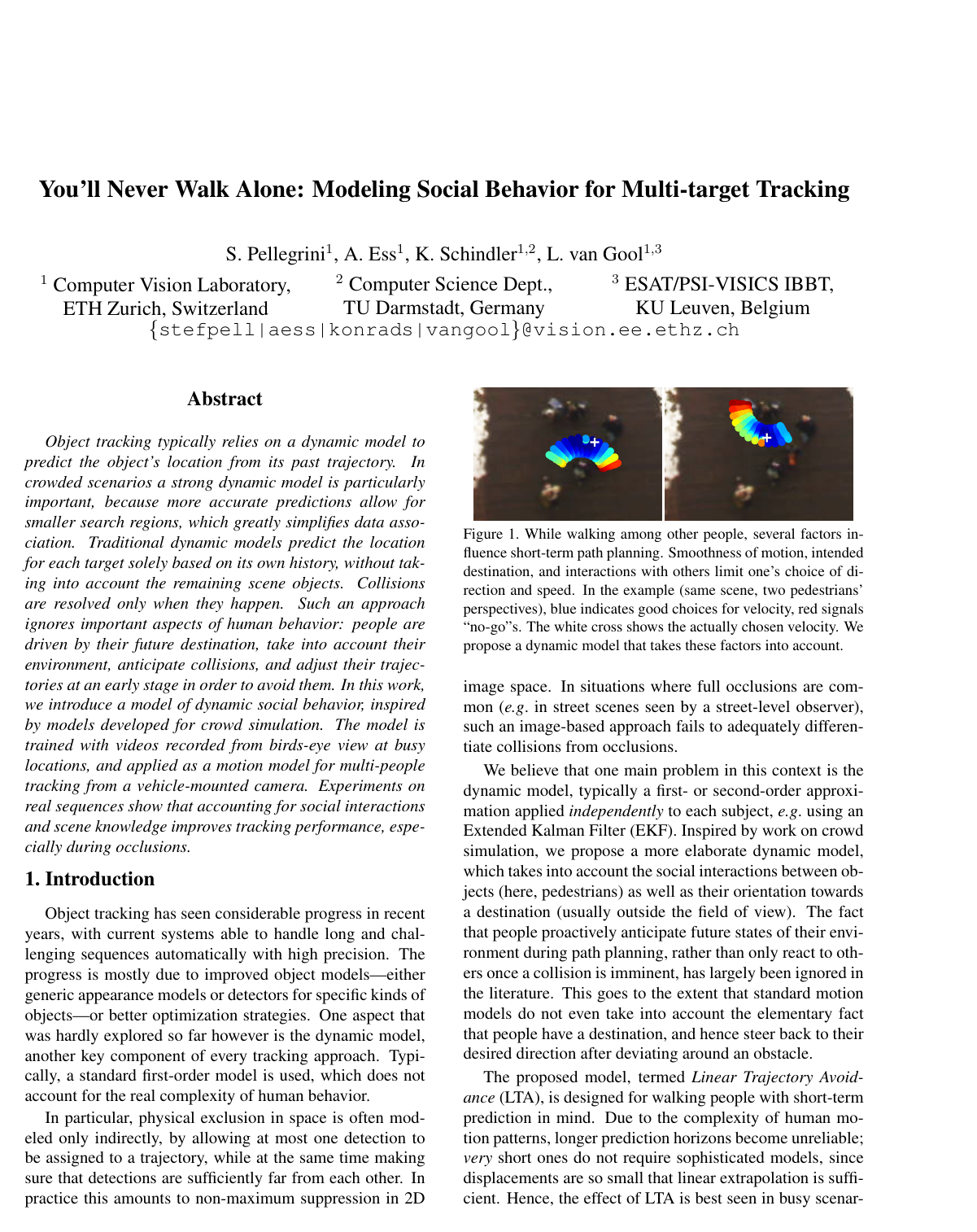
The researchers designed an energy-minimization framework where each pedestrian optimizes their velocity by anticipating the point of closest approach with others while maintaining a desired speed and heading. Six core behavioral parameters were trained using 25 minutes of annotated overhead video footage encompassing 650 pedestrian trajectories. The model was then evaluated across three settings: short-term trajectory prediction on an oblique shopping street video, a simple patch-based tracking experiment at a low frame rate (2.5 frames per second), and a state-of-the-art pedestrian tracker mounted on a moving vehicle using real-world street footage.
The evaluation produced four key findings. First, in trajectory prediction benchmarks, LTA reduced average prediction errors by 24% compared to standard linear extrapolation and by 6% compared to the traditional social force baseline. At a one-meter error tolerance threshold, LTA successfully predicted roughly 70% of trajectories, outperforming linear extrapolation (approximately 50%) and destination-only modeling (approximately 63%). Second, in low-frame-rate tracking, LTA consistently maintained target tracks through close encounters where linear models failed due to overshooting and path drift. Third, in vehicle-mounted mobile tracking, LTA substantially lowered tracking errors during occlusions, reducing recoverable identity switches by 44% (from 18 to 10 switches in one sequence) while keeping false positives and missed detections steady. Fourth, these performance gains were achieved at a negligible computational cost of under 10 milliseconds per frame for 15 individuals.
These findings show that tracking systems do not require complex, brittle data-association heuristics if their underlying motion models reflect basic human behavioral dynamics. Even approximate or coarsely estimated destination vectors substantially improve path prediction during sensor dropouts and visual occlusions. This provides immediate operational benefits for autonomous systems by enhancing safety, lowering identity confusion, and reducing computational overhead without requiring specialized hardware.
Based on these results, engineering teams developing autonomous navigation and surveillance systems should integrate destination-aware, social dynamic models into their tracking pipelines. For mobile observers where long-term destinations are unknown, rough heuristics—such as assuming forward motion parallel to the roadway—should be used as an effective substitute. Future development should incorporate a stochastic formulation to resolve ambiguous collision-avoidance directions, and extend the energy formulations to account for coordinated group behaviors, such as people walking together.
The primary limitation of the current model is its deterministic formulation, which occasionally causes large error spikes when it chooses the wrong side to pass an oncoming person. Additionally, evaluating performance in moderately crowded scenes with mostly straight paths may understate the model's advantages in denser crowds. Despite these boundaries, confidence in the findings is high, supported by consistent validation across multiple trackers, camera viewpoints, and standard performance metrics.
No sufficiently relevant recommendations were found.
- Paper: Social LSTM: Human Trajectory Prediction in Crowded Spaces, Alexandre Alahi et al. (2016). Social LSTM carries social-interaction modeling from hand-designed pedestrian dynamics into a learned framework that predicts multiple people’s trajectories jointly.
- Paper: Social GAN: Socially Acceptable Trajectories with Generative Adversarial Networks, Agrim Gupta et al. (2018). Social GAN advances socially aware pedestrian forecasting by generating diverse plausible futures rather than relying on a single predicted path.
- Paper: Trajectron++: Dynamically-Feasible Trajectory Forecasting with Heterogeneous Data, Tim Salzmann et al. (2020). Trajectron++ extends multi-agent forecasting with probabilistic predictions, environmental context, and physically feasible motion.
- Paper: M2I: From Factored Marginal Trajectory Prediction to Interactive Prediction, Qiao Sun et al. (2022). M2I develops interaction-aware forecasting further by explicitly modeling how one road user’s predicted motion shapes another’s response.