Client Selection for Federated Learning with Heterogeneous Resources in Mobile Edge

Takayuki NishioRyo Yonetani

article2018ICC 2019 - 2019 IEEE International Conference on Communications (ICC)1,831 citations

Proposes FedCS, a resource-aware client selection protocol for federated learning in mobile edge networks that significantly accelerates training time by filtering participating devices according to their computational capacity and wireless channel conditions.

Listen

Training modern artificial intelligence models on mobile devices allows organizations to leverage rich, real-world data while preserving user privacy by keeping data stored locally. However, standard federated learning methods struggle in practical cellular networks because client devices possess highly uneven computing speeds, varying data volumes, and fluctuating wireless connectivity. When slower or poorly connected devices bottleneck the network, model training stalls, leading to wasted bandwidth and prolonged training timelines.

The article introduces and evaluates FedCS, a resource-aware federated learning protocol designed to accelerate model training across heterogeneous mobile devices. The primary objective is to demonstrate that actively managing client selection within strict time limits can maximize update throughput and significantly speed up overall training without compromising model accuracy.

The researchers assessed FedCS by simulating a mobile edge computing environment within an urban cellular cell serving 1,000 client devices. Using standard image recognition tasks based on the CIFAR-10 and Fashion-MNIST datasets, the team evaluated both uniform and non-uniform data distributions among devices. The protocol polls candidate devices for their resource status—including local processing speed and wireless channel conditions—and uses an efficient greedy selection algorithm to schedule as many successful model updates as possible within a designated round deadline.

The evaluation produced several critical findings. First, FedCS accelerated model training substantially compared to baseline federated methods under identical deadlines, reaching 75% accuracy on CIFAR-10 about 76.5 minutes faster (a roughly 37% time reduction) and 85% accuracy on Fashion-MNIST about 33.3 minutes faster (a roughly 50% reduction). Second, the protocol incorporated more than twice as many participating devices per round (averaging 7.7 clients versus 3.3 for the baseline under a three-minute deadline), which directly drove faster convergence. Third, FedCS maintained its performance advantage even when accounting for moderate fluctuations in computing load and wireless throughput. Finally, in challenging non-uniform data environments where the baseline failed to reach target thresholds, FedCS successfully trained functional models, reaching 54% accuracy on CIFAR-10 and 71% on Fashion-MNIST within the allotted timeframe.

These results indicate that managing edge computing resources proactively can drastically lower the operational time and communication costs required to train decentralized machine learning models. FedCS offers an effective framework for deploying artificial intelligence across smart devices and connected vehicles without exposing private user data to centralized servers. For optimal performance, organizations adopting this framework must carefully tune round deadlines, as setting deadlines too short limits participant diversity, while setting them too long reduces the frequency of model aggregations.

To build upon these findings, future development should explore dynamic deadline adjustments that automatically adapt to real-time network traffic, as well as integrating model compression techniques to handle larger network models and highly fragmented datasets. While the simulations demonstrate robust performance in realistic LTE cellular conditions, leaders should note that the evaluation relied on synthetic workload simulations with moderately sized neural networks. Validating the protocol on larger commercial models and live, moving mobile edge deployments will be essential before full-scale operational rollout.

Cover for Client Selection for Federated Learning with Heterogeneous Resources in Mobile Edge

Abstract

We envision a mobile edge computing (MEC) framework for machine learning (ML) technologies, which leverages distributed client data and computation resources for training high-performance ML models while preserving client privacy. Toward this future goal, this work aims to extend Federated Learning (FL), a decentralized learning framework that enables privacy-preserving training of models, to work with heterogeneous clients in a practical cellular network. The FL protocol iteratively asks random clients to download a trainable model from a server, update it with own data, and upload the updated model to the server, while asking the server to aggregate multiple client updates to further improve the model. While clients in this protocol are free from disclosing own private data, the overall training process can become inefficient when some clients are with limited computational resources (i.e. requiring longer update time) or under poor wireless channel conditions (longer upload time). Our new FL protocol, which we refer to as FedCS, mitigates this problem and performs FL efficiently while actively managing clients based on their resource conditions. Specifically, FedCS solves a client selection problem with resource constraints, which allows the server to aggregate as many client updates as possible and to accelerate performance improvement in ML models. We conducted an experimental evaluation using publicly-available large-scale image datasets to train deep neural networks on MEC environment simulations. The experimental results show that FedCS is able to complete its training process in a significantly shorter time compared to the original FL protocol.

Table of Contents

  • I Introduction
  • II Federated Learning
  • II-A Federated Learning
  • II-B Heterogeneous Client Problem in FL
  • III FedCS: Federated Learning with Client Selection
  • III-A Assumptions
  • III-B FedCS Protocol
  • III-C Algorithm for Client Selection Step
  • IV Performance Evaluation
  • IV-A Simulated Environment
  • IV-B Experimental Setup of ML Tasks
  • IV-C Global Models and Their Updates
  • IV-D Evaluation Details
  • IV-E Results
  • V Conclusion
  • References

Knowls

  1. Knowl 1 — FedCS Protocol Workflow for Heterogeneous Edge Clients

    model/method

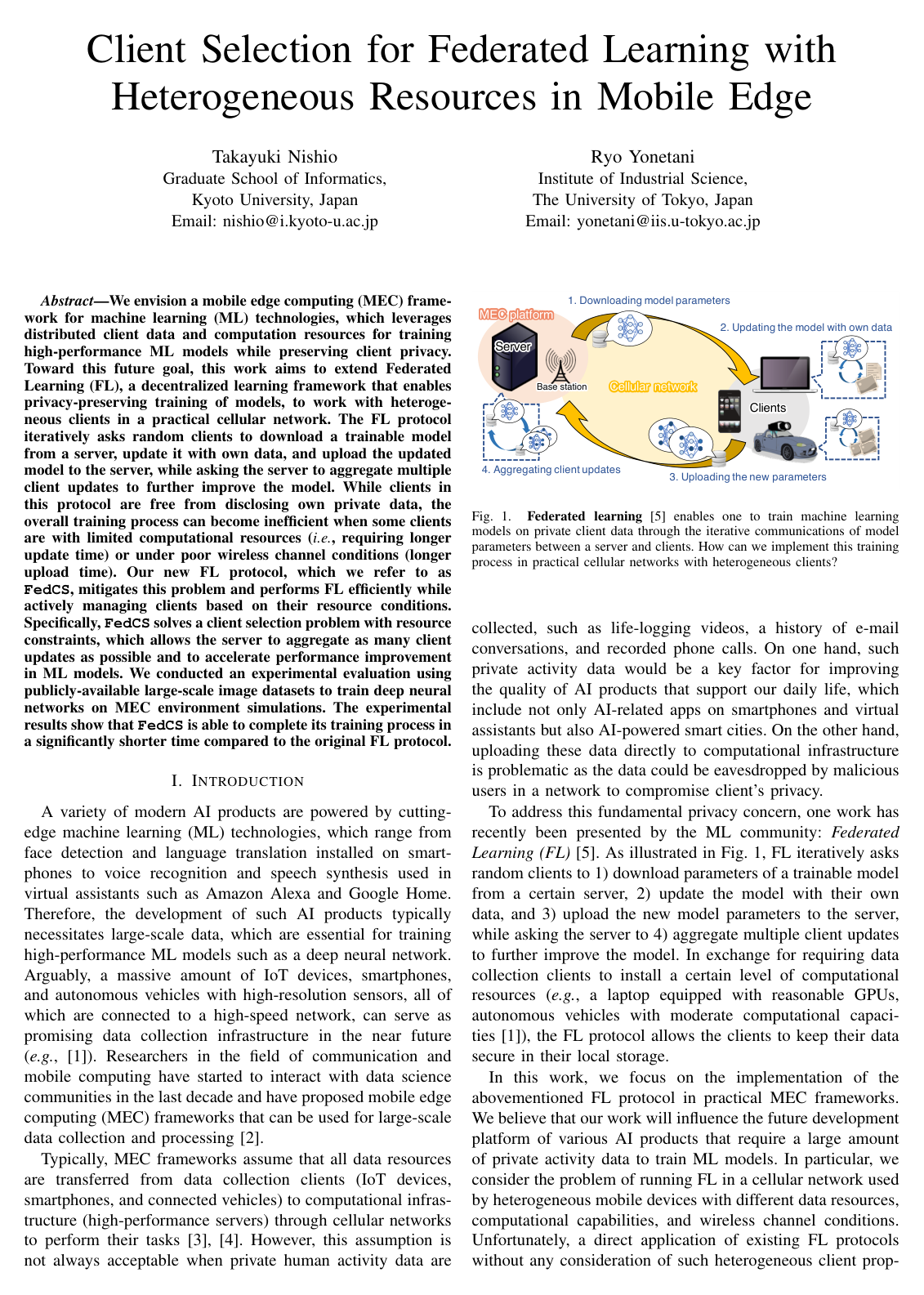
    Federated Learning with Client Selection (FedCS) is a decentralized training protocol designed for Mobile Edge Computing (MEC) networks comprising an edge server, a cellular base station (BS), and heterogeneous mobile clients with diverse channel conditions, computational power, and dataset sizes.

    FedCS executes iterative training rounds governed by a per-round deadline TroundT_\text{round} and a global deadline TfinalT_\text{final} through the following sequence of steps:

    1. Initialization: The edge server initializes the parameters of a global machine learning model either randomly or via pre-training on public data.

    2. Resource Request: The MEC operator sends a request to a randomly sampled subset K′⊆KK' \subseteq \mathcal{K} of all participating clients K={1,…,K}\mathcal{K} = \{1, \dots, K\}, where ∣K′∣=⌈K×C⌉|K'| = \lceil K \times C \rceil and C∈(0,1]C \in (0, 1] is the fraction of candidate clients queried per round. Clients in K′K' return their resource profiles, including wireless channel state, computational capabilities (such as available CPU or GPU processing speeds), and the local dataset size relevant to the learning task.

    3. Client Selection: Using the reported resource metrics, the MEC operator executes a scheduling procedure to determine a client subset S⊆K′S \subseteq K' and their upload sequence such that all selected clients can complete model distribution, local computation, and parameter upload within the round deadline TroundT_\text{round}.

    4. Distribution: The base station multicasts the global model parameters to all selected clients SS. Multicast transmission throughput is determined by the client in SS with the poorest channel state.

    5. Scheduled Update and Upload: Selected clients update the global model in parallel on their local datasets. Upon completing local training, clients sequentially transmit their updated model parameters back to the base station over allocated LTE Resource Blocks (RBs) in the order scheduled by the MEC operator.

    6. Aggregation: The server averages the received parameter updates and updates the global model.

    Steps 2 through 6 iterate until the global model achieves a target performance threshold or the cumulative elapsed time reaches TfinalT_\text{final}.

  2. Knowl 2 — Client Selection Problem Formulation under Round Deadlines

    equation

    In FedCS, the MEC operator optimizes the subset of participating clients to maximize the number of aggregated updates within a per-round deadline TroundT_\text{round}. Let K′⊆{1,…,K}K' \subseteq \{1, \dots, K\} be the set of candidate clients queried in the resource request step. The client selection and ordering is formulated as the following combinatorial optimization problem over the ordered sequence S=[k1,k2,…,k∣S∣]S = [k_1, k_2, \dots, k_{|S|}] where ki∈K′k_i \in K' and ∣S∣≤∣K′∣|S| \le |K'|:

    max⁡S∣S∣\max_{S} |S|

    subject toTround≥Tcs+TSd+Θ∣S∣+Tagg\text{subject to} \quad T_\text{round} \ge T_\text{cs} + T^d_S + \Theta_{|S|} + T_\text{agg}

    where:

    • ∣S∣|S| is the number of selected clients.
    • Tround∈R+T_\text{round} \in \mathbb{R}_+ is the time deadline for the round.
    • Tcs∈R+T_\text{cs} \in \mathbb{R}_+ is the execution time of the client selection step.
    • Tagg∈R+T_\text{agg} \in \mathbb{R}_+ is the execution time of the server model aggregation step.
    • TSd∈R+T^d_S \in \mathbb{R}_+ is the time required for the base station to multicast the global model to all clients in SS.
    • Θ∣S∣∈R+\Theta_{|S|} \in \mathbb{R}_+ is the total estimated time required for all ∣S∣|S| clients to finish both local model computation and sequential parameter uploads.
  3. Knowl 3 — Elapsed Time Model for Concurrent Local Update and Sequential Upload

    equation

    In FedCS, selected clients S=[k1,…,k∣S∣]S = [k_1, \dots, k_{|S|}] perform local model updates concurrently while uploading their updated parameters sequentially to avoid wireless bandwidth congestion. Let DmD_m denote the size of the global model parameters in bits, and let θk\theta_k denote the uplink throughput of client kk. Let tkUD∈R+t^\text{UD}_k \in \mathbb{R}_+ denote the local update computation time for client kk, and tkUL∈R+t^\text{UL}_k \in \mathbb{R}_+ denote its parameter upload time:

    tkUL=Dmθkt^\text{UL}_k = \frac{D_m}{\theta_k}

    Because the base station distributes the model to all selected clients via multicast, the distribution time TSdT^d_S is constrained by the slowest recipient:

    TSd=Dmmin⁡k∈S{θk}T^d_S = \frac{D_m}{\min_{k \in S} \{\theta_k\}}

    The cumulative elapsed time Θi\Theta_i from the start of the execution phase until the ii-th client kik_i finishes uploading its updated model parameters is defined recursively by:

    Θi:={0if i=0TiUD+TiULif i≥1\Theta_i := \begin{cases} 0 & \text{if } i = 0 \\ T^\text{UD}_i + T^\text{UL}_i & \text{if } i \ge 1 \end{cases}

    where:

    TiUD=∑j=1imax⁡{0,tkjUD−Θj−1}T^\text{UD}_i = \sum_{j=1}^i \max\{0, t^\text{UD}_{k_j} - \Theta_{j-1}\}

    TiUL=∑j=1itkjULT^\text{UL}_i = \sum_{j=1}^i t^\text{UL}_{k_j}

    Here, TiULT^\text{UL}_i accumulates the sequential upload times of all preceding clients. In TiUDT^\text{UD}_i, client kjk_j's update computation time tkjUDt^\text{UD}_{k_j} only contributes to the total elapsed time if it exceeds the elapsed upload and computation time Θj−1\Theta_{j-1} of prior clients, reflecting the pipelined parallelism between concurrent local updates and sequential uploads.

  4. Knowl 4 — Greedy Client Selection Algorithm for Knapsack-Constrained FL

    algorithm

    The FedCS client selection problem is solved using a greedy heuristic with computational complexity O(∣K′∣∣S∣)O(|K'||S|), avoiding the O(2∣K′∣!)O(2^{|K'|}!) complexity of brute-force search. At each iteration, the algorithm selects the client from the remaining candidate set K′K' that adds the minimum marginal time to the combined multicast distribution, upload, and unhidden computation time.

    Input: Candidate client index set K′K', round deadline TroundT_\text{round}, selection time TcsT_\text{cs}, aggregation time TaggT_\text{agg}, model size DmD_m, client update times {tkUD}\{t^\text{UD}_k\}, client upload throughputs {θk}\{\theta_k\}
    Output: Ordered sequence of selected clients SS
    Initialize S←[]S \leftarrow []
    Initialize TSd←0T^d_S \leftarrow 0
    Initialize Θ←0\Theta \leftarrow 0
    while ∣K′∣>0|K'| > 0 do
        x←arg⁡max⁡k∈K′1(TS∪{k}d−TSd)+tkUL+max⁡{0,tkUD−Θ}x \leftarrow \arg\max_{k \in K'} \frac{1}{(T^d_{S \cup \{k\}} - T^d_S) + t^\text{UL}_k + \max\{0, t^\text{UD}_k - \Theta\}}
        K′←K′∖{x}K' \leftarrow K' \setminus \{x\}
        Θ′←Θ+txUL+max⁡{0,txUD−Θ}\Theta' \leftarrow \Theta + t^\text{UL}_x + \max\{0, t^\text{UD}_x - \Theta\}
        t←Tcs+TS∪{x}d+Θ′+Taggt \leftarrow T_\text{cs} + T^d_{S \cup \{x\}} + \Theta' + T_\text{agg}
        if t<Troundt < T_\text{round} then
            Θ←Θ′\Theta \leftarrow \Theta'
            Append xx to SS
        end if
    end while
    return SS

    The algorithm repeatedly evaluates candidate clients k∈K′k \in K', finds the client xx with the largest ratio of unit progress to marginal delay, calculates tentative elapsed time tt, and appends xx to sequence SS if t<Troundt < T_\text{round}.

  5. Knowl 5 — MEC Cellular Environment and Dataset Simulation Setup

    experimental setup

    The simulation environment models an urban microcell of radius 2 km containing a single edge server co-located with a cellular base station (BS) and K=1000K = 1000 clients uniformly distributed across the cell.

    • Wireless Network Model: Communications use the LTE hexagonal layout defined by the ITU-R M.2135-1 Micro NLOS channel model at 2.5 GHz. BS and client antenna heights are 11 m and 1 m, transmission power is 20 dBm, and antenna gain is 0 dBi. Each client is allocated 10 Resource Blocks (1.8 MHz bandwidth) per 0.5 ms time slot. Shannon capacity with loss parameters Δ=1.6\Delta = 1.6 and ρmax=4.8\rho_\text{max} = 4.8 yields a mean uplink throughput of 1.4 Mbit/s and maximum throughput of 8.6 Mbit/s.
    • Computational Heterogeneity: Client local processing capability is uniformly sampled in the range [10,100][10, 100] data samples/second, resulting in average update times tkUD∈[5,500]t^\text{UD}_k \in [5, 500] seconds. Server selection and aggregation times are modeled as negligible (Tcs=0,Tagg=0T_\text{cs} = 0, T_\text{agg} = 0).
    • Uncertainty Perturbation: Runtime upload throughput and computational capacities are drawn from Gaussian distributions centered at their mean values with standard deviation set to r%r\% of the mean (r∈{0,10,20}r \in \{0, 10, 20\}). Default deadlines are Tround=3T_\text{round} = 3 minutes and Tfinal=400T_\text{final} = 400 minutes.
    • Datasets and Partitioning: Evaluated on CIFAR-10 (50,000 train, 10,000 test; 10 classes) and Fashion-MNIST (60,000 train, 10,000 test; 10 classes). Each of the 1000 clients holds between 100 and 1,000 training images. In the IID setting, samples are randomly drawn from the full dataset. In the Non-IID setting, each client's data is sampled exclusively from 2 randomly assigned classes.
    • Model Architectures: A CNN with six 3×33 \times 3 convolutional layers (32, 32, 64, 64, 128, 128 channels, ReLU, batch normalization, 2×22 \times 2 max pooling after every two layers) and three fully connected layers (382, 192, 10 units). Model size DmD_m is 4.6 million parameters (18.3 MB) for CIFAR-10 and 3.6 million parameters (14.4 MB) for Fashion-MNIST.
    • Training Hyperparameters: Candidate fraction C=0.1C = 0.1 (∣K′∣=100|K'| = 100), mini-batch size 50, 5 local epochs per round, initial learning rate 0.25, and learning rate decay 0.99.
  6. Knowl 6 — Convergence Speed and Final Accuracy under IID Data Partitioning

    data/table

    The performance of FedCS was benchmarked against FedLim (a deadline-limited variant of standard Federated Learning where clients are chosen uniformly at random and late uploads exceeding TroundT_\text{round} are discarded). Performance was measured by Time of Arrival (ToA@xx, in minutes to reach target test accuracy xx) and test accuracy at Tfinal=360T_\text{final} = 360 minutes across ten trials under IID data distribution.

    Method CIFAR-10
    [email protected] [email protected] Accuracy
    FedLim (Tround=3 minT_\text{round} = 3\text{ min}) 38.1 209.2 0.77
    FedCS Tround=3 min(r=0%)T_\text{round} = 3\text{ min} (r = 0\%) 25.8 132.7 0.79
    FedCS Tround=3 min(r=10%)T_\text{round} = 3\text{ min} (r = 10\%) 27.9 138.1 0.78
    FedCS Tround=3 min(r=20%)T_\text{round} = 3\text{ min} (r = 20\%) 31.1 178.3 0.78
    FedCS Tround=1 min(r=0%)T_\text{round} = 1\text{ min} (r = 0\%) NaN NaN 0.50
    FedCS Tround=5 min(r=0%)T_\text{round} = 5\text{ min} (r = 0\%) 41.0 166.6 0.79
    FedCS Tround=10 min(r=0%)T_\text{round} = 10\text{ min} (r = 0\%) 75.7 281.7 0.76
    Method Fashion-MNIST
    [email protected] [email protected] Accuracy
    FedLim (Tround=3 minT_\text{round} = 3\text{ min}) 10.4 66.8 0.90
    FedCS Tround=3 min(r=0%)T_\text{round} = 3\text{ min} (r = 0\%) 10.6 33.5 0.91
    FedCS Tround=3 min(r=10%)T_\text{round} = 3\text{ min} (r = 10\%) 11.3 32.1 0.92
    FedCS Tround=3 min(r=20%)T_\text{round} = 3\text{ min} (r = 20\%) 12.7 37.0 0.91
    FedCS Tround=1 min(r=0%)T_\text{round} = 1\text{ min} (r = 0\%) 3.0 73.7 0.89
    FedCS Tround=5 min(r=0%)T_\text{round} = 5\text{ min} (r = 0\%) 18.1 48.8 0.92
    FedCS Tround=10 min(r=0%)T_\text{round} = 10\text{ min} (r = 0\%) 42.0 93.3 0.91

    For Tround=3T_\text{round} = 3 min and r=0%r = 0\%, FedCS reaches 75%75\% accuracy on CIFAR-10 76.576.5 minutes faster than FedLim (132.7132.7 min vs. 209.2209.2 min) and reaches 85%85\% accuracy on Fashion-MNIST 33.333.3 minutes faster (33.533.5 min vs. 66.866.8 min). This acceleration is driven by client throughput: FedCS aggregates an average of 7.7 client updates per 3-minute round, compared to 3.3 clients for FedLim.

  7. Knowl 7 — Robustness and Performance under Non-IID Data Partitioning

    data/table

    Under a Non-IID partitioning where each client possesses data from only 2 of the 10 classes, FedCS was evaluated against FedLim with round deadline Tround=5T_\text{round} = 5 minutes over Tfinal=360T_\text{final} = 360 minutes. Metrics include Time of Arrival (ToA, in minutes) and final test classification accuracy averaged over ten trials.

    Method CIFAR-10
    [email protected] [email protected] Accuracy
    FedLim (Tround=5 minT_\text{round} = 5\text{ min}) NaN NaN 0.31
    FedCS (Tround=5 minT_\text{round} = 5\text{ min}) 91.7 213.7 0.54
    Method Fashion-MNIST
    [email protected] [email protected] Accuracy
    FedLim (Tround=5 minT_\text{round} = 5\text{ min}) NaN NaN 0.46
    FedCS (Tround=5 minT_\text{round} = 5\text{ min}) 82.4 187.7 0.71

    Under Non-IID data distributions, FedLim fails to achieve intermediate target accuracies (0.35 on CIFAR-10 and 0.50 on Fashion-MNIST), achieving final accuracies of only 0.31 and 0.46. In contrast, FedCS reaches 50% accuracy on CIFAR-10 in 213.7 minutes (final accuracy 0.54) and 70% accuracy on Fashion-MNIST in 187.7 minutes (final accuracy 0.71).

  8. Knowl 8 — Round Deadline Trade-off Between Client Participation and Aggregation Frequency

    empirical result

    The choice of the round deadline parameter TroundT_\text{round} governs a trade-off between the number of participating clients in each individual round and the total number of aggregation rounds completed before the final deadline TfinalT_\text{final}:

    • Excessively Large TroundT_\text{round} (e.g., 10 minutes): Allows a larger number of heterogeneous clients to be selected in each round, but sharply reduces the total number of aggregation steps executed within Tfinal=360T_\text{final} = 360 minutes. On CIFAR-10 (IID), [email protected] slows to 281.7 minutes with Tround=10T_\text{round} = 10 min compared to 132.7 minutes with Tround=3T_\text{round} = 3 min.
    • Excessively Small TroundT_\text{round} (e.g., 1 minute): Severely restricts the set of clients capable of completing local updates and uploads within the round deadline. On CIFAR-10 (IID), setting Tround=1T_\text{round} = 1 min causes the training process to fail to reach 50%50\% accuracy ([email protected] = NaN) and plateaus at a final accuracy of 0.50.

    Optimal training progress requires setting TroundT_\text{round} to an intermediate value (such as 3 to 5 minutes) that balances client diversity per round with aggregation frequency.

  9. Knowl 9 — Robustness of FedCS Client Selection to Resource Fluctuations

    empirical result

    FedCS remains robust to stochastic discrepancies between estimated client resource metrics (notified during the Resource Request step) and realized execution metrics during the Scheduled Update and Upload step.

    When actual client throughput and compute capacity fluctuate according to a Gaussian distribution with standard deviation equal to r%r\% of the mean:

    • At r=10%r = 10\% on CIFAR-10 with Tround=3T_\text{round} = 3 min, [email protected] increases moderately from 132.7 minutes (at r=0%r = 0\%) to 138.1 minutes, with final accuracy remaining at 0.78 (vs. 0.79 at r=0%r = 0\%).
    • At r=20%r = 20\%, [email protected] increases to 178.3 minutes while still significantly outperforming the baseline FedLim (209.2 minutes).
    • On Fashion-MNIST with Tround=3T_\text{round} = 3 min, [email protected] changes from 33.5 minutes (r=0%r=0\%) to 32.1 minutes (r=10%r=10\%) and 37.0 minutes (r=20%r=20\%), with final accuracy remaining steady at 0.91–0.920.91\text{--}0.92.

    These results demonstrate that estimation uncertainty up to 20%20\% does not compromise the efficiency advantages of the greedy client selection strategy.

  10. Knowl 10 — Limitations of Static Deadlines and Fixed Resource Assumptions in FedCS

    limitation

    The FedCS framework is subject to several practical limitations identified in its design and evaluation:

    1. Static Round Deadline: TroundT_\text{round} is fixed across all training rounds. This prevents the protocol from adapting dynamically to time-varying network congestion or varying stages of model convergence.
    2. Off-Peak Network Stability Assumption: The protocol assumes that average wireless channel conditions and client compute capacities remain stationary during the learning session (e.g., during off-peak hours at midnight), limiting applicability in highly dynamic networks with mobile or intermittently connected clients.
    3. Performance Degradation on Non-IID Partitions: While FedCS outperforms random client selection on Non-IID data, total convergence speed and final accuracy remain noticeably degraded compared to IID data due to the deadline restricting the total number of clients participating per round.

Coverage note — None. All major contributed methods, formal problem definitions, algorithms, experimental parameters, empirical results, and stated limitations have been covered.

References

  1. 1.J. Choi, V. Va, N. Gonzalez-Prelcic, R. Daniels, C. R. Bhat, and R. W. Heath, “Millimeter-wave vehicular communication to support massive automotive sensing,” IEEE Commun. Mag., vol. 54, no. 12, pp. 160–167, Dec. 2016.
  2. 2.Y. C. Hu, M. Patel, D. Sabella, N. Sprecher, and V. Young, “Mobile edge computing–a key technology towards 5G,” ETSI white paper, 2015.
  3. 3.X. Liu, Y. Liu, H. Song, and A. Liu, “Big data orchestration as a service network,” IEEE Commun. Mag., vol. 55, no. 9, pp. 94–101, Sept. 2017.
  4. 4.S. Kato and R. Shinkuma, “Priority control in communication networks for accuracy-freshness tradeoff in real-time road-traffic information delivery,” IEEE Access, vol. 5, pp. 25 226–25 235, Oct. 2017.
  5. 5.H. B. McMahan, E. Moore, D. Ramage, S. Hampson, and B. A. y Arcas, “Communication-efficient learning of deep networks from decentralized data,” in Proc. of the International Conference on Artificial Intelligence and Statistics, Apr. 2017.
  6. 6.T. Nishio, R. Shinkuma, T. Takahashi, and N. B. Mandayam, “Service-oriented heterogeneous resource sharing for optimizing service latency in mobile cloud,” in Proc. of the International Workshop on Mobile Cloud Computing & Networking, July 2013, pp. 19–26.
  7. 7.S. Sardellitti, G. Scutari, and S. Barbarossa, “Joint optimization of radio and computational resources for multicell mobile-edge computing,” IEEE Transactions on Signal and Information Processing over Networks, vol. 1, no. 2, pp. 89–103, June 2015.
  8. 8.Y. Yu, J. Zhang, and K. B. Letaief, “Joint subcarrier and CPU time allocation for mobile edge computing,” in Proc. of the IEEE Globecom, Dec. 2016, pp. 1–6.
  9. 9.K. Bonawitz, V. Ivanov, B. Kreuter, A. Marcedone, H. B. McMahan, S. Patel, D. Ramage, A. Segal, and K. Seth, “Practical secure aggregation for privacy-preserving machine learning,” in Proc. of the ACM CCS, Oct. 2017, pp. 1175–1191.
  10. 10.R. C. Geyer, T. Klein, and M. Nabi, “Differentially private federated learning: A client level perspective,” CoRR, vol. abs/1712.07557, 2017.
  11. 11.J. Konečný, H. B. McMahan, F. X. Yu, P. Richtárik, A. T. Suresh, and D. Bacon, “Federated learning: Strategies for improving communication efficiency,” in Proc. of the NIPS Workshop on Private Multi-Party Machine Learning, Dec. 2016.
  12. 12.S. Wang, T. Tuor, T. Salonidis, K. K. Leung, C. Makaya, T. He, and K. Chan, “When edge meets learning: Adaptive control for resource-constrained distributed machine learning,” in Proc. of the IEEE INFOCOM, Apr. 2018.
  13. 13.S. Sesia, M. Baker, and I. Toufik, LTE-the UMTS Long Term Evolution: From Theory to Practice. John Wiley & Sons, 2011.
  14. 14.M. Sviridenko, “A note on maximizing a submodular set function subject to a knapsack constraint,” Operations Research Letters, vol. 32, no. 1, pp. 41–43, Jan. 2004.
  15. 15.M. Series, “Guidelines for evaluation of radio interface technologies for IMT-Advanced,” Report ITU-R M.2135-1, 2009.
  16. 16.M. R. Akdeniz, Y. Liu, M. K. Samimi, S. Sun, S. Rangan, T. S. Rappaport, and E. Erkip, “Millimeter wave channel modeling and cellular capacity evaluation,” IEEE J. Sel. Areas Commun., vol. 32, no. 6, pp. 1164–1179, June 2014.
  17. 17.H. Xiao, K. Rasul, and R. Vollgraf, “Fashion-MNIST: a novel image dataset for benchmarking machine learning algorithms,” CoRR, vol. abs/1708.07747, 2017.
  18. 18.Y. Zhao, M. Li, L. Lai, N. Suda, D. Civin, and V. Chandra, “Federated learning with non-iid data,” CoRR, vol. abs/1806.00582, 2018.
  19. 19.K. He, X. Zhang, S. Ren, and J. Sun, “Deep residual learning for image recognition,” in Proc. of the IEEE CVPR, Dec. 2016, pp. 171–180.
  20. 20.Y. Yamada, M. Iwamura, and K. Kise, “Shakedrop regularization,” CoRR, vol. abs/1802.02375, 2018.

Citation

MLA
Nishio, T., and R. Yonetani. “Client Selection for Federated Learning with Heterogeneous Resources in Mobile Edge”. ICC 2019 - 2019 IEEE International Conference on Communications (ICC), 2019, pp. 1–7, https://doi.org/10.1109/ICC.2019.8761315.
APA
Nishio, T., & Yonetani, R. (2019). Client Selection for Federated Learning with Heterogeneous Resources in Mobile Edge. ICC 2019 - 2019 IEEE International Conference on Communications (ICC), 1–7. https://doi.org/10.1109/ICC.2019.8761315
Chicago
Nishio, T., and R. Yonetani. 2019. “Client Selection for Federated Learning with Heterogeneous Resources in Mobile Edge”. ICC 2019 - 2019 IEEE International Conference on Communications (ICC), 1–7. https://doi.org/10.1109/ICC.2019.8761315.
Harvard
Nishio, T. and Yonetani, R. (2019) “Client Selection for Federated Learning with Heterogeneous Resources in Mobile Edge”, ICC 2019 - 2019 IEEE International Conference on Communications (ICC). IEEE, pp. 1–7. Available at: https://doi.org/10.1109/ICC.2019.8761315.
Vancouver
1. Nishio T, Yonetani R (2019) Client Selection for Federated Learning with Heterogeneous Resources in Mobile Edge. In: ICC 2019 - 2019 IEEE International Conference on Communications (ICC). IEEE, pp 1–7

BibTeX

@inproceedings{Nishio_2019, title={Client Selection for Federated Learning with Heterogeneous Resources in Mobile Edge}, url={http://dx.doi.org/10.1109/ICC.2019.8761315}, DOI={10.1109/icc.2019.8761315}, booktitle={ICC 2019 - 2019 IEEE International Conference on Communications (ICC)}, publisher={IEEE}, author={Nishio, Takayuki and Yonetani, Ryo}, year={2019}, month=May, pages={1–7} }
Metadata:Crossref

Access the Paper

This paper is available from its original source. Click below to access the PDF.

Open PDF