PubMedQA: A Dataset for Biomedical Research Question Answering
Qiao JinBhuwan DhingraZhengping LiuWilliam W. CohenXinghua Lu
Introduces PubMedQA, a biomedical question answering benchmark requiring reasoning over quantitative findings in research abstracts, revealing a substantial performance gap between language models and human experts.
Biomedical natural language processing has historically been constrained by small datasets focused on simple fact retrieval rather than complex reasoning. In real-world biomedical literature, understanding study outcomes requires synthesizing quantitative findings and comparing clinical cohorts rather than extracting basic facts. To address this gap and support evidence-based decision-making, the article introduces PubMedQA, a novel biomedical question-answering dataset derived from PubMed research abstracts.
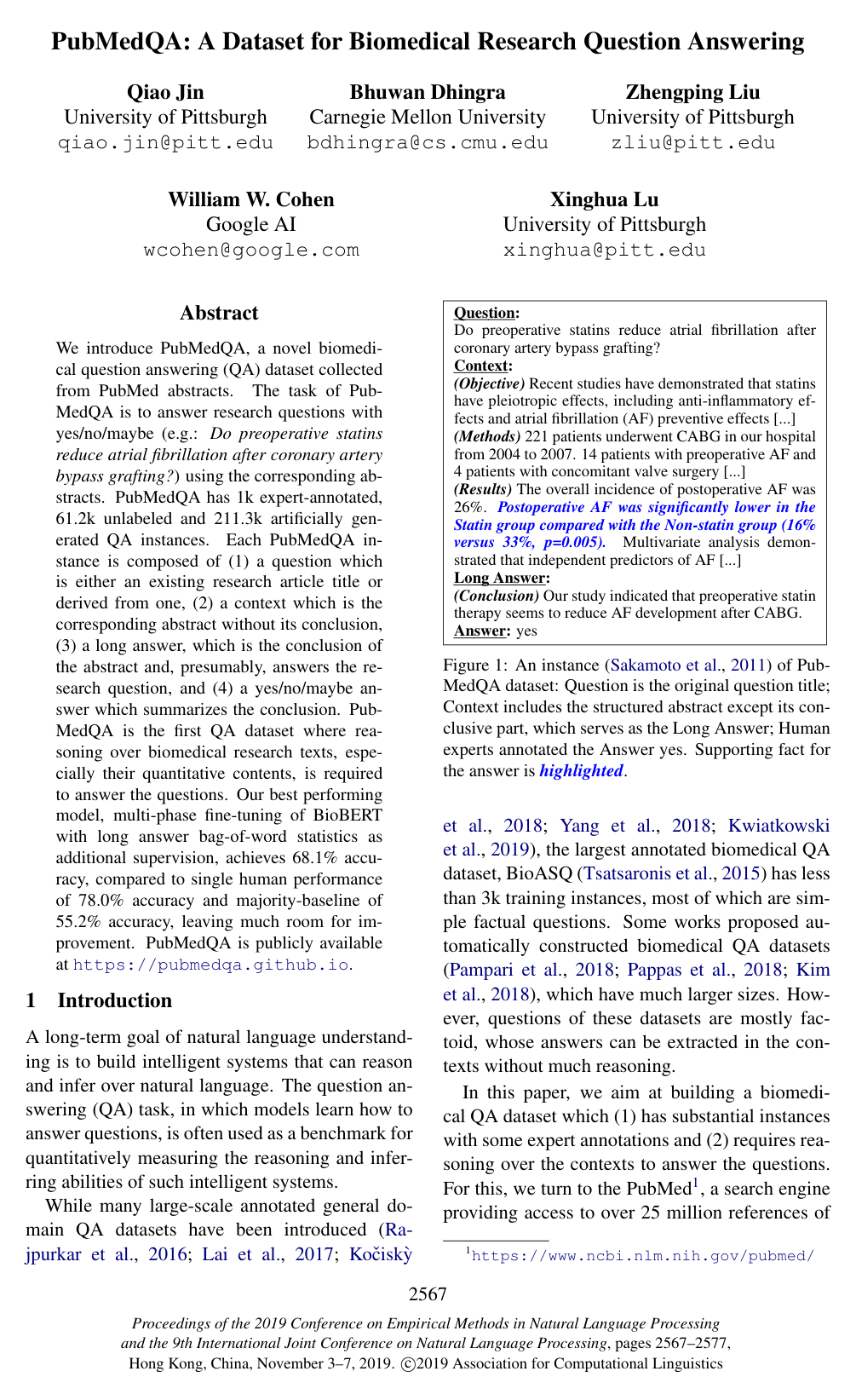
The article evaluates how effectively machine learning models can reason over biomedical study abstracts to answer research questions with "yes," "no," or "maybe." The dataset is structured across three tiers: 1,000 expert-annotated instances labeled by medical candidates, 61,200 unlabeled instances for semi-supervised learning, and 211,300 artificially generated instances created by converting statement titles into questions. Each instance includes a research question, the abstract text excluding its conclusion as the reasoning context, a long answer representing the original conclusion, and a categorical summary answer. Models were evaluated on their ability to infer the correct categorical answer using only the question and context, supported by a multi-phase fine-tuning schedule and auxiliary supervision from the long answer text.
The primary finding is that the best-performing model—a domain-specific BioBERT architecture trained via multi-phase fine-tuning with auxiliary supervision—achieved an accuracy of 68.1% and a macro-F1 score of 52.7% on the expert-labeled test set. This performance significantly exceeded the baseline majority-class guess of 55.2% accuracy. However, machine performance trailed far behind human capability, as a single human annotator achieved 78.0% accuracy under identical reasoning-required conditions and 90.4% when conclusions were provided. The analysis also revealed that 96.5% of questions required quantitative reasoning across cohorts or subgroup statistics, and 21.0% of contexts contained raw numerical data without textual interpretations. Furthermore, pre-training models on artificially generated data and using auxiliary supervision from the conclusion text consistently improved classification accuracy across model families.
These findings demonstrate that while artificial intelligence can assist in synthesizing scientific literature, current systems struggle with numerical and scientific reasoning tasks that humans resolve with relative ease. Relying on current automated systems for high-stakes medical or policy decisions carries substantial risk, as the models miss roughly one in three scientific conclusions. However, the success of multi-phase pre-training indicates that automated data generation can bridge resource bottlenecks where expert human annotation is prohibitively expensive.
Organizations developing automated literature review or evidence-based clinical tools should adopt multi-phase training schedules and structured supervision rather than relying solely on raw text matching. Future research should prioritize enhancing numerical reasoning mechanisms to handle uninterpreted statistics and exploring full long-answer generation to improve inference depth. Stakeholders should interpret the benchmark results with measured confidence: while the dataset offers rigorous coverage of clinical research topics, the expert test set is limited to 1,000 examples, and current automated models remain insufficient for standalone, autonomous clinical interpretation.
- Paper: BioBERT: a pre-trained biomedical language representation model for biomedical text mining, Jinhyuk Lee et al. (2019). PubMedQA’s strongest system uses BioBERT, so reading how BioBERT adapts BERT to biomedical text clarifies the model foundation behind the paper’s results.
- Paper: Large language models encode clinical knowledge, Karan Singhal et al. (2022). MultiMedQA incorporates PubMedQA to assess clinical question answering, extending the benchmark’s evaluation of research-abstract reasoning to broader medical questions and human-rated answer quality.
- Paper: BioGPT: Generative Pre-trained Transformer for Biomedical Text Generation and Mining, Renqian Luo et al. (2022). BioGPT evaluates biomedical question answering on PubMedQA, carrying the benchmark forward to generative models trained on a large PubMed corpus.
- Paper: Domain-Specific Language Model Pretraining for Biomedical Natural Language Processing, Yu Gu et al. (2020). PubMedBERT evaluates question answering within BLURB, extending biomedical language-model assessment across PubMedQA and other biomedical NLP tasks.