From captions to visual concepts and back
Hao FangSaurabh GuptaF. IandolaR. SrivastavaL. DengPiotr DollárJianfeng GaoXiaodong HeMargaret MitchellJohn C. Platt
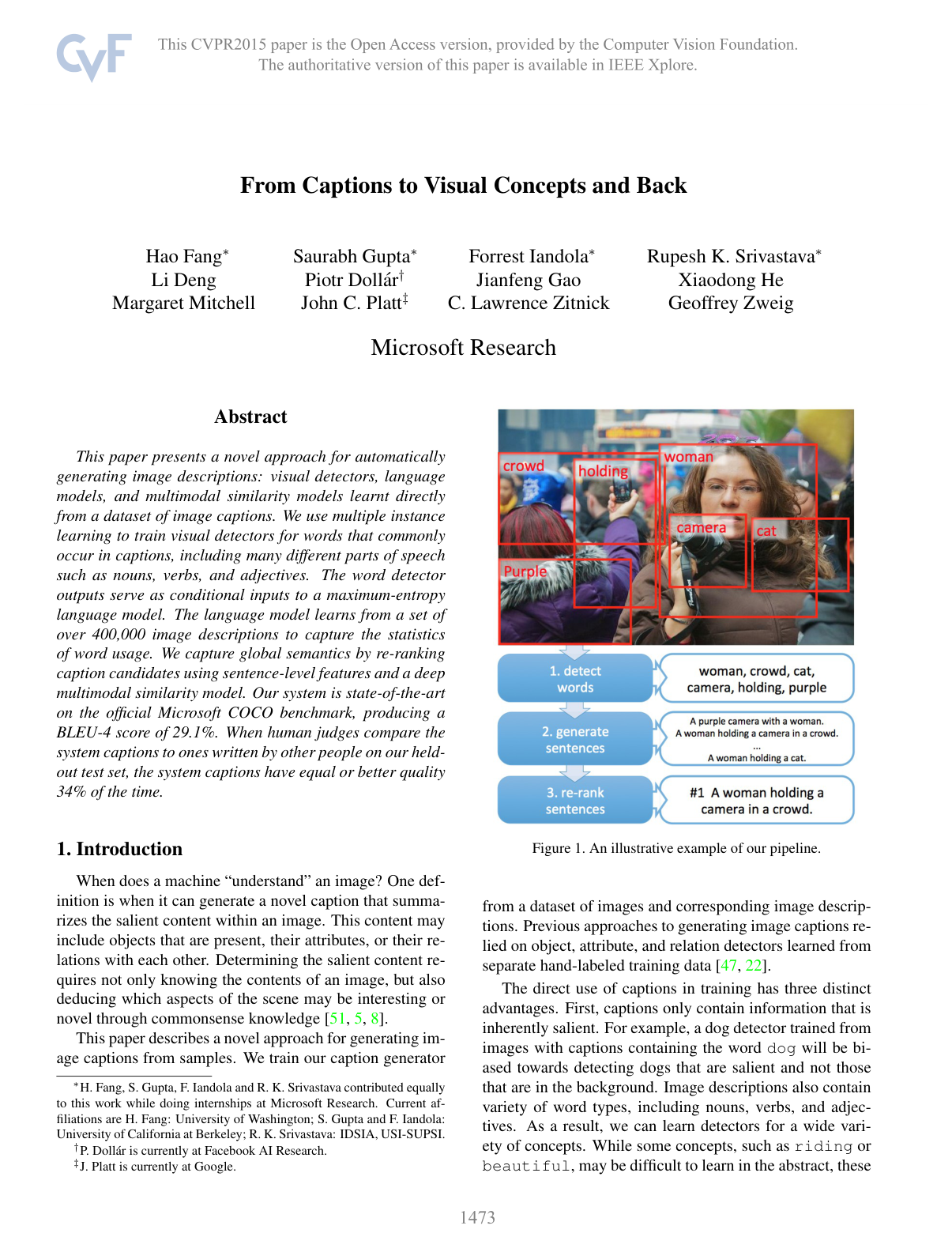
Presents an image captioning pipeline that learns visual concept detectors directly from weakly-supervised captions via multiple instance learning, generates candidate descriptions with a maximum-entropy language model, and selects the best description using a deep multimodal similarity model.
Automatically generating accurate, natural language descriptions of images is a fundamental challenge in artificial intelligence, with applications ranging from digital accessibility to automated media indexing. Traditional captioning systems rely heavily on expensive, hand-labeled bounding box annotations and struggle to identify abstract visual concepts or construct fluent, commonsense descriptions. The article addresses this challenge by evaluating an automated image captioning pipeline that learns visual concepts, language statistics, and cross-modal relevance directly from paired image and caption datasets without requiring manual bounding boxes.
The authors develop a three-stage framework. First, they train visual detectors for a 1,000-word vocabulary across various parts of speech using weakly supervised multiple instance learning applied to sub-regions of images via deep convolutional neural networks. Second, a maximum-entropy statistical language model takes these detected words to generate candidate sentences through a beam-search optimization process. Finally, a deep multimodal similarity model maps images and text into a shared semantic vector space, re-ranking candidate sentences to select the best caption. The framework was evaluated on the benchmark Microsoft Common Objects in Context (COCO) dataset, spanning over 80,000 training images and an official test set of over 40,000 images, alongside the PASCAL sentence dataset.
The experimental findings show that the proposed approach achieves state-of-the-art results across standard benchmarks. On the official Microsoft COCO test server, the system achieved a BLEU-4 score of 29.1% (compared to 21.7% for human-written captions) and equaled or surpassed human performance benchmarks on 12 of 14 evaluation metrics, including CIDEr. In human subjective assessments, human evaluators judged the system's generated captions to be of equal or better quality than human-written captions 34% of the time. Additionally, training visual detectors via multiple instance learning on image sub-regions systematically outperformed whole-image classification baselines, achieving an average precision of 34.0% across all vocabulary categories compared to 30.8% for standard image classifiers.
These results demonstrate that systems can learn rich, salient visual concepts—including verbs and adjectives—directly from raw caption data without costly bounding box annotations. By combining statistical language models with global multimodal re-ranking, the pipeline filters out visual noise and preserves commonsense semantics. This substantially lowers data labeling costs while delivering caption quality suitable for real-world deployment.
Organizations implementing automated image description should adopt weakly supervised region-based visual detection paired with multimodal semantic re-ranking rather than relying solely on end-to-end language models or costly hand-annotated object boxes. Decision-makers should note that while automatic metric scores frequently exceed human reference numbers, human judges still prefer human-written descriptions in roughly two-thirds of cases, meaning automatic metrics should not be treated as a complete replacement for human evaluation. Further work should explore refining abstract relationship detection, expanding vocabulary coverage beyond frequent words, and conducting pilot testing on domain-specific imagery before deploying in high-risk operational environments.
- Paper: Rich feature hierarchies for accurate object detection and semantic segmentation, Ross Girshick et al. (2014). Introduces the region-based convolutional neural network (R-CNN) methodology for extracting sub-region visual features, which underpins this work's weakly supervised multiple instance learning detector.
- Paper: DeViSE: A Deep Visual-Semantic Embedding Model, Andrea Frome et al. (2013). Establishes foundational deep visual-semantic embeddings mapping CNN visual features into a shared semantic space with text embeddings, which directly informs the multimodal similarity re-ranking stage.
- Paper: Framing Image Description as a Ranking Task: Data, Models and Evaluation Metrics, Micah Hodosh et al. (2013). Frames image description and cross-modal retrieval as shared-space ranking tasks, establishing the core retrieval and ranking principles utilized in this paper's final decoding phase.
- Paper: BabyTalk: Understanding and Generating Simple Image Descriptions, Girish Kulkarni et al. (2013). Pioneers the generation of image descriptions by first detecting visual concepts and entities and then composing them into natural language via statistical models.
- Paper: Every Picture Tells a Story: Generating Sentences from Images, Ali Farhadi et al. (2010). Provides early groundwork for mapping images to intermediate semantic concept representations before decoding them into descriptive natural sentences.
- Paper: Im2Text: Describing Images Using 1 Million Captioned Photographs, Vicente Ordonez et al. (2011). Demonstrates large-scale image captioning and content re-ranking using web-scale captioned photograph datasets.
- Paper: Object Recognition as Machine Translation: Learning a Lexicon for a Fixed Image Vocabulary, Pinar Duygulu et al. (2002). Introduces the translation framing of object recognition by mapping discrete visual image regions to text words using weakly annotated data.
- Paper: Matching Words and Pictures, Kobus Barnard et al. (2003). Presents early probabilistic models for jointly learning correspondences between unaligned image regions and text vocabulary from weakly labeled data.
- Paper: Deep visual-semantic alignments for generating image descriptions, Andrej Karpathy et al. (2015). Extends region-word alignment into an end-to-end multimodal recurrent neural network architecture for grounding sentence fragments directly in image regions.
- Paper: Show and tell: A neural image caption generator, Oriol Vinyals et al. (2015). Replaces multi-stage concept detection and language ranking pipelines with an end-to-end neural encoder-decoder captioning model.
- Paper: Show, Attend and Tell: Neural Image Caption Generation with Visual Attention, Kelvin Xu et al. (2015). Advances image captioning beyond static global vectors and fixed detectors by introducing dynamic spatial attention mechanisms over CNN feature grids.
- Paper: Image Captioning with Semantic Attention, Quanzeng You et al. (2016). Directly integrates intermediate semantic visual concept detectors with recurrent language generation via selective semantic attention.
- Paper: Bottom-Up and Top-Down Attention for Image Captioning and Visual Question Answering, Peter Anderson et al. (2018). Combines bottom-up object detection proposals with top-down visual attention inside neural language decoders, advancing the regional concept approach.
- Paper: Microsoft COCO Captions: Data Collection and Evaluation Server, Xinlei Chen et al. (2015). Establishes the standardized MS COCO Caption dataset and automated evaluation server utilized to benchmark captioning systems like the one presented here.
- Paper: CIDEr: Consensus-based image description evaluation, Ramakrishna Vedantam et al. (2014). Introduces the CIDEr consensus metric to evaluate captioning models specifically on human reference consensus rather than surface-level translation overlap.
- Paper: Flickr30k Entities: Collecting Region-to-Phrase Correspondences for Richer Image-to-Sentence Models, Bryan A. Plummer et al. (2015). Provides explicit phrase-to-bounding-box annotations on Flickr30k to ground weakly supervised region-concept alignments with ground-truth entity labels.
- Paper: Oscar: Object-Semantics Aligned Pre-training for Vision-Language Tasks, Xiujun Li et al. (2020). Generalizes the concept-detection philosophy by using detected semantic object tags as explicit anchor points for large-scale vision-language transformer pre-training.
- Paper: Self-Critical Sequence Training for Image Captioning, Steven J. Rennie et al. (2016). Improves caption generation fluency and scoring by optimizing recurrent captioning architectures directly on sentence-level metrics via self-critical reinforcement learning.