UCTopic: Unsupervised Contrastive Learning for Phrase Representations and Topic Mining

Jiacheng LiJingbo ShangJulian J. McAuley

article2022ACL68 citations

Presents an unsupervised contrastive learning framework that pairs masked-phrase contexts and applies cluster-assisted negative sampling to learn context-aware phrase representations and extract coherent topical terms without labeled data.

Abstract

High-quality phrase representations are essential to finding topics and related terms in documents (a.k.a. topic mining). Existing phrase representation learning methods either simply combine unigram representations in a context-free manner or rely on extensive annotations to learn context-aware knowledge. In this paper, we propose UCTOPIC, a novel unsupervised contrastive learning framework for context-aware phrase representations and topic mining. UCTOPIC is pretrained in a large scale to distinguish if the contexts of two phrase mentions have the same semantics. The key to pretraining is positive pair construction from our phrase-oriented assumptions. However, we find traditional in-batch negatives cause performance decay when finetuning on a dataset with small topic numbers. Hence, we propose cluster-assisted contrastive learning (CCL) which largely reduces noisy negatives by selecting negatives from clusters and further improves phrase representations for topics accordingly. UCTOPIC outperforms the state-of-the-art phrase representation model by 38.2% NMI in average on four entity clustering tasks. Comprehensive evaluation on topic mining shows that UCTOPIC can extract coherent and diverse topical phrases.

Table of Contents

  • 1 Introduction
  • 2 Background
  • 2.1 Contrastive Learning
  • 2.2 Phrase Encoder
  • 3 UCTopic
  • 3.1 Positive Instances
  • 3.2 Cluster-Assisted Contrastive Learning
  • 4 Experiments
  • 4.1 Implementation Details
  • 4.2 Entity Clustering
  • 4.3 Topical Phrase Mining
  • 5 Related Work
  • 6 Conclusion
  • References

Knowls

  1. Knowl 1 — UCTopic Unsupervised Phrase Representation Pre-training

    model/method

    UCTopic is an unsupervised framework for learning context-aware phrase representations via contrastive learning. A phrase instance is defined as x=(s,[l,r])x = (s, [l, r]), where ss is a sentence containing a phrase bounded by character indices ll and rr. A transformer-based encoder EE (specifically LUKE-BASE) maps xx to a span embedding h=E(s,[l,r])\mathbf{h} = E(s, [l, r]).

    To pre-train the model without manual annotation:

    1. Positive pairs (x,x+)(x, x^+) are constructed from pairs of sentences in English Wikipedia that contain the same phrase mention (or share the same Wikidata entity ID).
    2. To compel the encoder to capture contextual information rather than memorizing surface tokens, phrase mentions in the positive pair are replaced with [MASK] tokens. To mitigate train-evaluation distribution mismatch, one phrase mention in the positive pair is kept unmasked with probability p=0.5p = 0.5.
    3. The model is optimized jointly using a masked language modeling (MLM) loss and an in-batch contrastive loss with temperature τ=0.05\tau = 0.05.

    Pre-training is conducted on English Wikipedia (11.6 million sentences, 108.8 million training instances) using the AdamW optimizer with a learning rate of 5×10−55 \times 10^{-5} and batch size of 100 for 1 epoch.

  2. Knowl 2 — Cluster-Assisted Contrastive Learning for Domain Finetuning

    algorithm

    In-batch negative sampling fails during domain-specific finetuning on corpora with few topics because instances in the same batch frequently share the same underlying topic, turning true semantic positives into false negatives. Cluster-Assisted Contrastive Learning (CCL) mitigates this false negative noise by using clustering-derived pseudo-labels to guide negative selection.

    Input: Pre-trained phrase encoder EE, document sentences SS, extracted phrase instances X={(sk,[lk,rk])}X = \{(s_k, [l_k, r_k])\}, retention probability pp, selection fraction t∈{5,10,20,50}%,temperaturet \in \{5, 10, 20, 50\}\%, temperature \tau$.
    Output: Finetuned phrase encoder EE, topic representations {h~c∣c∈C}\{\tilde{\mathbf{h}}_{c} \mid c \in \mathcal{C}\}.
    Compute initial embeddings hk=E(xk)\mathbf{h}_k = E(x_k) for all xk∈Xx_k \in X.
    Cluster phrase embeddings into ∣C∣|\mathcal{C}| clusters using K-Means to obtain centroids {h~c∣c∈C}\{\tilde{\mathbf{h}}_{c} \mid c \in \mathcal{C}\}.
    For each cluster c∈Cc \in \mathcal{C}:
        Identify the top t%t\% of instances closest to centroid h~c\tilde{\mathbf{h}}_{c} by cosine distance and assign them pseudo-label cc.
    For each unique phrase mention pmp^m:
        Assign topic label c(pm)=majority_vote⁡({c(x)∣x contains pm and has a pseudo-label})c(p^m) = \operatorname{majority\_vote}(\{c(x) \mid x \text{ contains } p^m \text{ and has a pseudo-label}\}).
    for each training iteration do
        Sample a positive pair (xci,xci+)(x_{c_i}, x_{c_i}^+) belonging to topic ci∈Cc_i \in \mathcal{C}.
        Sample negative instances xcj−x_{c_j}^- from different topics cj∈Cc_j \in \mathcal{C} where cj≠cic_j \neq c_i.
        Apply context masking to instances while leaving mentions unmasked with probability pp.
        Update encoder EE parameters by minimizing the CCL contrastive loss using gradient descent.
    Update centroids h~c\tilde{\mathbf{h}}_{c} with the updated encoder embeddings.
    return E,{h~c∣c∈C}E, \{\tilde{\mathbf{h}}_{c}\mid c \in \mathcal{C}\}
  3. Knowl 3 — Phrase Semantics Assumptions for Positive Pair Construction

    assumption

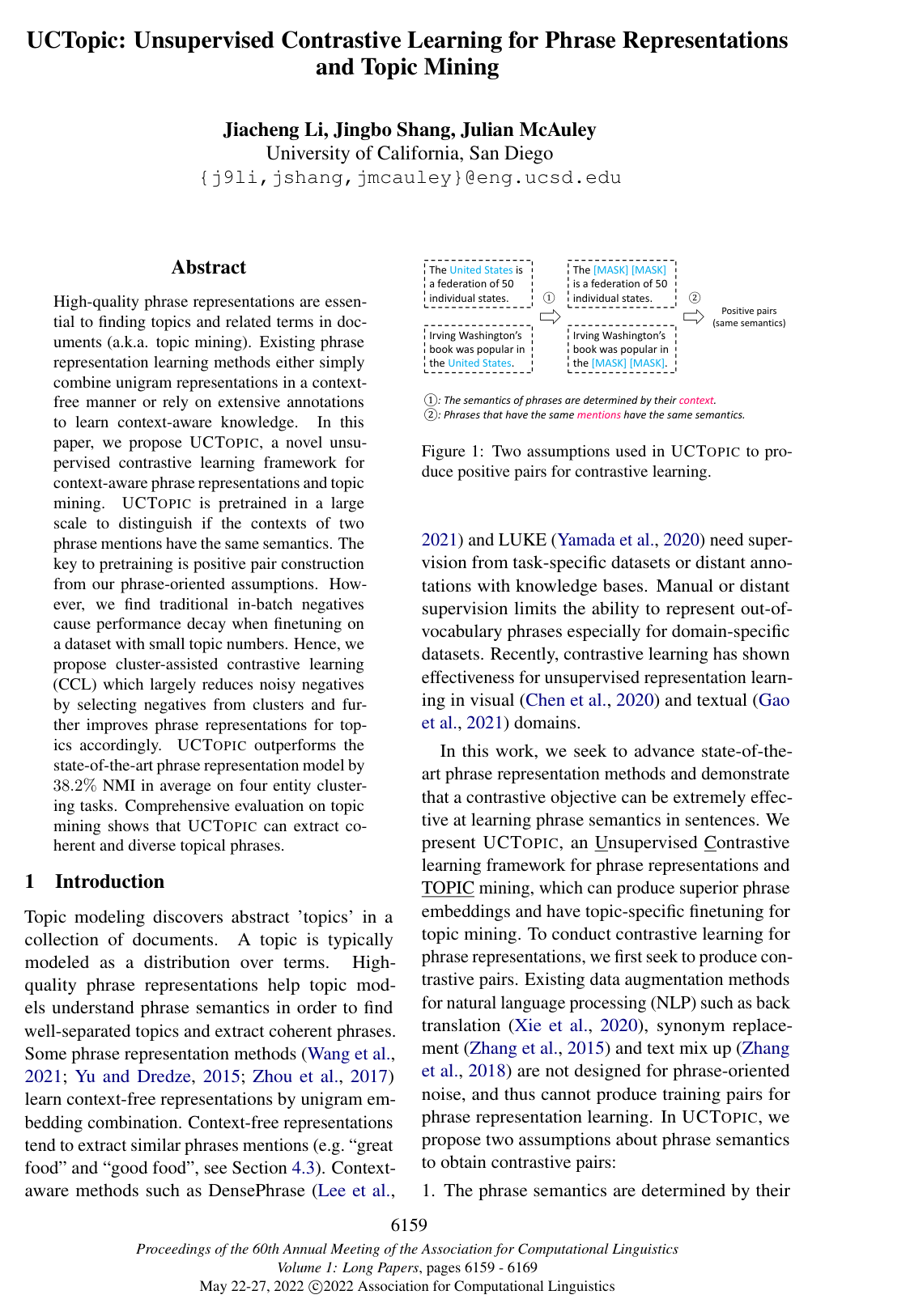
    UCTopic constructs contrastive positive pairs (x,x+)(x, x^+) for phrase representation learning based on two semantic assumptions:

    1. Contextual Determination: The semantic meaning of a phrase instance within a sentence is entirely determined by its surrounding context.
    2. Surface Mention Equivalence: Phrase occurrences that share the same surface mention (or link to the same knowledge-base entity ID) across different sentences share identical semantic meanings.

    Under these assumptions, masking the phrase mentions in two distinct sentences that originally contained the same phrase produces two masked context instances that are semantically identical to each other, forming a valid positive pair for contrastive representation learning.

  4. Knowl 4 — Contrastive Loss Functions for UCTopic Pre-training and CCL Finetuning

    equation

    The pre-training contrastive loss for a phrase representation h\mathbf{h} and its positive partner h+\mathbf{h}^+ across a mini-batch of NN instances using in-batch negatives is defined as:

    lpre=−log⁡exp⁡(sim⁡(h,h+)/τ)∑i=1Nexp⁡(sim⁡(h,hi)/τ)l_{\text{pre}} = -\log \frac{\exp(\operatorname{sim}(\mathbf{h}, \mathbf{h}^+) / \tau)}{\sum_{i=1}^{N} \exp(\operatorname{sim}(\mathbf{h}, \mathbf{h}_i) / \tau)}

    where sim⁡(h1,h2)=h1⊤h2∥h1∥∥h2∥\operatorname{sim}(\mathbf{h}_1, \mathbf{h}_2) = \frac{\mathbf{h}_1^\top \mathbf{h}_2}{\|\mathbf{h}_1\| \|\mathbf{h}_2\|} is the cosine similarity, τ\tau is the temperature hyperparameter (0.050.05), and hi\mathbf{h}_i is the ii-th instance embedding in the mini-batch.

    For Cluster-Assisted Contrastive Learning (CCL) finetuning, given a topic cluster set C\mathcal{C}, an anchor instance representation hci\mathbf{h}_{c_i} with a positive instance hci+\mathbf{h}_{c_i}^+ from topic cluster ci∈Cc_i \in \mathcal{C}, and negative instances hcj−\mathbf{h}_{c_j}^- sampled from topics cj∈C∖{ci}c_j \in \mathcal{C} \setminus \{c_i\}, the objective is:

    lCCL=−log⁡exp⁡(sim⁡(hci,hci+)/τ)exp⁡(sim⁡(hci,hci+)/τ)+∑cj∈C,cj≠ciexp⁡(sim⁡(hci,hcj−)/τ)l_{\text{CCL}} = -\log \frac{\exp(\operatorname{sim}(\mathbf{h}_{c_i}, \mathbf{h}_{c_i}^+) / \tau)}{\exp(\operatorname{sim}(\mathbf{h}_{c_i}, \mathbf{h}_{c_i}^+) / \tau) + \sum_{c_j \in \mathcal{C}, c_j \neq c_i} \exp(\operatorname{sim}(\mathbf{h}_{c_i}, \mathbf{h}_{c_j}^-) / \tau)}

  5. Knowl 5 — Topical Phrase Mining and Topic Assignment Inference

    model/method

    Topical phrase mining with UCTopic extracts domain-specific noun phrases (via spaCy noun chunking, excluding pronoun singletons) and assigns them to latent topics through the following inference steps:

    1. Dataset Topic Count Selection: K-Means is applied to pre-trained phrase representations for a 10K random phrase sample across candidate cluster numbers. The cluster count yielding the highest Silhouette Coefficient is chosen as the dataset topic count ∣C∣|\mathcal{C}|.
    2. Instance-Level Topic Prediction: Given an instance embedding h\mathbf{h} and cluster centroids {h~ci∣ci∈C}\{\tilde{\mathbf{h}}_{c_i} \mid c_i \in \mathcal{C}\}, the instance's topic is assigned via nearest neighbor cosine similarity:

    y=argmax⁡ci∈Csim⁡(h,h~ci)y = \operatorname{argmax}_{c_i \in \mathcal{C}} \operatorname{sim}(\mathbf{h}, \tilde{\mathbf{h}}_{c_i})

    1. Context-Agnostic Phrase Mention Topic Assignment: For a phrase mention pmp^m appearing in instances {x1m,x2m,…,xnm}\{x_1^m, x_2^m, \dots, x_n^m\}, the overall topic distribution vector zpm∈R∣C∣\mathbf{z}_{p^m} \in \mathbb{R}^{|\mathcal{C}|} is computed as the mean instance distribution:

    zpm=1n∑i=1nzxim\mathbf{z}_{p^m} = \frac{1}{n} \sum_{i=1}^{n} \mathbf{z}_{x_i^m}

    where zxim\mathbf{z}_{x_i^m} is the softmax topic distribution of instance ximx_i^m. The final topic of pmp^m corresponds to the dimension maximizing zpm\mathbf{z}_{p^m}.

  6. Knowl 6 — Entity Type Clustering Performance Across Domains

    data/table

    Entity clustering evaluation on four benchmark datasets (CoNLL2003 for news, BC5CDR for biomedical, MIT Movie for reviews, and W-NUT2017 for noisy emerging entities) measured by Accuracy (ACC) and Normalized Mutual Information (NMI).

    Datasets CoNLL2003 BC5CDR MIT-M W-NUT2017
    Metrics ACC NMI ACC NMI ACC NMI ACC NMI
    Pre-trained Representations
    Glove 0.528 0.166 0.587 0.026 0.880 0.434 0.368 0.188
    BERT-Ave. 0.421 0.021 0.857 0.489 0.826 0.371 0.270 0.034
    BERT-Mask 0.430 0.022 0.551 0.001 0.587 0.001 0.279 0.020
    LUKE 0.590 0.281 0.794 0.411 0.831 0.432 0.434 0.205
    DensePhrase 0.603 0.172 0.936 0.657 0.716 0.293 0.413 0.214
    Phrase-BERT 0.643 0.297 0.918 0.617 0.916 0.575 0.452 0.241
    Ours w/o CCL 0.704 0.464 0.977 0.846 0.845 0.439 0.509 0.287
    Finetuning on Pre-trained UCTOPIC Representations
    Ours w/ Class. 0.703 0.458 0.972 0.827 0.738 0.323 0.482 0.283
    Ours w/ In-B. 0.706 0.470 0.974 0.834 0.748 0.334 0.454 0.301
    Ours w/ Auto. 0.717 0.492 0.979 0.857 0.858 0.458 0.402 0.282
    UCTOPIC 0.743 0.495 0.981 0.865 0.942 0.661 0.521 0.314

    UCTopic with CCL achieves the best performance across all datasets and metrics, improving over Phrase-BERT by an average of 38.2% NMI and over the LUKE backbone by 73.2% NMI. Finetuning with simple pseudo-label classification (Ours w/ Class.) or in-batch negatives (Ours w/ In-B.) degrades performance relative to CCL due to noisy supervision and false negatives.

  7. Knowl 7 — Ablation of Phrase Context versus Surface Mention Inputs

    data/table

    An ablation study on W-NUT2017 evaluates how much semantic information UCTopic (pre-trained without CCL) and LUKE derive from context versus surface mentions when single phrase instances per mention are used to prevent frequency bias.

    Model UCTopic LUKE
    Metric ACC NMI ACC NMI
    Context+Mention 0.44 0.29 0.39 0.21
    Mention 0.32 (-27%) 0.15 (-48%) 0.28 (-28%) 0.10 (-52%)
    Context 0.43 (-3%) 0.16 (-44%) 0.27 (-31%) 0.07 (-67%)

    When surface mentions are completely masked (Context setting), UCTopic experiences only a 3% decrease in accuracy (0.44 to 0.43), whereas LUKE drops by 31% (0.39 to 0.27). This demonstrates that UCTopic's contrastive masking objective forces the model to encode rich contextual semantics rather than relying primarily on surface mention memorization.

  8. Knowl 8 — Topical Phrase Mining Informativeness, Diversity, and Coherence

    empirical result

    Topical phrase mining evaluated across three datasets—Gest (reviews, 22 topics), KP20k (computer science abstracts, 10 topics), and KPTimes (news articles, 16 topics)—demonstrates UCTopic's superiority over TopMine, PNTM, and Phrase-LDA across four quantitative criteria:

    1. Topic Separation (Phrase Intrusion): In a 6-phrase human intruder detection task (5 target topic phrases, 1 intruder phrase, 600 questions total), annotators achieved higher intruder identification accuracy with UCTopic (~0.57 on Gest, ~0.56 on KP20k, ~0.58 on KPTimes) than with PNTM (~0.43, ~0.38, ~0.41), TopMine (~0.48, ~0.31, ~0.27), and Phrase-LDA (~0.15, ~0.28, ~0.32).
    2. Topic Coherence & Precision@n: Human evaluation labeled coherent topics (Gest: UCTopic 20/22, TopMine 20/22, PNTM 18/22, Phrase-LDA 11/22; KP20k: UCTopic 10/10, TopMine 9/10, PNTM 9/10, Phrase-LDA 4/10). Within coherent topics, UCTopic maintained high top-nn precision (>0.9>0.9 up to n=50n=50), whereas baseline precision decayed significantly as nn increased.
    3. Phrase Diversity and Informativeness: Evaluated on the top 10 phrases per coherent topic using average phrase tf-idf (informativeness) and word diversity ∣w′∣/∣w∣|w'|/|w| (ratio of unique words w′w' to total words ww):
      • On Gest: UCTopic achieved tf-idf of 0.5186 and word-div of 0.7486, compared to PNTM (tf-idf 0.5152, word-div 0.5744) and TopMine (tf-idf 0.5379, word-div 0.6101).
      • On KP20k: UCTopic achieved tf-idf of 0.3311 and word-div of 0.7600, compared to PNTM (tf-idf 0.3383, word-div 0.6803) and TopMine (tf-idf 0.2551, word-div 0.7288).

    Context-agnostic models like PNTM produce redundant phrases sharing identical surface tokens (e.g., "drinks", "bar drink", "just drink"), while UCTopic extracts lexically diverse, semantically coherent topical phrases.

Coverage note — Qualitative topical phrase examples from the case study table were omitted as their quantitative findings on coherence and diversity are fully captured in the empirical evaluation knowl.

References

  1. 1.Lidong Bing, Piji Li, Yi Liao, Wai Lam, Weiwei Guo, and Rebecca J. Passonneau. 2015. Abstractive multi-document summarization via phrase selection and merging. In ACL.
  2. 2.David M. Blei, A. Ng, and Michael I. Jordan. 2003. Latent dirichlet allocation. J. Mach. Learn. Res., 3:993–1022.
  3. 3.Jonathan Chang, Jordan L. Boyd-Graber, Sean Gerrish, Chong Wang, and David M. Blei. 2009. Reading tea leaves: How humans interpret topic models. In NIPS.
  4. 4.Ting Chen, Simon Kornblith, Mohammad Norouzi, and Geoffrey E. Hinton. 2020. A simple framework for contrastive learning of visual representations. ArXiv, abs/2002.05709.
  5. 5.Ting Chen, Yizhou Sun, Yue Shi, and Liangjie Hong. 2017. On sampling strategies for neural network-based collaborative filtering. Proceedings of the 23rd ACM SIGKDD International Conference on Knowledge Discovery and Data Mining.
  6. 6.Marina Danilevsky, Chi Wang, Nihit Desai, Xiang Ren, Jingyi Guo, and Jiawei Han. 2014. Automatic construction and ranking of topical keyphrases on collections of short documents. In SDM.
  7. 7.Leon Derczynski, Eric Nichols, Marieke van Erp, and Nut Limsopatham. 2017. Results of the WNUT2017 shared task on novel and emerging entity recognition. In Proceedings of the 3rd Workshop on Noisy User-generated Text, pages 140–147, Copenhagen, Denmark. Association for Computational Linguistics.
  8. 8.Jacob Devlin, Ming-Wei Chang, Kenton Lee, and Kristina Toutanova. 2019. Bert: Pre-training of deep bidirectional transformers for language understanding. In NAACL.
  9. 9.Ahmed El-Kishky, Yanglei Song, Chi Wang, Clare R. Voss, and Jiawei Han. 2014. Scalable topical phrase mining from text corpora. ArXiv, abs/1406.6312.
  10. 10.Ygor Gallina, Florian Boudin, and Béatrice Daille. 2019. Kptimes: A large-scale dataset for keyphrase generation on news documents. In INLG.
  11. 11.Tianyu Gao, Xingcheng Yao, and Danqi Chen. 2021. Simcse: Simple contrastive learning of sentence embeddings. ArXiv, abs/2104.08821.
  12. 12.Raia Hadsell, Sumit Chopra, and Yann LeCun. 2006. Dimensionality reduction by learning an invariant mapping. 2006 IEEE Computer Society Conference on Computer Vision and Pattern Recognition (CVPR'06), 2:1735–1742.
  13. 13.Ruidan He, Wee Sun Lee, Hwee Tou Ng, and Daniel Dahlmeier. 2017. An unsupervised neural attention model for aspect extraction. In ACL.
  14. 14.Matthew Henderson, Rami Al-Rfou, Brian Strope, Yun-Hsuan Sung, László Lukács, Ruiqi Guo, Sanjiv Kumar, Balint Miklos, and Ray Kurzweil. 2017. Efficient natural language response suggestion for smart reply. ArXiv, abs/1705.00652.
  15. 15.Mohit Iyyer, Anupam Guha, Snigdha Chaturvedi, Jordan L. Boyd-Graber, and Hal Daumé. 2016. Feuding families and former friends: Unsupervised learning for dynamic fictional relationships. In NAACL.
  16. 16.Kalpesh Krishna, John Wieting, and Mohit Iyyer. 2020. Reformulating unsupervised style transfer as paraphrase generation. ArXiv, abs/2010.05700.
  17. 17.Jinhyuk Lee, Mujeen Sung, Jaewoo Kang, and Danqi Chen. 2021. Learning dense representations of phrases at scale. In ACL/IJCNLP.
  18. 18.J. Li, Yueping Sun, Robin J. Johnson, Daniela Sciaky, Chih-Hsuan Wei, Robert Leaman, A. P. Davis, C. Mattingly, Thomas C. Wiegers, and Zhiyong Lu. 2016. Biocreative v cdr task corpus: a resource for chemical disease relation extraction. Database: The Journal of Biological Databases and Curation, 2016.
  19. 19.Robert V. Lindsey, Will Headden, and Michael Stipicevic. 2012. A phrase-discovering topic model using hierarchical pitman-yor processes. In EMNLP.
  20. 20.Jingjing Liu, Panupong Pasupat, Yining Wang, D. Scott Cyphers, and James R. Glass. 2013. Query understanding enhanced by hierarchical parsing structures. 2013 IEEE Workshop on Automatic Speech Recognition and Understanding, pages 72–77.
  21. 21.Rui Meng, Sanqiang Zhao, Shuguang Han, Daqing He, Peter Brusilovsky, and Yu Chi. 2017. Deep keyphrase generation. In ACL.
  22. 22.Yu Meng, Chenyan Xiong, Payal Bajaj, Saurabh Tiwary, Paul N. Bennett, Jiawei Han, and Xia Song. 2021. Coco-lm: Correcting and contrasting text sequences for language model pretraining. ArXiv, abs/2102.08473.
  23. 23.David Mimno. 2015. Using phrases in mallet topic models. http://www.mimno.org/articles/phrases/.
  24. 24.Ellie Pavlick, Pushpendre Rastogi, Juri Ganitkevitch, Benjamin Van Durme, and Chris Callison-Burch. 2015. Ppdb 2.0: Better paraphrase ranking, fine-grained entailment relations, word embeddings, and style classification. In ACL.
  25. 25.Jeffrey Pennington, Richard Socher, and Christopher D. Manning. 2014. Glove: Global vectors for word representation. In EMNLP.
  26. 26.Peter Rousseeuw. 1987. Silhouettes: a graphical aid to the interpretation and validation of cluster analysis. Journal of Computational and Applied Mathematics, 20:53–65.
  27. 27.E. T. K. Sang and F. D. Meulder. 2003. Introduction to the conll-2003 shared task: Language-independent named entity recognition. ArXiv, cs.CL/0306050.
  28. 28.Livio Baldini Soares, Nicholas FitzGerald, Jeffrey Ling, and Tom Kwiatkowski. 2019. Matching the blanks: Distributional similarity for relation learning. ArXiv, abs/1906.03158.
  29. 29.Richard Socher, Cliff Chiung-Yu Lin, A. Ng, and Christopher D. Manning. 2011. Parsing natural scenes and natural language with recursive neural networks. In ICML.
  30. 30.Kihyuk Sohn. 2016. Improved deep metric learning with multi-class n-pair loss objective. In NIPS.
  31. 31.Stéphan Tulkens and Andreas van Cranenburgh. 2020. Embarrassingly simple unsupervised aspect extraction. In ACL.
  32. 32.Hanna M. Wallach. 2006. Topic modeling: beyond bag-of-words. Proceedings of the 23rd international conference on Machine learning.
  33. 33.Shufan Wang, Laure Thompson, and Mohit Iyyer. 2021. Phrase-bert: Improved phrase embeddings from bert with an application to corpus exploration. ArXiv, abs/2109.06304.
  34. 34.Xuerui Wang, Andrew McCallum, and Xing Wei. 2007. Topical n-grams: Phrase and topic discovery, with an application to information retrieval. Seventh IEEE International Conference on Data Mining (ICDM 2007), pages 697–702.
  35. 35.Zhuofeng Wu, Sinong Wang, Jiatao Gu, Madian Khabsa, Fei Sun, and Hao Ma. 2020. Clear: Contrastive learning for sentence representation. ArXiv, abs/2012.15466.
  36. 36.Qizhe Xie, Zihang Dai, Eduard H. Hovy, Minh-Thang Luong, and Quoc V. Le. 2020. Unsupervised data augmentation for consistency training. arXiv: Learning.
  37. 37.Jiaming Xu, Bo Xu, Peng Wang, Suncong Zheng, Guanhua Tian, and Jun Zhao. 2017. Self-taught convolutional neural networks for short text clustering. Neural networks : the official journal of the International Neural Network Society, 88:22–31.
  38. 38.Ikuya Yamada, Akari Asai, Hiroyuki Shindo, Hideaki Takeda, and Yuji Matsumoto. 2020. Luke: Deep contextualized entity representations with entity-aware self-attention. In EMNLP.
  39. 39.Mo Yu and Mark Dredze. 2015. Learning composition models for phrase embeddings. Transactions of the Association for Computational Linguistics, 3:227–242.
  40. 40.Dejiao Zhang, Feng Nan, Xiaokai Wei, Shang-Wen Li, Henghui Zhu, Kathleen McKeown, Ramesh Nallapati, Andrew O. Arnold, and Bing Xiang. 2021. Supporting clustering with contrastive learning. In NAACL.
  41. 41.Hongyi Zhang, Moustapha Cissé, Yann Dauphin, and David Lopez-Paz. 2018. mixup: Beyond empirical risk minimization. ArXiv, abs/1710.09412.
  42. 42.Xiang Zhang, Junbo Jake Zhao, and Yann André LeCun. 2015. Character-level convolutional networks for text classification. ArXiv, abs/1509.01626.
  43. 43.Yunyi Zhang, Jiaming Shen, Jingbo Shang, and Jiawei Han. 2020. Empower entity set expansion via language model probing. ArXiv, abs/2004.13897.
  44. 44.Zhihao Zhou, Lifu Huang, and Heng Ji. 2017. Learning phrase embeddings from paraphrases with grus. ArXiv, abs/1710.05094.

Citation

MLA
Li, J., et al. “UCTopic: Unsupervised Contrastive Learning for Phrase Representations and Topic Mining”. Proceedings of the 60th Annual Meeting of the Association for Computational Linguistics (Volume 1: Long Papers), 2022, pp. 6159–69, https://doi.org/10.18653/v1/2022.acl-long.426.
APA
Li, J., Shang, J., & McAuley, J. (2022). UCTopic: Unsupervised Contrastive Learning for Phrase Representations and Topic Mining. Proceedings of the 60th Annual Meeting of the Association for Computational Linguistics (Volume 1: Long Papers), 6159–6169. https://doi.org/10.18653/v1/2022.acl-long.426
Chicago
Li, J., J. Shang, and J. McAuley. 2022. “UCTopic: Unsupervised Contrastive Learning for Phrase Representations and Topic Mining”. Proceedings of the 60th Annual Meeting of the Association for Computational Linguistics (Volume 1: Long Papers), 6159–69. https://doi.org/10.18653/v1/2022.acl-long.426.
Harvard
Li, J., Shang, J. and McAuley, J. (2022) “UCTopic: Unsupervised Contrastive Learning for Phrase Representations and Topic Mining”, Proceedings of the 60th Annual Meeting of the Association for Computational Linguistics (Volume 1: Long Papers). Association for Computational Linguistics, pp. 6159–6169. Available at: https://doi.org/10.18653/v1/2022.acl-long.426.
Vancouver
1. Li J, Shang J, McAuley J (2022) UCTopic: Unsupervised Contrastive Learning for Phrase Representations and Topic Mining. In: Proceedings of the 60th Annual Meeting of the Association for Computational Linguistics (Volume 1: Long Papers). Association for Computational Linguistics, pp 6159–6169

BibTeX

@inproceedings{li-etal-2022-uctopic,
    title = "{UCT}opic: Unsupervised Contrastive Learning for Phrase Representations and Topic Mining",
    author = "Li, Jiacheng  and
      Shang, Jingbo  and
      McAuley, Julian",
    editor = "Muresan, Smaranda  and
      Nakov, Preslav  and
      Villavicencio, Aline",
    booktitle = "Proceedings of the 60th Annual Meeting of the Association for Computational Linguistics (Volume 1: Long Papers)",
    month = may,
    year = "2022",
    address = "Dublin, Ireland",
    publisher = "Association for Computational Linguistics",
    url = "https://aclanthology.org/2022.acl-long.426/",
    doi = "10.18653/v1/2022.acl-long.426",
    pages = "6159--6169"
}
Metadata:ACL Anthology

Access the Paper

This paper is available from its original source. Click below to access the PDF.

Open PDF
License: https://creativecommons.org/licenses/by/4.0/