Re3: Generating Longer Stories With Recursive Reprompting and Revision
Kevin YangYuandong TianNanyun PengDan Klein
Proposes a fully automatic framework that enables general-purpose language models to generate coherent, multi-thousand-word stories by combining structured plan generation, dynamic contextual prompt composition, reranking, and targeted factual revision.
Generating coherent long-form narratives of several thousand words remains a major challenge for artificial intelligence. Standard language models typically lose narrative focus, contradict earlier details, or wander away from the initial premise when generating long texts. The article addresses this challenge by evaluating whether decomposing the writing process into structured planning, drafting, and revising stages can enable general-purpose language models to produce high-quality, multi-thousand-word stories automatically.
The main objective of the article is to demonstrate and evaluate the Recursive Reprompting and Revision framework, an automated system designed to generate plot-coherent stories of over two thousand words from brief initial premises. The framework emulates the human writing process without requiring human intervention or task-specific training for the generation components.
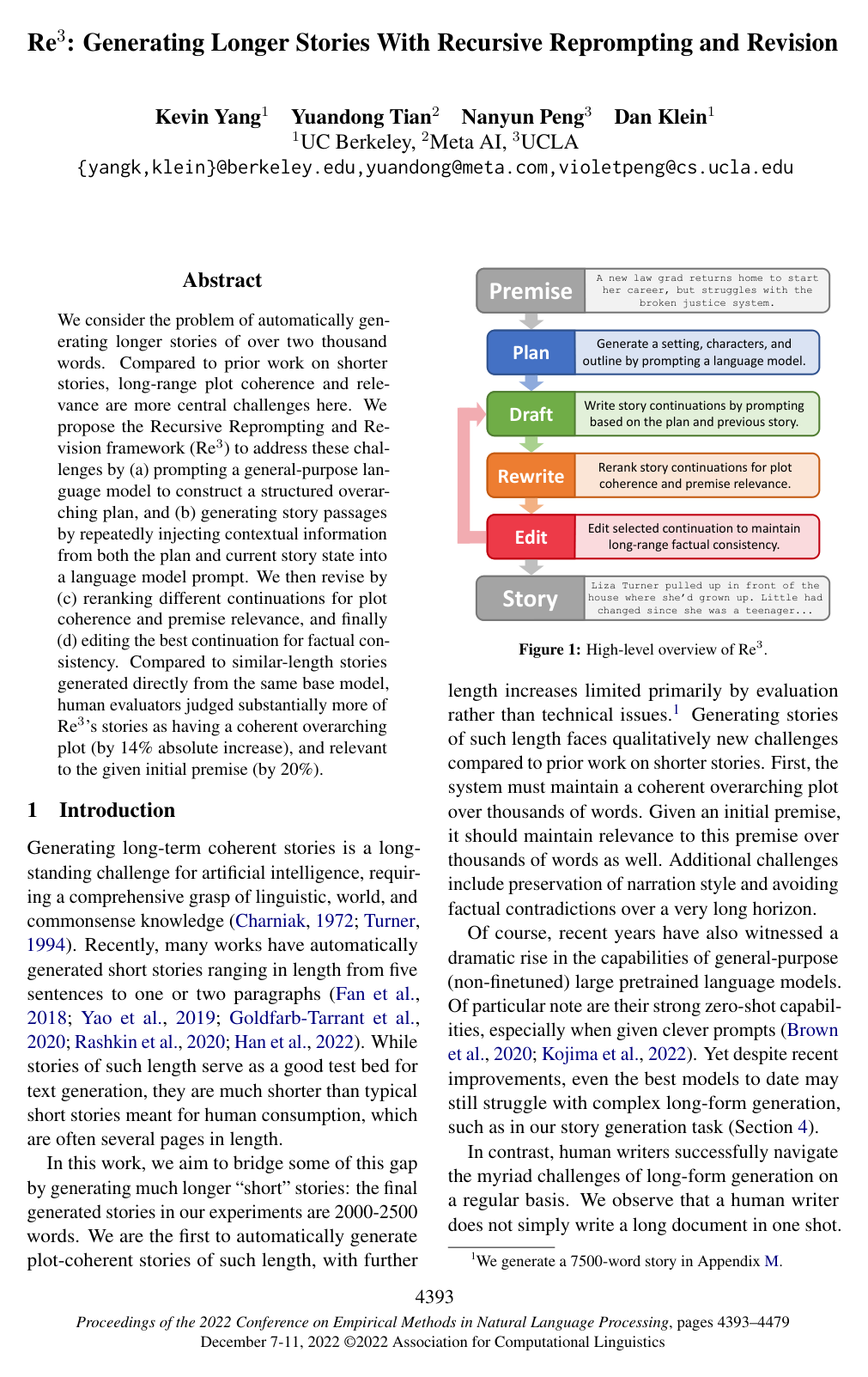
The authors designed a four-part modular approach: a planning module that generates story settings, character descriptions, and numbered outlines; a drafting module that recursively composes prompts combining high-level plans with recent narrative summaries; a rewrite module that reranks alternative continuations based on learned coherence and relevance models; and an edit module that tracks character attributes in a structured dictionary to detect and correct factual contradictions. To test the approach, the authors generated 2,000 to 2,500-word stories across 100 diverse premises and conducted pairwise human evaluations comparing the framework against two standard rolling-window language model baselines.
The evaluation revealed several key findings. First, human evaluators judged the framework's stories to have a coherent overarching plot significantly more often than the baselines, achieving up to a 14% absolute increase in perceived coherence. Second, faithfulness to the starting premise increased by up to 20%. Third, evaluators judged between 80.0% and 83.3% of the generated stories to be human-written. Finally, component ablation analyses demonstrated that the planning and rewrite modules were critical to maintaining coherence and relevance, whereas the factual edit module provided negligible measurable improvement to the overall story quality.
These findings imply that structured prompt management and discriminative reranking can effectively extend the capabilities of out-of-the-box language models to complex, long-horizon text generation. The framework demonstrates an ability to self-correct and return to high-level outlines even after minor narrative deviations. However, resolving fine-grained factual continuity remains a bottleneck, as current error detection and rewriting subroutines suffer from compounding inaccuracies.
To advance automated long-form generation, the article recommends developing hierarchical outline schemes for even longer texts, such as novellas, along with adaptive mechanisms to control narrative pacing. Crucially, researchers must prioritize creating automated evaluation metrics for long-range plot coherence and factual consistency to overcome the prohibitive cost and noise of relying exclusively on human annotators.
Readers should interpret these conclusions in light of several limitations. Evaluator agreement on subjective story quality metrics was low, and the study relied on a constrained sample size due to evaluation costs. Additionally, the inconsistency detection mechanism was limited to character attributes and exhibited modest accuracy, achieving a classification area under the curve score of only 0.684 in controlled testing.
- Paper: Hierarchical Neural Story Generation, Angela Fan et al. (2018). Introduces the foundational hierarchical premise-to-story framework that motivates structured planning in long-form neural story generation.
- Paper: Least-to-Most Prompting Enables Complex Reasoning in Large Language Models, Denny Zhou et al. (2022). Demonstrates how decomposing complex tasks into structured subproblems and passing intermediate contexts enables models to maintain global coherence.
- Paper: Chain-of-Thought Prompting Elicits Reasoning in Large Language Models, Jason Wei et al. (2022). Establishes intermediate structured reasoning traces via prompting, providing the fundamental mechanism used in recursive reprompting.
- Paper: Prompt Programming for Large Language Models: Beyond the Few-Shot Paradigm, Laria Reynolds et al. (2021). Examines prompt programming and narrative framing paradigms for steering generative language models without fine-tuning.
- Paper: Self-Refine: Iterative Refinement with Self-Feedback, Aman Madaan et al. (2023). Extends iterative prompting and revision workflows into a generalized self-feedback loop for refining language model generations across diverse tasks.
- Paper: Idea2Story: An Automated Pipeline for Transforming Research Concepts into Complete Scientific Narratives, Tengyue Xu et al. (2026). Applies hierarchical planning, recursive structuring, and review-driven refinement to the automated generation of complex scientific narratives.
- Paper: Recursive Language Models, Alex L. Zhang et al. (2025). Formalizes recursive prompt manipulation into a programmatic inference framework that scales context handling for ultra-long sequence tasks.
- Paper: Graph of Thoughts: Solving Elaborate Problems with Large Language Models, Maciej Besta et al. (2023). Generalizes linear and hierarchical plan-revision workflows into arbitrary graph-structured prompt and thought transformations.
- Paper: Intelligent Grimm - Open-ended Visual Storytelling via Latent Diffusion Models, Chang Liu et al. (2024). Expands multi-step narrative coherence and state maintenance principles from text generation into open-ended visual storytelling.