QMIX: Monotonic Value Function Factorisation for Deep Multi-Agent Reinforcement Learning
Tabish RashidMikayel SamvelyanChristian Schroeder de WittGregory FarquharJakob FoersterShimon Whiteson
Introduces QMIX, a multi-agent reinforcement learning algorithm that enforces monotonic value function factorisation to guarantee policy consistency between centralised training and decentralised execution on complex cooperative tasks like StarCraft II.
Coordinating teams of autonomous agents—such as autonomous vehicles or robotic swarms—requires systems that can make fast, independent decisions while pursuing a shared goal. While agents frequently have access to comprehensive global data in simulated training environments, real-world deployment is restricted by limited local observations and constrained communication. The core technical challenge is effectively leveraging full global data during centralized training while guaranteeing that individual agents can act independently and coherently during live execution.
This article evaluates QMIX, a novel reinforcement learning framework designed to train decentralized policies using a centralized, non-linear combination of individual agent values. The objective is to demonstrate that structurally enforcing a monotonic relationship between per-agent utility functions and the overall joint value function produces superior coordination and performance over existing multi-agent methods.
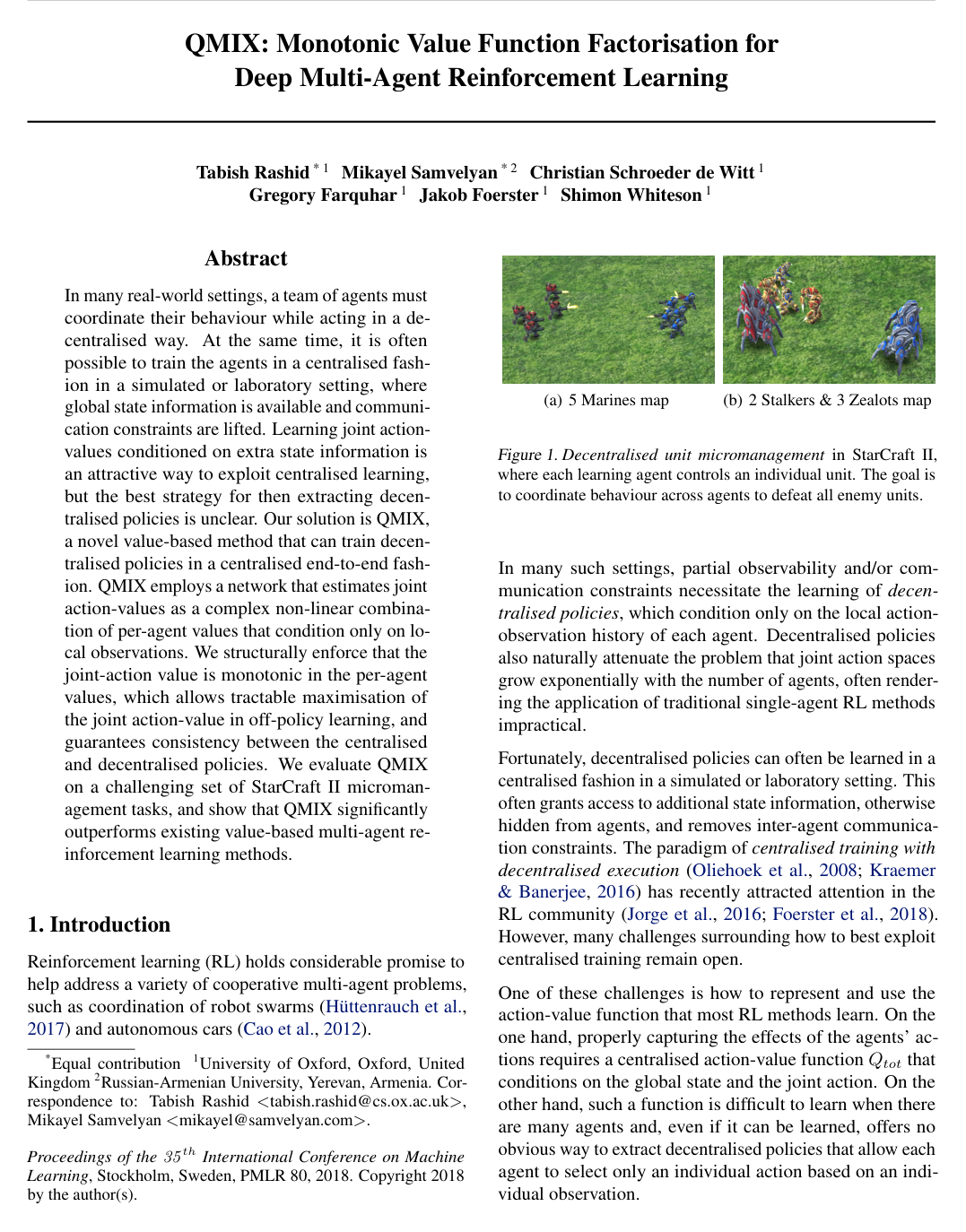
To test this approach, the researchers evaluated QMIX across a cooperative matrix game and a suite of complex multi-agent combat scenarios within the StarCraft II Learning Environment. The benchmark setups ranged from small homogeneous teams (e.g., 3 to 8 identical units) to larger, heterogeneous teams with diverse capabilities. The architecture was rigorously tested against standard baselines—independent Q-learning (IQL) and Value-Decomposition Networks (VDN)—alongside architectural ablations that systematically isolated the impact of non-linear mixing and centralized state conditioning.
The evaluation yielded several key operational findings. First, QMIX consistently achieved the highest win rates across all benchmark scenarios, notably outperforming existing value-based methods in learning speed and final performance. Second, the advantage of QMIX was most pronounced in complex heterogeneous team scenarios, such as the 3 Stalkers and 5 Zealots task, where prior factored methods failed to match even simple baseline heuristics. Third, qualitative policy analysis revealed that QMIX successfully learned sophisticated collaborative behaviors, such as defensive shielding and coordinated focus firing, whereas baseline approaches degraded into suboptimal or unstable movement patterns. Finally, ablation experiments confirmed that both non-linear factorisation and integration of global state features via hypernetworks are critical to achieving high performance in complex environments.
These findings indicate that teams of autonomous systems can achieve complex tactical coordination without requiring inter-agent communication during deployment, significantly reducing operational bandwidth demands and hardware vulnerability risks. Organizations deploying cooperative automated systems can achieve higher task success rates and greater policy stability by utilizing centralized off-policy training while maintaining scalable, decentralized execution.
Decision-makers considering deployment should note that QMIX relies on a monotonicity constraint, meaning it cannot represent scenarios where an agent's optimal immediate action strictly depends on the simultaneous actions of another agent in a non-monotonic manner. Future development should explore advanced exploration strategies and validate the method on larger swarms with wider unit diversity. Overall, there is high confidence that QMIX represents a robust and scalable architecture for cooperative multi-agent coordination under partial observability.
- Paper: Counterfactual Multi-Agent Policy Gradients, Jakob N. Foerster et al. (2017). Introduces the centralized training with decentralized execution framework and StarCraft micromanagement benchmark that motivate and contextualize QMIX's value-based approach.
- Paper: Multi-Agent Actor-Critic for Mixed Cooperative-Competitive Environments, Ryan Lowe et al. (2017). Establishes the standard paradigm of centralized training for decentralized execution in multi-agent reinforcement learning, providing essential context for QMIX's factorized value learning.
- Paper: Dueling Network Architectures for Deep Reinforcement Learning, Ziyu Wang et al. (2016). Presents value network architecture innovations that underpin deep value function estimation used in modern multi-agent deep Q-learning methods.
- Paper: Deep Reinforcement Learning with Double Q-learning, Hado van Hasselt et al. (2016). Addresses maximization bias in deep Q-learning, providing fundamental stability techniques utilized when training multi-agent deep action-value networks.
- Paper: Human-level control through deep reinforcement learning, Volodymyr Mnih et al. (2015). Provides the foundational Deep Q-Network algorithm and experience replay framework that QMIX extends to cooperative multi-agent settings.
- Paper: Markov Games as a Framework for Multi-Agent Reinforcement Learning, M. Littman (1994). Introduces Markov games as the standard theoretical formulation for multi-agent reinforcement learning problems that QMIX solves.
- Paper: Technical Note: Q-Learning, CHRISTOPHER J.C.H. WATKINS et al. (2004). Supplies the core mathematical principles and convergence foundations of Q-learning underlying value-based reinforcement learning algorithms.
- Paper: The Surprising Effectiveness of PPO in Cooperative Multi-Agent Games, Chao Yu et al. (2022). Re-evaluates cooperative multi-agent benchmarks by directly comparing on-policy policy gradient methods against standard off-policy factorized value baselines like QMIX.