Competition-level code generation with AlphaCode
Yujia LiDavid ChoiJunyoung ChungNate KushmanJulian SchrittwieserR. LeblondTomEcclesJames KeelingFelix Gimeno
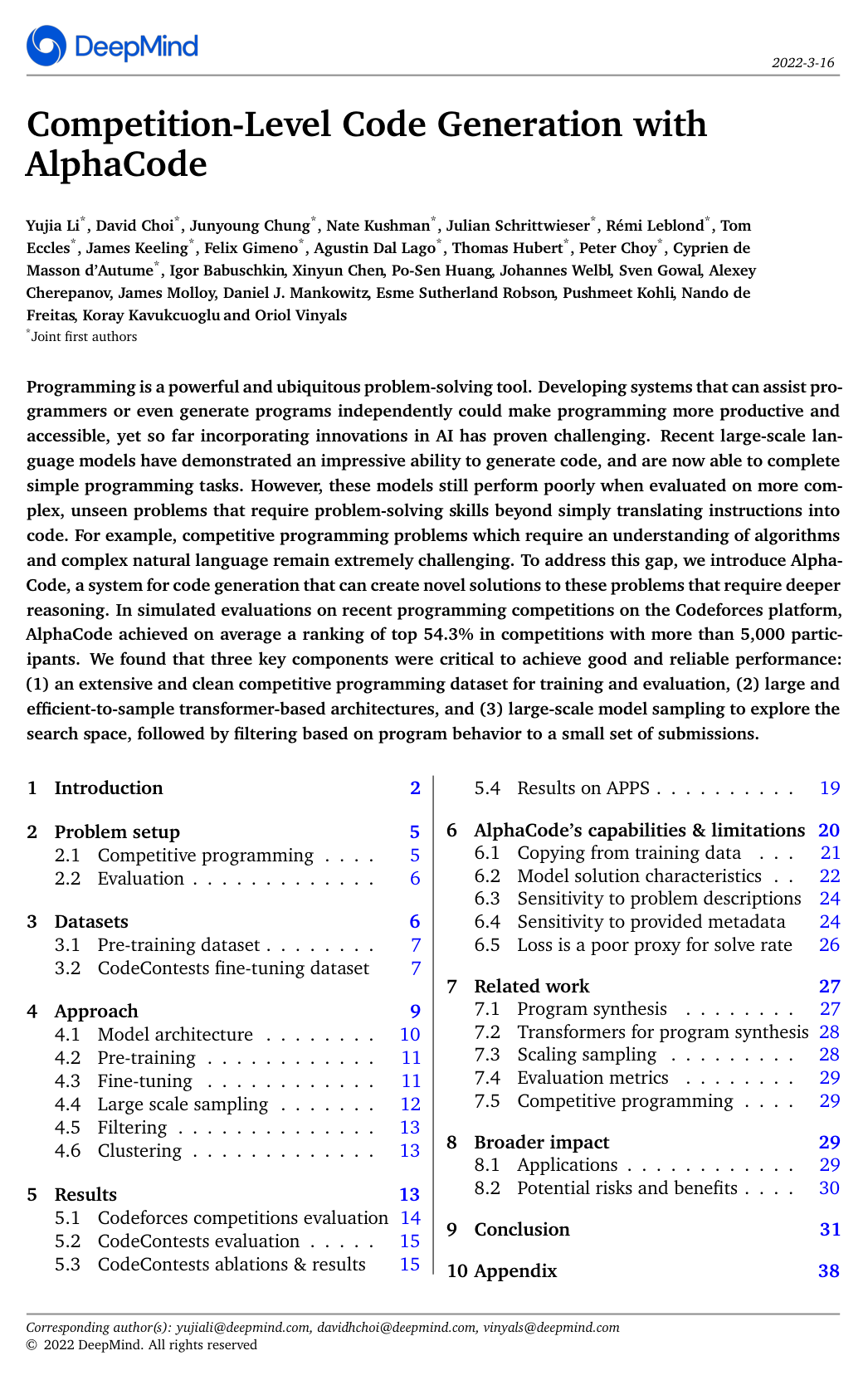
Presents AlphaCode, a code generation system that solves complex algorithmic challenges and achieves top 54.3% performance in human programming competitions on Codeforces by combining large-scale model sampling with execution-based filtering.
Developing artificial intelligence systems capable of writing software independently has long been a major goal in computer science. While recent large-scale language models can solve simple coding tasks or generate short code snippets, they consistently struggle with complex, unseen problems that require deeper algorithmic reasoning, mathematical problem-solving, and handling complex natural language specifications.
The article sets out to develop and evaluate AlphaCode, a code-generation system capable of creating novel solutions to challenging competitive programming problems at a level comparable to human competitors.
To evaluate this capability credibly, the authors introduced CodeContests, a curated dataset of competitive programming tasks featuring a strict temporal split to prevent data leakage and extensive generated test cases that reduced evaluation false positive rates from around 30–60% down to 4%. AlphaCode utilizes an asymmetric encoder-decoder transformer architecture pre-trained on 715 GB of open-source GitHub code and fine-tuned on CodeContests using offline reinforcement learning and regularization techniques. The system searches the program space by generating a massive volume of candidate solutions per problem (up to one million), filtering them down using public example test cases, and clustering the remaining candidates by their execution behavior to select a budget of at most 10 final submissions.
The investigation produced several key findings. First, in simulated evaluations across 10 recent programming competitions on the Codeforces platform (each with over 5,000 human participants), AlphaCode achieved an average ranking in the top 54.3%, corresponding to an estimated rating of 1238—placing it in the top 28% of active human competitors. Second, on the CodeContests dataset, the best system solved 34.2% of unseen problems using 10 submissions chosen from one million samples, significantly exceeding previous models that typically achieved low single-digit solve rates. Third, solve rates scaled log-linearly with model parameter scale, dataset size, training compute, and the number of drawn samples. Fourth, detailed analysis confirmed that the system does not simply copy code blocks or exploit dataset flaws, but actively reasons over the natural language task descriptions to generate original solutions.
These findings demonstrate for the first time that an automated system can reach human-median performance on open-ended, algorithmic programming benchmarks. In practice, this marks a substantial step toward automating software engineering workflows, improving developer productivity, and expanding access to programming education. However, the reliance on generating millions of samples introduces notable computational costs and energy demands, and automated code generation introduces potential security risks such as the creation of exploitable or malicious code.
For future development, organizations looking to build or deploy code generation systems should prioritize sampling efficiency and architectural improvements, such as multi-query attention, alongside behavioral filtering to manage computational expenses. Further work is recommended to design training objectives that align more closely with solve rates rather than standard loss metrics, as well as to establish robust safety, licensing, and vulnerability checks for generated code.
Readers should note specific limitations: AlphaCode struggles with certain problem classes, such as dynamic programming, and its strong performance relies heavily on large-scale parallel sampling and the availability of test cases for filtering. While confidence in the benchmarked competition results is high due to rigorous temporal splitting and verified test coverage, running such systems in production or live environments remains constrained by compute budgets and the need to handle edge-case behavior.
- Paper: Program Synthesis with Large Language Models, Jacob Austin et al. (2021). This foundational work on program synthesis with decoder-only language models establishes the base architectures and evaluation methodologies that AlphaCode adapts for competitive programming.
- Paper: Evaluating Large Language Models Trained on Code, Mark Chen et al. (2021). Evaluating Codex on complex programming tasks provides essential context on large-scale code generation and sampling strategies that inform AlphaCode's search and filtering approach.
- Paper: CodeBERT: A Pre-Trained Model for Programming and Natural Languages, Zhangyin Feng et al. (2020). CodeBERT introduces bimodal pre-training techniques for natural and programming languages that serve as a stepping stone for code-generative systems like AlphaCode.
- Paper: CodeT5: Identifier-aware Unified Pre-trained Encoder-Decoder Models for Code Understanding and Generation, Yue Wang et al. (2021). CodeT5 demonstrates how identifier-aware encoder-decoder architectures improve code understanding and generation tasks foundational to modern software models.
- Paper: Mastering Chess and Shogi by Self-Play with a General Reinforcement Learning Algorithm, David Silver et al. (2017). AlphaZero proves the effectiveness of large-scale model sampling and search-space exploration followed by rigorous verification, a core triad mirrored in AlphaCode.
- Paper: Code Llama: Open Foundation Models for Code, Baptiste Rozière et al. (2023). Code Llama extends open foundation models for code generation, building directly upon the code-specialization pipelines and scaling techniques introduced by AlphaCode.
- Paper: BigCodeBench: Benchmarking Code Generation with Diverse Function Calls and Complex Instructions, Terry Yue Zhuo et al. (2025). BigCodeBench generalizes code evaluation beyond AlphaCode's competitive programming scope into diverse function calls and realistic, multi-library software engineering tasks.
- Paper: Textbooks Are All You Need, Suriya Gunasekar et al. (2023). Textbooks Are All You Need builds on AlphaCode's findings by demonstrating how high-quality synthetic educational data can radically improve code generation efficiency in smaller models.
- Paper: LiveCodeBench: Holistic and Contamination Free Evaluation of Large Language Models for Code, Naman Jain et al. (2025). LiveCodeBench continues AlphaCode's focus on competitive programming evaluations by introducing a contamination-free benchmark for rapidly evolving code generation models.
- Paper: DeepSeek-R1: Incentivizing Reasoning Capability in LLMs via Reinforcement Learning, DeepSeek-AI et al. (2025). DeepSeek-R1 extends code and math reasoning capabilities through advanced reinforcement learning paradigms that overcome the sampling limitations of systems like AlphaCode.