On the Fairness of Causal Algorithmic Recourse
Julius von KügelgenAmir-Hossein KarimiUmang BhattIsabel ValeraAdrian WellerBernhard Schölkopf
Introduces causal criteria for algorithmic recourse to account for downstream intervention effects across protected groups, proving that fair recourse is distinct from predictive fairness and can motivate societal policy interventions over mere classifier adjustments.
Algorithmic decision-making systems increasingly impact critical life outcomes, such as credit approvals and employment. While traditional fairness research focuses on predictive parity across demographic groups, algorithmic recourse focuses on providing rejected applicants with actionable steps to achieve a favorable outcome. However, existing recourse approaches assume features can change independently and measure fairness simply through the geometric distance to a decision boundary, ignoring the downstream causal effects that real-world actions trigger.
The article develops a causal framework to evaluate and enforce fairness in algorithmic recourse at both the group and individual levels. It aims to demonstrate that recourse fairness is distinct from predictive fairness and to explore mechanisms—both algorithmic modifications and policy-level societal interventions—for eliminating disparities in the effort required to overturn unfavorable decisions.
To evaluate this framework, the authors conducted theoretical proofs alongside empirical numerical simulations using synthetic linear and non-linear datasets with 500 samples. They also analyzed an observational sample of over 45,000 records from the standard Adult benchmark dataset. The approach modeled causal dependencies using structural causal models to simulate downstream feature changes and calculated the optimal intervention costs for negatively classified individuals.
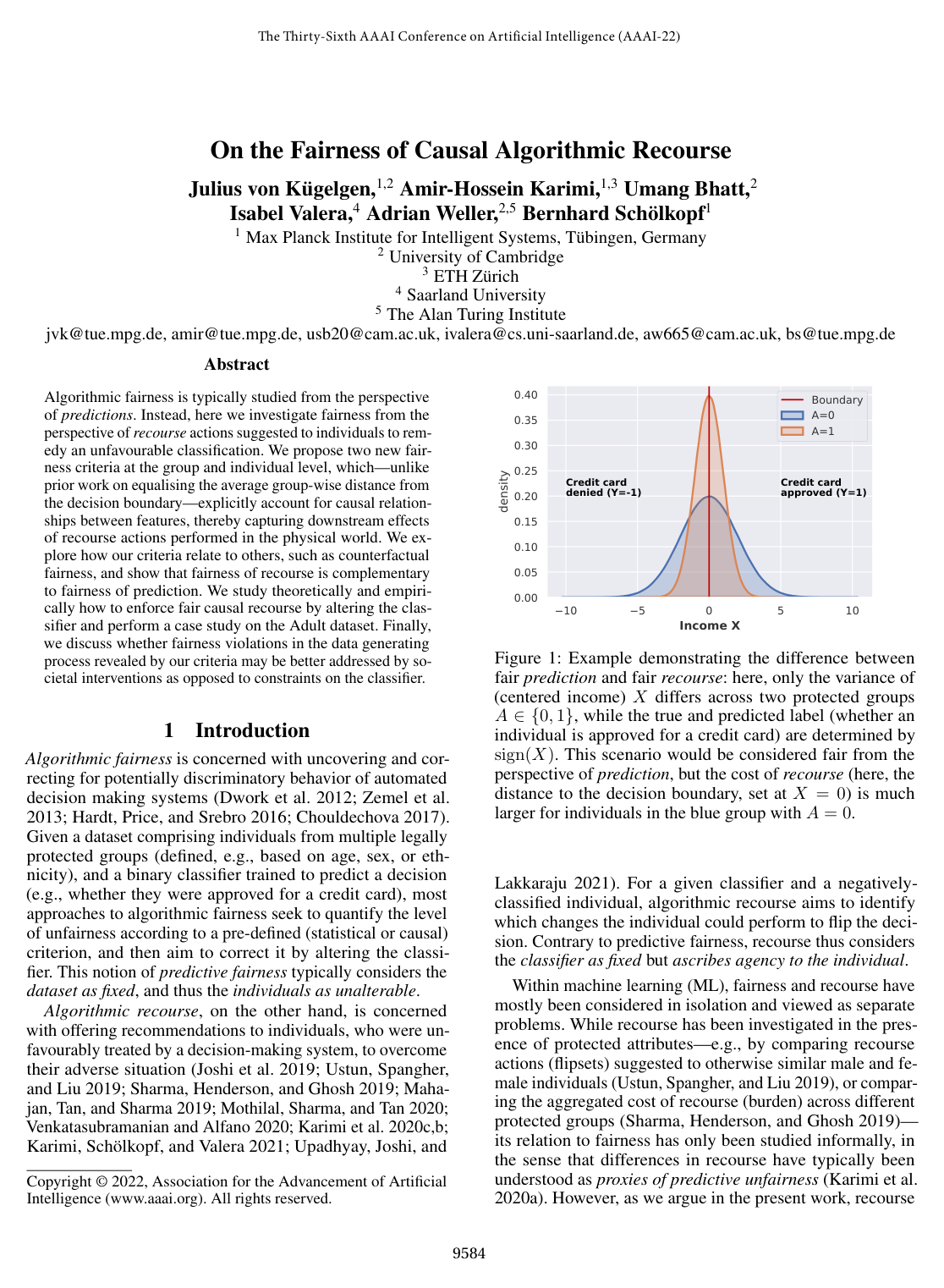
The investigation produced four central findings. First, predictive fairness and fair recourse are complementary: an algorithm can be perfectly fair in its predictions while still imposing substantially higher effort on one demographic group to reverse a negative decision. Second, traditional distance-based recourse metrics fail to capture true effort in interconnected systems, whereas causally informed metrics accurately detect hidden disparities. Third, satisfying group-level recourse fairness does not guarantee fairness for individuals, as within-group advantages can mask severe individual-level penalties. Fourth, an empirical evaluation on the Adult dataset revealed substantial discrimination across sex, age, and nationality, yielding an average individual counterfactual cost disparity of 24.32 and a maximum individual gap of 61.53.
These results demonstrate that organizations relying solely on predictive fairness criteria face hidden compliance, ethical, and reputation risks by placing disproportionate burdens on protected classes attempting to reverse automated denials. Furthermore, the analysis indicates that altering the predictive model is not always the best remedy: when disparities stem from underlying systemic conditions, restricting classifiers can severely degrade predictive accuracy. Instead, the authors highlight targeted societal interventions, such as subsidies or policy adjustments, as an effective means to equalize recourse costs without compromising algorithmic performance.
Decision-makers and system designers should audit deployed recourse mechanisms using causal metrics rather than simple geometric distances to ensure genuine equality of effort. Where algorithmic adjustments are required, developers can guarantee individual fairness by restricting models to non-descendant features or latent background factors, weighing the potential drop in accuracy against institutional priorities. When inequalities reflect broader systemic barriers, leadership should evaluate targeted policy interventions rather than forcing artificial constraints onto predictive models.
Confidence in the mathematical findings and synthetic benchmarks is high, but real-world implementation depends on having an accurately specified causal graph, as unobserved confounding or incorrect causal assumptions can lead to suboptimal recourse recommendations. Future work should focus on estimating robust causal models and formalizing multi-stakeholder cost-benefit trade-offs before deploying these methods in high-stakes operational environments.
- Paper: Counterfactual Fairness, Matt J. Kusner et al. (2017). Introduces the causal framework of counterfactual fairness upon which the paper establishes its causal foundations and compares recourse criteria.
- Paper: Counterfactual Explanations without Opening the Black Box: Automated Decisions and the GDPR, Sandra Wachter et al. (2017). Establishes the optimization framework for generating counterfactual explanations and algorithmic recourse to reverse unfavorable decisions.
- Paper: Explaining machine learning classifiers through diverse counterfactual explanations, Ramaravind Kommiya Mothilal et al. (2019). Explores actionable and diverse counterfactual recourse methods that the paper generalizes to incorporate downstream causal mechanisms.
- Paper: Fairness through awareness, Cynthia Dwork et al. (2012). Provides the foundational definitions for individual fairness and metric-based equal treatment that motivate individual-level recourse fairness.
- Paper: Direct and Indirect Effects, Judea Pearl (2001). Formulates the foundational structural equation and path-specific causal modeling necessary to evaluate downstream physical interventions.
- Paper: Equality of Opportunity in Supervised Learning, Moritz Hardt et al. (2016). Defines standard group-level prediction fairness criteria that the paper shows to be distinct and complementary to recourse fairness.
- Paper: Fairness Constraints: Mechanisms for Fair Classification, Muhammad Bilal Zafar et al. (2015). Demonstrates how to alter classifier decision boundaries under constrained optimization to satisfy mathematical fairness guarantees.
No sufficiently relevant recommendations were found.