On the Variance of the Adaptive Learning Rate and Beyond
Liyuan LiuHaoming JiangPengcheng HeWeizhu ChenXiaodong LiuJianfeng GaoJiawei Han
Proposes RAdam, a variant of the Adam optimizer that dynamically corrects the high variance of early adaptive learning rates to stabilize training without requiring manual warmup heuristics.
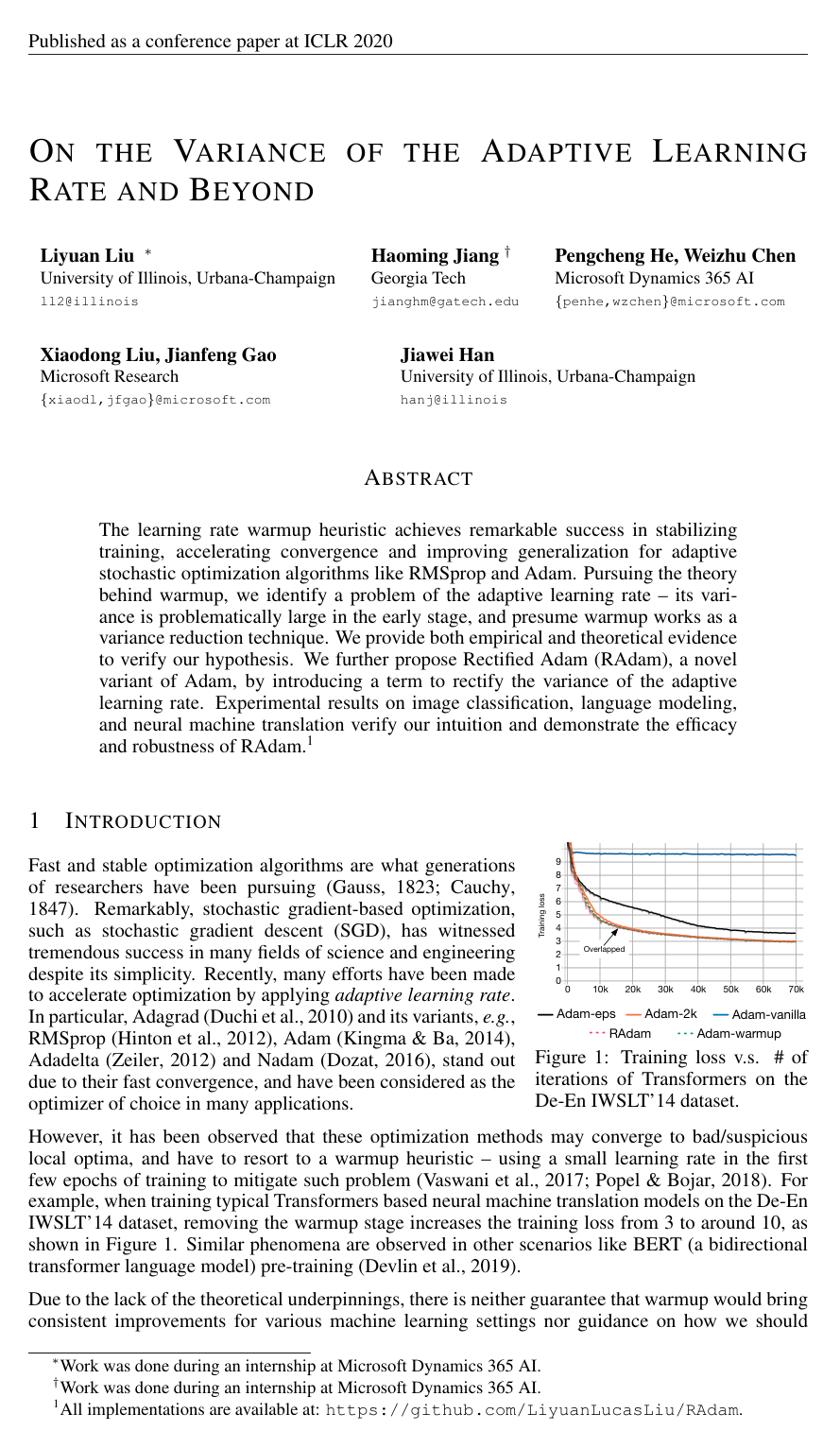
Training deep neural networks using adaptive optimization algorithms, such as Adam and RMSprop, often suffers from early-stage instability and poor convergence unless practitioners manually apply a learning rate warmup heuristic. Because warmup relies on empirical trial-and-error without a clear theoretical justification, selecting optimal training parameters requires substantial engineering effort and compute resources.
The article investigates the root cause of early training instability in adaptive optimizers and evaluates a principled variance-reduction method to eliminate the reliance on manual warmup schedules.
The researchers conducted theoretical statistical analyses modeling gradient updates and verified their findings through empirical experiments across diverse tasks, including language modeling on the One Billion Word dataset, image classification on CIFAR-10 and ImageNet, and neural machine translation on IWSLT'14 and WMT'16 datasets. They evaluated baseline optimizers (standard Adam and Stochastic Gradient Descent), heuristic warmup schedules, and a novel variance-rectified optimizer named Rectified Adam (RAdam).
The analysis produced several key findings: First, the primary cause of early-stage training failure is the undesirably large, sometimes unbounded, variance of the adaptive learning rate when sample sizes are small in initial iterations. Second, the article demonstrates mathematically and empirically that warmup functions primarily as a variance-reduction mechanism. Third, the proposed RAdam optimizer dynamically rectifies this variance by deactivating the adaptive rate when variance is intractable and scaling it when tractable, matching the translation performance of tuned warmup baselines (e.g., 34.76 BLEU on IWSLT'14 DE-EN compared to 34.66 for warmup). Finally, RAdam demonstrates superior robustness, maintaining high test accuracy across learning rates from 0.003 to 0.1 on CIFAR-10 where standard Adam and SGD performance degrades significantly.
These findings indicate that manual tuning of warmup schedules is unnecessary when variance is explicitly controlled. By removing an empirical hyperparameter, RAdam reduces experimentation cycles, lowers compute costs, and avoids severe early gradient distortion across different model architectures.
Engineering and research teams should consider adopting RAdam or similar variance-rectification techniques in place of standard Adam with manual warmup to streamline training pipelines. Future development should explore extending variance stabilization by sharing second-moment estimations across related network parameters.
The conclusions are well-supported across multiple benchmarks and theoretical derivations, though some approximations rely on standard statistical assumptions about gradient distributions. While RAdam consistently outperforms standard Adam and matches heuristic warmup, practitioners training convolutional vision models should note that standard Stochastic Gradient Descent may still achieve slightly higher final test generalization despite RAdam's superior training loss.
- Paper: Adam: A Method for Stochastic Optimization, Diederik P. Kingma et al. (2015). Reading the original Adam paper is essential because the source directly analyzes its early-stage learning rate variance and proposes an improved variant.
- Paper: On the Convergence of Adam and Beyond, Sashank J. Reddi et al. (2018). This paper examines convergence issues in adaptive optimizers like Adam, providing the foundational critique that motivates the variance analysis in the source.
- Paper: Decoupled Weight Decay Regularization, Ilya Loshchilov et al. (2019). This paper builds on Adam-family optimization by demonstrating the importance of decoupled weight decay to fix generalization gaps.