
Large Language Models Can Solve Real-World Planning Rigorously with Formal Verification Tools
Abstract
Large Language Models (LLMs) struggle to directly generate correct plans for complex multi-constraint planning problems, even with self-verification and self-critique. For example, a U.S. domestic travel planning benchmark TravelPlanner was proposed in Xie et al. (2024), where the best LLM OpenAI o1-preview can only find viable travel plans with a 10% success rate given all needed information. In this work, we tackle this by proposing an LLM-based planning framework that formalizes and solves complex multi-constraint planning problems as constrained satisfiability problems, which are further consumed by sound and complete satisfiability solvers. We start with TravelPlanner as the primary use case and show that our framework achieves a success rate of 93.9% and is effective with diverse paraphrased prompts. More importantly, our framework has strong zero-shot generalizability, successfully handling unseen constraints in our newly created unseen international travel dataset and generalizing well to new fundamentally different domains. Moreover, when user input queries are infeasible, our framework can identify the unsatisfiable core, provide failure reasons, and offers personalized modification suggestions. We show that our framework can modify and solve for an average of 81.6% and 91.7% unsatisfiable queries from two datasets and prove with ablations that all key components of our framework are effective and necessary. Project page: https://sites.google.com/view/llm-rwplanning.
1 Introduction
Recent work has demonstrated that large language models (LLMs) (Brown et al., 2020; Ouyang et al., 2022; Achiam et al., 2023), with abundant world knowledge, abilities to collect information via tools, and capabilities of reasoning, have significant potential in solving planning problems (Huang et al., 2022a; Ahn et al., 2022; Yao et al., 2022; Huang et al., 2022b; Song et al., 2023). However, modern LLMs are not well-suited for directly solving highly complex combinatorial optimization problems with multiple levels of constraints. This is because LLMs generate responses based on token probabilities derived from their training data and do not inherently possess the ability to perform rigorous logical or mathematical reasoning. To investigate the performance of LLMs on complex realistic multi-constraint problems, Xie et al. (2024) proposed a U.S. domestic travel planning benchmark, TravelPlanner, and showed that LLMs are not capable of handling this task and the best LLM at the time, GPT-4, only achieves a 0.6% success rate. We test the strongest model of today, OpenAI o1-preview (o1p), with TravelPlanner and observed a pass rate of 10.0% even with access to pre-collected information. LLM-Modulo Framework (Kambhampati et al., 2024), a recent work that combines LLMs with external critics, verifiers, and humans, raises the pass rate to 20% with GPT-4-Turbo and 65% with o1-preview, which is the best performance on TravelPlanner as of now.
To tackle multi-constraint problems like travel planning, an alternative way is through constraint-based planning to formalize the problem as a constraint satisfaction problem (CSP) (Dechter, 2003; Lozano-Pérez and Kaelbling, 2014), including boolean satisfiability problem (SAT) (Kautz and Selman, 1999; Rintanen, 2012) and satisfiability modulo theory (SMT) (Barrett et al., 2010; De Moura and Bjørner, 2011; Dantam et al., 2016), and solve it with existing algorithm-based solvers (Dutertre and De Moura, 2006; De Moura and Bjørner, 2008; Barrett et al., 2011). However, algorithm-based solvers usually have steep learning curves. As natural language queries have no fixed format, planners need to extract key information from input queries accurately to model the problem. Crucially, even if the extracted information is correct, users must still modify inputs and query the tools repeatedly if their inputs are unsatisfiable.
In short, LLM-based and algorithm-based planning methods have complementary strengths: LLMs excel at parsing human input and interactions but struggle to rigorously solve complex planning problems with multiple constraints. In contrast, algorithm-based solvers are sound and complete when solving multi-constraint satisfiability problems but are incapable of handling dynamic, general, and sometimes ambiguous natural language requirements. Can we design a framework that combines the merits of both paradigms and enables a strong, rigorous, and yet user-friendly planning experience for human users?
Motivated by this, in this paper, we propose a travel-planning framework that enables LLMs to process human queries and generate code to automatically utilize algorithm-based solvers, e.g., the SMT solver, to formally formulate, solve, and reason over the planning problem. Specifically, we take travel planning as the primary use case and provide LLMs with instruction steps and corresponding codes for using SMT solver to solve the example travel planning problems. We find that, with only three examples in the prompt, the LLM can effectively learn the pattern and generalize to new input queries. Since a solver is called to solve the problem with all the constraints encoded, our method is guaranteed to generate a plan if it exists.
Notably, our method offers following features, including and beyond aforementioned advantages.
-
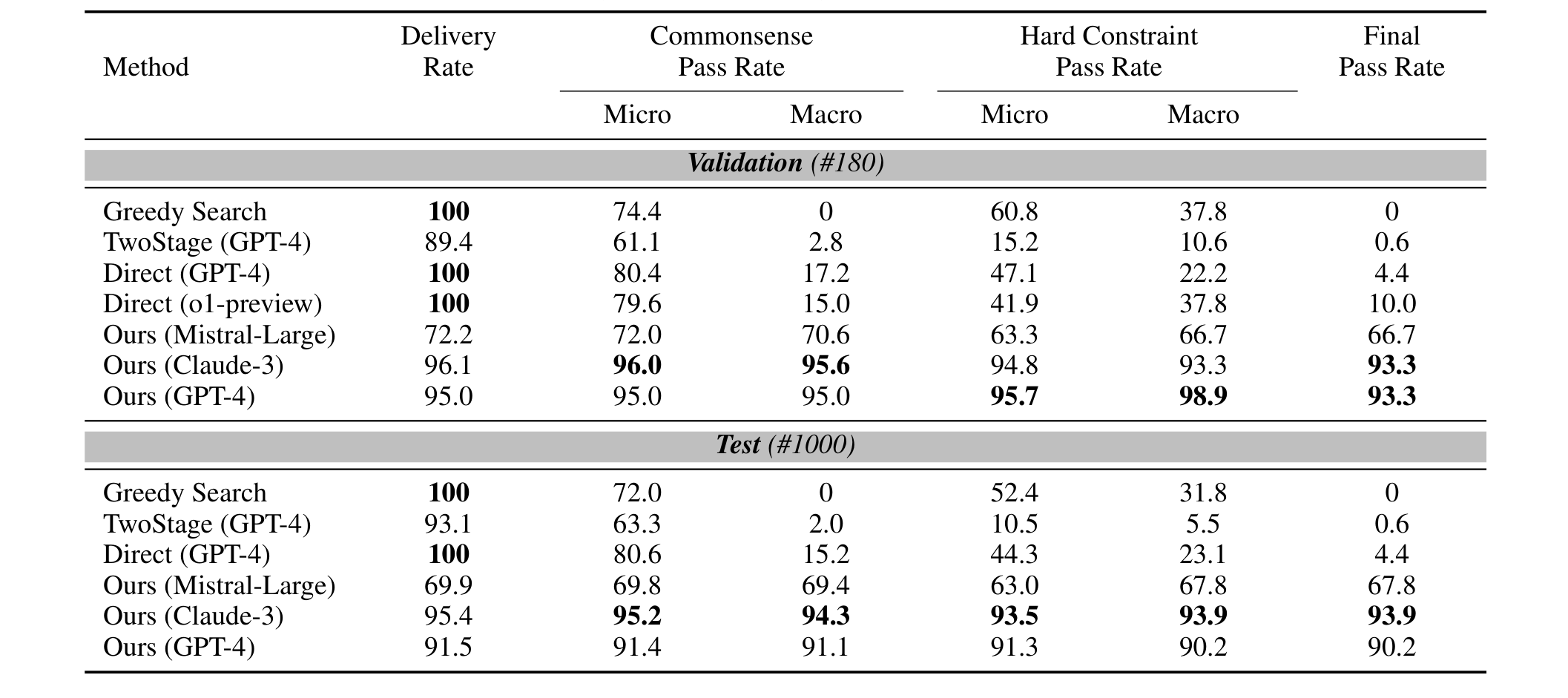
Superior Planning Success Rate. We evaluate our framework over different LLMs, GPT-4, Claude 3 Opus, and Mistral-large, and show that our framework achieves the best final pass rates of 93.3% and 93.9% on TravelPlanner validation and test sets. Our framework significantly outperforms the best tool-use framework on TravelPlanner, LLM Modulo, which achieves pass rates of 20% and 65% with GPT-4-Turbo and o1-preview.
-
Feedback Interactions on Unsolvable Cases. If the input query is not satisfiable, our framework utilizes SMT solvers to identify the exact unsatisfiable constraints, analyzes the unsatisfiable reasons, and proposes suggestions to modify the query until it becomes satisfiable. In addition to a fully autonomous mode of offering default modification suggestions by itself, LLM can even interactively communicate with humans to incorporate their unique preferences. Our experiments show that our feedback mechanism can turn an average of 81.6% and 91.7% insolvable problems from two datasets into solvable ones under different user reaction patterns to our model’s suggestions.
-
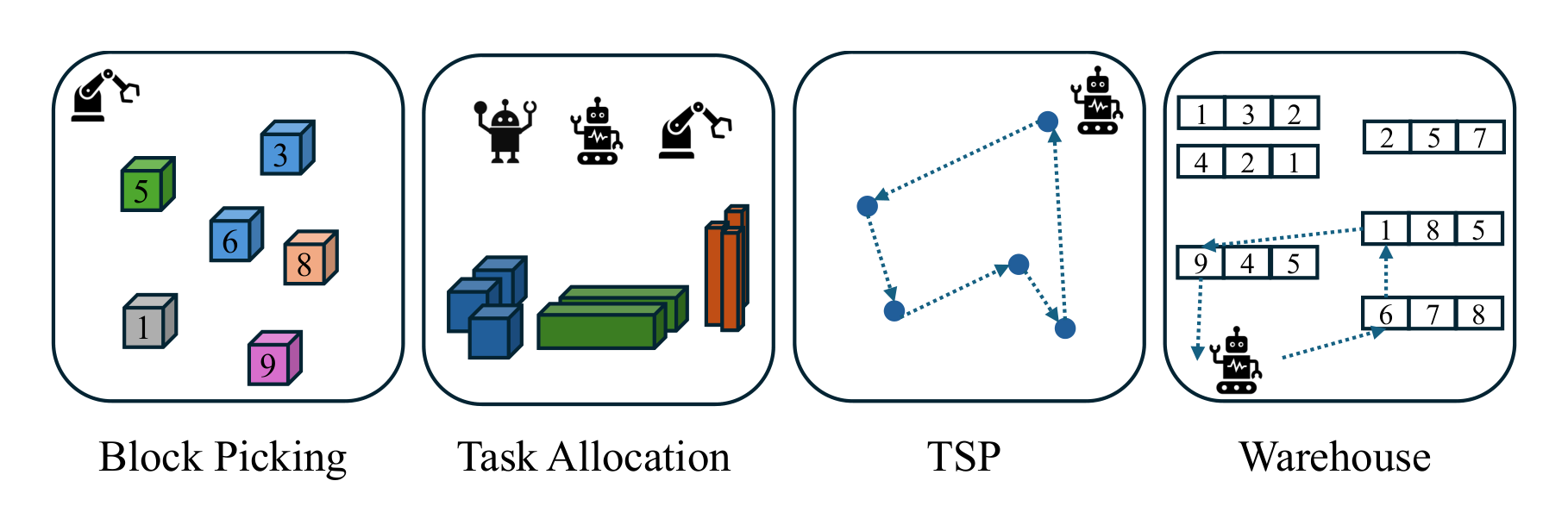
Strong Zero-Shot Generalizability to Unseen Constraints and Tasks. Although the proposed planning system is demonstrated with only travel planning examples with a fixed set of constraints, we found that it is readily generalizable to unseen constraints and even unseen planning tasks. Remarkably, we further introduce four completely new domains that involve combinatorial tasks: Block Picking, Task Allocation, Travelling Salesman Problem, and Warehouse. On all new scenarios, our framework achieves an average of 89.0% optimal rates for four new domains in a zero-shot manner, as discussed in Section 5.2.3.
-
High Prompt Robustness. To address concerns that the strong planning capabilities of our system might result from extensive prompt engineering, we conduct experiments to evaluate its robustness to varied paraphrased prompts. Our results show that the system effectively handles a wide range of prompt formulations, thus is not overly reliant on specific prompt designs. This highlights the flexibility and robustness of our method, establishing it as a powerful and adaptable planning paradigm.
2 Related Work
LLM Planning. LLMs have shown significant intelligence in reasoning (Wei et al., 2022; Kojima et al., 2022; Yao et al., 2022) and tool-use (Qin et al., 2023; Schick et al., 2024), offering the potential of promising planning capability. Previous works tackle planning problems with various ways (Huang et al., 2024): 1) decomposing the task into sub-tasks (Wei et al., 2022; Yao et al., 2022; Shen et al., 2024); 2) generating multiple plans and selecting the optimal one (Wang et al., 2023; Yao et al., 2024; Zhao et al., 2024; Besta et al., 2024; Hao et al., 2023); 3) reflecting on experiences and refining plan based on feedback (Shinn et al., 2024; Madaan et al., 2024; Chen et al., 2023b); 4) formalizing tasks and aiding with external planner (Liu et al., 2023; Guan et al., 2023; Chen et al., 2023a). While these planning algorithms have shown promising results, their planning scenarios are limited to simple tasks with a limited number of constraints. Xie et al. (2024) proposes a realistic complex travel planning benchmark and tests on various LLM planning methods to show that LLMs are not capable of handling multi-constraint tasks.
Algorithm-based Planning. Another way to tackle travel planning is through algorithm-based planning such as heuristic search (Hoffmann and Nebel, 2001; Helmert, 2006; Vidal, 2014) and constraint-based methods (Kautz and Selman, 1999; Rintanen, 2012, 2014; Lozano-Pérez and Kaelbling, 2014; Dantam et al., 2016). However, these methods can not generalize to diverse natural language inputs and may not guarantee to find the plan. Our framework enables LLM to utilize constraint-based planning methods by formalizing diverse human queries into an SMT problem and solving with sound and complete SMT solvers.
LLM Tool-use. Tool-using allows LLMs to utilize powerful external tools to increase reliability. Recent works explore how LLMs could utilize external tools such as search engines, operating environments, and code generators (Press et al., 2022; Yao et al., 2022; Schick et al., 2024; Liang et al., 2023; Singh et al., 2023; Peng et al., 2023; Song et al., 2023; Huang et al., 2022b; Yuan et al., 2024) to provide feedback or extra information. In our framework, LLMs generate codes to formulate the travel planning problem as an SMT problem and call the SMT solver. This overcomes LLM’s failure to consider all constraints by encoding and solving all constraints rigorously.
LLM Prompt Design. Prompt design is critical for LLM-based agents to improve the performance of black-box LLMs. While many works automatically evolve prompts through iterations (Wang et al., 2023; Fernando et al., 2023; Chen et al., 2024), in-context learning that includes example input-output pairs in prompts is a cheaper, widely-adopted, and reliable way (Brown et al., 2020; Wei et al., 2022; Liang et al., 2023). Although designing in-context examples requires task-specific efforts, most existing methods proposing to solve complex planning problems require different forms of task-specific efforts (Liu et al., 2023; Li et al., 2023; Gundawar et al., 2024). While our work requires prompt design, these designs are offline and not needed for end users. More importantly, we have shown that the performance of our framework is not sensitive to the specific wording of prompts (Section 5.2.1). Meanwhile, our framework generalizes and achieves great performance for other constraints and even in other tasks without the specific design of prompts (Sections 5.2.2 and 5.2.3).
3 Approach
3.1 Problem Formulation
In the framework design, we primarily focus on the specific travel planning task with a set of predefined constraints. However, we will show that the same prompts and workflow can readily be applied to new constraints and other planning scenarios.
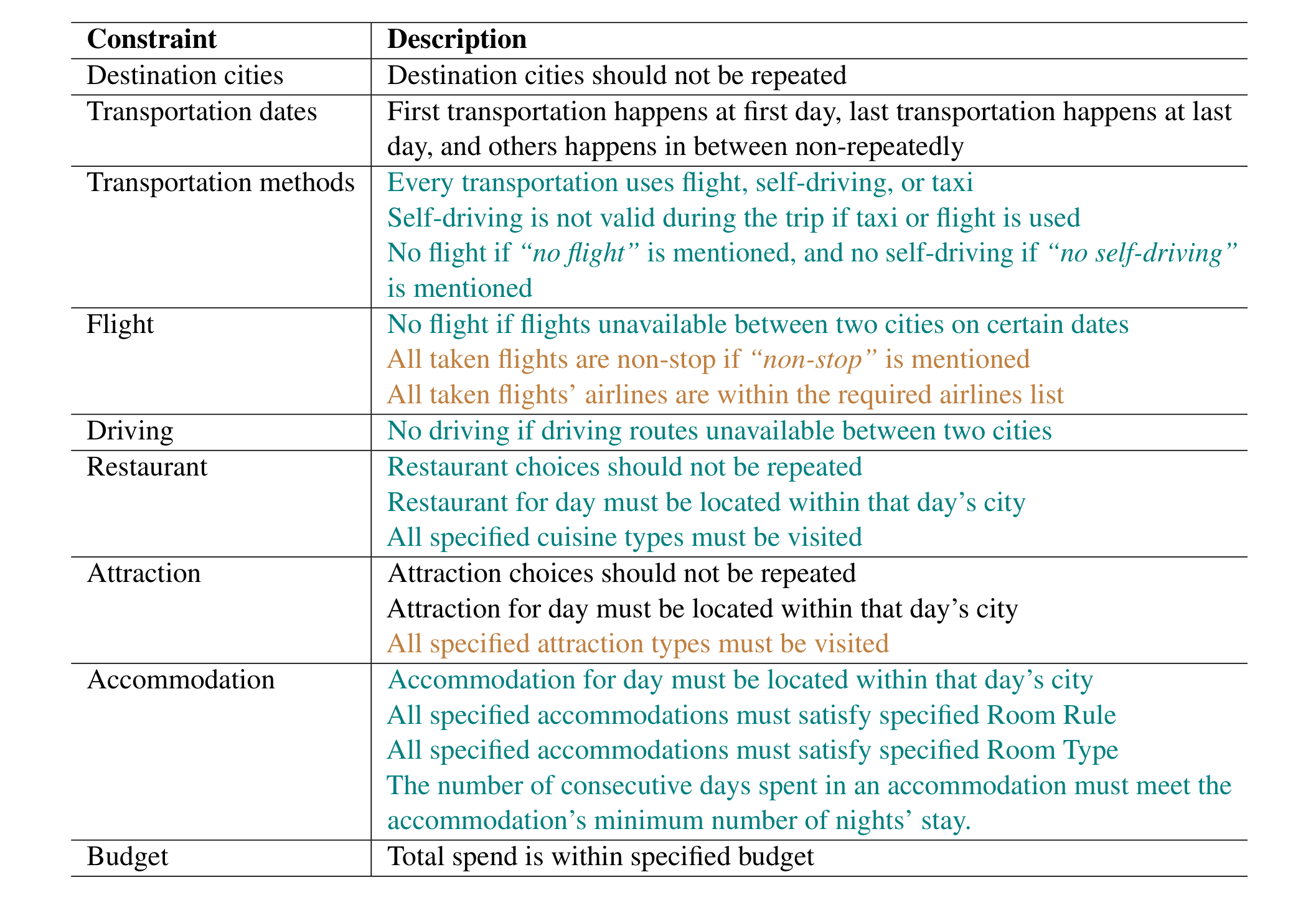
Our travel planning problem is formulated as follows. Given a natural language description of humans’ constraints CCC of a travel plan, the system should output a plan that satisfies CCC. The travel starts from city ooo, travels kkk destination cities, and returns to ooo. The travel spans nnn days. The travel takes k+1k + 1k+1 transportation methods for k+1k + 1k+1 travels from city to city. The travelers visit xxx attractions, dine in yyy restaurants, and live in accommodations for n−1n - 1n−1 nights. By default, we set x=nx = nx=n, y=3ny = 3ny=3n. However, this is not a fixed requirement. Users could specify their unique requirements by adding descriptions in prompts, for example, “Number of attractions to visit per day is 2”. Table 5 summarizes the constraints CCC for two datasets we used. The output plan should satisfy CCC and specify the city to visit, transportation method, attraction, restaurant, and accommodation for each day. See Appendix C for example input query and output plan.
3.2 Framework Overview
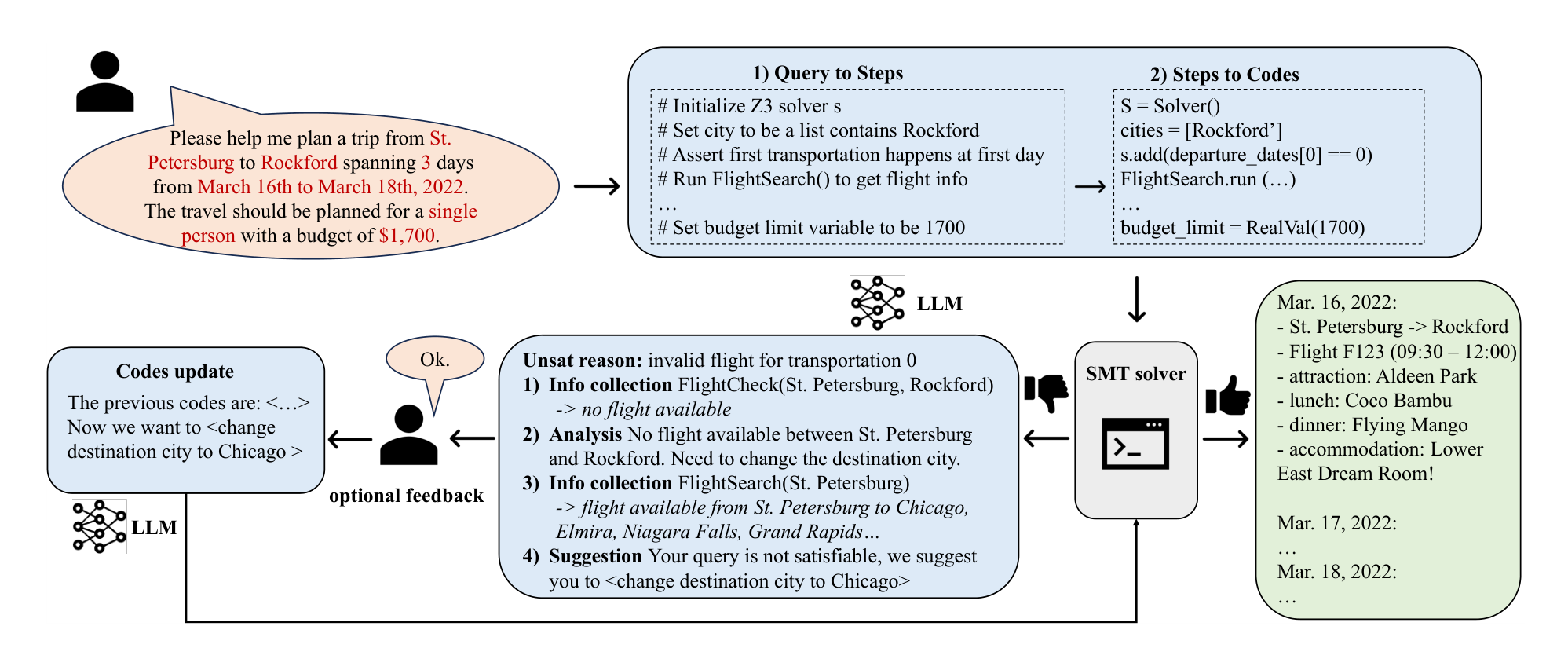
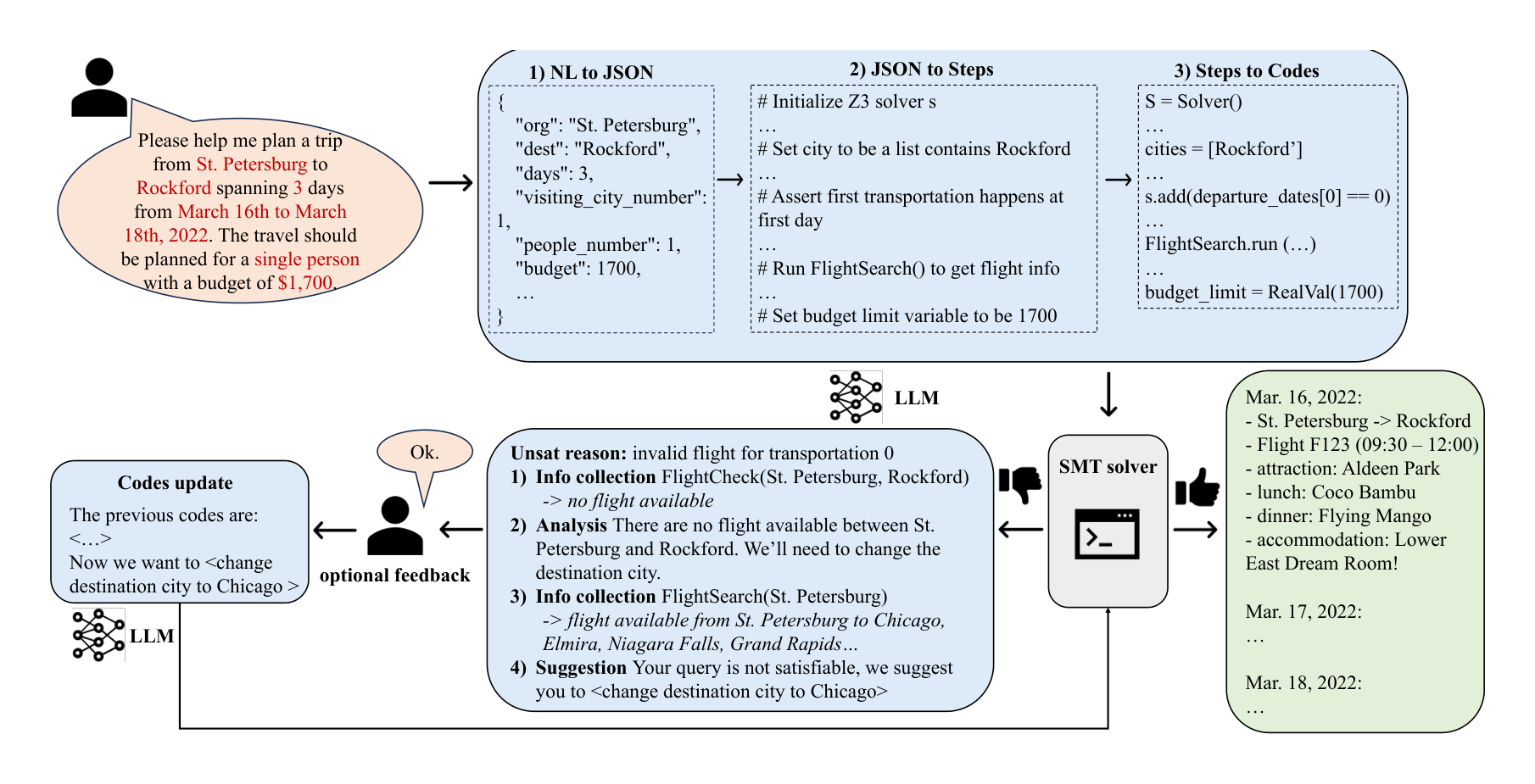
As shown in Fig. 1, if the planning problem comes with valid solutions, our framework solves the problem in four steps. First, an LLM is prompted to parse the user request and output a set of steps to convert the user descriptions to a formal planning problem. Second, the LLM is prompted to further convert the steps to code. Third, the framework calls an external formal solver, in our case the SMT solver, to execute the code, whose output is then parsed by the LLM into natural language outputs.
However, there are cases where the user queries do not bear valid solutions, e.g., the users request to stay in five-star hotels but the specified budget is too low, where the aforementioned steps would fail to generate a valid plan. In these cases, the LLM is prompted to reason about the situations to give suggestions to modify the constraints, e.g., increasing the budget. If users accept the suggestions, the modified planning problem is formed and sent to the solver; otherwise, new suggestions will be made until an agreement is reached or timeout.
Section 3.3 details the three steps to solve satisfiable planning problems; Section 3.4 describes our approach to repairing unsatisfiable plans iteratively. All the prompts are listed in Appendix G.
3.3 Satisfiable Plan Solving
3.3.1 Query-Step Generation
Query-Step generation involves transforming natural language queries into a sequence of executable steps, expressed in natural language, to formulate the constraints. For example, to specify the “travel spanning 3 days” constraint in the query in Fig. 1, an example sequence of steps is:
-
Set ‘t_dates’ variables for 2 transportation between cities
-
Assert first transportation happens at first day (day 0), and last happens at last day (day 2)
For the query “travel 2 destination cities in 5 days”, an example sequence of steps is:
-
Set ‘t_dates’ variables for 3 transportation between cities
-
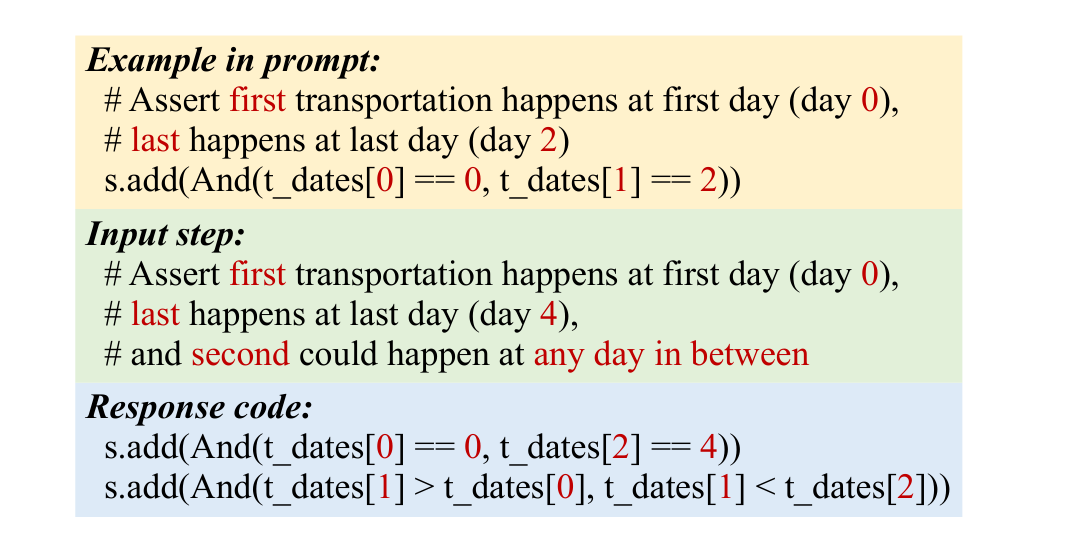
Assert first transportation happens at first day (day 0), last happens at last day (day 4), and second could happen at any day in between
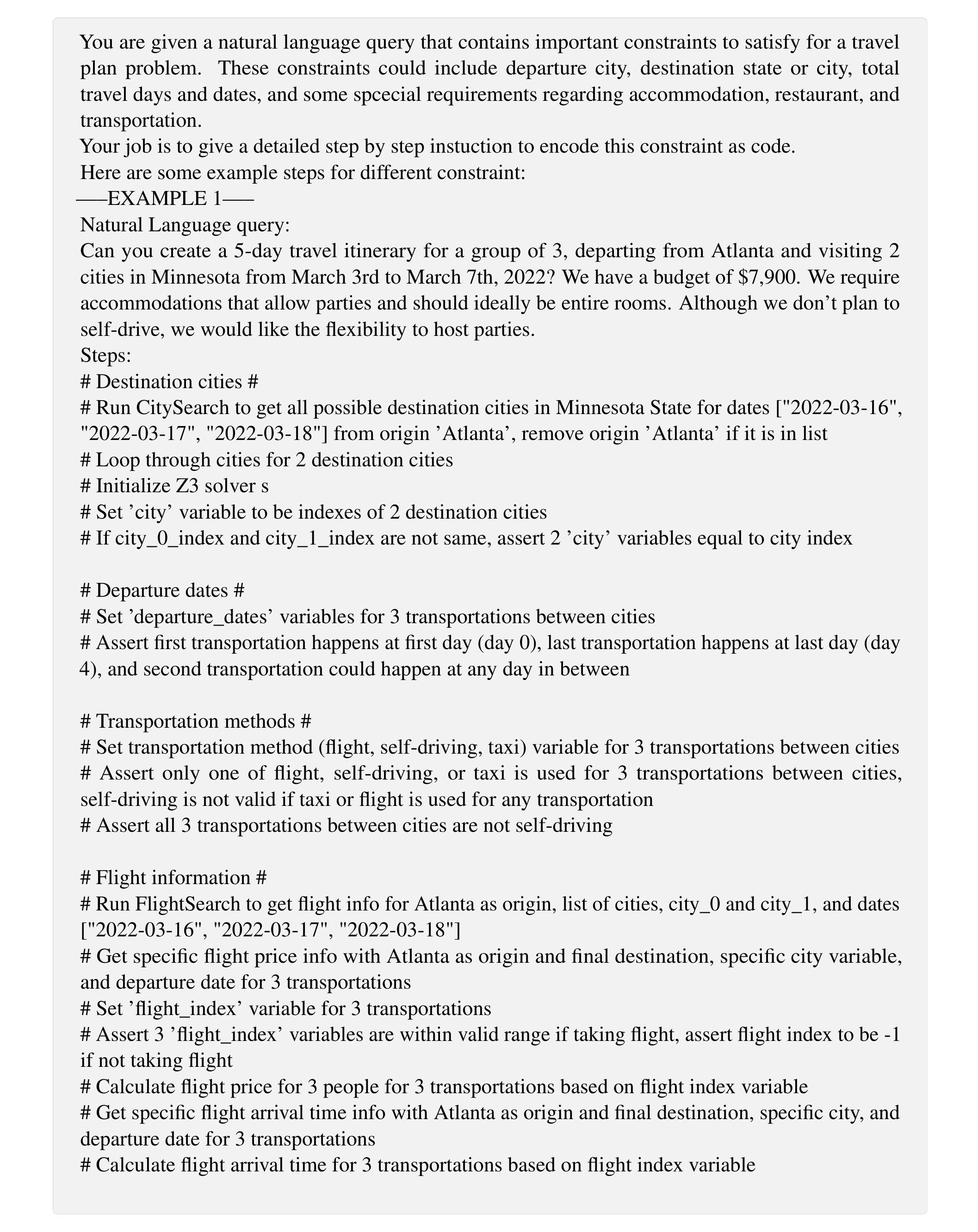
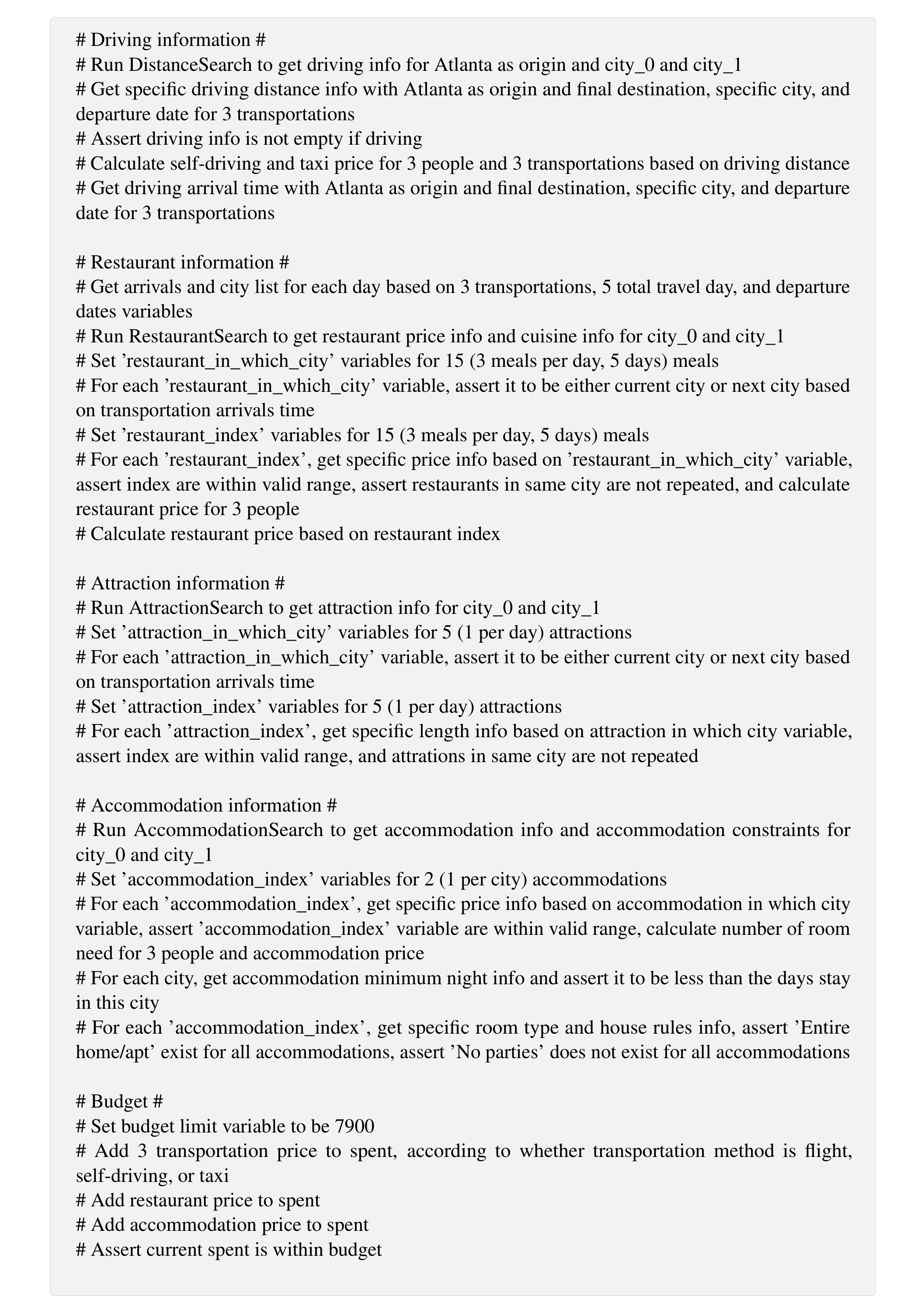
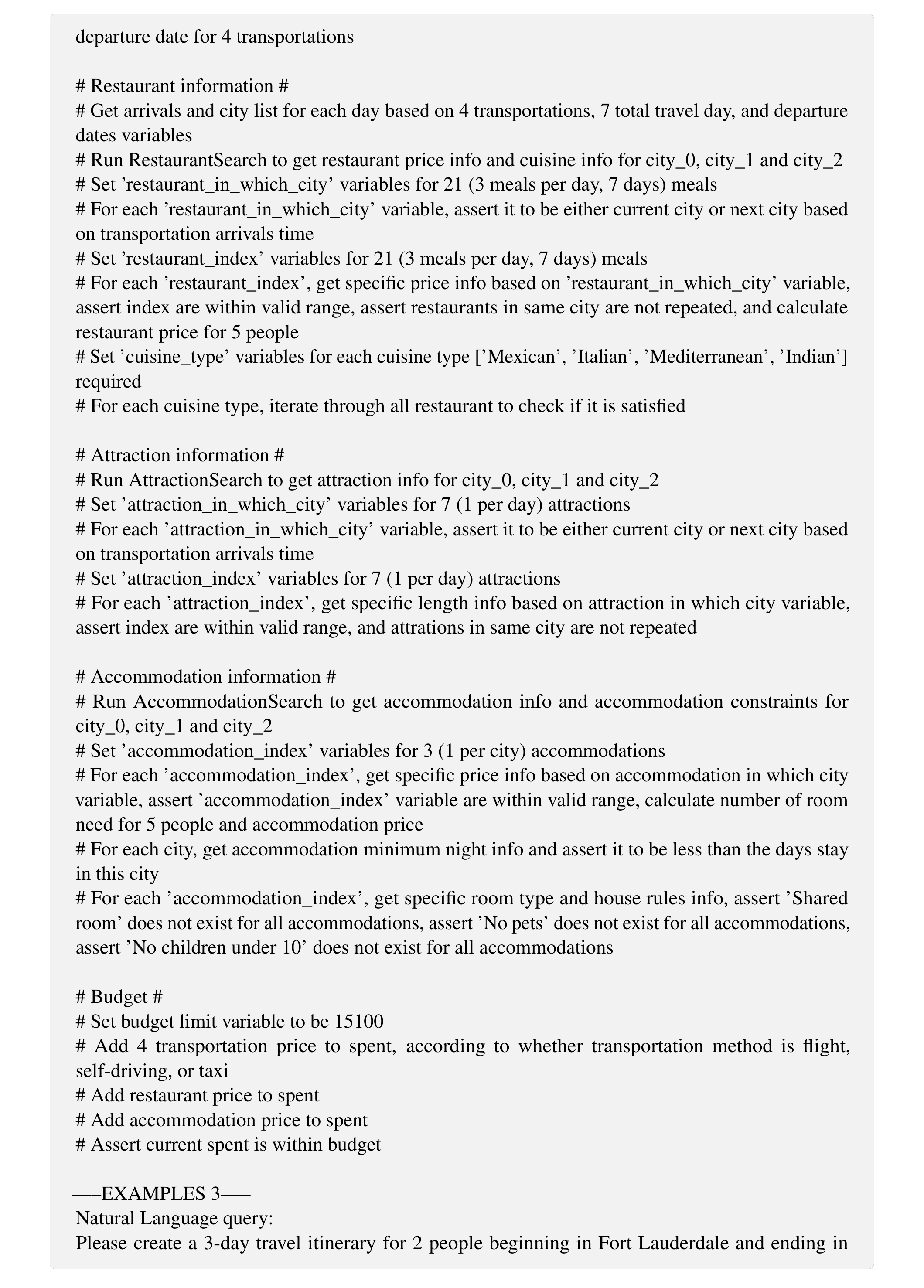
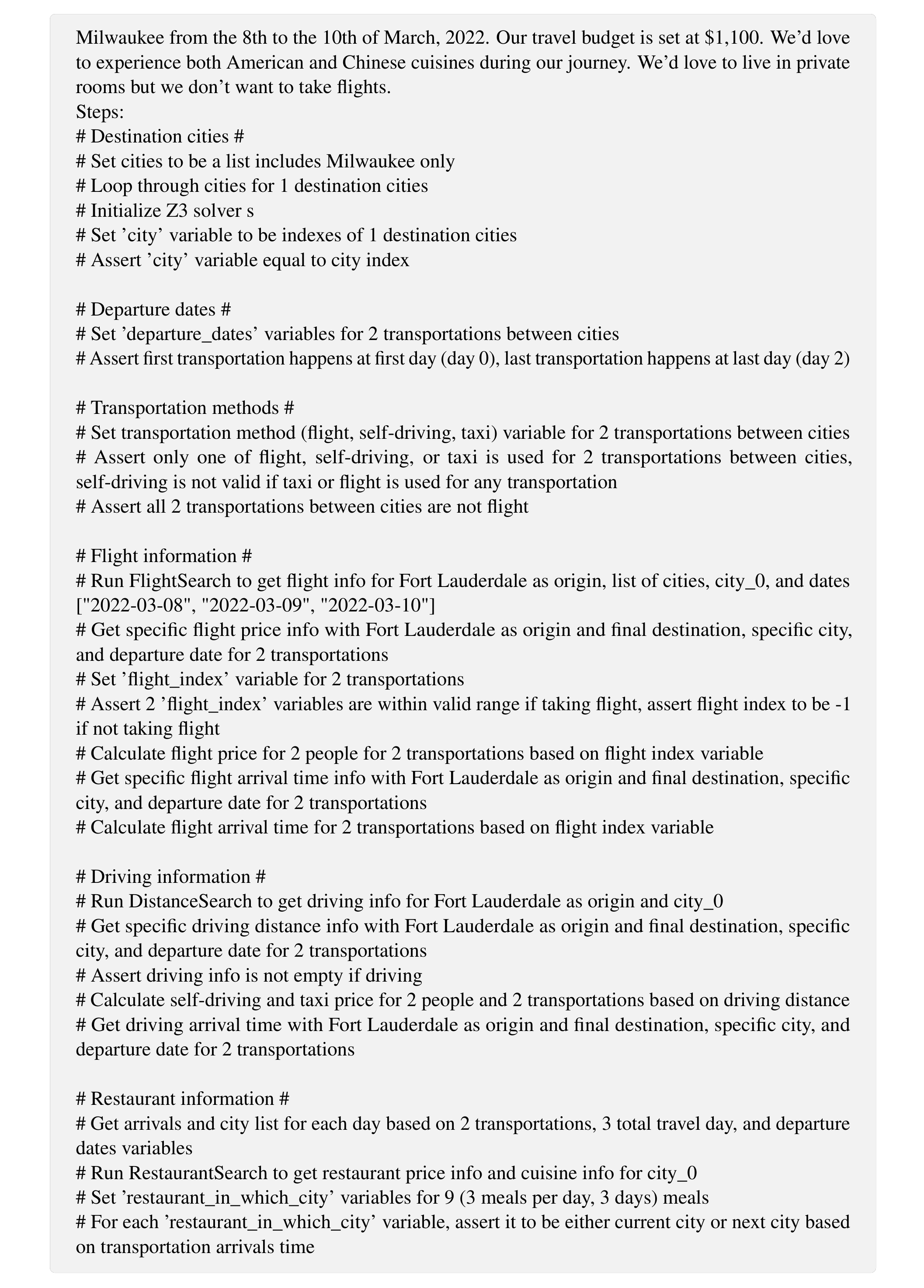
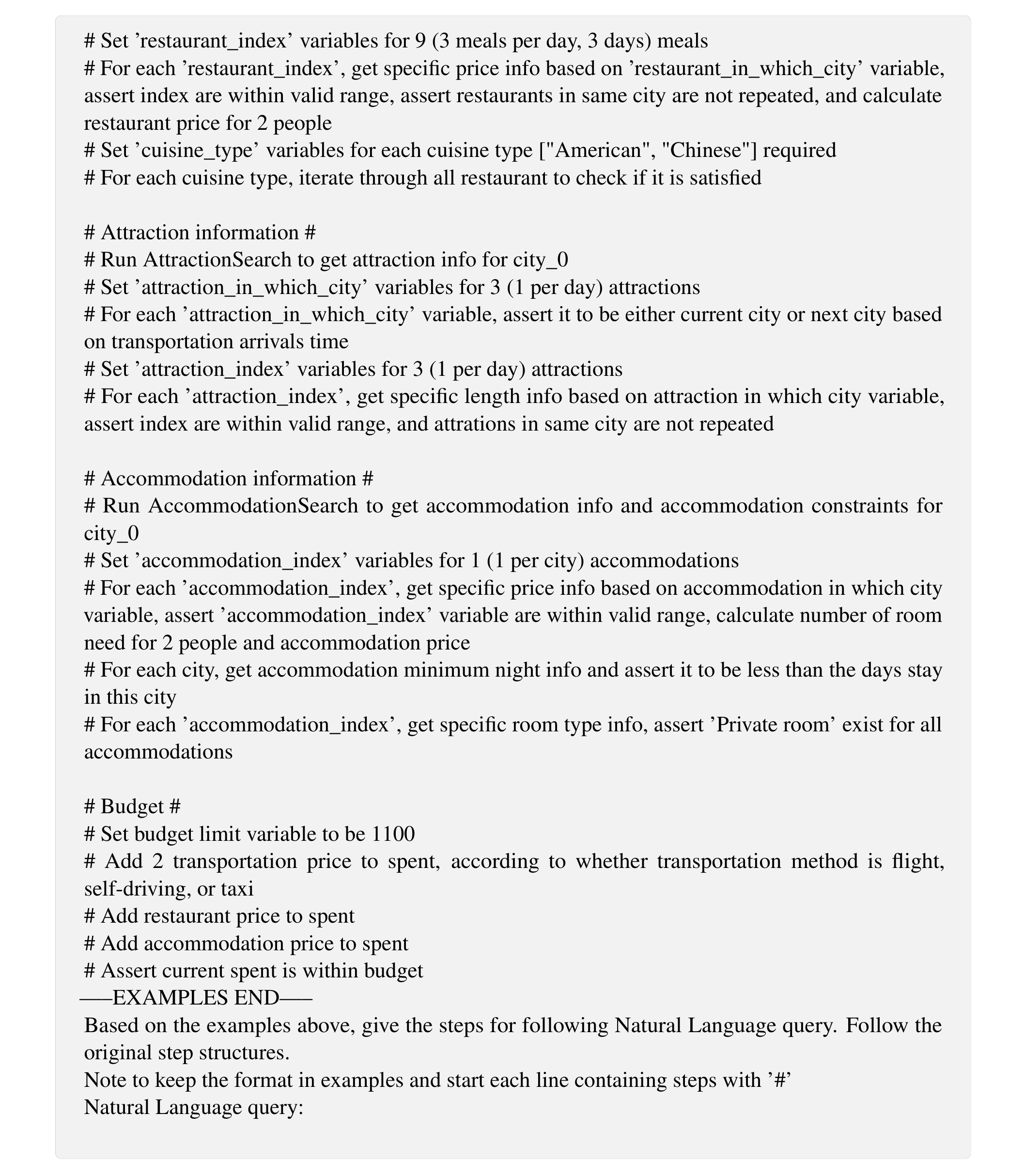
We teach the LLM to perform such generation by providing three human-crafted examples, each containing a natural language query and the corresponding steps. Since the steps to formulate different constraints are different, the steps in each example are broken into nine sections, each focusing on the constraints about one particular subject, such as destinations cities, departure dates, transportation methods, etc. (See Appendix G for the detailed prompt). It is important to note that although in-context examples only concern a limited number of constraints, the LLM is able to learn generic patterns and generalize to unseen constraints.
Optionally, converting natural language queries into fixed format JSON descriptions before generating the encoding steps could help LLMs summarize the key information and further improve the performance. However, prompting LLMs to generate JSON descriptions requires explanations of the needed fields in JSON, which could expose more information that helps LLMs to better understand the problem. For fairness, we do not generate JSON files when compared with other methods with natural language inputs. We include the result of our framework with this extra step in Appendix D.1.
3.3.2 Step-Code Generation
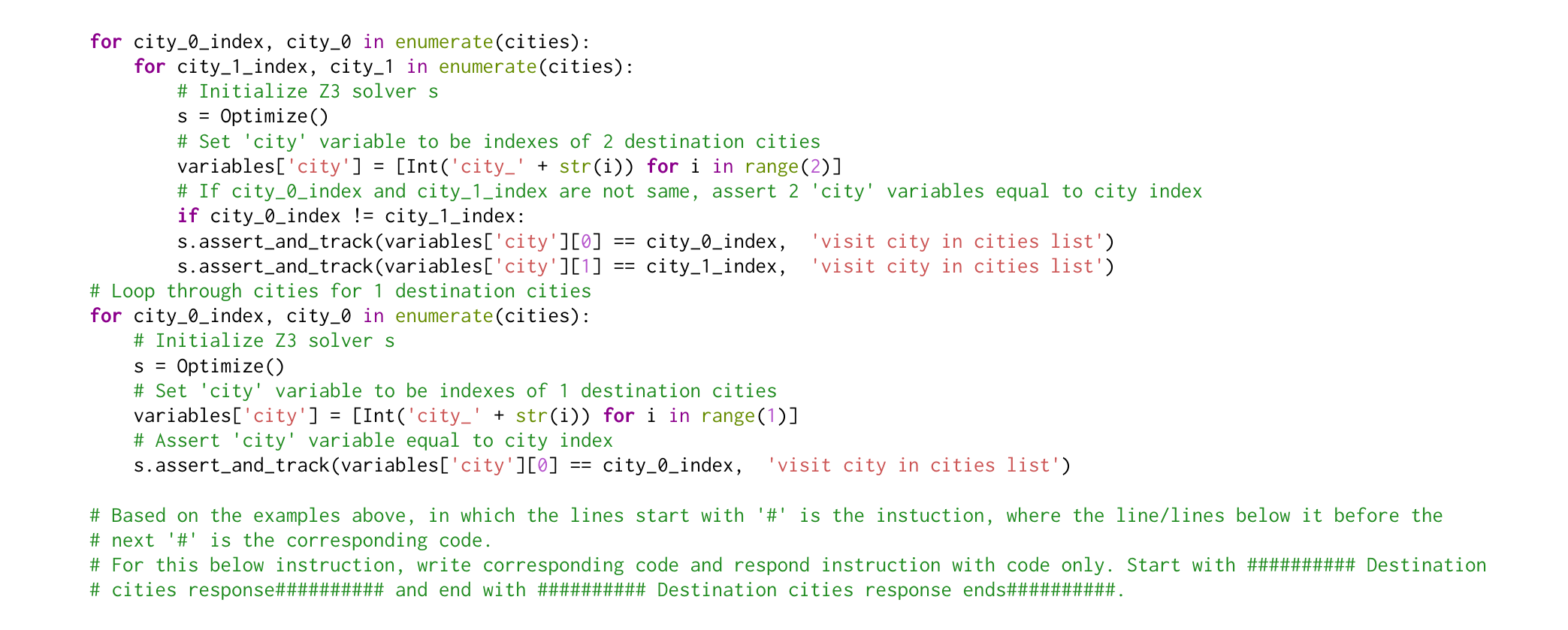
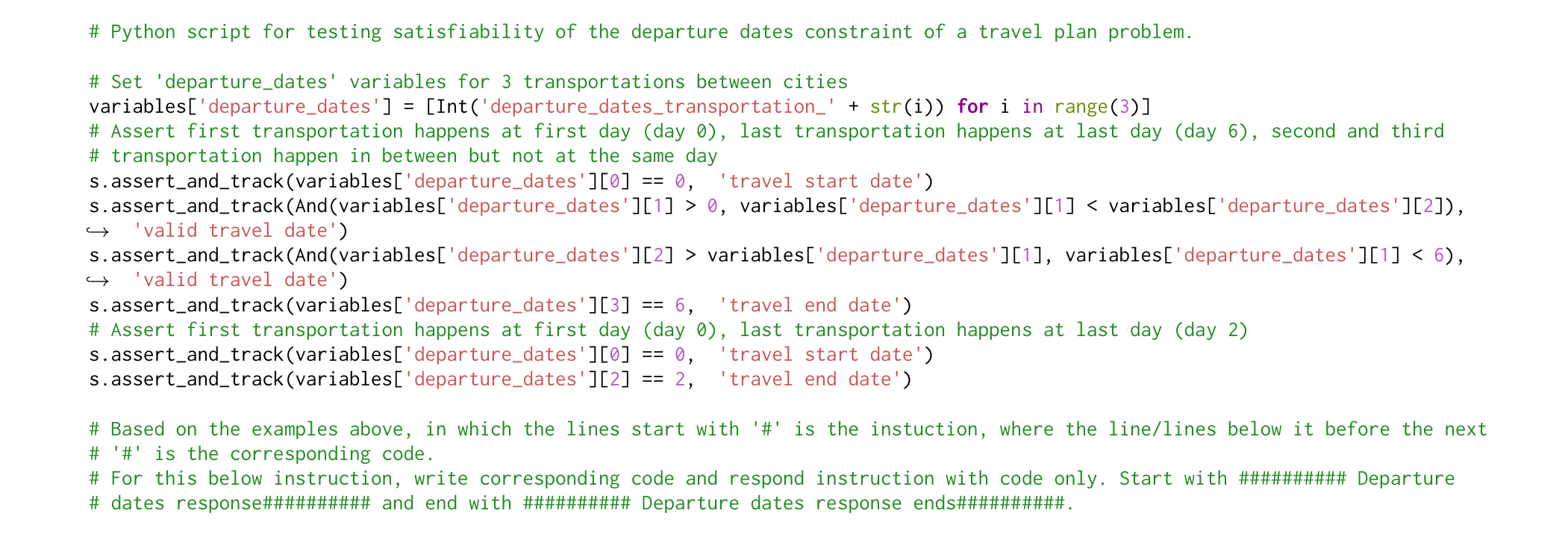
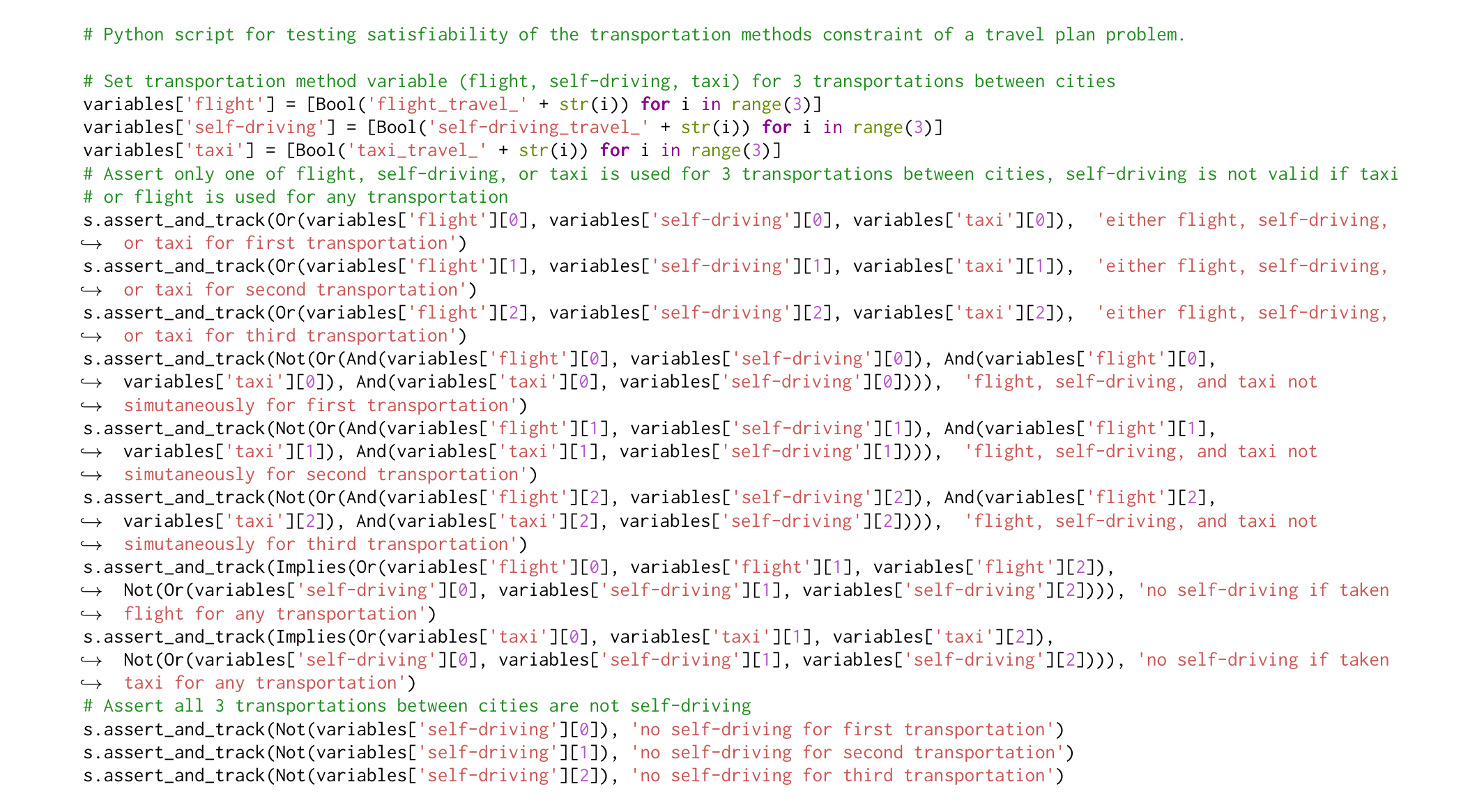
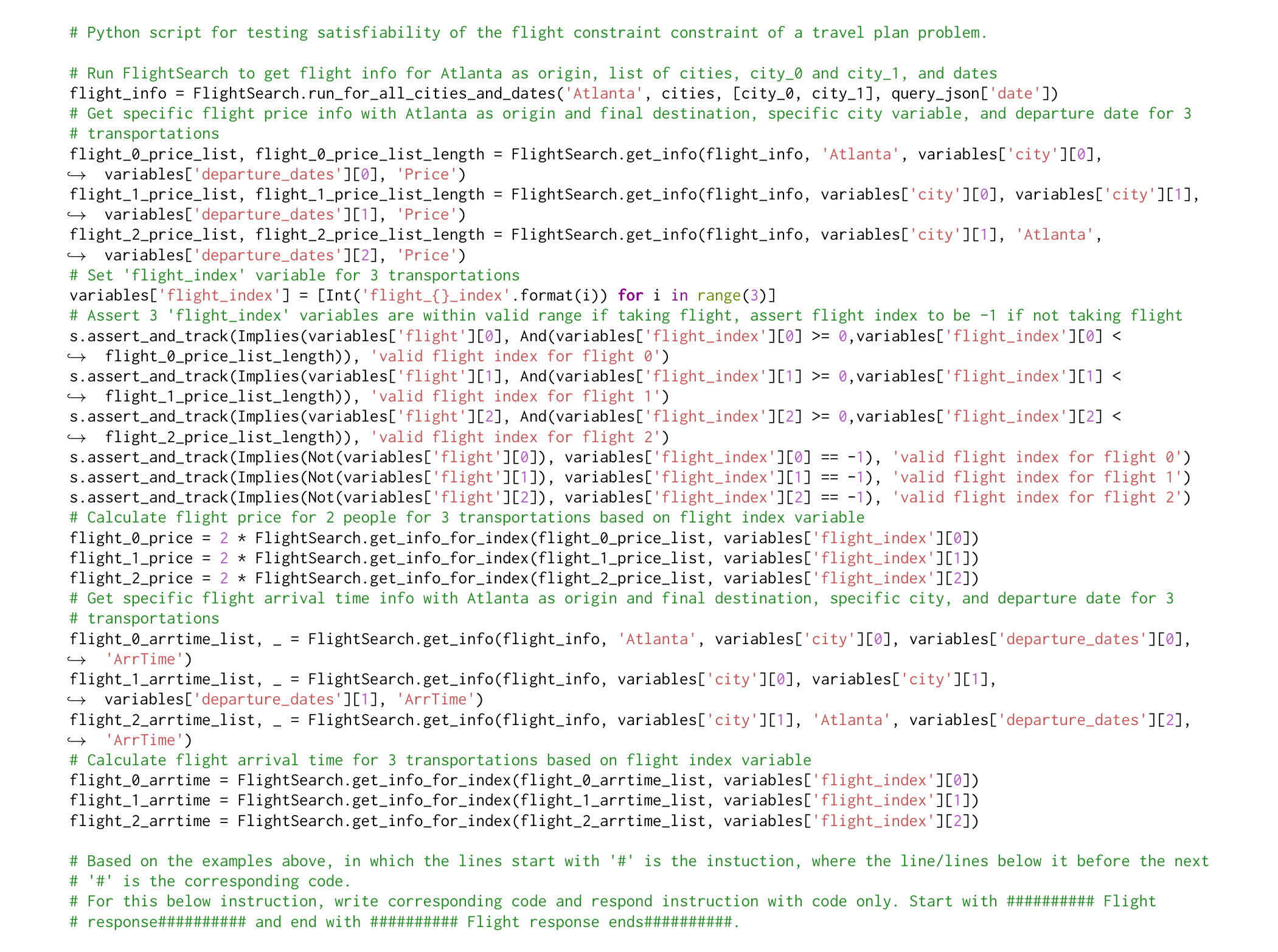
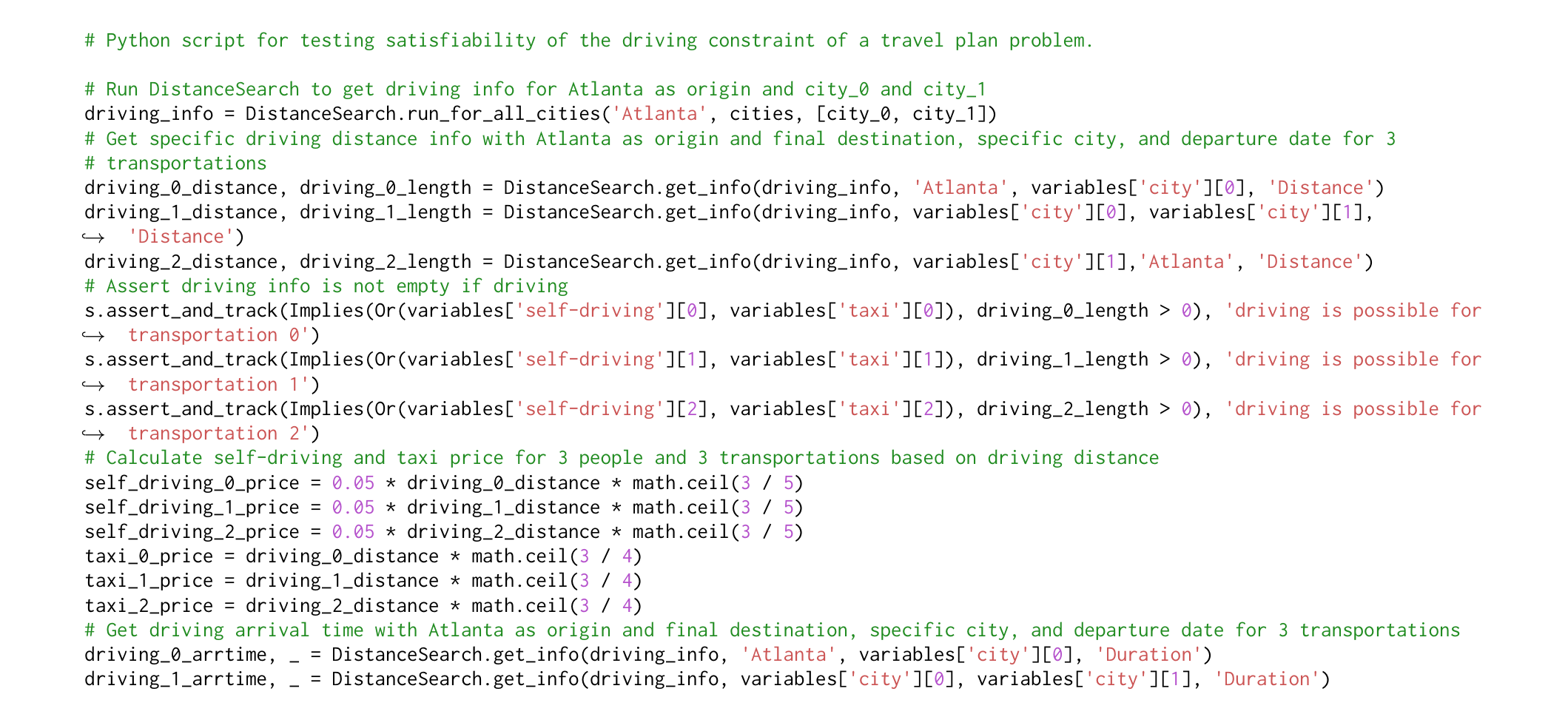
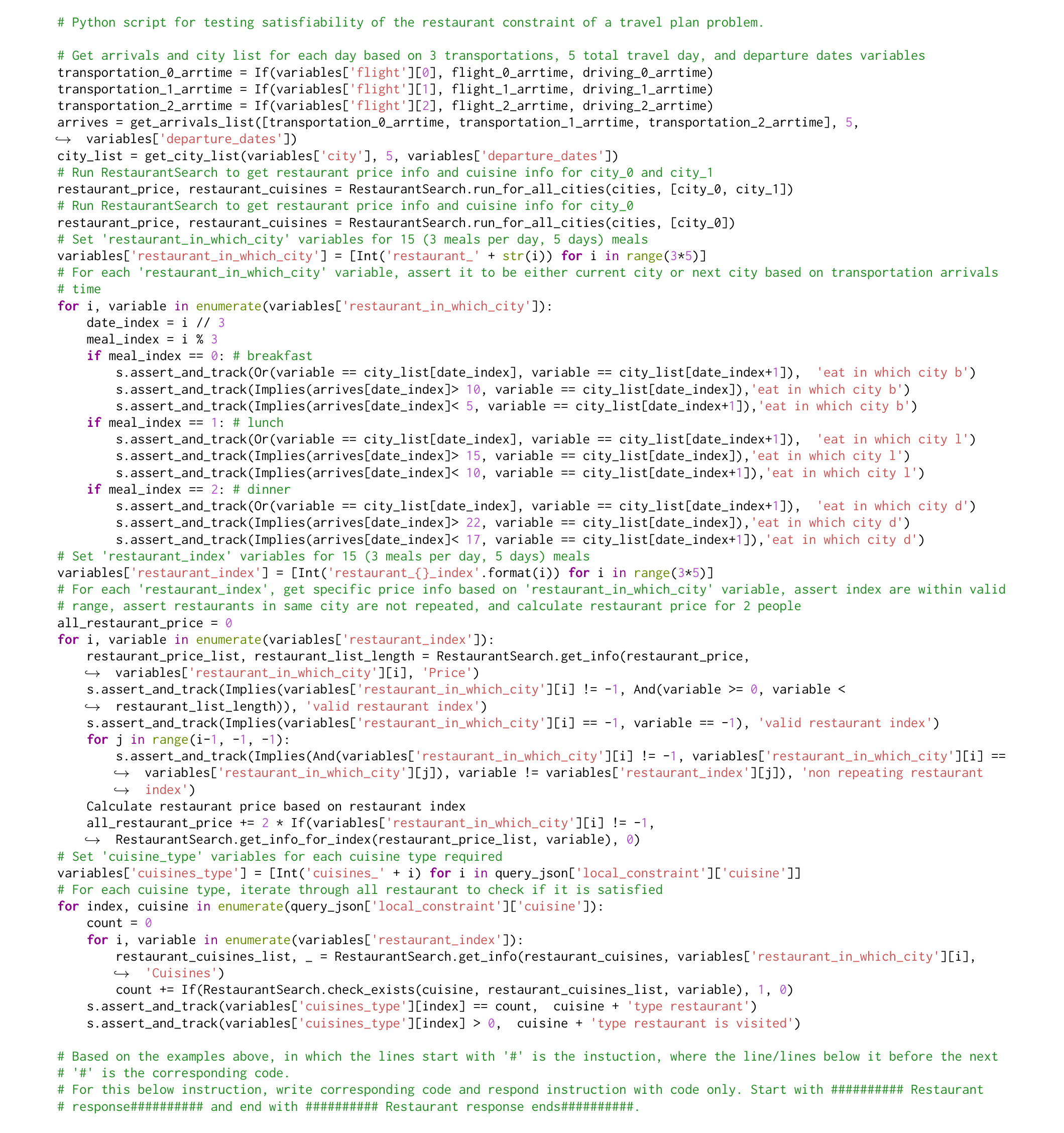
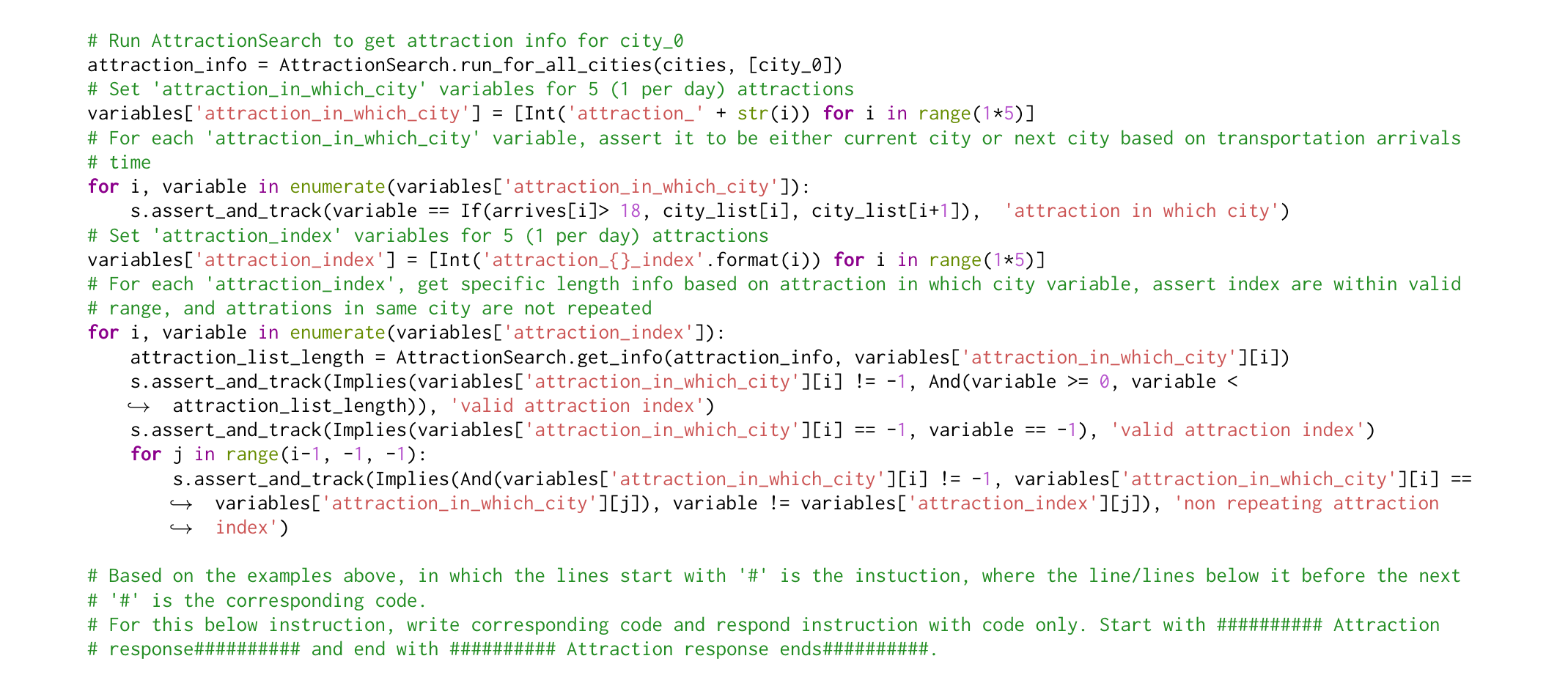
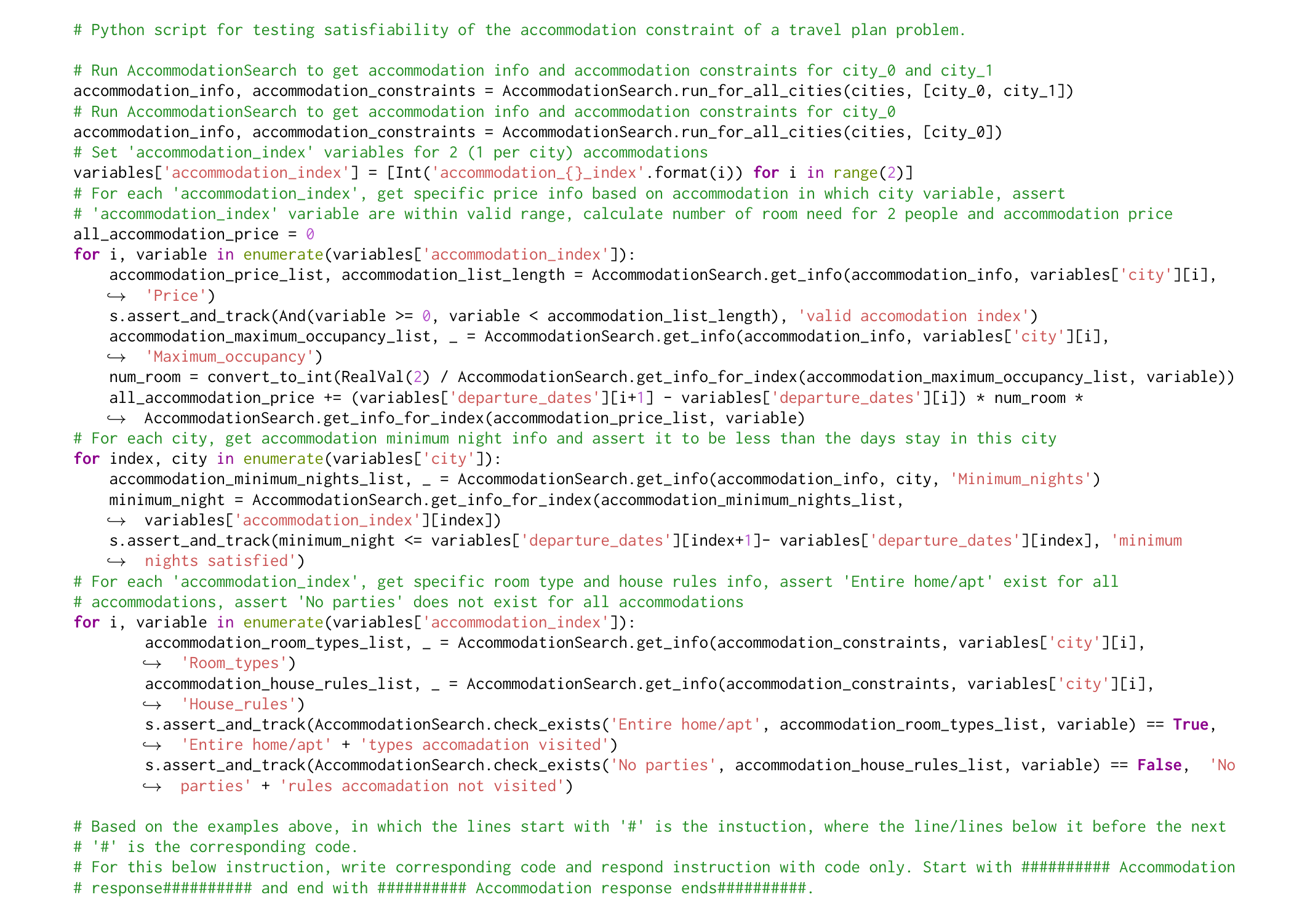
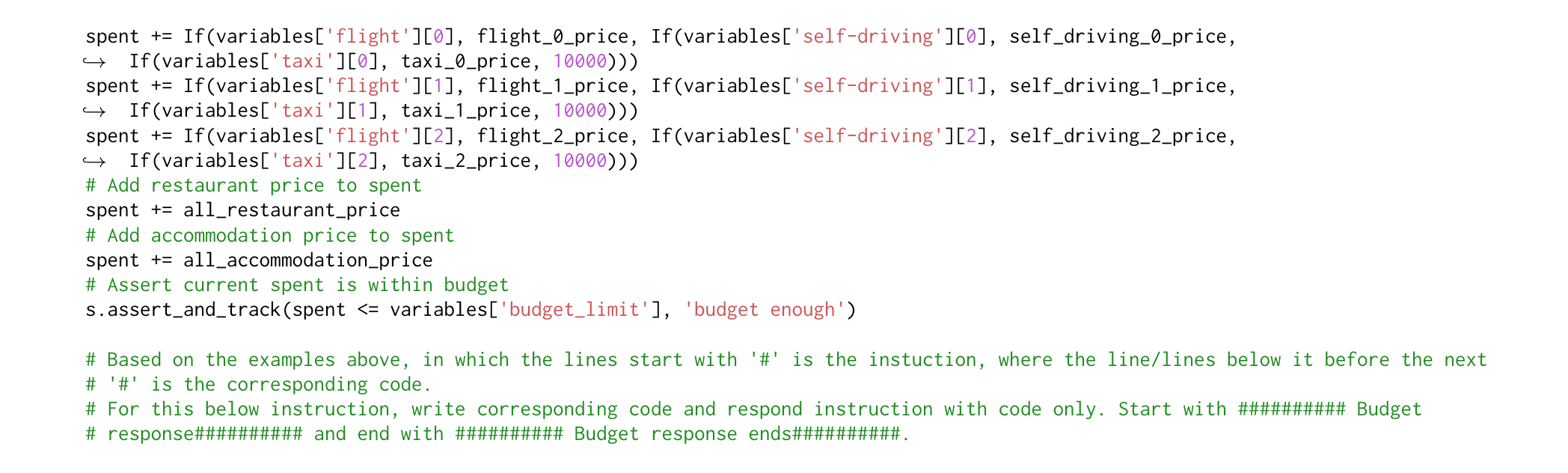
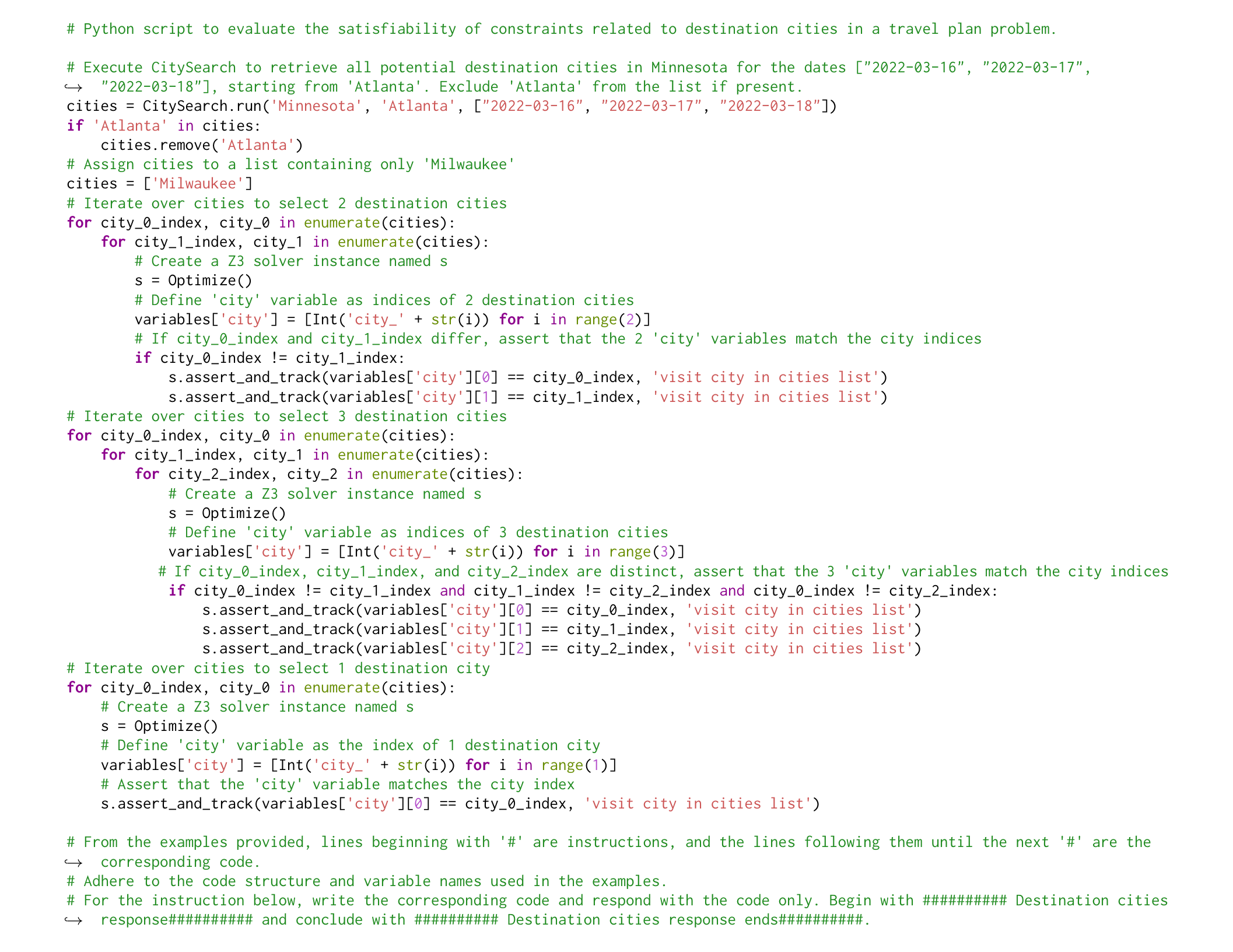
Step-code generation involves converting each of the steps generated in the previous stage into Python code, which would call the relevant APIs that collect information, such as CitySearch, FlightSearch, AttractionSearch etc., as well as the SMT solver to execute the steps. Inspired by Liang et al. (2023), we teach the LLM to generate the code using examples as demonstrations, as shown in Fig. 1 (part 3). Each example contains a single step drawn from the query-code generation examples (Section 3.3.1), and the corresponding human-written code. To ensure comprehensiveness, our step-code examples cover almost all the steps mentioned in the query-step examples, less some duplicated or highly similar steps. Since the examples already contain sufficient demonstrations of all the API and SMT solver calls, the LLM can learn to use these APIs and the solver without separate API documentation. Fig. 2 shows how the LLM generalizes to new instruction steps to write corresponding codes given these examples.
3.3.3 SMT Solver
After generating codes, our framework executes these codes to encode the problem and call the SMT solver. Since the SMT solver is sound and complete, it guarantees to find a solution if there exists one. Thus, if the constraints are satisfiable, the solver generates a formally verified plan. If the constraints are not satisfiable, the solver outputs the unsatisfiable reasons and LLM could, based on its commonsense and reasoning capabilities, analyze the reasons, actively collect more information, and provide humans with suggestions to modify the constraints. We extract the unsatisfiable reasons with Z3 solver’s get_unsat_core function. When the framework proves the constraints to be unsatisfiable, it proceeds to interactive plan repair with the unsatisfiable reasons.
3.4 Interactive Plan Repair
When a proposed query is not satisfiable, LLM’s reasoning capability and commonsense knowledge to analyze the current situation and offer suggestions become vital. Furthermore, these capabilities enable an interactive setting, in which humans can agree, disagree, or provide feedback to LLM’s proposed suggestions. LLM can deliver personalized plans built upon different human preferences.
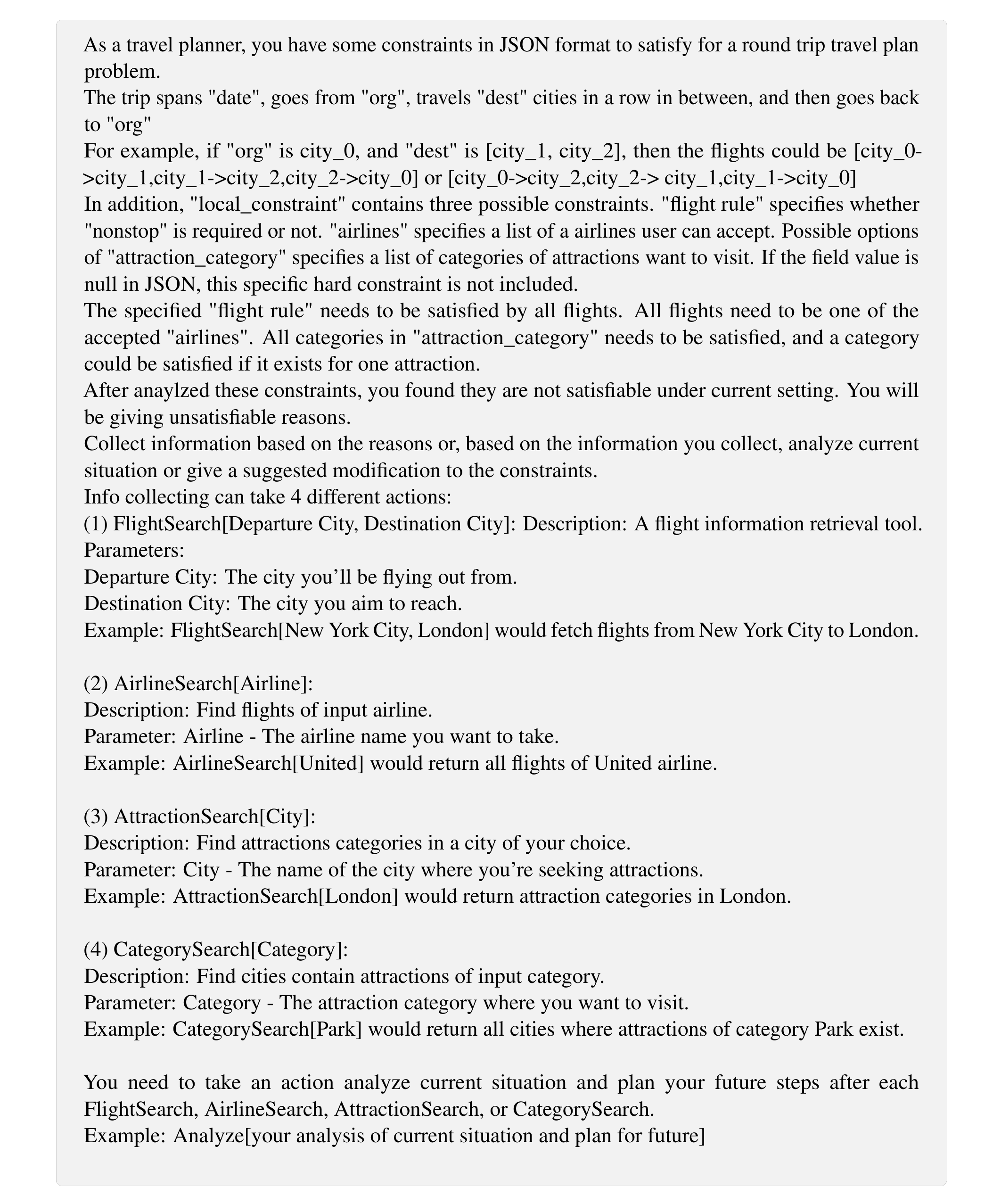
Inspired by ReAct (Yao et al., 2022), in our framework, LLM could either take an action to collect information based on unsatisfiable reasons, analyze the current situation based on collected information, or provide suggestions. We equip LLM with information collection APIs and descriptions of their usage. As shown in Fig. 1, the unsatisfiable reason is “invalid flight for transportation 0”. With the reason, the LLM first collects flight information with FlightCheck API. Realizing no flight is available between St. Petersburg and Rockford, LLM analyzes and decides to change the destination city. It then runs FlightSearch API to search for all available destinations and chooses one of them. LLM offers this as a suggestion to the user. The user can optionally provide feedback, including yes, no, any natural language preference, or even modifications users proposed. If the user disagrees with the suggestion or provides their preferences, the framework starts another iteration and proposes new suggestions. If the users do not provide feedback, agree with the suggestion, or propose their own modification, the framework continues by inputting this modification, together with original codes, to an LLM and prompting it to modify the codes. By running the modified codes, the framework generates a plan if the modified constraints are satisfiable. Otherwise, the framework will gather the unsatisfiable reasons and start another round.
4 Dataset
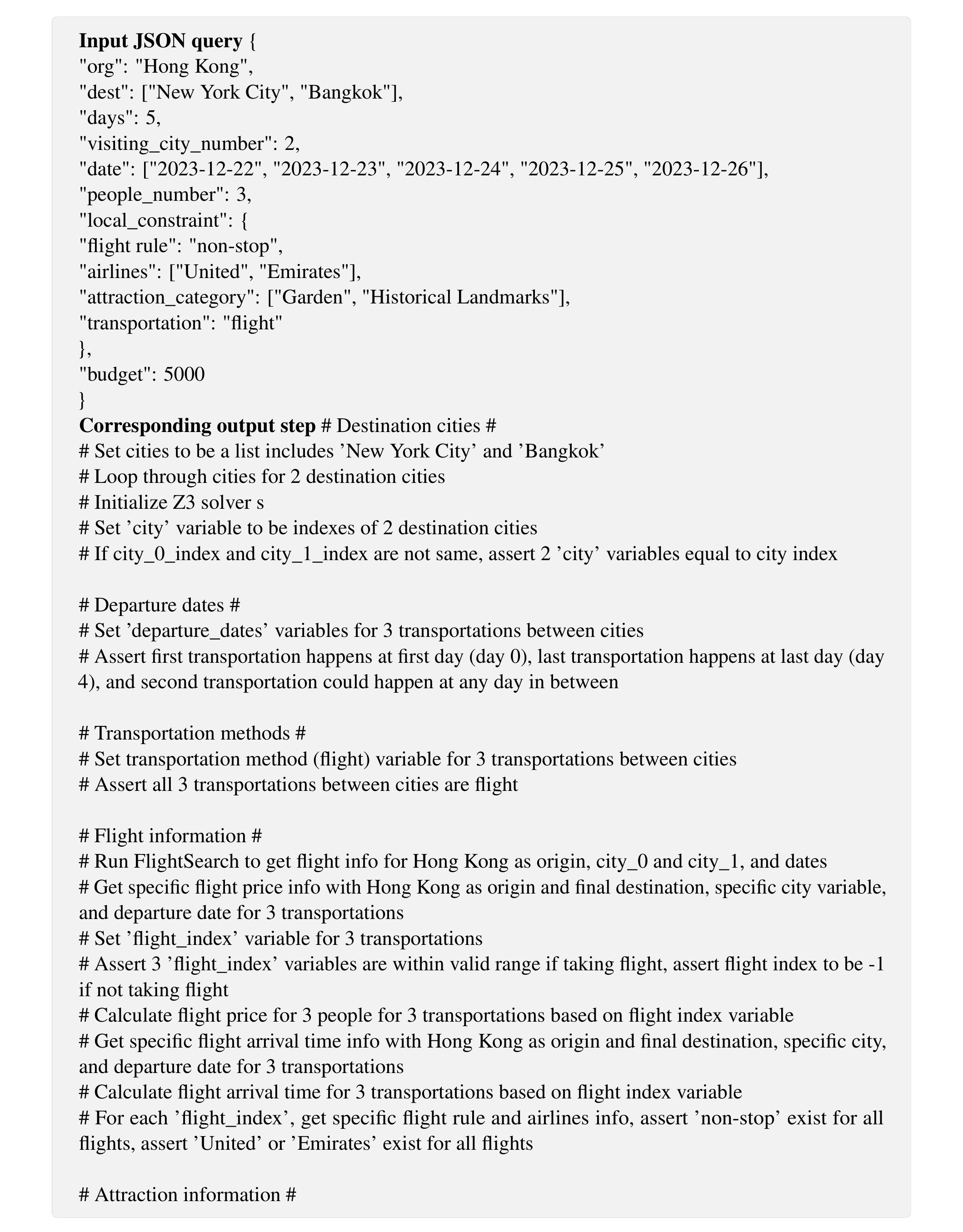
To access our framework’s ability to 1) generalize to unseen constraints and 2) interactive plan repair for unsatisfiable queries, we propose a dataset, UnsatChristmas, that introduces new constraints not included in TravelPlanner and contains 39 unsatisfiable queries under this setting. The queries in UnsatChristmas aim to create an international travel plan for Christmas week in 2023. We set cities in our dataset to be the top ten worldwide city destinations in 20191 and obtain attraction information from Metabase2. We utilize Google Flights3 to collect flight information from 12-24-2023 to 12-30-2023 for these ten cities. Compared with TravelPlanner, we omit detailed information on transportation methods, restaurants, and accommodations but introduce detailed constraints regarding flights and attractions. As shown in Table 5, UnsatChristmas allows users to specify preferences for 1) non-stop flights, 2) the list of airlines, and 3) the list of attraction categories. We collect 39 unsatisfiable queries with 4 possible reasons: non-stop flight rule not satisfied, flight airline requirement not satisfied, attraction category requirement not satisfied, budget not enough. Out of the 39 queries, 12 fail due to one reason, 18 fail due to two reasons, 8 fail due to three reasons, and 1 fails due to four reasons. There are 13 queries with a single destination city, 13 with two, and 13 with three. In addition, to test the interactive plan repair performance, we also modify 12 queries from the training set of TravelPlanner to be unsatisfiable.
5 Experimental Results
We examine our framework on both TravelPlanner and UnsatChristmas. We use GPT-4 (Achiam et al., 2023) with temperature 0 by default, and we also compare with Claude 3 Opus-20240229 (cla) and Mistral-Large (Mis) with temperature 0 for satisfiable plan solving evaluation. We use Z3 SMT solver (De Moura and Bjørner, 2008). Since the solution space is prohibitive considering the combinatorial choices and a few queries have very limited feasible plans, we limit the SMT solver’s maximum runtime for each query to 30 minutes. Please refer to Appendix B for cost and runtime analysis.
5.1 Satisfiable Plan Solving Evaluation
We examine how well our framework can create travel plans for satisfiable natural language queries on the TravelPlanner benchmark. We design our example instruction steps and corresponding codes using three queries from TravelPlanner’s training set and tune the prompt with other queries in the training set. We evaluate our method on both the validation (180 queries) and the test set (1000 queries).
Evaluation Metric We adopt evaluation metrics from Xie et al. (2024) and mainly look at the Final Pass Rate, which represents whether LLMs pass all constraints. Please refer to Appendix D.2 for detailed descriptions of other evaluation metrics.
Baselines We compare our framework with the three strongest models using different strategies from Xie et al. (2024). Greedy Search uses a traditional search algorithm and heuristically optimizes for total cost. TwoStage (GPT-4), a two-stage tool-use framework, collects information with ReAct (Yao et al., 2022) and then gives plans. Direct (GPT-4), a sole-planning framework, has access to all necessary information and gives plans without tool-calling needs. We also include the result of Direct (o1-preview), the strongest reasoning model so far, for the validation set. Due to the long runtime of o1-preview, we do not evaluate Two-Stage or our framework with o1-preview. To verify the effectiveness of our framework in varied LLMs, we also evaluate with Claude 3 Opus and Mistral-Large. We tune the prompt with the training set and include the prompt differences in Appendix G.1.3.
Results and Analysis Table 1 shows the performance comparison. From the results, all LLM planning methods, TwoStage (GPT-4), Direct (GPT-4), and Direct (o1-preview), struggle to take all constraints into consideration with a final pass rate of 0.6%, 4.4%, and 10.0%. Without formal specification, Greedy Search fails to pass any of the tasks. Ours (Claude-3), with the capability of formally encoding the problem as an SMT problem, achieves the highest final pass rate of 93.3% and 93.9% for validation and test set. This demonstrates our framework’s robustness in solving satisfiable queries. In addition, Ours (GPT-4) could reach comparable results as Ours (Claude-3). Although the pass rate for Ours (Mistral-Large) drops 26.6% and 26.1% compared to Ours (Claude-3), it still significantly outperforms baselines, and 92.3% and 97.0% of its delivered plans are correct plans. See Appendix G.1.4 for major failure cases of Ours (Mistral-Large). These results demonstrate the adaptability of our framework to various LLMs.
In addition, since inputs of baselines are natural language only, to ensure fairness, we do not include the additional step to translate natural language inputs into JSON representations. However, we show that including this step could even further improve the performance by helping LLMs extract and summarize key information before generating steps. We test on all three LLMs and achieve 98.9%, 98.3%, and 84.4% pass rates with on average 9.4% improvements on the validation set. We also test GPT-4 on the test set, which achieves 97.0%. Please refer to Appendix D.1 for details.
5.2 Generalization Capability Analysis
5.2.1 New Prompts
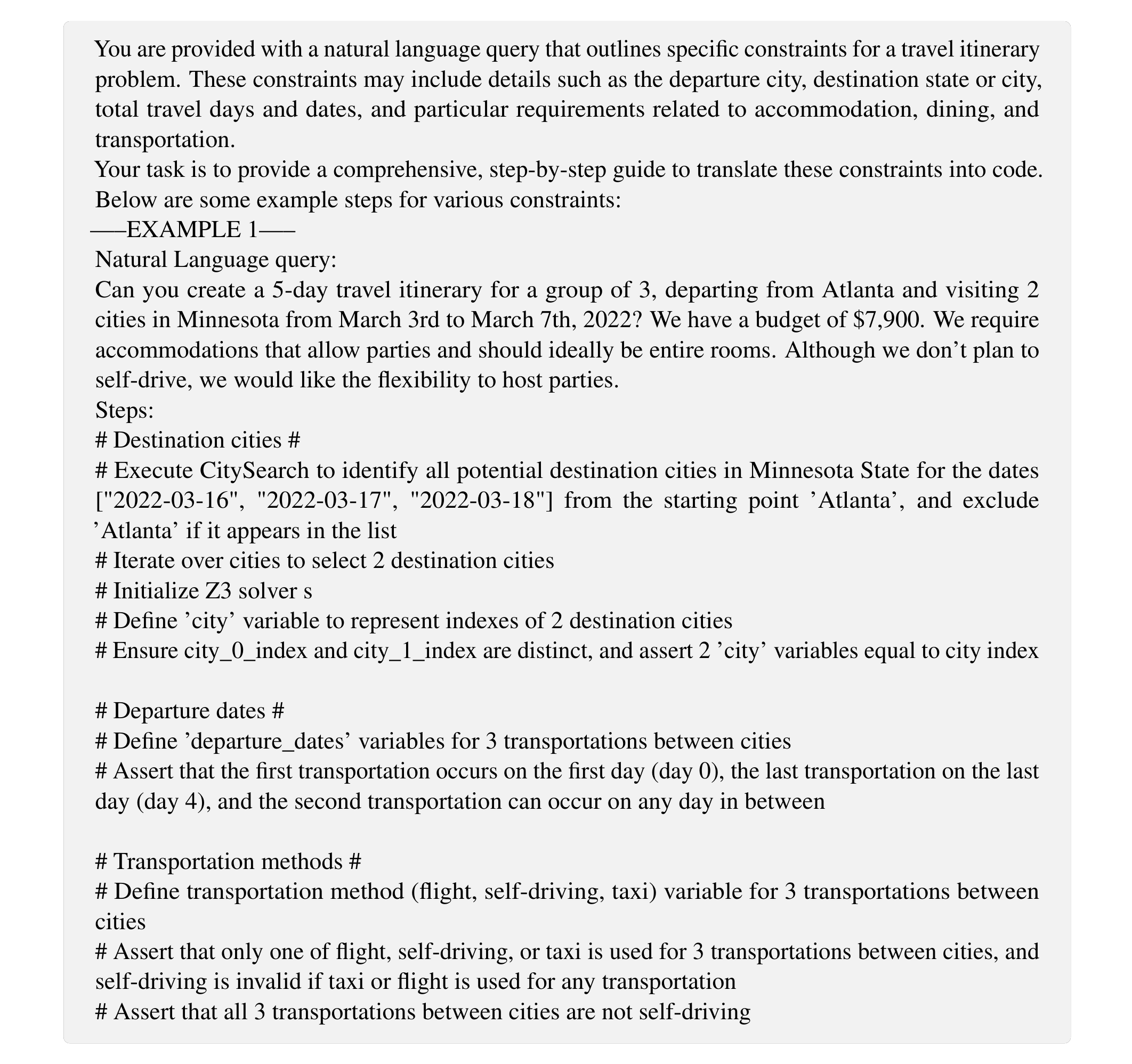
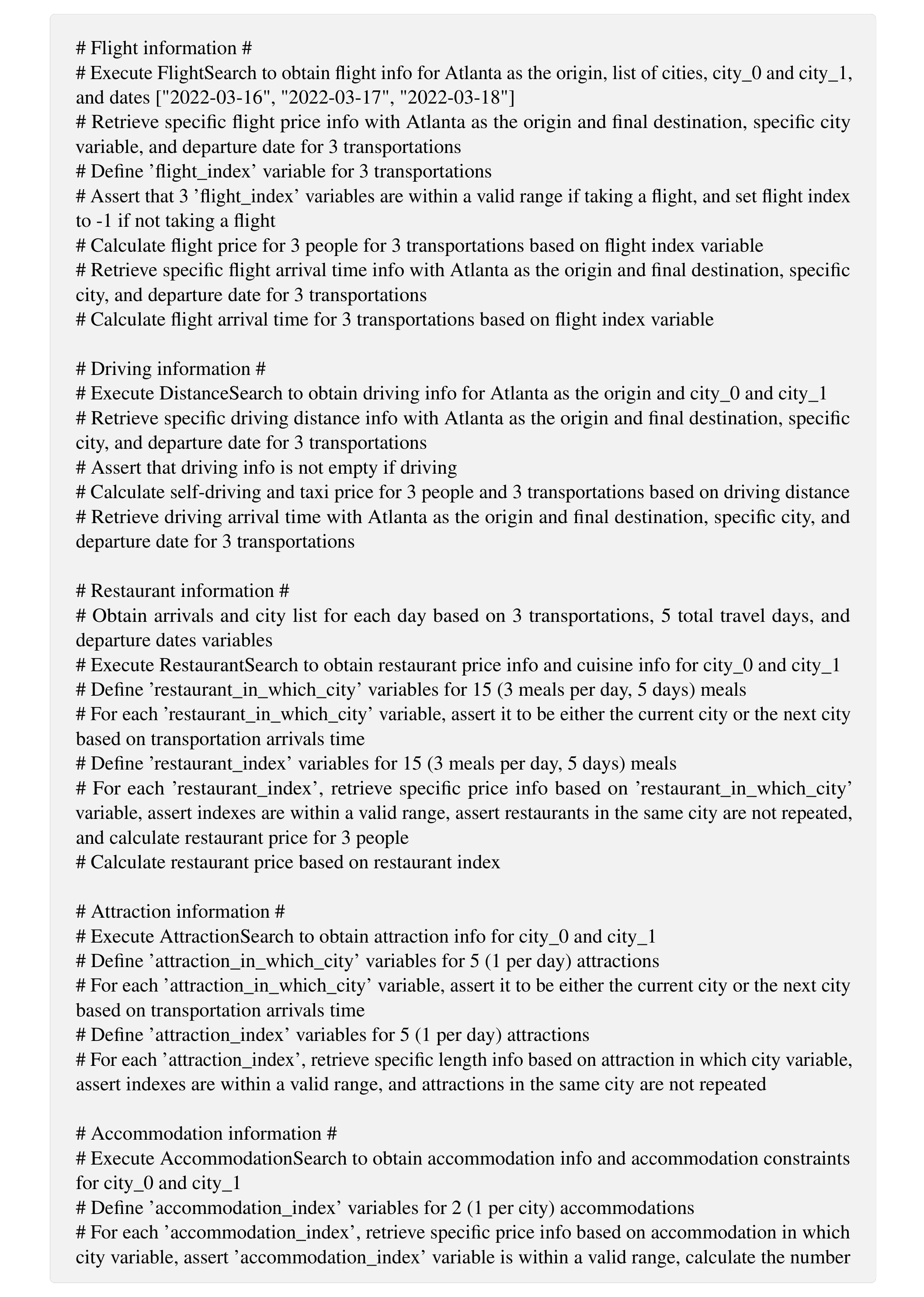
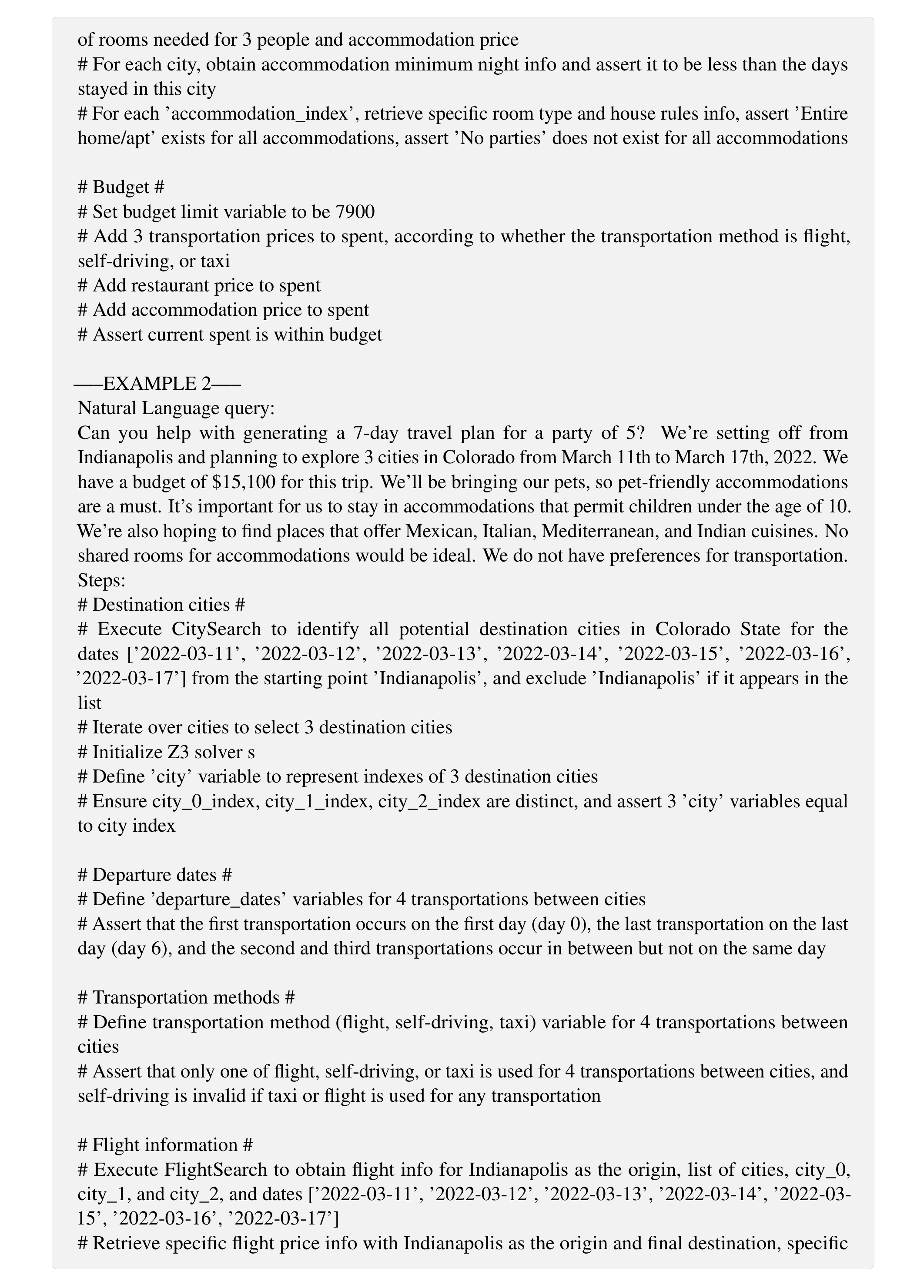
Since both Query-Step and Step-Code prompts require careful design, we test the compatibility of our framework to handle diverse new prompts. We use GPT-4o (gpt) to paraphrase the entire Query-Step and Step-Code prompts, including the examples used in prompts, for every query in TravelPlanner’s validation set and repeat for all 180 queries. We use the paraphrased prompts to test our framework, which achieves a final pass rate of 86.7% for GPT-4. This showcases the outstanding performance of our framework is not sensitive to the wording of prompts and does not heavily rely on the prompt design. Please refer to Appendix G.4 for example paraphrased prompts.
5.2.2 New Travel Plan Constraints
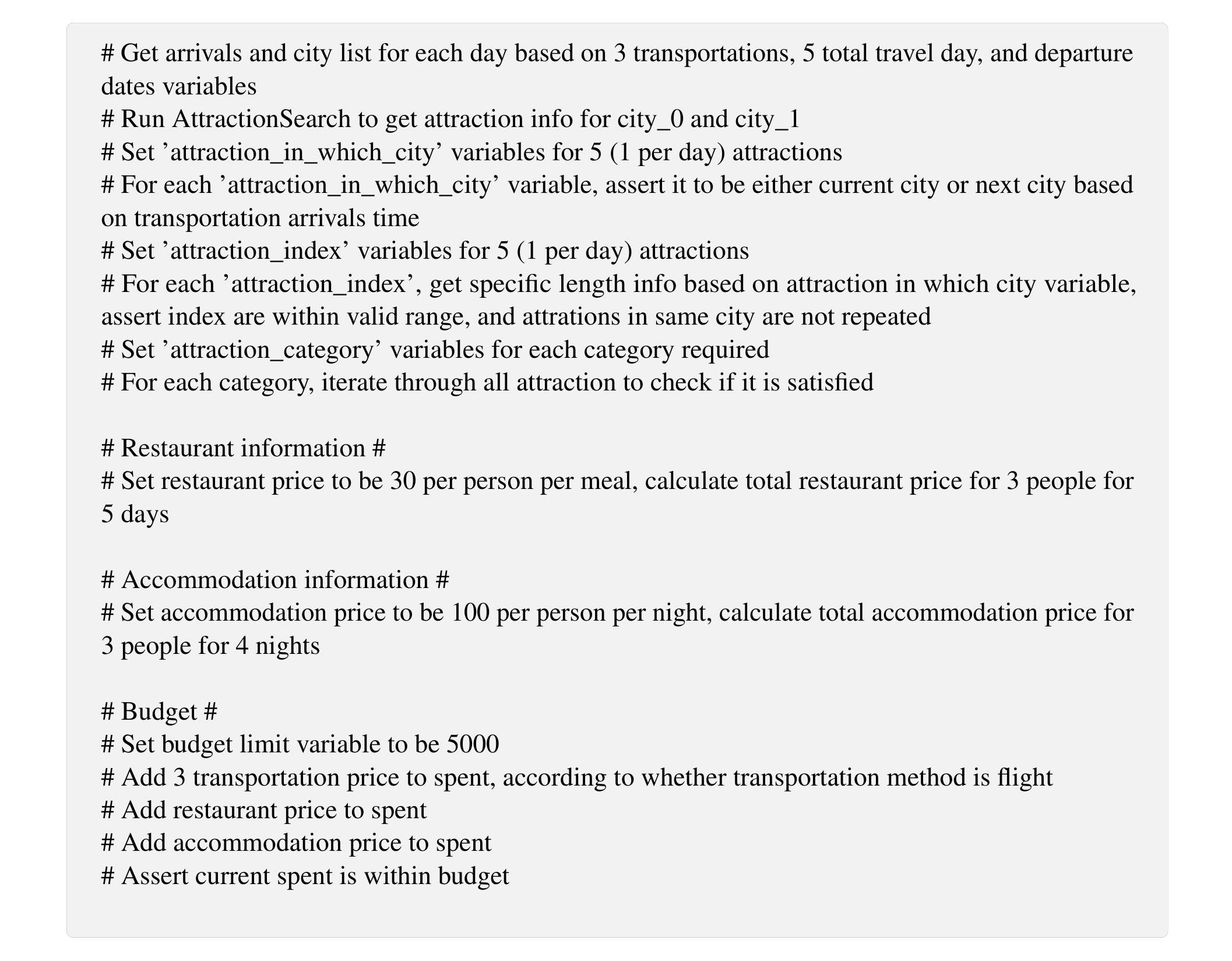
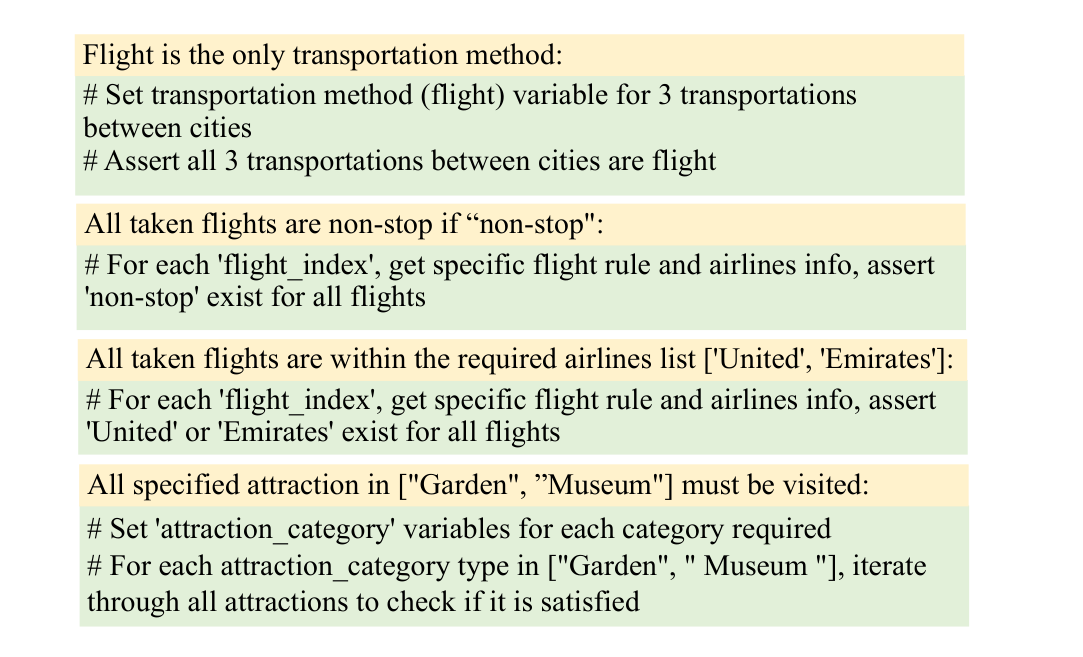
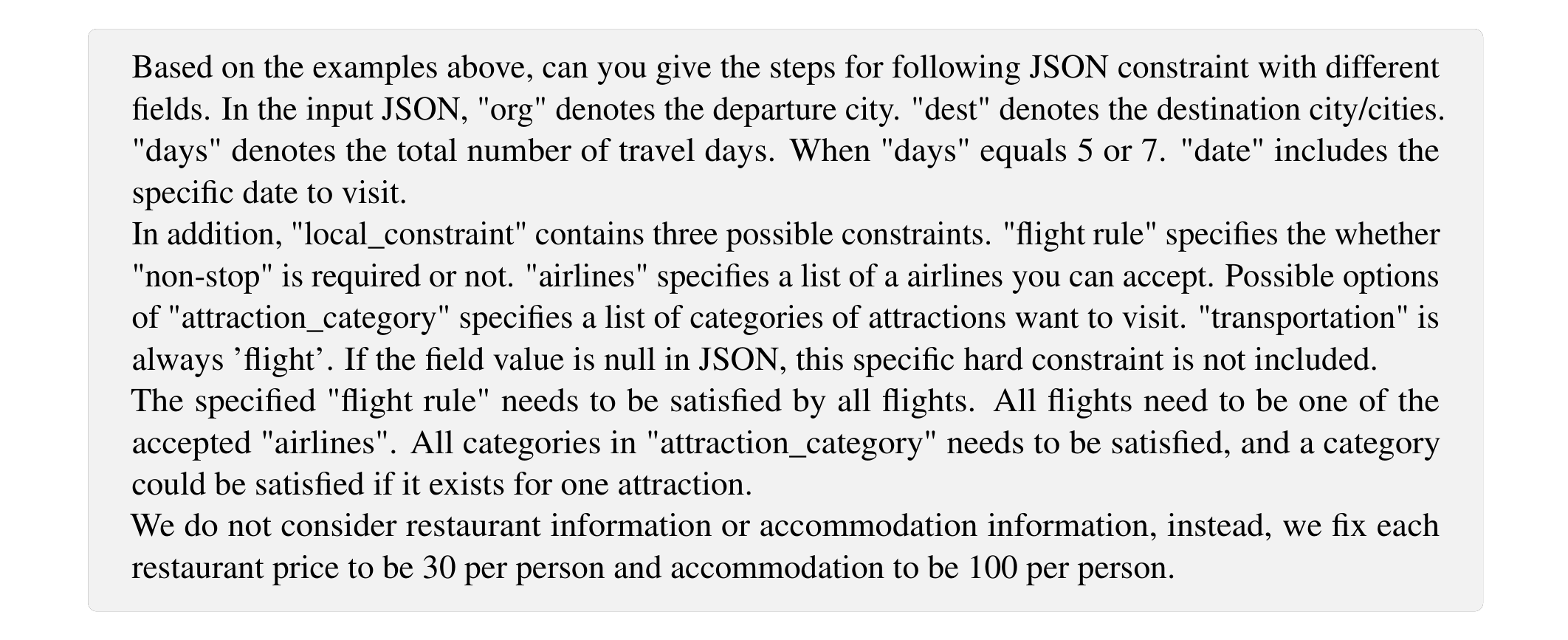
Since the travel planning problem involves various constraints of different types, our example instruction steps may not be comprehensive enough to cover all possible constraints. Here we examine our framework’s robustness by testing whether it could generalize to the constraint types not shown in prompt examples in a zero-shot manner. As shown in Table 5, UnsatChristmas has different constraints than TravelPlanner. We show that by adding several lines of constraint description in the JSON-Step prompt, LLM could generate steps for new constraints without the need to add new examples. Figure 3 shows how our framework encodes unseen constraints in UnsatChristmas. Please see Appendix G.3 for the added constraint description and see Appendix H for full generated steps.
5.2.3 New Multi-Constraint Planning Tasks
To show the capability of our framework to generalize to other domains, we conduct experiments in four new tasks: Block Picking, Task Allocation, Travelling Salesman Problem (TSP), Warehouse. For each task, we create 25 different scenarios. See Appendix F.1 for detailed descriptions. For both Query-Step and Step-Code generation, we include one example from travel planning and a few lines of new problem description (Appendix F.2) in the prompt to test the zero-shot generalization capability. We implement the TwoStage tool-use framework as baselines. We use GPT-4o (gpt) as the LLM to account for long code generation. We use both delivery rate and optimal rate as the evaluation metrics. Results in Table 2 show that LLMs themselves fail to directly solve multi-constraint problems with large solution spaces, but our framework, with its knowledge of encoding and solving travel planning problems as SMT problems, could be adapted to other multi-constraint problems in a zero-shot manner with good optimal rate: 92%, 92%, 100%, and 72% respectively. Please refer to Appendix F.3 for failure cases analysis.
5.3 Interactive Plan Repair Evaluation
We examine our framework’s interactive plan repair capability on both the modified queries from TravelPlanner and UnsatChristmas.
Evaluation Metric We evaluate success rate: if our framework successfully modifies the query and delivers a feasible plan within 10 iterations.
Implementation Details Queries of UnsatChristmas have four unsatisfactoriness modes: 1) not enough budget, 2) no required non-stop flight, 3) no required airline, 4) no required attraction category. We test our framework with simulated users with different preferences. One mimic user agrees to all suggestions proposed by LLM, and five mimic users have hard constraints for budget, non-stop flight, airline, attraction category, and destination cities, respectively. They refuse suggestions that change their hard constraint and provide feedback indicating they will not change this information. Modified queries of TravelPlanner have three unsatisfactoriness modes: 1) not enough budget, 2) no required transportation method, and 3) no required house type. Mimic users have hard constraints for budget, destination cities, transportation methods, and house type.
Ablation Studies Key components in our framework include 1) LLM receives unsatisfiable reasons from the solver; 2) LLM collects information based on the reasons, analyzes, and offers suggestions; 3) LLM receives human preferences regarding offered suggestions and modifies codes; 4) SMT solver gives satisfiability verification. We perform ablation studies to examine these key components. We compare: 1) No Reason: asking LLM to resolve unsatisfiable queries without providing unsatisfiable reasons; 2) No Feedback: asking the human to only provide binary “agree” or “disagree” feedback without explaining why; 3) No Solver: removing the SMT solver. The LLM directly gives a list of suggestions in one iteration because no solver is provided to verify the updated query; 4) Ours: our approach (Section 3.4); 5) Ours-20: our approach with maximum 20 iterations.
Results and Analysis Table 3 and 4 show the interactive plan repair performance. Our framework successfully addresses an average of 78.6% and 85.0% diverse human preferences across all types of mimic humans. Ours-20 raises the success rate to 81.6% and 91.7%, showing the potential of increasing iteration limits to achieve better results. We include figures of iterations versus performance in Appendix E. For queries from both datasets, Ours significantly outperforms No Solver by an average of 53.4% and 60.0% across all mimic humans. This suggests that LLM’s capability to utilize the SMT solver to verify the modified query largely benefits the interactive plan repair process. Ours also outperforms No Reason by an average of 14.9% and 5.0% and outperforms No Feedback by an average of 7.8% and 14.1%. These results validate the effectiveness of our key components.
6 Conclusion
In this work, we propose a framework that enables LLMs to utilize an SMT solver to formally formulate and solve complex realistic planning problems as constrained satisfiability problems. Our framework generalizes to natural language query inputs, almost guarantees to deliver plans for satisfiable queries with a pass rate of 93.9%, and provides personalized suggestions to modify unsatisfiable queries. We prove our framework can handle diverse paraphrased prompts. We also show that our framework can generalize to unseen constraint types and new domains in a zero-shot manner.
7 Limitation
The limitations and potential risks of the work are as follows:
Prompt Designing We need a careful design of instruction steps and corresponding codes to encode the problem. It is time-consuming to formulate the problem from scratch. However, as discussed in Section 2 LLM Prompt Design, most of the existing works that could achieve strong performance on complex planning problems rely on different forms of task-specific efforts. In addition, the potential of our framework to generalize to the unseen constraints and unseen tasks eases the future efforts needed to incorporate more constraints into the framework and to solve more different multi-constraint problems. We also show our framework compatibility to handle diverse paraphrased prompts. Moreover, as the designers of the framework, we design offline prompts to enable full model autonomy for end users. Thus, after these prompts are designed, the effort needed for any end user to utilize our framework is a simple natural language query. With our framework, end users can utilize powerful solvers to solve their problems without having any knowledge about the solvers.
Solver Runtime The runtime of SMT may become slower as the problem complexity increases. For the TravelPlanner dataset, we set the maximum runtime of the SMT solver to 30 minutes. But we want to emphasize that only 1.3% of the 1180 queries fail to find a plan because their runtime exceeds the 30-minute limit we set. Except for that, for 179 out of 180 solved queries in the validation set, the solver on average takes 38.39 seconds to solve one query. We include a detailed runtime and cost analysis in Appendix B. For more massive databases with more destination city choices, various constraint types, and queries that only have a few feasible plans, our framework could take a long runtime to find the plan. To relieve this limitation, a potential way is to introduce some heuristics and prioritize a portion of the the choices to be verified first. In addition, since SMT solvers tend to explore a large logical search space, other solvers could be faster for certain types of problems. For example, if the problem has purely linear constraints and optimization goals, mixed-integer linear program (MILP) solvers are likely to be faster than SMT solvers. We believe there is great potential to adapt the framework to use alternative solvers for runtime advantages if preferred. For example, encoding with the MILP solver is similar to the SMT solver in that they both follow the [variable initialization - adding constraints - (possibly) calculating and optimizing objectives]. Following our framework, one simple solution is introducing a new component in the framework that, provided with some SMT->MILP translation codes, asks LLMs to base on previously generated steps and SMT codes to write the MILP codes. We are happy to explore more possibilities in the future.
Risky Data Since all information sources of our framework is from the database we use, it currently does not have the capability to distinguish unsafe or incorrect information. One potential risk of our framework is that it could generate risky plans based on unsafe information from the database.
Acknowledgments
This work was supported by ONR under Award N00014-22-1-2478 and MIT-IBM Watson AI Lab. However, this article solely reflects the opinions and conclusions of its authors.
References
Introducing openai o1-preview. https://openai.com/index/introducing-openai-o1-preview/. Accessed: 2024-09-12.
Introducing the next generation of claude. https://www.anthropic.com/news/claude-3-family. Accessed: 2024-03-04.
Josh Achiam, Steven Adler, Sandhini Agarwal, Lama Ahmad, Ilge Akkaya, Florencia Leoni Aleman, Diogo Almeida, Janko Altenschmidt, Sam Altman, Shyamal Anadkat, et al. 2023. Gpt-4 technical report. arXiv preprint arXiv:2303.08774.
Michael Ahn, Anthony Brohan, Noah Brown, Yevgen Chebotar, Omar Cortes, Byron David, Chelsea Finn, Chuyuan Fu, Keerthana Gopalakrishnan, Karol Hausman, et al. 2022. Do as i can, not as i say: Grounding language in robotic affordances. arXiv preprint arXiv:2204.01691.
Clark Barrett, Christopher L Conway, Morgan Deters, Liana Hadarean, Dejan Jovanović, Tim King, Andrew Reynolds, and Cesare Tinelli. 2011. cvc4. In Computer Aided Verification: 23rd International Conference, CAV 2011, Snowbird, UT, USA, July 14-20, 2011. Proceedings 23, pages 171–177. Springer.
Clark Barrett, Aaron Stump, Cesare Tinelli, et al. 2010. The smt-lib standard: Version 2.0. In Proceedings of the 8th international workshop on satisfiability modulo theories (Edinburgh, UK), volume 13, page 14.
Maciej Besta, Nils Blach, Ales Kubicek, Robert Gerstenberger, Michal Podstawski, Lukas Gianinazzi, Joanna Gajda, Tomasz Lehmann, Hubert Niewiadomski, Piotr Nyczyk, et al. 2024. Graph of thoughts: Solving elaborate problems with large language models. In Proceedings of the AAAI Conference on Artificial Intelligence, volume 38, pages 17682–17690.
Tom Brown, Benjamin Mann, Nick Ryder, Melanie Subbiah, Jared D Kaplan, Prafulla Dhariwal, Arvind Neelakantan, Pranav Shyam, Girish Sastry, Amanda Askell, et al. 2020. Language models are few-shot learners. Advances in neural information processing systems, 33:1877–1901.
Yongchao Chen, Jacob Arkin, Yilun Hao, Yang Zhang, Nicholas Roy, and Chuchu Fan. 2024. Prompt optimization in multi-step tasks (promst): Integrating human feedback and preference alignment. arXiv preprint arXiv:2402.08702.
Yongchao Chen, Jacob Arkin, Yilun Hao, Yang Zhang, Nicholas Roy, and Chuchu Fan. 2023a. Autotamp: Autoregressive task and motion planning with llms as translators and checkers. arXiv preprint arXiv:2306.06531.
Yongchao Chen, Jacob Arkin, Yang Zhang, Nicholas Roy, and Chuchu Fan. 2023b. Scalable multi-robot collaboration with large language models: Centralized or decentralized systems? arXiv preprint arXiv:2309.15943.
Neil T Dantam, Zachary K Kingston, Swarat Chaudhuri, and Lydia E Kavraki. 2016. Incremental task and motion planning: A constraint-based approach. In Robotics: Science and systems, volume 12, page 00052. Ann Arbor, MI, USA.
Leonardo De Moura and Nikolaj Bjørner. 2008. Z3: An efficient smt solver. In International conference on Tools and Algorithms for the Construction and Analysis of Systems, pages 337–340. Springer.
Leonardo De Moura and Nikolaj Bjørner. 2011. Satisfiability modulo theories: introduction and applications. Communications of the ACM, 54(9):69–77.
Rina Dechter. 2003. Constraint processing. Morgan Kaufmann.
Bruno Dutertre and Leonardo De Moura. 2006. A fast linear-arithmetic solver for dpll (t). In International Conference on Computer Aided Verification, pages 81–94. Springer.
Chrisantha Fernando, Dylan Banarse, Henryk Michalewski, Simon Osindero, and Tim Rocktäschel. 2023. Promptbreeder: Self-referential self-improvement via prompt evolution. arXiv preprint arXiv:2309.16797.
Lin Guan, Karthik Valmeekam, Sarath Sreedharan, and Subbarao Kambhampati. 2023. Leveraging pretrained large language models to construct and utilize world models for model-based task planning. Advances in Neural Information Processing Systems, 36:79081–79094.
Atharva Gundawar, Mudit Verma, Lin Guan, Karthik Valmeekam, Siddhant Bhambri, and Subbarao Kambhampati. 2024. Robust planning with llm-modulo framework: Case study in travel planning. arXiv preprint arXiv:2405.20625.
Shibo Hao, Yi Gu, Haodi Ma, Joshua Jiahua Hong, Zhen Wang, Daisy Zhe Wang, and Zhiting Hu. 2023. Reasoning with language model is planning with world model. arXiv preprint arXiv:2305.14992.
Malte Helmert. 2006. The fast downward planning system. Journal of Artificial Intelligence Research, 26:191–246.
Jörg Hoffmann and Bernhard Nebel. 2001. The ff planning system: Fast plan generation through heuristic search. Journal of Artificial Intelligence Research, 14:253–302.
Wenlong Huang, Pieter Abbeel, Deepak Pathak, and Igor Mordatch. 2022a. Language models as zero-shot planners: Extracting actionable knowledge for embodied agents. In International Conference on Machine Learning, pages 9118–9147. PMLR.
Wenlong Huang, Fei Xia, Ted Xiao, Harris Chan, Jacky Liang, Pete Florence, Andy Zeng, Jonathan Tompson, Igor Mordatch, Yevgen Chebotar, et al. 2022b. Inner monologue: Embodied reasoning through planning with language models. arXiv preprint arXiv:2207.05608.
Xu Huang, Weiwen Liu, Xiaolong Chen, Xingmei Wang, Hao Wang, Defu Lian, Yasheng Wang, Ruiming Tang, and Enhong Chen. 2024. Understanding the planning of llm agents: A survey. arXiv preprint arXiv:2402.02716.
Subbarao Kambhampati, Karthik Valmeekam, Lin Guan, Mudit Verma, Kaya Stechly, Siddhant Bhambri, Lucas Saldyt, and Anil Murthy. 2024. Llms can’t plan, but can help planning in llm-modulo frameworks. arXiv preprint arXiv:2402.01817.
Henry Kautz and Bart Selman. 1999. Unifying sat-based and graph-based planning. In IJCAI, volume 99, pages 318–325.
Takeshi Kojima, Shixiang Shane Gu, Machel Reid, Yutaka Matsuo, and Yusuke Iwasawa. 2022. Large language models are zero-shot reasoners. Advances in neural information processing systems, 35:22199–22213.
Beibin Li, Konstantina Mellou, Bo Zhang, Jeevan Pathuri, and Ishai Menache. 2023. Large language models for supply chain optimization. arXiv preprint arXiv:2307.03875.
Jacky Liang, Wenlong Huang, Fei Xia, Peng Xu, Karol Hausman, Brian Ichter, Pete Florence, and Andy Zeng. 2023. Code as policies: Language model programs for embodied control. In 2023 IEEE International Conference on Robotics and Automation (ICRA), pages 9493–9500. IEEE.
Bo Liu, Yuqian Jiang, Xiaohan Zhang, Qiang Liu, Shiqi Zhang, Joydeep Biswas, and Peter Stone. 2023. Llm+ p: Empowering large language models with optimal planning proficiency. arXiv preprint arXiv:2304.11477.
Tomás Lozano-Pérez and Leslie Pack Kaelbling. 2014. A constraint-based method for solving sequential manipulation planning problems. In 2014 IEEE/RSJ International Conference on Intelligent Robots and Systems, pages 3684–3691. IEEE.
Aman Madaan, Niket Tandon, Prakhar Gupta, Skyler Hallinan, Luyu Gao, Sarah Wiegreffe, Uri Alon, Nouha Dziri, Shrimai Prabhumoye, Yiming Yang, et al. 2024. Self-refine: Iterative refinement with self-feedback. Advances in Neural Information Processing Systems, 36.
Long Ouyang, Jeffrey Wu, Xu Jiang, Diogo Almeida, Carroll Wainwright, Pamela Mishkin, Chong Zhang, Sandhini Agarwal, Katarina Slama, Alex Ray, et al. 2022. Training language models to follow instructions with human feedback. Advances in neural information processing systems, 35:27730–27744.
Baolin Peng, Michel Galley, Pengcheng He, Hao Cheng, Yujia Xie, Yu Hu, Qiuyuan Huang, Lars Liden, Zhou Yu, Weizhu Chen, et al. 2023. Check your facts and try again: Improving large language models with external knowledge and automated feedback. arXiv preprint arXiv:2302.12813.
Ofir Press, Muru Zhang, Sewon Min, Ludwig Schmidt, Noah A Smith, and Mike Lewis. 2022. Measuring and narrowing the compositionality gap in language models. arXiv preprint arXiv:2210.03350.
Yujia Qin, Shihao Liang, Yining Ye, Kunlun Zhu, Lan Yan, Yaxi Lu, Yankai Lin, Xin Cong, Xiangru Tang, Bill Qian, et al. 2023. Toolllm: Facilitating large language models to master 16000+ real-world apis. arXiv preprint arXiv:2307.16789.
Jussi Rintanen. 2012. Planning as satisfiability: Heuristics. Artificial intelligence, 193:45–86.
Jussi Rintanen. 2014. Madagascar: Scalable planning with sat. Proceedings of the 8th International Planning Competition (IPC-2014), 21:1–5.
Timo Schick, Jane Dwivedi-Yu, Roberto Dessì, Roberta Raileanu, Maria Lomeli, Eric Hambro, Luke Zettlemoyer, Nicola Cancedda, and Thomas Scialom. 2024. Toolformer: Language models can teach themselves to use tools. Advances in Neural Information Processing Systems, 36.
Yongliang Shen, Kaitao Song, Xu Tan, Dongsheng Li, Weiming Lu, and Yueting Zhuang. 2024. Hugginggpt: Solving ai tasks with chatgpt and its friends in hugging face. Advances in Neural Information Processing Systems, 36.
Noah Shinn, Federico Cassano, Ashwin Gopinath, Karthik Narasimhan, and Shunyu Yao. 2024. Reflexion: Language agents with verbal reinforcement learning. Advances in Neural Information Processing Systems, 36.
Ishika Singh, Valts Blukis, Arsalan Mousavian, Ankit Goyal, Danfei Xu, Jonathan Tremblay, Dieter Fox, Jesse Thomason, and Animesh Garg. 2023. Progprompt: Generating situated robot task plans using large language models. In 2023 IEEE International Conference on Robotics and Automation (ICRA), pages 11523–11530. IEEE.
Chan Hee Song, Jiaman Wu, Clayton Washington, Brian M Sadler, Wei-Lun Chao, and Yu Su. 2023. Llm-planner: Few-shot grounded planning for embodied agents with large language models. In Proceedings of the IEEE/CVF International Conference on Computer Vision, pages 2998–3009.
Vincent Vidal. 2014. Yahsp3 and yahsp3-mt in the 8th international planning competition. Proceedings of the 8th International Planning Competition (IPC-2014), pages 64–65.
Xinyuan Wang, Chenxi Li, Zhen Wang, Fan Bai, Haotian Luo, Jiayou Zhang, Nebojsa Jojic, Eric P Xing, and Zhiting Hu. 2023. Promptagent: Strategic planning with language models enables expert-level prompt optimization. arXiv preprint arXiv:2310.16427.
Xuezhi Wang, Jason Wei, Dale Schuurmans, Quoc Le, Ed Chi, Sharan Narang, Aakanksha Chowdhery, and Denny Zhou. 2022. Self-consistency improves chain of thought reasoning in language models. arXiv preprint arXiv:2203.11171.
Jason Wei, Xuezhi Wang, Dale Schuurmans, Maarten Bosma, Fei Xia, Ed Chi, Quoc V Le, Denny Zhou, et al. 2022. Chain-of-thought prompting elicits reasoning in large language models. Advances in neural information processing systems, 35:24824–24837.
Jian Xie, Kai Zhang, Jiangjie Chen, Tinghui Zhu, Renze Lou, Yuandong Tian, Yanghua Xiao, and Yu Su. 2024. Travelplanner: A benchmark for real-world planning with language agents. arXiv preprint arXiv:2402.01622.
Shunyu Yao, Dian Yu, Jeffrey Zhao, Izhak Shafran, Tom Griffiths, Yuan Cao, and Karthik Narasimhan. 2024. Tree of thoughts: Deliberate problem solving with large language models. Advances in Neural Information Processing Systems, 36.
Shunyu Yao, Jeffrey Zhao, Dian Yu, Nan Du, Izhak Shafran, Karthik Narasimhan, and Yuan Cao. 2022. React: Synergizing reasoning and acting in language models. arXiv preprint arXiv:2210.03629.
Siyu Yuan, Kaitao Song, Jiangjie Chen, Xu Tan, Yongliang Shen, Ren Kan, Dongsheng Li, and Deqing Yang. 2024. Easytool: Enhancing llm-based agents with concise tool instruction. arXiv preprint arXiv:2401.06201.
Zirui Zhao, Wee Sun Lee, and David Hsu. 2024. Large language models as commonsense knowledge for large-scale task planning. Advances in Neural Information Processing Systems, 36.
Large Language Models Can Solve Real-World Planning Rigorously with Formal Verification Tools
1 Introduction 1
2 Related Work 2
3 Approach 3
3.1 Problem Formulation . . . . . . . . . . . . . . . . . . . . . . . . . . . . . . . . . . . . . 3
3.2 Framework Overview . . . . . . . . . . . . . . . . . . . . . . . . . . . . . . . . . . . . . 4
3.3 Satisfiable Plan Solving . . . . . . . . . . . . . . . . . . . . . . . . . . . . . . . . . . . . . 4
3.3.1 Query-Step Generation . . . . . . . . . . . . . . . . . . . . . . . . . . . . . . . . 4
3.3.2 Step-Code Generation . . . . . . . . . . . . . . . . . . . . . . . . . . . . . . . . . 4
3.3.3 SMT Solver . . . . . . . . . . . . . . . . . . . . . . . . . . . . . . . . . . . . . . . 5
3.4 Interactive Plan Repair . . . . . . . . . . . . . . . . . . . . . . . . . . . . . . . . . . . . . 5
4 Dataset 5
5 Experimental Results 6
5.1 Satisfiable Plan Solving Evaluation . . . . . . . . . . . . . . . . . . . . . . . . . . . . . . 6
5.2 Generalization Capability Analysis . . . . . . . . . . . . . . . . . . . . . . . . . . . . . . 6
5.2.1 New Prompts . . . . . . . . . . . . . . . . . . . . . . . . . . . . . . . . . . . . . . 6
5.2.2 New Travel Plan Constraints . . . . . . . . . . . . . . . . . . . . . . . . . . . . . . 7
5.2.3 New Multi-Constraint Planning Tasks . . . . . . . . . . . . . . . . . . . . . . . . 8
5.3 Interactive Plan Repair Evaluation . . . . . . . . . . . . . . . . . . . . . . . . . . . . . . 8
6 Conclusion 8
7 Limitation 9
A Description of constraints 15
B Runtime and cost analysis 16
B.1 Satisfiable Plan Solving . . . . . . . . . . . . . . . . . . . . . . . . . . . . . . . . . . . . 16
B.2 Interactive Plan Repair . . . . . . . . . . . . . . . . . . . . . . . . . . . . . . . . . . . . . 16
C Example input queries and output plans 17
D Satisfiable Plan Solving Evaluation Details 19
D.1 Result of Ours+JSON on TravelPlanner . . . . . . . . . . . . . . . . . . . . . . . . . . . 19
D.2 Description of other evaluation metrics . . . . . . . . . . . . . . . . . . . . . . . . . . . 19
E Interactive Plan Repair: Iteration versus Performance 20
F New Multi-constraint Tasks details 21
F.1 Task Setup . . . . . . . . . . . . . . . . . . . . . . . . . . . . . . . . . . . . . . . . . . . . 21
F.2 Added task description in prompt . . . . . . . . . . . . . . . . . . . . . . . . . . . . . . 21
F.3 Failure case analysis . . . . . . . . . . . . . . . . . . . . . . . . . . . . . . . . . . . . . . 22
G Prompts 24
G.1 Prompts for Satisfiable Plan Solving . . . . . . . . . . . . . . . . . . . . . . . . . . . . . 24
G.2 Prompts for Interactive Plan Repair . . . . . . . . . . . . . . . . . . . . . . . . . . . . . 35
G.3 Prompts for Generalization Evaluation . . . . . . . . . . . . . . . . . . . . . . . . . . . 41
G.4 Paraphrased Prompt Examples . . . . . . . . . . . . . . . . . . . . . . . . . . . . . . . . 42
H Example input query and output step for generalization evaluation 49
A Description of constraints
B Runtime and cost analysis
Since TravelPlanner's database has 65 states, 312 cities, 3827361 flights, 17603 driving information, 5303 attractions, 9552 restaurants, and 5064 accommodations, the solution space is extremely large considering the combinatorial choices. In addition, a few queries are challenging in that they have few feasible plans. We limit SMT solver's maximum runtime for each query to 30 minutes. However, we show below that solver is not time consuming for most of the cases.
In this section, we include the detail runtime and cost analysis of both satisfiable plan solving and interactive plan repair of our framework.
B.1 Satisfiable Plan Solving
For the satisfiable plan solving part, we recorded the runtime and cost for 180 queries in TravelPlanner's validation set. Over the 180 queries, the average cost is $0.74 per query using GPT-4. Over the 179 queries with delivered plans, the average time spent for different stages in our framework are shown in Table 6. The average total time spent for all stages is 245.66 seconds (4.09 minutes) per query. The Step-Code generation contains multiple LLM calls for various types of constraints, thus takes most of the time.
Out of the 180 queries, there is one query with no delivered plan since its runtime exceeds 30 minutes. For queries with heavy computational costs, introducing some heuristics that prioritize a portion of all possible solutions could help to reduce the computational overhead of SMT solvers. Our framework introduces a simple heuristic: for queries that ask to visit multiple cities in a state, we will prioritize the cities with available transportations between the origin. This heuristic helps to reduce the runtime, especially for a big state with 20 cities. In addition to this simple heuristic, some other heuristics may help, which we plan to explore more in the future: pre-calculate estimated money spent and prioritize the cheaper solutions, prioritize the cities with a larger number of transportation methods/ restaurants/ accommodations, etc.
B.2 Interactive Plan Repair
For the interactive plan solving part, we recorded the runtime and cost for queries in UnsatChristmas for mimic-human with hard budget constraints. Over the 23 (out of 39) successful queries, the average cost is $0.65 per iteration using GPT-4. The average time spent for different stages in our framework are shown in Table 7. The average total time spent for both stages is 33.68 seconds per iteration. Note that for mimic-human with hard budget constraints, the average number of iterations that successfully modify the queries is 2.22 per query.
C Example input queries and output plans
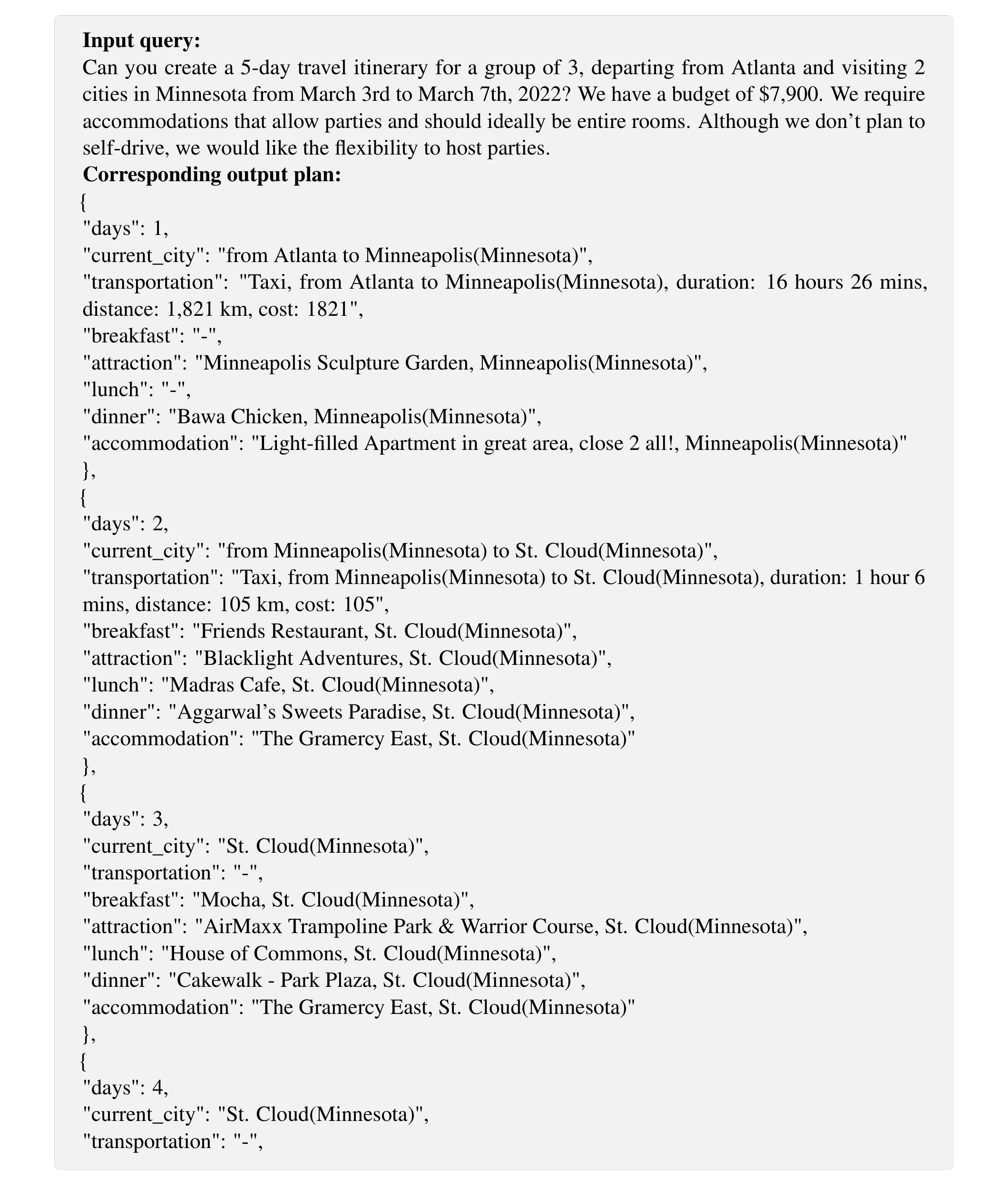
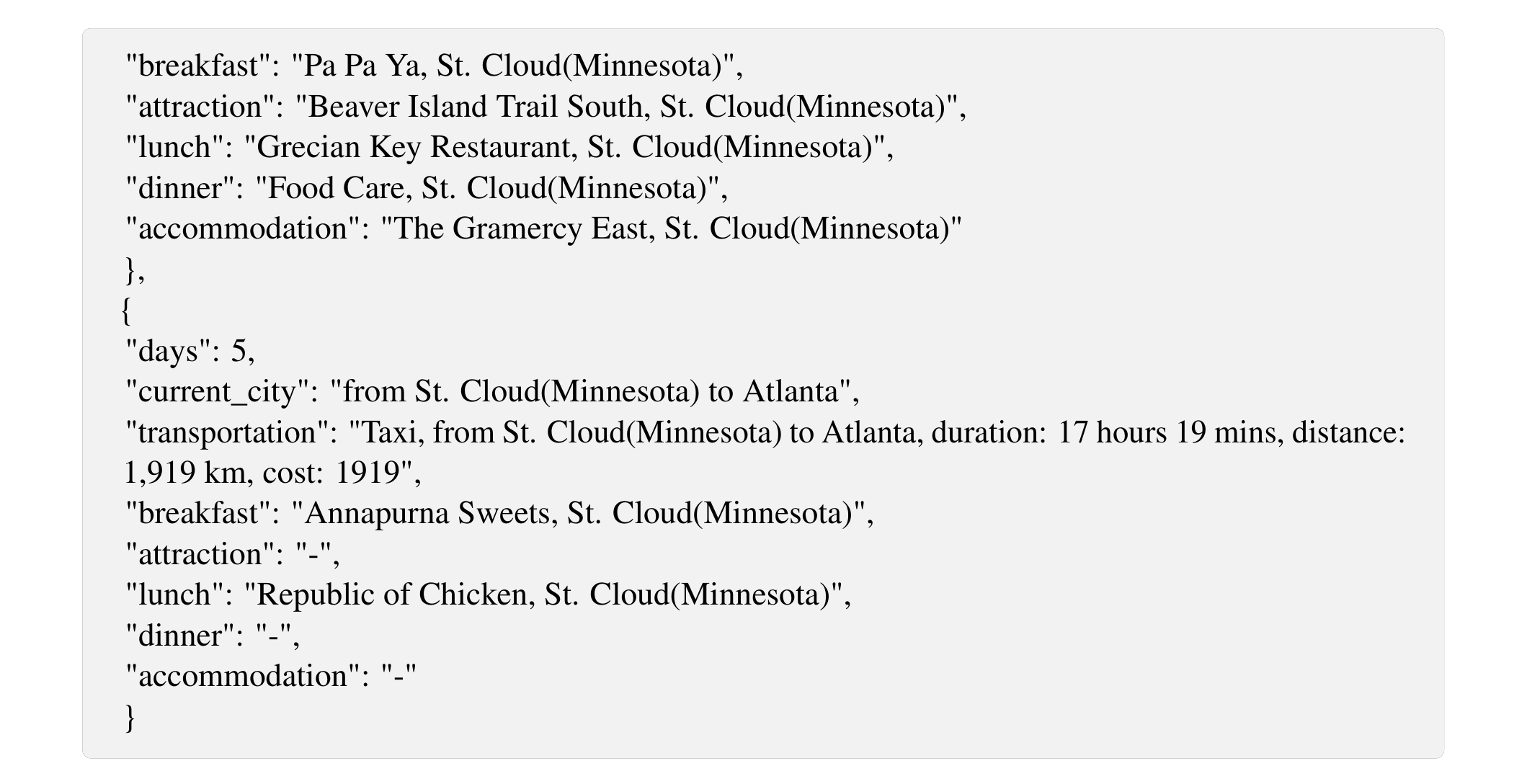
In an query, the user can specify 1) length of travel (3, 5, or 7 days), 2) the destination city or state (for 5/7 days travel, the destination cities would be 2/3 cities from a state), 3) travel dates, 4) budget, 5) preferences regarding transportation methods, 6) preferences regarding restaurant cuisine types, 7) preferences regarding accommodation type and rules.
We list an example input query and the corresponding output plans.
D Satisfiable Plan Solving Evaluation Details
D.1 Result of Ours+JSON on TravelPlanner
Here we include the Ours+JSON framework and satisfiable Plan Solving result of Ours+JSON on dataset TravelPlanner. We test the same LLMs (GPT-4, Claude-3-Opus, and Mistral-Large) on the validation set and test GPT-4 on the test set of TravelPlanner. Our framework achieves final pass rates of 98.9%, 98.3%, and 84.4% respectively on validation set, and 97.0% for GPT-4 on test set. From the result, the performance is further improved by 5.6%, 5.0%, and 17.7% for GPT-4, Claude-3, and Mistral on validation set, and is further improved by 6.8% for GPT-4 on test set. Since translating the JSON allows the LLMs to first extract and summarize the key information from the natural langauge query into a fix-formatted clear representation, it helps to understand and represent the problem better.
D.2 Description of other evaluation metrics
Delivery Rate measures whether a final plan is generated within a limited time.
Commonsense constraints defined in (Xie et al., 2024) include: all information in the plan is within closed sandbox, the plan is complete without any left out part, all activities should be conducted in current city, travel route is reasonable, restaurant and attractions should not be repeated, transportation is reasonable (no self-driving if taxi or flight is taken during the travel), the nunmber of consecutive days spent in a specific accommodation must meet its required minimum number of nights' stay.
Hard constraints include: the total spend of the trip is within budget, the specified room rule does not exist ("No parties", "No smoking", "No children under 10", "No pets", and "No visitors"), the specified room type exists ("Entire Room", "Private Room", "Shared Room", and "No Shared Room"), the specified cuisine types are fulfilled during the trip ("Chinese", "American", "Italian", "Mexican", "Indian", "Mediterranean", and "French"), the specified transportation method is satisfied ("No flight" and "No self-driving".).
For Commonsense Constraint Pass Rate and Hard Constraint Pass Rate, two evaluation modes, micro and macro, are used to test the agent's capability to follow single constraint and follow constraints holistically. Micro calculates the ratio of passed constraints to the total number of constraints, while Macro calculates the ratio of plans that pass all commonsense or hard constraints among all tested plans.
E Interactive Plan Repair: Iteration versus Performance
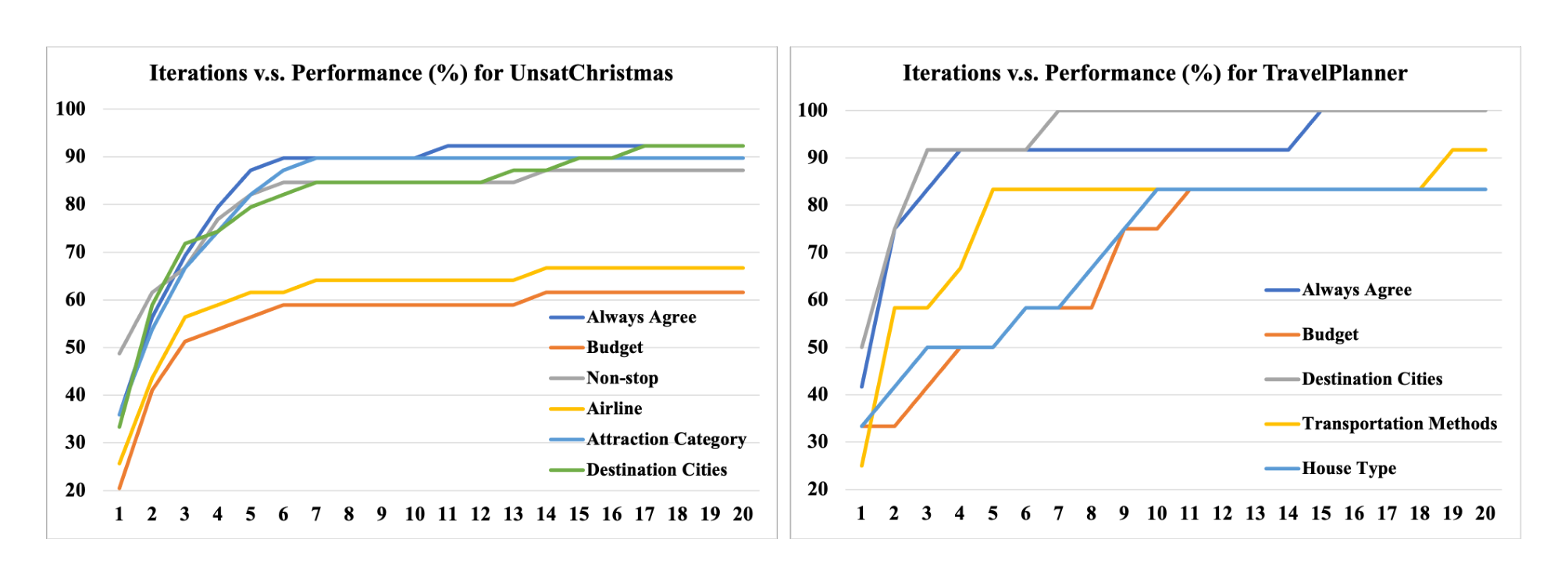
Figure 5 shows the performance (success rate %) of interactive plan repair over different numbers of iterations for both datasets.
For the 39 queries in UnsatChristmas, 63.7% of the queries could be successfully modified to be satisfiable within 3 iterations, 74.8% within 5 iterations, 78.6% within 10 iterations, and 81.6% within 20 iterations. The performance increases quickly during the first 5 iterations, and the framework solves a limited number of more difficult queries with more iterations.
Similarly, for the 12 modified queries in TravelPlanner, 65.0% of the queries could be successfully modified to be satisfiable within 3 iterations, 73.3% within 5 iterations, 85.0% within 10 iterations, and 91.7% within 20 iterations.
The results suggest that we do not need extensive iterations to fully capture a major portion of the human queries.
F New Multi-constraint Tasks details
F.1 Task Setup
F.1.1 Block Picking
There are blocks of different colors and scores in the scene. The goal is to select required number of unique blocks with required color, while maximizing the score. All possible block colors are red, yellow, black, pink, and blue. For 25 different scenarios, we set the total number of blocks to be a random number between 50 to 200, each with a random score between 1 to 20 and a random color. For the query, we will randomly choose 1 to 3 colors from all colors to be the required color, and 10 to be the required number of blocks to pick.
F.1.2 Task Allocation
Given a list of three tasks A, B and C, and three heterogeneous robots that are skilled at different tasks, the goal is to find the way to assign different tasks to different robots and finish the tasks with minimized finish time. The three robots could work in parallel, but the finish time counts the time when the last robot stops working. For 25 different scenarios, we set number of task A, B and C to be random numbers between 10 to 100. For each robot, we set its work time to finish each task to be a random number between 10 to 100.
F.1.3 TSP
Given a list of ten cities, the goal is to visit each city exactly once with minimized distance travelled. For 25 different scenarios, we set the coordinates of each city to be a random tuple between 0 and 1.
F.1.4 Warehouse
The robot has a task list of length N that needs to be finished one by one. In the warehouse, there are 50 stations, where the robots can visit stations to finish different tasks. The robot starts at station 0, travel n stations to finish n tasks, and then travel back to station 0. The robot needs to finish n tasks while minimizing the total distance travelled. For 25 different scenarios, we set the total task number to be 50, and the total station number to be 50, and each station can be used to accomplish 3 random tasks. We set the number of tasks the robot need to finish to be a random number from 3 to 10, and the tasks to be random numbers within 50. We set the coordinates of each station to be a random tuple between 0 and 1.
F.2 Added task description in prompt
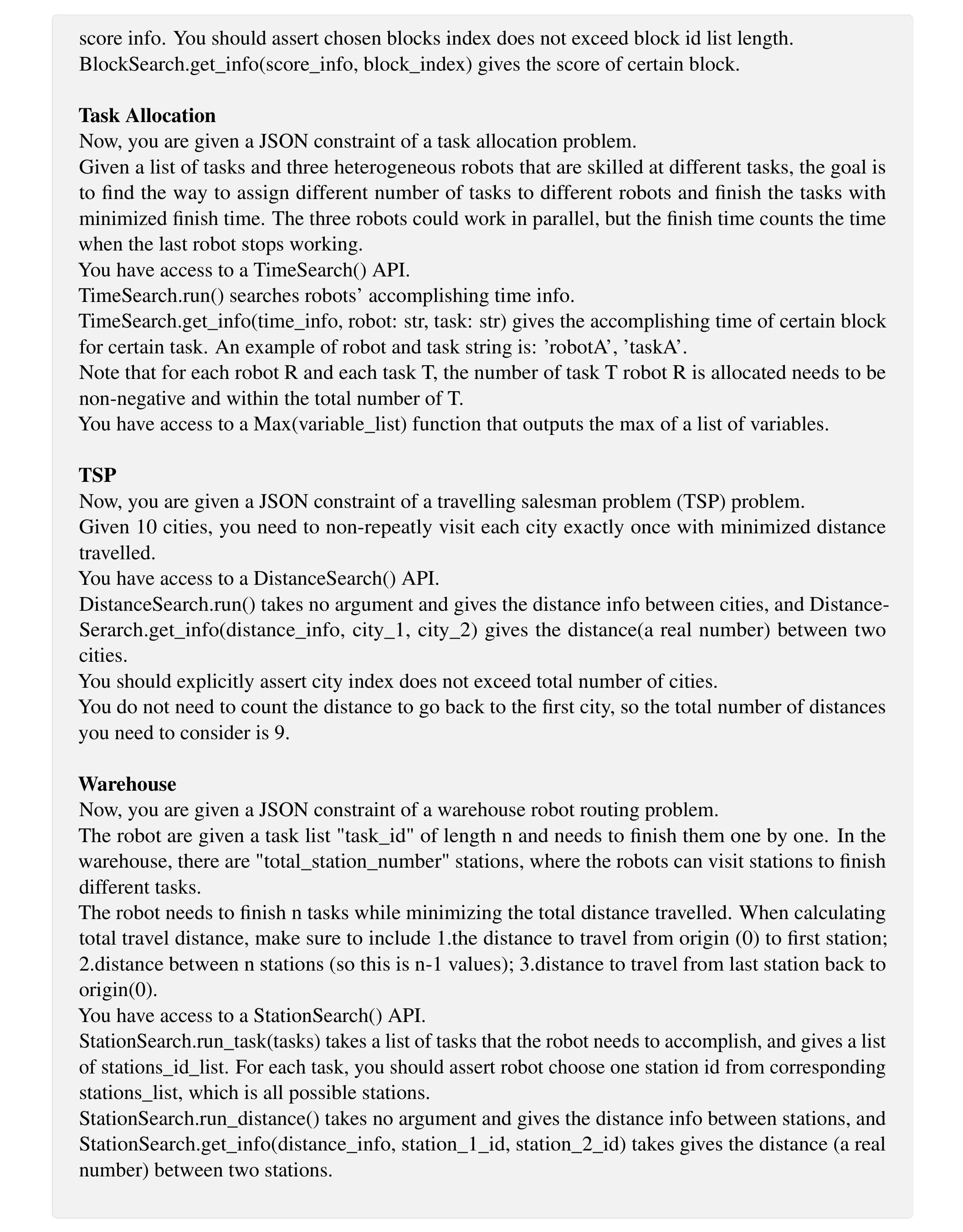
F.3 Failure case analysis
For Block Picking, Task Allocation, and Warehouse, there are failure cases.
Block Picking For Block Picking, LLM fails to give the optimal plan for 2 out of 25 delivered plans. The failure reasons are same for these two plans. In the block picking task, all picked blocks need to be distinct. Thus, in the codes LLM writes, it needs to explicitly check all block indexes it chooses are different. In these two plans, the LLM fails to take this into account, thus repeatedly choose same blocks with high scores to maximize the score.
Task Allocation For Task Allocation, LLM fails to deliver the plan for 2 out of 25 scenarios. The failure reasons are same. The LLMs are provided a Max(variable_list) function, which takes in a list of variables and return the max. However, in the codes written by LLM, they fail to input a list of variables, but input the variables themselves one by one. This gives runtime errors thus fails to deliver the plan.
Warehouse For Warehouse, LLM fails to deliver the plan for 4 out of 25 scenarios, and fails to give the optimal plan for 3 out of the 21 delivered plan.
Note that Warehouse is a more challenging task in that it needs to select stations to visit while calculate the minimum travel distance between them at the same time. Thus, the codes are more complex to write. The delivery failure reasons for the 4 scenarios are same. Since the task requires the robot to travel from origin, visit n stations, and back to origin at the end. LLM could choose to set n station variables to represent n stations needs to visit or set n+2 station variables and make the first and last one to equal to 0. However, in the failure cases, the LLM set n variables to represent n stations, but at the same time assert first and last one to equal to 0. This brings conflicts because the it could assert one variable to equal to two values at the same time.
The non-optimal reasons for the 3 delivered plan are same: since the StationSearch.run_task(tasks) outputs a station_id_list, the contents are IDs of stations. LLM needs to create station variables and assert it to equal to value from the ID lists. However, in the codes, LLM assert the station variables to equal to index from zero to length of station_id_list. This makes it to calculate incorrect distance thus outputting non-optimal solutions.
G Prompts
G.1 Prompts for Satisfiable Plan Solving
G.1.1 Query-Step prompt
The instruction prompt for natural language to steps translation prompt is provided as follows:
G.1.2 Step-Code prompt
The step to code example prompt for each constraint type is provided as follows:
Destination cities:

Departure Dates:
Transportation Methods:

Flight Information:
Driving Information:

Restaurant Information:
Attraction Information:

Accommodation Information:
Budget:

G.1.3 Prompt difference of GPT-4, Claude 3, and Mistral-Large
With the prompt we have for GPT-4 as the starting point, we adjust the prompts (add more explanations or examples) for Claude-3 and Mistral-Large using the training set in TravelPlanner.
Claude-3 almost has the same prompt as GPT-4, except for the JSON-Step prompt. Since in training set, a failure case for Claude-3 is it is not able to handle the "house rule" properly. When the JSON specifies "house rule" to be "children under 10" it means the travellers have children under 10 and would like to stay in accommodations without "No children under 10" rule. While Claude-3 sometimes is not able to give "No children under 10" in the step, instead, it gives steps with "children under 10 not allowed". To enable it to handle this, we add one sentence explanation "if house rule ’xxx’ is mentioned, then ’No xxx’ should not exist for all accommodations." in JSON-Step prompt.
Compared to Claude-3, Mistral-Large needs more prompt adjustment:
-
We add "You can only assign null to local constraints if it is needed. Other fields must have values." to NL-JSON prompt because Mistral-Large sometimes misses some information in JSON translation.
-
Claude-3 uses the same JSON-Step prompt as Mistral-Large.
-
We add a 3-city loop-through-cities example in Destination Cities Step-Code prompt; We add a 2-city travel-date-assertion example in Departure Dates prompt; We add a 1-city transportation-method assertion-example to Transportation Methods; We add instructions that ask LLM to not use for-loops and name variable with "i" as when it tries to iteratively create or access variables with i it fails to write the correct code.
From the amount of changes we need to make, we can observe that Mistral-Large in general produces more code generation errors compared to GPT-4 and Claude-3, thus needing more examples and explanations provided in prompts.
G.1.4 Failure cases of Mistral-Large
Although we tune our prompt with training set, there are still some failure cases that do not appear in training set and thus negatively affect Mistral-Large’s delivery rate.
The major failure mode is: "room type" takes the value "no shared room". This room type is special in that when other room types such as "private room" is specified, the generated instruction steps should be "private room exists for all accommodations". However, only when "no shared room" is mentioned, the steps should be "shared room does not exist for all accommodations." Since "no shared room" does not appear in training set or examples, and Mistral-Large is not able to generalize to it, it fails by producing "not shard room exists for all accommodations", thus fails to search for home with type "not shared room". This is the major failure mode and is responsible for 7.8% of failed delivered plans (15.0% in total). Other than this, the failures are induced by runtime issue or some occasional code generation errors.
G.2 Prompts for Interactive Plan Repair
G.2.1 Suggestion prompt
The instruction prompt that guides LLM to collect information, analyze current situation, and offer suggestions for unsatisfiable queries is provided as follows:
Suggestion prompt for UnsatChristmas:

Suggestion prompt for TravelPlanner:
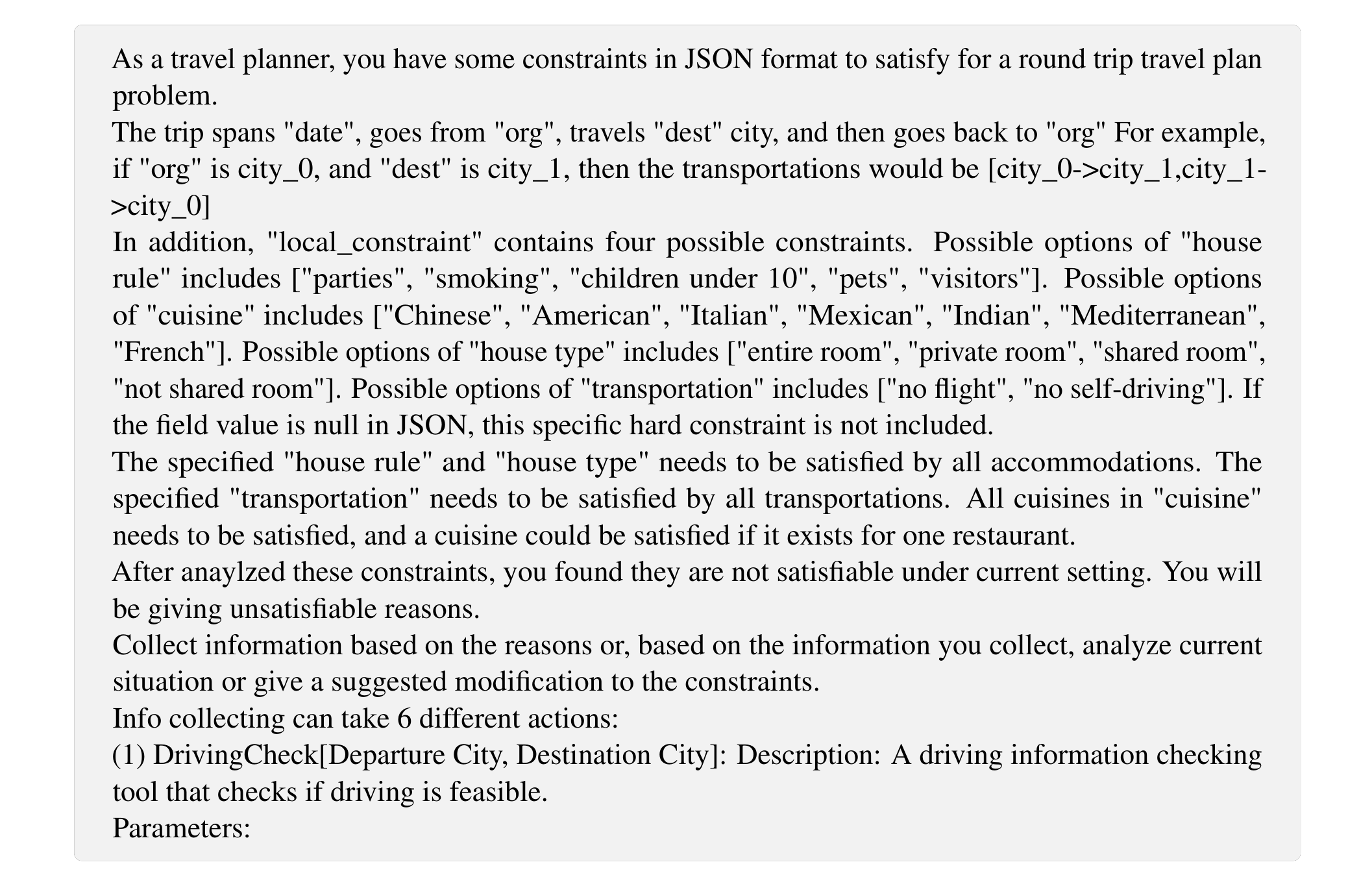
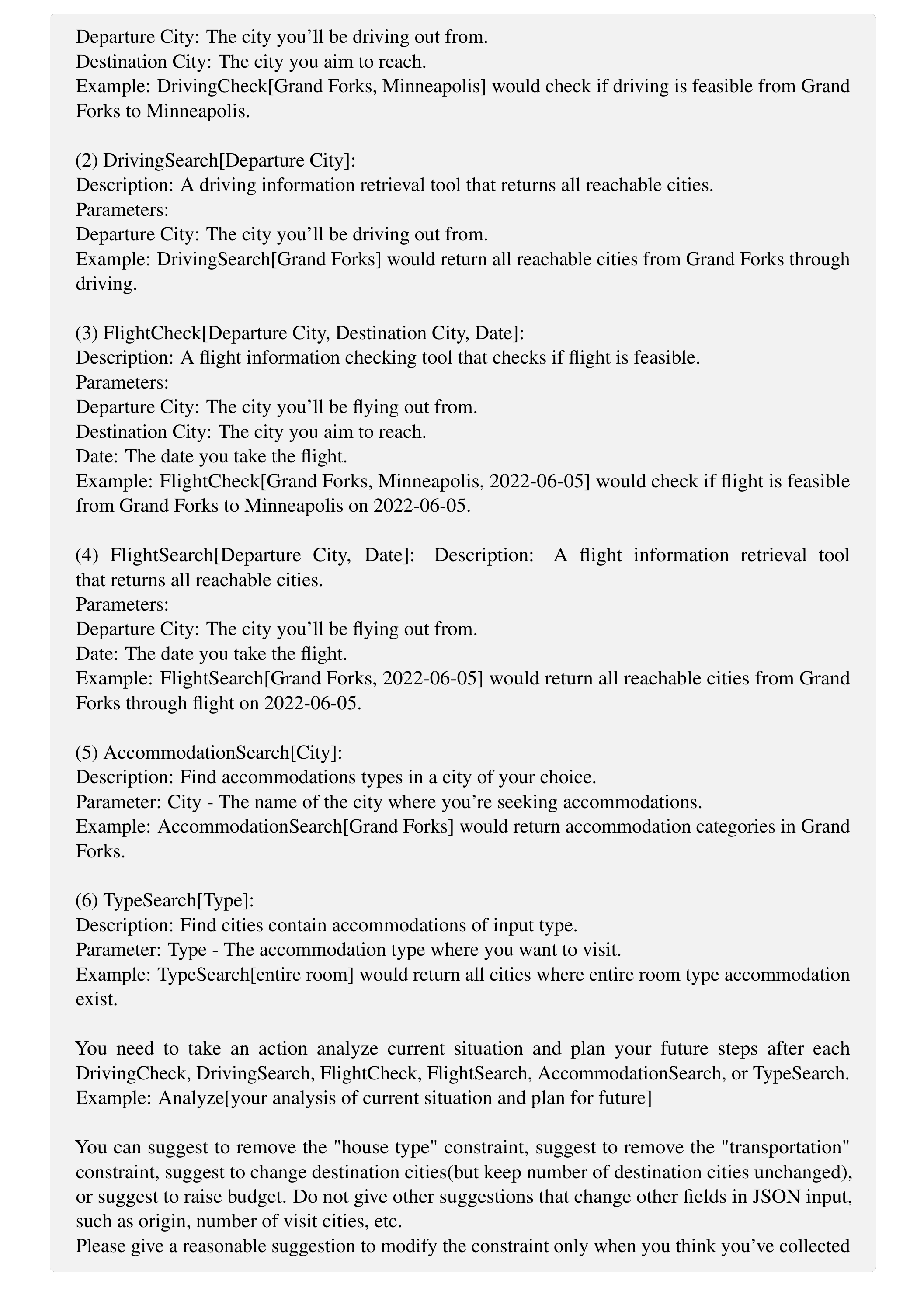
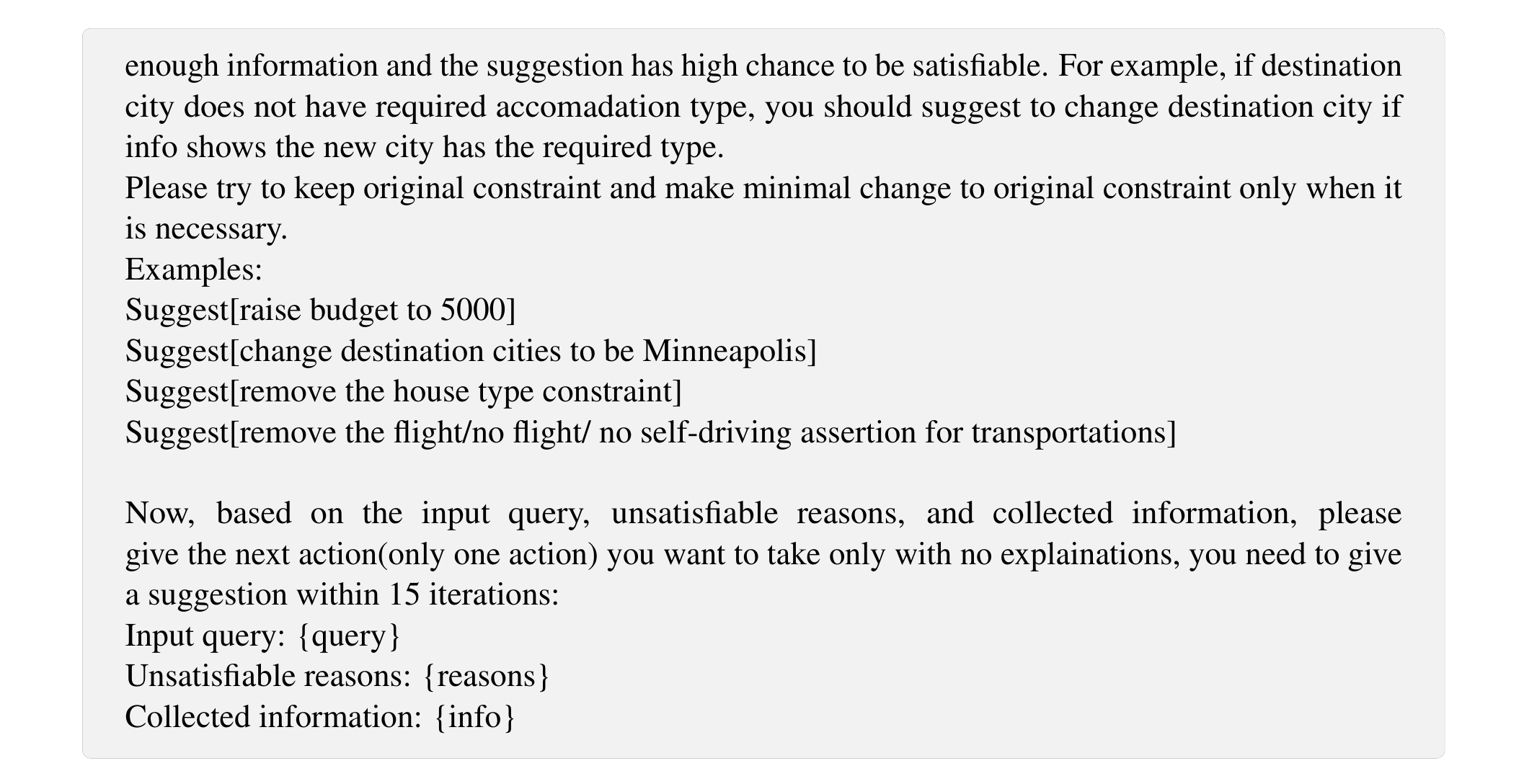
G.2.2 Suggestion-No Reason prompt
The Suggestion-No Reason prompt is basically modified from the Suggestion prompt by removing all descriptions about reasons.
G.2.3 Suggestion-No Sovler prompt
The instruction suggestion prompt that remove the iterative solver calling and directly guide LLM to offer a list of suggestions is provided as follows:
Suggestion-No Sovler prompt for UnsatChristmas:
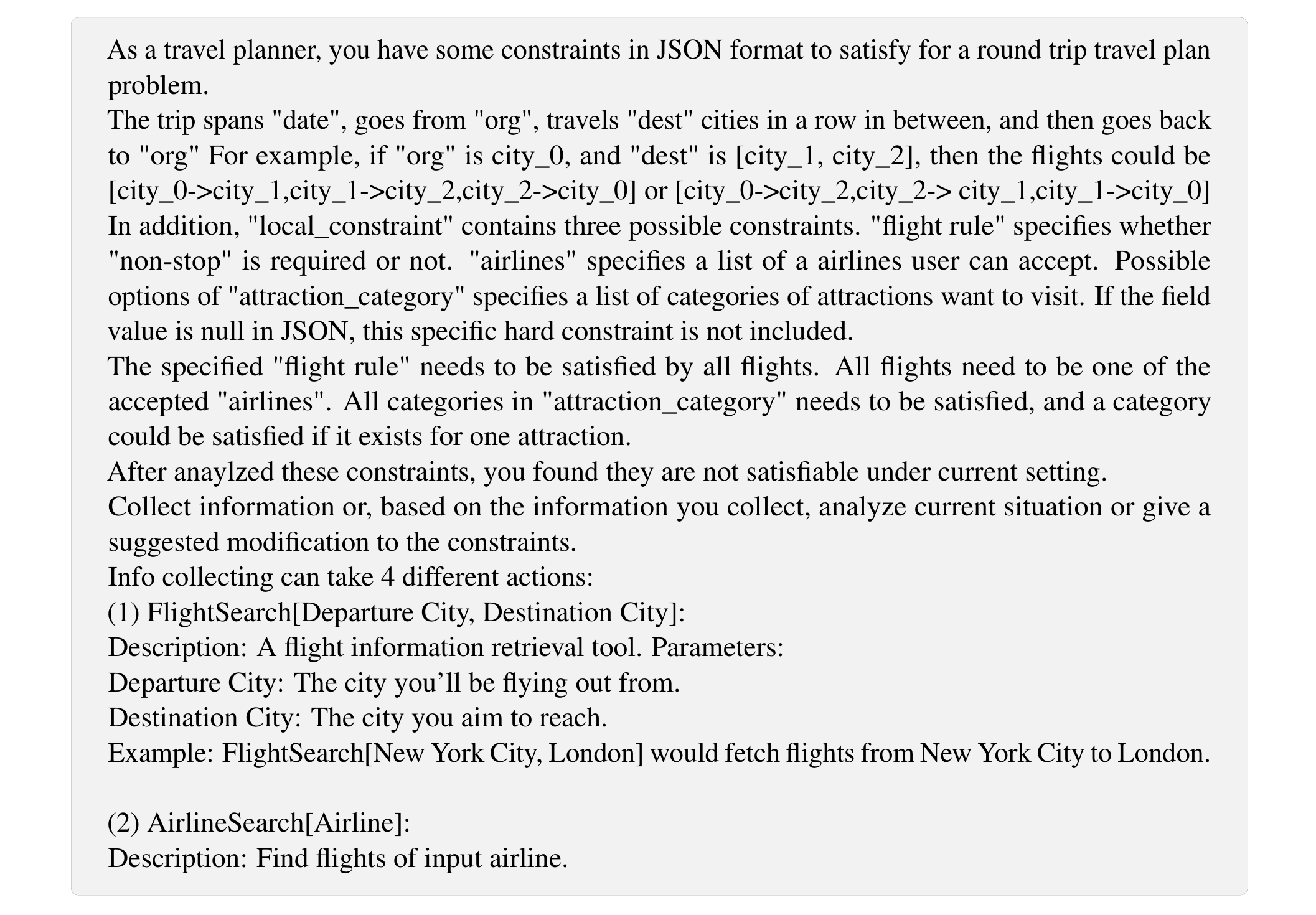
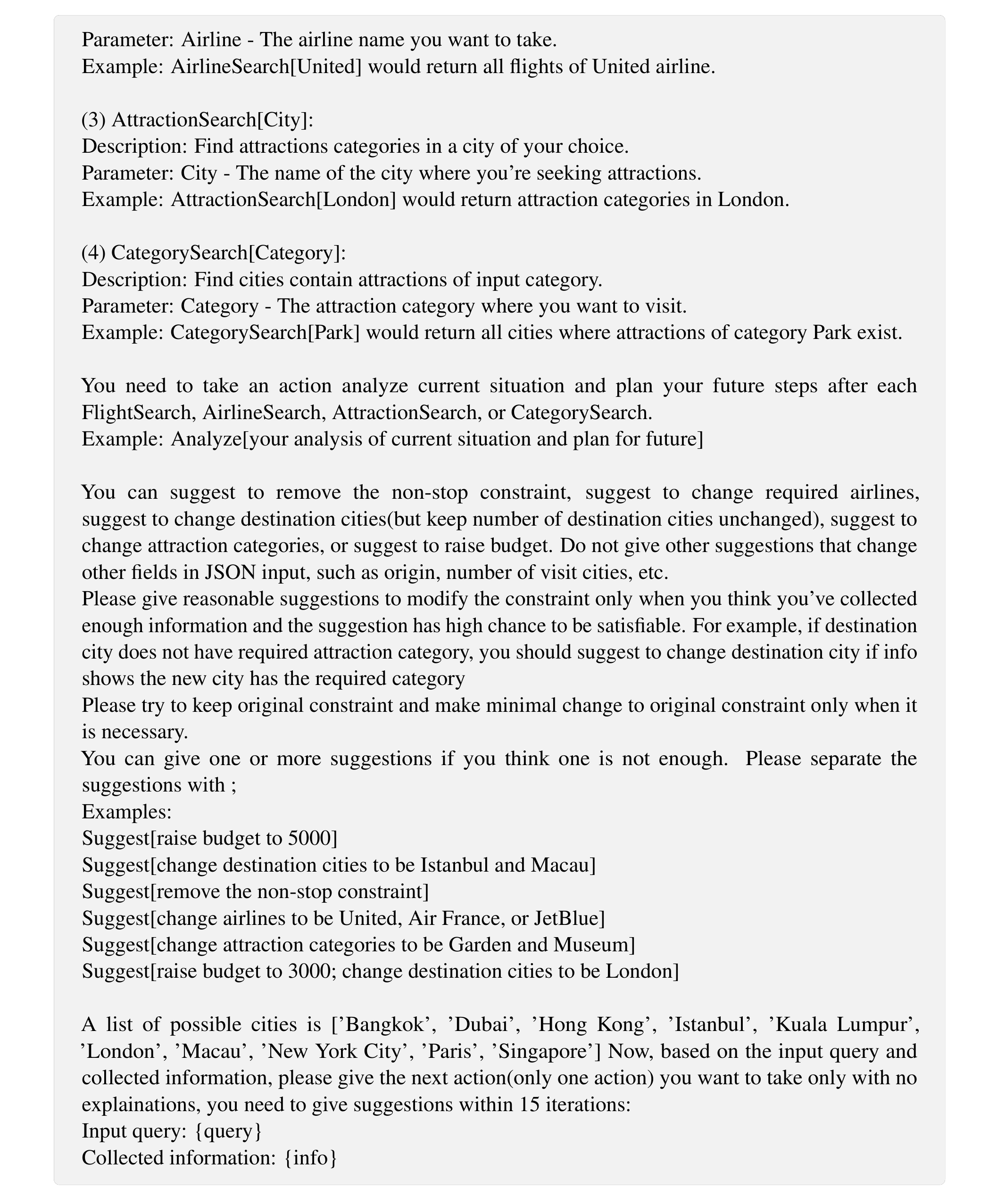
Suggestion-No Sovler prompt for UnsatChristmas:

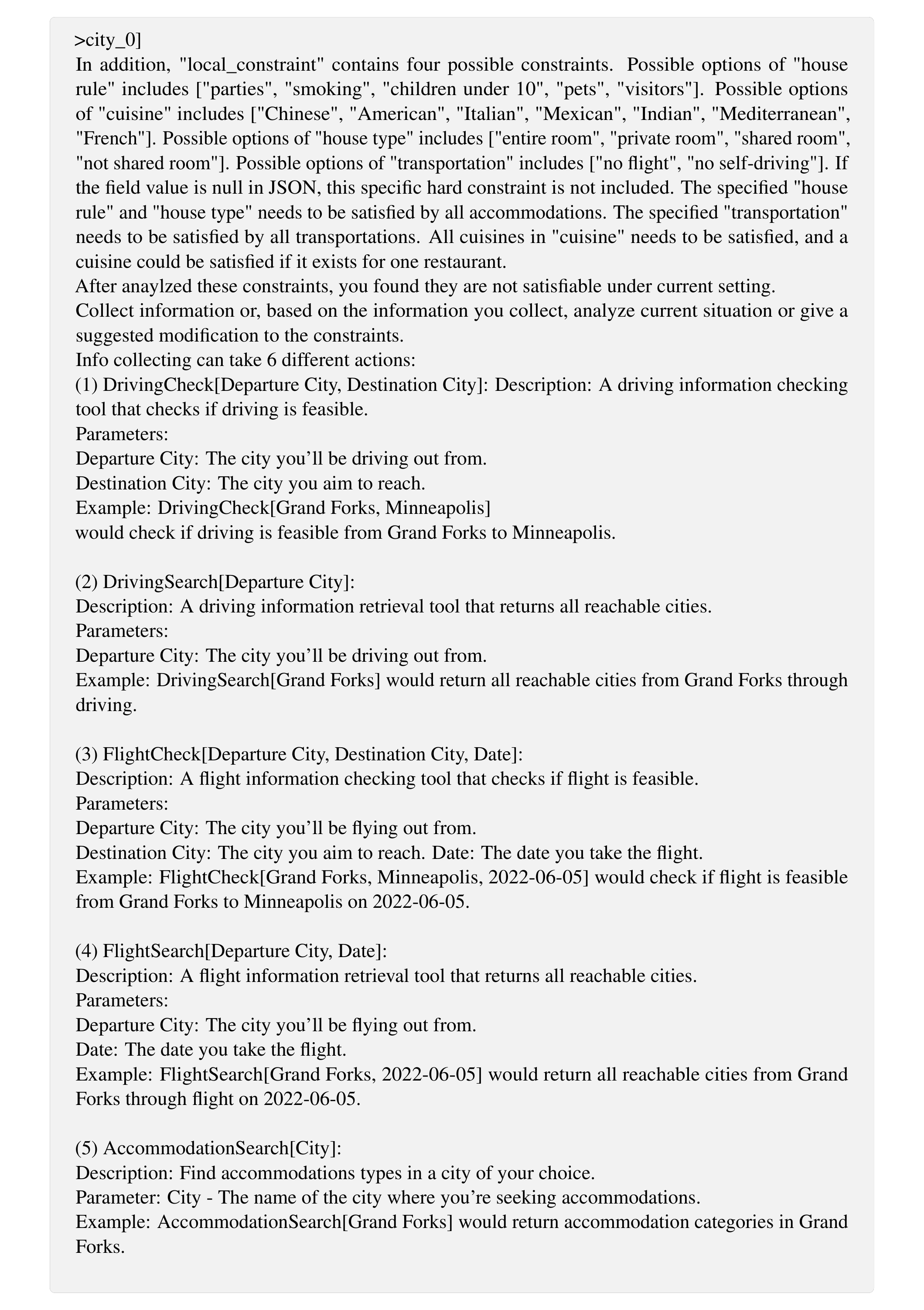
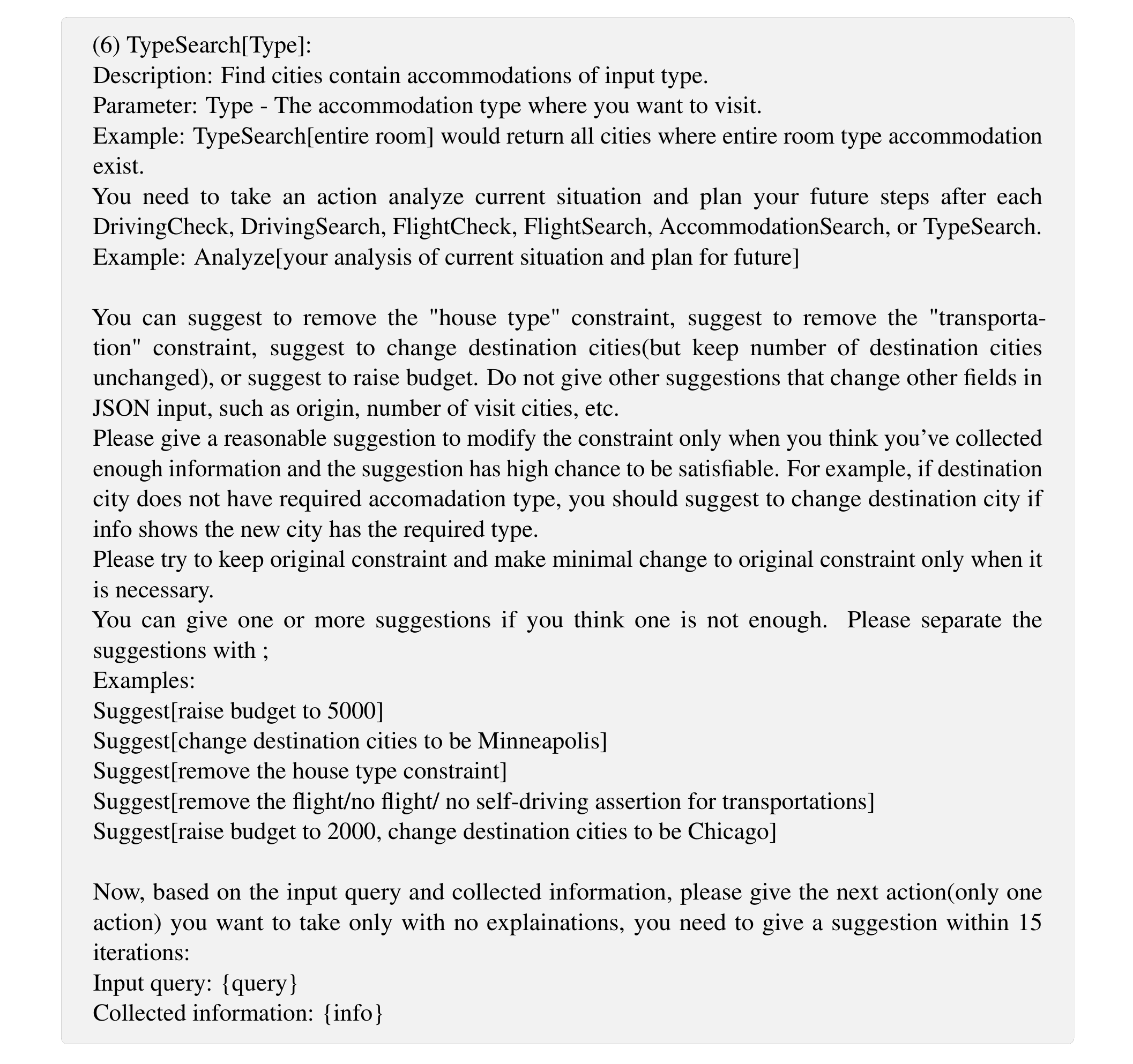
G.2.4 Code modify prompt
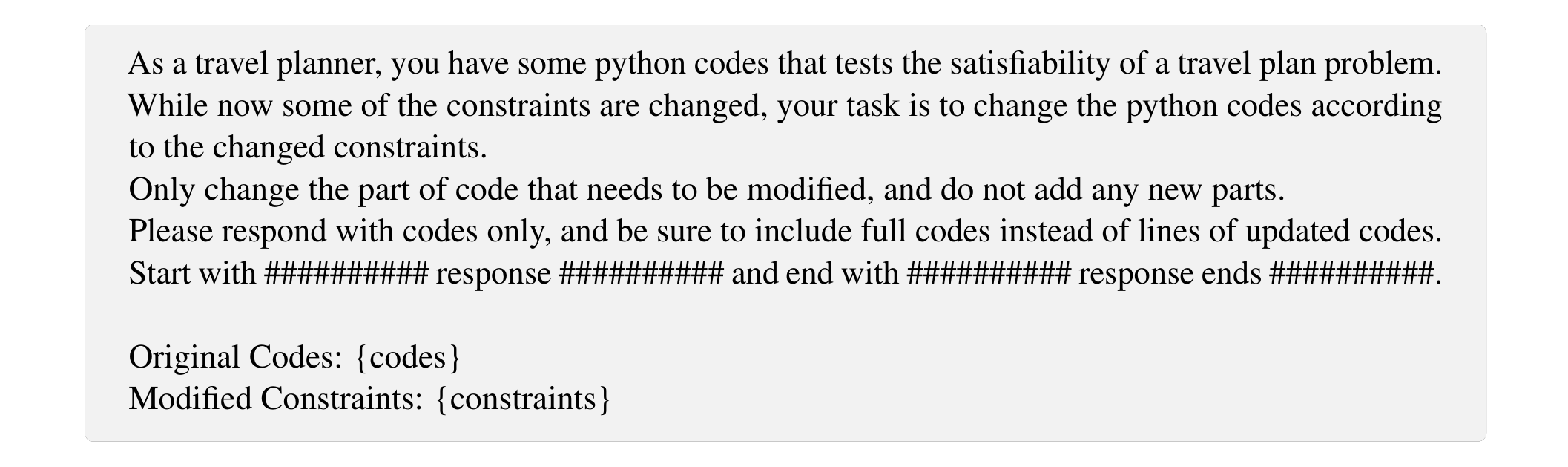
G.3 Prompts for Generalization Evaluation
To test the capability of our framework to generalize to unseen constraint types, we add this task description and append at the end of Step-Code prompt:
G.4 Paraphrased Prompt Examples
Here’s an example paraphrased prompt for Query-Step:
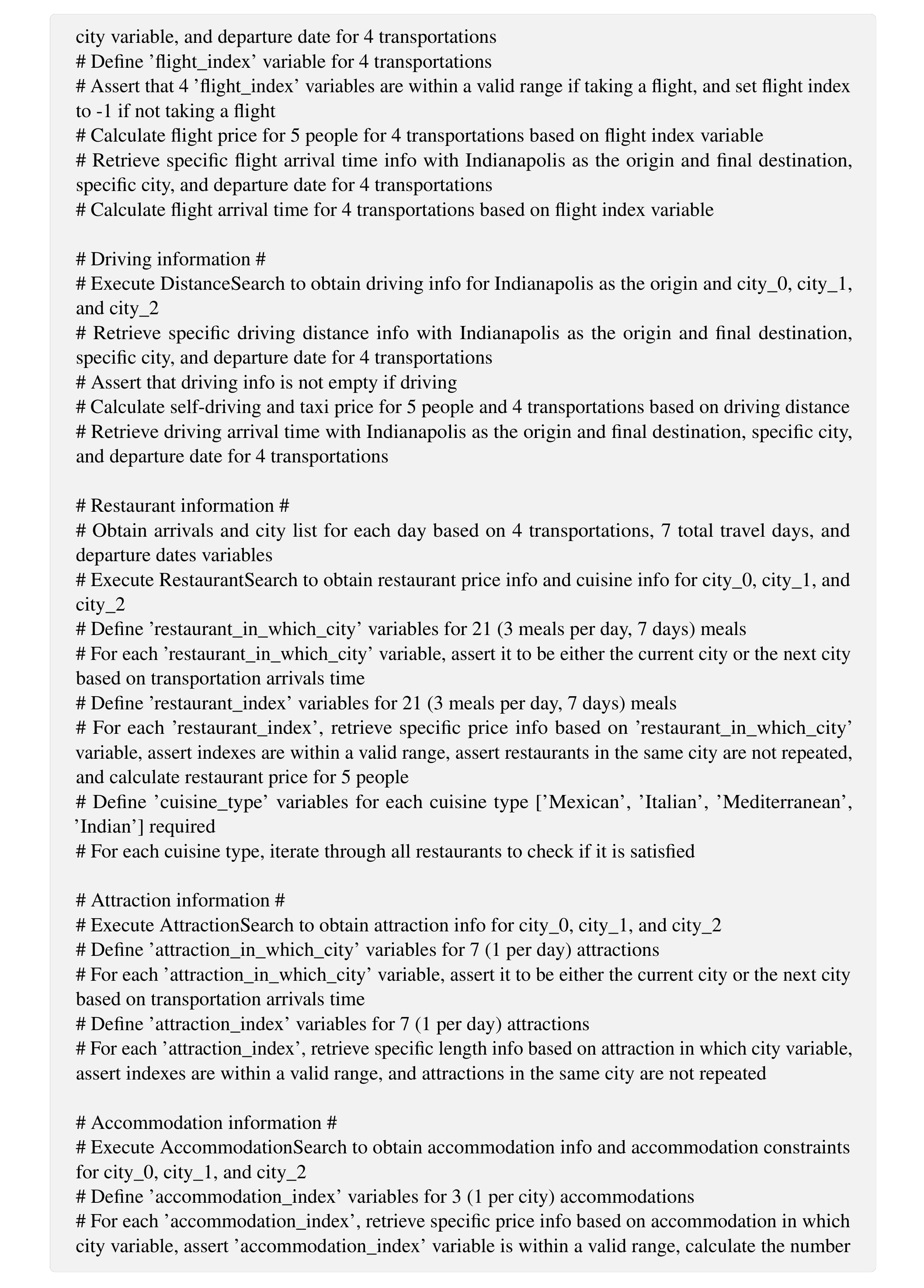
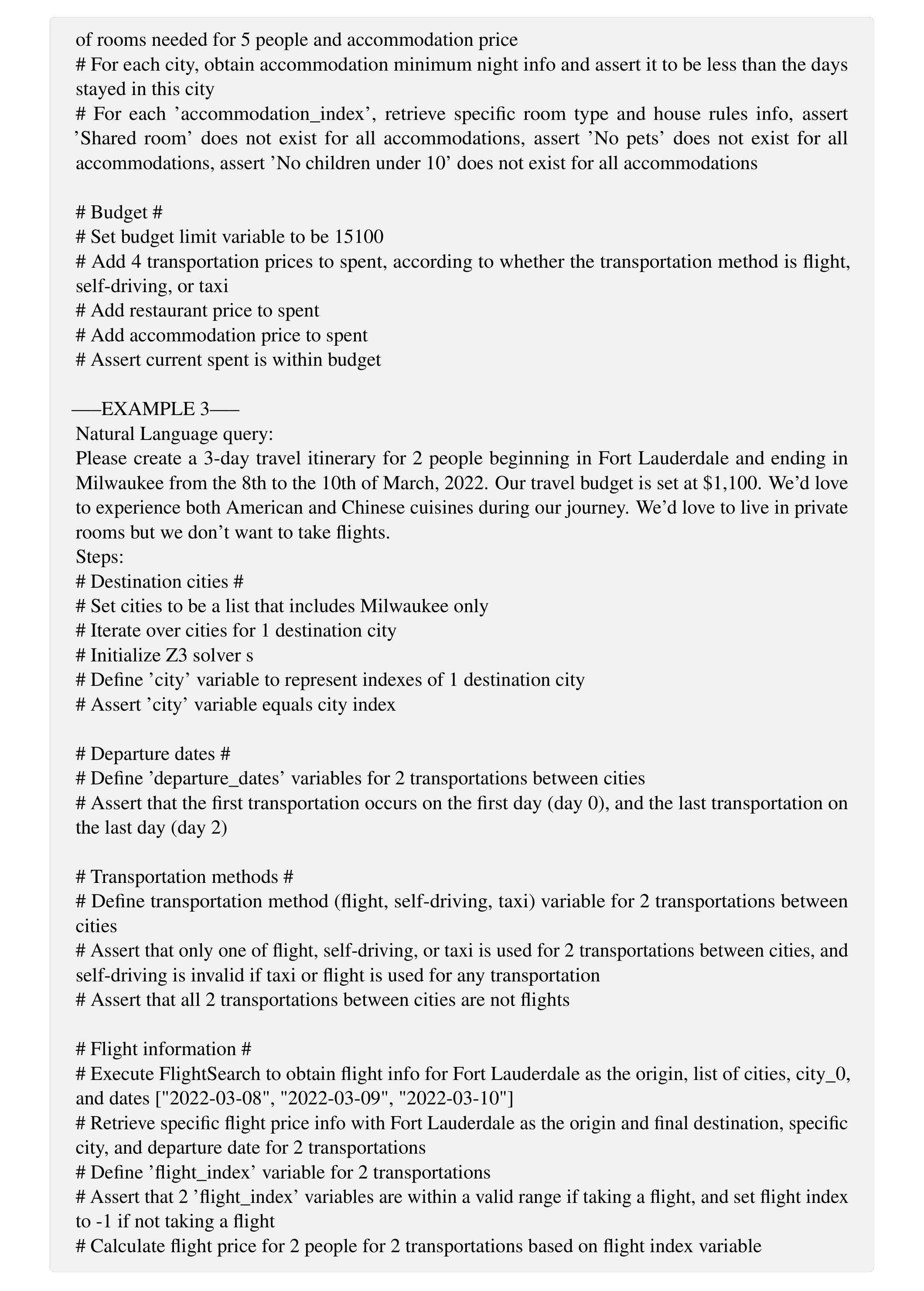
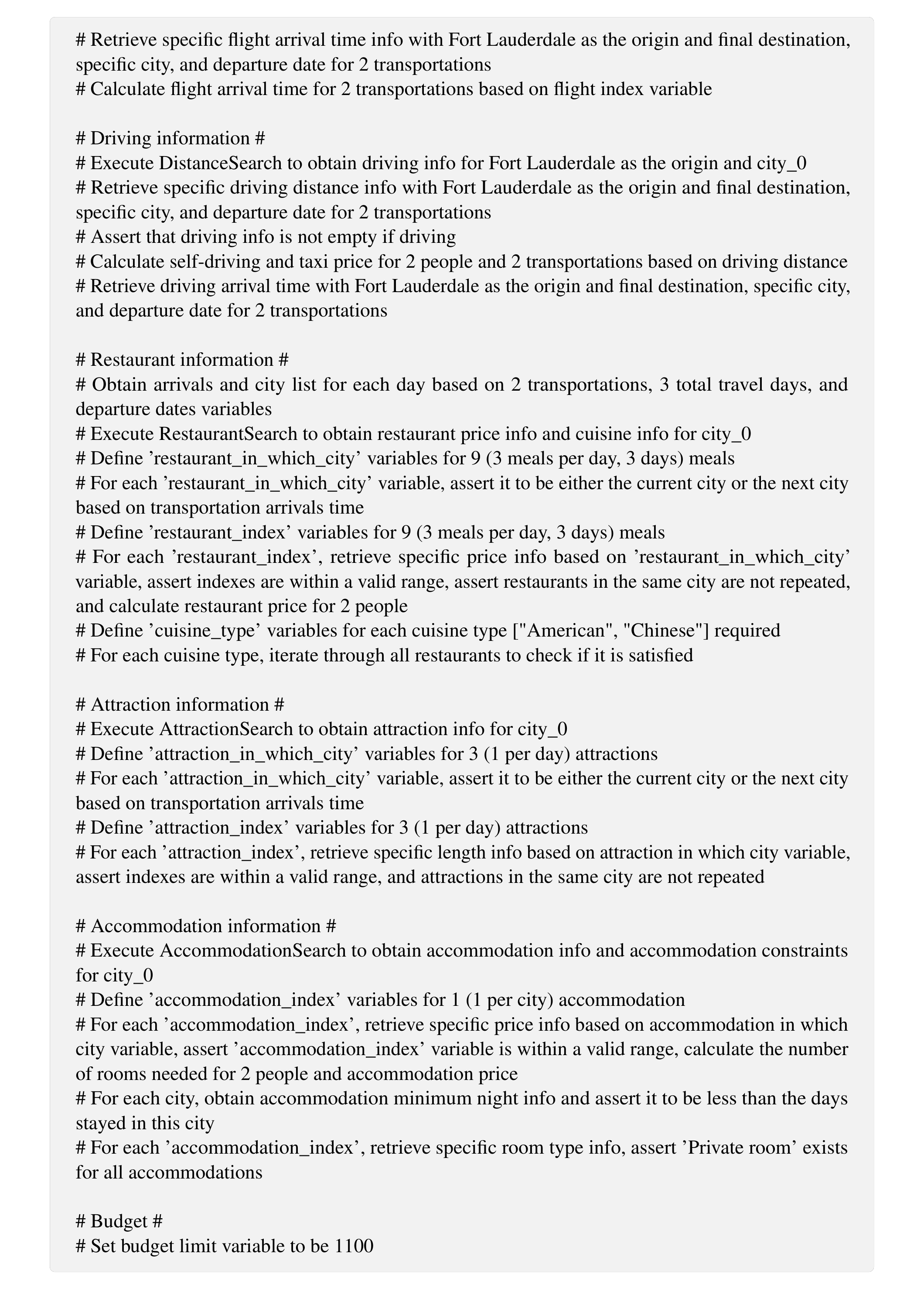
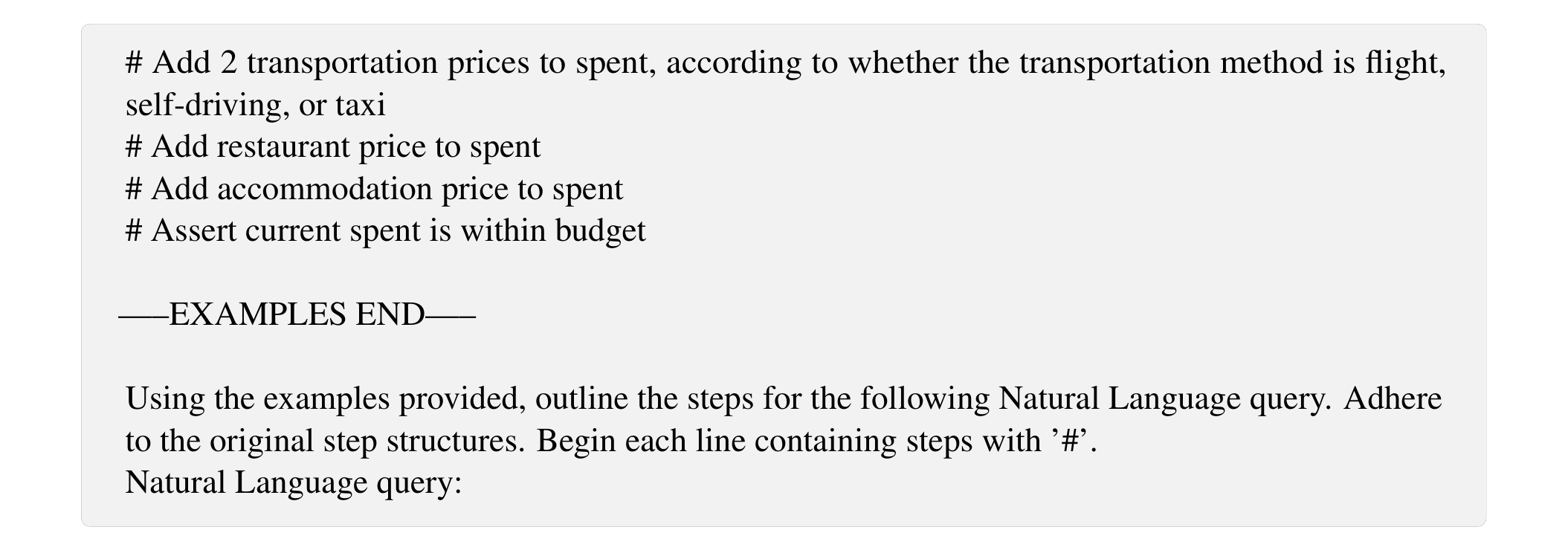
Here’s an example paraphrased prompt for Step-Code (Destination City constraint type):
H Example input query and output step for generalization evaluation
We include the full example of Query-Step generation for unseen constraint types here: