Protecting Respondents' Identities in Microdata Release

Pierangela Samarati

article2001TKDE2,525 citations

Establishes the foundational model of k-anonymity against linking attacks and introduces an efficient binary search algorithm over generalization lattices to release truthful microdata using minimal generalization and suppression.

Listen

The article addresses the growing need to release detailed microdata from sources such as census surveys, health organizations, and government agencies while protecting the identities of the individuals described. Explicit identifiers like names and Social Security numbers are routinely removed, yet combinations of other attributes—race, birth date, sex, and ZIP code—can still serve as quasi-identifiers that link released records to publicly available data such as voter lists, enabling re-identification and unintended disclosure of sensitive information. This risk has become acute because of widespread electronic data availability and increased computational power for linking attacks, especially in medical and financial domains.

The work sets out to provide a formal foundation for releasing microdata that satisfies a quantifiable anonymity requirement. It defines k-anonymity as the property that every combination of values on a quasi-identifier appears at least k times in the released table, thereby ensuring that each record can be linked to at least k individuals. The article shows how generalization of attribute values and selective suppression of tuples can enforce this property while preserving the truthfulness of every released fact.

The approach begins by modeling generalization hierarchies for each attribute domain and representing possible generalizations as paths in a lattice of distance vectors. An algorithm performs a binary search over the height of this lattice to locate a k-minimal generalization that meets the anonymity requirement and stays within a user-specified suppression threshold. Suppression is applied only to the minimal set of outlier tuples needed at the chosen generalization level. The method operates on the projection of the private table onto the quasi-identifier and produces a unique minimal-suppression table for any given distance vector.

Key findings demonstrate that multiple k-minimal generalizations may exist for a given table and k value; the algorithm returns one of lowest absolute distance. Suppression and generalization are complementary: allowing a modest number of tuple suppressions (for example, one or two records) can avoid large increases in generalization depth. Preference policies such as minimum absolute or relative distance, maximum tuple diversity, or minimum suppression can then be applied to select among candidate minimal solutions. The framework also shows that k-anonymity cannot be guaranteed by checking only two- or three-way attribute combinations, a limitation of earlier heuristic systems.

These results matter because they enable organizations to release truthful microdata for research and analysis with provable privacy guarantees, avoiding the distortions introduced by noise-addition or swapping techniques. Decision makers can balance data utility against privacy by choosing k, the suppression threshold, and a preference policy that reflects the intended use of the data.

Next steps include implementing efficient algorithms for large tables, extending the model to handle updates, multiple releases, and collusion risks, and exploring cell-level suppression and finer-grained preference constraints. The main limitations are the assumption of a single static quasi-identifier and the requirement that the original table already contains at least k records; further work is needed before the approach can be applied confidently to dynamic or multi-table environments.

Samarati (2001).pdf
  • Paper: Deep Learning with Differential Privacy, Martín Abadi et al. (2016). Extends formal privacy guarantees beyond table-level generalization and suppression to rigorous differential privacy mechanisms applied directly during model training.
  • Paper: Membership Inference Attacks Against Machine Learning Models, Reza Shokri et al. (2016). Demonstrates membership inference attacks against released statistical and predictive models, analyzing downstream re-identification risks that persist when raw microdata releases are replaced by model interfaces.
  • Paper: Extracting Training Data from Large Language Models, Nicholas Carlini et al. (2020). Illustrates how modern models inadvertently memorize and expose unique verbatim records, demonstrating contemporary disclosure risks analogous to microdata quasi-identifier linkage.
  • Paper: Large-scale online deanonymization with LLMs, Simon Lermen et al. (2026). Shows how modern language models automate cross-domain quasi-identifier linkage attacks at scale over unstructured text, extending the classical structured record linkage threat model.
  • Paper: Federated Machine Learning, Qiang Yang et al. (2019). Applies decentralized collaborative computing to train models across isolated data silos without releasing or centralizing sensitive microdata.
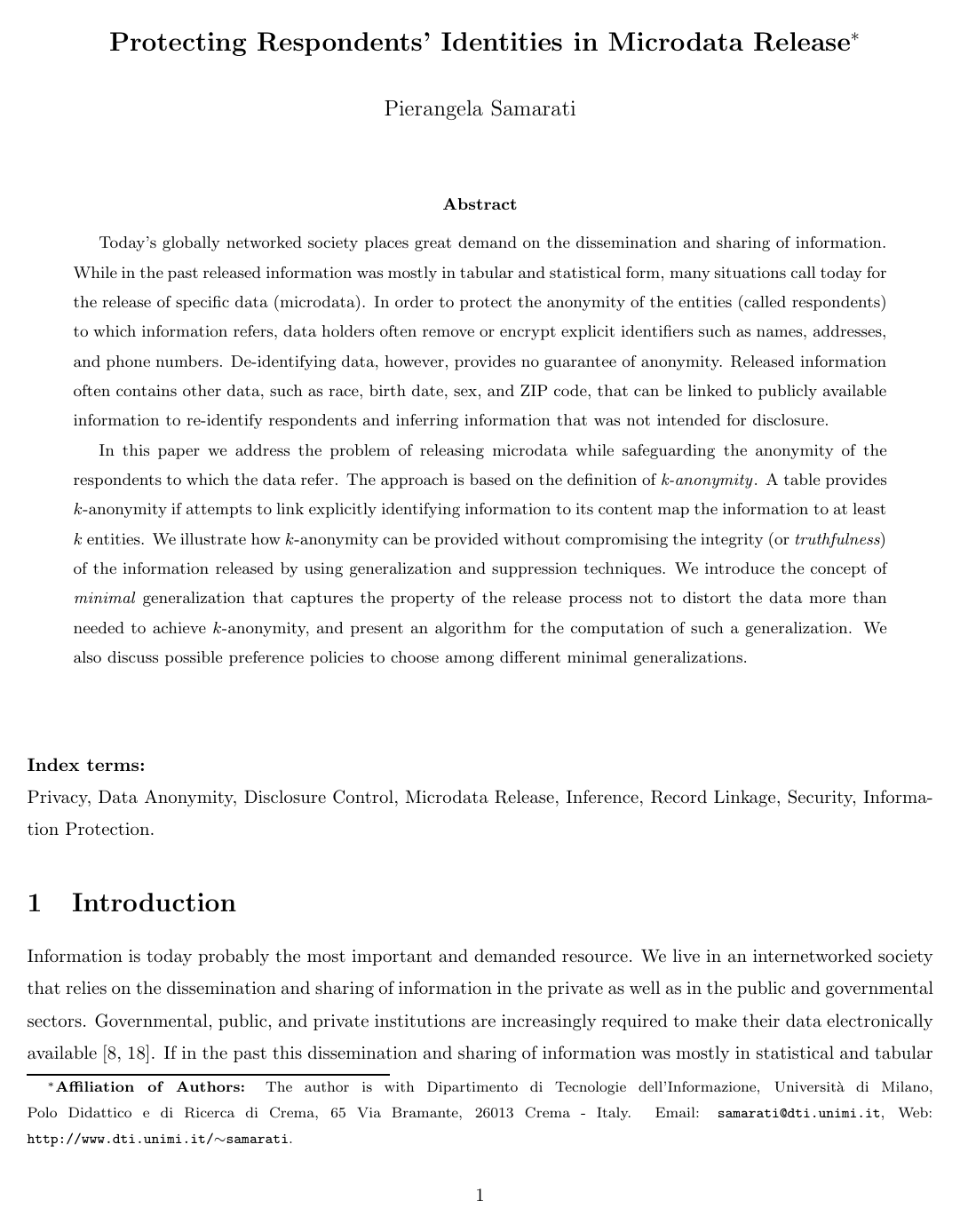
Cover for Protecting Respondents' Identities in Microdata Release

Abstract

Today’s globally networked society places great demand on the dissemination and sharing of information. While in the past released information was mostly in tabular and statistical form, many situations call today for the release of specific data (microdata). In order to protect the anonymity of the entities (called respondents) to which information refers, data holders often remove or encrypt explicit identifiers such as names, addresses, and phone numbers. De-identifying data, however, provides no guarantee of anonymity. Released information often contains other data, such as race, birth date, sex, and ZIP code, that can be linked to publicly available information to re-identify respondents and inferring information that was not intended for disclosure.

In this paper we address the problem of releasing microdata while safeguarding the anonymity of the respondents to which the data refer. The approach is based on the definition of k-anonymity. A table provides k-anonymity if attempts to link explicitly identifying information to its content map the information to at least k entities. We illustrate how k-anonymity can be provided without compromising the integrity (or truthfulness) of the information released by using generalization and suppression techniques. We introduce the concept of minimal generalization that captures the property of the release process not to distort the data more than needed to achieve k-anonymity, and present an algorithm for the computation of such a generalization. We also discuss possible preference policies to choose among different minimal generalizations.

Table of Contents

  • Index terms:
  • 1 Introduction
  • 2 Assumptions and preliminary definitions
  • 3 Generalizing data
  • 3.1 Generalization relationships
  • 3.2 Generalized table and minimal generalization
  • 4 Suppressing data
  • 5 Computing a k-minimal generalization
  • Find_vector
  • 6 Preferences
  • 7 Related work
  • 8 Conclusions
  • Acknowledgments
  • References

Knowls

  1. Knowl 1 — Definition of k-Anonymity and Quasi-Identifiers

    definition

    Let PTPT be a private table containing microdata where each tuple represents at most one respondent, and explicit identifiers (e.g., names, Social Security numbers) have been removed or encrypted. A quasi-identifier QI={A1,…,An}QI = \{A_1, \dots, A_n\} is a set of attributes in PTPT that, in combination, can be linked with external information to re-identify respondents.

    A table T(A1,…,Am)T(A_1, \dots, A_m) satisfies kk-anonymity with respect to quasi-identifier QI⊆{A1,…,Am}QI \subseteq \{A_1, \dots, A_m\} if and only if each distinct sequence of values in the projection T[QI]T[QI] appears with at least kk occurrences in T[QI]T[QI], where k≥1k \ge 1 is an integer anonymity parameter.

    Under the condition that all attributes in PTPT externally available in combination to a recipient are contained in QIQI, satisfying kk-anonymity guarantees that linking released data with external tables matches each released tuple indistinctly to at least kk individuals in the population.

  2. Knowl 2 — Domain and Value Generalization Hierarchies and Domain Tuple Lattice

    definition

    Generalization replaces attribute values with broader, less specific representations. For each ground attribute domain DD, a set of generalized domains Dom\mathrm{Dom} is structured by a generalization relation ≤D\le_D satisfying:

    1. ∀Di,Dj,Dz∈Dom:(Di≤DDj∧Di≤DDz)  ⟹  (Dj≤DDz∨Dz≤DDj)\forall D_i, D_j, D_z \in \mathrm{Dom} : (D_i \le_D D_j \wedge D_i \le_D D_z) \implies (D_j \le_D D_z \vee D_z \le_D D_j), ensuring that every domain has at most one direct generalization and yielding a totally ordered domain generalization hierarchy DGHD\mathrm{DGH}_D.
    2. All maximal elements of Dom\mathrm{Dom} are singletons, ensuring all values in a domain can be generalized to a single common value.

    A value generalization hierarchy VGHD\mathrm{VGH}_D is a tree rooted at the unique maximal generalized value whose leaves are values of ground domain DD, where each value v∈Div \in D_i has a unique parent v′∈Djv' \in D_j representing its direct generalization with Di≤DDjD_i \le_D D_j.

    For a quasi-identifier on ground domain tuple DT=⟨D1,…,Dn⟩DT = \langle D_1, \dots, D_n \rangle, the domain generalization hierarchy DGHDT=DGHD1×⋯×DGHDn\mathrm{DGH}_{DT} = \mathrm{DGH}_{D_1} \times \dots \times \mathrm{DGH}_{D_n} defines a lattice under coordinate-wise ordering. Each maximal path from DTDT to the maximal domain tuple forms a generalization strategy.

  3. Knowl 3 — Generalized Tables and Distance Vectors with Tuple Suppression

    definition

    Let Ti(A1,…,An)T_i(A_1, \dots, A_n) and Tj(A1,…,An)T_j(A_1, \dots, A_n) be tables defined on the same attributes. TjT_j is a generalization of TiT_i with suppression, denoted Ti⪯TjT_i \preceq T_j, if and only if:

    1. ∣Tj∣≤∣Ti∣|T_j| \le |T_i|;
    2. ∀Az∈{A1,…,An}:dom(Az,Ti)≤Ddom(Az,Tj)\forall A_z \in \{A_1, \dots, A_n\} : \mathrm{dom}(A_z, T_i) \le_D \mathrm{dom}(A_z, T_j);
    3. There exists an injective mapping from TjT_j to TiT_i associating each tuple tj∈Tjt_j \in T_j with a tuple ti∈Tit_i \in T_i such that ti[Az]≤Vtj[Az]t_i[A_z] \le_V t_j[A_z] for all Az∈{A1,…,An}A_z \in \{A_1, \dots, A_n\}.

    Tuples in TiT_i that have no image in TjT_j are suppressed tuples. The distance vector between TiT_i and TjT_j is DVi,j=[d1,…,dn]DV_{i,j} = [d_1, \dots, d_n], where each dzd_z is the length of the path between dom(Az,Ti)\mathrm{dom}(A_z, T_i) and dom(Az,Tj)\mathrm{dom}(A_z, T_j) in DGHdom(Az,Ti)\mathrm{DGH}_{\mathrm{dom}(A_z, T_i)}. Distance vectors are ordered coordinate-wise: DV≤DV′DV \le DV' iff dz≤dz′d_z \le d'_z for all z∈{1,…,n}z \in \{1, \dots, n\}, and DV<DV′DV < DV' iff DV≤DV′DV \le DV' and DV≠DV′DV \neq DV'.

  4. Knowl 4 — Minimal Required Suppression and Uniqueness Theorem

    theoretical result

    Let TiT_i be a table and TjT_j a generalization of TiT_i (Ti⪯TjT_i \preceq T_j) satisfying kk-anonymity. TjT_j enforces minimal required suppression if and only if for all TzT_z such that Ti⪯TzT_i \preceq T_z, DVi,z=DVi,jDV_{i,z} = DV_{i,j}, and TzT_z satisfies kk-anonymity, ∣Tj∣≥∣Tz∣|T_j| \ge |T_z|.

    For any table Ti(A1,…,An)T_i(A_1, \dots, A_n), distance vector DV=[d1,…,dn]DV = [d_1, \dots, d_n] where 0≤dz≤hz0 \le d_z \le h_z (hzh_z being the height of DGHdom(Az,Ti)\mathrm{DGH}_{\mathrm{dom}(A_z, T_i)}), and integer kk with 0<k≤∣Ti∣0 < k \le |T_i|:

    1. There exists exactly one generalized table TjT_j (Ti⪯Tj,DVi,j=DVT_i \preceq T_j, DV_{i,j} = DV) satisfying kk-anonymity by enforcing minimal required suppression.
    2. For any other table TzT_z (Ti⪯Tz,DVi,z=DVT_i \preceq T_z, DV_{i,z} = DV) satisfying kk-anonymity, Tz≠Tj  ⟹  Tj⊃TzT_z \neq T_j \implies T_j \supset T_z.

    This unique table TjT_j is obtained by generalizing all attribute values in TiT_i according to distance vector DVDV and removing all and only tuples whose resulting quasi-identifier value sequence appears with fewer than kk occurrences.

  5. Knowl 5 — k-Minimal Generalization with Suppression

    definition

    Let TiT_i and TjT_j be tables such that Ti⪯TjT_i \preceq T_j, and let MaxSup≥0\mathrm{MaxSup} \ge 0 be a specified integer threshold representing the maximum allowed number of suppressed tuples. The table TjT_j is a kk-minimal generalization of TiT_i with suppression threshold MaxSup\mathrm{MaxSup} if and only if:

    1. TjT_j satisfies kk-anonymity enforcing minimal required suppression;
    2. ∣Ti∣−∣Tj∣≤MaxSup|T_i| - |T_j| \le \mathrm{MaxSup};
    3. ∀Tz:(Ti⪯Tz∧Tz satisfies (1) and (2))  ⟹  ¬(DVi,z<DVi,j)\forall T_z : (T_i \preceq T_z \wedge T_z \text{ satisfies (1) and (2)}) \implies \neg(DV_{i,z} < DV_{i,j}).

    Under this definition, suppression is preferred over generalization up to MaxSup\mathrm{MaxSup} suppressed tuples, and a generalization is minimal if no other valid generalization exists with a strictly smaller distance vector.

  6. Knowl 6 — Monotonicity of Suppression over the Generalization Lattice

    theoretical result

    Let Ti=PT[QI]T_i = PT[QI] be a private table and let TjT_j and TzT_z be two generalizations of TiT_i (Ti⪯TjT_i \preceq T_j and Ti⪯TzT_i \preceq T_z) enforcing minimal required suppression for a given kk-anonymity requirement.

    If DVi,j<DVi,zDV_{i,j} < DV_{i,z}, then ∣Tj∣≤∣Tz∣|T_j| \le |T_z|. Consequently, the number of suppressed tuples satisfies:

    ∣Ti∣−∣Tz∣≤∣Ti∣−∣Tj∣|T_i| - |T_z| \le |T_i| - |T_j|

    As a direct corollary, for any suppression threshold MaxSup\mathrm{MaxSup}:

    • If ∣Ti∣−∣Tj∣≤MaxSup|T_i| - |T_j| \le \mathrm{MaxSup}, then ∣Ti∣−∣Tz∣≤MaxSup|T_i| - |T_z| \le \mathrm{MaxSup}.
    • If ∣Ti∣−∣Tz∣>MaxSup|T_i| - |T_z| > \mathrm{MaxSup}, then ∣Ti∣−∣Tj∣>MaxSup|T_i| - |T_j| > \mathrm{MaxSup}.

    Thus, required suppression monotonically decreases (or stays equal) as generalization increases along any path in the generalization lattice.

  7. Knowl 7 — Lattice-Height Binary Search Algorithm for k-Minimal Generalization

    algorithm

    The algorithm Find_vector computes a distance vector sol corresponding to a kk-minimal generalization of Ti=PT[QI]T_i = PT[QI] by conducting a binary search over the height of distance vectors in the lattice VLDT\mathrm{VL}_{DT}. The height of a distance vector DV=[d1,…,dn]DV = [d_1, \dots, d_n] is defined as height(DV,VLDT)=∑z=1ndz\mathrm{height}(DV, \mathrm{VL}_{DT}) = \sum_{z=1}^n d_z. By monotonicity of suppression, if no vector at height hh satisfies kk-anonymity with ≤MaxSup\le \mathrm{MaxSup} suppressed tuples, no solution can exist at any height below hh.

    Input: Table Ti=PT[QI]T_i = PT[QI], anonymity requirement kk, suppression threshold MaxSup\mathrm{MaxSup}, lattice VLDT\mathrm{VL}_{DT}
    Output: Distance vector sol\mathrm{sol} of a kk-minimal generalization
    low := 0
    high := height(⊤\top, VLDT\mathrm{VL}_{DT})
    sol := ⊤\top
    while low < high do
        try := floor((low + high) / 2)
        Vectors := {vec | height(vec, VLDT\mathrm{VL}_{DT}) = try}
        reach_k := false
        while Vectors != empty and reach_k == false do
            Select and remove a vector vec from Vectors
            if satisfies(vec, k, TiT_i, MaxSup\mathrm{MaxSup}) then
                sol := vec
                reach_k := true
        if reach_k == true then
            high := try
        else
            low := try + 1
    return sol

    The function satisfies(vec, k, Ti, MaxSup) returns true if the unique generalization of TiT_i at distance vector vec enforcing minimal required suppression suppresses at most MaxSup\mathrm{MaxSup} tuples, and false otherwise.

  8. Knowl 8 — Tuple-Level Distance Matrix for Anonymity Evaluation

    model/method

    The satisfaction check satisfies(vec, k, Ti, MaxSup) can be computed directly without materializing the generalized table by constructing a tuple distance matrix VTVT.

    For any two tuples x=⟨v1′,…,vn′⟩x = \langle v'_1, \dots, v'_n \rangle and y=⟨v1′′,…,vn′′⟩y = \langle v''_1, \dots, v''_n \rangle in Ti=PT[QI]T_i = PT[QI], their distance vector is Vx,y=[d1,…,dn]V_{x,y} = [d_1, \dots, d_n], where each dzd_z is the length of the path from the domain of vz′v'_z (and vz′′v''_z) to the lowest common ancestor of vz′v'_z and vz′′v''_z in VGHDz\mathrm{VGH}_{D_z}.

    1. Let outliers in TiT_i be distinct tuples xx with occurrence count count(x,Ti)<k\mathrm{count}(x, T_i) < k.
    2. Matrix VTVT has a row for each distinct outlier xx and a column for each distinct tuple y∈Tiy \in T_i, with entry VT[x,y]=Vx,yVT[x,y] = V_{x,y}.
    3. For candidate distance vector vec, compute the cluster size for each outlier row xx:

    Cx=∑y∈Ti:VT[x,y]≤veccount(y,Ti)C_x = \sum_{y \in T_i : VT[x,y] \le vec} \mathrm{count}(y, T_i)

    1. Compute total required suppression:

    req_sup=∑x:Cx<kcount(x,Ti)\mathrm{req\_sup} = \sum_{x : C_x < k} \mathrm{count}(x, T_i)

    The predicate satisfies(vec, k, Ti, MaxSup) evaluates to true if and only if req_sup≤MaxSup\mathrm{req\_sup} \le \mathrm{MaxSup}.

  9. Knowl 9 — Preference Policies and Data Quality Metrics for Minimal Generalizations

    model/method

    When multiple kk-minimal generalizations exist for a table TiT_i with distance vector DVi,j=[d1,…,dn]DV_{i,j} = [d_1, \dots, d_n] and domain hierarchy heights hz=height(DGHdom(Az,Ti))h_z = \mathrm{height}(\mathrm{DGH}_{\mathrm{dom}(A_z, T_i)}), preference policies select among them:

    • Minimum Absolute Distance: Prefers generalizations minimizing total generalization steps: Absdisti,j=∑z=1ndz\mathrm{Absdist}_{i,j} = \sum_{z=1}^n d_z
    • Minimum Relative Distance: Prefers generalizations minimizing normalized generalization steps: Reldisti,j=∑z=1ndzhz\mathrm{Reldist}_{i,j} = \sum_{z=1}^n \frac{d_z}{h_z}
    • Maximum Distribution: Prefers generalizations maximizing the number of distinct tuples in the released table.
    • Minimum Suppression: Prefers generalizations maximizing output table cardinality ∣Tj∣|T_j|.

    Data quality trade-offs are quantified by:

    • Accuracy: 1−1n∑z=1ndzhz1 - \frac{1}{n} \sum_{z=1}^n \frac{d_z}{h_z} (loss of precision via generalization).
    • Completeness: ∣Tj∣∣Ti∣\frac{|T_j|}{|T_i|} (loss of data via suppression).

Coverage note — Specific comparison examples with previous heuristic systems (mu-Argus and Datafly) were omitted as they serve as empirical/qualitative contrast rather than primary theoretical contributions of the proposed model.

References

  1. 1.N.R. Adam and J.C. Wortman. Security-control methods for statistical databases: A comparative study. ACM Computing Surveys, 21(4):515–556, 1989.
  2. 2.Ross Anderson. A security policy model for clinical information systems. In Proc. of the 1996 IEEE Symposium on Security and Privacy, pages 30–43, Oakland, CA, May 1996.
  3. 3.L.H. Cox. Suppression methodology and statistical disclosure analysis. Journal of the American Statistical Association, 75:377–385, 1980.
  4. 4.Tore Dalenius. Finding a needle in a haystack - or identifying anonymous census record. Journal of Official Statistics, 2(3):329–336, 1986.
  5. 5.B.A. Davey and H.A. Priestley. Introduction to Lattices and Order. Cambridge University Press, 1990.
  6. 6.Dorothy E. Denning. Cryptography and Data Security. Addison-Wesley, 1982.
  7. 7.John Dobson, Sushil Jajodia, Martin Olivier, Pierangela Samarati, and Bhavani Thuraisingham. Privacy issues in www and data mining. IFIP WG11.3 Working Conference on Database Security - Panel Notes, 1998.
  8. 8.George T. Duncan, Thomas B. Jabine, and Virginia A. de Wolf, editors. Private Lives and Public Policies. National Academy Press, 1993.
  9. 9.A. Hundepool and L. Willenborg. μ\mu- and τ\tau-Argus: Software for statistical disclosure control. In Third International Seminar on Statistical Confidentiality, Bled, 1996.
  10. 10.Sushil Jajodia and Catherine Meadows. Inference Problems in Multilevel Secure Database Management Systems. In Marshall D. Abrams, Sushil Jajodia, and Harold J. Podell, editors, Information Security - An Integrated Collection of Essays, pages 570–584. IEEE Computer Society Press, 1995.
  11. 11.Teresa Lunt. Aggregation and inference: Facts and fallacies. In Proc. of the IEEE Symposium on Security and Privacy, pages 102–109, Oakland, CA, May 1989.
  12. 12.Committee on Maintaining Privacy and Security in Health Care Application of the National Information Infrastructure. For the record - protecting electronic health information, 1997.
  13. 13.Federal Committee on Statistical Methodology. Statistical policy working paper 22. Report on Statistical Disclosure Limitation Methodology, May 1994.
  14. 14.X. Qian, M.E. Stickel, P.D. Karp, T.F. Lunt, and T.D. Garvey. Detection and elimination of inference channels in multilevel relational database systems. In Proc. of the IEEE Symposium on Security and Privacy, pages 196–205, Oakland, CA, May 1993.
  15. 15.P. Samarati and L. Sweeney. Protecting privacy when disclosing information: kk-anonymity and its enforcement through generalization and suppression. Technical report, SRI International, March 1998.
  16. 16.Latanya Sweeney. Guaranteeing anonymity when sharing medical data, the Datafly system. In Proc. Journal of the American Medical Informatics Association, Washington, DC: Hanley & Belfus, Inc., 1997.
  17. 17.Latanya Sweeney. Weaving technology and policy together to maintain confidentiality. Journal of Law, Medicine & Ethics, 25(2–3):98–110, 1997.
  18. 18.Rein Turn. Information privacy issues for the 1990s. In Proc. of the IEEE Symposium on Security and Privacy, pages 394–400, Oakland, CA, May 1990.
  19. 19.Jeffrey D. Ullman. Principles of Databases and Knowledge-Base Systems, volume I. Computer Science Press, 1989.
  20. 20.L. Willenborg and T. De Waal. Statistical Disclosure Control in Practice. Springer-Verlag, 1996.
  21. 21.Beverly Woodward. The computer-based patient record confidentiality. The New England Journal of Medicine, 333(21):1419–1422, 1995.

Citation

MLA
Samarati, P. “Protecting Respondents Identities in Microdata Release”. IEEE Transactions on Knowledge and Data Engineering, vol. 13, no. 6, 2001, pp. 1010–27, https://doi.org/10.1109/69.971193.
APA
Samarati, P. (2001). Protecting respondents identities in microdata release. IEEE Transactions on Knowledge and Data Engineering, 13(6), 1010–1027. https://doi.org/10.1109/69.971193
Chicago
Samarati, P. 2001. “Protecting Respondents Identities in Microdata Release”. IEEE Transactions on Knowledge and Data Engineering 13 (6): 1010–27. https://doi.org/10.1109/69.971193.
Harvard
Samarati, P. (2001) “Protecting respondents identities in microdata release”, IEEE Transactions on Knowledge and Data Engineering, 13(6), pp. 1010–1027. Available at: https://doi.org/10.1109/69.971193.
Vancouver
1. Samarati P (2001) Protecting respondents identities in microdata release. IEEE Transactions on Knowledge and Data Engineering 13:1010–1027

BibTeX

@article{Samarati_2001, title={Protecting respondents identities in microdata release}, volume={13}, ISSN={1041-4347}, url={http://dx.doi.org/10.1109/69.971193}, DOI={10.1109/69.971193}, number={6}, journal={IEEE Transactions on Knowledge and Data Engineering}, publisher={Institute of Electrical and Electronics Engineers (IEEE)}, author={Samarati, P.}, year={2001}, pages={1010–1027} }
Metadata:Crossref

Access the Paper

This paper is available from its original source. Click below to access the PDF.

Open PDF