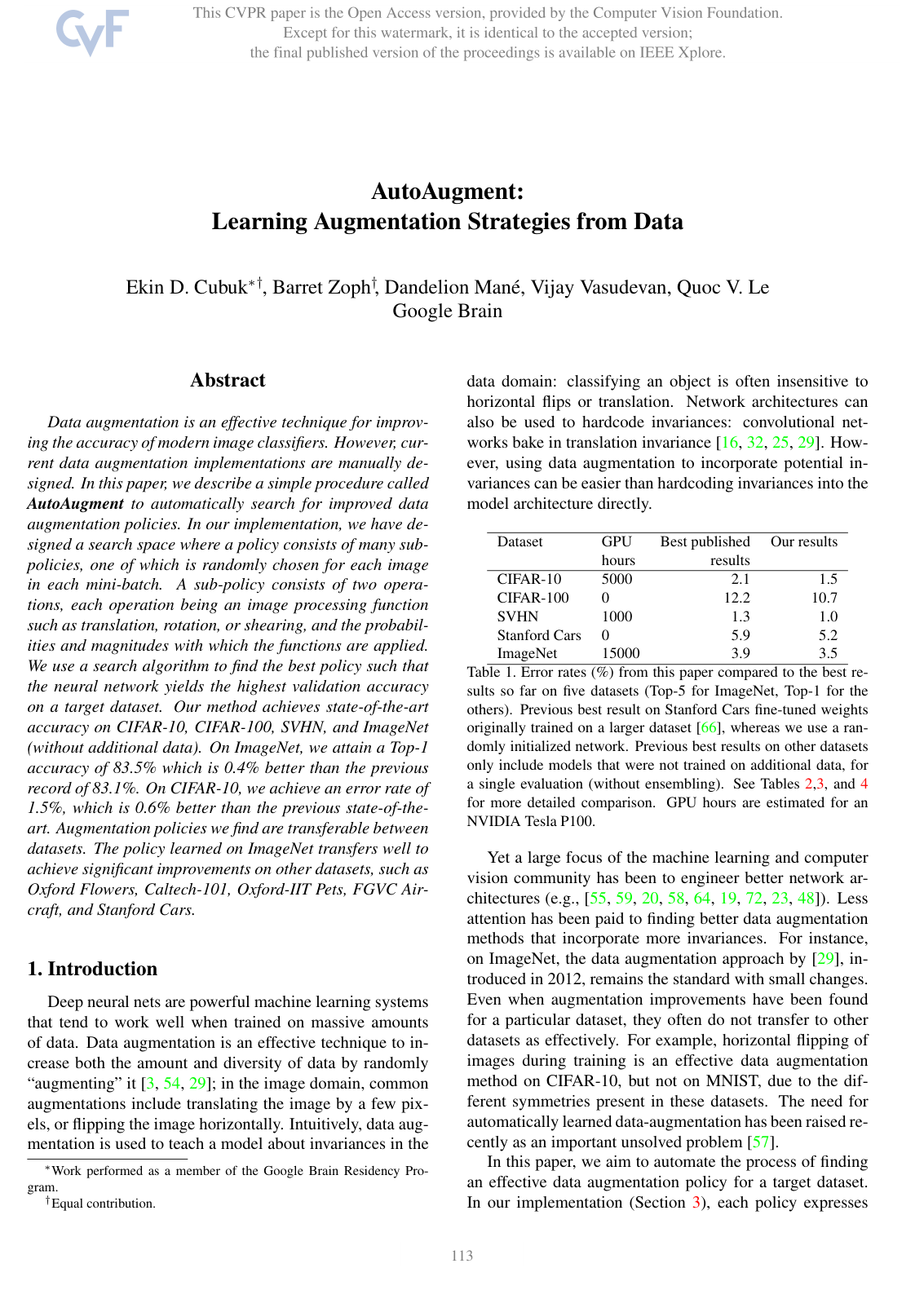
AutoAugment: Learning Augmentation Strategies From Data
Ekin D. CubukBarret ZophDandelion ManéVijay VasudevanQuoc V. Le
article2019CVPR2,690 citations
Ekin D. CubukBarret ZophDandelion ManéVijay VasudevanQuoc V. Le
The AutoAugment search space specifies a data augmentation policy composed of sub-policies. Each sub-policy consists of two image processing operations applied in sequence: .
Each operation is defined by three components:
A single sub-policy has possible configurations. The total search space for a policy containing 5 concurrent sub-policies comprises possible policies.
The AutoAugment search process uses a recurrent neural network (RNN) controller to explore the discrete space of augmentation policies. The controller is a single-layer Long Short-Term Memory (LSTM) network with 100 hidden units. At each step, it produces 30 softmax predictions corresponding to 5 sub-policies 2 operations 3 discrete attributes (operation type, magnitude level, and probability level), feeding each prediction embedding into the next step.
The controller is trained using Proximal Policy Optimization (PPO) with learning rate , an entropy penalty weight of to promote exploration, and an exponential moving average reward baseline with decay .
To reduce computational cost during reinforcement learning policy search, proxy child models are trained on reduced datasets:
Final Policy Formulation: At the end of the search, the sub-policies from the top 5 highest-reward policies are concatenated to form a single final policy containing sub-policies.
Application During Training: When training full target models, for every mini-batch, one of the 25 sub-policies is chosen uniformly at random for each input image. The image is transformed sequentially by the sub-policy's two operations according to their individual probabilities and magnitudes. AutoAugment is applied after baseline pre-processing (such as standard cropping and horizontal flipping) and before Cutout.
AutoAugment significantly reduces test set error rates across multiple architectures on CIFAR-10, CIFAR-100, and SVHN. On reduced subsets (4,000 examples for CIFAR-10, 1,000 examples for SVHN), AutoAugment achieves performance comparable to semi-supervised methods without utilizing any unlabeled data.
All entries report test error rate percentages (lower is better), averaged over 5 runs. Baseline pre-processing includes standardizing, horizontal flips (50%), zero-padding, and random cropping (with Cutout where indicated). On reduced SVHN, standalone Cutout degrades performance (), whereas AutoAugment lowers error to .
Additionally, on the Recht et al. CIFAR-10 test set, PyramidNet+ShakeDrop trained with AutoAugment achieves a error rate ( absolute drop relative to original CIFAR-10), demonstrating superior generalization compared to models without AutoAugment (which show drops of ).
Applying the 25 sub-policies found on a 120-class subset of ImageNet to full ImageNet training yields state-of-the-art Top-1 and Top-5 accuracy improvements across standard and neural-architecture-searched models without extra data or ensembling.
Validation set accuracy is reported as Top-1 / Top-5 percentages (higher is better). Models are trained from scratch for 270 epochs with batch size 4096, initial learning rate 1.6, and 10-fold decays at epochs 90, 180, and 240. Baseline Inception pre-processing scales pixel values to , applies horizontal flipping (), and includes random color distortions.
Augmentation policies learned on ImageNet transfer directly to Fine-Grained Visual Categorization (FGVC) datasets. Inception-v4 models were trained from scratch for 1,000 epochs with cosine learning rate decay at resolution.
All metrics report test Top-1 error rates (lower is better). On Stanford Cars, training from scratch with transferred AutoAugment policies achieves a error rate, surpassing the prior best published result ( error) which required fine-tuning ImageNet pre-trained weights with deep layer aggregation.
The reinforcement learning search process discovers distinct, dataset-tailored transformation choices that align with domain-specific invariances:
AutoAugment achieves larger accuracy gains on CIFAR-10 compared to adversarial data augmentation methods that train a generator to propose transformation sequences that fool a discriminator (Ratner et al., 2017).
AutoAugment directly optimizes downstream classification accuracy via validation reward, whereas generative/adversarial methods optimize sequence realism relative to training samples, leading to smaller generalization improvements.
Ablation experiments on CIFAR-10 using Wide-ResNet-28-10 isolate the contributions of the search space vs. the learned parameters:
While random sampling within the designed discrete search space outperforms baseline augmentation ( baseline, with Cutout), RL optimization of operation types, probabilities, and magnitudes provides an additional absolute error reduction.
The number of sub-policies used during training directly impacts generalization error on CIFAR-10 (evaluated on Wide-ResNet-28-10):
Coverage note — No substantial contributed material was omitted. All search space definitions, RL search mechanics, proxy child setups, CIFAR/SVHN/ImageNet/FGVC benchmark results, comparisons to prior automated augmentation methods, policy property analyses, and ablation studies are covered.
@inproceedings{Cubuk_2019, title={AutoAugment: Learning Augmentation Strategies From Data}, url={http://dx.doi.org/10.1109/cvpr.2019.00020}, DOI={10.1109/cvpr.2019.00020}, booktitle={2019 IEEE/CVF Conference on Computer Vision and Pattern Recognition (CVPR)}, publisher={IEEE}, author={Cubuk, Ekin D. and Zoph, Barret and Mané, Dandelion and Vasudevan, Vijay and Le, Quoc V.}, year={2019}, month=June, pages={113–123} }This paper has an official code repository available. Click below to access the source code.
View RepositoryThis paper is available from its original source. Click below to access the PDF.
Open PDFLicense: Published with permission