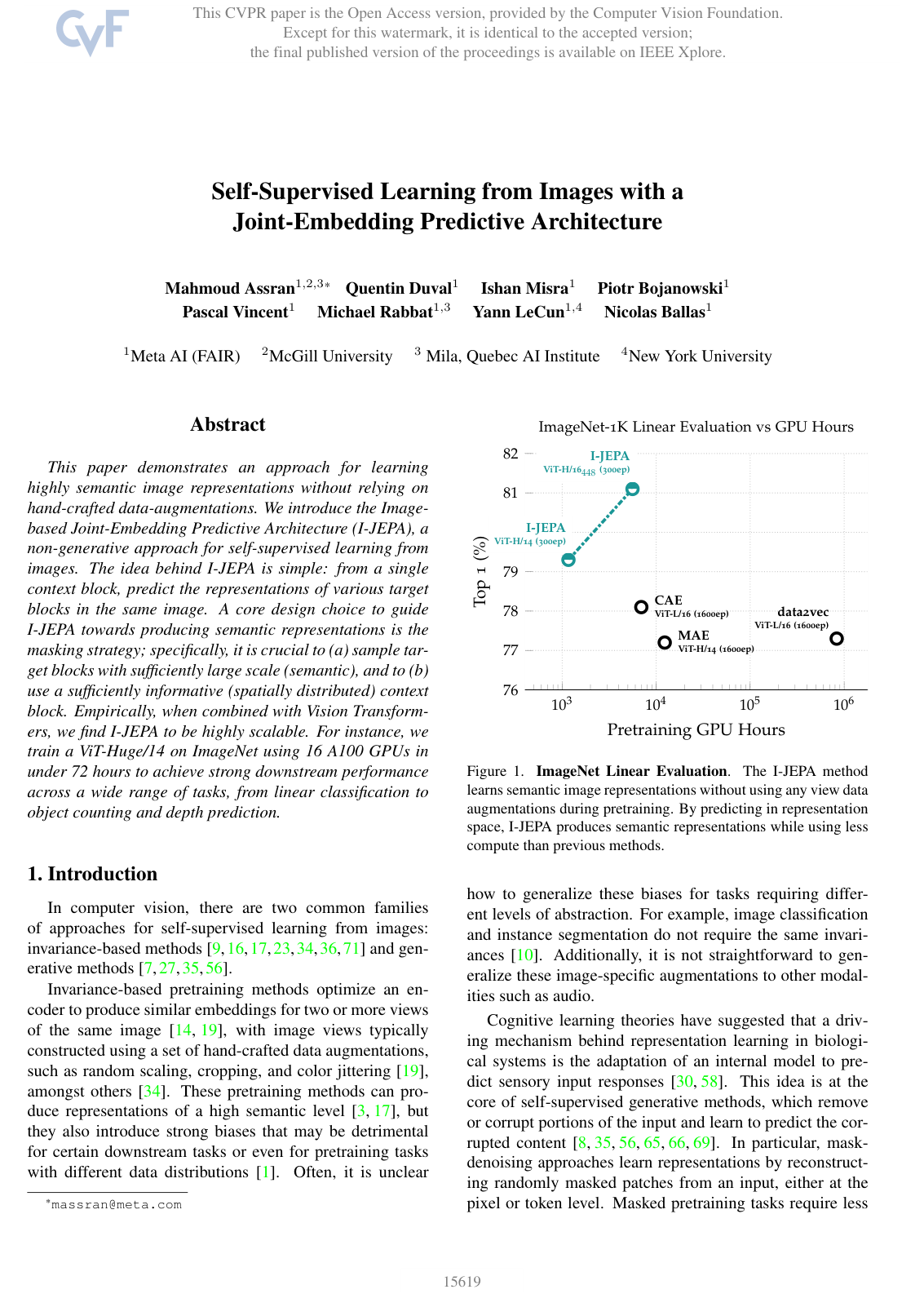
The Image-based Joint-Embedding Predictive Architecture (I-JEPA) is a non-generative self-supervised learning framework designed to learn semantic visual representations from images without requiring hand-crafted data augmentations.
Given an image y partitioned into N non-overlapping patches, I-JEPA extracts abstract representation targets by passing the unmasked image through a target encoder fθˉ, producing patch-level representations sy={sy1,…,syN}. A single, spatially distributed context block x is formed by sampling a large image region and removing any patches overlapping with the target regions. The context block x is processed by a context encoder fθ to produce latent patch features sx={sxj}j∈Bx, where Bx is the set of context patch indices.
A narrow Vision Transformer predictor network gϕ takes the context representations sx and a set of learnable mask tokens (each enriched with positional embeddings corresponding to target patch locations) as inputs to predict the latent patch representations of M target blocks: s^y(i)=gϕ(sx,{mj}j∈Bi) for i∈{1,…,M}. The context encoder fθ and predictor gϕ are optimized via gradient descent on the prediction error in representation space, while the target encoder parameters θˉ are updated at each iteration as an exponential moving average (EMA) of θ to prevent representation collapse.