metapath2vec: Scalable Representation Learning for Heterogeneous Networks
Yuxiao DongNitesh V. ChawlaAnanthram Swami
Develops scalable heterogeneous network embedding frameworks that combine meta-path-guided random walks with type-specific negative sampling to capture both structural and semantic relations across diverse node types.
Heterogeneous networks, which contain multiple types of nodes and relationships, are common in real-world settings such as academic collaboration graphs, yet conventional network embedding methods like DeepWalk and node2vec treat all nodes uniformly and therefore fail to preserve both structural proximity and semantic distinctions. The article addresses this limitation by introducing two models, metapath2vec and metapath2vec++, that learn low-dimensional node representations while respecting network heterogeneity.
The work set out to maximize the likelihood of preserving heterogeneous neighborhoods so that the resulting embeddings could improve downstream tasks including node classification, clustering, and similarity search. The approach relies on meta-path-guided random walks to generate context sequences that encode semantic relations, followed by a heterogeneous skip-gram objective; metapath2vec++ further refines negative sampling to respect node types. Experiments were conducted on two large academic networks—the AMiner computer-science graph with millions of authors and papers and the smaller DBIS dataset—using standard parameter settings and multiple evaluation splits.
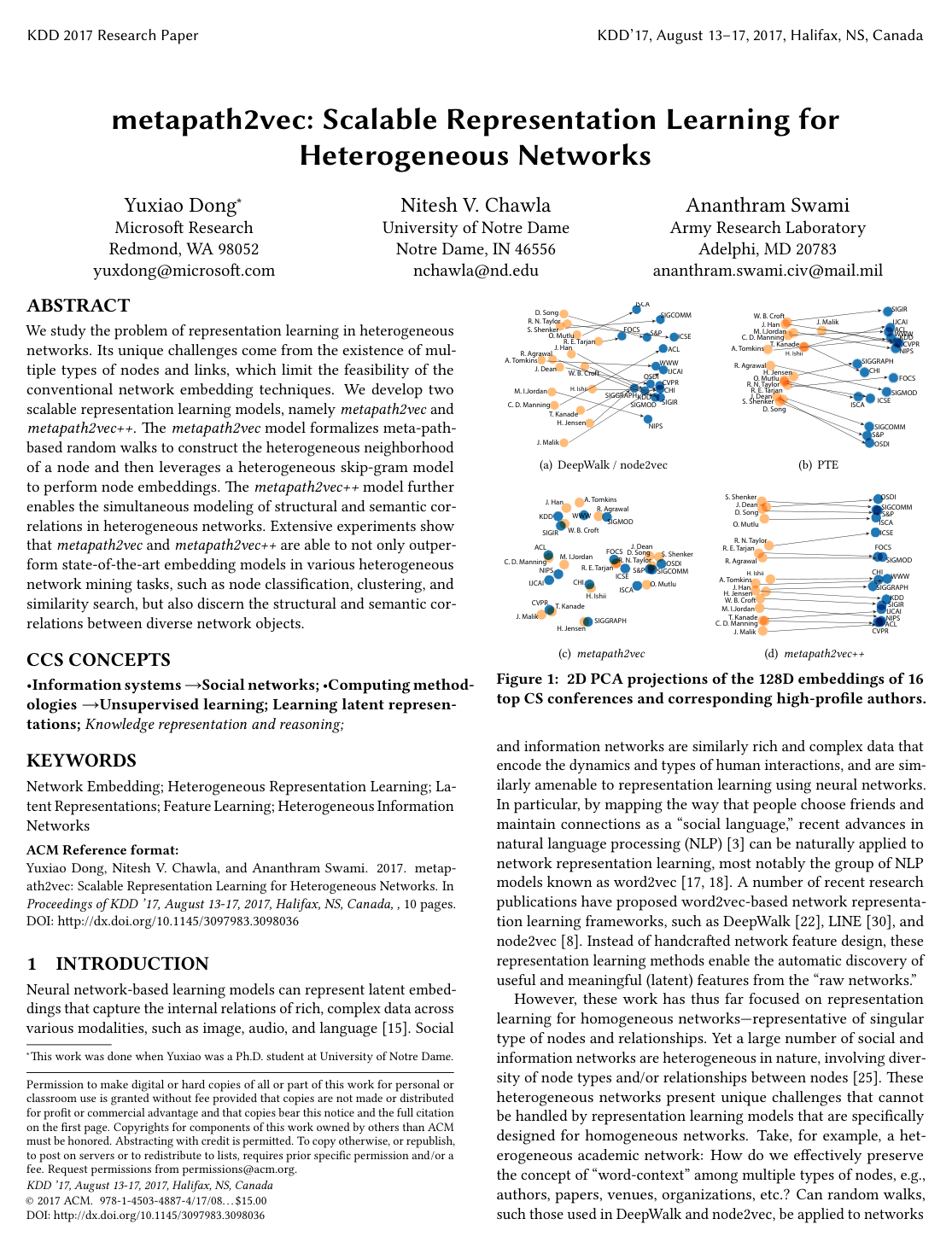
The models consistently outperformed baselines. With only 5 % labeled data, venue classification improved by 35–319 % relative to DeepWalk, LINE, and PTE; author clustering gains reached 13–16 % over the strongest baselines. Visualization of the embeddings showed that metapath2vec++ automatically grouped venues and authors by research area and aligned related pairs along consistent directions, a property absent from prior methods. Parameter studies indicated that performance remains high under cost-effective choices of walk length and neighborhood size.
These results imply that organizations managing heterogeneous data can obtain richer features for search, recommendation, and anomaly detection without hand-crafted meta-path features for every task. The approach scales to networks of millions of nodes when parallelized across dozens of cores, completing training in minutes.
Next steps supported by the article include automatic discovery of useful meta-paths, reduction of intermediate walk data, incorporation of temporal dynamics, and extension to other network genres. The main limitations are dependence on user-specified meta-path schemes and the generation of large intermediate path sets; results are demonstrated primarily on academic networks, so caution is warranted when generalizing to domains with markedly different heterogeneity patterns. Overall, the evidence for the core performance claims is strong and reproducible on the released data and code.
- Paper: DeepWalk: online learning of social representations, Bryan Perozzi et al. (2014). DeepWalk establishes the foundational framework of using random walks on graphs combined with the Word2Vec skip-gram objective, which metapath2vec directly adapts and extends to heterogeneous networks.
- Paper: node2vec: Scalable Feature Learning for Networks, Aditya Grover et al. (2016). Node2vec formalizes parameterized, flexible random walk strategies for network representation learning, serving as the immediate homogeneous baseline and conceptual precursor to meta-path-guided walks.
- Paper: LINE: Large-scale Information Network Embedding, Jian Tang et al. (2015). LINE introduces scalable first- and second-order proximity optimization with negative sampling for large-scale information networks, providing a core baseline and architectural point of comparison for metapath2vec.
- Paper: Efficient Estimation of Word Representations in Vector Space, Tomáš Mikolov et al. (2013). This work introduces the Skip-gram architecture and efficient negative sampling formulations that metapath2vec customizes into heterogeneous skip-gram models.
- Paper: Distributed Representations of Words and Phrases and their Compositionality, Tomas Mikolov et al. (2013). Mikolov et al. formulate the negative sampling optimization and subsampling strategies that underpin the heterogeneous negative sampling techniques designed in metapath2vec++.
- Paper: Translating Embeddings for Modeling Multi-relational Data, Antoine Bordes et al. (2013). TransE provides seminal principles for multi-relational and heterogeneous graph embedding by modeling distinct relational semantics in latent vector spaces.
- Paper: Modeling Relational Data with Graph Convolutional Networks, Michael Schlichtkrull et al. (2018). Relational Graph Convolutional Networks (R-GCNs) extend message-passing graph neural networks to multi-relational and heterogeneous graphs, moving beyond random-walk-based embeddings like metapath2vec to end-to-end deep relational learning.
- Paper: KGAT: Knowledge Graph Attention Network for Recommendation, Xiang Wang et al. (2019). KGAT extends heterogeneous and relational network representation into recommendation systems by replacing predefined meta-paths with end-to-end attentive propagation across multi-hop entity pathways.
- Paper: Graph Convolutional Neural Networks for Web-Scale Recommender Systems, Rex Ying et al. (2018). PinSage advances scalable random-walk-based graph convolution methods to web-scale bipartite graphs with rich node attributes, building on principles of scalable walk sampling seen in metapath2vec.
- Paper: Graph Neural Networks: A Review of Methods and Applications, Jie Zhou et al. (2018). This comprehensive survey contextualizes random-walk embedding approaches like metapath2vec within the broader evolution of spatial, spectral, and relational Graph Neural Network frameworks.