OFA: Unifying Architectures, Tasks, and Modalities Through a Simple Sequence-to-Sequence Learning Framework
Peng WangAn YangRui MenJunyang LinShuai BaiZhikang LiJianxin MaChang ZhouJingren ZhouHongxia Yang
Introduces OFA, an instruction-driven sequence-to-sequence framework that unifies diverse vision and language tasks—from image generation to visual grounding—into a single architecture without task-specific layers, achieving state-of-the-art performance using only 20 million pretraining image-text pairs.
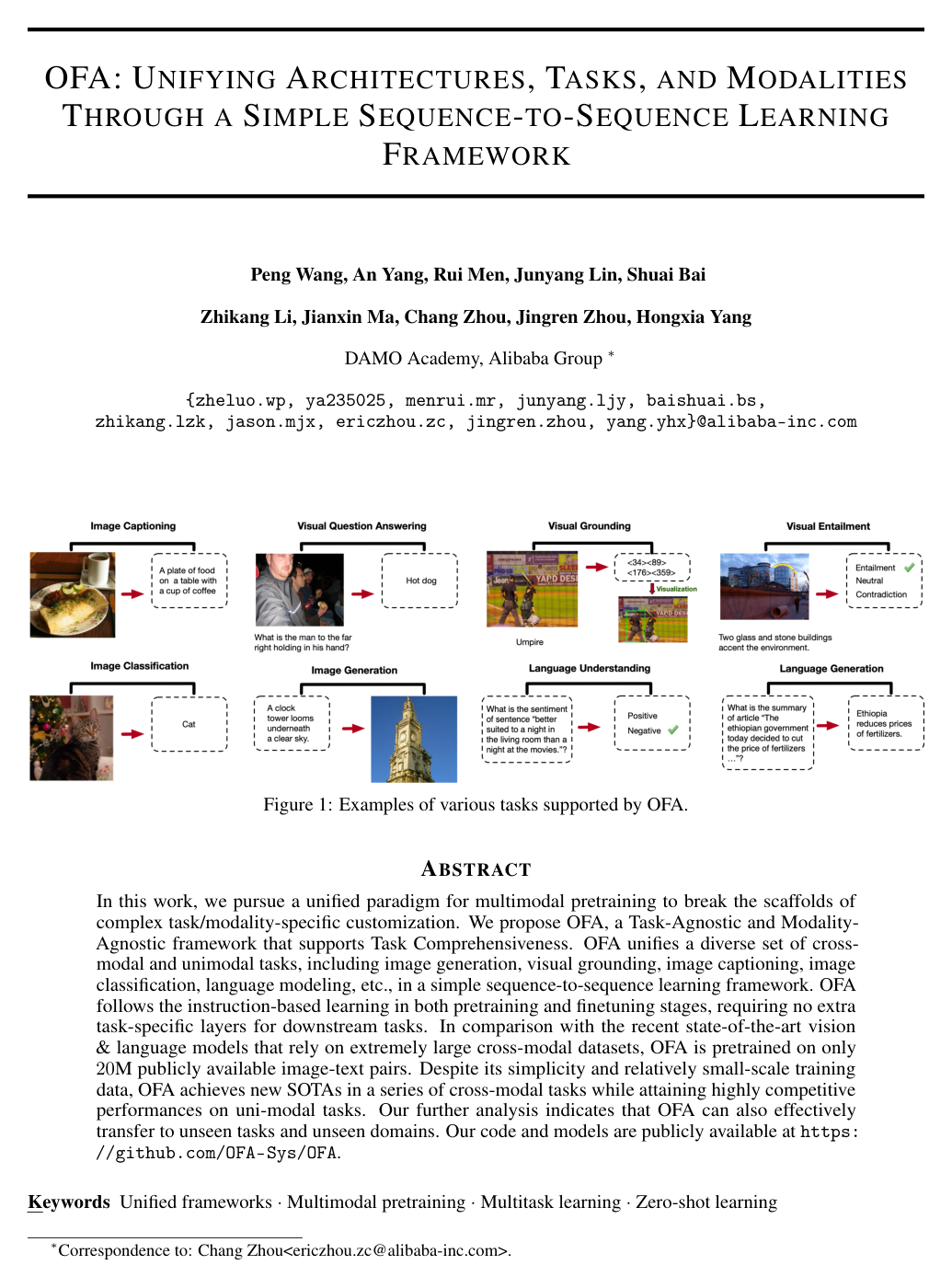
Current artificial intelligence systems often require separate, customized model architectures and task-specific components for different types of data, such as images, text, and combined visual-textual inputs. This fragmentation increases system complexity, inflates training and maintenance costs, and limits the ability of models to generalize across varied, real-world tasks. The article addresses this challenge by introducing OFA (One For All), a unified framework designed to process multimodal and unimodal tasks—including text generation, visual grounding, image classification, and image generation—within a single, standardized architecture without adding custom layers for downstream applications.
The core objective of the article is to demonstrate that an omnipotent model can achieve task-agnostic and modality-agnostic capabilities through a sequence-to-sequence learning structure. The authors evaluate this approach using an encoder-decoder Transformer backbone pretrained on a comparatively compact dataset of 20 million publicly available image-text pairs, accompanied by visual and text-only corpora. By converting text, image patches, and bounding box coordinates into a unified token vocabulary and conditioning tasks via natural language instructions, the framework executes diverse tasks using the same compute engine.
The findings show that OFA outperforms or matches existing state-of-the-art models across several benchmarks. In cross-modal benchmarks, OFA achieved top results, including an 82.0 accuracy score on Visual Question Answering (test-std) and a leading 154.9 CIDEr score on MSCOCO image captioning. For image generation, OFA achieved an improved Fréchet Inception Distance of 10.5 while utilizing a significantly smaller candidate sample size (24 samples) compared to competing baselines. On unimodal benchmarks, the framework achieved performance comparable to leading domain-specific systems, matching advanced language models on standard language understanding benchmarks, establishing a state-of-the-art score on Gigaword text summarization, and attaining an 85.6% top-1 accuracy on ImageNet-1K image classification. Furthermore, the model exhibited solid zero-shot transfer capabilities to unseen tasks, such as grounded question answering, and out-of-domain visual data.
These results carry significant implications for artificial intelligence development and deployment. By proving that a unified sequence-to-sequence structure can outperform specialized models without requiring massive proprietary datasets—such as those scaling to nearly two billion pairs—OFA presents an efficient path toward lowering computational overhead, simplifying model lifecycle management, and minimizing engineering risk. Organizations can leverage a single foundation model across diverse operational needs rather than building and maintaining isolated models for each application.
Based on these outcomes, engineering and research teams should consider adopting unified sequence-to-sequence architectures to consolidate their artificial intelligence infrastructure. However, stakeholders should note specific operational limitations: the model exhibits high sensitivity to natural language prompt formulation, and its zero-shot capabilities remain constrained on sentence-pair classification tasks due to pretraining data boundaries. Further work is recommended to automate prompt optimization and systematically investigate broader pretraining data distributions to strengthen zero-shot robustness before deploying the system in critical, unsupervised production environments.
- Paper: UNITER: UNiversal Image-TExt Representation Learning, Yen-Chun Chen et al. (2020). UNITER establishes the foundational multi-task cross-modal pretraining and masking objectives that OFA simplifies into a unified sequence-to-sequence format.
- Paper: Oscar: Object-Semantics Aligned Pre-training for Vision-Language Tasks, Xiujun Li et al. (2020). Oscar demonstrates how aligning visual elements with semantic anchor tags improves cross-modal representations, informing OFA's approach to modality-agnostic cross-modal alignment.
- Paper: VisualBERT: A Simple and Performant Baseline for Vision and Language, Liunian Harold Li et al. (2019). VisualBERT introduces a unified single-stack Transformer architecture for joint vision-and-language tasks, serving as early architectural inspiration for sequence-based multimodal modeling.
- Paper: Align before Fuse: Vision and Language Representation Learning with Momentum Distillation, Junnan Li et al. (2021). ALBEF establishes the paradigm of detector-free alignment prior to multimodal fusion that sequence-to-sequence multimodal pretraining frameworks like OFA streamline.
- Paper: VL-BERT: Pre-training of Generic Visual-Linguistic Representations, Weijie Su et al. (2019). VL-BERT provides key background on generic visual-linguistic representation pretraining across both text-only and multimodal corpora.
- Paper: An Empirical Study of Training End-to-End Vision-and-Language Transformers, Zi-Yi Dou et al. (2022). METER provides systematic empirical insights into transformer backbones and training objectives for end-to-end vision-and-language learning.
- Paper: MultiInstruct: Improving Multi-Modal Zero-Shot Learning via Instruction Tuning, Zhiyang Xu et al. (2023). MultiInstruct directly uses OFA as its foundational base model to benchmark and improve multimodal zero-shot generalization via instruction tuning.
- Paper: Unified-IO: A Unified Model for Vision, Language, and Multi-Modal Tasks, Jiasen Lu et al. (2022). Unified-IO expands the discrete token sequence-to-sequence paradigm exemplified by OFA to a wider spectrum of dense computer vision and multi-modal generation tasks.
- Paper: Image as a Foreign Language: BEIT Pretraining for Vision and Vision-Language Tasks, Wenhui Wang et al. (2023). BEIT-3 advances the vision of general-purpose foundation models by framing images as a foreign language with multiway expert routing.
- Paper: Qwen-VL: A Versatile Vision-Language Model for Understanding, Localization, Text Reading, and Beyond, Jinze Bai et al. (2023). Qwen-VL builds upon unified sequence-to-sequence vision-language architectures to enable fine-grained visual localization and OCR within modern large multimodal models.
- Paper: Generative Multimodal Models are In-Context Learners, Quan Sun et al. (2024). Emu2 scales up unified generative sequence modeling across multimodal in-context learning and image synthesis.
- Paper: OMG-LLaVA: Bridging Image-level, Object-level, Pixel-level Reasoning and Understanding, Tao Zhang et al. (2024). OMG-LLaVA extends token-to-token multimodal reasoning architectures to bridge high-level understanding with object- and pixel-level perception.
- Paper: LLaVA-OneVision: Easy Visual Task Transfer, Bo Li et al. (2024). LLaVA-OneVision extends unified visual task transfer concepts to encompass single-image, multi-image, and video understanding scenarios.
- Paper: A survey on multimodal large language models, Shukang Yin et al. (2023). This survey provides a comprehensive analysis of modern multimodal foundation architectures and instruction-tuning paradigms that followed unified systems like OFA.