Depth Anything: Unleashing the Power of Large-Scale Unlabeled Data
Lihe YangBingyi KangZilong HuangXiao-Gang XuJiashi FengHengshuang Zhao
Presents Depth Anything, a foundation model for monocular depth estimation trained on 62 million automatically annotated images using semantic priors and optimization perturbations, setting new state-of-the-art zero-shot benchmarks across diverse image domains.
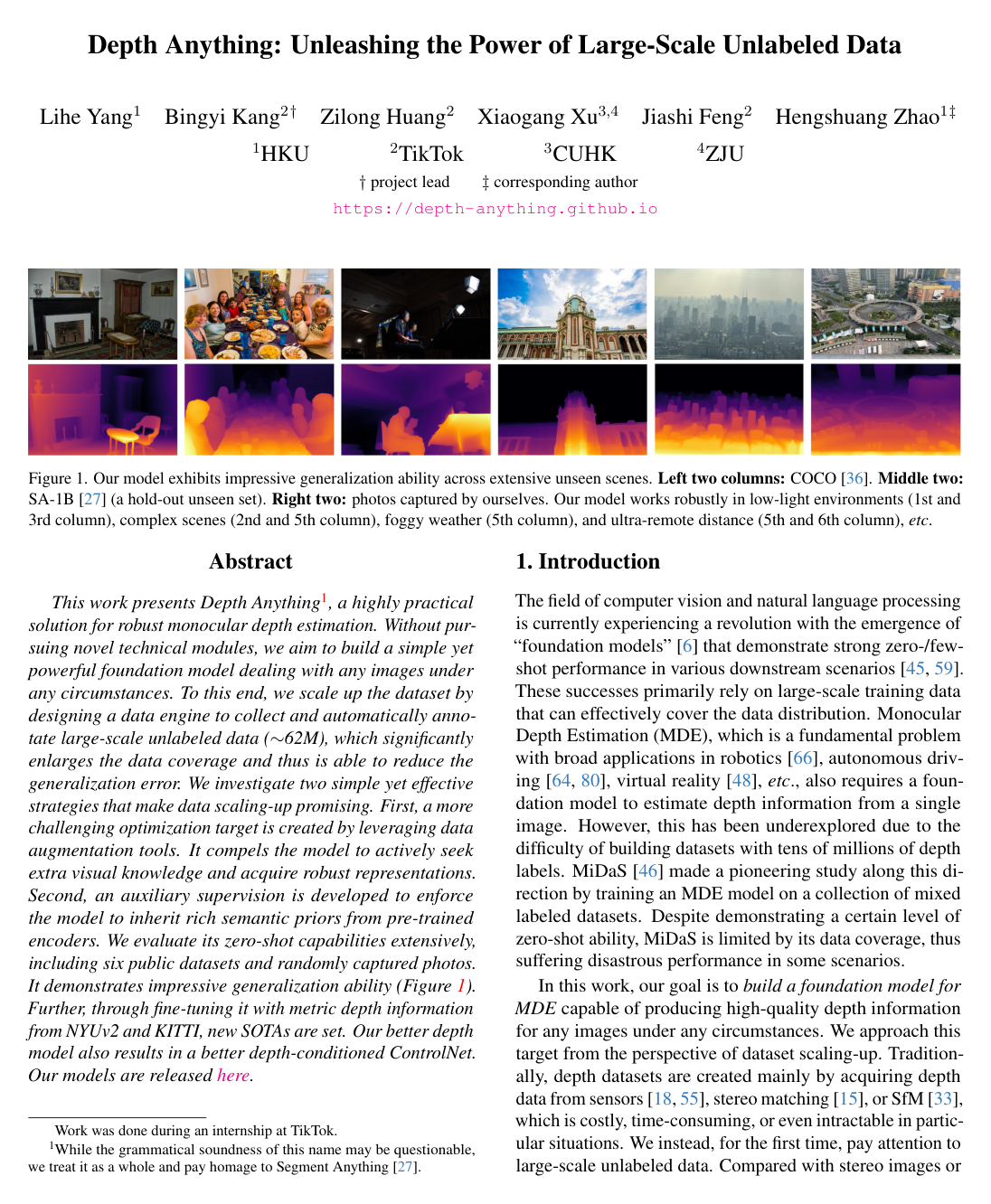
Monocular depth estimation—the task of predicting three-dimensional depth from a single two-dimensional image—is crucial for emerging applications in autonomous driving, robotics, and augmented reality. Historically, developing reliable AI models for this task has been hindered by the high cost and difficulty of acquiring sensor-labeled depth data, which severely limits how well these models generalize to unseen real-world environments.
The article introduces and evaluates Depth Anything, a robust foundation model for single-image depth estimation designed to process arbitrary images across diverse conditions. The primary objective is to demonstrate that massive scaling using cheap, unlabeled monocular images can overcome previous generalization bottlenecks.
To achieve this, the authors built an automated data engine that combined 1.5 million labeled images from six public datasets with approximately 62 million unlabeled images from eight diverse open-source collections. An initial teacher model trained on labeled data assigned estimated depth labels to the unlabeled images. A student model was then trained on this combined dataset using two core strategies: injecting heavy color and spatial perturbations (such as image region mixing) into the unlabeled images to force robust representation learning, and enforcing an auxiliary feature-alignment constraint with a pre-trained image encoder to preserve rich semantic scene understanding.
The evaluation yielded several key findings. First, in zero-shot relative depth estimation across six benchmark datasets, Depth Anything substantially outperformed previous leading models such as MiDaS v3.1; notably, the smallest version (24.8 million parameters) outperformed MiDaS models that were more than ten times larger on multiple datasets. Second, when fine-tuned on standard benchmarks like KITTI and NYUv2, the model established new state-of-the-art accuracy in metric depth estimation. Third, when repurposed for high-level semantic segmentation on the Cityscapes and ADE20K benchmarks, the pre-trained encoder surpassed existing models trained on ImageNet-21K. Finally, qualitative assessments confirmed that the model significantly improves downstream applications, including depth-conditioned image generation and video editing.
These findings demonstrate that high-cost sensor data collection can be largely bypassed by intelligently leveraging unlabeled visual data. For organizations developing perception systems, this approach lowers data acquisition expenses, decreases deployment risks in unstructured open-world settings, and offers a unified vision encoder capable of handling both mid-level geometry and high-level semantic tasks simultaneously.
Organizations in robotics, autonomous navigation, and generative media should adopt Depth Anything as a strong baseline or pre-trained backbone for perception and image generation pipelines. Engineering teams should select model sizes based on computational constraints, as the small-parameter variants provide high accuracy suitable for resource-limited edge devices.
The reported results carry high confidence across standard public benchmarks and varied photographic environments. However, practitioners should note that the current training resolution is capped at standard dimensions, and the architecture has so far scaled up to large vision transformers. Future improvements will require training on higher-resolution imagery and scaling to giant model sizes to further reduce error in highly detailed scenes.
- Paper: Towards Robust Monocular Depth Estimation: Mixing Datasets for Zero-Shot Cross-Dataset Transfer, René Ranftl et al. (2019). This paper establishes foundational cross-dataset training techniques and scale-invariant losses that directly enable the large-scale data mixing strategy used in Depth Anything.
- Paper: Vision Transformers for Dense Prediction, René Ranftl et al. (2021). This work introduces vision transformer backbones for dense prediction tasks, providing the architectural foundation utilized by modern depth foundation models.
- Paper: Depth Pro: Sharp Monocular Metric Depth in Less Than a Second, Alexey Bochkovskiy et al. (2025). Depth Pro directly extends the monocular depth estimation paradigm introduced by Depth Anything by pushing toward sharp, sub-second metric depth prediction.