Good Vibrations? A Qualitative Study of Co-Creation, Communication, Flow, and Trust in Vibe Coding

Veronica PimenovaSarah FakhouryChristian BirdMargaret-Anne StoreyMadeline Endres

article2025arXiv42 citationsACM SIGSOFT Distinguished Paper Award

Establishes the first empirically grounded theory of vibe coding by analyzing developer practices, detailing how trust governs AI co-creation and developer flow while identifying critical breakdown points in debugging, reliability, and code review.

Listen

The rapid emergence of generative artificial intelligence has fostered new software development paradigms, most notably "vibe coding"—an approach where developers build software primarily through natural language conversation with an artificial intelligence model rather than writing code manually. While initial public discourse has ranged from enthusiasm over immense speed to skepticism regarding software quality, there has been limited empirical evidence exploring how practitioners actually experience this workflow. The article addresses this gap by defining the vibe coding paradigm, explaining why and how developers practice it, and documenting its psychological and operational impacts. Its main objective is to establish an empirically grounded theory of vibe coding that articulates the relationships between natural language interaction, human-AI co-creation, developer flow and joy, and the mediating role of trust.

To conduct this evaluation, the researchers analyzed qualitative data across three complementary sources collected between May and July 2025. The dataset comprised 46 Reddit discussion threads (over 102,000 words), 88 professional LinkedIn posts (over 25,000 words), and in-depth, semi-structured interviews with 11 software practitioners whose experience spanned from novice developers to veterans with over 40 years in the field. Using a flexible qualitative analysis methodology adapted from grounded theory, the authors coded over 5,000 comments and 14,000 sentences to achieve theoretical saturation, triangulating perspectives across anonymous forums, professional networks, and direct practitioner interviews.

The article yields four core findings. First, vibe coding functions as a distinct natural language programming paradigm characterized by frequent conversational interactions with minimal direct code inspection. Second, the developer experience is primarily driven by psychological "flow" and joy, as developers offload low-level implementation hurdles and rapid prototyping barriers to an artificial intelligence partner. Third, human-AI trust serves as the central mediator across a continuum ranging from simple task delegation to full architectural co-creation, where greater trust enhances momentum but increases risk. Fourth, practitioners encounter 13 critical pain points—including prompt specification challenges, model conversational memory loss, silent test tampering, code bloat, and severe review fatigue—and are actively forming practical coping mechanisms, such as proactive conversation resets, context injection files, modular task scoping, and external version control tracking.

These findings indicate substantial implications for cost, risk management, and software governance. While vibe coding significantly lowers the barrier to entry and accelerates rapid prototyping, relying entirely on vibes without engineering rigor creates steep technical debt, security vulnerabilities (such as plaintext credentials), and team collaboration bottlenecks. Furthermore, outsourcing code reviews back to the generating models introduces unverified risks. The analysis shows that seasoned developers already self-regulate this workflow, deliberately restricting vibe coding to low-stakes tasks, internal tooling, and exploratory prototypes while avoiding safety-critical, enterprise-grade, or private legacy codebases.

Based on these insights, organizations should not deploy vibe-coded prototypes directly to production environments without rigorous, independent testing and architectural review. Engineering leaders should establish clear verification guardrails, while computing education programs must balance conversational artificial intelligence orchestration skills with core computer science fundamentals. For tooling providers, future environments must integrate explicit version control provenance, persistent conversational memory, and trust-calibration features to sustain developer flow without sacrificing system reliability.

Confidence in these conclusions is supported by strong multi-source qualitative triangulation across varying professional contexts. However, leaders should note several limitations: the findings represent a time-bounded snapshot of early adopters during mid-2025, rely in part on retrospective self-reporting, and draw on a modest interview sample size. Longitudinal studies in large-scale enterprise environments remain necessary to quantitatively measure the long-term impacts of vibe coding on software maintainability and team productivity.

arXiv: 2509.12491
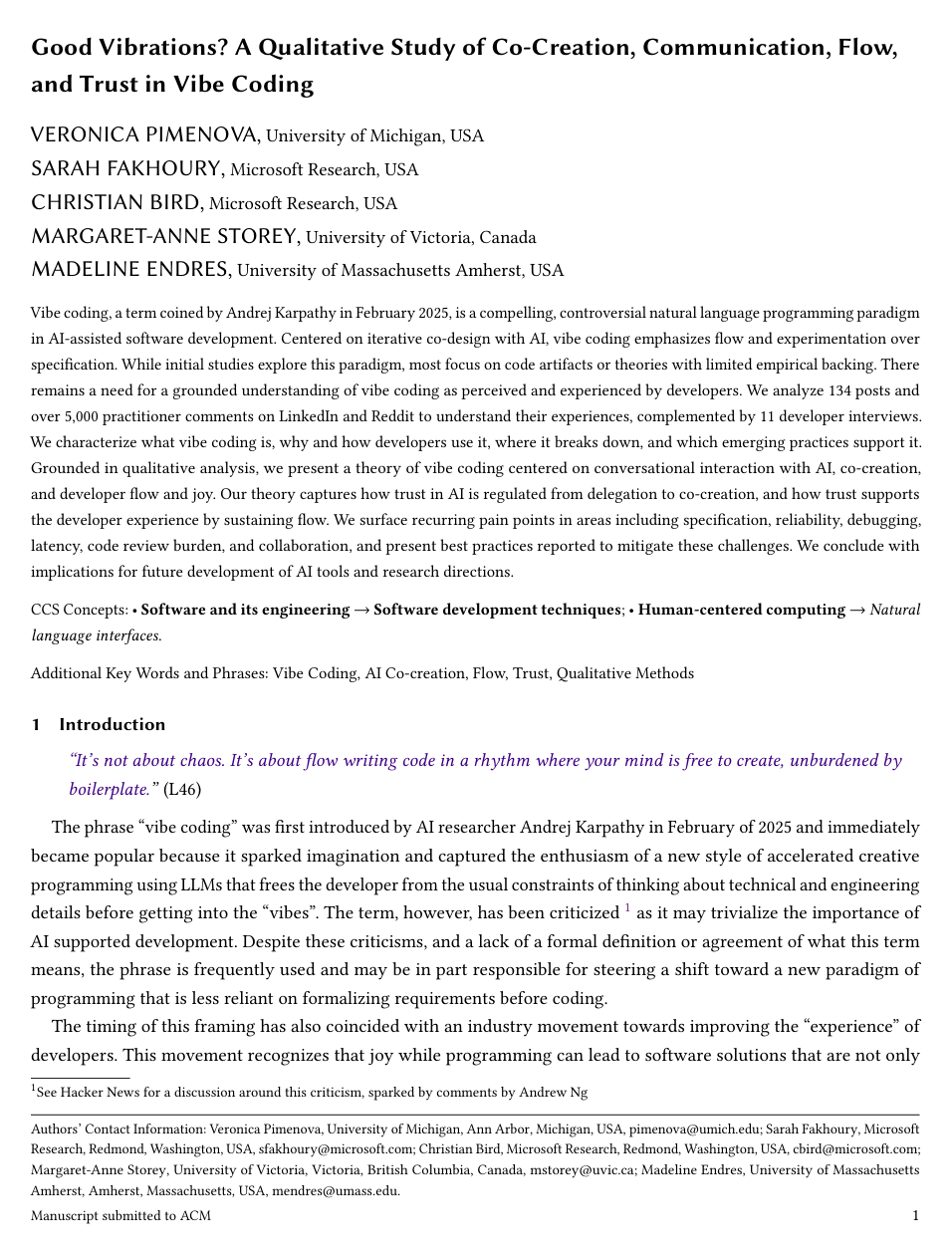
Cover for Good Vibrations? A Qualitative Study of Co-Creation, Communication, Flow, and Trust in Vibe Coding

Abstract

Vibe coding, a term coined by Andrej Karpathy in February 2025, has quickly become a compelling and controversial natural language programming paradigm in AI-assisted software development. Centered on iterative co-design with an AI assistant, vibe coding emphasizes flow and experimentation over strict upfront specification. While initial studies have begun to explore this paradigm, most focus on analyzing code artifacts or proposing theories with limited empirical backing. There remains a need for a grounded understanding of vibe coding as it is perceived and experienced by developers. We present the first systematic qualitative investigation of vibe coding perceptions and practice. Drawing on over 190,000 words from semi-structured interviews, Reddit threads, and LinkedIn posts, we characterize what vibe coding is, why and how developers use it, where it breaks down, and which emerging practices aim to support it. We propose a qualitatively grounded theory of vibe coding centered on conversational interaction with AI, co-creation, and developer flow and joy. We find that AI trust regulates movement along a continuum from delegation to co-creation and supports the developer experience by sustaining flow. We surface recurring pain points and risks in areas including specification, reliability, debugging, latency, code review burden, and collaboration. We also present best practices that have been discovered and shared to mitigate these challenges. We conclude with implications for the future of AI dev tools and directions for researchers investigating vibe coding.

Table of Contents

  • 1 Introduction
  • 2 Background
  • 2.1 Natural Language Programming Paradigms
  • 2.2 Other Paradigms of AI Co-Creation
  • 2.3 Flow and Software Development
  • 3 Methodology and Research Questions
  • 3.1 Guiding Research Questions
  • 3.2 Data Collection
  • 3.3 Analysis Methodology
  • 4 Findings
  • 4.1 Findings—Definition: What is Vibe Coding?
  • 4.2 Findings—The Paradigm: Vibe Coding and Conversational Interaction with AI
  • 4.3 Findings—The Activity: Vibe Coding and Software Co-Creation
  • 4.4 Findings—Developer Experience: Vibe Coding and Flow
  • 4.5 Findings—Trust as a Mediating Factor of Vibe and Flow
  • 4.5.1 Vibe Coding Risks
  • 4.6 Findings—Summary
  • 5 Discussion and Implications
  • 5.1 Platform specific differences
  • 5.2 Generalized Implications and Future Work
  • 6 Related Work
  • 6.1 Defining Vibe Coding
  • 6.2 Conversational Interaction with AI
  • 6.3 Co-Creation with AI
  • 6.4 Trust as a Mediating Factor
  • 6.5 Flow and Joy
  • 7 Limitations and Threats to Validity
  • 8 Conclusion
  • References

Knowls

  1. Knowl 1 — Vibe coding as an interaction–co-creation–flow theory

    model/method

    The study proposes an empirically grounded account of vibe coding with four connected components: conversational interaction with an AI agent is the programming paradigm; human–AI co-creation is the central activity; flow and joy characterize the developer experience; and trust mediates how much authority developers give the AI. In this account, greater trust can enable deeper co-creation and support flow, but can also increase software, developer, and societal risks. Interaction and co-creation pain points can interrupt flow, while reported practices for managing those problems may help restore it. The components are analytically distinct but interdependent, and the account describes practitioners’ perceptions rather than experimentally established causal effects.

  2. Knowl 2 — Conversational natural language as the programming surface

    empirical result

    Practitioners describe vibe coding as programming through frequent, iterative natural-language exchanges with an AI agent: they express or refine goals, inspect results, and ask the agent to make further changes. Many aim to guide the tool without directly reading or editing much code, including asking the agent to fix problems they might otherwise address themselves. The defining interaction is relatively high-contact; one interviewee characterized lower interaction with the AI as more agentic. Practitioners said this style can reduce cognitive effort by offloading syntax and implementation details, avoid learning technologies they do not want to use, and make software creation more accessible to people without formal programming training.

  3. Knowl 3 — Co-creation ranges from delegation to shared decisions

    empirical result

    In practitioners’ accounts, vibe coding often goes beyond asking an AI to implement a fully specified task: the AI may contribute to feature, design, or architectural decisions and act as a sounding board or thought partner. Developers describe a continuum from delegating implementation while retaining direction to allowing the AI substantial influence over the process and its decisions. Reported benefits include brainstorming, learning through questions, faster work with unfamiliar frameworks, and perceived productivity gains. Common reported settings include personal projects, weekend projects, custom productivity tools, exploratory work, and rapid prototyping.

  4. Knowl 4 — Reported pain points in AI conversation

    empirical result

    Practitioners reported five recurring problems in conversational interaction with current vibe-coding tools: (1) difficulty expressing intent precisely in natural language, including unexpected effects from phrasing or assigned personas; (2) inconsistent conversational memory, which can produce repeated suggestions and unproductive prompt loops; (3) inaccurate AI claims about its own capabilities or prior actions; (4) slow or costly responses, including delays associated with quotas, rate limits, or service load; and (5) intrusive company-imposed guardrails, refusals, or responses perceived as scolding. Participants described these problems as frustrating and as potential disruptions to concentration and flow.

  5. Knowl 5 — Reported pain points in AI co-creation

    empirical result

    Practitioners identified eight recurring problems in co-creating software with AI: model knowledge gaps, especially for newer technologies and private or legacy codebases; low reliability; incorrect or incomplete solutions, including unannounced changes to tests or code; poor code quality, style, or efficiency; weak planning and structure, including degradation in long conversations; loss of version-control oversight when changes span many files; difficulty debugging or refactoring generated code; and the burden of reviewing large volumes of generated code. These problems can compound: broad or poorly tracked changes make errors harder to find, while extensive manual review can become exhausting and conflict with the low-code-interaction style practitioners seek.

  6. Knowl 6 — Flow and joy as the intended developer experience

    empirical result

    The study characterizes the desired vibe-coding experience as flow: deep engagement involving focus, perceived control, intrinsic reward, and absorption in the activity. Practitioners associated conversational interaction and iterative co-creation with this experience, describing natural-language work as freeing them from tedious implementation details and rapid run–refine cycles as making progress visible. In terms of flow conditions, the researchers interpret clear intermediate goals, an appropriate balance between task challenge and perceived skill, and immediate feedback as supported by iterative development and reification of ideas. Joy often accompanied flow in participants’ accounts. Conversely, interaction and co-creation problems could interrupt concentration and produce frustration.

  7. Knowl 7 — Practices reported for managing problems and sustaining flow

    model/method

    Practitioners reported practices intended both to mitigate vibe-coding problems and to preserve conditions for flow. For conversational interaction, these include using personas and structured prompts to communicate intent, asking AI to help refine a request, using external memory aids such as project maps or persistent rules, restarting conversations when their quality declines, selecting models and plans with task and cost in mind, and managing frustration. For co-creation, reported strategies include planning before implementation; splitting work into smaller tasks; choosing technologies the model is likely to know; matching tasks to model capabilities and context limits; selectively using AI; managing abstractions and structure; supplying specific quality instructions or persistent general guidance; generating or using tests and validating results; asking for citations; maintaining a mental model of the codebase; using AI for debugging support or rubberducking; tracking changes with version control and AI-generated change logs; and maintaining a list of recurring mistakes. Some practitioners also ask an AI to audit generated code, while others advocate manual review.

  8. Knowl 8 — Trust regulates delegation, co-creation, and review

    theoretical result

    The study identifies trust in AI as a contextual mediator of how much authority a developer cedes. Greater trust can enable faster, more effortless work and allow the AI to make higher-level decisions; lower trust can lead developers to constrain the AI to delegated tasks or scrutinize its output more closely. Trust also creates a tension around code review: manual reading and testing can help developers assess reliability, but reviewing large outputs is burdensome and may undermine the desired flow. Delegating review to an AI may preserve effortlessness, but relies on trust in the reviewing model and was not shown by the study to be as effective as traditional review. Practitioners described calibrating use to context, with more willingness to vibe code for low-stakes personal work than for safety-critical systems or sensitive data.

  9. Knowl 9 — Risks perceived at software, developer, and societal levels

    limitation

    Practitioners raised concerns that vibe coding could produce technical debt, unmaintainable or insecure software, and difficulties moving a prototype into production. They also described possible team costs when colleagues must review or maintain work created by someone who cannot explain it. Developer-level concerns included legal or professional consequences from mishandling sensitive data, reduced learning of programming fundamentals—particularly for junior developers—and potentially unhealthy reliance on AI. Societal concerns included the environmental cost of wasteful model use, AI-generated applications being used for scams or data theft, and reduced confidence in the provenance and quality of open-source software. These are reported risks and concerns, not impacts measured or verified by this study; the authors characterize some societal risks as speculative.

  10. Knowl 10 — Qualitative evidence base and limits of the findings

    experimental setup

    The study triangulated three sources: 46 Reddit discussions containing 102,741 words, 88 LinkedIn posts containing 25,493 words, and 11 semi-structured practitioner interviews containing 64,650 words. The social-media material included more than 5,000 comments and 14,939 sentences; the full dataset contained 192,884 words. Reddit searches were screened and a subset was analyzed until saturation; LinkedIn posts were gathered through recent and highly liked hashtag searches, then screened for relevance. Interviews lasted 30–60 minutes and included participants with varied programming backgrounds, including one participant with no prior programming experience. Researchers used iterative qualitative coding and axial synthesis, resolving coding differences through discussion and negotiated agreement rather than calculating inter-rater reliability; they did not quantify theme frequencies. The data capture a snapshot from May to July 2025, and selection based on high-engagement or recent posts, platform norms, the small interview sample, and reliance on the explicit label “vibe coding” limit how broadly the findings can be generalized. LinkedIn discussions tended to be more positive and Reddit discussions more negative, although positive, negative, and neutral views appeared across all sources.

Coverage note — The paper’s detailed implications for education, tool design, and future research are not separate knowls because they are recommendations derived from the reported findings rather than additional empirical results.

References

  1. 1.Jane Agee. 2009. Developing qualitative research questions: A reflective process. International journal of qualitative studies in education 22, 4 (2009), 431–447.
  2. 2.Shraddha Barke, Michael B James, and Nadia Polikarpova. 2023. Grounded copilot: How programmers interact with code-generating models. Proceedings of the ACM on Programming Languages 7, OOPSLA1 (2023), 85–111.
  3. 3.Michel Beaudouin-Lafon. 2000. Instrumental interaction: an interaction model for designing post-WIMP user interfaces. In Proceedings of the SIGCHI conference on Human factors in computing systems. 446–453.
  4. 4.Andrew Brown, Amanda Chang, Brian Holtz, and Salvatore D’Angelo. 2023. Developer Productivity for Humans, Part 6: Measuring Flow, Focus, and Friction for Developers. IEEE Software 40, 5 (2023), 16–21. doi:10.1109/MS.2023.3305718
  5. 5.Jenna Butler, Jina Suh, Sankeerti Haniyur, and Constance Hadley. 2024. Dear Diary: A randomized controlled trial of Generative AI coding tools in the workplace. arXiv preprint arXiv:2410.18334 (October 2024). doi:10.48550/arXiv.2410.18334 Submitted on 24 Oct 2024.
  6. 6.Mark Chen, Jerry Tworek, Heewoo Jun, Qiming Yuan, Henrique Ponde de Oliveira Pinto, Jared Kaplan, Harri Edwards, Yuri Burda, Nicholas Joseph, Greg Brockman, Alex Ray, Raul Puri, Gretchen Krueger, Michael Petrov, Heidy Khlaaf, Girish Sastry, Pamela Mishkin, Brooke Chan, Scott Gray, Nick Ryder, Mikhail Pavlov, Alethea Power, Lukasz Kaiser, Mohammad Bavarian, Clemens Winter, Philippe Tillet, Felipe Petroski Such, Dave Cummings, Matthias Plappert, Fotios Chantzis, Elizabeth Barnes, Ariel Herbert-Voss, William Hebgen Guss, Alex Nichol, Alex Paino, Nikolas Tezak, Jie Tang, Igor Babuschkin, Suchir Balaji, Shantanu Jain, William Saunders, Christopher Hesse, Andrew N. Carr, Jan Leike, Josh Achiam, Vedant Misra, Evan Morikawa, Alec Radford, Matthew Knight, Miles Brundage, Mira Murati, Katie Mayer, Peter Welinder, Bob McGrew, Dario Amodei, Sam McCandlish, Ilya Sutskever, and Wojciech Zaremba. 2021. Evaluating Large Language Models Trained on Code. arXiv preprint arXiv:2107.03374 (2021).
  7. 7.Yi-Hung Chou, Boyuan Jiang, Yi Wen Chen, Mingyue Weng, Victoria Jackson, Thomas Zimmermann, and James A. Jones. 2025. Building Software by Rolling the Dice: A Qualitative Study of Vibe Coding. arXiv:2512.22418 [cs.SE] https://arxiv.org/abs/2512.22418
  8. 8.COBOL Committee. 1960. COBOL Report. Technical Report. Department of Defense. First standard/specification.
  9. 9.Mihaly Csikszentmihalyi. 1990. Flow: The Psychology of Optimal Experience. Harper & Row, New York.
  10. 10.Mihaly Csikszentmihalyi. 1996. Creativity: Flow and the Psychology of Discovery and Invention. HarperCollins, New York.
  11. 11.Mihaly Csikszentmihalyi, Reed Larson, et al. 2014. Flow and the foundations of positive psychology. Vol. 10. Springer.
  12. 12.Allen Cypher (Ed.). 1993. Watch What I Do: Programming by Demonstration. MIT Press.
  13. 13.Nicole M Deterding and Mary C Waters. 2021. Flexible coding of in-depth interviews: A twenty-first-century approach. Sociological methods & research 50, 2 (2021), 708–739.
  14. 14.DORA Team. 2024. 2024 State of DevOps Report. Technical Report. Google Cloud. Report on developer productivity and GenAI impact.
  15. 15.Dana Feng, Bhada Yun, and April Yi Wang. 2026. From Junior to Senior: Allocating Agency and Navigating Professional Growth in Agentic AI-Mediated Software Engineering. In Proceedings of the 2026 CHI Conference on Human Factors in Computing Systems (CHI ’26). Association for Computing Machinery, New York, NY, USA, Article 596, 24 pages. doi:10.1145/3772318.3791642
  16. 16.Casey Fiesler, Michael Zimmer, Nicholas Proferes, Sarah Gilbert, and Naiyan Jones. 2024. Remember the human: A systematic review of ethical considerations in reddit research. Proceedings of the ACM on Human-Computer Interaction 8, GROUP (2024), 1–33.
  17. 17.Norbert E. Fuchs, Kaarel Kaljurand, and Tobias Kuhn. 2008. Attempto Controlled English for Knowledge Representation. Reasoning Web (2008), 104–124.
  18. 18.Norbert E. Fuchs and Rolf Schwitter. 1996. Attempto Controlled English (ACE). In Proceedings of the First International Workshop on Controlled Language Applications.
  19. 19.Kiev Gama, Filipe Calegario, Victoria Jackson, Alexander Nolte, Luiz Augusto Morais, and Vinicius Garcia. 2026. "Can you feel the vibes?": An exploration of novice programmer engagement with vibe coding. In Proceedings of the 2026 IEEE/ACM International Conference on Software Engineering: Software Engineering Education and Training (ICSE-SEET). arXiv:2512.02750 [cs.SE] doi:10.48550/arXiv.2512.02750
  20. 20.Francis Geng, Anshul Shah, Haolin Li, Nawab Mulla, Steven Swanson, Gerald Soosai Raj, Daniel Zingaro, and Leo Porter. 2025. Exploring Student-AI Interactions in Vibe Coding. arXiv:2507.22614 [cs.HC] https://arxiv.org/abs/2507.22614
  21. 21.Sriram Gopalakrishnan. 2026. Don’t Vibe Code, Do Skele-Code: Interactive No-Code Notebooks for Subject Matter Experts to Build Lower-Cost Agentic Workflows. arXiv preprint arXiv:2603.18122 (2026).
  22. 22.Daniel Graziotin, Xiaofeng Wang, and Pekka Abrahamsson. 2014. Happy software developers solve problems better: psychological measurements in empirical software engineering. PeerJ 2 (03 2014), e289. doi:10.7717/peerj.289
  23. 23.Michaela Greiler, Margaret-Anne Storey, and Abi Noda. 2022. An Actionable Framework for Understanding and Improving Developer Experience. IEEE Transactions on Software Engineering 49, 4 (May 2023), 1411–1425. doi:10.1109/TSE.2022.3177992 ArXiv preprint: arXiv:2205.06352.
  24. 24.Egon G Guba and Yvonna S Lincoln. 1989. Fourth generation evaluation. Sage.
  25. 25.Sumit Gulwani. 2011. Automating String Processing in Spreadsheets Using Input-Output Examples. In Proceedings of the 38th Annual ACM SIGPLAN-SIGACT Symposium on Principles of Programming Languages. ACM, 317–330.
  26. 26.David Harel. 2002. Biting the silver bullet: Toward a brighter future for system development. Computer 25, 1 (2002), 8–20.
  27. 27.Ruanqianqian (Lisa) Huang, Avery Reyna, Sorin Lerner, Haijun Xia, and Brian Hempel. 2025. Professional Software Developers Don’t Vibe, They Control: AI Agent Use for Coding in 2025. arXiv preprint arXiv:2512.14012 (2025). https://arxiv.org/abs/2512.14012
  28. 28.Yeonju Jang, Mose Sakashita, Koichiro Niinuma, and Aakar Gupta. 2026. Evolving Enactions of Expertise: Software Engineers’ Evaluation and Demonstration of Coding Expertise with AI Coding Assistants. In Proceedings of the 2026 CHI Conference on Human Factors in Computing Systems (CHI ’26). Association for Computing Machinery, New York, NY, USA, Article 115, 17 pages. doi:10.1145/3772318.3791260
  29. 29.Eirini Kalliamvakou et al. 2021. The SPACE of Developer Productivity: There’s More to it than You Think. ACM Queue 19, 1 (2021).
  30. 30.Saketh Ram Kasibatla, Raven Rothkopf, Hila Peleg, Benjamin C. Pierce, Sorin Lerner, Harrison Goldstein, and Nadia Polikarpova. 2025. Decision-Oriented Programming with Aporia. arXiv preprint arXiv:2604.05203 (2025). https://arxiv.org/abs/2604.05203
  31. 31.Mary Beth Kery and Brad A Myers. 2017. Exploring exploratory programming. In 2017 IEEE Symposium on Visual Languages and Human-Centric Computing (VL/HCC). IEEE, 25–29.
  32. 32.Abidullah Khan, Atefah Shokrizadeh, and Jinghui Cheng. 2025. Beyond Automation: How Designers Perceive AI as a Creative Partner in the Divergent Thinking Stages of UI/UX Design. In Proceedings of the 2025 CHI Conference on Human Factors in Computing Systems. 1–12.
  33. 33.Shahedul Huq Khandkar. 2009. Open coding. University of Calgary 23, 2009 (2009), 2009.
  34. 34.Mansi Khemka and Brian Houck. 2024. Toward Effective AI Support for Developers: A Survey of Desires and Concerns. Commun. ACM 67, 11 (October 2024), 42–49. doi:10.1145/3690928
  35. 35.Charlotte Kobiella, Daniela Breidenstein, and Albrecht Schmidt. 2026. From Throw-Away to Takeaway: How GenAI and Vibe Coding Accelerate Prototyping Across Technical Skill Levels. In Proceedings of the 2026 CHI Conference on Human Factors in Computing Systems. doi:10.1145/3772318.3790757
  36. 36.Gábor Kusper and Csaba Szabó. 2025. Vibe Coding in Education. In 2025 International Conference on Emerging eLearning Technologies and Applications (ICETA). 506–511. doi:10.1109/ICETA67772.2025.11280285
  37. 37.Jie Li, Youyang Hou, Laura Lin, Ruihao Zhu, Hancheng Cao, and Abdallah El Ali. 2026. Vibe Coding for Product Design: Understanding Product Team Members’ Perceptions of AI-Assisted Design and Development. arXiv:2509.10652 [cs.HC] https://arxiv.org/abs/2509.10652
  38. 38.Tianyi Li, Tanay Maheshwari, and Alex Voelker. 2025. User-Centered Design with AI in the Loop: A Case Study of Rapid User Interface Prototyping with "Vibe Coding". arXiv:2507.21012 [cs.HC] https://arxiv.org/abs/2507.21012
  39. 39.Xi Victoria Lin, Chenglong Wang, Luke Zettlemoyer, and Michael D. Ernst. 2018. NL2Bash: A Corpus and Semantic Parser for Natural Language Interface to the Linux Operating System. In Proceedings of the Eleventh International Conference on Language Resources and Evaluation (LREC 2018). European Language Resources Association (ELRA), Miyazaki, Japan.
  40. 40.Chenyan Liu, Yun Lin, Jiaxin Chang, Jiawei Liu, Binhang Qi, Bo Jiang, Zhiyong Huang, and Jin Song Dong. 2026. EditFlow: Benchmarking and Optimizing Code Edit Recommendation Systems via Reconstruction of Developer Flows. Proc. ACM Program. Lang. 10, OOPSLA1, Article 141 (April 2026), 28 pages. doi:10.1145/3798249
  41. 41.Renkai Ma, Yue You, Xinning Gui, and Yubo Kou. 2023. How Do Users Experience Moderation?: A Systematic Literature Review. Proceedings of the ACM on Human-Computer Interaction 7, CSCW2 (2023), 1–30.
  42. 42.Yimeng Ma, Yu Huang, and Kevin Leach. 2024. Breaking the Flow: A Study of Interruptions During Software Engineering Activities. In Proceedings of the IEEE/ACM 46th International Conference on Software Engineering (ICSE ’24). Association for Computing Machinery, New York, NY, USA, 1–12. doi:10.1145/3597503.3639079 ACM SIGSOFT Distinguished Paper Award winner.
  43. 43.Nora McDonald, Sarita Schoenebeck, and Andrea Forte. 2019. Reliability and inter-rater reliability in qualitative research: Norms and guidelines for CSCW and HCI practice. Proceedings of the ACM on human-computer interaction 3, CSCW (2019), 1–23.
  44. 44.McKinsey & Company. 2023. Unleashing Developer Productivity with Generative AI. Technical Report. McKinsey Digital. https://www.mckinsey.com/capabilities/mckinsey-digital/our-insights/unleashing-developer-productivity-with-generative-ai
  45. 45.Christian Meske, Tobias Hermanns, Esther von der Weiden, Kai-Uwe Loser, and Thorsten Berger. 2025. Vibe Coding as a Reconfiguration of Intent Mediation in Software Development: Definition, Implications, and Research Agenda. arXiv:2507.21928 [cs.SE] https://arxiv.org/abs/2507.21928
  46. 46.André N. Meyer. 2019. Fostering Software Developer Productivity through Awareness Increase and Goal-Setting. Doctoral dissertation. University of Zurich, Zurich, Switzerland. doi:10.5167/UZH-174312 Available at University of Zurich Open Repository and Archive (ZORA).
  47. 47.Miro. 2025. Miro: Online Whiteboard for Visual Collaboration. https://miro.com Accessed: 2025-09-10.
  48. 48.Brad A. Myers, John F. Pane, and Andy Ko. 2004. Natural Programming Languages and Environments. Commun. ACM 47, 9 (2004), 47–52.
  49. 49.Naji Najem, Braden P. Murphy, Hiroshi Otomo, Klaus Schmidt, Christian Pichot, and Olga Sushchenko. 2025. Bridging the Expectation Gap: Characterizing User Misconceptions of LLM-Based Programming Assistants. SSRN preprint (2025). doi:10.5281/ZENODO.17661322
  50. 50.Kaia Newman, Sarah Snay, Madeline Endres, Manasvi Parikh, and Andrew Begel. 2025. Disclosure of Neurodivergence in Software Workplaces: a Mixed Methods Study of Forum and Survey Perspectives. In Proceedings of the 27th International ACM SIGACCESS Conference on Computers and Accessibility. 1–17.
  51. 51.Kaia Newman, Sarah Snay, Madeline Endres, Manasvi Parikh, and Andrew Begel. 2025. "Get Me in the Groove": a Mixed Methods Study on Supporting Adhd Professional Programmers. In 47th IEEE/ACM International Conference on Software Engineering, ICSE 2025, Ottawa, ON, Canada, April 26 - May 6, 2025. IEEE, 1217–1229. doi:10.1109/ICSE55347.2025.00242
  52. 52.Abi Noda, Margaret-Anne Storey, Nicole Forsgren, and Michaela Greiler. 2023. DevEx: What Actually Drives Productivity. ACM Queue 21, 2 (2023). doi:10.1145/3595878 Originally published in Queue vol. 21, no. 2.
  53. 53.Gabrielle O’Brien. 2025. How Scientists Use Large Language Models to Program. In Proceedings of the 2025 CHI Conference on Human Factors in Computing Systems. 1–16.
  54. 54.Gabrielle O’Brien, Antonio Pedro Santos Alves, Sebastian Baltes, Grischa Liebel, Mircea Lungu, and Marcos Kalinowski. 2025. User Misconceptions of LLM-Based Conversational Programming Assistants. In Proceedings of the Journal Ahead Workshop at ICSE ’26. https://arxiv.org/abs/2510.25662
  55. 55.Joanna Paliszkiewicz and Magdalena Mądra-Sawicka. 2016. Impression Management in Social Media: The Example of LinkedIn. Management (18544223) 11, 3 (2016).
  56. 56.Jonathan Parsons, Michael Schrider, Oyebanjo Ogunlela, and Sepideh Ghanavati. 2023. Understanding developers privacy concerns through reddit thread analysis. arXiv preprint arXiv:2304.07650 (2023).
  57. 57.Kai Petersen and Claes Wohlin. 2011. Measuring the Flow in Lean Software Development. Software: Practice and Experience 41, 9 (August 2011), 975–996. doi:10.1002/spe.975
  58. 58.Madison Pickering, Helena Williams, Alison Gan, Weijia He, Hyojae Park, Francisco Piedrahita Velez, Michael L Littman, and Blase Ur. 2025. How Humans Communicate Programming Tasks in Natural Language and Implications For End-User Programming with LLMs. In Proceedings of the 2025 CHI Conference on Human Factors in Computing Systems. 1–34.
  59. 59.Nicholas Proferes, Naiyan Jones, Sarah Gilbert, Casey Fiesler, and Michael Zimmer. 2021. Studying reddit: A systematic overview of disciplines, approaches, methods, and ethics. Social Media+ Society 7, 2 (2021), 20563051211019004.
  60. 60.Kevin Pu, Daniel Lazaro, Ian Arawjo, Haijun Xia, Ziang Xiao, Tovi Grossman, and Yan Chen. 2025. Assistance or disruption? exploring and evaluating the design and trade-offs of proactive ai programming support. In Proceedings of the 2025 CHI Conference on Human Factors in Computing Systems. 1–21.
  61. 61.Nathalie Riche, Anna Offenwanger, Frederic Gmeiner, David Brown, Hugo Romat, Michel Pahud, Nicolai Marquardt, Kori Inkpen, and Ken Hinckley. 2025. AI-Instruments: Embodying Prompts as Instruments to Abstract & Reflect Graphical Interface Commands as General-Purpose Tools. In Proceedings of the 2025 CHI Conference on Human Factors in Computing Systems. 1–18.
  62. 62.Saima Ritonummi, Valtteri Siitonen, Markus Salo, and Henri Pirkkalainen. 2024. Exploring Barriers That Prevent Employees from Experiencing Flow in the Software Industry. Journal of Workplace Learning 36, 3 (April 2024), 223–238. doi:10.1108/JWL-11-2022-0146 Article publication date: 15 August 2023; Issue publication date: 30 April 2024.
  63. 63.Steven I Ross, Fernando Martinez, Stephanie Houde, Michael Muller, and Justin D Weisz. 2023. The programmer’s assistant: Conversational interaction with a large language model for software development. In Proceedings of the 28th International Conference on Intelligent User Interfaces. 491–514.
  64. 64.Cindy Royal. 2026. Integrating Vibe Coding and Flow Theory: A Student-Centered Model for AI-Augmented Coding Education. Journalism & Mass Communication Educator (2026). doi:10.1177/10776958251407389
  65. 65.Paul Rozin and Edward B Royzman. 2001. Negativity bias, negativity dominance, and contagion. Personality and social psychology review 5, 4 (2001), 296–320.
  66. 66.Marisa Salanova, Alma M. Rodríguez-Sánchez, Wilmar B. Schaufeli, and Eva Cifre. 2014. Flowing Together: A Longitudinal Study of Collective Efficacy and Collective Flow Among Workgroups. Journal of Psychology 148, 4 (2014), 435–455. doi:10.1080/00223980.2013.806290
  67. 67.Ranjan Sapkota, Konstantinos I. Roumeliotis, and Manoj Karkee. 2025. Vibe Coding vs. Agentic Coding: Fundamentals and Practical Implications of Agentic AI. arXiv:2505.19443 [cs.SE] https://arxiv.org/abs/2505.19443
  68. 68.Advait Sarkar and Ian Drosos. 2025. Vibe coding: programming through conversation with artificial intelligence. arXiv:2506.23253 [cs.HC] https://arxiv.org/abs/2506.23253
  69. 69.Limor Shifman. 2013. Memes in a digital world: Reconciling with a conceptual troublemaker. Journal of computer-mediated communication 18, 3 (2013), 362–377.
  70. 70.Michael Silverstein. 2003. Indexical order and the dialectics of sociolinguistic life. Language & communication 23, 3-4 (2003), 193–229.
  71. 71.Armando Solar-Lezama. 2008. Program Synthesis by Sketching. Ph. D. Dissertation. UC Berkeley.
  72. 72.Ningzhi Tang, Chaoran Chen, Zihan Fang, Gelei Xu, Maria Dhakal, Yiyu Shi, Collin McMillan, Yu Huang, and Toby Jia-Jun Li. 2026. Programming by Chat: A Large-Scale Behavioral Analysis of 11,579 Real-World AI-Assisted IDE Sessions. arXiv preprint arXiv:2604.00436 (2026). https://arxiv.org/abs/2604.00436
  73. 73.Christoph Treude and Margaret-Anne Storey. 2025. Generative AI and Empirical Software Engineering: A Paradigm Shift. In Proceedings of the 3rd International Conference on AI-Powered Software (AIware). doi:10.1109/AIware64474.2025.00012
  74. 74.Priyan Vaithilingam, Tianyi Zhang, and Elena L Glassman. 2022. Expectation vs. experience: Evaluating the usability of code generation tools powered by large language models. In Chi conference on human factors in computing systems extended abstracts. 1–7.
  75. 75.Maike Vollstedt and Sebastian Rezat. 2019. An introduction to grounded theory with a special focus on axial coding and the coding paradigm. Compendium for early career researchers in mathematics education 13, 1 (2019), 81–100.
  76. 76.Etienne Wenger. 1998. Communities of Practice: Learning, Meaning, and Identity. Cambridge University Press, Cambridge. doi:10.1017/CBO9780511803932
  77. 77.Terry Winograd. 1972. Procedures as a Representation for Data in a Computer Program for Understanding Natural Language. Ph. D. Dissertation. MIT. MIT AI Technical Report 235, Published in Cognitive Psychology Vol. 3.
  78. 78.William A. Woods. 1973. Progress in Natural Language Understanding: An Application to Lunar Geology. In AFIPS Conference Proceedings, Vol. 42. 441–450. National Computer Conference and Exposition.
  79. 79.Feiyang Xu, Poonacha K Medappa, Murat M Tunc, Martijn Vroegindeweij, and Jan C Fransoo. 2025. AI-assisted Programming May Decrease the Productivity of Experienced Developers by Increasing Maintenance Burden. arXiv preprint arXiv:2510.10165 (2025).
  80. 80.Ryan Yen, Jian Zhao, and Daniel Vogel. 2025. Code Shaping: Iterative Code Editing with Free-form AI-Interpreted Sketching. In Proceedings of the 2025 CHI Conference on Human Factors in Computing Systems. 1–17.
  81. 81.Pengcheng Yin, Bowen Deng, Edgar Chen, Bogdan Vasilescu, and Graham Neubig. 2018. Learning to Mine Aligned Code and Natural Language Pairs from Stack Overflow. In Proceedings of the 15th International Conference on Mining Software Repositories. ACM, 476–486.
  82. 82.Tao Yu, Rui Zhang, Kai Yang, Michihiro Yasunaga, Dongxu Wang, Zifan Li, James Ma, Irene Li, Qingning Yao, Shanelle Roman, Zilin Zhang, and Dragomir Radev. 2018. Spider: A Large-Scale Human-Labeled Dataset for Complex and Cross-Domain Semantic Parsing and Text-to-SQL Task. In Proceedings of the 2018 Conference on Empirical Methods in Natural Language Processing. Association for Computational Linguistics, 3911–3921.
  83. 83.JD Zamfirescu-Pereira, Eunice Jun, Michael Terry, Qian Yang, and Björn Hartmann. 2025. Beyond code generation: Llm-supported exploration of the program design space. In Proceedings of the 2025 CHI Conference on Human Factors in Computing Systems. 1–17.
  84. 84.Luke S. Zettlemoyer and Michael Collins. 2005. Learning to Map Sentences to Logical Form: Structured Classification with Probabilistic Categorial Grammars. In Proceedings of the Twenty-First Conference on Uncertainty in Artificial Intelligence. 658–666.
  85. 85.Luke S. Zettlemoyer and Michael Collins. 2007. Online Learning of Relaxed CCG Grammars for Parsing to Logical Form. In Proceedings of the 2007 Joint Conference on Empirical Methods in Natural Language Processing and Computational Natural Language Learning. 678–687.
  86. 86.Xinqi Zhang, Hari Subramonyam, Advait Sarkar, Ian Drosos, Jack Wang, Kyungho Lee, Veronica Pimenova, Xiang “Anthony” Chen, and Kai Lukoff. 2026. Generative Design and Vibe Coding: Rethinking The Design-Development Divide for UI Prototyping. In Extended Abstracts of the 2026 CHI Conference on Human Factors in Computing Systems. doi:10.1145/3772363.3778802
  87. 87.Manuela Züger, Will Snipes, Christopher Corley, André Meyer, Boyang Li, Thomas Fritz, David Shepherd, Vinay Augustine, Patrick Francis, and Nicholas Kraft. 2017. Reducing Interruptions at Work: A Large-Scale Field Study of FlowLight. 61–72. doi:10.1145/3025453.3025662

Citation

MLA
Pimenova, V., et al. “Good Vibrations? A Qualitative Study of Co-Creation, Communication, Flow, and Trust in Vibe Coding”. arXiv, 2025, http://arxiv.org/abs/2509.12491v2.
APA
Pimenova, V., Fakhoury, S., Bird, C., Storey, M.-A., & Endres, M. (2025). Good Vibrations? A Qualitative Study of Co-Creation, Communication, Flow, and Trust in Vibe Coding. arXiv. http://arxiv.org/abs/2509.12491v2
Chicago
Pimenova, V., S. Fakhoury, C. Bird, M.-A. Storey, and M. Endres. 2025. “Good Vibrations? A Qualitative Study of Co-Creation, Communication, Flow, and Trust in Vibe Coding”. arXiv. http://arxiv.org/abs/2509.12491v2.
Harvard
Pimenova, V. et al. (2025) “Good Vibrations? A Qualitative Study of Co-Creation, Communication, Flow, and Trust in Vibe Coding”, arXiv [Preprint]. Available at: http://arxiv.org/abs/2509.12491v2.
Vancouver
1. Pimenova V, Fakhoury S, Bird C, Storey M-A, Endres M (2025) Good Vibrations? A Qualitative Study of Co-Creation, Communication, Flow, and Trust in Vibe Coding. arXiv

BibTeX

@article{pimenova2025good,
  title = {Good Vibrations? A Qualitative Study of Co-Creation, Communication, Flow, and Trust in Vibe Coding},
  author = {Pimenova, Veronica and Fakhoury, Sarah and Bird, Christian and Storey, Margaret-Anne and Endres, Madeline},
  year = {2025},
  journal = {arXiv},
  url = {http://arxiv.org/abs/2509.12491v2},
  eprint = {2509.12491}
}
Metadata:arXiv

Access the Paper

This paper is available from its original source. Click below to access the PDF.

Open PDF
License: https://creativecommons.org/licenses/by/4.0/