LightEA: A Scalable, Robust, and Interpretable Entity Alignment Framework via Three-view Label Propagation

Xin MaoWenting WangYuanbin WuMan Lan

article2022EMNLP56 citations

Proposes a non-neural entity alignment framework using three-view label propagation and sparse Sinkhorn iteration to achieve state-of-the-art alignment accuracy with a fraction of the computational time and full model interpretability.

Listen

Knowledge graphs organize real-world information into structured networks of entities and relationships, powering critical tools such as search engines and dialogue systems. Because these graphs are typically developed independently across different organizations and sources, integrating them through entity alignment—identifying matching entities across distinct graphs—is essential for expanding knowledge coverage. However, prevailing alignment techniques rely heavily on complex graph neural networks that require heavy iterative model training. Consequently, existing methods suffer from prohibitive computation times when applied to large real-world datasets and operate largely as uninterpretable black boxes.

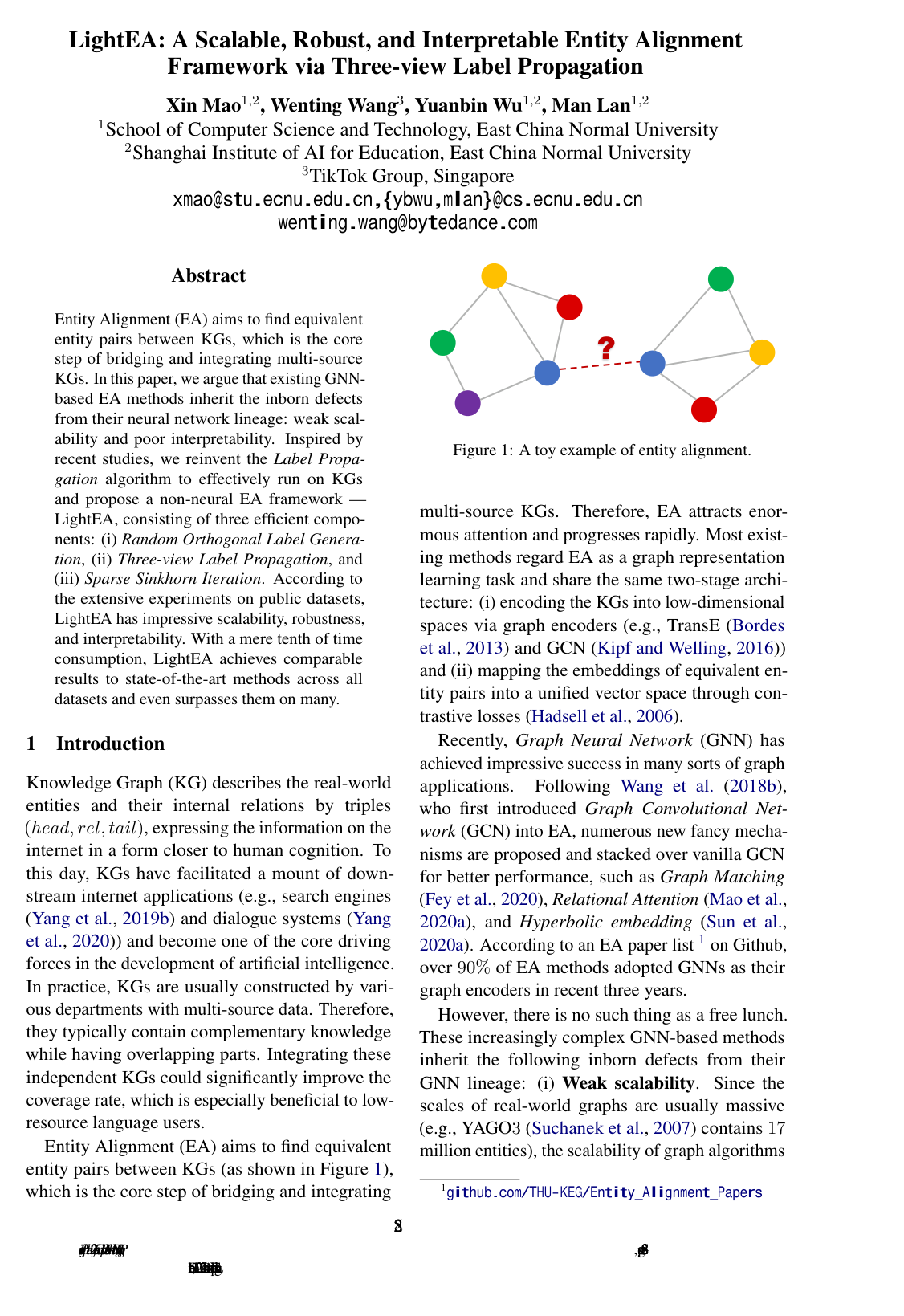
The article introduces and evaluates LightEA, a non-neural framework designed to achieve highly scalable, robust, and interpretable entity alignment. LightEA adapts the classical label propagation technique to heterogeneous graphs using three primary components: generating compact random orthogonal label vectors to represent known alignments, propagating entity and relation labels across three structural graph perspectives, and resolving one-to-one entity matches using a sparse assignment algorithm.

To establish its effectiveness, the framework was evaluated across four public benchmark suites representing diverse conditions, including cross-lingual pairs, sparse structures, medium-sized graphs with 100,000 entities, and a million-scale dataset comprising over one million entities and nearly ten million relationships. Performance was measured on alignment accuracy and execution runtime against state-of-the-art neural and non-neural baselines.

The evaluation revealed several key findings. First, LightEA delivered substantial execution speedups, requiring under one-tenth the runtime of leading methods—completing alignment on standard benchmarks in 7 to 35 seconds and processing the million-entity dataset in under four minutes on a single graphic processing unit, where many existing systems fail to run entirely. Second, despite eliminating trainable parameters, the framework matched or surpassed the accuracy of leading neural approaches across benchmark datasets. Third, incorporating literal features, such as translated entity names, boosted top-one alignment accuracy above 95% on cross-lingual benchmarks without requiring pre-aligned training pairs. Finally, because the label propagation mechanism is entirely linear, alignment outcomes and errors can be directly audited and traced back to specific graph neighborhoods.

These findings indicate that complex neural architectures are not strictly necessary to achieve high-accuracy graph integration. By replacing intensive neural network training with linear label propagation, organizations can drastically cut computational hardware costs, accelerate integration timelines, and audit alignment decisions for higher confidence and accountability. When deploying the framework, practitioners should tailor the configuration to available resources: use the basic configuration when speed is paramount, apply iterative alignment when pre-labeled data is scarce, or incorporate textual names when textual attributes are present. Future research should prioritize refactoring the framework into high-performance computing languages, testing linear speedups across multi-processor environments, and refining ways to preserve model interpretability during large-scale execution without excessive memory overhead.

arXiv: 2210.10436
Cover for LightEA: A Scalable, Robust, and Interpretable Entity Alignment Framework via Three-view Label Propagation

Abstract

Entity Alignment (EA) aims to find equivalent entity pairs between KGs, which is the core step of bridging and integrating multi-source KGs. In this paper, we argue that existing GNN-based EA methods inherit the inborn defects from their neural network lineage: weak scalability and poor interpretability. Inspired by recent studies, we reinvent the Label Propagation algorithm to effectively run on KGs and propose a non-neural EA framework — LightEA, consisting of three efficient components: (i) Random Orthogonal Label Generation, (ii) Three-view Label Propagation, and (iii) Sparse Sinkhorn Iteration. According to the extensive experiments on public datasets, LightEA has impressive scalability, robustness, and interpretability. With a mere tenth of time consumption, LightEA achieves comparable results to state-of-the-art methods across all datasets and even surpasses them on many.

Table of Contents

  • 1 Introduction
  • 2 Task Definition
  • 3 Related Work
  • 3.1 Entity Alignment
  • 3.2 Label Propagation and GCN
  • 4 The Proposed Method
  • 4.1 Random Orthogonal Label Generation
  • 4.2 Three-view Label Propagation
  • 4.3 Sparse Sinkhorn Iteration
  • 5 Experiments
  • 5.1 Datasets and Metrics
  • 5.2 Baselines
  • 5.3 Hyper-parameters
  • 5.4 Main Experiments
  • 5.5 Hyper-parameters
  • 5.6 How to Interpret the Results
  • 5.7 An Example of Tracing the Wrong Case
  • 6 Conclusion
  • Limitations
  • Ethics Statement
  • References
  • A Sinkhorn Iteration
  • B Datasets
  • C Time Costs
  • D Hyper-parameter
  • E Pre-aligned Ratio
  • F Ablation Study
  • G OpenEA Benchmark (v2.0)

Knowls

  1. Knowl 1 — Three-view Label Propagation for Heterogeneous Knowledge Graphs

    model/method

    To generalize classical Label Propagation (LP) from homogeneous graphs to heterogeneous Knowledge Graphs (KGs) without the quadratic dimensionality explosion or sparse-tensor incompatibility of full tensor-matrix multiplication, the third-order adjacency tensor A∈R∣E∣×∣E∣×∣R∣\mathcal{A} \in \mathbb{R}^{|\mathcal{E}| \times |\mathcal{E}| \times |\mathcal{R}|} of a KG G=(E,R,T)\mathcal{G} = (\mathcal{E}, \mathcal{R}, \mathcal{T}) is compressed along three orthogonal projection planes into three 2D view matrices:

    1. Side view Aside∈R∣E∣×∣E∣A_{\text{side}} \in \mathbb{R}^{|\mathcal{E}| \times |\mathcal{E}|} summing along the relation mode (Aside[i,j]=∑rA[i,j,r]A_{\text{side}}[i,j] = \sum_{r} \mathcal{A}[i,j,r]), capturing direct head-to-tail entity connectivity.
    2. Front view Afront∈R∣E∣×∣R∣A_{\text{front}} \in \mathbb{R}^{|\mathcal{E}| \times |\mathcal{R}|} summing along the tail entity mode (Afront[i,r]=∑jA[i,j,r]A_{\text{front}}[i,r] = \sum_{j} \mathcal{A}[i,j,r]), capturing head-to-relation connectivity.
    3. Top view Atop∈R∣R∣×∣E∣A_{\text{top}} \in \mathbb{R}^{|\mathcal{R}| \times |\mathcal{E}|} summing along the head entity mode (Atop[r,j]=∑iA[i,j,r]A_{\text{top}}[r,j] = \sum_{i} \mathcal{A}[i,j,r]), capturing relation-to-tail connectivity.

    Label propagation alternates synchronously across entities and relations for kk steps:

    Le(k+1)=AsideLe(k)+AfrontLr(k)L_e^{(k+1)} = A_{\text{side}} L_e^{(k)} + A_{\text{front}} L_r^{(k)}

    Lr(k+1)=AtopLe(k)L_r^{(k+1)} = A_{\text{top}} L_e^{(k)}

    where Le(k)∈R∣E∣×dL_e^{(k)} \in \mathbb{R}^{|\mathcal{E}| \times d} and Lr(k)∈R∣R∣×dL_r^{(k)} \in \mathbb{R}^{|\mathcal{R}| \times d} denote entity and relation label matrices at propagation step kk. After kk rounds, the representation of entity eie_i is formed by concatenating representations across all propagation depths:

    leiout=[lei(0)∥lei(1)∥⋯∥lei(k)]l_{e_i}^{\text{out}} = \left[ l_{e_i}^{(0)} \parallel l_{e_i}^{(1)} \parallel \dots \parallel l_{e_i}^{(k)} \right]

    The overall computational complexity is O(∣T∣d)O(|\mathcal{T}|d) where ∣T∣|\mathcal{T}| is the number of triples and dd is the label vector dimension, matching the linear computational complexity of homogeneous LP and requiring no trainable neural network parameters.

  2. Knowl 2 — Random Orthogonal Label Generation on High-Dimensional Hyper-spheres

    theoretical result

    In entity alignment between two KGs Gs\mathcal{G}_s and Gt\mathcal{G}_t given pre-aligned seed pairs P={(ei,ej)}\mathcal{P} = \{(e_i, e_j)\}, treating each seed pair as a distinct class requires one-hot label vectors of dimension ∣P∣|\mathcal{P}|, causing massive memory footprint and extreme sparsity on large graphs.

    By Ball's lemma for modern convex geometry, if x\mathbf{x} and y\mathbf{y} are independent random unit vectors uniformly sampled on the dd-dimensional unit hyper-sphere Sd−1\mathbb{S}^{d-1}, the inner product satisfies:

    P(⟨x,y⟩>ϵ)≤(1−ϵ2)(d+1)/2P\left(\langle \mathbf{x}, \mathbf{y} \rangle > \epsilon\right) \le \left(1 - \epsilon^2\right)^{(d+1)/2}

    For d>2048d > 2048, P(⟨x,y⟩>0.1)<3.37×10⁻⁵P(\langle \mathbf{x}, \mathbf{y} \rangle > 0.1) < 3.37 \times 10^{-5}, guaranteeing that independently sampled high-dimensional random unit vectors are mutually quasi-orthogonal. LightEA initializes label representations by drawing independent random vectors random(d)∈Sd−1\text{random}(d) \in \mathbb{S}^{d-1}:

    lei(0)=lej(0)=random(d)∀(ei,ej)∈Pl_{e_i}^{(0)} = l_{e_j}^{(0)} = \text{random}(d) \quad \forall (e_i, e_j) \in \mathcal{P}

    Unpaired entities and all relation labels Lr(0)L_r^{(0)} are initialized to all-zero vectors in Rd\mathbb{R}^d, compressing input label dimensions from ∣P∣|\mathcal{P}| to d≪∣P∣d \ll |\mathcal{P}| with negligible loss of orthogonality.

  3. Knowl 3 — Sparse Sinkhorn Iteration for One-to-One Alignment Decoding

    model/method

    Entity alignment requires a bijective mapping between source and target entities, which can be formulated as a maximum weight matching assignment problem:

    arg⁡max⁡P∈P∣E∣⟨P,S⟩F=lim⁡τ→0+Sinkhorn(S/τ)\arg\max_{P \in \mathcal{P}_{|\mathcal{E}|}} \langle P, S \rangle_F = \lim_{\tau \to 0^+} \text{Sinkhorn}(S / \tau)

    where S∈R∣Es∣×∣Et∣S \in \mathbb{R}^{|\mathcal{E}_s| \times |\mathcal{E}_t|} is the entity similarity matrix (Si,j=cosine(leiout,lejout)S_{i,j} = \text{cosine}(l_{e_i}^{\text{out}}, l_{e_j}^{\text{out}})), P∣E∣\mathcal{P}_{|\mathcal{E}|} is the set of permutation matrices, ⟨⋅⟩F\langle \cdot \rangle_F is the Frobenius inner product, and τ>0\tau > 0 is a temperature hyperparameter.

    The standard Sinkhorn iteration applies alternating row-wise and column-wise normalizations with complexity O(q∣E∣2)O(q|\mathcal{E}|^2) for qq iterations:

    Sink(0)(S)=exp⁡(S),Sink(q)(S)=Nc(Nr(Sink(q−1)(S)))\text{Sink}^{(0)}(S) = \exp(S), \quad \text{Sink}^{(q)}(S) = \mathcal{N}_c\left(\mathcal{N}_r\left(\text{Sink}^{(q-1)}(S)\right)\right)

    Nr(S)=S⊘(S1N1NT),Nc(S)=S⊘(1N1NTS)\mathcal{N}_r(S) = S \oslash (S \mathbf{1}_N \mathbf{1}_N^T), \quad \mathcal{N}_c(S) = S \oslash (\mathbf{1}_N \mathbf{1}_N^T S)

    where ⊘\oslash denotes element-wise division and 1N\mathbf{1}_N is an all-ones column vector.

    Sparse Sinkhorn Iteration accelerates this decoding by retaining only the top-kk nearest neighbors for each entity using Approximate Nearest Neighbor (ANN) search (such as inverted index systems or product quantizers) and setting all other entries in SS to zero. Because exponential normalization exp⁡(S/τ)\exp(S/\tau) pushes small values toward zero, this sparsification reduces time and memory complexity from O(q∣E∣2)O(q|\mathcal{E}|^2) to O(qk∣E∣)O(qk|\mathcal{E}|) with negligible loss in alignment accuracy.

  4. Knowl 4 — Linear Alignment Interpretability via Propagation Path Tracing

    model/method

    Because Three-view Label Propagation is strictly linear and contains no parameterized transformations or non-linear activations, entity predictions can be explained deterministically. When the Random Orthogonal Label Generation is replaced with explicit one-hot seed indicators:

    1. The xx-th dimension of the propagation vector lei(k)l_{e_i}^{(k)} represents the exact cumulative structural relevance score between entity eie_i and the xx-th pre-aligned seed pair (es,et)∈P(e_s, e_t) \in \mathcal{P} at hop distance kk.
    2. Equivalent entities exhibit matching distributions of top relevance scores across identical pre-aligned seed indices.
    3. Alignment errors can be diagnosed by ranking the top non-zero components of lei(1)l_{e_i}^{(1)} and lei(2)l_{e_i}^{(2)} to identify misleading structural overlap and neighborhood distortion causing misalignments.
  5. Knowl 5 — LightEA Entity Alignment Performance on Benchmark Datasets

    data/table

    Performance of LightEA variants (LightEA-B: basic; LightEA-I: bi-directional iterative semi-supervised; LightEA-L: unsupervised with literal entity translations) evaluated with Hits@1 (H@1), Hits@10 (H@10), and Mean Reciprocal Rank (MRR) using a 30%/70% train/test split on DBP15K, SRPRS, DWY100K, and DBP1M datasets:

    Dataset LightEA-B LightEA-I LightEA-L
    H@1 H@10 MRR H@1 H@10 MRR H@1 H@10 MRR
    DBP15K ZH-EN 0.756 0.905 0.811 0.812 0.915 0.849 0.952 0.984 0.964
    DBP15K JA-EN 0.762 0.919 0.819 0.821 0.933 0.864 0.981 0.997 0.987
    DBP15K FR-EN 0.807 0.943 0.857 0.863 0.959 0.900 0.995 0.998 0.996
    SRPRS FR-EN 0.466 0.746 0.560 0.484 0.769 0.570 0.986 0.994 0.989
    SRPRS DE-EN 0.594 0.814 0.670 0.615 0.817 0.685 0.988 0.995 0.991
    DWY DBP-WD 0.861 0.962 0.898 0.907 0.978 0.934 - - -
    DWY DBP-YG 0.884 0.977 0.918 0.902 0.980 0.929 - - -
    DBP1M FR-EN 0.262 0.450 0.318 0.285 0.468 0.345 - - -
    DBP1M DE-EN 0.258 0.457 0.316 0.289 0.479 0.347 - - -

    LightEA-B and LightEA-I match or exceed complex neural and GNN-based baselines across all benchmarks (e.g., matching Dual-AMN's 0.808 H@1 on DBP15K ZH-EN with 0.812 H@1, and achieving 0.907 H@1 on DWY DBP-WD vs. 0.869 H@1 for Dual-AMN), while LightEA-L sets state-of-the-art results among literal-aware methods.

  6. Knowl 6 — Computational Efficiency and Runtime Comparison Across Graph Scales

    data/table

    Execution time comparison (in seconds) on a single Nvidia RTX 3090 GPU and AMD EPYC 7452 CPU across small, medium, and large-scale EA benchmarks:

    Method DBP15K SRPRS DWY100K DBP1M
    Dual-AMN 69 57 2,237 -
    LargeEA-D 26 23 227 2,119
    ClusterEA-D 43 36 389 1,503
    LightEA-B 2.8 2.2 15.4 97
    LightEA-I 7.1 6.5 34.5 228
    LightEA-L 14.8 11.2 - -

    Because LightEA replaces iterative backpropagation with single-pass sparse label propagation and Sparse Sinkhorn decoding, LightEA-B achieves over a 10×10\times speedup over the fastest accelerated GNN frameworks (LargeEA-D, ClusterEA-D) and more than a 100×100\times speedup over standard GNN methods (e.g., completing DWY100K in 15.4s compared to 2,237s for Dual-AMN and 70,085s for MTransE).

  7. Knowl 7 — Ablation Analysis of Three-View Propagation and Sparse Sinkhorn Decoding

    data/table

    Ablation study demonstrating the impact of removing Three-view decomposition (reducing propagation to homogeneous LP by discarding AfrontA_{\text{front}} and AtopA_{\text{top}}) and removing Sparse Sinkhorn Iteration (substituting greedy nearest-neighbor alignment) on DBP15K subsets under the LightEA-I configuration:

    Configuration DBP15K ZH-EN DBP15K JA-EN DBP15K FR-EN
    Hits@1 MRR Hits@1 MRR Hits@1 MRR
    LightEA-I 0.812 0.849 0.821 0.864 0.863 0.900
    - Three-view 0.537 0.588 0.606 0.580 0.574 0.623
    - Sinkhorn 0.664 0.739 0.638 0.722 0.666 0.748

    Removing the Three-view tensor decomposition leads to catastrophic drops in Hits@1 (24.7% to 28.9% absolute decrease), proving that distinguishing head, relation, and tail roles is critical. Discarding Sparse Sinkhorn decoding degrades Hits@1 by 14.8% to 19.7%, demonstrating the importance of enforcing the one-to-one matching constraint.

  8. Knowl 8 — LightEA Performance on OpenEA Benchmark v2.0

    data/table

    Evaluation of LightEA-B and LightEA-I on OpenEA benchmark version 2.0, where URI entity name biases are filtered, across 16 settings encompassing cross-lingual (EN-FR, EN-DE) and mono-lingual (D-W, D-Y) pairs at 15K and 100K scales under sparse (V1) and dense (V2) topologies (20% training, 10% validation, 70% testing split):

    Dataset LightEA-B LightEA-I
    H@1 H@10 MRR H@1 H@10 MRR
    EN-FR-15K-V1 0.607 0.867 0.697 0.670 0.895 0.748
    EN-FR-15K-V2 0.826 0.960 0.875 0.913 0.986 0.941
    EN-FR-100K-V1 0.462 0.714 0.544 0.507 0.736 0.581
    EN-FR-100K-V2 0.765 0.917 0.819 0.830 0.943 0.871
    EN-DE-15K-V1 0.760 0.938 0.821 0.781 0.947 0.840
    EN-DE-15K-V2 0.919 0.974 0.939 0.951 0.987 0.965
    EN-DE-100K-V1 0.581 0.793 0.650 0.604 0.805 0.670
    EN-DE-100K-V2 0.822 0.916 0.855 0.863 0.938 0.890
    D-W-15K-V1 0.663 0.867 0.737 0.732 0.902 0.796
    D-W-15K-V2 0.924 0.990 0.949 0.951 0.995 0.968
    D-W-100K-V1 0.588 0.796 0.659 0.642 0.833 0.707
    D-W-100K-V2 0.874 0.962 0.906 0.926 0.983 0.947
    D-Y-15K-V1 0.770 0.891 0.817 0.826 0.927 0.864
    D-Y-15K-V2 0.976 0.995 0.983 0.976 0.996 0.983
    D-Y-100K-V1 0.758 0.916 0.811 0.781 0.931 0.832
    D-Y-100K-V2 0.961 0.990 0.972 0.977 0.996 0.984

    Performance is substantially higher on dense graphs (V2) than sparse graphs (V1) across all language pairs and scales, and the bi-directional iterative strategy (LightEA-I) consistently improves accuracy across both settings.

  9. Knowl 9 — Hyperparameter Sensitivity and Over-smoothing in Three-View Propagation

    empirical result

    Analysis of LightEA-I hyperparameters yields the following operating characteristics:

    1. Vector dimension dd: As dd increases from 64 to 1024, Hits@1 increases monotonically due to enhanced quasi-orthogonality between random seeds. Beyond d=1024d = 1024, performance gains exhibit diminishing marginal returns consistent with Ball's bound on hyper-sphere orthogonality.
    2. Propagation rounds kk: Propagation depth exhibits an optimal peak at k=2k = 2. Increasing depth to k≥3k \ge 3 leads to oversmoothing and performance degradation, mirroring the depth limits observed in Graph Convolutional Networks.
    3. Top-kk nearest neighbors: Restricting similarity matrix candidate search to k=500k = 500 in Sparse Sinkhorn Iteration maintains peak Hits@1 accuracy while drastically pruning the quadratic assignment cost.
  10. Knowl 10 — Current Limitations of the LightEA Framework

    limitation

    The LightEA framework has three principal limitations:

    1. Incompatibility of exact interpretability and high efficiency: Exact path tracing requires full one-hot identity vectors of dimension ∣P∣|\mathcal{P}|, which causes severe memory bottlenecks on large graphs and restricts exact interpretability to small subgraphs.
    2. Lack of multi-GPU validation: Although the non-neural, matrix-multiplication-based architecture theoretically admits linear parallel scaling across multiple GPUs, experimental verification was performed exclusively on a single GPU.
    3. Reliance on general deep learning frameworks: The reference implementation relies on TensorFlow, which introduces unnecessary overhead compared to dedicated low-level CUDA and C++ implementations tailored for sparse linear algebra.

Coverage note — None was omitted; all key algorithmic mechanisms, theoretical formulations, empirical results, hyperparameter analyses, interpretability methods, and limitations are fully covered.

References

  1. 1.Keith Ball. 1997. An elementary introduction to modern convex geometry.
  2. 2.Antoine Bordes, Nicolas Usunier, Alberto García-Durán, Jason Weston, and Oksana Yakhnenko. 2013. Translating embeddings for modeling multi-relational data. In Advances in Neural Information Processing Systems 26: 27th Annual Conference on Neural Information Processing Systems 2013. Proceedings of a meeting held December 5-8, 2013, Lake Tahoe, Nevada, United States, pages 2787–2795.
  3. 3.Yixin Cao, Zhiyuan Liu, Chengjiang Li, Zhiyuan Liu, Juanzi Li, and Tat-Seng Chua. 2019. Multi-channel graph neural network for entity alignment. In Proceedings of the 57th Conference of the Association for Computational Linguistics, ACL 2019, Florence, Italy, July 28- August 2, 2019, Volume 1: Long Papers, pages 1452–1461.
  4. 4.Muhao Chen, Yingtao Tian, Kai-Wei Chang, Steven Skiena, and Carlo Zaniolo. 2018. Co-training embeddings of knowledge graphs and entity descriptions for cross-lingual entity alignment. In Proceedings of the Twenty-Seventh International Joint Conference on Artificial Intelligence, IJCAI 2018, July 13-19, 2018, Stockholm, Sweden, pages 3998–4004. ijcai.org.
  5. 5.Muhao Chen, Yingtao Tian, Mohan Yang, and Carlo Zaniolo. 2017. Multilingual knowledge graph embeddings for cross-lingual knowledge alignment. In Proceedings of the Twenty-Sixth International Joint Conference on Artificial Intelligence, IJCAI 2017, Melbourne, Australia, August 19-25, 2017, pages 1511–1517.
  6. 6.Marco Cuturi. 2013. Sinkhorn distances: Lightspeed computation of optimal transport. In Advances in Neural Information Processing Systems 26: 27th Annual Conference on Neural Information Processing Systems 2013. Proceedings of a meeting held December 5-8, 2013, Lake Tahoe, Nevada, United States, pages 2292–2300.
  7. 7.Jiankang Deng, Jia Guo, Niannan Xue, and Stefanos Zafeiriou. 2019. Arcface: Additive angular margin loss for deep face recognition. In IEEE Conference on Computer Vision and Pattern Recognition, CVPR 2019, Long Beach, CA, USA, June 16-20, 2019, pages 4690–4699. Computer Vision Foundation / IEEE.
  8. 8.Matthias Fey, Jan Eric Lenssen, Christopher Morris, Jonathan Masci, and Nils M. Kriege. 2020. Deep graph matching consensus. In 8th International Conference on Learning Representations, ICLR 2020, Addis Ababa, Ethiopia, April 26-30, 2020.
  9. 9.Yunjun Gao, Xiaoze Liu, Junyang Wu, Tianyi Li, Pengfei Wang, and Lu Chen. 2022. Clusterea: Scalable entity alignment with stochastic training and normalized mini-batch similarities. CoRR, abs/2205.10312.
  10. 10.Congcong Ge, Xiaoze Liu, Lu Chen, Baihua Zheng, and Yunjun Gao. 2021a. Largeea: Aligning entities for large-scale knowledge graphs. Proc. VLDB Endow., 15(2):237–245.
  11. 11.Congcong Ge, Xiaoze Liu, Lu Chen, Baihua Zheng, and Yunjun Gao. 2021b. Make it easy: An effective end-to-end entity alignment framework. In SIGIR ’21: The 44th International ACM SIGIR Conference on Research and Development in Information Retrieval, Virtual Event, Canada, July 11-15, 2021, pages 777–786. ACM.
  12. 12.Lingbing Guo, Zequn Sun, and Wei Hu. 2019. Learning to exploit long-term relational dependencies in knowledge graphs. In Proceedings of the 36th International Conference on Machine Learning, ICML 2019, 9-15 June 2019, Long Beach, California, USA, pages 2505–2514.
  13. 13.Raia Hadsell, Sumit Chopra, and Yann LeCun. 2006. Dimensionality reduction by learning an invariant mapping. In 2006 IEEE Computer Society Conference on Computer Vision and Pattern Recognition (CVPR 2006), 17-22 June 2006, New York, NY, USA, pages 1735–1742.
  14. 14.Qian Huang, Horace He, Abhay Singh, Ser-Nam Lim, and Austin R. Benson. 2021. Combining label propagation and simple models out-performs graph neural networks. In 9th International Conference on Learning Representations, ICLR 2021, Virtual Event, Austria, May 3-7, 2021. OpenReview.net.
  15. 15.Hervé Jégou, Matthijs Douze, and Cordelia Schmid. 2011. Product quantization for nearest neighbor search. IEEE Trans. Pattern Anal. Mach. Intell., 33(1):117–128.
  16. 16.Jeff Johnson, Matthijs Douze, and Hervé Jégou. 2019. Billion-scale similarity search with GPUs. IEEE Transactions on Big Data, 7(3):535–547.
  17. 17.Thomas N. Kipf and Max Welling. 2016. Semi-supervised classification with graph convolutional networks. CoRR, abs/1609.02907.
  18. 18.Eugene L Lawler. 1963. The quadratic assignment problem. Management science, 9(4):586–599.
  19. 19.Xin Mao, Meirong Ma, Hao Yuan, Jianchao Zhu, Zongyu Wang, Rui Xie, Wei Wu, and Man Lan. 2022. An effective and efficient entity alignment decoding algorithm via third-order tensor isomorphism. In ACL.
  20. 20.Xin Mao, Wenting Wang, Yuanbin Wu, and Man Lan. 2021a. Boosting the speed of entity alignment 10 ×: Dual attention matching network with normalized hard sample mining. In WWW ’21: The Web Conference 2021, Virtual Event / Ljubljana, Slovenia, April 19-23, 2021, pages 821–832. ACM / IW3C2.
  21. 21.Xin Mao, Wenting Wang, Yuanbin Wu, and Man Lan. 2021b. From alignment to assignment: Frustratingly simple unsupervised entity alignment. In Proceedings of the 2021 Conference on Empirical Methods in Natural Language Processing, EMNLP 2021, Virtual Event / Punta Cana, Dominican Republic, 7-11 November, 2021, pages 2843–2853. Association for Computational Linguistics.
  22. 22.Xin Mao, Wenting Wang, Huimin Xu, Man Lan, and Yuanbin Wu. 2020a. MRAEA: an efficient and robust entity alignment approach for cross-lingual knowledge graph. In WSDM ’20: The Thirteenth ACM International Conference on Web Search and Data Mining, Houston, TX, USA, February 3-7, 2020, pages 420–428.
  23. 23.Xin Mao, Wenting Wang, Huimin Xu, Yuanbin Wu, and Man Lan. 2020b. Relational reflection entity alignment. In CIKM ’20: The 29th ACM International Conference on Information and Knowledge Management, Virtual Event, Ireland, October 19-23, 2020, pages 1095–1104. ACM.
  24. 24.Fabian M. Suchanek, Gjergji Kasneci, and Gerhard Weikum. 2007. Yago: a core of semantic knowledge. In Proceedings of the 16th International Conference on World Wide Web, WWW 2007, Banff, Alberta, Canada, May 8-12, 2007, pages 697–706. ACM.
  25. 25.Zequn Sun, Muhao Chen, Wei Hu, Chengming Wang, Jian Dai, and Wei Zhang. 2020a. Knowledge association with hyperbolic knowledge graph embeddings. In Proceedings of the 2020 Conference on Empirical Methods in Natural Language Processing, EMNLP 2020, Online, November 16-20, 2020, pages 5704–5716. Association for Computational Linguistics.
  26. 26.Zequn Sun, Wei Hu, and Chengkai Li. 2017. Cross-lingual entity alignment via joint attribute-preserving embedding. In The Semantic Web - ISWC 2017 - 16th International Semantic Web Conference, Vienna, Austria, October 21-25, 2017, Proceedings, Part I, volume 10587 of Lecture Notes in Computer Science, pages 628–644. Springer.
  27. 27.Zequn Sun, Wei Hu, Qingheng Zhang, and Yuzhong Qu. 2018. Bootstrapping entity alignment with knowledge graph embedding. In Proceedings of the Twenty-Seventh International Joint Conference on Artificial Intelligence, IJCAI 2018, July 13-19, 2018, Stockholm, Sweden, pages 4396–4402.
  28. 28.Zequn Sun, JiaCheng Huang, Wei Hu, Muchao Chen, Lingbing Guo, and Yuzhong Qu. 2020b. Transedge: Translating relation-contextualized embeddings for knowledge graphs. CoRR, abs/2004.13579.
  29. 29.Zequn Sun, Qingheng Zhang, Wei Hu, Chengming Wang, Muhao Chen, Farahnaz Akrami, and Chengkai Li. 2020c. A benchmarking study of embedding-based entity alignment for knowledge graphs. Proc. VLDB Endow., 13(11):2326–2340.
  30. 30.Feng Wang, Jian Cheng, Weiyang Liu, and Haijun Liu. 2018a. Additive margin softmax for face verification. IEEE Signal Process. Lett., 25(7):926–930.
  31. 31.Hongwei Wang and Jure Leskovec. 2020. Unifying graph convolutional neural networks and label propagation. CoRR, abs/2002.06755.
  32. 32.Zhichun Wang, Qingsong Lv, Xiaohan Lan, and Yu Zhang. 2018b. Cross-lingual knowledge graph alignment via graph convolutional networks. In Proceedings of the 2018 Conference on Empirical Methods in Natural Language Processing, Brussels, Belgium, October 31 - November 4, 2018, pages 349–357.
  33. 33.Yuting Wu, Xiao Liu, Yansong Feng, Zheng Wang, Rui Yan, and Dongyan Zhao. 2019. Relation-aware entity alignment for heterogeneous knowledge graphs. In Proceedings of the Twenty-Eighth International Joint Conference on Artificial Intelligence, IJCAI 2019, Macao, China, August 10-16, 2019, pages 5278–5284.
  34. 34.Yuting Wu, Xiao Liu, Yansong Feng, Zheng Wang, and Dongyan Zhao. 2020. Neighborhood matching network for entity alignment. In Proceedings of the 58th Annual Meeting of the Association for Computational Linguistics, ACL 2020, Online, July 5-10, 2020, pages 6477–6487. Association for Computational Linguistics.
  35. 35.Kun Xu, Linfeng Song, Yansong Feng, Yan Song, and Dong Yu. 2020. Coordinated reasoning for cross-lingual knowledge graph alignment. In The Thirty-Fourth AAAI Conference on Artificial Intelligence, AAAI 2020, The Thirty-Second Innovative Applications of Artificial Intelligence Conference, IAAI 2020, The Tenth AAAI Symposium on Educational Advances in Artificial Intelligence, EAAI 2020, New York, NY, USA, February 7-12, 2020, pages 9354–9361. AAAI Press.
  36. 36.Kun Xu, Liwei Wang, Mo Yu, Yansong Feng, Yan Song, Zhiguo Wang, and Dong Yu. 2019. Cross-lingual knowledge graph alignment via graph matching neural network. In Proceedings of the 57th Conference of the Association for Computational Linguistics, ACL 2019, Florence, Italy, July 28- August 2, 2019, Volume 1: Long Papers, pages 3156–3161.
  37. 37.Hsiu-Wei Yang, Yanyan Zou, Peng Shi, Wei Lu, Jimmy Lin, and Xu Sun. 2019a. Aligning cross-lingual entities with multi-aspect information. In Proceedings of the 2019 Conference on Empirical Methods in Natural Language Processing and the 9th International Joint Conference on Natural Language Processing, EMNLP-IJCNLP 2019, Hong Kong, China, November 3-7, 2019, pages 4430–4440.
  38. 38.Shiquan Yang, Rui Zhang, and Sarah M. Erfani. 2020. Graphdialog: Integrating graph knowledge into end-to-end task-oriented dialogue systems. In Proceedings of the 2020 Conference on Empirical Methods in Natural Language Processing, EMNLP 2020, Online, November 16-20, 2020, pages 1878–1888. Association for Computational Linguistics.
  39. 39.Yueji Yang, Divyakant Agrawal, H. V. Jagadish, Anthony K. H. Tung, and Shuang Wu. 2019b. An efficient parallel keyword search engine on knowledge graphs. In 35th IEEE International Conference on Data Engineering, ICDE 2019, Macao, China, April 8-11, 2019, pages 338–349. IEEE.
  40. 40.X. Zhao, W. Zeng, J. Tang, W. Wang, and F. Suchanek. 2020. An experimental study of state-of-the-art entity alignment approaches. IEEE Transactions on Knowledge and Data Engineering, pages 1–1.
  41. 41.Xiaojin Zhu and Zoubin Ghahramani. 2002. Learning from labeled and unlabeled data with label propagation.

Citation

MLA
Mao, X., et al. “LightEA: A Scalable, Robust, and Interpretable Entity Alignment Framework via Three-view Label Propagation”. Proceedings of the 2022 Conference on Empirical Methods in Natural Language Processing, 2022, pp. 825–38, https://doi.org/10.18653/v1/2022.emnlp-main.52.
APA
Mao, X., Wang, W. T., Wu, Y., & Lan, M. (2022). LightEA: A Scalable, Robust, and Interpretable Entity Alignment Framework via Three-view Label Propagation. Proceedings of the 2022 Conference on Empirical Methods in Natural Language Processing, 825–838. https://doi.org/10.18653/v1/2022.emnlp-main.52
Chicago
Mao, X., W. T. Wang, Y. Wu, and M. Lan. 2022. “LightEA: A Scalable, Robust, and Interpretable Entity Alignment Framework via Three-view Label Propagation”. Proceedings of the 2022 Conference on Empirical Methods in Natural Language Processing, 825–38. https://doi.org/10.18653/v1/2022.emnlp-main.52.
Harvard
Mao, X. et al. (2022) “LightEA: A Scalable, Robust, and Interpretable Entity Alignment Framework via Three-view Label Propagation”, Proceedings of the 2022 Conference on Empirical Methods in Natural Language Processing. Association for Computational Linguistics, pp. 825–838. Available at: https://doi.org/10.18653/v1/2022.emnlp-main.52.
Vancouver
1. Mao X, Wang WT, Wu Y, Lan M (2022) LightEA: A Scalable, Robust, and Interpretable Entity Alignment Framework via Three-view Label Propagation. In: Proceedings of the 2022 Conference on Empirical Methods in Natural Language Processing. Association for Computational Linguistics, pp 825–838

BibTeX

@inproceedings{mao-etal-2022-lightea,
    title = "{L}ight{EA}: A Scalable, Robust, and Interpretable Entity Alignment Framework via Three-view Label Propagation",
    author = "Mao, Xin  and
      Wang, Wenting  and
      Wu, Yuanbin  and
      Lan, Man",
    editor = "Goldberg, Yoav  and
      Kozareva, Zornitsa  and
      Zhang, Yue",
    booktitle = "Proceedings of the 2022 Conference on Empirical Methods in Natural Language Processing",
    month = dec,
    year = "2022",
    address = "Abu Dhabi, United Arab Emirates",
    publisher = "Association for Computational Linguistics",
    url = "https://aclanthology.org/2022.emnlp-main.52/",
    doi = "10.18653/v1/2022.emnlp-main.52",
    pages = "825--838"
}
Metadata:ACL Anthology

Access the Paper

This paper is available from its original source. Click below to access the PDF.

Open PDF
License: https://creativecommons.org/licenses/by/4.0/