InfoDiffusion: Representation Learning Using Information Maximizing Diffusion Models
Yingheng WangYair SchiffAaron GokaslanWeishen PanFei WangChristopher De SaVolodymyr Kuleshov
Proposes InfoDiffusion, a framework that integrates mutual information regularization into diffusion models to extract semantically meaningful, disentangled low-dimensional latent representations without sacrificing generative sample quality.
Modern generative artificial intelligence models often face a fundamental trade-off between output quality and interpretability. Denoising diffusion models produce state-of-the-art images, audio, and molecular designs, but their internal variables typically lack semantic structure, making them ill-suited for representation learning—the unsupervised discovery of high-level concepts such as facial features, object attributes, or distinct categories. Conversely, traditional frameworks like variational autoencoders provide structured, interpretable representations but generate noticeably lower-quality samples.
The article demonstrates that augmenting diffusion models with low-dimensional auxiliary latent variables regularized by mutual information maximization enables the simultaneous learning of disentangled, human-interpretable representations and high-fidelity data generation. The authors introduce InfoDiffusion, an algorithm designed to prevent powerful diffusion decoders from ignoring compact latent codes while ensuring that learned representations align cleanly with user-specified prior distributions.
To evaluate the proposed method, the researchers conducted extensive empirical benchmarks across five standard image datasets: FashionMNIST, CIFAR10, FFHQ, CelebA, and 3DShapes. The approach uses an encoder to infer compact latent vectors and conditions a multi-step diffusion decoder across all layers using adaptive normalization. The evaluation compared InfoDiffusion against conventional autoencoders, variational baselines, diffusion autoencoders, and leading self-supervised contrastive learning methods on sample quality, representation utility in downstream classification, and factor disentanglement.
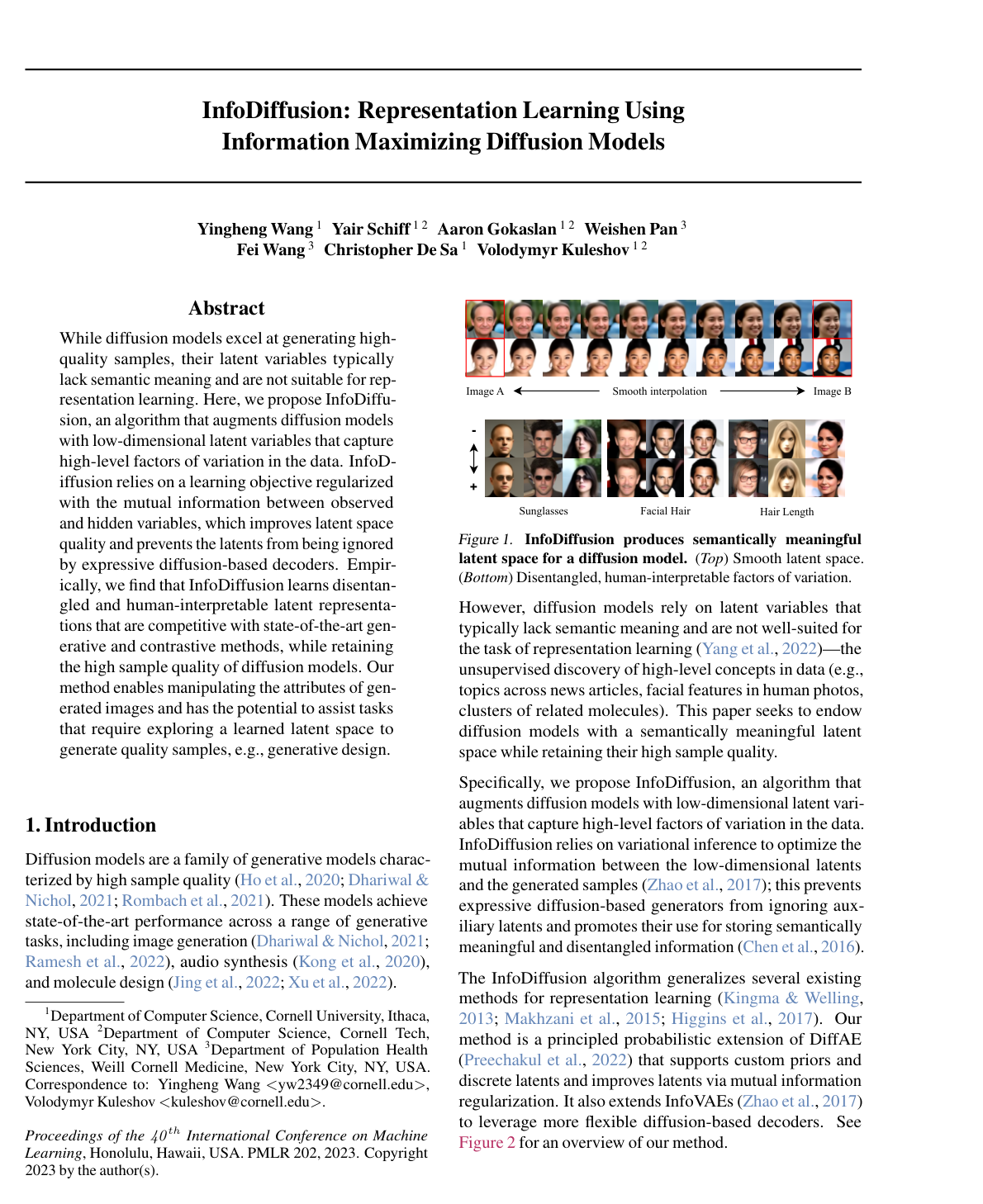
The findings show that InfoDiffusion achieves superior or highly competitive representation quality while fully preserving the generation fidelity of diffusion models. On downstream classification tasks, linear models trained on InfoDiffusion's compact representations matched or outperformed existing baselines across all datasets. In disentanglement benchmarks, InfoDiffusion achieved the highest scores on 3DShapes (0.342 DCI) and CelebA (0.299 Total Attribute Disentanglement), outperforming both traditional generative models and 32-dimensional contrastive baselines by wide margins. Furthermore, the model demonstrated strong qualitative control, allowing smooth interpolation between data points and precise manipulation of individual attributes (such as adding smiles or altering hairstyles) without corrupting image fidelity. Finally, the framework successfully accommodated discrete and categorical variables, expanding beyond standard continuous assumptions.
These results indicate that generative systems no longer require separate architectures for high-level data understanding and high-resolution generation. For practical applications such as generative product design, digital content creation, and medical diagnostics, InfoDiffusion reduces system complexity and deployment risks by providing direct, predictable human control over generated content while retaining state-of-the-art visual quality. Unlike earlier diffusion autoencoder variants, it also supports unconditional generation directly from prior distributions without requiring auxiliary latent diffusion models.
Organizations developing controllable generative tools or automated feature extraction pipelines should pilot auxiliary-variable diffusion frameworks in workflows requiring structured manipulation. Future work should evaluate this methodology beyond image generation, applying it to complex non-visual domains such as molecular conformation, material science, and audio synthesis, while investigating scalability to higher-resolution data regimes.
Confidence in these findings is high across standard computer vision benchmarks, backed by rigorous multi-fold evaluations and mathematical proofs of global optimality. However, decision-makers should note that the empirical evaluations were conducted on standardized datasets at moderate image resolutions. Additional validation on complex, out-of-distribution industrial datasets is recommended prior to broad operational deployment.
- Paper: InfoGAN: Interpretable Representation Learning by Information Maximizing Generative Adversarial Nets, Xi Chen et al. (2016). Introduces the foundational paradigm of maximizing mutual information between auxiliary latent codes and generated outputs to learn disentangled representations in deep generative models.
- Paper: Denoising Diffusion Probabilistic Models, Jonathan Ho et al. (2020). Establishes the core denoising diffusion probabilistic framework that InfoDiffusion augments with structured auxiliary latent variables.
- Paper: beta-VAE: Learning Basic Visual Concepts with a Constrained Variational Framework, Irina Higgins et al. (2016). Pioneers unsupervised factor disentanglement principles and evaluation protocols that provide standard comparative baselines for InfoDiffusion.
- Paper: Fixing a Broken ELBO, Alexander A. Alemi et al. (2018). Provides the theoretical information-theoretic bounds explaining why standard likelihood-based objectives fail to encode meaningful representations into latent codes.
- Paper: Disentangling by Factorising, Hyunjik Kim et al. (2018). Develops total correlation regularizers and disentanglement benchmarks directly targeted and compared against in InfoDiffusion's evaluation suite.
- Paper: Denoising Diffusion Implicit Models, Jiaming Song et al. (2021). Presents non-Markovian deterministic sampling and latent trajectory mechanics essential for understanding continuous interpolation in diffusion models.
- Paper: Representation Alignment for Generation: Training Diffusion Transformers Is Easier Than You Think, Sihyun Yu et al. (2025). Extends the integration of representation learning and diffusion architectures by aligning internal model representations directly with external visual encoders during training.
- Paper: Masked Autoencoders Are Effective Tokenizers for Diffusion Models, Hao Chen et al. (2025). Investigates how structured and discriminative latent spaces govern diffusion performance, providing an alternate avenue for combining representation richness with high-fidelity generation.
- Paper: Generalization in diffusion models arises from geometry-adaptive harmonic representations, Zahra Kadkhodaie et al. (2024). Provides a theoretical analysis of the internal geometric and harmonic representations that emerge inside diffusion network denoisers.
- Paper: An exact information theory of generalization phase transitions in Bayesian diffusion models, Henry Hunt et al. (2026). Formalizes an analytical, information-theoretic perspective on how diffusion models avoid memorization and generalize through restricted Bayesian representations.