DocRes: A Generalist Model Toward Unifying Document Image Restoration Tasks
Jiaxin ZhangDezhi PengChongyu LiuPeirong ZhangLianwen Jin
Introduces DocRes, a unified generalist model that uses dynamic task-specific visual prompts to perform five distinct document restoration tasks—including dewarping, deshadowing, and binarization—while matching or exceeding the performance of specialized single-task systems.
Document processing systems frequently struggle with low-quality captured images affected by geometric distortions, shadows, uneven lighting, blurriness, and poor contrast. Conventional solutions deploy separate, dedicated machine learning models for each individual defect. This fragmented setup introduces substantial operational complexity, inflates maintenance costs, and misses the synergistic performance benefits of multi-task learning. Developing a unified restoration system has historically been difficult because disparate restoration tasks often share identical input images but require completely different visual outputs.
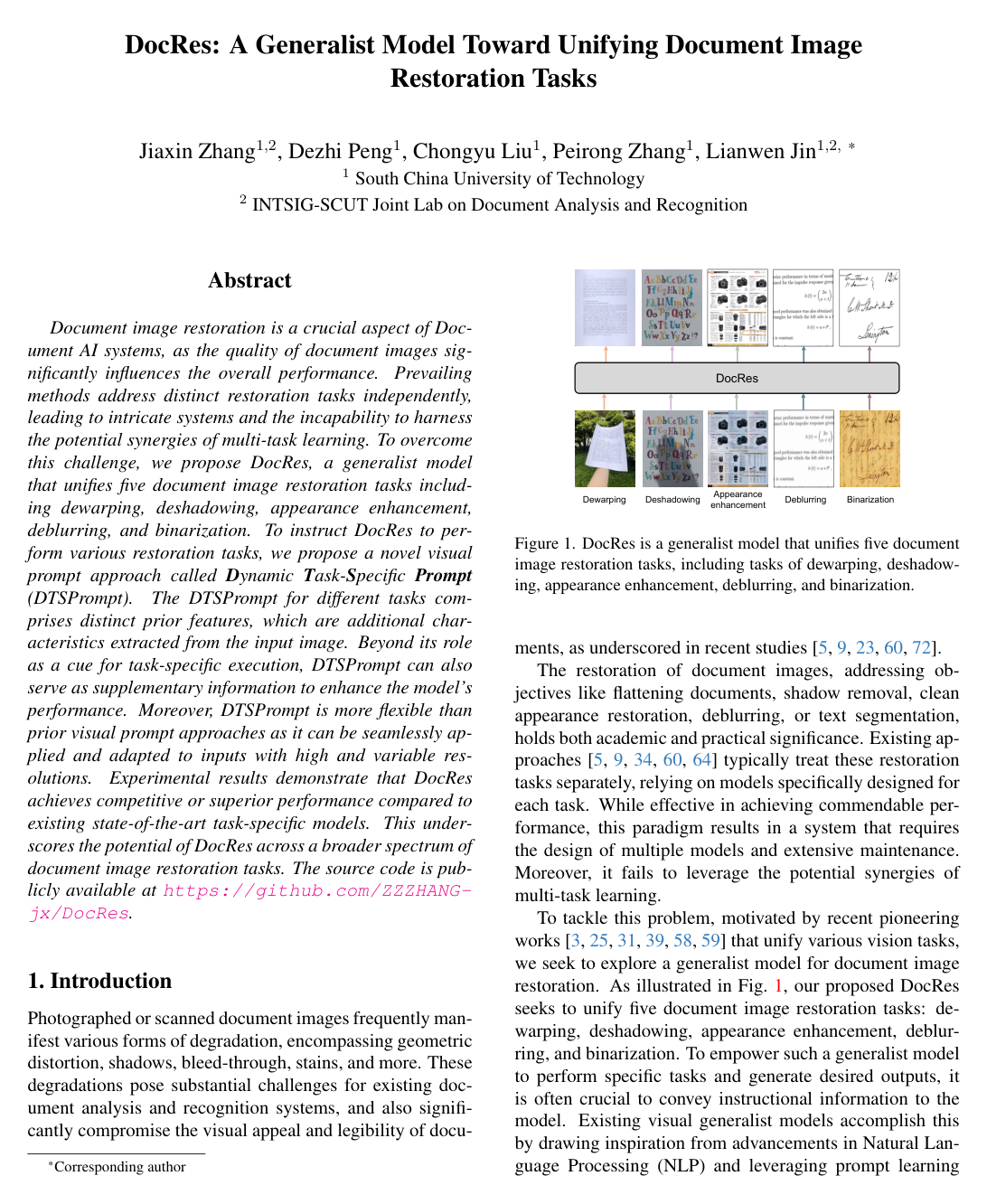
The article introduces and evaluates DocRes, a unified multi-task model capable of handling five distinct document restoration tasks: dewarping, deshadowing, appearance enhancement, deblurring, and binarization. The objective is to demonstrate that a single generalist model can replace multiple specialized systems and achieve competitive or superior performance without complex architectural changes.
The researchers developed a mechanism called Dynamic Task-Specific Prompts to instruct a single underlying neural network on which restoration task to execute. Unlike prior prompt techniques that rely on static tokens or computationally heavy visual pairs, this approach extracts visual cues directly from the input image, such as document masks, background approximations, Sauvola thresholds, and gradient maps. The researchers integrated these prompts into an off-the-shelf restoration network and trained the unified model on standard synthetic and real-world benchmark datasets across all five tasks, comparing its outputs directly against leading specialized systems.
The evaluation produced several key findings. First, the single DocRes model matched or outperformed specialized, state-of-the-art models across standard benchmarks, achieving top scores in deblurring and competitive metrics in dewarping, shadow removal, and contrast enhancement. Second, the model demonstrated strong multi-task synergy, particularly in binarization, where training alongside other tasks substantially improved accuracy on historical text benchmarks compared to baseline models. Third, DocRes exhibited superior real-world generalization; although trained on scanned historical documents, it successfully cleaned camera-captured modern smartphone documents containing unmodeled lighting and blur artifacts. Finally, the unified model proved highly efficient, requiring only 15.2 million parameters—roughly half to one-quarter the size of many single-task models.
These findings suggest that organizations can dramatically simplify automated document processing pipelines. Replacing a suite of independent models with a single multi-task system reduces infrastructure footprint, eases deployment overhead, and lowers overall maintenance costs. The shared visual representations also provide natural robustness against real-world noise without requiring distinct models for every anticipated distortion.
Stakeholders looking to streamline document processing pipelines should consider piloting unified restoration frameworks. Moving forward, engineering efforts should investigate trainable prompt generators with shared parameters to refine feature extraction, as well as single-pass architectures that can execute compound restorations in one step to prevent sequential error accumulation.
While the results demonstrate high confidence across standard benchmarks, certain trade-offs remain. For tasks like deblurring and shadow removal, the extracted prompt features currently act more as task indicators than performance boosters due to the use of basic heuristic filters. Additionally, applying the model iteratively to handle multiple compounding defects on a single image can lead to error accumulation across stages. Caution is advised when processing heavily degraded documents through multi-step pipelines until single-pass multi-defect models are developed.
- Paper: Pre-Trained Image Processing Transformer, Hanting Chen et al. (2020). Read IPT first to see an earlier shared-network approach to multiple image-restoration tasks, the generalist restoration problem DocRes specializes for documents.
No sufficiently relevant recommendations were found.