A Point Set Generation Network for 3D Object Reconstruction from a Single Image

Haoqiang FanHao SuLeonidas Guibas

article2017CVPR2,736 citations

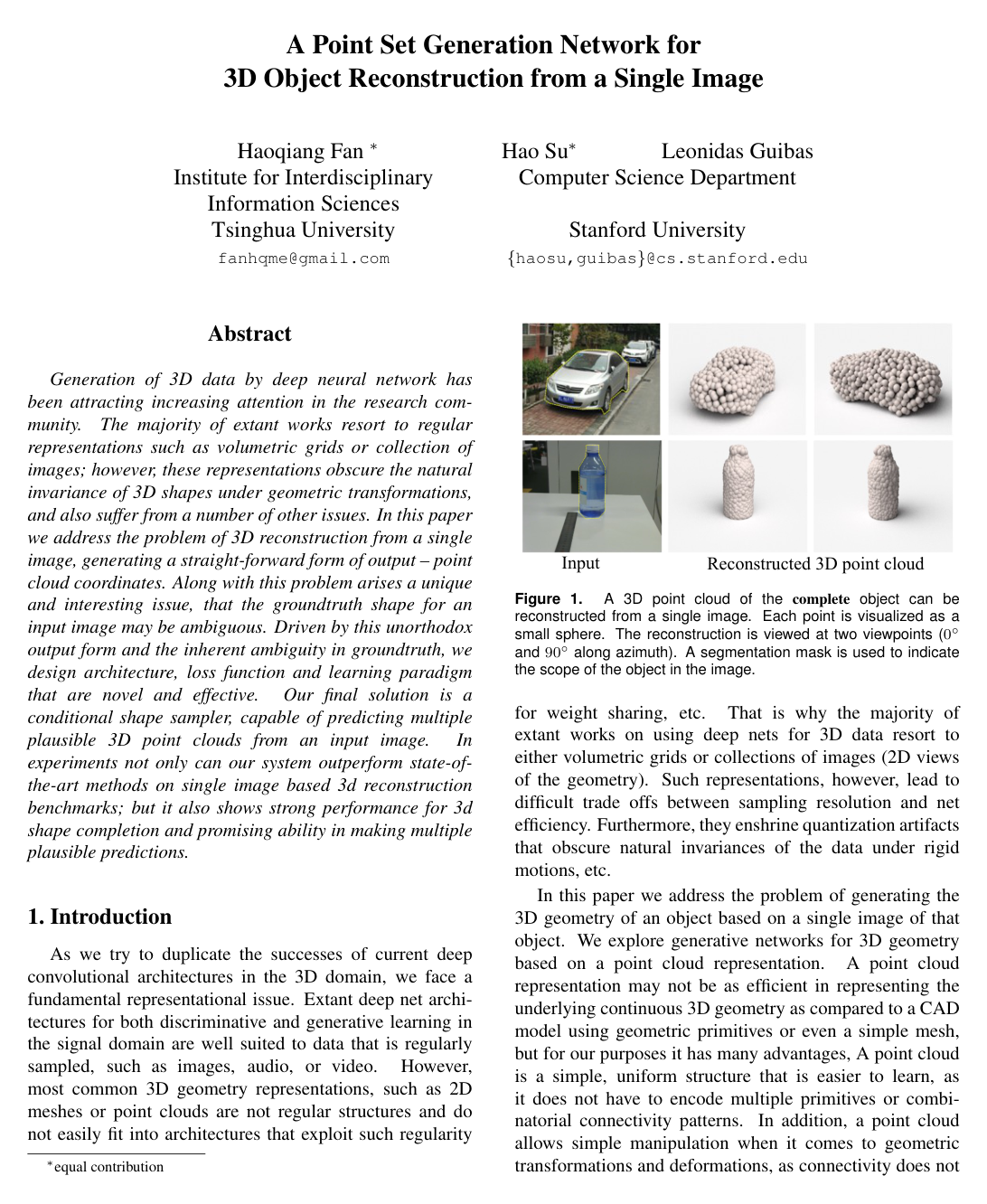
Introduces the Point Set Generation Network, a deep learning framework that reconstructs 3D object geometries directly as unordered point clouds from single 2D images while handling shape ambiguity by predicting multiple plausible outputs.

Listen

The article addresses the challenge of reconstructing complete 3D object shapes from single 2D images, a task that remains ill-posed due to missing depth information and inherent ambiguities in possible completions. Existing deep learning approaches rely on volumetric grids or image collections, which introduce quantization artifacts, limit resolution, and fail to respect natural geometric invariances under transformations.

The work set out to demonstrate that a neural network can directly generate unordered 3D point clouds as output, while also producing multiple plausible reconstructions to reflect ground-truth uncertainty.

The authors developed a conditional generative network with an encoder that processes the input image and a random vector, followed by predictor branches that combine fully connected layers for flexibility with deconvolution layers for smooth surfaces. They trained the model end-to-end using Chamfer distance or Earth Mover’s distance as loss functions on 220,000 synthetic models from ShapeNet, rendered into single-view images, and incorporated a min-of-N loss or conditional variational autoencoder to enable sampling of varied outputs.

The network consistently outperformed the prior state-of-the-art volumetric method 3D-R2N2 across CD, EMD, and intersection-over-union metrics on 13 object categories, often exceeding that baseline even when the baseline received five input views. It preserved thin structures such as chair legs and object details more reliably, successfully completed partial RGBD inputs by hallucinating missing geometry using learned shape priors, and generated multiple distinct yet plausible point clouds whose variation aligned with sources of ambiguity such as object thickness or unseen sides. Human modelers achieved comparable numerical scores on a validation subset, indicating the results approach manual reconstruction quality.

These outcomes indicate that point-cloud generation offers a more efficient and structurally faithful representation for single-image 3D recovery than volumetric alternatives, potentially lowering computational cost and improving downstream tasks that require surface geometry. The approach also provides a practical mechanism for capturing prediction uncertainty without explicit multi-view input.

Further development should focus on scaling to cluttered real-world scenes, integrating detection mechanisms for composite objects, and cascading local refinement steps to add high-frequency surface detail. Additional labeled real imagery and expanded category coverage would strengthen generalization before deployment in robotics or augmented-reality pipelines.

The primary limitations are reliance on synthetic training data with clean backgrounds, a fixed output of 1024 points, and occasional failures on unfamiliar shapes or heavily occluded objects; results on real photographs remain promising but unquantified at scale.

Cover for A Point Set Generation Network for 3D Object Reconstruction from a Single Image

Abstract

Generation of 3D data by deep neural network has been attracting increasing attention in the research community. The majority of extant works resort to regular representations such as volumetric grids or collection of images; however, these representations obscure the natural invariance of 3D shapes under geometric transformations and also suffer from a number of other issues. In this paper we address the problem of 3D reconstruction from a single image, generating a straight-forward form of output -- point cloud coordinates. Along with this problem arises a unique and interesting issue, that the groundtruth shape for an input image may be ambiguous. Driven by this unorthodox output form and the inherent ambiguity in groundtruth, we design architecture, loss function and learning paradigm that are novel and effective. Our final solution is a conditional shape sampler, capable of predicting multiple plausible 3D point clouds from an input image. In experiments not only can our system outperform state-of-the-art methods on single image based 3d reconstruction benchmarks; but it also shows a strong performance for 3d shape completion and promising ability in making multiple plausible predictions.

Table of Contents

  • 1 Introduction
  • 2 Related Work
  • 3 Problem and Notations
  • 4 Approach
  • 4.1 Overview
  • 4.2 Point Set Prediction Network
  • 4.3 Distance Metric between Point Sets
  • 4.4 Generation of Multiple Plausible Shapes
  • 5 Experiment
  • 5.1 Training Data Generation by Synthesis
  • 5.2 3D Shape Reconstruction from RGB Images
  • 5.3 3D Shape Completion from RGBD Images
  • 5.4 Predicting Multiple Plausible Shapes
  • 5.5 Network Design Analysis
  • 5.6 More results and application to real world data
  • 5.7 Analysis of human ability for single view 3D reconstruction
  • 5.8 Analysis of failure cases
  • 5.9 Implementation details
  • 6 Discussion
  • References

Knowls

  1. Knowl 1 — Dual-Branch Point Set Generation Network Architecture

    model/method

    The Point Set Generation Network generates an unordered set of N=1024N = 1024 3D point coordinates S={(xi,yi,zi)}i=1NRN×3S = \{(x_i, y_i, z_i)\}_{i=1}^N \in \mathbb{R}^{N \times 3} directly from a single 2D RGB or RGB-D image IR192×256×CI \in \mathbb{R}^{192 \times 256 \times C} (optionally perturbed by a random vector rN(0,I)r \sim \mathcal{N}(0, \mathbf{I})).

    The network comprises an encoder and a dual-branch predictor:

    1. Encoder: A series of convolutional and ReLU layers with strided convolutions (16 feature channels at the highest resolution, doubling at each downsampling step) that projects the input image II (and latent vector rr) into a latent embedding.
    2. Fully Connected (FC) Predictor Branch: A multi-layer fully connected network that predicts the 3D coordinates of N1=256N_1 = 256 points. Because each point is parameterized independently, this branch provides high flexibility to capture thin, detached, or intricate geometry (such as chair legs, plane tails, and firearm barrels).
    3. Deconvolution (Deconv) Predictor Branch: A deconvolutional network that outputs a 3-channel feature map of dimensions H×W=32×24H \times W = 32 \times 24, yielding H×W=768H \times W = 768 3D points (x,y,z)(x, y, z). By exploiting 2D spatial continuity and convolution weight sharing, this branch generates smooth continuous surfaces that wrap around the object's primary body.
    4. Hourglass Extension: An extended architecture nests the encoder-decoder structure inside recurrent stacked hourglass modules with skip connections linking intermediate encoder feature maps to predictor layers, facilitating the fusion of global semantics with local structural details.

    The final point cloud is the union of the N1N_1 points from the fully connected branch and the H×WH \times W points from the deconvolution branch (256+768=1024256 + 768 = 1024 points).

  2. Knowl 2 — Chamfer Distance for Point Set Prediction Loss

    equation

    The Chamfer Distance (CD) between two point sets S1,S2R3S_1, S_2 \subset \mathbb{R}^3 is defined as:

    dCD(S1,S2)=xS1minyS2xy22+yS2minxS1xy22d_{CD}(S_1, S_2) = \sum_{x \in S_1} \min_{y \in S_2} \|x - y\|_2^2 + \sum_{y \in S_2} \min_{x \in S_1} \|x - y\|_2^2

    where 2\|\cdot\|_2 denotes the Euclidean norm in R3\mathbb{R}^3.

    Properties:

    • dCDd_{CD} is non-negative and symmetric with respect to S1S_1 and S2S_2, though it does not satisfy the triangle inequality.
    • As a function of point coordinates in S1S_1 and S2S_2, dCDd_{CD} is continuous and piecewise smooth, making it differentiable almost everywhere and suitable for backpropagation in neural networks.
    • Nearest neighbor searches for each point xS1x \in S_1 (or yS2y \in S_2) are mutually independent, enabling trivial GPU parallelization and efficient calculation via spatial data structures (e.g., KD-trees).
  3. Knowl 3 — Earth Mover's Distance for Point Set Prediction Loss

    equation

    The Earth Mover's Distance (EMD) between two point sets S1,S2R3S_1, S_2 \subset \mathbb{R}^3 of equal cardinality S1=S2=N|S_1| = |S_2| = N is defined as the solution to the linear assignment problem:

    dEMD(S1,S2)=minϕ:S1S2xS1xϕ(x)2d_{EMD}(S_1, S_2) = \min_{\phi: S_1 \to S_2} \sum_{x \in S_1} \|x - \phi(x)\|_2

    where ϕ:S1S2\phi : S_1 \to S_2 is a bijective mapping (permutation).

    Properties:

    • For almost all point set configurations (outside a zero-measure set), the optimal assignment bijection ϕ\phi is unique and invariant to infinitesimal perturbations of point coordinates, rendering dEMDd_{EMD} differentiable almost everywhere.
    • Because exact assignment is computationally prohibitive for batch training on GPUs, an asynchronous (1+ϵ)(1 + \epsilon)-approximation relaxation scheme with bounded runtime per instance is utilized, yielding gradient updates with assignment error typically around 1%1\%.
  4. Knowl 4 — Min-of-N Loss for Modeling Ground Truth Ambiguity

    model/method

    To handle single-view 3D reconstruction ambiguity (where occluded/invisible regions admit multiple plausible geometric completions), the point set generator G(I,r;Θ)G(I, r; \Theta) is parameterized by network weights Θ\Theta, conditioning image II, and a latent perturbation vector rN(0,I)r \sim \mathcal{N}(0, \mathbf{I}).

    Direct minimization of standard point set distances with a single random vector forces the network to ignore the latent code and predict an averaged mean shape. To preserve multi-modal diversity, training minimizes the Min-of-N (MoN) loss:

    minΘkmin1jn{d(G(Ik,rj;Θ),Skgt)}\min_{\Theta} \sum_k \min_{1 \le j \le n} \left\{ d\left(G(I_k, r_j; \Theta), S_k^{gt}\right) \right\}

    where for each training instance kk, IkI_k is the input image, SkgtS_k^{gt} is the ground truth 3D point cloud, r1,r2,,rnN(0,I)r_1, r_2, \dots, r_n \sim \mathcal{N}(0, \mathbf{I}) are nn independent identically distributed latent noise samples, and d(,)d(\cdot, \cdot) is a permutation-invariant point set distance (dCDd_{CD} or dEMDd_{EMD}).

    By computing the loss strictly on the single prediction among the nn generated candidates that is closest to the ground truth, gradient updates encourage each latent branch to specialize in distinct plausible shape modes. In practice, setting n=2n = 2 (Mo2) suffices to capture shape variance across ambiguous views.

  5. Knowl 5 — Conditional Variational Autoencoder Formulation for Point Set Sampling

    model/method

    An alternative framework for learning a conditional shape distribution P(SX)P(S|X) from an input 2D image XX is a Conditional Variational Autoencoder (CVAE):

    1. Training Phase: Ground truth 3D shape SS is converted to a volumetric voxel representation YY. A 3D convolutional encoder Q(zY,X)Q(z|Y, X) infers the parameters of a conditional Gaussian latent distribution q(zY,X)=N(μ(Y,X),Σ(Y,X))q(z|Y, X) = \mathcal{N}(\mu(Y, X), \Sigma(Y, X)). A latent code zz is sampled via the reparameterization trick, and a point set decoder network f(z,X)f(z, X) predicts point coordinates SpredS^{pred}. The network is trained with the joint objective:

    LCVAE=d(f(z,X),S)+DKL(Q(zY,X)N(0,I))\mathcal{L}_{CVAE} = d(f(z, X), S) + D_{KL}\left(Q(z|Y, X) \parallel \mathcal{N}(0, \mathbf{I})\right)

    where d(,)d(\cdot, \cdot) is Chamfer Distance or Earth Mover's Distance, and DKLD_{KL} is the Kullback-Leibler divergence to an isotropic Gaussian prior.

    1. Inference Phase: The 3D volumetric encoder QQ is discarded. Multiple distinct 3D point clouds are sampled for a single test image XX by drawing zN(0,I)z \sim \mathcal{N}(0, \mathbf{I}) and decoding Spred=f(z,X)S^{pred} = f(z, X).
  6. Knowl 6 — Comparative Mean-Shape Characteristics of Chamfer and Earth Mover's Distances

    theoretical result

    When a network is trained under ground truth ambiguity to minimize expected loss ESP[L(Spred,S)]\mathbb{E}_{S \sim \mathcal{P}}[L(S^{pred}, S)], the predicted "mean shape" reflects the structural properties of the chosen distance metric:

    • Continuous Geometric Variations (e.g., smoothly varying object radius or translation): Chamfer Distance (CD) matches points independently, which produces blurry, diffuse, and "splashy" point distributions around regions of high variance. Earth Mover's Distance (EMD) enforces a global 1-to-1 bijection constraint across the entire point budget, causing the predicted point set to concentrate sharply at the geometric expectation of the continuous parameter.
    • Categorical / Discrete Variations (e.g., discrete multi-modal attachments or part presence/absence): CD places a fraction of the point budget at each possible discrete structural location without geometric distortion of individual parts. In contrast, EMD cannot split points across separate spatial modes without incurring large transportation costs, leading to compact but severely distorted hybrid geometries that compromise between the categorical options.
  7. Knowl 7 — Point Cloud to Voxel Post-Processing Conversion

    algorithm

    To evaluate point set predictions against volumetric 3D reconstruction baselines using volumetric Intersection-over-Union (IoU), predicted point sets S={(xi,yi,zi)}i=1NS = \{(x_i, y_i, z_i)\}_{i=1}^N are rasterized into a 32×32×3232 \times 32 \times 32 binary occupancy grid through the following pipeline:

    Input: Predicted point set SRN×3S \in \mathbb{R}^{N \times 3}, input image II
    Output: Binary voxel occupancy grid Vout{0,1}32×32×32V_{out} \in \{0, 1\}^{32 \times 32 \times 32}
    1. Initialize voxel grid VoccR32×32×32V_{occ} \in \mathbb{R}^{32 \times 32 \times 32} to zero.
    2. Splat each point pSp \in S as a unit cube [1×1×1][1 \times 1 \times 1] into VoccV_{occ} using trilinear/bilinear interpolation, accumulating the fractional volume overlap to form a continuous occupancy representation.
    3. Predict scalar object volume vpredRv_{pred} \in \mathbb{R} from image II using a volume estimation network to normalize for point density differences across object scales.
    4. Replicate vpredv_{pred} to form a spatial volume prior tensor VvolR32×32×32V_{vol} \in \mathbb{R}^{32 \times 32 \times 32}.
    5. Concatenate VoccV_{occ} and VvolV_{vol} along the channel dimension to form a 2-channel tensor VinR32×32×32×2V_{in} \in \mathbb{R}^{32 \times 32 \times 32 \times 2}.
    6. Pass VinV_{in} through a 3D CNN consisting of 6 convolutional layers with 3×3×33 \times 3 \times 3 kernels (trained with voxel IoU loss).
    7. Threshold the output probabilities at 0.50.5 to yield VoutV_{out}.
    return VoutV_{out}
  8. Knowl 8 — Single-View 3D Reconstruction Performance on ShapeNet Benchmark

    data/table

    Comparison of single-view 3D reconstruction performance measured by volumetric Intersection-over-Union (IoU on a 32332^3 voxel grid) against the 3D-R2N2 baseline across 13 ShapeNet object categories. Point set predictions from the Point Set Generation Network are post-processed into 32332^3 voxel grids. Higher IoU indicates higher reconstruction fidelity.

    Category Ours (1 view) 3D-R2N2 (1 view) 3D-R2N2 (3 views) 3D-R2N2 (5 views)
    plane 0.601 0.513 0.549 0.561
    bench 0.550 0.421 0.502 0.527
    cabinet 0.771 0.716 0.763 0.772
    car 0.831 0.798 0.829 0.836
    chair 0.544 0.466 0.533 0.550
    monitor 0.552 0.468 0.545 0.565
    lamp 0.462 0.381 0.415 0.421
    speaker 0.737 0.662 0.708 0.717
    firearm 0.604 0.544 0.593 0.600
    couch 0.708 0.628 0.690 0.706
    table 0.606 0.513 0.564 0.580
    cellphone 0.749 0.661 0.732 0.754
    watercraft 0.611 0.513 0.596 0.610
    Mean 0.640 0.560 0.617 0.631

    In single-view 3D reconstruction, the Point Set Generation Network outperforms 1-view 3D-R2N2 across all 13 categories (mean IoU 0.640 vs. 0.560). Furthermore, the single-view point set network outperforms 5-view 3D-R2N2 on 8 out of 13 categories as well as in category-wise mean IoU (0.640 vs. 0.631). In direct point distance evaluations (where 1 unit is defined as 1/101/10 of the ground truth grid length), the point set network achieves a Chamfer Distance of 0.25 (vs. 0.71 for 3D-R2N2) and an Earth Mover's Distance of 0.80 (vs. 1.02 for 3D-R2N2).

  9. Knowl 9 — Ablation Analysis of Predictor Network Architectures

    empirical result

    Evaluating predictor architectures on synthetic ShapeNet renderings demonstrates the distinct contributions of the deconvolution branch, fully connected branch, and hourglass topology (measured in CD and EMD error, where lower values are better):

    • Vanilla CNN (Pure Fully Connected Predictor): Achieves CD=0.50\text{CD} = 0.50 and EMD=0.88\text{EMD} = 0.88.
    • Two Branches (Combined Fully Connected and Deconvolution): Achieves CD=0.43\text{CD} = 0.43 and EMD=0.83\text{EMD} = 0.83.
    • Hourglass Version (Stacked Multi-Scale Predictor): Achieves CD=0.41\text{CD} = 0.41 and EMD=0.79\text{EMD} = 0.79.

    Visualization of isolated predictor outputs reveals that the deconvolution branch forms a continuous 2D manifold wrapping the object's bulk volume, whereas the fully connected branch predicts unorganized, high-frequency structural elements (such as thin appendages, gun barrels, and chair legs).

  10. Knowl 10 — Failure Modes in Single-View Point Set Reconstruction

    limitation

    The point set generation framework exhibits two primary failure modes:

    1. Out-of-Distribution and Novel Geometries: When presented with an object category unseen during training, the network cannot reconstruct the novel topology and instead produces a distorted compromise from familiar training priors (for example, attempting to reconstruct an unfamiliar aircraft-like shape as an airplane without wings).
    2. Multi-Object Compositions: In the absence of an explicit bounding box detection, instance segmentation, or visual attention mechanism, scenes containing multiple compositional objects result in entangled and geometrically corrupted reconstructions.

Coverage note — Minor implementation details (e.g., Blinn-Phong shading rendering parameters with local lighting models on 220k CAD models and the 16-model manual human baseline GUI modeling setup) were omitted as they serve purely as supporting experimental mechanics.

References

  1. 1.J. Aloimonos. Shape from texture. Biological cybernetics, 58(5):345–360, 1988.
  2. 2.D. P. Bertsekas. A distributed asynchronous relaxation algorithm for the assignment problem. In Decision and Control, 1985 24th IEEE Conference on, pages 1703–1704. IEEE, 1985.
  3. 3.J. Carreira, S. Vicente, L. Agapito, and J. Batista. Lifting object detection datasets into 3d. IEEE Transactions on Pattern Analysis and Machine Intelligence, 38(7):1342–1355, 2016.
  4. 4.A. X. Chang, T. Funkhouser, L. Guibas, P. Hanrahan, Q. Huang, Z. Li, S. Savarese, M. Savva, S. Song, H. Su, J. Xiao, L. Yi, and F. Yu. ShapeNet: An Information-Rich 3D Model Repository. Technical Report arXiv:1512.03012 [cs.GR], 2015.
  5. 5.C. B. Choy, D. Xu, J. Gwak, K. Chen, and S. Savarese. 3d-r2n2: A unified approach for single and multiview 3d object reconstruction. arXiv preprint arXiv:1604.00449, 2016.
  6. 6.C. Doersch. Tutorial on variational autoencoders. arXiv preprint arXiv:1606.05908, 2016.
  7. 7.D. Eigen, C. Puhrsch, and R. Fergus. Depth map prediction from a single image using a multi-scale deep network. In Advances in neural information processing systems, pages 2366–2374, 2014.
  8. 8.Y. Eldar, M. Lindenbaum, M. Porat, and Y. Y. Zeevi. The farthest point strategy for progressive image sampling. IEEE Transactions on Image Processing, 6(9):1305–1315, 1997.
  9. 9.D. F. Fouhey, A. Gupta, and M. Hebert. Data-driven 3D primitives for single image understanding. In ICCV, 2013.
  10. 10.J. Fuentes-Pacheco, J. Ruiz-Ascencio, and J. M. Rendón-Mancha. Visual simultaneous localization and mapping: a survey. Artificial Intelligence Review, 43(1):55–81, 2015.
  11. 11.K. Häming and G. Peters. The structure-from-motion reconstruction pipeline–a survey with focus on short image sequences. Kybernetika, 46(5):926–937, 2010.
  12. 12.D. Hoiem, A. A. Efros, and M. Hebert. Automatic photo pop-up. ACM transactions on graphics (TOG), 24(3):577–584, 2005.
  13. 13.B. K. Horn. Obtaining shape from shading information. In Shape from shading, pages 123–171. MIT press, 1989.
  14. 14.Q. Huang, H. Wang, and V. Koltun. Single-view reconstruction via joint analysis of image and shape collections. ACM Transactions on Graphics (TOG), 34(4):87, 2015.
  15. 15.A. Kar, S. Tulsiani, J. Carreira, and J. Malik. Category-specific object reconstruction from a single image. In CVPR, 2015.
  16. 16.D. Maturana and S. Scherer. Voxnet: A 3d convolutional neural network for real-time object recognition. In IEEE/RSJ International Conference on Intelligent Robots and Systems, September 2015.
  17. 17.M. Mirza and S. Osindero. Conditional generative adversarial nets. arXiv preprint arXiv:1411.1784, 2014.
  18. 18.A. Newell, K. Yang, and J. Deng. Stacked hourglass networks for human pose estimation. arXiv preprint arXiv:1603.06937, 2016.
  19. 19.D. J. Rezende, S. Eslami, S. Mohamed, P. Battaglia, M. Jaderberg, and N. Heess. Unsupervised learning of 3d structure from images. arXiv preprint arXiv:1607.00662, 2016.
  20. 20.Y. Rubner, C. Tomasi, and L. J. Guibas. The earth mover’s distance as a metric for image retrieval. International journal of computer vision, 40(2):99–121, 2000.
  21. 21.A. Saxena, M. Sun, and A. Y. Ng. Make3d: Learning 3d scene structure from a single still image. IEEE transactions on pattern analysis and machine intelligence, 31(5):824–840, 2009.
  22. 22.H. Su, Q. Huang, N. J. Mitra, Y. Li, and L. Guibas. Estimating image depth using shape collections. ACM Transactions on Graphics (TOG), 33(4):37, 2014.

Citation

MLA
Fan, H., et al. “A Point Set Generation Network for 3D Object Reconstruction from a Single Image”. 2017 IEEE Conference on Computer Vision and Pattern Recognition (CVPR), 2017, pp. 2463–71, https://doi.org/10.1109/CVPR.2017.264.
APA
Fan, H., Su, H., & Guibas, L. (2017). A Point Set Generation Network for 3D Object Reconstruction from a Single Image. 2017 IEEE Conference on Computer Vision and Pattern Recognition (CVPR), 2463–2471. https://doi.org/10.1109/CVPR.2017.264
Chicago
Fan, H., H. Su, and L. Guibas. 2017. “A Point Set Generation Network for 3D Object Reconstruction from a Single Image”. 2017 IEEE Conference on Computer Vision and Pattern Recognition (CVPR), 2463–71. https://doi.org/10.1109/CVPR.2017.264.
Harvard
Fan, H., Su, H. and Guibas, L. (2017) “A Point Set Generation Network for 3D Object Reconstruction from a Single Image”, 2017 IEEE Conference on Computer Vision and Pattern Recognition (CVPR). IEEE, pp. 2463–2471. Available at: https://doi.org/10.1109/CVPR.2017.264.
Vancouver
1. Fan H, Su H, Guibas L (2017) A Point Set Generation Network for 3D Object Reconstruction from a Single Image. In: 2017 IEEE Conference on Computer Vision and Pattern Recognition (CVPR). IEEE, pp 2463–2471

BibTeX

@inproceedings{Fan_2017, title={A Point Set Generation Network for 3D Object Reconstruction from a Single Image}, url={http://dx.doi.org/10.1109/CVPR.2017.264}, DOI={10.1109/cvpr.2017.264}, booktitle={2017 IEEE Conference on Computer Vision and Pattern Recognition (CVPR)}, publisher={IEEE}, author={Fan, Haoqiang and Su, Hao and Guibas, Leonidas}, year={2017}, month=July, pages={2463–2471} }
Metadata:Crossref

Source Code

This paper has an official code repository available. Click below to access the source code.

View Repository

Access the Paper

This paper is available from its original source. Click below to access the PDF.

Open PDF

License: IEEE