Deep Metric Learning via Lifted Structured Feature Embedding
Hyun Oh SongYu XiangStefanie JegelkaSilvio Savarese
Proposes a lifted structured prediction loss that optimizes the entire matrix of pairwise distances within training batches for deep metric learning, substantially outperforming traditional triplet methods across visual retrieval benchmarks including the newly introduced Online Products dataset.
Visual search, product recommendation, and large-scale image categorization require systems to quickly determine whether two images show the same object or category. Traditional classification models struggle when faced with tens of thousands of categories and very few sample images per category. To address this challenge, deep metric learning maps images into a continuous feature space where similar items cluster together and dissimilar items remain separated. Existing training strategies, however, process isolated pairs or triplets within each training batch, leaving valuable structural relationships between the remaining samples unused and slowing down model convergence.
The article develops and evaluates a training methodology that utilizes all pairwise relationships across an entire mini-batch rather than analyzing isolated pairs or triplets. The objective is to demonstrate that lifting batch distance vectors into a dense pairwise matrix and optimizing a structured loss function significantly improves visual retrieval and clustering accuracy on previously unseen categories.
The authors implemented their structured learning algorithm within a standard deep convolutional neural network architecture. They evaluated performance across three distinct image collections: a fine-grained bird dataset, a fine-grained car dataset, and a newly assembled collection of 120,000 online e-commerce product images across roughly 23,000 distinct classes. In every benchmark, the training and testing sets contained entirely non-overlapping categories to verify general similarity learning. The evaluation measured clustering quality via standard statistical metrics and retrieval quality via top-match recall rates across various embedding dimensions.
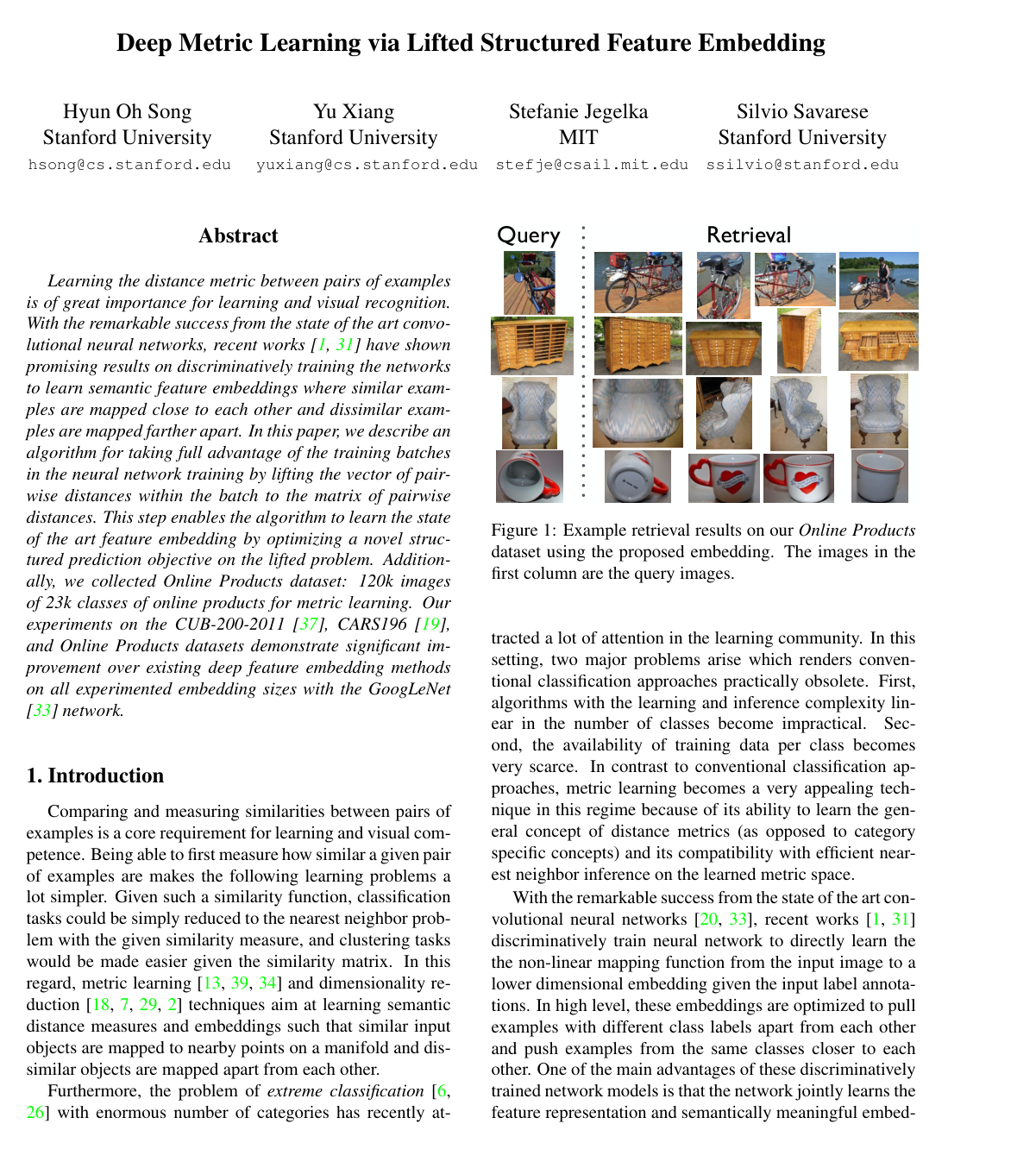
The experimental findings show that the proposed approach consistently outperforms standard pair-based and triplet-based embedding baselines across all datasets and dimensionalities. On fine-grained car and bird benchmarks, the algorithm achieved substantially higher clustering scores and retrieval rates compared to standard methods. On the e-commerce product dataset, the model maintained high retrieval precision, with most misclassifications limited to subtle differences between very similar products. Furthermore, the approach simplifies network training by using a single network stream rather than multi-branch architectures.
These results indicate that organizations managing large visual catalogs can achieve superior search and discovery performance without retraining models as new inventory categories appear. By fully utilizing in-batch relationships, development teams can train higher-performing visual search engines with greater stability and fewer architectural complexities. Consequently, systems can handle extreme classification challenges and zero-shot retrieval tasks with higher confidence and reduced operational overhead.
Organizations developing visual search, digital asset management, or e-commerce discovery platforms should consider adopting dense batch-level structured loss formulations for their embedding pipelines. Initial deployments should benchmark the approach against existing retrieval pipelines to measure search relevance gains. Future investigations should examine how these embeddings scale under additional domain shifts and explore extending the dataset for broader fine-grained visual recognition tasks.
The empirical findings are well-supported across multiple benchmarks and standard embedding dimensions. Nevertheless, practitioners should account for potential limitations, including computational memory demands when scaling to exceptionally large batch sizes and visual degradation caused by highly ambiguous or near-identical fine-grained items.
- Paper: Deep Metric Learning Using Triplet Network, Elad Hoffer et al. (2014). It introduces deep metric learning with triplet networks, establishing the relative comparison paradigm that the source generalizes to batch-wide lifted structured embeddings.
- Paper: Dimensionality Reduction by Learning an Invariant Mapping, Raia Hadsell et al. (2006). It provides the foundational contrastive loss and Siamese network framework for learning distance mappings using pairwise relationships.
- Paper: Distance Metric Learning for Large Margin Nearest Neighbor Classification, Kilian Q. Weinberger et al. (2005). It formulates margin-based distance metric learning for nearest-neighbor classification, which directly informs the margin and neighborhood structure utilized in deep embedding losses.
- Paper: Learning a similarity metric discriminatively, with application to face verification, Sumit Chopra et al. (2005). It pioneers discriminative similarity metric learning with convolutional Siamese networks under contrastive objectives.
- Paper: Distance Metric Learning with Application to Clustering with Side-Information, Eric P. Xing et al. (2002). It establishes the classic convex optimization framework for learning distance metrics from pairwise side-information constraints.
- Paper: Improved Deep Metric Learning with Multi-class N-pair Loss Objective, Kihyuk Sohn (2016). It extends batch-aware deep metric learning by proposing an N-pair multi-class objective evaluated directly on the Stanford Online Products and fine-grained benchmarks introduced in the source.
- Paper: In Defense of the Triplet Loss for Person Re-Identification, Alexander Hermans et al. (2017). It develops in-batch hard negative mining techniques (batch-hard loss) that build upon structured batch-level distance matrices for deep metric embeddings.
- Paper: A Discriminative Feature Learning Approach for Deep Face Recognition, Yandong Wen et al. (2016). It proposes center loss to enhance feature compactness and discriminability for deep metric verification tasks, complementing pairwise and structured embedding methods.
- Paper: SphereFace: Deep Hypersphere Embedding for Face Recognition, Weiyang Liu et al. (2017). It advances deep metric representation learning by introducing angular margin constraints on hyperspherical embeddings.
- Paper: Unsupervised Feature Learning via Non-parametric Instance Discrimination, Zhirong Wu et al. (2018). It generalizes metric embedding principles to unsupervised representation learning using non-parametric instance discrimination and memory banks.