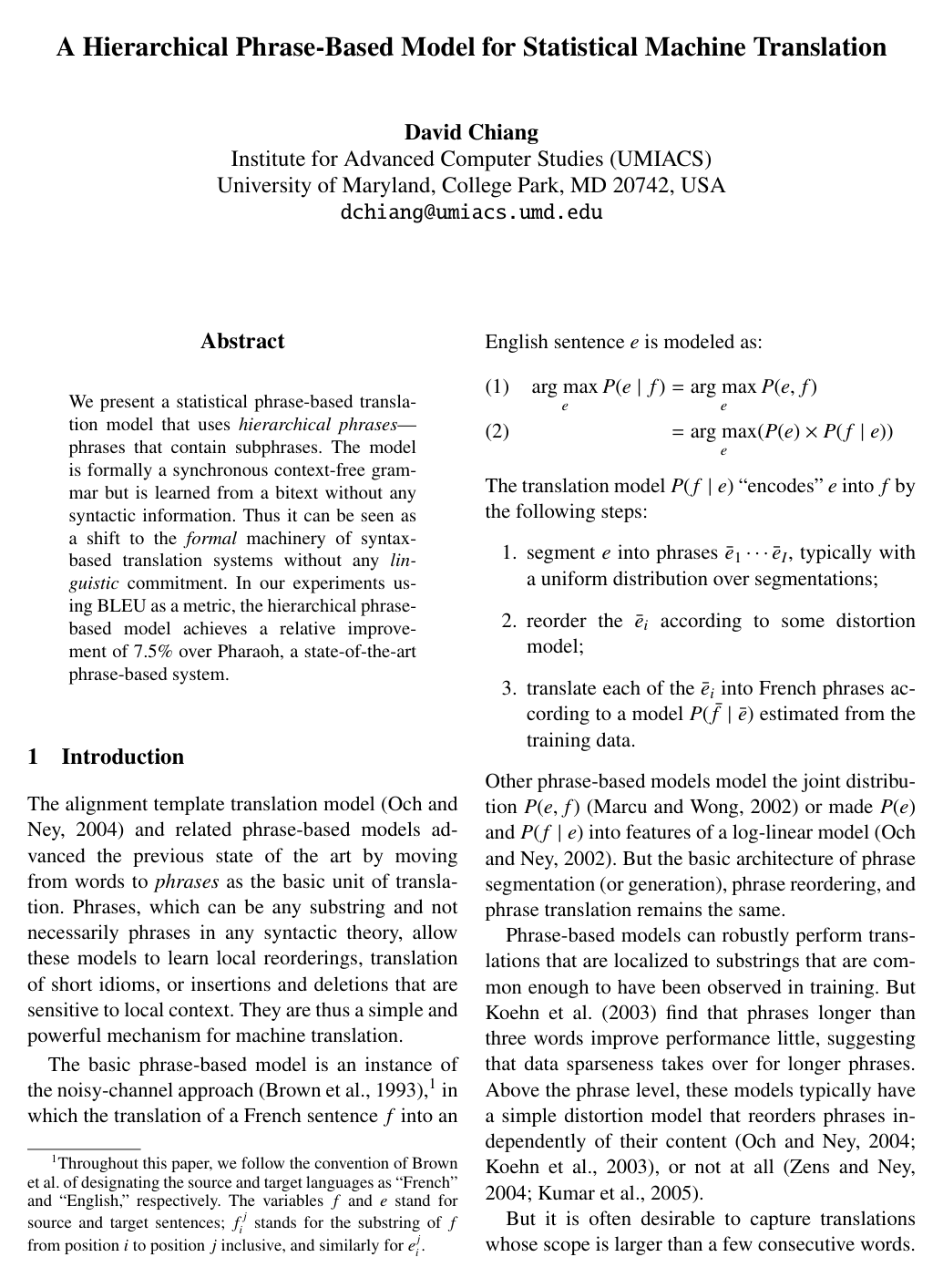
A Hierarchical Phrase-Based Model for Statistical Machine Translation

David Chiang

article2005ACL1,316 citationsBest Paper

Introduces a synchronous context-free grammar translation model that learns hierarchical phrase structures directly from parallel text without syntactic annotations, improving translation quality and long-distance reordering over standard phrase-based systems.

Listen

Standard phrase-based statistical machine translation systems excel at translating short, continuous word sequences, but they struggle with structural reordering across long distances, such as differing modifier placements between languages. Expanding conventional phrases to capture wider contexts typically fails due to data sparseness, while standard distortion models reorder words independently of their semantic content. The article evaluates a hierarchical phrase-based translation model designed to capture long-distance structural relationships and phrase reordering without relying on syntactically annotated linguistic data.

To address this limitation, the approach learns hierarchical translation rules—phrases containing gaps or subphrases—represented as a weighted synchronous context-free grammar. The grammar is induced automatically from word-aligned parallel text without linguistic parsers or syntactic treebanks, using heuristic rule extraction and beam-search chart parsing for decoding. The model was evaluated on a Chinese-to-English translation task using the Foreign Broadcast Information Service training corpus (over 16 million words combined) and standard benchmark test sets, comparing translation quality against Pharaoh, a state-of-the-art phrase-based baseline.

The analysis produced three primary findings. First, the hierarchical phrase-based model achieved a translation score of 0.2877 compared to 0.2676 for the baseline, representing a statistically significant relative improvement of 7.5% using the same training data. Second, precision improvements over the baseline grew progressively larger on longer word sequences (higher-order n-grams), confirming superior long-range structural coherence. Third, adding an explicit linguistic syntax feature from a syntactic parser yielded no statistically significant performance increase on the evaluation test set, showing that the unconstrained hierarchical phrases were already capturing the necessary structural alignments.

These findings demonstrate that translation systems can gain the structural strengths of syntax-based translation while retaining the flexibility and robustness of statistical phrase-based methods, all without requiring expensive annotated linguistic treebanks. However, large grammar sizes pose computational memory demands and risk search ambiguity, and the evaluated implementation exhibited search pruning trade-offs. Organizations deploying or researching machine translation should adopt hierarchical phrase architectures for languages with major word-order differences, while prioritizing grammar pruning and optimized decoding implementations to reduce memory overhead and support larger training volumes.

Chiang (2005).pdf
Cover for A Hierarchical Phrase-Based Model for Statistical Machine Translation

Abstract

We present a statistical phrase-based translation model that uses hierarchical phrases—phrases that contain subphrases. The model is formally a synchronous context-free grammar but is learned from a bitext without any syntactic information. Thus it can be seen as a shift to the formal machinery of syntax-based translation systems without any linguistic commitment. In our experiments using BLEU as a metric, the hierarchical phrase-based model achieves a relative improvement of 7.5% over Pharaoh, a state-of-the-art phrase-based system.

Table of Contents

  • 1 Introduction
  • 2 The model
  • 3 Training
  • 4 Decoding
  • 5 Experiments
  • 5.1 Baseline
  • 5.2 Hierarchical model
  • 5.3 Adding a constituent feature
  • 6 Conclusion
  • Acknowledgements
  • References

Knowls

  1. Knowl 1 — Synchronous CFG Formalism for Hierarchical Phrase-Based Translation

    model/method

    Hierarchical phrase-based translation formalizes translation rules using a weighted synchronous context-free grammar (SCFG). In this grammar, rewrite rules map between source-language strings and target-language strings with aligned nonterminal symbols:

    X→⟨γ,α,∼⟩X \to \langle \gamma, \alpha, \sim \rangle

    where XX is a nonterminal symbol, γ\gamma is a string of source terminals and nonterminals, α\alpha is a string of target terminals and nonterminals, and ∼\sim is a one-to-one correspondence between the nonterminal occurrences in γ\gamma and those in α\alpha.

    Unlike linguistically syntax-based MT, the grammar uses a single generic nonterminal symbol XX for all phrase categories learned from parallel text without syntactic annotations. To combine translated phrases serially into a complete sentence, the grammar incorporates two special glue rules:

    S→⟨S1X2,S1X2⟩S \to \langle S_{1} X_{2}, S_{1} X_{2} \rangle

    S→⟨X1,X1⟩S \to \langle X_{1}, X_{1} \rangle

    where SS is the start symbol, and subscripts denote co-indexed nonterminals linked by ∼\sim. These glue rules allow the system to concatenate partial hierarchical translations sequentially, backing off to standard phrase-based combinations when hierarchical rules are not applied.

  2. Knowl 2 — Hierarchical Phrase Extraction and Rule Filtering

    algorithm

    Given a sentence pair with word alignments ⟨f,e,∼⟩\langle f, e, \sim \rangle (where ∼\sim is a binary relation between source positions in ff and target positions in ee), the hierarchical phrase extraction algorithm identifies initial contiguous phrase pairs and recursively extracts hierarchical rules with nonterminals.

    Input: Word-aligned sentence pair <f, e, ~>
    Output: Set of filtered synchronous CFG rules R
    1. Identify initial phrase pairs:
       Let Init = { <f_i^j, e_{i'}^{j'}> |
         (exists k in [i, j], k' in [i', j'] s.t. f_k ~ e_{k'}) and
         (for all k in [i, j], k' not in [i', j'], not (f_k ~ e_{k'})) and
         (for all k not in [i, j], k' in [i', j'], not (f_k ~ e_{k'})) }
    2. Filter initial phrase pairs:
       If multiple pairs in Init share the identical set of alignment points, retain only the smallest.
       Discard pairs where the source phrase f_i^j has length > 10.
    3. Initialize rule set:
       R = { X -> <f_i^j, e_{i'}^{j'}> | <f_i^j, e_{i'}^{j'}> in Init }
    4. Form difference rules (hierarchical phrases):
       For each rule r = (X -> <gamma, alpha>) in R:
         For each initial phrase pair <f_i^j, e_{i'}^{j'}> in Init:
           If f_i^j is a substring of gamma (gamma = gamma_1 f_i^j gamma_2) with length > 1 and
              e_{i'}^{j'} is a substring of alpha (alpha = alpha_1 e_{i'}^{j'} alpha_2):
             Let k be an unused nonterminal index
             new_rule = X -> <gamma_1 X_k gamma_2, alpha_1 X_k alpha_2>
             If new_rule satisfies:
               - source RHS (gamma_1 X_k gamma_2) has <= 5 symbols (terminals + nonterminals)
               - total nonterminals on RHS <= 2
               - no adjacent nonterminals on the source RHS
               - contains >= 1 pair of aligned terminal words
             Then R = R union { new_rule }
    5. Probability estimation:
       Assign uniform weight to each initial phrase pair, and distribute that weight equally among all rules extracted from it.
       Compute P(gamma | alpha) and P(alpha | gamma) by relative frequency estimation on this weighted distribution.
    return R
  3. Knowl 3 — Log-Linear Derivation Scoring in Hierarchical SMT

    equation

    The score of a translation derivation DD generating source sentence f(D)f(D) and target sentence e(D)e(D) is defined under a log-linear model:

    w(D)=(∏⟨r,i,j⟩∈Dw(r))×plm(e(D))λlm×exp⁡(−λwp∣e(D)∣)w(D) = \left( \prod_{\langle r, i, j \rangle \in D} w(r) \right) \times p_{lm}(e(D))^{\lambda_{lm}} \times \exp\left(-\lambda_{wp} |e(D)|\right)

    where ⟨r,i,j⟩∈D\langle r, i, j \rangle \in D denotes an application of synchronous rule rr spanning source substring fijf_i^j, plm(e(D))p_{lm}(e(D)) is the nn-gram language model probability of the target string with weight λlm\lambda_{lm}, and exp⁡(−λwp∣e(D)∣)\exp(-\lambda_{wp} |e(D)|) is the word penalty with weight λwp\lambda_{wp} controlling target length.

    Each synchronous rewrite rule r=X→⟨γ,α⟩r = X \to \langle \gamma, \alpha \rangle has a weight determined by a product of rule features:

    w(X→⟨γ,α⟩)=∏kϕk(X→⟨γ,α⟩)λkw(X \to \langle \gamma, \alpha \rangle) = \prod_{k} \phi_k(X \to \langle \gamma, \alpha \rangle)^{\lambda_k}

    where the active rule features ϕk\phi_k are:

    1. Bidirectional phrase translation probabilities: P(γ∣α)P(\gamma \mid \alpha) and P(α∣γ)P(\alpha \mid \gamma).
    2. Bidirectional lexical weights: Pw(γ∣α)P_w(\gamma \mid \alpha) and Pw(α∣γ)P_w(\alpha \mid \gamma), computed as weighted averages over word alignments observed during training.
    3. Phrase penalty: exp⁡(1)\exp(1), enabling tuning of derivation length preference.

    For glue rules, the terminal glue rule S→⟨X1,X1⟩S \to \langle X_1, X_1 \rangle has weight 11, while the recursive glue rule is weighted by a specific glue penalty:

    w(S→⟨S1X2,S1X2⟩)=exp⁡(−λg)w(S \to \langle S_1 X_2, S_1 X_2 \rangle) = \exp(-\lambda_g)

    where λg\lambda_g controls the system's preference for hierarchical rule compositions versus serial phrase combinations.

  4. Knowl 4 — CKY Beam-Search Decoding for Hierarchical SMT

    algorithm

    Decoding finds the target yield of the single highest-scoring synchronous derivation generating the input source sentence ff:

    e^=e(arg⁡max⁡D:f(D)=fw(D))\hat{e} = e\left(\arg\max_{D: f(D) = f} w(D)\right)

    The search is implemented as a bottom-up CKY chart parser on the source sentence integrated with the target language model via finite-state intersection.

    Input: Source sentence f of length n, grammar R, LM parameters, pruning parameters (b_X, beta_X, b_S, beta_S, b_rule)
    Output: 1-best translation e
    1. Initialize chart cells C[i, j] = empty for all 0 <= i < j <= n
    2. For span length l = 1 to n:
         For start index i = 0 to n - l:
           j = i + l
           // Enforce span limit on X
           If l <= 10:
             For each rule r in R matching source span f_i^j:
               Combine r with antecedent chart items in sub-spans
               Intersect target side with LM states
               Score derivation items and add to cell C_X[i, j]
             
             // Prune X cell
             Keep at most b_X best items in C_X[i, j]
             Discard any item with score < beta_X * (best score in C_X[i, j])
           
           // Apply glue rules for S cells
           If l == 1:
             C_S[i, j] = { S -> <X_1, X_1> applied to items in C_X[i, j] }
           Else:
             For split point k from i+1 to j:
               Combine S in C_S[i, k] and X in C_X[k, j] using S -> <S_1 X_2, S_1 X_2>
               Add resulting items to C_S[i, j]
           
           // Prune S cell
           Keep at most b_S best items in C_S[i, j]
           Discard any item with score < beta_S * (best score in C_S[i, j])
    3. Beam heuristic optimization:
       When populating a cell, if an antecedent item or rule falls outside the beam, skip generating candidates from any lower-scoring rules or lower-scoring antecedents.
    4. Extract yield:
       Return the target string yield e of the highest-scoring S item in C_S[0, n].

    Because the maximum span for XX is bounded (l≤10l \le 10), the decoding complexity is asymptotically linear O(n)O(n) in source sentence length.

  5. Knowl 5 — Translation Performance: Hierarchical SMT vs. Phrase-Based Baseline

    data/table

    The hierarchical phrase-based translation model was evaluated against Pharaoh (a state-of-the-art standard phrase-based decoder) on Chinese-to-English translation using the FBIS training corpus (7.2M source + 9.2M target words), NIST 2002 MT evaluation set (development), and NIST 2003 MT evaluation set (test). Both systems used a trigram language model trained on 155M words of English newswire and optimized feature weights via minimum error rate training (MERT) targeting BLEU.

    BLEU-4 nn-gram precisions
    System 1 2 3 4 5 6 7 8
    Pharaoh 0.2676 0.72 0.37 0.19 0.10 0.052 0.027 0.014 0.0075
    hierarchical 0.2877 0.74 0.39 0.21 0.11 0.060 0.032 0.017 0.0084
    +constituent 0.2881 0.73 0.39 0.21 0.11 0.062 0.032 0.017 0.0088

    The hierarchical model achieved a BLEU score of 0.2877 on the test set, representing an absolute improvement of 0.0201 (a 7.5% relative gain) over Pharaoh's 0.2676, which is statistically significant (p<0.01p < 0.01). The relative precision gains are consistently higher at larger nn-gram orders.

  6. Knowl 6 — MERT Feature Weights in Hierarchical Phrase-Based Translation

    data/table

    Minimum-error-rate training (MERT) weights obtained by maximizing BLEU on the NIST 2002 development set (normalized so absolute values sum to 1) for the Pharaoh baseline, the hierarchical model, and the hierarchical model augmented with a syntactic constituent feature:

    System Plm(e)P_{lm}(e) P(γ∣α)P(\gamma|\alpha) P(α∣γ)P(\alpha|\gamma) Pw(γ∣α)P_w(\gamma|\alpha) Pw(α∣γ)P_w(\alpha|\gamma) Word Phr λd\lambda_d λg\lambda_g λc\lambda_c
    Pharaoh 0.19 0.095 0.030 0.14 0.029 -0.20 0.22 0.11 — —
    hierarchical 0.15 0.036 0.074 0.037 0.076 -0.32 0.22 — 0.09 —
    +constituent 0.11 0.026 0.062 0.025 0.029 -0.23 0.21 — 0.11 0.20

    Key notation: Word is target word penalty λwp\lambda_{wp}; Phr is phrase penalty (positive values indicate a penalty); λd\lambda_d is the baseline distortion penalty; λg\lambda_g is the glue rule penalty for S→⟨S1X2,S1X2⟩S \to \langle S_1 X_2, S_1 X_2 \rangle; and λc\lambda_c is the syntactic constituent feature weight.

    In the hierarchical model, λg=0.09\lambda_g = 0.09 penalizes glue rule usage noticeably less than the regular phrase penalty (extPhr=0.22 ext{Phr} = 0.22) penalizes standard rules. Consequently, the decoder defaults to serial concatenation of phrases unless other model components (such as language model scoring) actively favor hierarchical rule derivations.

  7. Knowl 7 — Syntactic Constituent Feature in Hierarchical SMT

    model/method

    To evaluate whether explicitly favoring syntactically coherent phrases improves hierarchical translation, an optional binary constituent feature is incorporated into the derivation score:

    c(i,j)={1if source span fij is a syntactic constituent0otherwisec(i, j) = \begin{cases} 1 & \text{if source span } f_i^j \text{ is a syntactic constituent} \\ 0 & \text{otherwise} \end{cases}

    Constituency is determined by parsing the source sentences with an external statistical tree-substitution-grammar parser trained on the Penn Chinese Treebank. This feature adds a factor exp⁡(λc⋅c(i,j))\exp(\lambda_c \cdot c(i, j)) to the weight of each rule application spanning fijf_i^j.

    While adding this constituent feature improved BLEU score on the development set (from 0.314 to 0.322 with learned weight λc=0.20\lambda_c = 0.20), it produced only a minor change on the test set (BLEU 0.2881 vs. 0.2877), which was not statistically significant.

Coverage note — None was omitted; all contributed aspects of the model definition, grammar induction, log-linear scoring, decoding algorithm, constituent feature extension, and empirical evaluation are covered.

References

  1. 1.A. V. Aho and J. D. Ullman. 1969. Syntax directed translations and the pushdown assembler. Journal of Computer and System Sciences, 3:37–56.
  2. 2.Daniel M. Bikel and David Chiang. 2000. Two statistical parsing models applied to the Chinese Treebank. In Proceedings of the Second Chinese Language Processing Workshop, pages 1–6.
  3. 3.Hans Ulrich Block. 2000. Example-based incremental synchronous interpretation. In Wolfgang Wahlster, editor, Verbmobil: Foundations of Speech-to-Speech Translation, pages 411–417. Springer-Verlag, Berlin.
  4. 4.Peter F. Brown, Stephen A. Della Pietra, Vincent J. Della Pietra, and Robert L. Mercer. 1993. The mathematics of statistical machine translation: Parameter estimation. Computational Linguistics, 19:263–311.
  5. 5.Stanley F. Chen and Joshua Goodman. 1998. An empirical study of smoothing techniques for language modeling. Technical Report TR-10-98, Harvard University Center for Research in Computing Technology.
  6. 6.Philipp Koehn, Franz Josef Och, and Daniel Marcu. 2003. Statistical phrase-based translation. In Proceedings of HLT-NAACL 2003, pages 127–133.
  7. 7.Philipp Koehn. 2003. Noun Phrase Translation. Ph.D. thesis, University of Southern California.
  8. 8.Philipp Koehn. 2004a. Pharaoh: a beam search decoder for phrase-based statistical machine translation models. In Proceedings of the Sixth Conference of the Association for Machine Translation in the Americas, pages 115–124.
  9. 9.Philipp Koehn. 2004b. Statistical significance tests for machine translation evaluation. In Proceedings of the 2004 Conference on Empirical Methods in Natural Language Processing (EMNLP), pages 388–395.
  10. 10.Shankar Kumar, Yonggang Deng, and William Byrne. 2005. A weighted finite state transducer translation template model for statistical machine translation. Natural Language Engineering. To appear.
  11. 11.Daniel Marcu and William Wong. 2002. A phrase-based, joint probability model for statistical machine translation. In Proceedings of the 2002 Conference on Empirical Methods in Natural Language Processing (EMNLP), pages 133–139.
  12. 12.Franz Josef Och and Hermann Ney. 2000. Improved statistical alignment models. In Proceedings of the 38th Annual Meeting of the ACL, pages 440–447.
  13. 13.Franz Josef Och and Hermann Ney. 2002. Discriminative training and maximum entropy models for statistical machine translation. In Proceedings of the 40th Annual Meeting of the ACL, pages 295–302.
  14. 14.Franz Josef Och and Hermann Ney. 2004. The alignment template approach to statistical machine translation. Computational Linguistics, 30:417–449.
  15. 15.Franz Josef Och, Ignacio Thayer, Daniel Marcu, Kevin Knight, Dragos Stefan Munteanu, Quamrul Tipu, Michel Galley, and Mark Hopkins. 2004. Arabic and Chinese MT at USC/ISI. Presentation given at NIST Machine Translation Evaluation Workshop.
  16. 16.Franz Josef Och. 2003. Minimum error rate training in statistical machine translation. In Proceedings of the 41st Annual Meeting of the ACL, pages 160–167.
  17. 17.Kishore Papineni, Salim Roukos, Todd Ward, and Wei-Jing Zhu. 2002. Bʐᴇᴜ: a method for automatic evaluation of machine translation. In Proceedings of the 40th Annual Meeting of the ACL, pages 311–318.
  18. 18.Andreas Stolcke. 2002. SRILM – an extensible language modeling toolkit. In Proceedings of the International Conference on Spoken Language Processing, volume 2, pages 901–904.
  19. 19.Dekai Wu. 1997. Stochastic inversion transduction grammars and bilingual parsing of parallel corpora. Computational Linguistics, 23:377–404.
  20. 20.Kenji Yamada and Kevin Knight. 2001. A syntax-based statistical translation model. In Proceedings of the 39th Annual Meeting of the ACL, pages 523–530.
  21. 21.Richard Zens and Hermann Ney. 2004. Improvements in phrase-based statistical machine translation. In Proceedings of HLT-NAACL 2004, pages 257–264.
  22. 22.Ying Zhang, Stephan Vogel, and Alex Waibel. 2004. Interpreting BLEU/NIST scores: How much improvement do we need to have a better system? In Proceedings of the Fourth International Conference on Language Resources and Evaluation (LREC), pages 2051–2054.

Citation

MLA
Chiang, D. “A Hierarchical Phrase-Based Model for Statistical Machine Translation”. Proceedings of the 43rd Annual Meeting of the Association for Computational Linguistics (ACL’05), 2005, pp. 263–70, https://doi.org/10.3115/1219840.1219873.
APA
Chiang, D. (2005). A Hierarchical Phrase-Based Model for Statistical Machine Translation. Proceedings of the 43rd Annual Meeting of the Association for Computational Linguistics (ACL’05), 263–270. https://doi.org/10.3115/1219840.1219873
Chicago
Chiang, D. 2005. “A Hierarchical Phrase-Based Model for Statistical Machine Translation”. Proceedings of the 43rd Annual Meeting of the Association for Computational Linguistics (ACL’05), 263–70. https://doi.org/10.3115/1219840.1219873.
Harvard
Chiang, D. (2005) “A Hierarchical Phrase-Based Model for Statistical Machine Translation”, Proceedings of the 43rd Annual Meeting of the Association for Computational Linguistics (ACL’05). Association for Computational Linguistics, pp. 263–270. Available at: https://doi.org/10.3115/1219840.1219873.
Vancouver
1. Chiang D (2005) A Hierarchical Phrase-Based Model for Statistical Machine Translation. In: Proceedings of the 43rd Annual Meeting of the Association for Computational Linguistics (ACL’05). Association for Computational Linguistics, pp 263–270

BibTeX

@inproceedings{chiang-2005-hierarchical,
    title = "A Hierarchical Phrase-Based Model for Statistical Machine Translation",
    author = "Chiang, David",
    editor = "Knight, Kevin  and
      Ng, Hwee Tou  and
      Oflazer, Kemal",
    booktitle = "Proceedings of the 43rd Annual Meeting of the Association for Computational Linguistics ({ACL}{'}05)",
    month = jun,
    year = "2005",
    address = "Ann Arbor, Michigan",
    publisher = "Association for Computational Linguistics",
    url = "https://aclanthology.org/P05-1033/",
    doi = "10.3115/1219840.1219873",
    pages = "263--270"
}
Metadata:ACL Anthology

Access the Paper

This paper is available from its original source. Click below to access the PDF.

Open PDF
License: https://creativecommons.org/licenses/by-nc-sa/4.0/