Rethinking Tabular Data Understanding with Large Language Models
Tianyang LiuFei WangMuhao Chen
Demonstrates how structural variations degrade tabular reasoning in large language models and introduces table normalization alongside a mixed self-consistency framework that unites textual and symbolic reasoning to reach state-of-the-art accuracy on WikiTableQuestions.
Modern organizations increasingly rely on large language models to automate data analysis and decision-making from structured tabular data. However, the extent to which these models can reliably comprehend and reason over structured tables remains underexplored. The article evaluates the robustness of language models against structural table changes, compares the effectiveness of textual versus code-based symbolic reasoning, and tests whether aggregating multiple reasoning pathways can improve overall accuracy.
The researchers conducted an extensive empirical evaluation using GPT-3.5 across more than 3,300 perturbed configurations and full benchmarks from the standard WikiTableQuestions dataset, along with supplementary testing on the TabFact dataset. They evaluated models across four table variations, including original tables, row-shuffled tables, transposed tables, and combinations of both, using two zero-shot reasoning approaches: step-by-step natural language prompting and dynamic code execution via a Python shell agent.
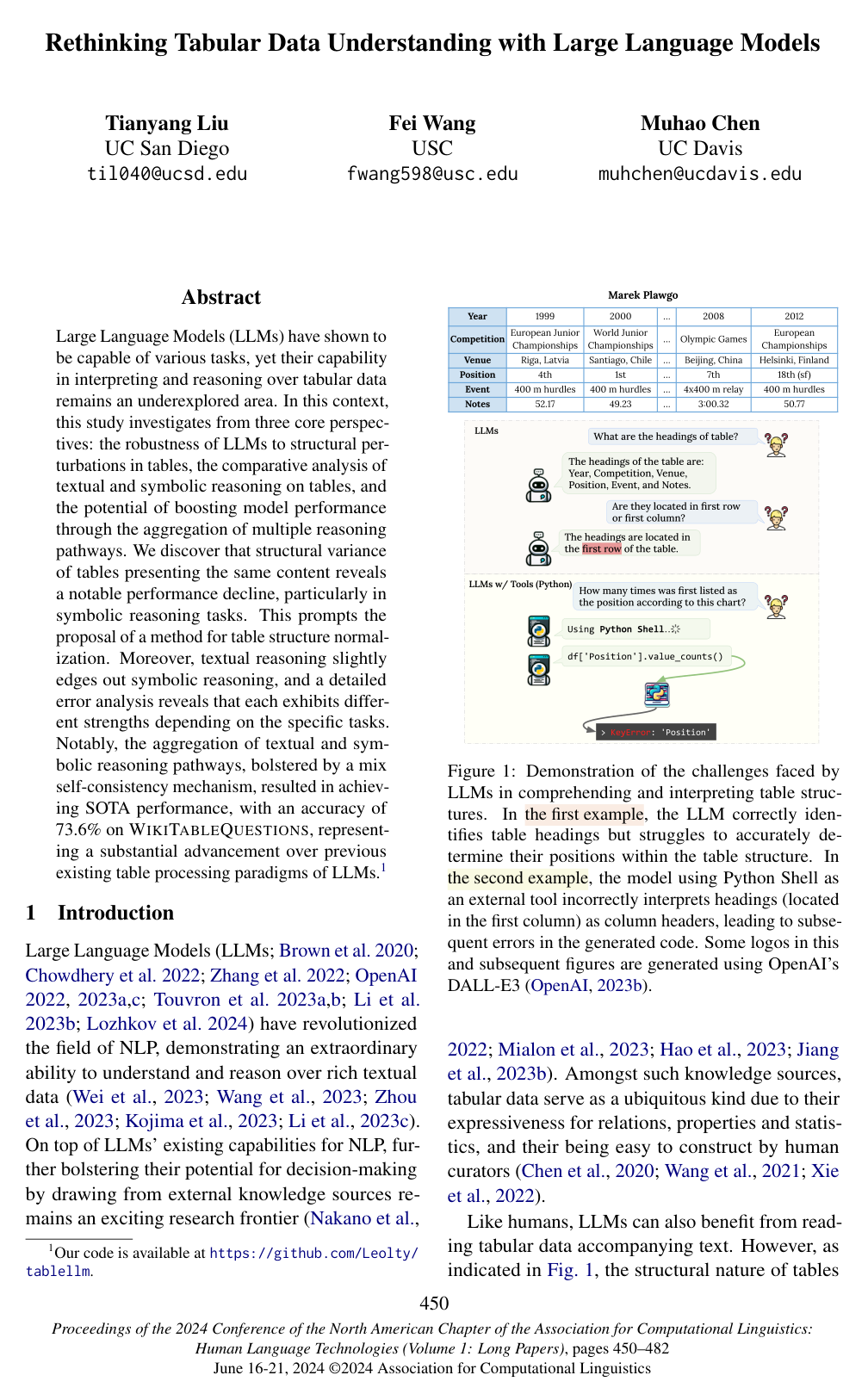
The findings reveal several critical insights into model performance. First, language models are highly vulnerable to structural changes, with direct table transposition causing performance to drop by about 14% in textual prompting and plunging by roughly 78% in code-based reasoning. Second, models struggle with direct transposition detection and execution, but a proposed two-stage content-aware normalization method effectively eliminates structural vulnerabilities without degrading baseline performance. Third, textual reasoning slightly outperforms code-based reasoning on standard tasks, with textual methods excelling in semantic comprehension while code execution performs better on precise counting and filtering. Finally, combining both reasoning pathways via a mixed self-consistency voting mechanism achieved a new state-of-the-art accuracy of 73.6% on the WikiTableQuestions benchmark.
These findings demonstrate that adopting automated table normalization and hybrid reasoning strategies significantly reduces operational risk, minimizes calculation errors, and improves data processing accuracy. Organizations deploying language models should not rely solely on single-prompt or purely code-based frameworks. Instead, implementations should combine automated structural preprocessing to standardize table orientations and leverage ensemble voting across both textual and programmatic reasoning paths, while taking care to avoid automated row reordering if queries depend on original row sequences.
While the study provides strong empirical support for these strategies, stakeholders should note certain limitations. The evaluations relied on GPT-3.5 and Wikipedia-sourced tables, which may introduce domain-specific biases or data overlap, and all methods experienced noticeable accuracy declines as table length increased. Further pilots and evaluations using newer model architectures and enterprise-specific datasets are recommended before full-scale deployment.
- Paper: Self-Consistency Improves Chain of Thought Reasoning in Language Models, Xuezhi Wang et al. (2023). It introduces the self-consistency voting mechanism over multiple reasoning paths that the source directly adapts and extends into a mixed textual-and-code voting strategy.
- Paper: Program of Thoughts Prompting: Disentangling Computation from Reasoning for Numerical Reasoning Tasks, Wenhu Chen et al. (2022). It formalizes the Program-of-Thoughts paradigm of delegating reasoning and computation to external code execution, providing the foundation for the source's code-based symbolic reasoning pathways.
- Paper: StructGPT: A General Framework for Large Language Model to Reason over Structured Data, Jinhao Jiang et al. (2023). It establishes iterative reading and reasoning interfaces for LLMs over structured tables and graphs, framing the tabular reasoning baselines analyzed in the source.
- Paper: Dynamic Prompt Learning via Policy Gradient for Semi-structured Mathematical Reasoning, Pan Lu et al. (2023). It benchmarks mathematical and analytical reasoning over heterogeneous tabular structures, motivating the source's inquiry into structural sensitivities and prompt robustness.
- Paper: DIN-SQL: Decomposed In-Context Learning of Text-to-SQL with Self-Correction, Mohammadreza Pourreza et al. (2023). It demonstrates decomposed prompting and schema alignment for structured databases, offering foundational context for the source's table normalization and multi-step reasoning approaches.
- Paper: ConvFinQA: Exploring the Chain of Numerical Reasoning in Conversational Finance Question Answering, Zhiyu Chen et al. (2022). It explores multi-step numerical reasoning over financial tables, illustrating the core computational challenges over tabular data that the source systematically tests under structural perturbations.
- Paper: Large Language Models are Zero-Shot Reasoners, Takeshi Kojima et al. (2022). It establishes zero-shot chain-of-thought prompting, which serves as one of the primary textual reasoning baselines evaluated in the source.
- Paper: Chain-of-Thought Prompting Elicits Reasoning in Large Language Models, Jason Wei et al. (2022). It introduces intermediate chain-of-thought reasoning in large language models, forming the core paradigm underpinning the source's step-by-step prompting evaluations.
- Paper: TableBench: A Comprehensive and Complex Benchmark for Table Question Answering, Xianjie Wu et al. (2025). It extends table understanding evaluation by introducing a complex 18-capability benchmark across multiple industries to assess the advanced tabular reasoning gaps highlighted by the source.
- Paper: Can LLMs Clean Up Your Mess? A Survey of Application-Ready Data Preparation with LLMs, Wei Zhou et al. (2026). It provides a comprehensive survey on LLM-driven data preparation and cleaning workflows, broadening the source's content-aware normalization insights to end-to-end enterprise data engineering pipelines.
- Paper: MATH-Perturb: Benchmarking LLMs' Math Reasoning Abilities against Hard Perturbations, Kaixuan Huang et al. (2025). It generalizes the source's methodology of structural and input perturbation testing to benchmark whether mathematical reasoning models rely on genuine problem solving or brittle surface cues.
- Paper: GSM-Symbolic: Understanding the Limitations of Mathematical Reasoning in Large Language Models, Iman Mirzadeh et al. (2025). It deepens the investigation into reasoning robustness and symbolic perturbation vulnerabilities in language models by isolating template-level numerical and structural variations.
- Paper: Encouraging Divergent Thinking in Large Language Models through Multi-Agent Debate, Tian Liang et al. (2024). It extends multi-path and ensemble reasoning mechanisms beyond self-consistency voting into dynamic multi-agent debate frameworks for resolving deceptive analytical tasks.
- Paper: Recursive Language Models Meet Uncertainty: The Surprising Effectiveness of Self-Reflective Program Search for Long Context, Keivan Alizadeh et al. (2026). It applies self-reflective programmatic search and uncertainty aggregation to handle long-context reasoning, building upon hybrid code-text execution strategies.
- Paper: Plan-on-Graph: Self-Correcting Adaptive Planning of Large Language Model on Knowledge Graphs, Liyi Chen et al. (2024). It builds on structured-data planning and verification by introducing dynamic path exploration and self-correction over knowledge graphs.