Pedestrian Detection: An Evaluation of the State of the Art
Piotr DollárChristian WojekBernt SchielePietro Perona
Establishes a standardized evaluation protocol and the large-scale Caltech Pedestrian Dataset while benchmarking sixteen detectors across six datasets to identify critical performance bottlenecks for small and occluded pedestrians.
This paper evaluates the current state of pedestrian detection algorithms in computer vision through a unified benchmark. Pedestrian detection supports applications such as automotive safety, robotics, surveillance, and elderly care, yet nearly 5,000 pedestrian fatalities occur annually in the United States alone. Prior work suffered from inconsistent datasets and evaluation protocols that prevented reliable comparisons of methods or identification of failure modes.
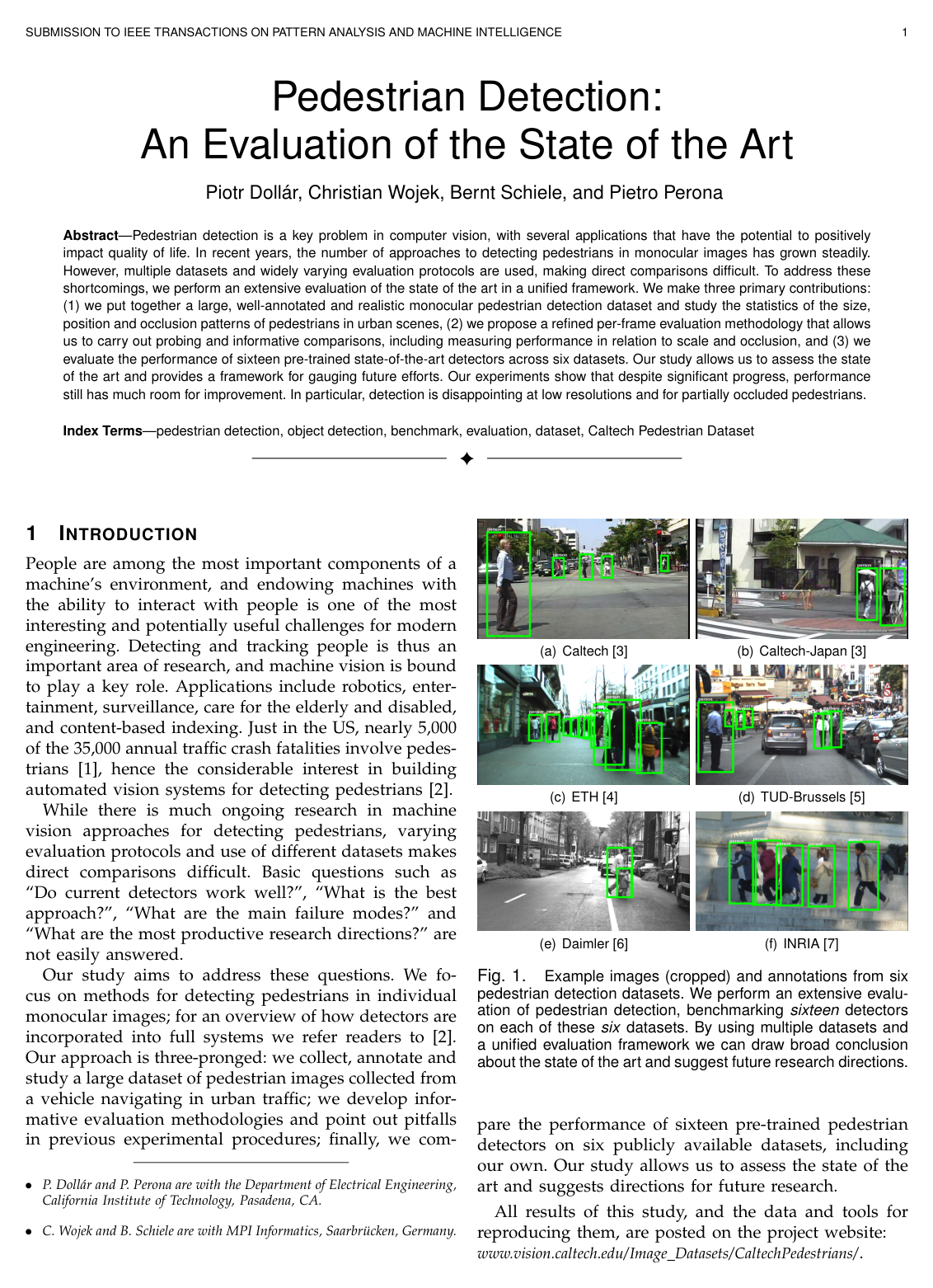
The authors set out to quantify detector performance, rank leading approaches, expose main weaknesses, and outline productive research directions. They assembled the Caltech Pedestrian Dataset, which contains roughly 350,000 annotated bounding boxes across 250,000 video frames recorded from a vehicle in urban traffic. They also developed a refined per-frame evaluation protocol that measures performance by scale and occlusion level while standardizing bounding-box aspect ratios and using expanded filtering to avoid over- or under-counting errors. Sixteen pre-trained detectors were then tested on this dataset plus five others (INRIA, ETH, TUD-Brussels, Daimler-DB, and Caltech-Japan) under identical conditions.
The study reveals that detection accuracy has advanced steadily yet remains far from adequate for practical use. Log-average miss rates exceed 80 percent across all annotated pedestrians and stay above 50 percent even for clearly visible pedestrians at least 50 pixels tall. Performance drops sharply below 80-pixel height and with any occlusion, and it collapses entirely at far scales or under heavy occlusion. Detectors that combine gradient histograms with additional cues such as texture, color self-similarity, or motion perform best, while part-based and motion-aware methods gain the most from higher resolution. Detector rankings prove reasonably stable across datasets, and statistical tests confirm that the top few methods are not significantly separable given current sample sizes.
These results indicate that current algorithms cannot yet meet the requirements of safety-critical systems that must operate at medium scales and tolerate partial occlusion. The mismatch between typical research focus on high-resolution, unoccluded cases and real-world operating conditions is pronounced. The authors recommend directing effort toward improved handling of medium-scale pedestrians, occlusion patterns, motion features at low resolution, temporal integration, contextual cues, and training on larger, more varied data. They also note that faster implementations and region-of-interest selection will be essential for deployment.
The evaluation relies on pre-trained detectors rather than retraining on the new dataset, and computational limits restricted testing to every thirtieth frame. Nevertheless, the breadth of detectors, datasets, and conditions, together with public release of all code and annotations, supports high confidence in the reported rankings and the identified gaps.
- Paper: Histograms of Oriented Gradients for Human Detection, Navneet Dalal et al. (2005). Histograms of Oriented Gradients (HOG) provide the fundamental pedestrian feature representation evaluated and built upon across multiple detectors in the source paper.
- Paper: The Pascal Visual Object Classes Challenge: A Retrospective, M. Everingham et al. (2014). The PASCAL VOC retrospective establishes the evaluation protocols and benchmark datasets used to compare detection algorithms in the source paper.
- Paper: Object Detection with Discriminatively Trained Part-Based Models, Pedro F. Felzenszwalb et al. (2010). Deformable part-based models represent one of the primary state-of-the-art pedestrian and object detectors evaluated within the source study's unified framework.
- Paper: Faster R-CNN: Towards Real-Time Object Detection with Region Proposal Networks, Shaoqing Ren et al. (2015). Faster R-CNN advances the state of object detection by integrating region proposal generation into deep networks, directly building on the evaluation frameworks established for pedestrian and general detection.
- Paper: You Only Look Once: Unified, Real-Time Object Detection, Joseph Redmon et al. (2016). YOLO extends single-stage detection concepts to achieve real-time inference, overcoming the speed limitations highlighted in earlier pedestrian and object detection evaluations.
- Paper: Simple online and realtime tracking, Alex Bewley et al. (2016). SORT applies state-of-the-art object detections from evaluation studies like the source paper to solve online multi-object tracking with minimal overhead.
- Paper: Simple online and realtime tracking with a deep association metric, Nicolai Wojke et al. (2017). Deep SORT extends real-time tracking frameworks by incorporating learned appearance metrics derived from pedestrian re-identification to prevent identity switches during occlusions.