Intention = Choice + Commitment

Philip R. CohenHector J. Levesque

article1987AAAI2,247 citations

Establishes a foundational modal logic of rational agency that defines intentions through choice and persistent commitment, formally explaining how autonomous agents maintain, drop, and coordinate goals without adopting unwanted side effects.

Listen

Autonomous systems operating in multi-agent environments must be able to understand, predict, and coordinate with other entities. While past work focused on plan recognition, it frequently lacked a rigorous model of the underlying mental states, particularly how strongly an entity maintains its objectives over time. This gap makes it difficult to predict how an entity will behave following unexpected setbacks or changing conditions.

The article establishes a formal mathematical and logical definition of intention, demonstrating that it can be constructed as a composite of choice and persistent commitment. By developing a modal logic of rational action, the authors provide an analytical framework that formally captures how an agent adopts, pursues, and abandons goals.

The investigation employs a possible-worlds semantics combined with dynamic temporal logic. The framework models beliefs, desires, and actions across extended timelines while enforcing core constraints, such as realism (agents do not pursue what they believe is already impossible or achieved) and the elimination of endless deferral. The methodology formally deduces the behavioral properties that emerge when agents commit to specific future states.

The analysis yields four central findings. First, an intention is formally represented as a persistent goal: an agent will sustain a chosen objective until it believes the goal is fulfilled, is deemed impossible, or violates the underlying conditions that justified adopting it. Second, this model explains why agents do not necessarily intend all expected side effects of their planned actions, solving a longstanding philosophical paradox. Third, the framework proves that competent agents acting on persistent goals will eventually accomplish them rather than abandoning them prematurely. Fourth, by allowing commitments to depend on contextual conditions or beliefs about other parties, the framework provides a foundation for structured hierarchies of subgoals and interpersonal coordination.

These findings provide immediate benefits for artificial intelligence architecture and multi-agent coordination. By decoupling intention from low-level execution plans, autonomous systems can anticipate whether a collaborator will retry a failed task without needing to simulate their full internal replanning logic. This reduces computational overhead, improves behavioral reliability, and mitigates safety risks associated with unpredictable agent interactions.

Organizations developing cooperative robotic fleets, automated conversational interfaces, or distributed autonomous software should adopt this composite model of commitment to structure agent decision-making. Future initiatives should focus on translating this descriptive logic into computationally tractable algorithms and extending the model to support full interpersonal communication protocols.

While the theoretical analysis is robust, the model relies on idealized assumptions, including full logical consistency in agent beliefs and a possible-worlds framework that abstracts away fine-grained computational constraints. Leaders can have high confidence in the qualitative principles demonstrated, but practical deployment will require adapting the logic to systems with limited computational power and imperfect information.

Cohen et al (1987).pdf
  • Paper: BDI Agents: From Theory to Practice, Anand S. Rao (1995). This paper builds directly upon the logical formalization of choice and commitment to construct practical Belief-Desire-Intention agent architectures and interpreters.
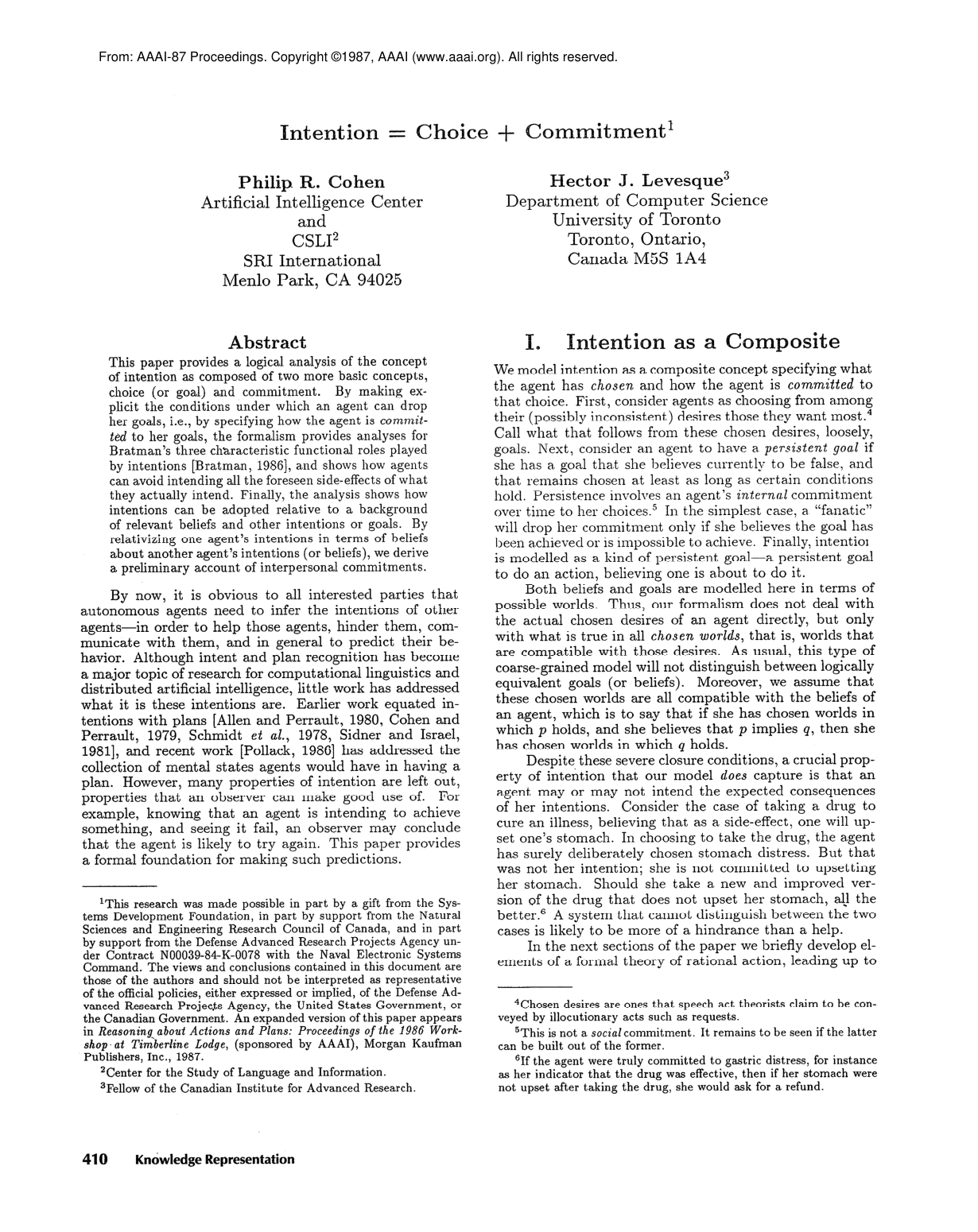
Cover for Intention = Choice + Commitment

Abstract

This paper provides a logical analysis of the concept of intention as composed of two more basic concepts, choice (or goal) and commitment. By making explicit the conditions under which an agent can drop her goals, i.e., by specifying how the agent is committed to her goals, the formalism provides analyses for Bratman's three characteristic functional roles played by intentions [Bratman, 1986], and shows how agents can avoid intending all the foreseen side-effects of what they actually intend. Finally, the analysis shows how intentions can be adopted relative to a background of relevant beliefs and other intentions or goals. By relativizing one agent's intentions in terms of beliefs about another agent's intentions (or beliefs), we derive a preliminary account of interpersonal commitments.

Table of Contents

  • I. Intention as a Composite
  • A. Syntax
  • B. Semantics
  • C. Properties and Assumptions
  • III. ersistent oals
  • A.. The Logic of
  • v, Conclusiom
  • VI. Acknowledgements
  • References

Knowls

  1. Knowl 1 — Definition of Persistent Goal (P-GOAL)

    definition

    A persistent goal (P-GOALP\text{-}GOAL) formalizes an internal, fanatical commitment of an agent toward an achievement goal. An agent xx has a persistent goal that proposition pp be true if and only if xx has an achievement goal for pp (desiring pp to hold later while believing pp is currently false), and xx will not drop the goal of pp holding later before xx comes to believe that pp is true or that pp is permanently impossible to achieve.

    Formally: (P-GOAL x p)=def(GOAL x (LATER p))(BEL x ¬p)(BEFORE [(BEL x p)(BEL x ¬p)] ¬(GOAL x (LATER p)))(P\text{-}GOAL\ x\ p) \stackrel{\text{def}}{=} (GOAL\ x\ (LATER\ p)) \land (BEL\ x\ \neg p) \land (BEFORE\ [(BEL\ x\ p) \lor (BEL\ x\ \Box \neg p)]\ \neg(GOAL\ x\ (LATER\ p)))

    where:

    • (BEL x p)(BEL\ x\ p) denotes that agent xx believes pp.
    • (GOAL x p)(GOAL\ x\ p) denotes that pp holds in all worlds compatible with the chosen desires of agent xx.
    • (LATER p)=def¬pp(LATER\ p) \stackrel{\text{def}}{=} \neg p \land \Diamond p, where p\Diamond p means pp is true at some present or future point (i.e., e (HAPPENS e;p?)\exists e\ (HAPPENS\ e;p?)).
    • p=def¬¬p\Box p \stackrel{\text{def}}{=} \neg \Diamond \neg p means pp remains true throughout the entire course of events from now on.
    • (BEFORE α β)=defc (HAPPENS c;β?)a (ac)(HAPPENS a;α?)(BEFORE\ \alpha\ \beta) \stackrel{\text{def}}{=} \forall c\ (HAPPENS\ c;\beta?) \supset \exists a\ (a \le c) \land (HAPPENS\ a;\alpha?), signifying that α\alpha becomes true no later than β\beta (where aca \le c means event sequence aa is a prefix subsequence of cc).

    Under this definition, believing pp or believing ¬p\Box \neg p are both necessary and sufficient conditions for dropping a persistent goal.

  2. Knowl 2 — Definition of Intention to Act (INTEND1)

    definition

    Intending to perform an action is formalized as a specialized persistent goal to have executed that action knowingly. For an agent xx and an action expression aa, INTEND1INTEND_1 is defined as:

    (INTEND1 x a)=def(P-GOAL x [DONE x (KNOW x (HAPPENS a))?;a])(INTEND_1\ x\ a) \stackrel{\text{def}}{=} (P\text{-}GOAL\ x\ [DONE\ x\ (KNOW\ x\ (HAPPENS\ a))?;a])

    where:

    • (P-GOAL x p)(P\text{-}GOAL\ x\ p) is a persistent goal specifying that agent xx will not drop the goal (LATER p)(LATER\ p) until xx believes pp or believes ¬p\Box \neg p.
    • (HAPPENS a)(HAPPENS\ a) indicates that a sequence of events satisfying action expression aa occurs next.
    • (KNOW x p)=defp(BEL x p)(KNOW\ x\ p) \stackrel{\text{def}}{=} p \land (BEL\ x\ p).
    • (KNOW x (HAPPENS a))?(KNOW\ x\ (HAPPENS\ a))? is a dynamic-logic test action requiring the agent to know that action aa is about to occur immediately prior to execution, preventing accidental or unknowing execution from fulfilling the intention.
    • (DONE x α)=def(DONE α)(AGT x α)(DONE\ x\ \alpha) \stackrel{\text{def}}{=} (DONE\ \alpha) \land (AGT\ x\ \alpha) asserts that agent xx is the sole agent who just completed the execution of α\alpha.

    This formulation defines intention as a commitment to successful completion rather than merely a commitment to being on the verge of acting.

  3. Knowl 3 — Definition of Relativized Persistent Goal (P-R-GOAL) and Relativized Intention

    definition

    A relativized persistent goal (P-R-GOALP\text{-}R\text{-}GOAL) generalizes persistent commitment by allowing an agent's persistent goal for pp to depend on an arbitrary background proposition qq (such as an overarching plan, an underlying reason, or a supergoal). An agent maintains the persistent goal for pp until believing pp is satisfied, believing pp is impossible, or believing that the justifying condition qq is false:

    (P-R-GOAL x p q)=def(GOAL x (LATER p))(BEL x ¬p)(BEFORE [(BEL x p)(BEL x ¬p)(BEL x ¬q)] ¬(GOAL x (LATER p)))(P\text{-}R\text{-}GOAL\ x\ p\ q) \stackrel{\text{def}}{=} (GOAL\ x\ (LATER\ p)) \land (BEL\ x\ \neg p) \land (BEFORE\ [(BEL\ x\ p) \lor (BEL\ x\ \Box \neg p) \lor (BEL\ x\ \neg q)]\ \neg(GOAL\ x\ (LATER\ p)))

    Correspondingly, a relativized intention to act relativizes the execution commitment to background condition qq:

    (INTEND1 x a q)=def(P-R-GOAL x [DONE x (KNOW x (HAPPENS a))?;a] q)(INTEND_1\ x\ a\ q) \stackrel{\text{def}}{=} (P\text{-}R\text{-}GOAL\ x\ [DONE\ x\ (KNOW\ x\ (HAPPENS\ a))?;a]\ q)

    This construct enables hierarchical subgoal relationships (e.g., adopting subgoal pp relative to supergoal qq via (P-R-GOAL x p (GOAL x q))(P\text{-}R\text{-}GOAL\ x\ p\ (GOAL\ x\ q))), where abandoning the supergoal provides a legitimate justification for dropping the subgoal.

  4. Knowl 4 — Foundational Axiomatic Assumptions of Rational Agency

    assumption

    The logic of rational action, belief, and goal is governed by four core semantic validity assumptions:

    1. Agents Know Primitive Actions: (HAPPENS x e)(BEL x (HAPPENS e))\models (HAPPENS\ x\ e) \supset (BEL\ x\ (HAPPENS\ e)) where ee is a primitive event variable and (HAPPENS x e)=def(HAPPENS e)(AGT x e)(HAPPENS\ x\ e) \stackrel{\text{def}}{=} (HAPPENS\ e) \land (AGT\ x\ e). Primitive events executed by an agent occur only if the agent consciously recognizes they will occur (accidental events happen to an agent rather than being performed by them).

    2. Consistency of Goals: (GOAL x p)¬(GOAL x ¬p)\models (GOAL\ x\ p) \supset \neg(GOAL\ x\ \neg p) There is always at least one possible world compatible with an agent's chosen goals.

    3. Realism: (BEL x p)(GOAL x p)\models (BEL\ x\ p) \supset (GOAL\ x\ p) Every chosen world is compatible with the agent's current beliefs; an agent cannot engage in wishful thinking about the present state of affairs.

    4. No Infinite Deferral: ¬(GOAL x (LATER p))\models \Diamond \neg (GOAL\ x\ (LATER\ p)) Agents eventually drop all achievement goals (GOAL x (LATER p))(GOAL\ x\ (LATER\ p)). Such goals either convert to maintenance goals or are dropped entirely (e.g., when recognized as unachievable).

  5. Knowl 5 — Formal Semantics and Syntax of the Rational Action Logic

    model/method

    The formal system is a first-order multimodal logic evaluated over a possible-worlds structure M=D,T,E,Φ,B,G,AgtM = \langle D, \mathcal{T}, \mathcal{E}, \Phi, B, G, Agt \rangle:

    • A world σT\sigma \in \mathcal{T} is a discrete, temporally extended sequence of primitive events indexed by integers nZn \in \mathbb{Z}. σ(n)\sigma(n) is the unique primitive event occurring at point nn.
    • DD is a domain including agents and finite event sequences; Φ\Phi interprets predicates at world σ\sigma and index nn.
    • B(σ,x,n,σ)B(\sigma, x, n, \sigma^*) and G(σ,x,n,σ)G(\sigma, x, n, \sigma^*) are accessibility relations defining worlds σ\sigma^* compatible with the beliefs and chosen goals (desires), respectively, of agent xx in world σ\sigma at time nn.

    Modal operators are evaluated at M,σ,v,n\langle M, \sigma, v, n \rangle with variable assignment vv:

    • M,σ,v,n(BEL x p)    σM, \sigma, v, n \models (BEL\ x\ p) \iff \forall \sigma^* such that B(σ,v(x),n,σ)B(\sigma, v(x), n, \sigma^*), M,σ,v,npM, \sigma^*, v, n \models p.
    • M,σ,v,n(GOAL x p)    σM, \sigma, v, n \models (GOAL\ x\ p) \iff \forall \sigma^* such that G(σ,v(x),n,σ)G(\sigma, v(x), n, \sigma^*), M,σ,v,npM, \sigma^*, v, n \models p.
    • M,σ,v,n(AGT x e)    v(e)=e1e2emM, \sigma, v, n \models (AGT\ x\ e) \iff v(e) = e_1 e_2 \dots e_m and for all ii, Agt(ei)=v(x)Agt(e_i) = v(x).
    • M,σ,v,n(HAPPENS a)    mnM, \sigma, v, n \models (HAPPENS\ a) \iff \exists m \ge n such that M,σ,v,n[a]mM, \sigma, v, n [a] m.
    • M,σ,v,n(DONE a)    mnM, \sigma, v, n \models (DONE\ a) \iff \exists m \le n such that M,σ,v,m[a]nM, \sigma, v, m [a] n.

    Action expressions a,ba, b follow Dynamic Logic:

    • Single event: M,σ,v,n[e]n+m    v(e)=e1emM, \sigma, v, n [e] n+m \iff v(e) = e_1 \dots e_m and σ(n+i)=ei\sigma(n+i) = e_i for 1im1 \le i \le m.
    • Sequence: M,σ,v,n[a;b]m    kM, \sigma, v, n [a;b] m \iff \exists k (nkmn \le k \le m) such that M,σ,v,n[a]kM, \sigma, v, n [a] k and M,σ,v,k[b]mM, \sigma, v, k [b] m.
    • Nondeterministic choice: M,σ,v,n[ab]m    M,σ,v,n[a]mM, \sigma, v, n [a|b] m \iff M, \sigma, v, n [a] m or M,σ,v,n[b]mM, \sigma, v, n [b] m.
    • Test: M,σ,v,n[p?]n    M,σ,v,npM, \sigma, v, n [p?] n \iff M, \sigma, v, n \models p.
    • Iteration: M,σ,v,n[a]m    n1,,nkM, \sigma, v, n [a^*] m \iff \exists n_1, \dots, n_k (n1=n,nk=mn_1 = n, n_k = m) with M,σ,v,ni[a]ni+1M, \sigma, v, n_i [a] n_{i+1} for all 1ik11 \le i \le k-1.
  6. Knowl 6 — Theorem on Realization of Persistent Goals under Competence

    theoretical result

    If an agent has a persistent goal to achieve pp, is permanently competent with respect to pp, and does not prematurely drop the goal before coming to believe that pp is impossible, then pp will eventually become true.

    Formally: (P-GOAL y p)(COMPETENT y p)¬[BEFORE (BEL y ¬p) ¬(GOAL y (LATER p))]p\models (P\text{-}GOAL\ y\ p) \land \Box(COMPETENT\ y\ p) \land \neg [BEFORE\ (BEL\ y\ \Box \neg p)\ \neg(GOAL\ y\ (LATER\ p))] \supset \Diamond p

    where (COMPETENT y p)=def(BEL y p)p(COMPETENT\ y\ p) \stackrel{\text{def}}{=} (BEL\ y\ p) \supset p, meaning agent yy has only correct beliefs regarding pp.

  7. Knowl 7 — Screen of Admissibility for Incompatible Intentions

    theoretical result

    Intentions serve as a "screen of admissibility" that prevents an agent from adopting or intending actions believed to conflict with prior commitments. If an agent intends to perform action bb, and invariantly believes that performing action aa prevents the subsequent completion of bb, the agent cannot consistently intend the sequence a;ba;b:

    (INTEND1 x b)(BEL x [(DONE x a)¬(DONE x b)])¬(INTEND1 x a;b)\models (INTEND_1\ x\ b) \land \Box (BEL\ x\ [(DONE\ x\ a) \supset \Box \neg (DONE\ x\ b)]) \supset \neg(INTEND_1\ x\ a;b)

    where (INTEND1 x a)=def(P-GOAL x [DONE x (KNOW x (HAPPENS a))?;a])(INTEND_1\ x\ a) \stackrel{\text{def}}{=} (P\text{-}GOAL\ x\ [DONE\ x\ (KNOW\ x\ (HAPPENS\ a))?;a]).

  8. Knowl 8 — Tracking and Maintenance of Intentions After Execution Failure

    theoretical result

    Agents track the success of their attempts and retain their intentions when an attempt fails, provided they do not believe the goal has become impossible. If an agent performs an action bb intending to accomplish aa, but recognizes upon completion that aa was not done, the agent preserves the intention to do aa:

    (BEL x ¬(DONE x a))¬(BEL x ¬(DONE x a))(DONE x [(INTEND1 x a)(BEL x (HAPPENS x a))]?;b)(INTEND1 x a)\models (BEL\ x\ \neg (DONE\ x\ a)) \land \neg(BEL\ x\ \Box \neg(DONE\ x\ a)) \land (DONE\ x\ [(INTEND_1\ x\ a) \land (BEL\ x\ (HAPPENS\ x\ a))]?;b) \supset (INTEND_1\ x\ a)

    where (INTEND1 x a)=def(P-GOAL x [DONE x (KNOW x (HAPPENS a))?;a])(INTEND_1\ x\ a) \stackrel{\text{def}}{=} (P\text{-}GOAL\ x\ [DONE\ x\ (KNOW\ x\ (HAPPENS\ a))?;a]).

  9. Knowl 9 — Separation of Intentions from Foreseen Side-Effects

    theoretical result

    An agent who intends an action believing it will produce an inevitable side-effect does not automatically intend the side-effect. In the formal logic of persistent goals, knowing that pp implies qq across all accessible future worlds does not transfer commitment to qq:

    (INTEND1 x a;p?)(BEL x (pq))⊭(INTEND1 x a;q?)(INTEND_1\ x\ a;p?) \land (BEL\ x\ \Box(p \supset q)) \not\models (INTEND_1\ x\ a;q?)

    This non-entailment holds because an agent's belief (BEL x (pq))(BEL\ x\ \Box(p \supset q)) can change over time (e.g., if a new method for achieving pp without side-effect qq is discovered). Because the agent is prepared to drop qq if circumstances allow, qq is not held as a persistent goal (P-GOALP\text{-}GOAL). Only under the rigid condition where the implication is believed invariantly for all time, (BEL x (pq))\Box (BEL\ x\ \Box(p \supset q)), does the agent become committed to tracking qq as an intended outcome.

  10. Knowl 10 — Avoidance of McDermott's Little Nell Paradox

    theoretical result

    The "Little Nell" paradox arises in temporal planning logics where an agent drops an intention to achieve q\Diamond q prematurely upon believing that q\Diamond q will inevitably occur due to the agent's current plan, causing the action to be abandoned and the goal to fail.

    The persistent goal framework prevents this paradox because an achievement goal requires (LATER p)(LATER\ p), which demands that pp is false at the current time point: (LATER p)=def¬pp(LATER\ p) \stackrel{\text{def}}{=} \neg p \land \Diamond p

    Substituting p=qp = \Diamond q yields: (LATER q)¬qq¬qqfalse(LATER\ \Diamond q) \equiv \neg \Diamond q \land \Diamond \Diamond q \equiv \neg \Diamond q \land \Diamond q \equiv \text{false}

    Consequently, (P-GOAL x q)(P\text{-}GOAL\ x\ \Diamond q) is identically false for all agents xx and propositions qq. Agents cannot form persistent goals or intentions toward mere eventualities q\Diamond q, completely blocking the formation of self-defeating intentions.

Coverage note — Omitted the formalization of state-of-affairs intentions (INTEND2) and preliminary discussions of interpersonal speech acts, as the paper explicitly defers their formal technical treatments to Cohen & Levesque (1987).

References

  1. 1.J. F. Allen and C. R. Perrault. Analyzing intention in dialogues. Artificial Intelligence, 15(3):143-178, 1980.
  2. 2.M. Bratman. Two faces of intention. The Philosophical Review, XCIII(3):375-405, 1984.
  3. 3.M. Bratman. Intentions, plans, and practical reason. 1986. Harvard University Press, in preparation.
  4. 4.P. R. Cohen and H. J. Levesque. Rational interaction as the basis for communication. In preparation.
  5. 5.P. R. Cohen and H. J. Levesque. Persistence, Intention, and Commitment. Technical Report 415, Artificial Intelligence Center, SRI International, Menlo Park, California, February 1987. Also appears in Proceedings of the 1986 Timberline Workshop on Planning and Practical Reasoning, Morgan Kaufman Publishers, Inc. Los Altos, California.
  6. 6.P. R. Cohen and C. R. Perrault. Elements of a plan-based theory of speech acts. Cognitive Science, 3(3):177-212, 1979. Reprinted in Readings in Artificial Intelligence, Morgan Kaufman Publishing Co., Los Altos, California, B. Webber and N. Nilsson (eds.), pp. 478-495., 1981.
  7. 7.D. McDermott. A temporal logic for reasoning about processes and plans. Cognitive Science, 6(2):101-155, April-June 1982.
  8. 8.M. E. Pollack. Inferring Domain Plans in Question Answering. PhD thesis, Department of Computer Science, University of Pennsylvania, 1986.
  9. 9.C. F. Schmidt, N. S. Sridharan, and J. L. Goodson. The plan recognition problem: an intersection of artificial intelligence and psychology. Artificial Intelligence, 10:45-83, 1978.
  10. 10.C. Sidner and D. Israel. Recognizing intended meaning and speaker's plans. In Proceedings of the Seventh International Joint Conference on Artificial Intelligence, Vancouver, B. C., 1981.

Citation

MLA
Cohen, P. R., and H. J. Levesque. “Intention = Choice + Commitment”. National Conference on Artificial Intelligence, 1987, pp. 410–15, https://dblp.uni-trier.de/db/conf/aaai/aaai87.html#CohenL87.
APA
Cohen, P. R., & Levesque, H. J. (1987). Intention = choice + commitment. National Conference on Artificial Intelligence, 410–415. https://dblp.uni-trier.de/db/conf/aaai/aaai87.html#CohenL87
Chicago
Cohen, P. R., and H. J. Levesque. 1987. “Intention = Choice + Commitment”. National Conference on Artificial Intelligence, 410–15. https://dblp.uni-trier.de/db/conf/aaai/aaai87.html#CohenL87.
Harvard
Cohen, P.R. and Levesque, H.J. (1987) “Intention = choice + commitment”, National Conference on Artificial Intelligence, pp. 410–415. Available at: https://dblp.uni-trier.de/db/conf/aaai/aaai87.html#CohenL87.
Vancouver
1. Cohen PR, Levesque HJ (1987) Intention = choice + commitment. National Conference on Artificial Intelligence 410–415

BibTeX

@article{cohen1987intention,
  title = {Intention = choice + commitment},
  author = {Cohen, Philip R. and Levesque, Hector J.},
  year = {1987},
  journal = {National Conference on Artificial Intelligence},
  pages = {410-415},
  url = {https://dblp.uni-trier.de/db/conf/aaai/aaai87.html#CohenL87}
}
Metadata:DOI registry

Access the Paper

This paper is available from its original source. Click below to access the PDF.

Open PDF