Economic Policy for AGI*
Julian Jacobs1,2^{1,2}1,2 and Alex Imas1,3^{1,3}1,3
1^11Google DeepMind
2^22University of Oxford
3^33University of Chicago
1^11Google DeepMind
2^22University of Oxford
3^33University of Chicago
15 September 2026
Abstract
The growing role of Artificial Intelligence (AI) in the economy has been met with both hope and anxiety. The hope is driven by the potential of the technology to accelerate economic growth and push the frontier of science. Yet this promise is tempered by anxiety over AI's potential impact on the labor market. Such concerns have prompted researchers and policymakers to weigh responses to help manage any AI-driven disruption. The need for such interventions may be particularly pronounced if highly capable and advanced AI systems—including artificial general intelligence (AGI)—develop and diffuse widely. This paper sets out to systematically evaluate 11 such policy responses across four core dimensions: whether a policy (1) boosts welfare, (2) supports agency and socio-economic empowerment, (3) can be feasibly implemented, and (4) remains durable across different economic scenarios. We conducted our investigation using a multi-method approach, including economic analysis, a nationally representative survey of 2,019 Americans, and a simulated panel of AI agents trained on the personas of 51 prominent economists. Our work suggests a strong tension between popular support for a policy and that policy's durability across different scenarios of economic transformation, with public preferences and scenario durability negatively correlated. Given the epistemic uncertainty over the level of disruption that might emerge due to AI, our analysis points to a dynamic and phased policy package that evolves as labor market conditions shift. This package could include expanded unemployment insurance, a negative income tax, and capital redistribution.
Keywords: Economic policy, artificial intelligence, redistribution, labor.
^*We are grateful to Sebastien Krier, Ben Ansell, Joshua Martin, Stephanie Chan, and Steph Hughes-Fitt for their helpful comments and feedback on earlier drafts of this paper. We thank John Horton for invaluable support using the multi-agent rater simulation infrastructure. The views, findings, and recommendations expressed in this paper are strictly those of the authors and do not necessarily reflect the views, positions, or policies of Google DeepMind, the University of Oxford, or the University of Chicago.
Introduction
There is growing anxiety about the economic impacts of artificial intelligence (AI). Concerns about how advanced AI systems might impact jobs, incomes, and inequality are becoming a defining issue across many countries. This is particularly pronounced among younger generations, according to recent polling (CSAIP, 2026). According to our own recent surveys, AI ranked as the most significant economic concern for adults across several developed economies (Jacobs, 2026). And all of these worries have surfaced before any definitive evidence of labor disruption has appeared.1
1.
See, for example, "The jobs apocalypse is postponed. An AI jobs boom is here" from the Economist.
As AI capabilities improve, a growing number of social scientists and policymakers are taking seriously the idea that artificial general intelligence (AGI)—advanced AI systems capable of performing cognitive tasks at least at the level of the average skilled adult—could usher in significant changes to modern economies. On one side, this includes significant potential improvements to economic growth. Indeed, just as the Industrial Revolution lowered the costs of production and lifted economies from stagnation to exponential improvements in living standards, healthcare, and science, AGI could usher in similarly transformative changes in growth and welfare (Mokyr, 1990; Morris, 2010). Consider, for instance, that in the 18th century, US agriculture employed between 80 and 90 percent of the labor force; today that number is below 2 percent, even as total agricultural output nearly tripled between 1948 and 2021 alone (Gordon, 2016; Lebergott, 1966). This drop in the price of food has ushered in unprecedented increases in living standards and well-being.
At the same time, public concern about AI's impacts on labor and inequalities is based on some precedent. In the past, major technological transformations boosted long run economic growth while also creating short and medium run disruption for many workers and communities. Consider that during the Industrial Revolution and the period of early 20th century mechanization, technological change lowered real wages for many middle and lower income workers at the time (Acemoglu and Restrepo, 2018; Allen, 2009; Autor, 2015; Goldin and Katz, 2008). Meanwhile demand for skills changed, leading some workers to be displaced while others were complemented by new technologies (Autor et al., 2003). Crucially, these transitions could last for a generation. For example, Feigenbaum and Gross (2024) show that while the automation of telephone operation in the early 20th century did not reduce overall local employment, since subsequent cohorts entered other growing occupations, the incumbent telephone operators who were displaced suffered persistent employment losses and downward occupational mobility. In other words, many people who lived through prior technological shocks were indeed harmed by the periods of innovation that they lived through.
The central question confronting policymakers today is: Can we manage the economic transition better this time while preserving the immense benefits of technological progress?
Historically, governments struggled to manage productivity-boosting transitions in real time. Instead, policy typically has operated ex-post, deploying compensatory measures or safety nets only after labor displacement impacts employment and wages (Acemoglu and Johnson, 2023; Allen, 2009; Lindert, 2004; Polanyi, 1944). In part, this lag reflects underdeveloped administrative institutions and weak data (Kleven et al., 2016). It may also have stemmed from legitimate fears that intervening prematurely might stifle innovation, or introduce a cure worse than the disease (Costinot and Werning, 2023; Diamond and Mirrlees, 1971; Guerreiro et al., 2022; Mokyr, 1990).
Still, there are at least a few reasons for optimism that society can manage this transition more effectively than in the past. Compared to prior moments in history, policymakers today benefit from more mature fiscal institutions (Kleven et al., 2016), advances in social science have left us with a richer set of potential policy tools (Card et al., 2018; Currie and Gahvari, 2008), and there has been much progress in measurement and analysis of economic data, including through new forms of data collection (Chetty et al., 2024). Indeed, more robust data—including granular, real-time telemetry from frontier AI labs mapping task-level usage across the economy (Eloundou et al., 2024; Handa et al., 2025; Iscenko et al., 2026; Labaschin et al., 2025)—may give societies a better chance to preemptively create a phased AGI policy plan based on empirically-derived triggers (Boushey et al., 2019; Korinek and Lockwood, 2026; Korinek and Suh, 2024). This approach would be particularly useful in helping policymakers avoid the dual pitfalls of either acting too late to cushion displaced workers, or acting too prematurely, which could create more disruption than it mitigates.
Yet this approach faces three main challenges. First, while our data institutions are better than a century ago, they are still not up to the task of capturing AI's economic impacts at the timescale needed. This includes contemporary labor-market statistics, which have declined in quality and often has considerable lag (Frank et al., 2019; Iscenko et al., 2026; Meyer et al., 2015; National Academies of Sciences, Engineering, and Medicine, 2024). Data on AI usage and chat logs are currently disaggregated across different AI companies, which limits our ability to generate a coherent perspective about how AI is impacting jobs. We also need better data on AI-enabled substitution, unemployment spell durations, and statistics on elasticities of consumer demand.
The second challenge is the extent of epistemic uncertainty over the exact timescale of AGI's potential emergence, the precise nature of its economic effects, and the trajectory of its diffusion across markets. This translates to uncertainty over the appropriate policy response for managing the transition. At one end, AGI impacts could resemble historical technology shocks where labor demand remains intact as new human-complementary tasks emerge. The core challenge then would be to create income and living standard stability for workers who experience lower wages or employment disruptions. At the other extreme, however, AGI could also mark a fundamental discontinuity in the history of modern economics, potentially disrupting the fundamental role of labor in the economy (Korinek and Suh, 2024; Susskind, 2020). Indeed, if AI eventually achieves recursive self-improvement (RSI), where systems could autonomously design and optimize superior successors, this could significantly hasten both AI capabilities and diffusion (Aghion et al., 2019; Good, 1965; Trammell and Korinek, 2023).
Finally, policy proposals often suffer from an absence of standardized evaluation rubrics. Interventions are frequently studied in silos without a common set of criteria to evaluate policy proposals across the dimensions that society may care about—this includes living standards, but also non-pecuniary factors such as work meaning, individual economic agency, democratic participation, and shared ownership in the productive economy.
This paper aims to make progress in confronting these challenges by evaluating eleven household-facing policies on four standardized dimensions: (1) Welfare and Macroeconomic Resilience, (2) Economic Agency and Democratic Empowerment, (3) Feasibility and Implementation, and (4) Durability Across Scenarios. For the last dimension, we considered how each policy's efficacy on the first three dimensions would fare across three levels of potential disruption: mild, moderate, or transformative. Our use of these scenarios reflects the current epistemic uncertainty around the potential impact of AGI on the economy. To complete this analysis, we employed a mixed-methods approach which combined 1) a comprehensive literature review and economic analysis of each policy and 2) a deliberative panel of 51 AI agent trained on the viewpoints of prominent economists spanning a wide spectrum of attitudes.2 The latter allows us to remove some researcher degrees of freedom and mitigate potential bias (Grace et al., 2024; Korinek and Suh, 2024). We supplemented these data sources with an original nationally representative survey of 2,019 Americans capturing public attitudes toward AGI policy responses.
2.
We did the latter by using Expected Parrot Domain-Specific Language (EDSL) platform (Horton and Horton, 2024; Horton, 2023).
Our work suggests that no single policy is a panacea across all potential AGI scenarios. While the American public overwhelmingly favors work-contingent interventions, such as job retraining (+72.8% net approval) and unemployment insurance (+56.5%), our results suggest that these programs are also least robust to transformative scenarios marked by substantial routine and non-routine automation. On the other hand, durable pre-distributive floors encounter voter skepticism.
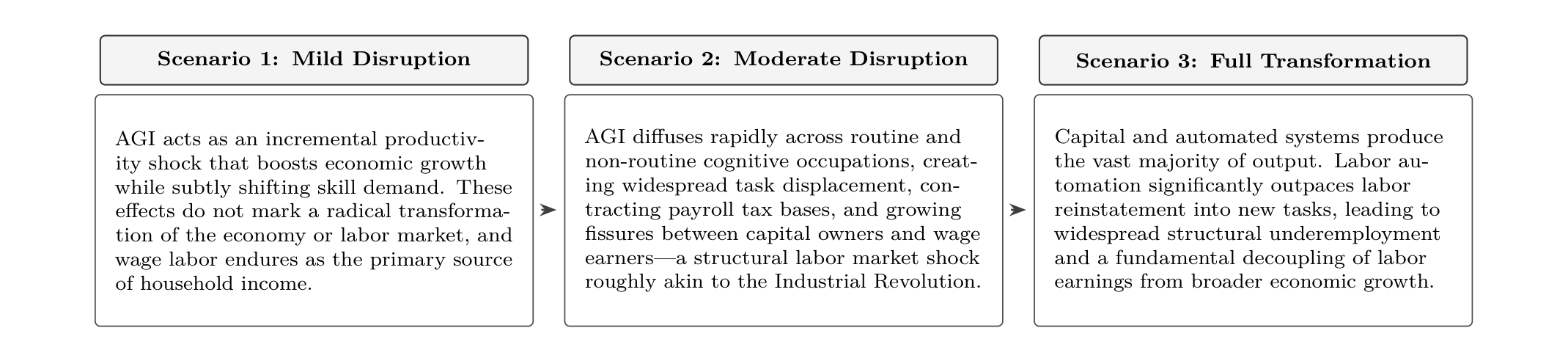
Due to the uncertainty about the precise nature and scale of AI's economic impacts, the analysis points to a sequenced and trigger-based set of "least-regret" interventions, matched to emerging data on distinct macroeconomic scenarios (Figure 1). This set of policies obtain high scores across the dimensions we evaluate, laying on the Pareto frontier across these dimensions, which includes durability to different AGI scenarios. In the first Mild Disruption scenario, the analysis suggests that policymakers should rely on expanded unemployment insurance (UI), earned income tax credit (EITC), and, where possible, employer-led apprenticeships. These are effective interventions that build on existing government infrastructure and programming. They also preserve work incentives and scale relatively well if labor market disruption increases. In the second Moderate Disruption scenario, this analysis suggests transitioning the EITC into a negative income tax (NIT), which is triggered based on data pointing to prolonged unemployment spells, falling incomes, and sluggish job reinstatement effects. In the last Full Transformation scenario, our analysis suggests an optimal response could include triggering a pre-distribution policy that provides a safety net while ensuring people continue to have a stake in the productive economy, such as through universal basic capital (UBC), which would provide an equity dividend and ownership stake in capital-driven economic growth. Since institutions can be slow to develop and deploy policies when they are needed most, it is prudent to pre-design the implementation details and deployment institutions in the near-term so that interventions can be rolled out quickly and effectively. We also consider potential mechanisms to fund economic policies for AGI. In order to finance a robust policy response without harming innovation and growth, our evaluation suggested that traditional fiscal policy, such as expanded corporate taxation may be more effective than more narrow proposals targeting AI inputs (such as compute hardware or token taxes). The analysis points to significant risk of distortions, including on how models are trained, and a lack of robustness as a funding mechanism.
The remainder of our paper proceeds as follows. The Evaluation Framework and Methods section details our evaluation rubric, the data infrastructure and empirical triggers required for policy sequencing, our 51-economist agent panel methodology, and our national survey. The Economic Policies for AGI and Funding AGI Policy sections present our empirical findings for household-facing redistributive policies and revenue mechanisms, respectively, across Scenarios 1, 2, and 3. The final section concludes with a brief discussion about the implications of our work. Extensive policy evaluations and individual agent scores are detailed in the Appendix.
Evaluation Framework and Methods
We begin by discussing the methodological approach we took to analyze potential economic policy responses to AGI. To do so, we combined (i) economic analysis and literature review, (ii) survey data, and, (iii) agent-based persona evaluators. We note that the approach we have taken is by no means exhaustive nor conclusive, and it comes with significant limitations.
To begin, we sought to identify which policies to include in our analysis. We focused our work on the United States, to keep the scope of our research tractable. Our hope in doing so, however, is to create a methodological approach that could be adopted, improved on, and replicated in other national contexts. Furthermore, we expect many of the findings we observe in the United States will be relevant to other policy environments, particularly in developed economies. With the United States national context in mind, we then selected eleven redistributive policies that appeared most frequently in literature, policy discussions, and broader discourse, though this approach was admittedly holistic. We then considered 14 prominent taxation and governance mechanisms.
We define redistributive policy here as interventions focused on sharing AGI's economic benefits, promoting continued work, or bent on supporting human living standards. Taxation and governance policies, meanwhile, are primarily focused on generating revenue for governments within the bounds of legal and administrative feasibility. Given their divergent aims, we evaluate redistributive and taxation policy separately, using distinct criteria for each. For redistributive interventions, we evaluate policies across four clusters of sub-criteria, which we call dimensions. These dimensions and their underlying criteria are summarized in Table 1.
Our first dimension is Welfare and Macroeconomic Resilience, which is composed of three sub-criteria. The first of these assesses whether each policy boosts standards of living, defined here as an intervention's ability to alleviate poverty, smooth consumption amid income shocks, and generally preserve a meaningful quality of life. The second piece is whether a given policy supports human meaning and socio-psychological well-being, for instance capturing the impact of a particular intervention on the non-pecuniary dimensions of work. This is informed by extensive sociological and psychological evidence, which suggests that formal employment provides significant non-monetary value in addition to financial benefits (Case and Deaton, 2020; Deci and Ryan, 2000; Hussam et al., 2022; Jahoda, 1982). This dimension assesses whether policies support continued participation in the productive economy. Finally, this dimension captures a measure of macroeconomic stabilization, whereby we assess whether interventions serve as effective automatic stabilizers, which adjust dynamically based on macroeconomic circumstances. For instance, a highly dynamic policy doles out more economic aid during crises or when a higher number of people need financial support; it reduces disbursements in cases where there is wage growth, high levels of employment, and a strong baseline standard of living (Boushey et al., 2019; Landais et al., 2018; McKay and Reis, 2016; Sahm, 2019).
The second dimension is Economic Agency and Democratic Empowerment, which focuses in on how particular interventions may impact societal economic and political participation. It is also composed of three criteria. The first is economic participation, capturing if a policy is likely to enhance individual economic freedom, bargaining power, and mobility. Second, we look at whether each intervention is likely to preserve ownership of economic gains. Most interventions offer transfers to workers, without sharing a direct capital stake in the AI sector or broader economy. Literature has previously suggested sharing capital may be particularly important in circumstances where economic growth decouples from labor and wage growth (Allen, 2009; Korinek and Stiglitz, 2019; Mian et al., 2021; Turner, 2018; Wiedemann, 2021). The final component of the Economic Agency and Democratic Empowerment dimension is our measure of democratic voice, which captures whether a given intervention create the material security, autonomy, institutional embeddedness, and conditions for citizens to participate in democratic life and the political process. An intervention that scores low in this component would, for instance, be one that enables regulatory capture, entrenches civic passivity, and creates barriers to democratic and institutional participation.
Our third dimension is Feasibility and Implementation. An intervention will score worse on this dimension if it is difficult to actually implement. This dimension is therefore composed of four components. The first two criteria are political and popular support respectively. Although we recognize public—and political attitudes—regularly shift, it is nonetheless worth capturing how much support any given dimension is likely to garner today within both public discourse and political processes. To better inform our measure of public support, we use direct results from our survey analysis, explained in detail later. Our third criterion assesses the economic feasibility of any given intervention, capturing the fiscal commitments required, the potential for macroeconomic distortions, and the possible effects on incentive structures within markets. Finally, our fourth criteria captures the administrative capacity required to deploy any given policy and whether the United States would be able to deploy necessary interventions at speed if required. This includes evaluating the complexity of delivery infrastructure, as well as the political and administrative processes that might slow down any intervention.
Our fourth and final dimension is Durability Across Scenarios. This dimension is particularly important when considering the potential trajectory of a future AGI economic transition. There is considerable uncertainty about the path that AI developments will take in the coming years, to say nothing of uncertainty around diffusion timelines and economic impacts. As a consequence, we assess each intervention's durability across three scenarios of AGI economic impacts. The first of these describes a world where society experiences Mild Disruption (Scenario 1), where AGI might boost productivity and growth by a moderate amount, while shifting demand for skills subtly. These effects could still be significant over the medium to long term, but such a scenario would not on its own mark a radical transformation of the American economy and its labor market. Next is a scenario marked by Moderate Disruption & Wage Compression (Scenario 2), whereby AGI diffuses rapidly across routine and non-routine occupations, creating significant labor market displacement, wage compression, and fissures between individuals who have a share in AI's growing capital base and those that do not. We treat Scenario 2 as roughly akin the Industrial Revolution in its scale and effects. Finally, we evaluate a policy's performance under a scenario marked by genuine economic and societal transformation, characterized by unprecedented labor-capital decoupling (Scenario 3). In such a world, capital and automated systems produce a much larger share of output. Meanwhile AGI-enabled labor automation effects might significantly outpace the presence of any labor reinstatement impacts, leading to widespread under-employment, as well as a significant decoupling of wage growth from broader economic growth. Unsurprisingly, many interventions that are reasonably robust in Scenario 1 are not robust to the disruption characterizing Scenario 3. On the other hand, many interventions that are effective for managing Scenario 3 would face prohibitive hurdles and introduce potential distortions in Scenario 1.
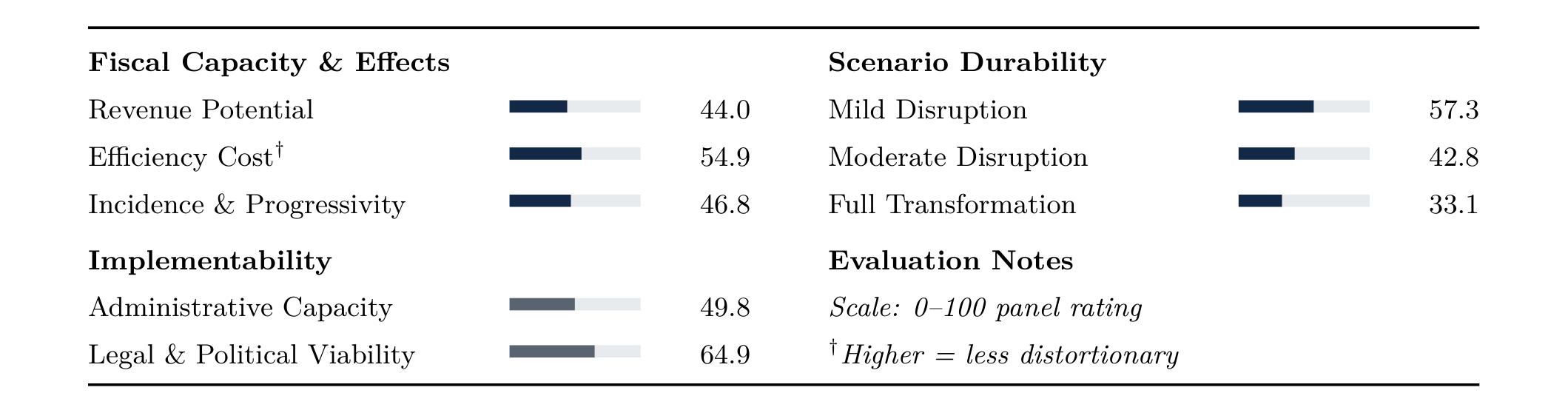
Policies to manage the AGI economic transition will also require methods of implementing and paying for them. To evaluate a set of 14 commonly-cited tax and governance policies, we have again developed a four dimension evaluative criteria, capturing each intervention's benefits to fiscal capacity, economic effects, implementation feasibility, and durability across three potential AGI economic scenarios. This framework is summarized in Table 2:
Our first dimension assesses the Fiscal Capacity generated by any particular taxation or AI governance intervention. This includes an estimate of whether any particular taxation scheme is capable of increasing government revenue. We additionally assess the size of the overall tax base. If an intervention has a high potential of increasing revenue, but is drawing from a very narrow portion of the economy, this may impose risks of market distortions and failures to capture broader revenue-generating opportunities. Finally, our measure of base stability looks at the resilience of any particular mechanism across other types of economic frictions, including the business cycle, market volatility, macroeconomic shocks, and avoidance restructuring.
Our second dimension—Economic Effects and Incidence—looks at the practical economic implications of each potential tax intervention. This dimension is composed of two pieces. The first is the efficiency cost of any particular policy, including an evaluation of possible deadweight loss and market distortions to investment, capital development, and labor supply, among other categories. Tax theory typically suggests, for instance, that taxing intermediate inputs can produce production inefficiency and potential downstream distortions (Auerbach and Hines, 2002; Diamond and Mirrlees, 1971). Our second criteria looks at the incidence and progressivity of each potential tax and governance policy. This includes evaluating the distributional burden of the intervention across capital, income, and consumption distributions.
We then evaluate the Implementability of each tax or governance intervention. Our measure of administrative capacity accounts for the complexity of any particular tax provision, including potential bottlenecks to implementation, such as those that might emerge from auditing, classification criterion, loopholes, and compliance issues. Our measure of political feasibility captures institutional and popular push back to any particular tax proposal. Of course, political attitudes may shift over time, particularly if economic conditions are altered by the diffusion of advanced AI systems. Hence, it should be noted that our evaluation of this dimension may be biased to the attitudes prevalent today.
Finally, we again assess the Scenario Durability of any particular tax intervention. This includes the same three economic scenarios as before. There are several methodological obstacles to effectively evaluating economic policies for AGI. For one, we are studying the potential usefulness of interventions for an uncertain potential future technology shock. As a consequence, we do not know for certain whether AGI will emerge in the manner we anticipate, whether its economic effects will follow patterns outlined in this piece, and, by extension, whether historical or theoretical evidence on policy efficacy will be informative for the future. Second, given the forward-looking nature of our research question, we are limited in our ability to conduct rigorous empirical analysis, including causal inference work on program efficacy. Finally, the interventions we discuss in this piece are the subject of intense debate among policymakers, social scientists, and the broader public. There is therefore considerable scope for investigator bias and variation in interpretation of existing evidence.
We employed a multi-pronged research approach to help partially overcome these methodological challenges. The core of our approach is centered around an in-depth literature review and economic analysis of each policy. Building on recent scholarship suggesting that multi-agent evaluations can be helpful for reducing certain forms of idiosyncratic investigator bias, we also used a multi-agent evidence-coding system built on methods used in (Horton, 2023). The approach works by generating a simulated panel of 51 expert economist personas, modeled after real-world prominent academic and professional economists who participate in the Kent Clark Center for Global Markets (formerly the IGM Economic Experts Panel) (Horton, 2023). These include personas modeled on such prominent economists as John Cochrane, Markus Brunnermeier, and William Nordhaus, among others—a full list is included in the Appendix. The simulation is implemented using Expected Parrot Domain-Specific Language (EDSL), an open-source package designed by Expected Parrot. EDSL constructs each agent persona by drawing on detailed biographical and professional traits, institutional affiliations, research histories, and a record of their actual responses to past Kent Clark Center surveys.
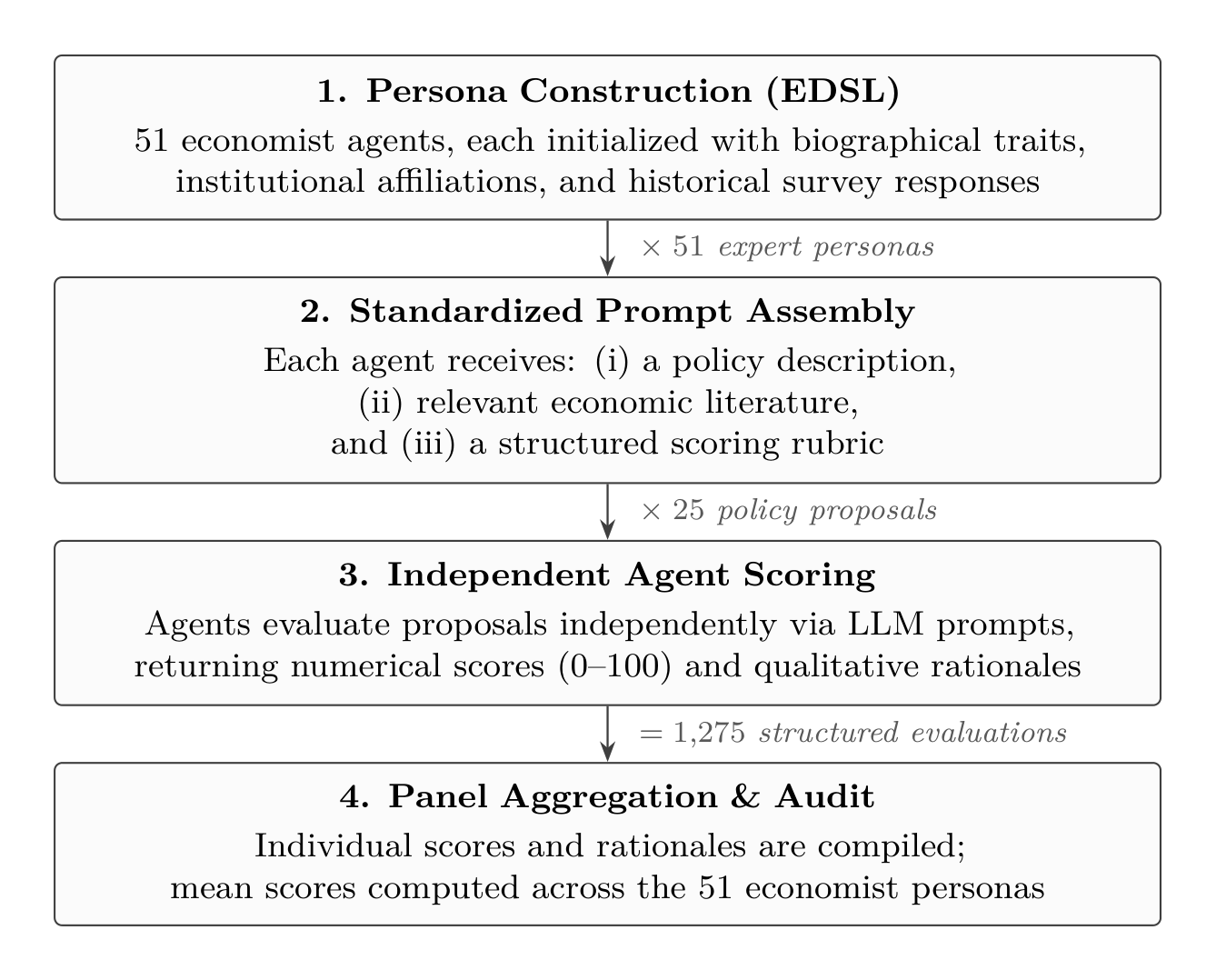
There are several advantages of this approach. First, by surveying a diverse panel of 51 agents, we remove some degree of investigator bias in shaping outputs. Second, the panel includes a broad spectrum of economic perspectives. This includes scholars with neoclassical views, Keynesian attitudes, and generally diverse sets of socio-political and economic attitudes. These agents are then prompted with extensive literature reviews, which form the basis of their individual policy evaluations. And finally, the deliberative nature of this scoring approach can be helpful in identifying areas of substantive agreement and disagreement in the literature, especially since each agents' scored outputs are restricted to a strict continuous scoring criteria (0 to 100) and a structured format for explaining their economic reasoning across each dimension. The reported averages in the paper represent mean scores across each of the personas. A complete breakdown of individual expert scores, affiliations, and qualitative rationales is provided in the Appendix. Figure 2 outlines the process of this analysis in full.
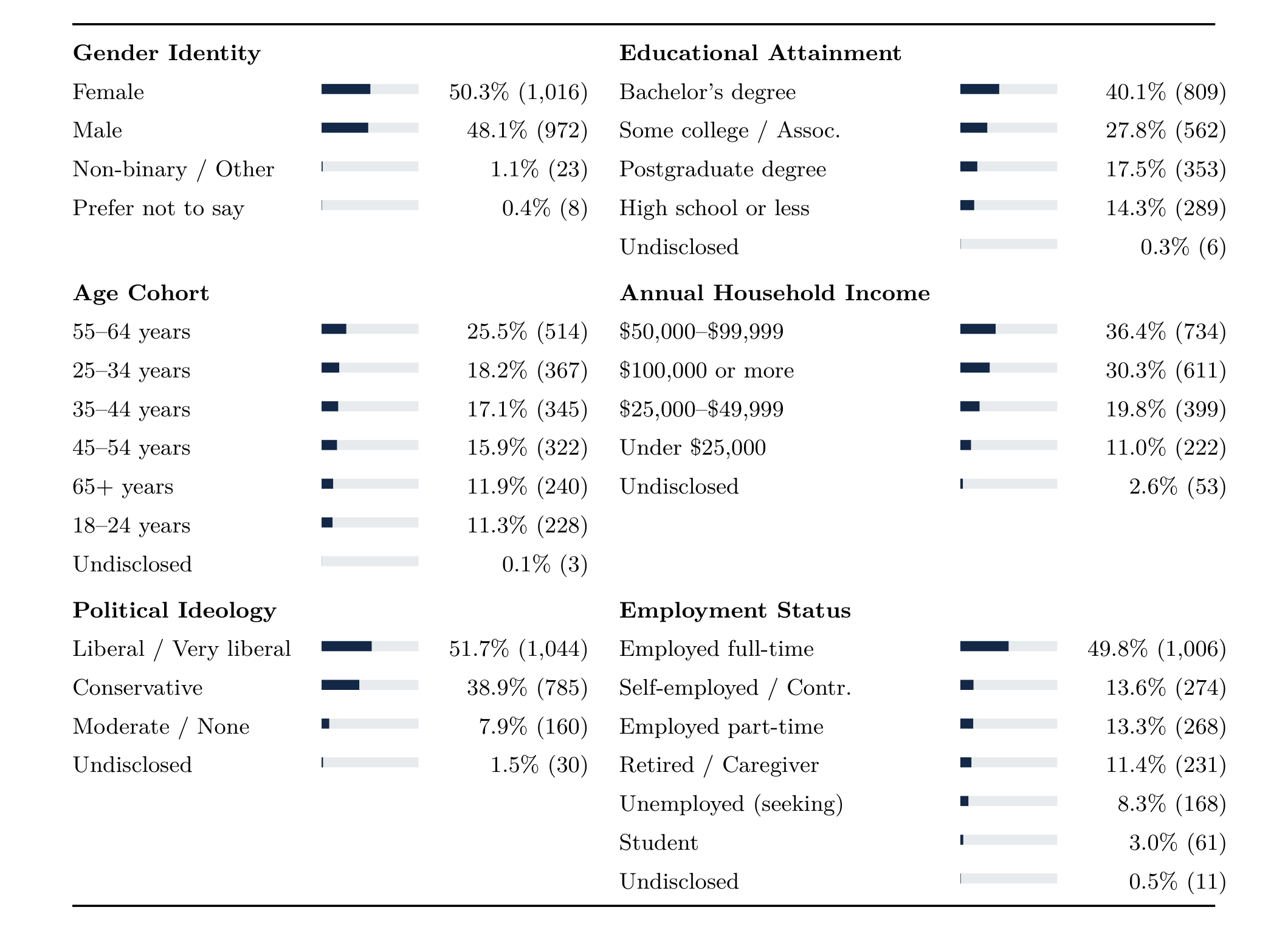
Finally, we complement these approaches with an original survey on policy attitudes. In June 2026, we surveyed a representative sample of Americans (N=2,019N = 2,019N=2,019) to gauge current public sentiments about each potential policy intervention, in addition to broader views about AI, its economic impacts, and how society ought to respond. This survey is used directly to inform our measure of public support for redistributive interventions. We summarize the demographic characteristics of our survey sample, among other details, in the Appendix.
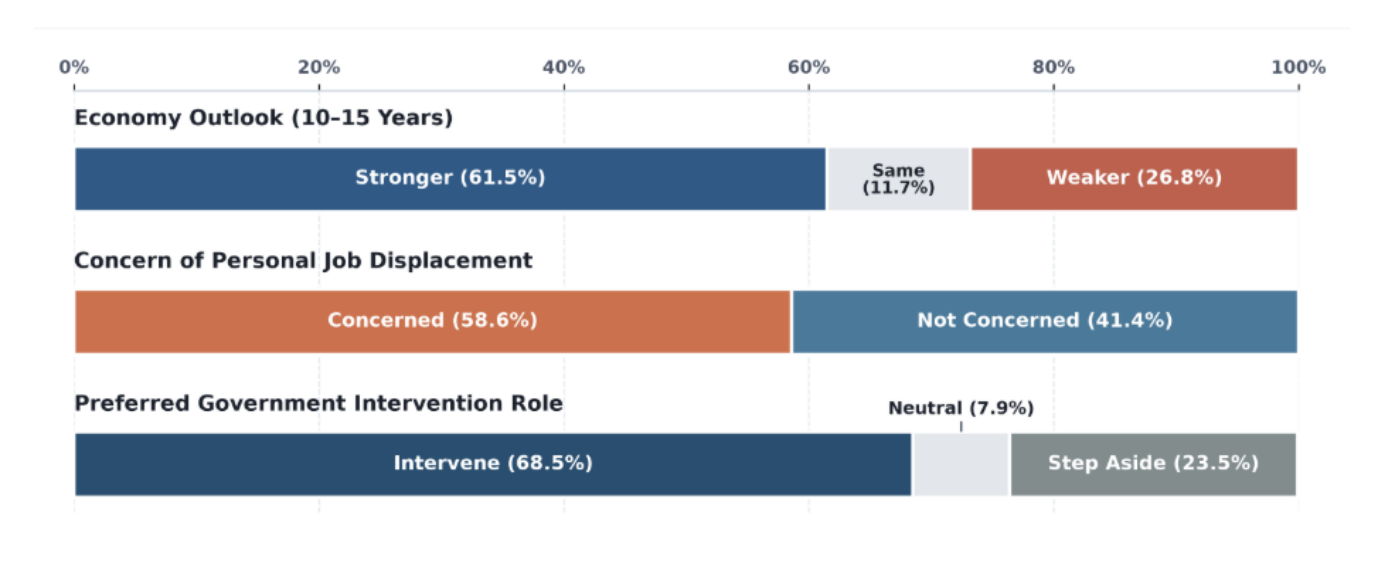
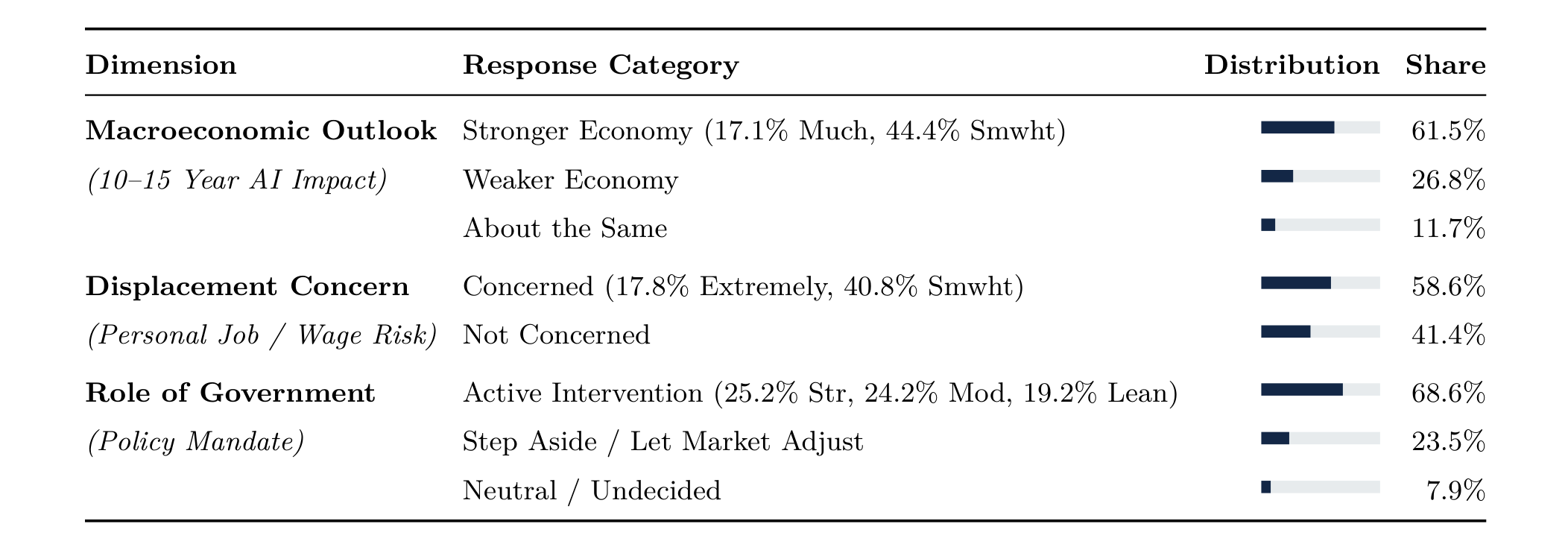
Figure 3 reports high level survey results. Across our sample, there is a majority belief that advanced AI will boost the overall economy over the next 10-15 years, with 61.5% (17.1% much stronger, 44.4% somewhat stronger). Still, and perhaps surprisingly, about 59% of respondents are concerned that AI will reduce their personal income or replace their current job (17.8% extremely concerned, 40.8% somewhat concerned). This suggests a possible tension between macroeconomic optimism about AI's broader economic implications as well as personal feelings of insecurity about potential employment effects. We believe that these attitudes may partly inform the strong preferences for government intervention in response to AI within our sample. Indeed, when Americans were asked whether the government should actively intervene to protect workers or step aside and let markets adjust, nearly 69% of respondents support some level of government intervention (25.2% strongly support, 24.2% moderately support, 19.2% slightly lean toward intervention). In contrast, only 23.5% of the sample lean toward letting the market adjust naturally, while 7.9% remain neutral.
In pursuing a mixed methods approach to answering our research question, we note several significant methodological limitations. These include, for instance, that neither historical evidence nor the agentic personas may be able to accurately project how attitudes will change in the future. Additionally, economists—even the heterogeneous sample we consider—may not offer a representative perspective, especially when weighting the normative dimensions we consider. And finally, due to the varied and idiosyncratic nature of agent behavior, it is impossible to perfectly replicate results, even with identical prompting. As a result, we view this paper as outlining a methodological framework for assessing policy questions for which the data does not currently exist. Yet we proceed with epistemic humility that the methods used here are merely suggestive of potential paths policymakers could explore; they cannot tell us definitively which interventions will be most helpful for managing AGI economic transitions. We hope that future work builds, extends, and most importantly, improves on this approach.
Economic Policies for AGI
We begin by discussing the results of our study of economic policies to help manage the AGI transition. Our survey of American public attitudes found that there is substantial public support for government interventions to help workers if AI-enabled labor displacing shocks emerge. This is in line with prior and concurrent evidence, as well as our theoretical expectations (Blue Rose Research, 2024; CSAIP, 2026; Jacobs, 2026). To date, there has been a significant increase in proposals to broadly distribute AI’s economic benefits through a diversity of mechanisms (Klinova and Korinek, 2021; Korinek and Stiglitz, 2019; O’Keefe et al., 2020). This includes various forms of basic income programs, capital sharing interventions, and worker retraining or upskilling (Altman, 2021; Autor et al., 2022; Freeman, 2015; Vivalt et al., 2024). Even before AI’s economic effects become apparent in macroeconomic data, there appears to be significant demand—across the public, academy, and policy—to design an effective framework to manage the potential economic effects of advanced AI systems (Acemoglu, 2024; Brynjolfsson et al., 2019; Cazzaniga et al., 2024; Council of Economic Advisers, 2024).
In this section, we proceed with our analysis of 11 redistributive interventions to help manage the AGI economic transition. Some of these policies work by attempting to directly cushion against the immediate frictions and disruptions that might emerge as a consequence of highly capable AI systems. Others aim to ensure there are opportunities for people to continue participating in economic life, even if many jobs disappear. Meanwhile, these policies can broadly be sorted into two categories. The first is targeted policies, which administer support generally conditioned on an eligibility criteria—for instance, wages or employment status. Universal policies, by contrast, offer benefits irrespective of most need-based or eligibility-informed criteria. Of course, policies operate across a spectrum, and there is no strict binary between targeted and universal interventions; however, this can nonetheless be a helpful framework for understanding how policies work. In Table 3, we list all 11 policies that we evaluate in this paper, along with a brief definition of each, sorting between targeted and universal interventions. We note again that, though this list of interventions captures many commonly-cited policy ideas, it is not all-encompassing.
With this list of interventions in mind, Table 4 reports the results from our panel analysis. Our work produces four main findings. First, we show that public support for an intervention is negatively correlated with an intervention’s likely durability under a Full AGI Economic Transformation. We similarly show that the readiness of an intervention today is negatively correlated with its durability in scenarios marked by full AGI economic transformation. Third, our analysis shows that the interventions that raise material living standards are largely distinct from those that provide a direct ownership stake in AI-driven capital growth. Finally, given uncertainty over which scenario is likely to emerge, resolving these three trade-offs points to a package of sequenced policies that are implemented according to data-driven trigger rules based on which scenario becomes more likely. These policies lie on the Pareto frontier of the dimensions we consider, and include expanded unemployment insurance (UI), expanded earned income tax credits (EITC) and employer-led retraining programs in the case of Mild Scenarios, negative income taxes (NIT) in the case of a Moderate disruption, and—in scenarios of Full Transformation where economic growth decouples from wage growth—a pre-distribution policy such as universal basic capital (UBC) intervention.
Public support and scenario durability run in opposite directions
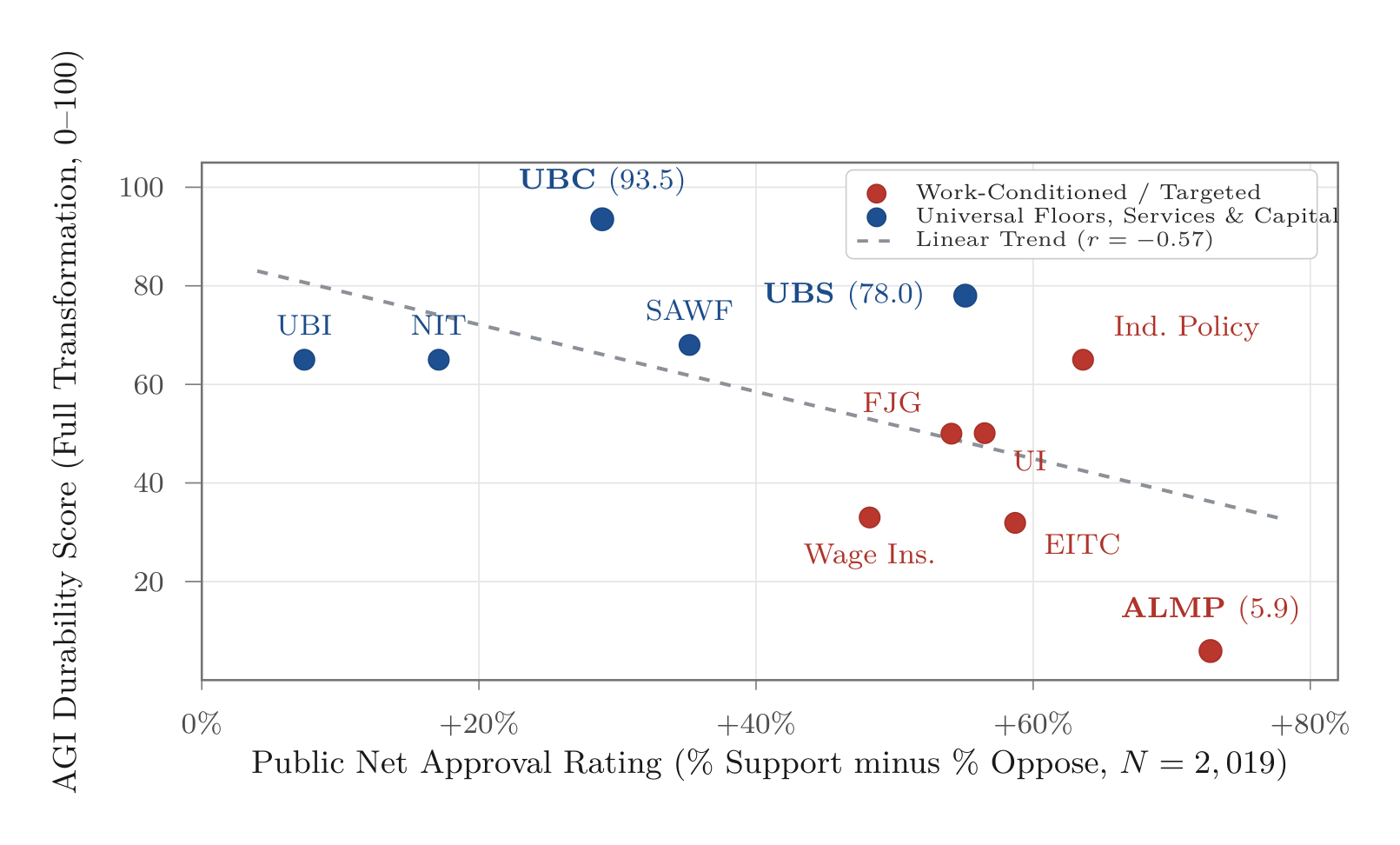
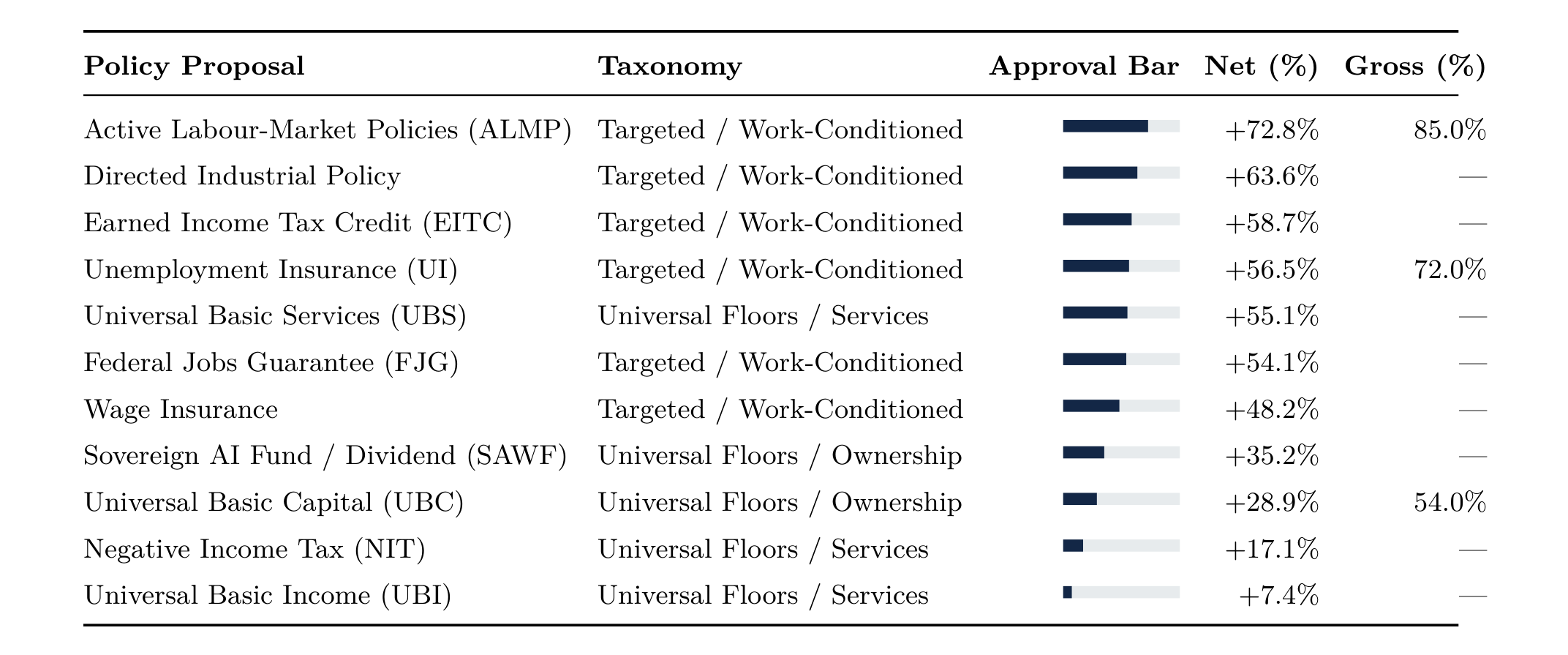
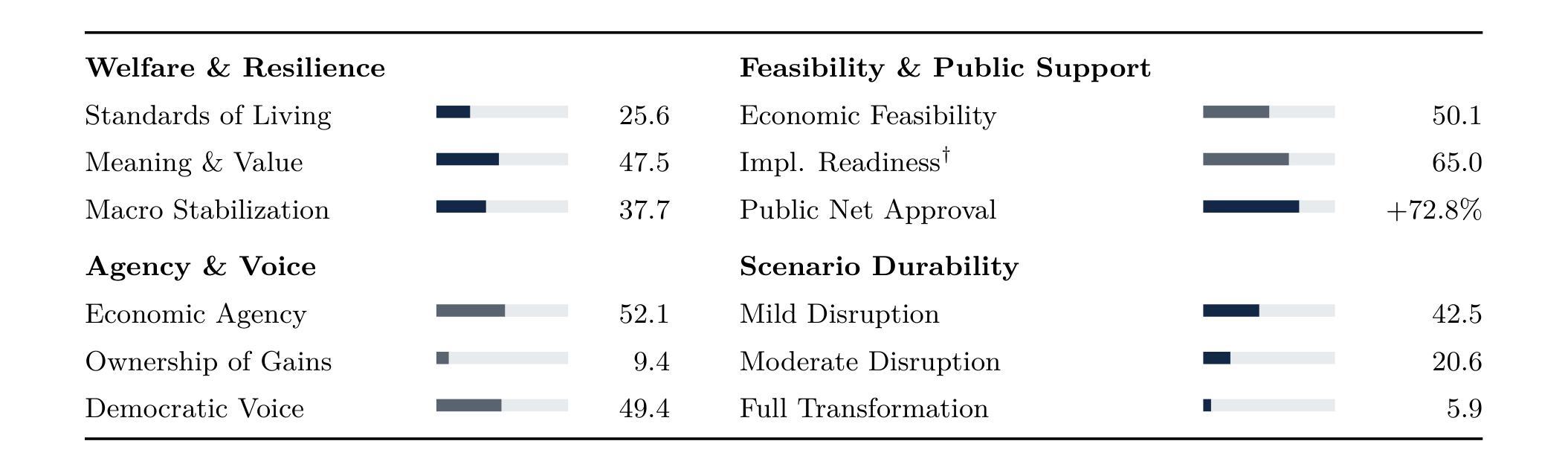
Table 4 shows that rating scores and public net approval for particular policies pull in opposite directions. This implies that the programs that are most popular with the public are not the ones identified as being most durable in managing the AGI economic transition. For instance, retraining receives exceptionally high popular approval scores of +72.8 percentage points. Yet it has the lowest durability score, with 23 on average, and just 5.9 under a full AGI economic transformation. These results are made further apparent in Figure 4, which plots public net approval from our representative survey of Americans against durability in a full transformation scenario. We find a pronounced negative relationship (r=−0.57r = -0.57r=−0.57), suggesting that the interventions that command the most support today are ones that may be particularly fragile in a scenario where AI capabilities lead to a substantial transformation of economic activities and the labor market. On the other hand, the exact interventions rated as being most capable of withstanding a transformative AGI economic scenario were ones that received skepticism from the public survey. Of course, these results are true only of respondents surveyed today. These attitudes may shift as the level of disruption labor markets changes.
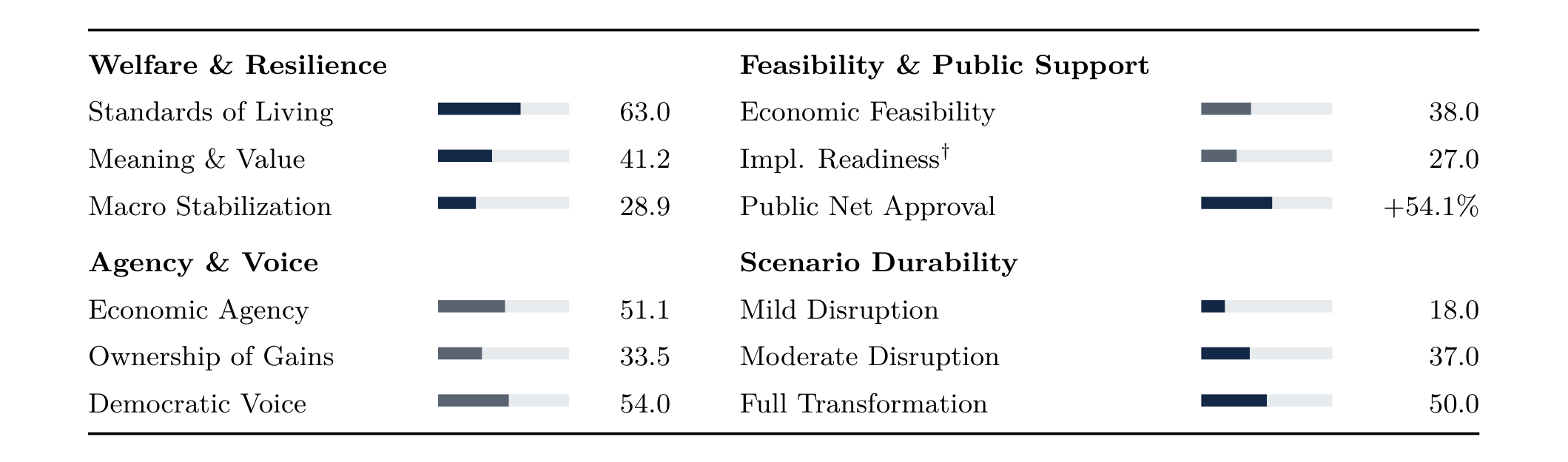
What explains this mismatch between durability and public preferences? One answer may lie in Americans’ normative attitudes. An extensive literature suggests that public attitudes about redistribution are heavily moderated by perceptions of reciprocity, contribution, and deservedness. (Alesina and Glaeser, 2004; Bowles and Gintis, 2006; Stantcheva, 2021). Today’s US public may therefore think of social assistance, not as an unconditional entitlement, but instead as part of a social contract between members of society. In that context, formal employment may serve as a core means through which people understand contribution, deservedness of social security, and social standing (Jahoda, 1982). If this theoretical mechanism is correct, it would help explain why interventions that condition assistance on labor force participation—or attempts to rejoin the labor market—receive the highest levels of support. Beyond worker retraining, we can see this in high net approval scores for directed industrial policy (+63.6 percentage points), the earned income tax credit (+58.7 percentage points), unemployment insurance (+56.5 percentage points), and a federal jobs guarantee (+54.1 percentage points).
Yet existing norms that create a preference for work-conditioned social security and redistribution may be challenged in the more disruptive and transformative AGI scenarios. Active labor market programming such as retraining and wage subsidy programs function effectively only to the extent that technological progress creates new demands for human labor. Their success is primarily conditioned on the program smoothing labor transitions, both in terms of encouraging re-hiring and supplementing wages. This is an effective intervention in cases where technological disruption is mild or localized, and where the challenge is primarily about helping workers shift across occupations and reduce friction in labor market transitions.
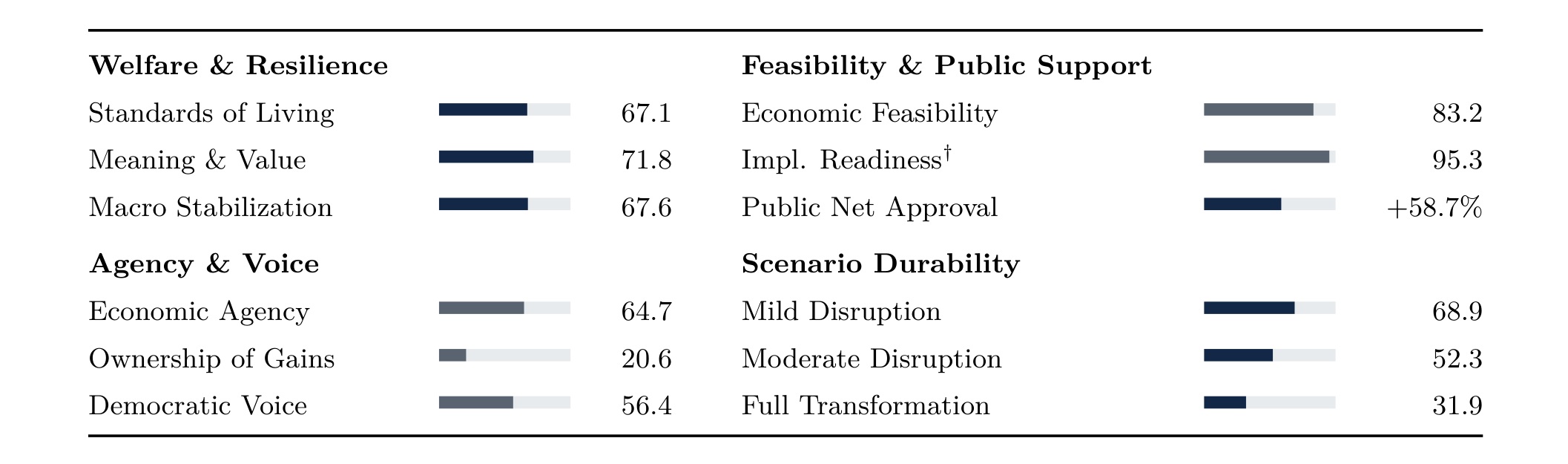
Yet under a scenario marked by a deep AGI economic transformation, AI systems could reduce the number of viable destinations for workers. A major concern, then, would be that retraining and other active labor market programs would simply reshuffle a queue of jobseekers, changing who might get remaining work opportunities, but not changing the availability of work (Card et al., 2018; Jacobs and Canedy, 2026). In other words, it’s not clear that retraining can create jobs where they might not otherwise exist. Similar problems confront other work-conditioned interventions like the EITC (whose durability falls from 68.9 under mild disruption to 31.9 under transformation) and wage insurance (falling to 33.0). In both cases, earnings subsidies might cushion workers, but they may do little for workers who endure prolonged bouts of unemployment (or under-employment), or who leave the labor market altogether.
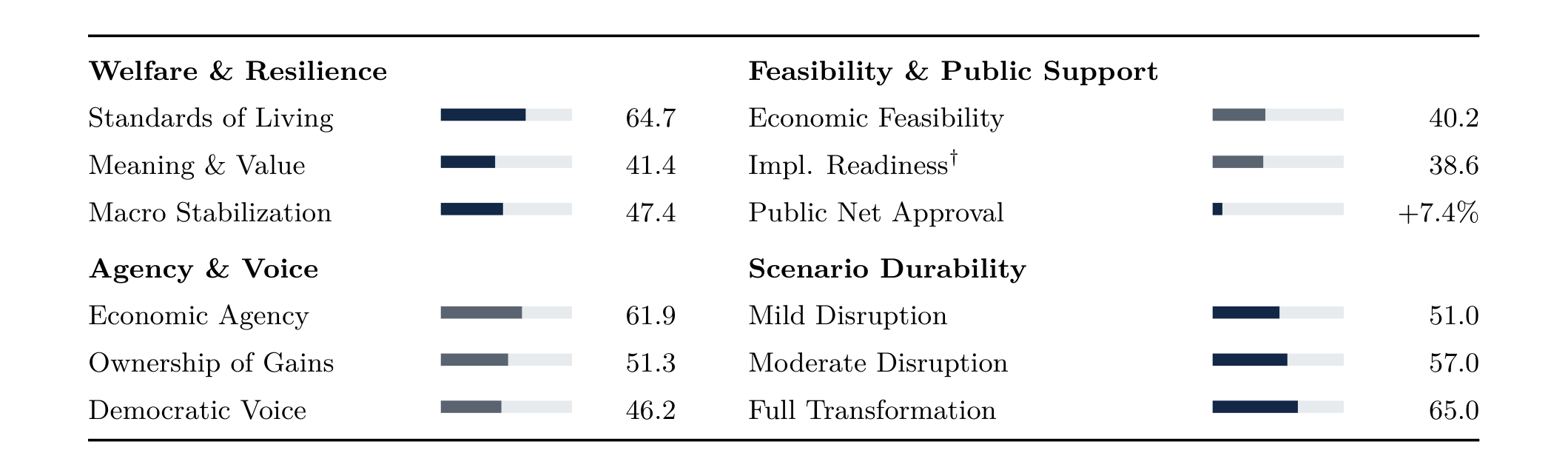
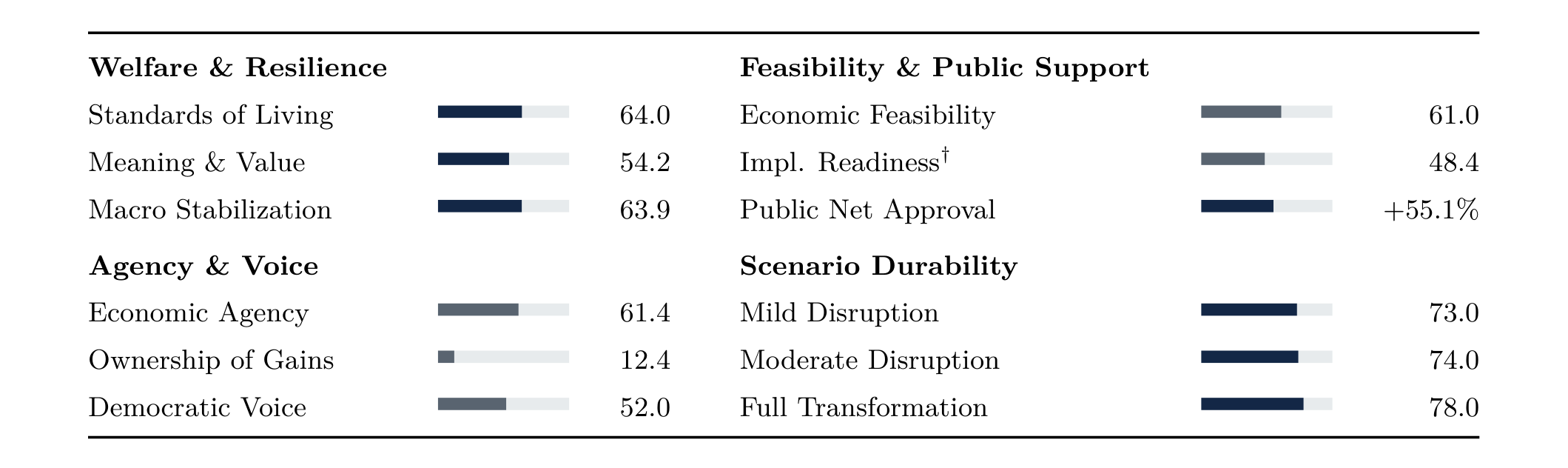
On the other side, unconditional safety nets and pre-distributive capital sharing models are more effective in supporting citizens in scenarios of more transformative AGI. Yet the universal basic income receives the lowest net approval of any policy in our survey (+7.4 percentage points), while the negative income tax garners only +17.1 percentage points. Universal basic capital, meanwhile, receives just +28.9 percentage points of net support.
One exception to the trend is universal basic services (UBS). Indeed, unlike other universal and non-work conditioned cash transfer programs, UBS receives very strong public net approval (+55.1 percentage points). Our analysis also suggests it is durable across the three scenarios we evaluate—it received a durability rating of 73.0 under mild disruption and 78.0 under full transformation. How might we reconcile this aberration in public support for universal policies? One answer is that the American public might make a distinction between unearned economic transfers and in-kind benefits, such as those related to healthcare, childcare, education, and transit. Indeed these sorts of public goods are already more firmly embedded within existing notions of the social contract. UBS is also more implementable because the ease of deploying in-kind benefits may not fundamentally change if full AGI economic transformation emerges. Although we have identified a mismatch between current public attitudes and the durability of particular interventions across potential AGI economic scenarios, public attitudes may shift. If AI does indeed usher in significant labor displacement, it seems plausible that public opinion may change, for instance, to greater support for universal policies that provide support regardless of employment status.
Durability-readiness trade-offs
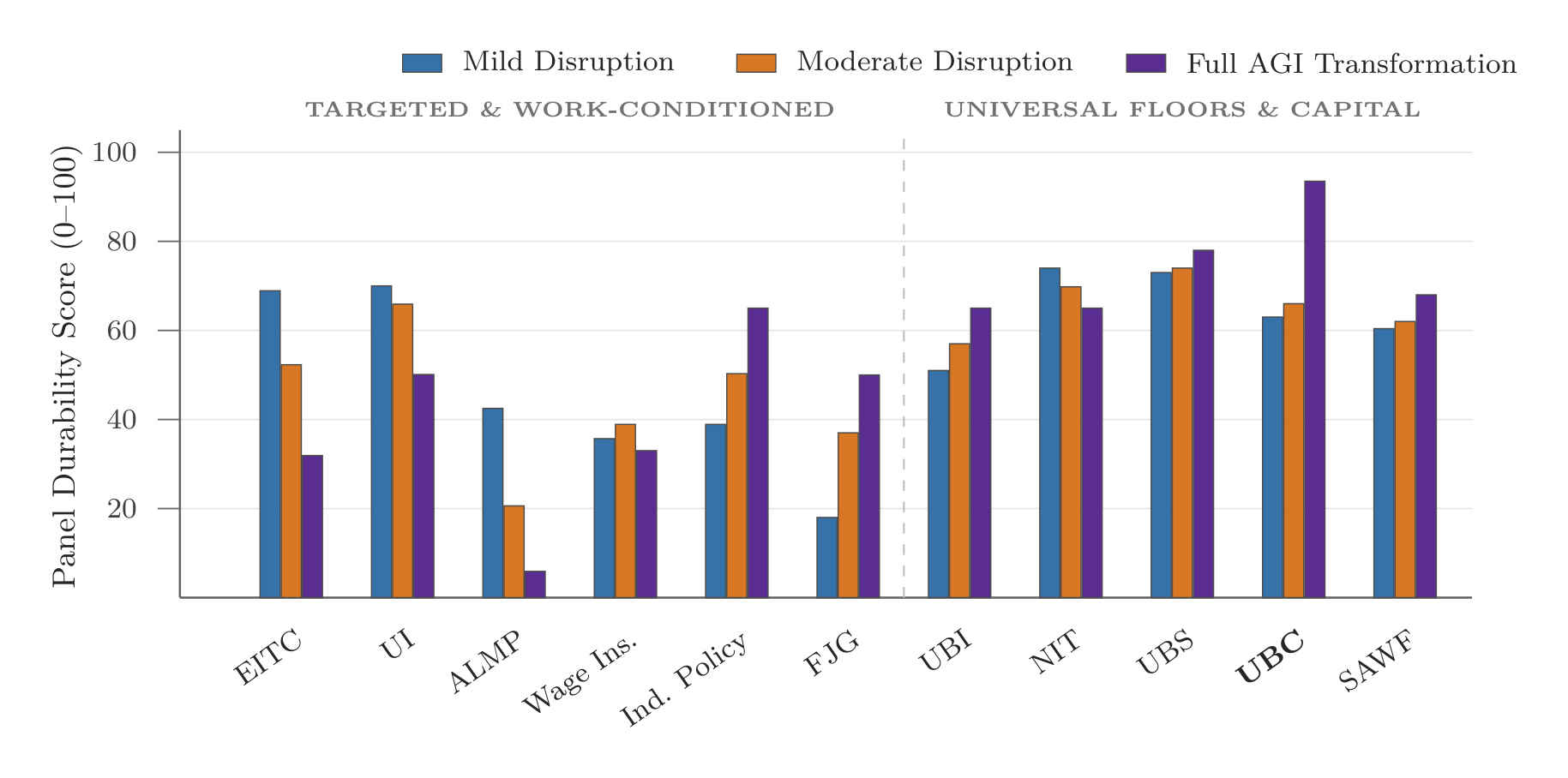
The analysis also points to a potential negative correlation between the near term feasibility of any particular redistribution policy in mild AGI economic scenarios and its durability in transformative scenarios. We illustrate this in Figure 5, which shows policy resilience across progressively deeper levels of AGI economic shocks. We note that the interventions that receive the highest readiness ratings under mild scenarios see a marked reduction of their durability scores as AGI’s economic impacts become more pronounced. The precise reasons for this may vary across policies. Some interventions like active labor market programs may lose their effectiveness and impact as the economy changes and experiences disruption. Meanwhile, other interventions may become administratively more challenging for governments to deploy.
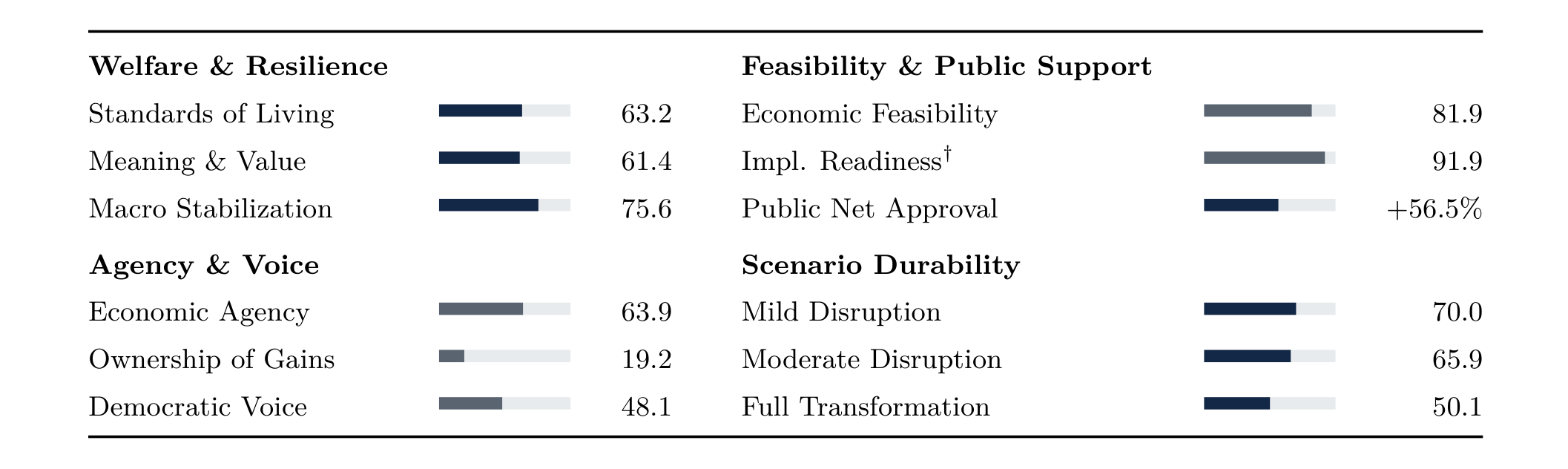
The nature of this tension can be seen in the left-hand panel of Figure 5, which shows the performance of both targeted and universal policies across the three AGI economic scenarios we consider. Under mild disruption, where the labor market fundamentally remains intact but AGI can shifts demand for particular skills, many existing interventions may perform well. For instance, unemployment insurance (UI) scores 70.0 for durability, while the earned income tax credit receives 68.9. In mildly disruptive scenarios which shift demand for skills and corresponding wage premia, UI and EITC could help workers who need to re-skill into new forms of employment while supporting them during the transition.
Yet if the nature of the AGI’s economic impacts broaden, both EITC and UI both perform worse, at 52.3 and 65.9 respectively under moderate disruption scenarios, and 31.9 and 50.1 under full transformation. Active labor market scores, meanwhile, deteriorate from 42.5 under mild disruption to 20.6 under moderate disruption. In a moderate scenario, the job market is still dynamic but there could be considerable latency in the emergence of new well-paid employment and we might see a widening of wage inequalities across the employment distribution, akin to prior major technology shocks. If this occurs, UI and EITC programs may do too little to cushion a fundamental mismatch between workers’ desire for well-paid and economically useful work and what is available to them in the labor market. These work-conditioned and targeted interventions, unsurprisingly, continue to lose their usefulness as AGI diffuses and the rate of economic substitution widens to comprise a full economy transformation.
We see an opposite trajectory among universal policies. These programs initially receive lower scores under mild scenarios due to their greater barriers to implementation, potential to create market distortions if not well timed, and lower levels of public support. Yet the analysis suggests that their durability may increase as AGI’s economic impacts widen and economic growth meaningfully decouples from wage growth. For instance, universal basic capital (UBC) sees its score increase from 63.0 under mild disruption to 66.0 under moderate disruption and 93.5 under full AGI transformation (the highest score in our study). This dynamic is intuitive. Broadening the ownership of capital today might face a battery of challenges from feasibility, efficiency, and a lack of political and popular support.
However, in the Full Transformation scenario where a large portion of economic growth is decoupled from labor, broadening capital ownership may be important for giving everyone a stake in the productive economy (Ackerman and Alstott, 1999; Altman, 2021; Hamilton and Darity, 2010). This is roughly in line with previous bi-partisan proposals to give Americans a baseline equity stake in the US economy as part of their retirement accounts (Bipartisan Policy Center, 2016; Ghilarducci and Hassett, 2021; Hickenlooper et al., 2023). For the same reasons that UBC is particularly helpful as a means to share AGI’s economic benefits in a capital-driven economy, UBI receives lower scores, since it does not give people an ownership stake in the AGI-driven economy, providing a subsistence stipend instead. Meanwhile, Universal Basic Services (UBS) remains remarkably durable across all three AGI economic scenarios that we considered in this paper, receiving 73.0 under mild disruption, 74.0 under moderate disruption, and 78.0 under transformation.
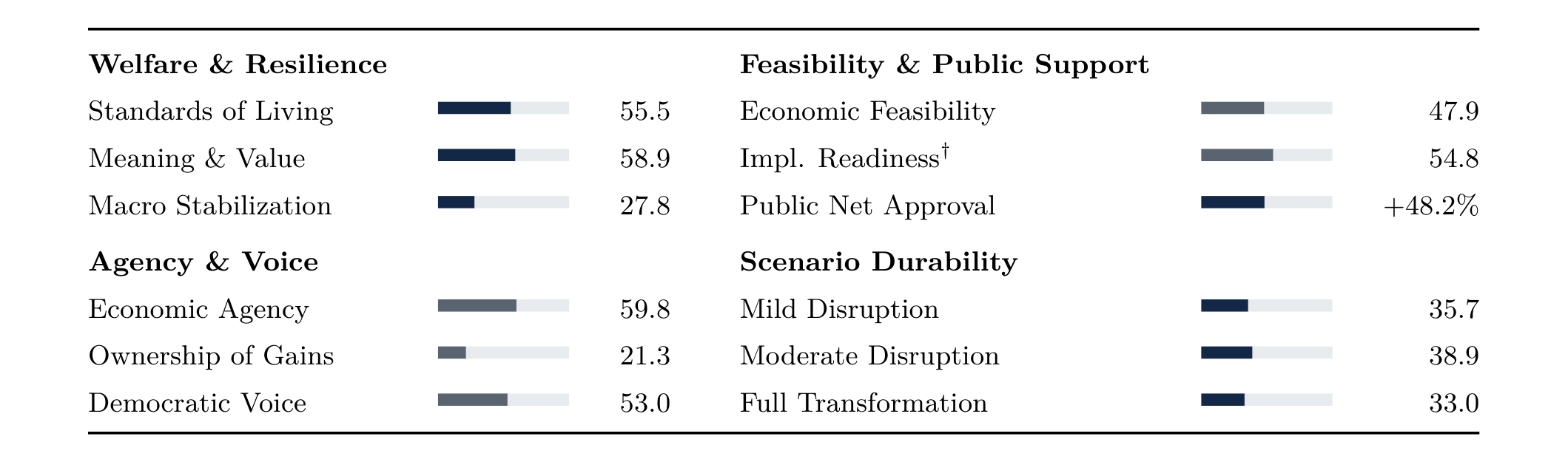
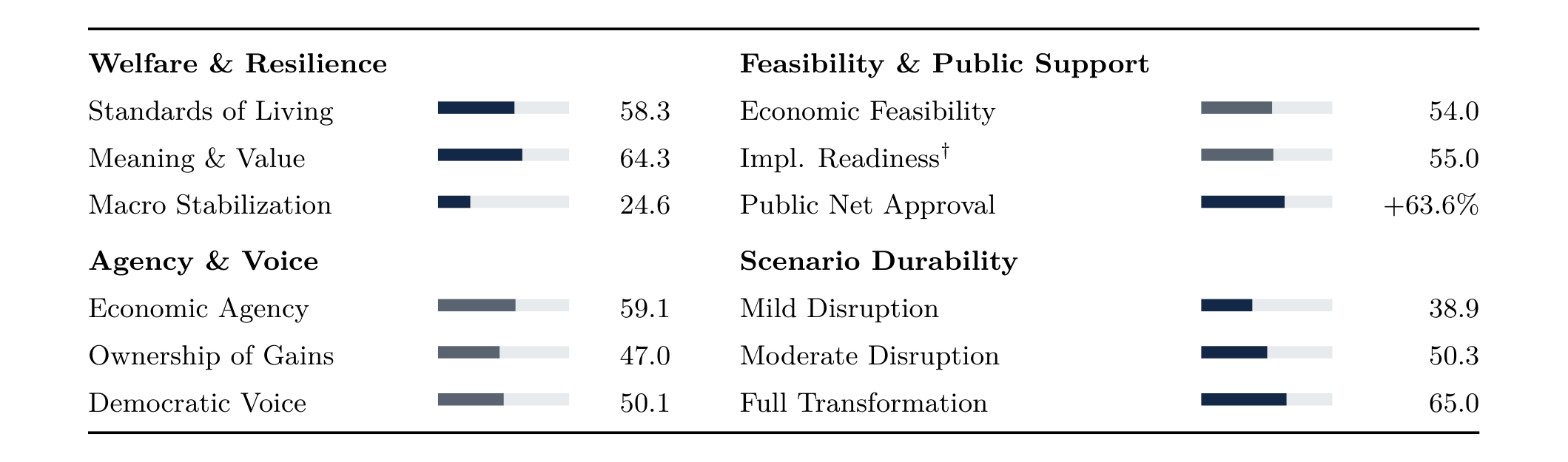
We also note that directed industrial policy and a federal jobs guarantee present unconventional durability profiles, rising from 38.9 to 65.0 and 18.0 to 50.0 from mild disruption to full transformation. Both interventions are targeted ones, designed to kindle economic activity, share AGI’s economic gains, and create jobs through targeted spending. Their mechanisms vary greatly, but both were penalized in our analysis for potential inefficiencies, deadweight loss, and the risk of fraud, among other considerations. However, we note directed government spending on jobs or industrial capacity can create new sources of employment, which may not have otherwise emerged spontaneously in the economy. Industrial policy could create economically-useful sources of employment if targeting areas of market failure, for instance in helping building out and updating America’s physical built infrastructure. A jobs guarantee could create last-resort employment opportunities, but received low scores across all three scenarios due to the high capacity for waste and market distortions. Although industrial policy and a federal jobs guarantee mark two examples of targeted interventions that see an increase in scores under more extreme AGI scenarios, they may be less-effective than other interventions and therefore do not lie on the Pareto frontier.
Living standards and ownership of gains
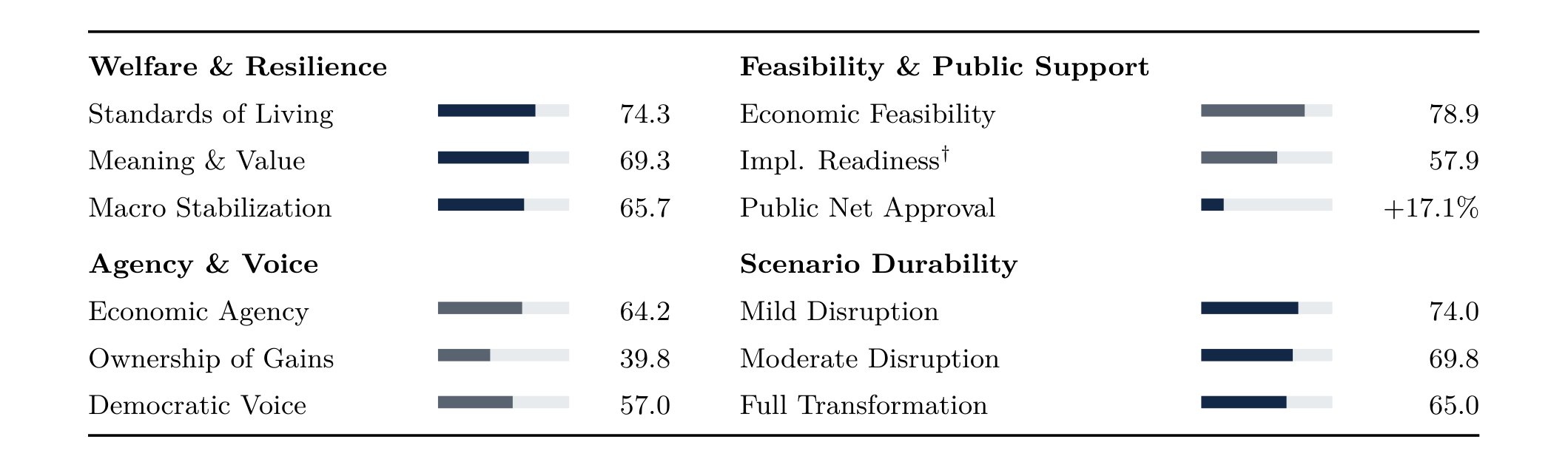
Next, we see a sharp divergence between the interventions that support household living standards and those that offer direct ownership of capital. In our analysis, a wide range of interventions receive strong scores for their capacity to boost material living standards. Indeed, 10 of the 11 evaluated policies receive living standards scores above 52, with seven exceeding 62. This includes the earned income tax credit (67.1), unemployment insurance (63.2), universal basic services (64.0), universal basic income (64.7), and negative income tax (74.3)
By contrast, only a small handful of interventions offer stakes in capital, which may become important in the full transformation scenario of AGI. Universal basic capital (UBC) scores high on our ownership measure (94.9). But a Sovereign AI Fund, where the government holds stakes in AI firms and distributes dividends to citizens using AI-generated economic gains, receives a significantly lower score of 54.9. This is largely because if AGI does indeed boost economic growth, those gains should occur across many industries, not just in the AI sector. Specifically, AI may act like other general purpose technologies like electricity, where most of the value accrued downstream to firms using the technology. For example, a lot of AI’s value may accrue to the application layer, or the firms that build specialized harnesses and use AI as a complement to their organizational capital. These gains would not be picked up by a Sovereign AI fund despite the economy still undergoing substantial disruption and transformation. A Sovereign AI Fund that is built purely on AI firm capital may therefore be less effective than giving all citizens a diversified stake in the economy’s capital.
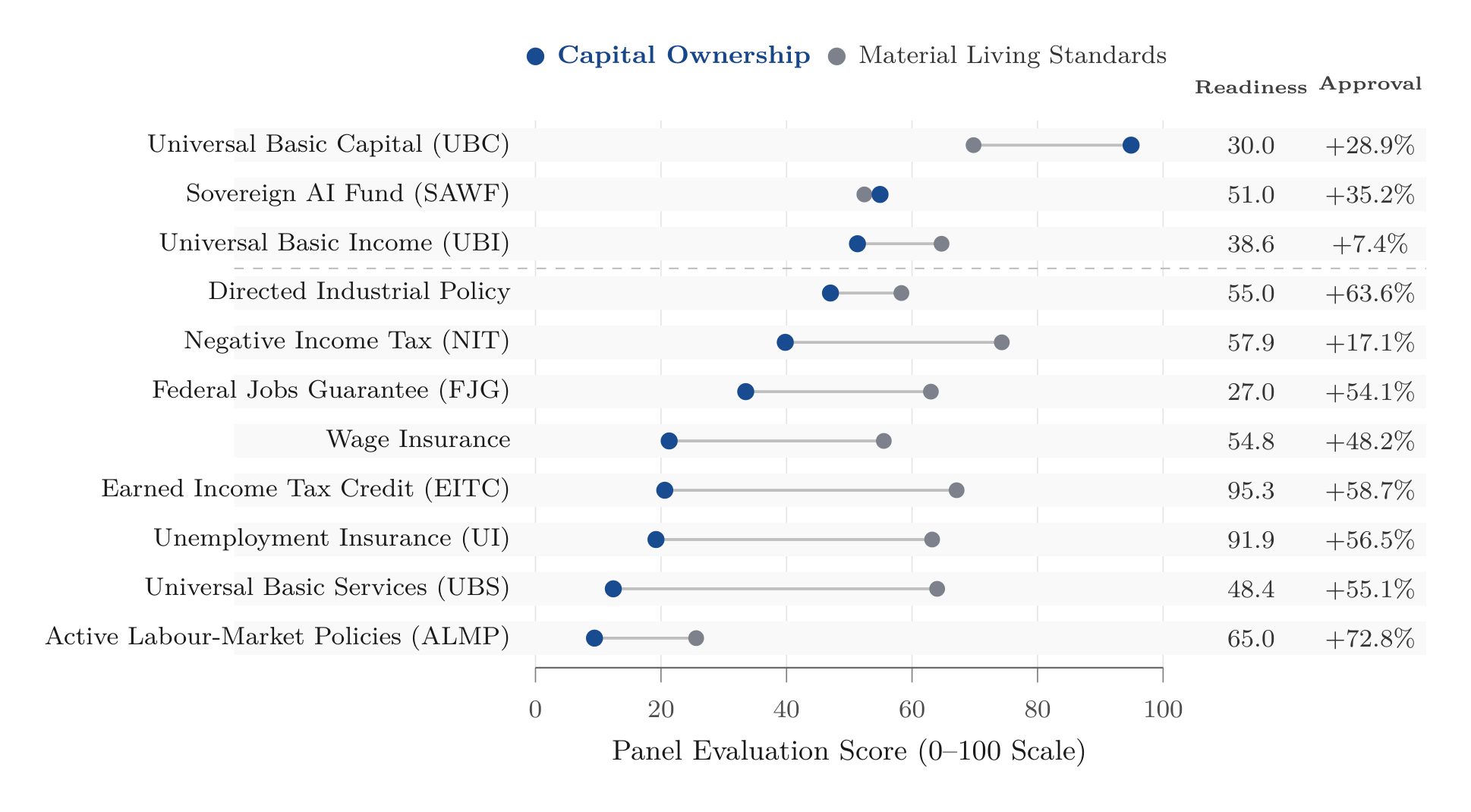
Still, as we show in Figure 6, UBC is likely to face steep hurdles. It scores only 30.0 on implementation readiness, which speaks to the difficult institutional, administrative, and political barriers the policy might face. UBC also has only modest net approval rating of +28.9 percentage points, which is low compared to other considerably more popular redistributive measures. The Sovereign AI Fund does a little better, with an implementation readiness score of 51.0 and net approval of +35.2 percentage points. Taken together, these three empirical tensions, between public support and durability, mild versus transformative resilience, and living standards versus capital ownership, demonstrate why no single static policy is sufficient.
Altogether, our findings suggest that policymakers face a distinct trade-off across AGI economic scenarios. The interventions most useful in cases of mild disruption may not be the ones that are most helpful in an economy marked by a full AGI transformation. The interventions that can be rolled out with the greatest administrative ease today—including unemployment insurance, EITC, and retraining—see a marked deterioration of their durability as the scale of AGI’s economic effects grow. By contrast, the most effective long-term solutions—including universal basic capital—score low in feasibility, may be distortive, and are relatively unpopular today. As we discuss next, these results suggest that a sequenced approach to policy implementation, reliant on triggers that respond to emerging data signals, may be most helpful in managing the economic impacts of AGI.
A robust core and phased policy sequence
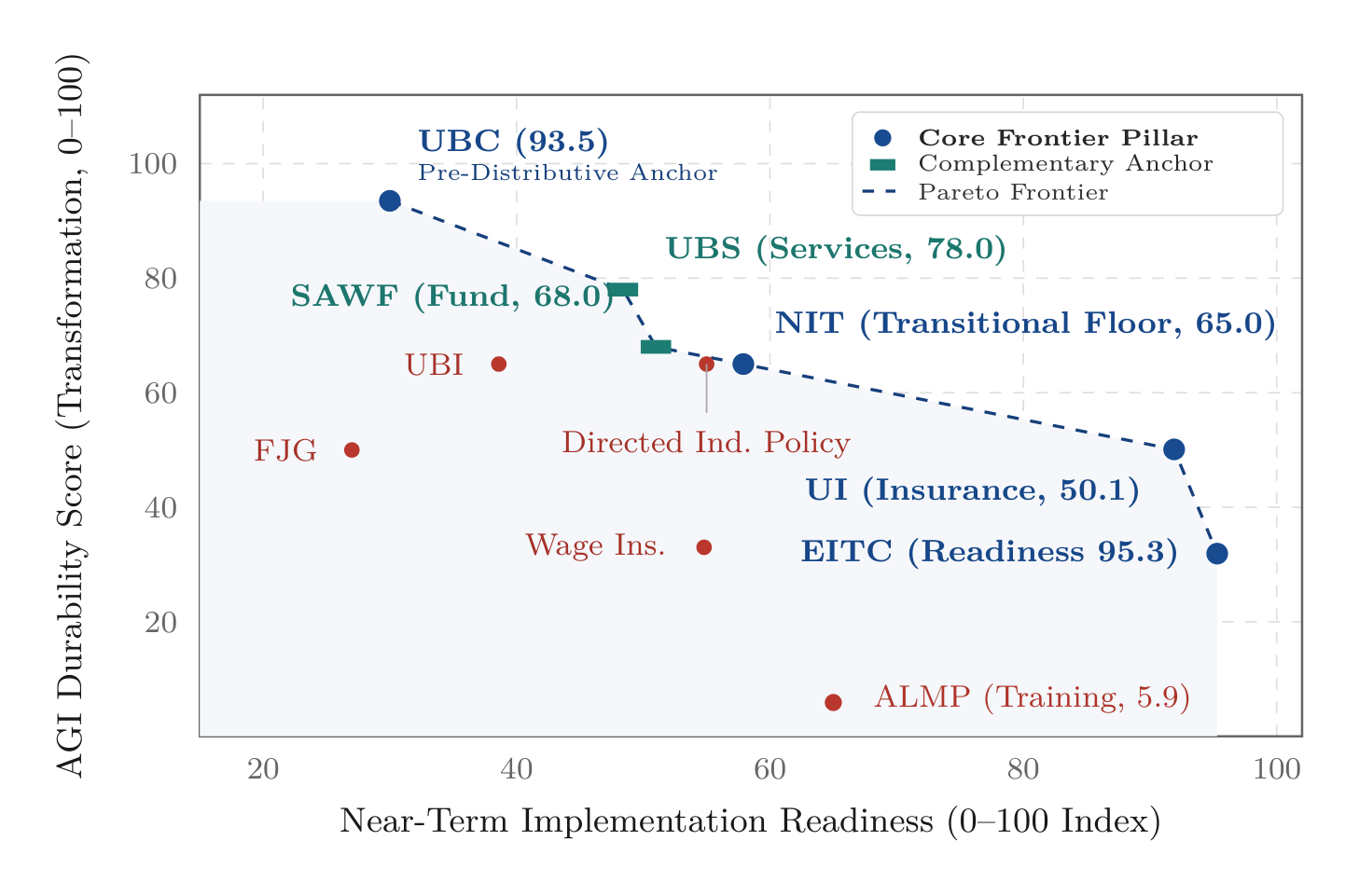
Given the mismatches between mild-scenario durability and transformative-scenario durability, selecting effective package of redistributive interventions is a challenge. Our analysis identifies a small group of policies that obtain high scores across the dimensions we evaluate, laying on the Pareto frontier of those dimensions, which includes durability to different AGI scenarios. This frontier and the associated policies are illustrated in Figure 7. For instance, expanded unemployment insurance (UI) and the earned income tax credit (EITC) perform well across material living standards (63.2 and 67.1 respectively), meaning (61.4 and 71.8), macroeconomic stability, (75.6 and 67.6), and agency (63.9 and 64.7). Meanwhile, both score high in feasibility, with UI and EITC ratings for economic feasibility at 81.9 and 83.2 and implementation readiness ratings at 91.9 and 95.3. These high scores can be explained by the fact that both interventions rely on existing and well-developed administrative infrastructure. For instance, an expanded EITC directly integrates into the federal income tax system and UI already benefits from established federal and state deployment mechanisms. An expansion of both interventions, which widens eligibility requirements and increases compensation levels, could therefore offer income support and automatic macroeconomic stabilization support without requiring entirely new administrative structures.
The Negative Income Tax (NIT) achieves particularly high scores across our measures of welfare outcomes and scenario durability. For instance, it receives the highest score for living standards (74.3) of the 11 interventions we evaluated, in addition to solid ratings for meaning (69.3) and agency (64.2). The NIT is also rated as more durable across the three AGI economic scenarios, relative to UI and EITC. The strong scores for NIT are in line with the fact that, if designed well, it creates a solid welfare baseline alongside an incentive to work, since its phase-out mechanism against earned income makes work more financially rewarding than non-work.
One limitation of the NIT is its current administrative feasibility. It receives high scores for economic feasibility at 78.9, which is in line with current bi-partisan literature (Friedman, 1962; Hoynes and Rothstein, 2019; Moffitt, 2003; Tobin, 1965). Yet its implementation readiness is 57.9, which is markedly below EITC (95.3) and UI (91.9). Although it is economically efficient, a well-designed NIT requires regular measures of household income and the infrastructure to distribute regular payments, as opposed to as part of year-end annual returns (Alstott, 1995; Nichols and Rothstein, 2016; Splinter et al., 2026). This is not an insurmountable administrative challenge, but it is one that would require concerted policy and legislative efforts. Therefore, an expanded EITC, which expands existing supplement wages for low income employed workers , may be a more appropriate response to Mild scenarios, while investments are made to transition it to a NIT when signals for the Moderate scenario emerge.
Finally, as discussed above, universal basic capital (UBC) anchors the frontier under Full Transformation. It achieves the highest durability (93.5) and ownership (94.9) scores by giving citizens a direct equity stake in the productive economy. Yet because it scores low on implementation readiness (30.0) and has relatively low popular and political support, it should be phased in as signals for the Full Transformation scenario begin to emerge. Instead, it would be a worthwhile investment to pre-design UBC’s institutional and deployment infrastructure so that it can be ready if it is needed.
Our work suggests that a data-driven phased sequence of policies might offer the best response to managing a deeply-uncertain AGI economic transition. Indeed, the trade-offs faced by policy makers are difficult to resolve within any single, static institutional framework. The policies that democratic legislatures can deploy with the greatest administrative ease today—expanded unemployment insurance, retraining, and EITC—are less durable in more transformative scenarios. Policies like the NIT and UBC have higher durability across scenarios, but they have lower support and face higher costs and institutional barriers. A sequencing of policy interventions could help manage labor market frictions in mild AGI-economic shocks. Meanwhile, policymakers could concurrently establish necessary infrastructure, data collection, and trigger rules to prepare the economy in the event that more transformative scenarios materialize. Practically, this includes developing the infrastructure to deploy an NIT or UBC program, if necessary.
Funding AGI Policy
Of course, any country's ability to mobilize redistribution policies, such as the ones outlined in this paper, is contingent on its ability to pay for those interventions. In this section we, briefly discuss the results of our analysis about how the United States could raise funds to support policies in each of the three disruption scenarios we consider. In doing so, we also emphasize the importance of continued incentives for growth and competition. AGI's potential economic impacts are confounding, not only because of their possible distributional effects, but also because they could change and compresses governments' ability to collect revenue through taxation (Korinek and Lockwood, 2026). Conventional social safety nets financed through payroll deductions and personal income taxes could face shortfalls, exactly at the moments when redistribution is most needed.
We now briefly examine fourteen revenue, financing, and governance mechanisms, which could be helpful in raising public revenue amid a potential AGI economic transition. Each policy is evaluated across four core dimensions: Fiscal Capacity, which captures the revenue potential and the stability of the funding base. Economic Effects and Incidence looks at the potential for deadweight loss, distortions, and broader negative distributional consequences. Implementability measures the feasibility of deploying the mechanism from an administrative and political perspective. Finally, as we did with redistribution policy, we look at Scenario Durability across our three scenarios of (Mild Disruption, Moderate Disruption, and Full Transformation).
Notes: Panel categorizations and instrument ordering correspond to the evaluation in Table 6.
Table 6 reports the evaluation ratings from our agent panel. Similar to our findings in the redistribution analysis, the ratings suggest substantial heterogeneity across mechanisms and across transformation scenarios. The full results of our analysis are in the Appendix. Two main findings emerge. First, our work suggests that more traditional funding instruments, such as expanded corporate and top marginal personal income taxation, when paired with land value taxes, form a fiscally attractive strategy that is durable across scenarios. This strategy could have minimal distortive effects while maintaining incentives for growth and competition. Second, the analysis suggests that taxes targeting AI inputs (e.g., token taxes) are dominated by the previously listed alternatives because the former will likely introduce distortions (e.g., on how models are trained) which will have unintended consequences for productivity, growth, and potentially safety as well.
Notes: All criteria are evaluated on a continuous 0–100 scale by simulated economist agents (N=51N = 51N=51).
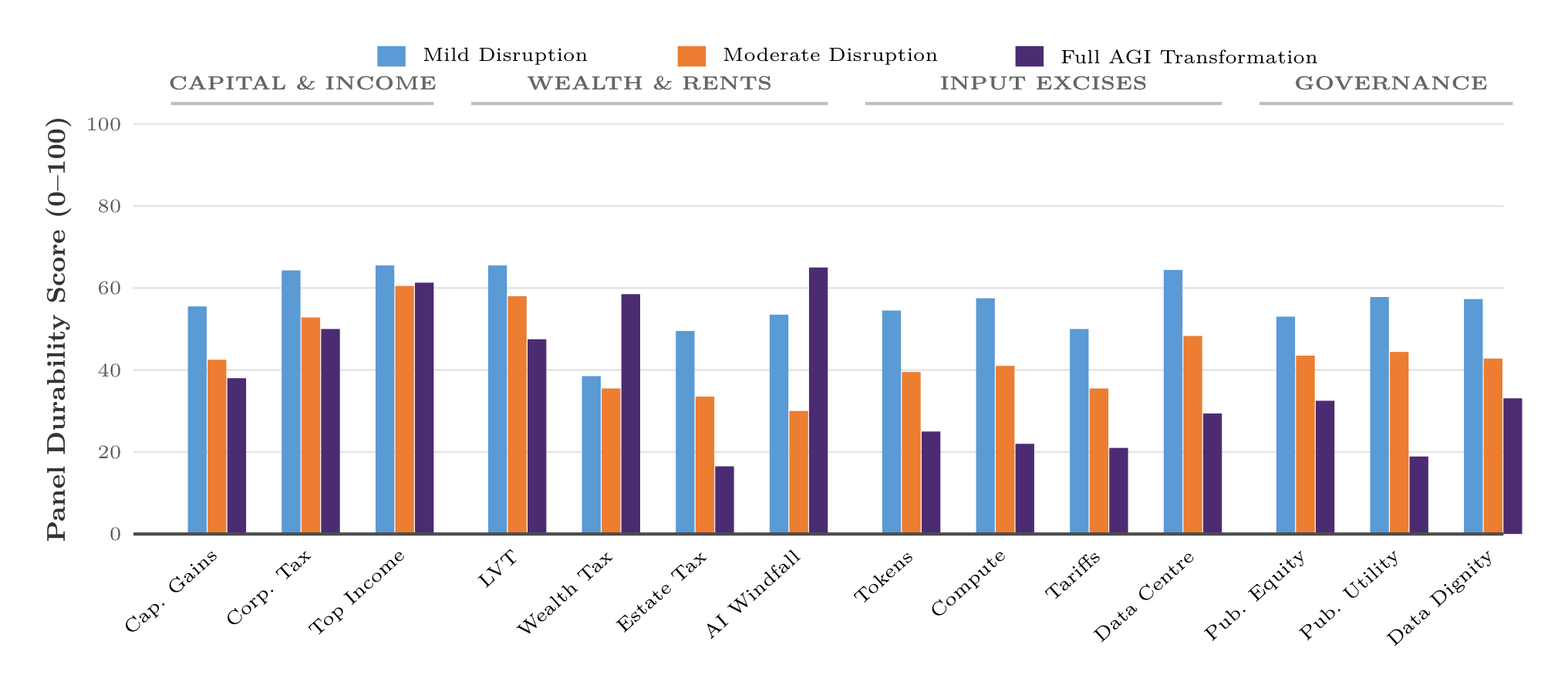
Figure 8 evaluates the durability of funding mechanisms across different levels of disruption. While some mechanisms have decreasing durability in more transformative scenarios (e.g., taxes on inputs), others are more resilient. For example, Land-Value Taxation scores 65.5 in mild disruption, 58.0 in moderate disruption, and 47.5 under transformation. Since unimproved land cannot be moved offshore or substituted away, it provides a reliable tax in every scenario of economic transformation. In addition to Land-Value Taxation, the analysis points to Corporate Income Taxation and Top Marginal Personal Income Taxation as an effective package of funding mechanisms that are efficient, minimally distortive, and durable to different levels of transformation.
Land-Value Taxation achieves the highest economic efficiency score in the entire evaluation (77.9), alongside strong revenue potential (69.0) and administrative feasibility (57.0). This rating directly reflects optimal tax theory's classical Georgist insight (Arnott and Stiglitz, 1979; Schwerhoff et al., 2022). Since the supply of unimproved land is inelastic, taxing its economic rent generates near-zero deadweight loss. In an economy where AI dramatically expands output, spatial constraints could create value through scarcity. LVT captures this value without penalizing capital investment or building improvements, while avoiding the capital-flight vulnerabilities and other distortive properties associated with funding mechanisms.
Corporate taxation has the second-highest revenue potential in the study (71.0) and maintains solid durability through moderate disruption (52.8) and transformation (50.0). Operating at the entity level, corporate income taxes are a direct, broad-based mechanism for taxing capital returns (Harberger, 1962), simplifying administration and maintaining base stability across changing economic scenarios. Finally, top marginal personal income taxes receive the highest progressivity score of any evaluated instrument (80.0), paired with substantial revenue potential (66.2) and administrative ease (53.5).
In contrast to these funding mechanisms, taxes levied directly on the intermediate inputs of AI have some of the lowest durability, efficiency, and progressivity scores in the evaluation. The analysis penalizes input-based taxes for several reasons. First, taxing intermediate inputs runs up against the Diamond–Mirrlees production efficiency theorem (Diamond and Mirrlees, 1971), which suggests that optimal tax regimes should tax final rents and profits rather than intermediate factor inputs to preserve efficiency. Taxing AI inputs like tokens or data center electricity induces potentially inefficient input substitution and deadweight losses throughout all downstream sectors that utilize AI tools. As an example, AI coding tools and the underlying reasoning models have shown incredible promise for unlocking productivity gains; these types of models also consume more tokens. Taxing tokens will create incentives to train models that either reason less—making them less economically useful—or reason in a way that is potentially difficult for humans to interpret—which makes monitoring more difficult and creates safety risks.
Conclusion
The potential emergence of AGI could be among the most significant moments in economic history. By reducing the costs of goods and services throughout the economy, an AGI transition could kindle significant improvements to human well-being, health, and prosperity, in a manner similar to the Industrial Revolution and early 20th century periods of technological innovation.
This was an initial attempt to taxonomize and assess in a standardized framework the battery of potential interventions that societies could explore for an AGI transition, using an exploratory agent-based methodological approach. Yet more work - especially experiments, empirical evaluations, and research studying the global economic developmental impacts of AGI - is necessary to further validate policy options as AI evolves. Throughout this economic transition, it will be particularly important for policymakers to improve data collection on AI's economic impacts in order to better understand the real-world impact of the technology on employment and wages.
The value of this framework is that it also illustrates how we might sequence policy. Interventions like expanded unemployment insurance and negative income taxes may be worth implementing sooner since they automatically adjust to labor market conditions. Other policies - such as basic capital programming - may be worth implementing at later stages, as the evidence on AI's impacts becomes clearer. This will require investment in improved data collection and monitoring. Interventions deployed too early could impose unnecessary costs and market distortions, while policies deployed too late could leave society unable to address initial AI-labor shocks.
The most important takeaway from our work is that society has the capacity and tools to shape our economic trajectory in the AGI era. As history has repeatedly demonstrated, economic growth that concentrates among a small segment of society is socially and politically fraught. If AGI emerges and does indeed increase economic growth, as we expect, then a central question of our time may be one about ensuring wide access to the benefits of that growth. This includes using AGI's gains to support improved standards of living and opportunity for all.
References
Acemoglu, D., & Johnson, S. (2023). Power and progress: Our thousand-year struggle over technology and prosperity. PublicAffairs.
Acemoglu, D., & Restrepo, P. (2018). The race between man and machine: Implications of technology for growth, factor shares, and employment. American Economic Review, 108, 1488–1542.
Acemoglu, D. (2024). The simple macroeconomics of AI. Economic Policy, 39(120), 5–48. https://doi.org/10.1093/epolic/eiae042.
Ackerman, B., & Alstott, A. (1999). The Stakeholder Society. Yale University Press.
Aghion, P., Jones, B. F., & Jones, C. I. (2019). Artificial intelligence and economic growth. In A. Agrawal, J. Gans, & A. Goldfarb (Eds.), The Economics of Artificial Intelligence: An Agenda (pp. 237–282). University of Chicago Press.
Alesina, A., & Glaeser, E. L. (2004). Fighting poverty in the US and Europe: A world of difference. Oxford University Press.
Allen, R. C. (2009). Engels' Pause: Technical Change, Capital Accumulation, and Inequality in the British Industrial Revolution. Explorations in Economic History, 46, 418–435.
Alstott, A. L. (1995). The Earned Income Tax Credit and the limitations of tax-based welfare reform. Harvard Law Review, 108(3), 533–592. https://doi.org/10.2307/1341849.
Altman, S. (2021). Moore's law for everything. Sam Altman Blog, March 16, 2021. https://moores.samaltman.com/.
Arnott, R. J., & Stiglitz, J. E. (1979). Aggregate land rents, expenditure on public goods, and optimal city size. The Quarterly Journal of Economics, 93(4), 471–500.
Auerbach, A. J., & Hines, J. R. (2002). Taxation and economic efficiency. Handbook of Public Economics, 3, 1347–1421.
Autor, D. H., Levy, F., & Murnane, R. J. (2003). The skill content of recent technological change: An empirical exploration. The Quarterly Journal of Economics, 118(4), 1279–1333.
Autor, D. H., Mindell, D. A., & Reynolds, E. B. (2022). The work of the future: Building better jobs in an age of intelligent machines. MIT Press.
Autor, D. H. (2015). Why are there still so many jobs? The history and future of workplace automation. Journal of Economic Perspectives, 29(3), 3–30.
Bipartisan Policy Center. (2016). Securing our financial future: Report of the Commission on Retirement Security and Personal Savings. Bipartisan Policy Center.
Blue Rose Research. (2024). Public preferences for automation and social protection: Empirical polling on AI transitions. Research Report.
Boushey, H., Nunn, R., & Shambaugh, J. (Eds.). (2019). Recession ready: Fiscal policies to stabilize the American economy. The Hamilton Project and Washington Center for Equitable Growth, Brookings Institution Press.
Bowles, S., & Gintis, H. (2006). Social preferences, moral sentiments, and reciprocity. In S.-C. Kolm & J. M. Ythier (Eds.), Handbook of the Economics of Giving, Altruism and Reciprocity (Vol. 1, pp. 339–395). Elsevier.
Brynjolfsson, E., Rock, D., & Syverson, C. (2019). Artificial intelligence and the modern productivity paradox: A clash of expectations and statistics. In A. Agrawal, J. Gans, & A. Goldfarb (Eds.), The Economics of Artificial Intelligence: An Agenda (pp. 23–57). University of Chicago Press.
Card, D., Kluve, J., & Weber, A. (2018). What works? A meta analysis of recent active labor market program evaluations. Journal of the European Economic Association, 16(3), 894–931.
Case, A., & Deaton, A. (2020). Deaths of Despair and the Future of Capitalism. Princeton University Press.
Cazzaniga, M., Jaumotte, F., Li, L., Melina, G., Panton, A. J., Pizzinelli, C., Rockall, E., & Tavares, M. M. (2024). Gen-AI: Artificial intelligence and the future of work. IMF Staff Discussion Note SDN/2024/001.
Chetty, R., Friedman, J. N., Stepner, M., & The Opportunity Insights Team. (2024). The economic impacts of COVID-19: Evidence from a new public database built using private sector data. The Quarterly Journal of Economics, 139(2), 829–889. https://doi.org/10.1093/qje/qjad048.
Costinot, A., & Werning, I. (2023). Robots, trade, and Luddism: A sufficient statistic approach to optimal technology regulation. The Review of Economic Studies, 90(5), 2261–2291. https://doi.org/10.1093/restud/rdac076.
Council of Economic Advisers. (2024). An economic framework for understanding artificial intelligence. In Economic Report of the President (Chap. 7, pp. 239–278). U.S. Government Publishing Office.
CSAIP. (2026). What 56,000 Americans told us about AI policy. Center for the Study of AI Policy & Blue Rose Research Report, August 28, 2026. Available at https://blog.csaip.org/p/what-56000-americans-told-us-about.
Currie, J., & Gahvari, F. (2008). Transfers in cash and in-kind: Theory meets the data. Journal of Economic Literature, 46(2), 333–383. https://doi.org/10.1257/jel.46.2.333.
Deci, E. L., & Ryan, R. M. (2000). The "what" and "why" of goal pursuits: Human needs and the self-determination of behavior. Psychological Inquiry, 11(4), 227–268.
Diamond, P. A., & Mirrlees, J. A. (1971). Optimal taxation and public production I: Production efficiency. American Economic Review, 61(1), 8–27.
Eloundou, T., Manning, S., Mishkin, P., & Rock, D. (2024). GPTs are GPTs: Labor market impact potential of LLMs. Science, 384(6702), 1306–1308. https://doi.org/10.1126/science.adj0998.
Feigenbaum, J. J., & Gross, D. P. (2024). Answering the call of automation: How the labor market adjusted to mechanizing telephone operation. The Quarterly Journal of Economics, 139(3), 1879–1939.
Frank, M. R., Autor, D., Bessen, J. E., Brynjolfsson, E., Cebrian, M., Deming, D. J., Feldman, M., Groh, M., Lobo, J., Moro, E., Wang, D., Youn, H., & Rahwan, I. (2019). Toward understanding the impact of artificial intelligence on labor. Proceedings of the National Academy of Sciences, 116(14), 6531–6539. https://doi.org/10.1073/pnas.1900949116.
Freeman, R. B. (2015). Who owns the robots rules the world. IZA World of Labor, 2015, 5. https://doi.org/10.15185/izawol.5.
Friedman, M. (1962). Capitalism and Freedom. University of Chicago Press.
Ghilarducci, T., & Hassett, K. A. (2021). What if low-income American workers had access to wealth-building vehicles like the federal employees' Thrift Savings Plan? Economic Innovation Group.
Goldin, C., & Katz, L. F. (2008). The Race between Education and Technology. Belknap Press of Harvard University Press.
Good, I. J. (1965). Speculations concerning the first ultraintelligent machine. Advances in Computers, 6, 31–88. https://doi.org/10.1016/S0065-2458(08)60418-0.
Gordon, R. J. (2016). The rise and fall of American growth: The U.S. standard of living since the Civil War. Princeton University Press.
Grace, K., Stewart, H., Sandkühler, J. F., Thomas, S., Weinstein-Raun, B., & Brauner, J. (2024). Thousands of AI authors on the future of AI. arXiv preprint arXiv:2401.02843. https://doi.org/10.48550/arXiv.2401.02843.
Guerreiro, J., Rebelo, S., & Teles, P. (2022). Should robots be taxed? The Review of Economic Studies, 89, 279–311.
Hamilton, D., & Darity, W. (2010). Can 'baby bonds' eliminate the racial wealth gap in putative post-racial America? Review of Black Political Economy, 37, 207–216.
Handa, K., Tamkin, A., McCain, M., Huang, S., Durmus, E., Heck, S., Mueller, J., Hong, J., Ritchie, S., Belonax, T., Troy, K. K., Amodei, D., Kaplan, J., Clark, J., & Ganguli, D. (2025). Which economic tasks are performed with AI? Evidence from millions of Claude conversations. arXiv preprint arXiv:2503.04761. https://doi.org/10.48550/arXiv.2503.04761.
Harberger, A. C. (1962). The incidence of the corporation income tax. Journal of Political Economy, 70(3), 215–240.
Hickenlooper, J., Tillis, T., Sewell, T., & Smucker, L. (2023). Retirement Savings for Americans Act of 2023, S. 3128 / H.R. 6069, 118th Cong.
Horton, J. J., & Horton, R. (2024). EDSL: Expected Parrot domain specific language for AI powered social science. Expected Parrot Technical Report.
Horton, J. J. (2023). Large Language Models as Simulated Economic Agents. NBER Working Paper 31122.
Hoynes, H. W., & Rothstein, J. (2019). Universal basic income in the United States and advanced countries. Annual Review of Economics, 11, 929–958.
Hussam, R., Kelley, E. M., Lane, G., & Zahra, F. (2022). The Psychosocial Value of Employment: Evidence from a Refugee Camp. American Economic Review, 112, 3694–3724.
Iscenko, Z., Strand, S., Chen, Y., Aimard, G., Codreanu, M., Sampathkumar, V., Imas, A., Jacobs, J., Muiruri, E., Mateos-Garcia, J., Ng, J. J., Javed, S., Martin, J., Ajmeri, O., Calin, D., Kim, A., Curto Millet, F., & Manyika, J. (2026). Google's AI & Economy ATLAS v1.0: Mapping Gemini usage in the economy. arXiv preprint arXiv:2608.00038.
Jacobs, J., & Canedy, J. (2026). Did U.S. worker retraining reduce participant automation exposure? arXiv preprint arXiv:2605.03767.
Jacobs, J. (2026). It's more than money: Work, meaning, and the political backlash to AI. Draft Working Paper.
Jahoda, M. (1982). Employment and unemployment: A social-psychological analysis. Cambridge University Press.
Kleven, H. J., Kreiner, C. T., & Saez, E. (2016). Why can modern governments tax so much? Historical evidence on information, third-party reporting, and the growth of the tax state. Economica, 83(330), 219–246. https://doi.org/10.1111/ecca.12182.
Klinova, K., & Korinek, A. (2021). AI and shared prosperity. Proceedings of the 2021 AAAI/ACM Conference on AI, Ethics, and Society (AIES '21), 645–651. https://doi.org/10.1145/3461702.3462619.
Korinek, A., & Lockwood, L. M. (2026). Public finance in the age of AI: A primer. NBER Working Paper 34873. https://doi.org/10.3386/w34873.
Korinek, A., & Stiglitz, J. E. (2019). Artificial intelligence and its implications for income distribution and unemployment. In A. Agrawal, J. Gans, & A. Goldfarb (Eds.), The Economics of Artificial Intelligence: An Agenda (pp. 349–390). University of Chicago Press.
Korinek, A., & Suh, D. (2024). Scenarios for the transition to AGI. NBER Working Paper 32255. https://doi.org/10.3386/w32255.
Labaschin, B., Eloundou, T., Manning, S., Mishkin, P., & Rock, D. (2025). Extending "GPTs Are GPTs" to firms. AEA Papers and Proceedings, 115, 51–55. https://doi.org/10.1257/pandp.20251045.
Landais, C., Michaillat, P., & Saez, E. (2018). A macroeconomic approach to optimal unemployment insurance: Theory. American Economic Journal: Economic Policy, 10, 152–181.
Lebergott, S. (1966). Labor force and employment, 1800–1960. In D. S. Brady (Ed.), Output, employment, and productivity in the United States after 1800 (pp. 117–204). National Bureau of Economic Research.
Lindert, P. H. (2004). Growing public: Social spending and economic growth since the eighteenth century (Vol. 1). Cambridge University Press.
McKay, A., & Reis, R. (2016). The role of automatic stabilizers in the U.S. business cycle. Econometrica, 84(1), 141–194. https://doi.org/10.3982/ECTA11574.
Meyer, B. D., Mok, W. K. C., & Sullivan, J. X. (2015). Household surveys in crisis. Journal of Economic Perspectives, 29(4), 199–226. https://doi.org/10.1257/jep.29.4.199.
Mian, A., Straub, L., & Sufi, A. (2021). The saving glut of the rich. NBER Working Paper 26941. https://doi.org/10.3386/w26941.
Moffitt, R. A. (2003). The negative income tax and the evolution of U.S. welfare policy. Journal of Economic Perspectives, 17(3), 119–140. https://doi.org/10.1257/089533003769204380.
Mokyr, J. (1990). The Lever of Riches: Technological Creativity and Economic Progress. Oxford University Press.
Morris, I. (2010). Why the West Rules—for Now: The Patterns of History, and What They Reveal About the Future. Farrar, Straus and Giroux.
National Academies of Sciences, Engineering, and Medicine. (2024). Artificial intelligence and the future of work. The National Academies Press. https://doi.org/10.17226/27644.
Nichols, A., & Rothstein, J. (2016). The Earned Income Tax Credit. In R. A. Moffitt (Ed.), Economics of Means-Tested Transfer Programs in the United States (Vol. 1, pp. 137–218). University of Chicago Press.
O'Keefe, C., Cihon, P., Garfinkel, B., Flynn, C., Leung, J., & Dafoe, A. (2020). The Windfall Clause: Distributing the benefits of AI for the common good. Proceedings of the AAAI/ACM Conference on AI, Ethics, and Society (AIES '20), 327–331. https://doi.org/10.1145/3375627.3375842.
Polanyi, K. (1944). The great transformation: The political and economic origins of our time. Farrar & Rinehart.
Sahm, C. (2019). Direct stimulus payments to individuals. In H. Boushey, R. Nunn, & J. Shambaugh (Eds.), Recession ready: Fiscal policies to stabilize the American economy (pp. 67–92). The Hamilton Project and Washington Center for Equitable Growth, Brookings Institution Press.
Schwerhoff, G., Edenhofer, O., & Fleurbaey, M. (2022). Equity and efficiency effects of land value taxation. IMF Working Paper 2022/263. https://doi.org/10.5089/9798400230424.001.
Splinter, D., Elwell, J., & Xu, L. (2026). Advance tax credits: Reconciliations and repayments. National Tax Journal, 79(1), 73–106. https://doi.org/10.1086/737017.
Stantcheva, S. (2021). Understanding tax policy: How do people reason? The Quarterly Journal of Economics, 136, 2309–2369.
Susskind, D. (2020). A world without work: Technology, automation, and how we should respond. Metropolitan Books.
Tobin, J. (1965). The case for an income guarantee. The Public Interest, 4, 31–41.
Trammell, P., & Korinek, A. (2023). Economic growth under transformative AI. NBER Working Paper 31815. https://doi.org/10.3386/w31815.
Turner, A. (2018). Capitalism in the age of robots: Work, income and wealth in the 21st century. Institute for New Economic Thinking Lecture.
Vivalt, E., Rhodes, E., Bartik, A. W., Broockman, D. E., Krause, P., & Miller, S. (2024). The employment effects of a guaranteed income: Experimental evidence from two U.S. states. NBER Working Paper 32719. https://doi.org/10.3386/w32719.
Wiedemann, A. (2021). Indebted: How Families Make Ends Meet in an Unequal America. Princeton University Press.
Appendix A: Simulated Economist Panel Roster (N=51N = 51N=51)
Table 7 details the 51 simulated economist personas comprising our expert evaluation panel, modeled on U.S. panelists from the Kent A. Clark Center for Global Markets (formerly the IGM Economic Experts Panel).
Notes: The simulated panel comprises 51 economist personas modeled on U.S. panelists from the Kent A. Clark Center for Global Markets (formerly the IGM Economic Experts Panel) (Horton, 2023). Unmarked panelists hold Active panel status; †^\dagger† denotes Alumni status (including deceased members Alberto Alesina and Edward Lazear, and Federal Reserve Bank of Chicago President Austan Goolsbee); ‡^\ddagger‡ denotes Hiatus status.
Appendix B: Policy-by-Policy Evaluation Profiles — Redistribution
B.1. Earned Income Tax Credit (EITC)
Targeted & Work-Conditioned
B.2. Unemployment Insurance (UI)
Targeted & Work-Conditioned
B.3. Active Labour-Market Policies (ALMP)
Targeted & Work-Conditioned
B.4. Wage Insurance
Targeted & Work-Conditioned
B.5. Directed Industrial Policy
Targeted & Work-Conditioned
B.6. Federal Jobs Guarantee (FJG)
Targeted & Work-Conditioned
B.7. Universal Basic Income (UBI)
Universal Floors, Services & Ownership
B.8. Negative Income Tax (NIT)
Universal Floors, Services & Ownership
B.9. Universal Basic Services (UBS)
Universal Floors, Services & Ownership
B.10. Universal Basic Capital (UBC)
Universal Floors, Services & Ownership
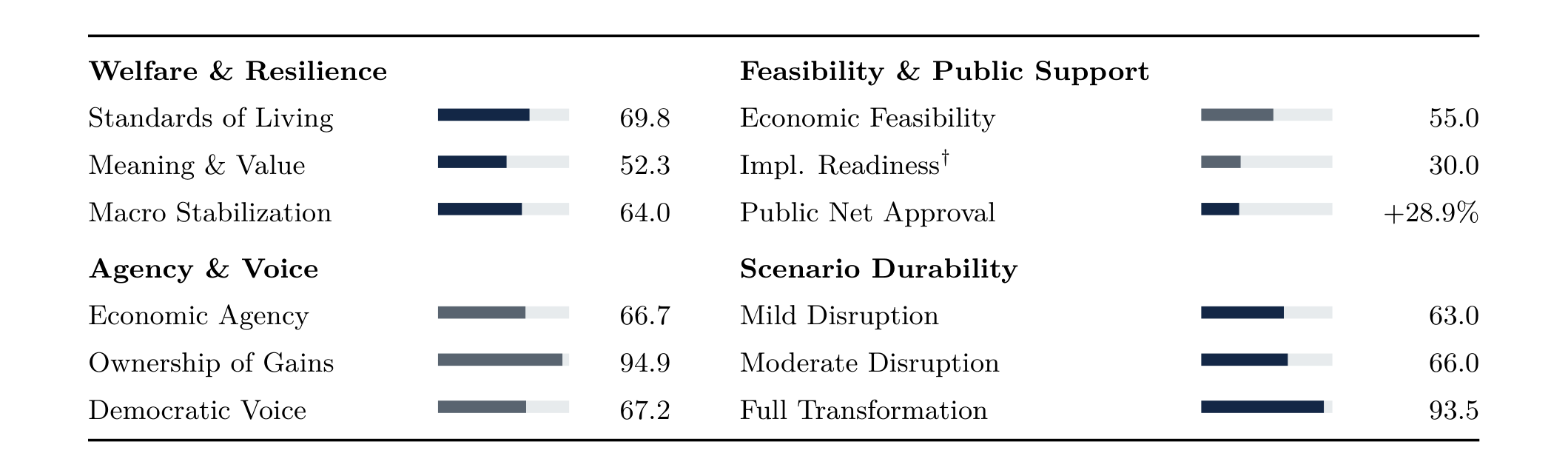
B.11. Sovereign AI Fund / Dividend (SAWF)
Universal Floors, Services & Ownership
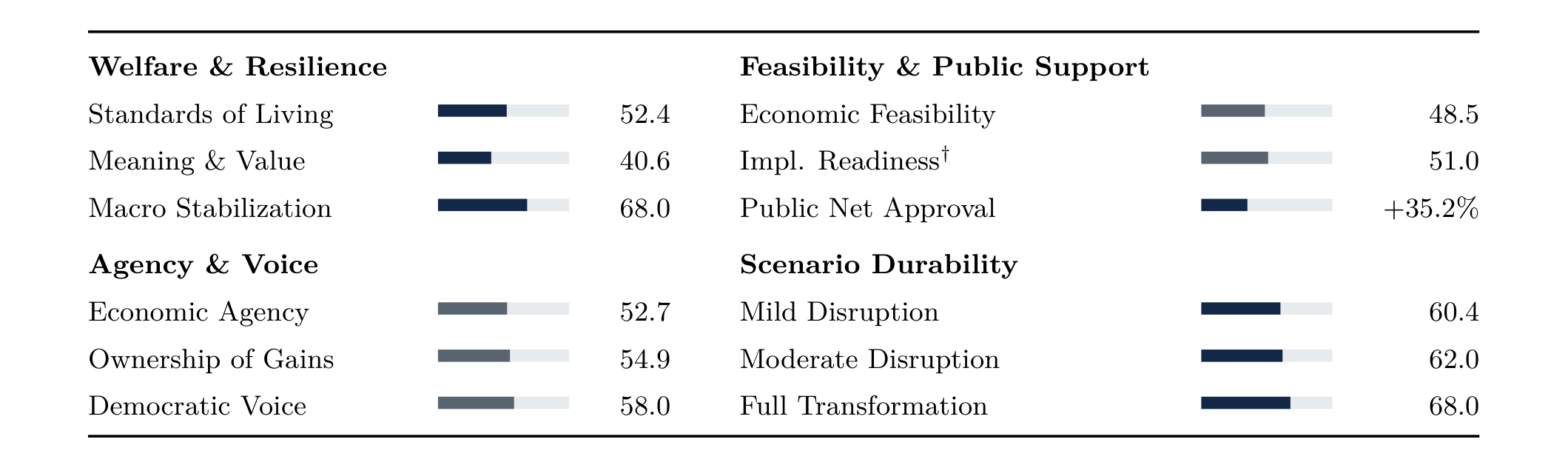
Appendix C: Policy-by-Policy Evaluation Profiles — Taxation Mechanisms
C.1. Capital-Gains Reform & Step-Up Repeal
Broad-Based Capital, Corporate & Income Taxes
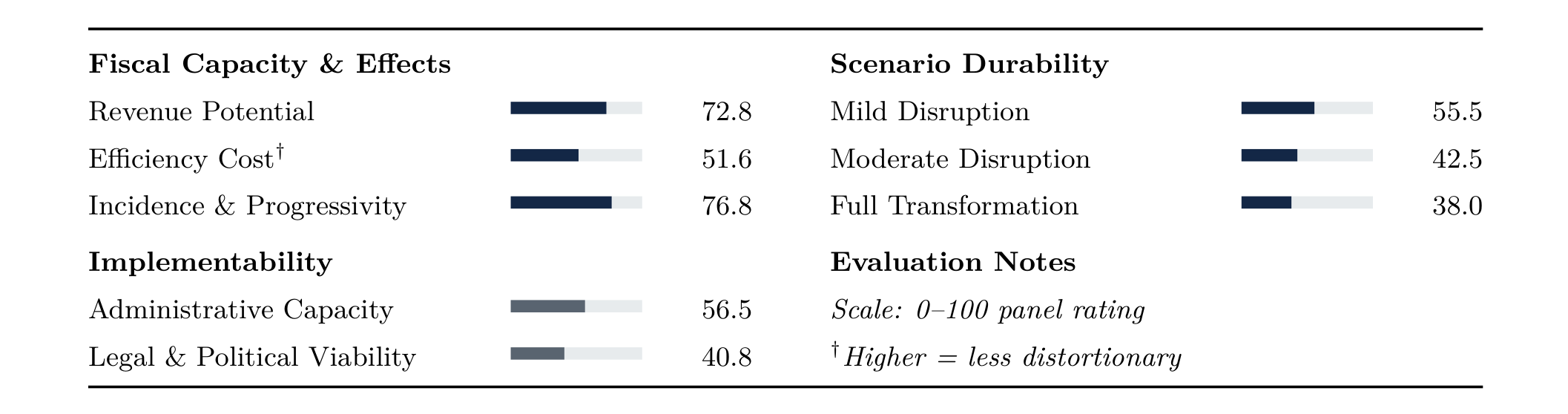
C.2. Corporate Income Tax & Book Minimum Tax
Broad-Based Capital, Corporate & Income Taxes
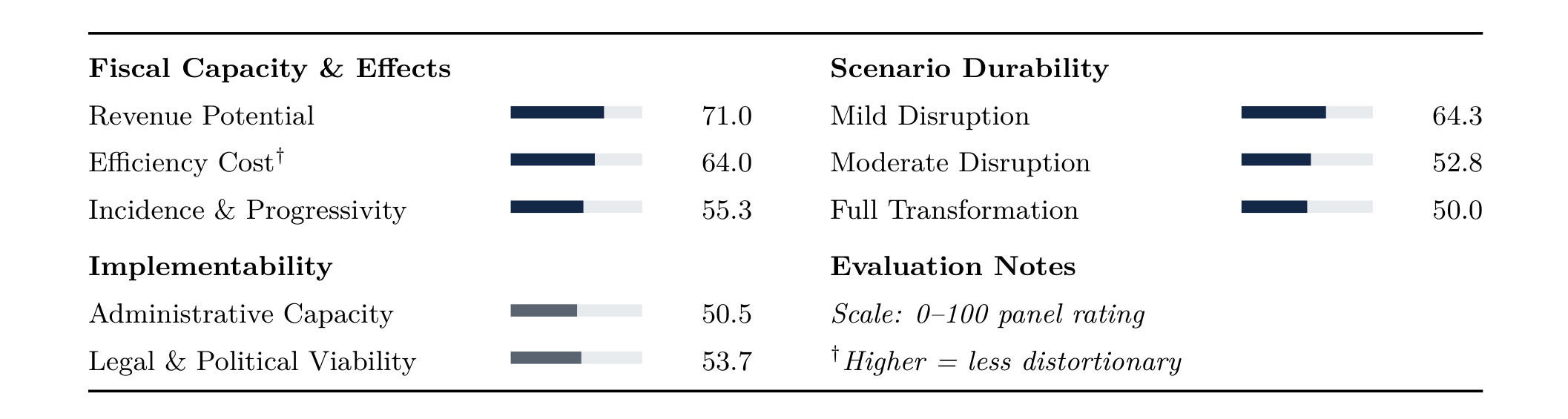
C.3. Top Marginal Personal Income Tax Adjustments
Broad-Based Capital, Corporate & Income Taxes
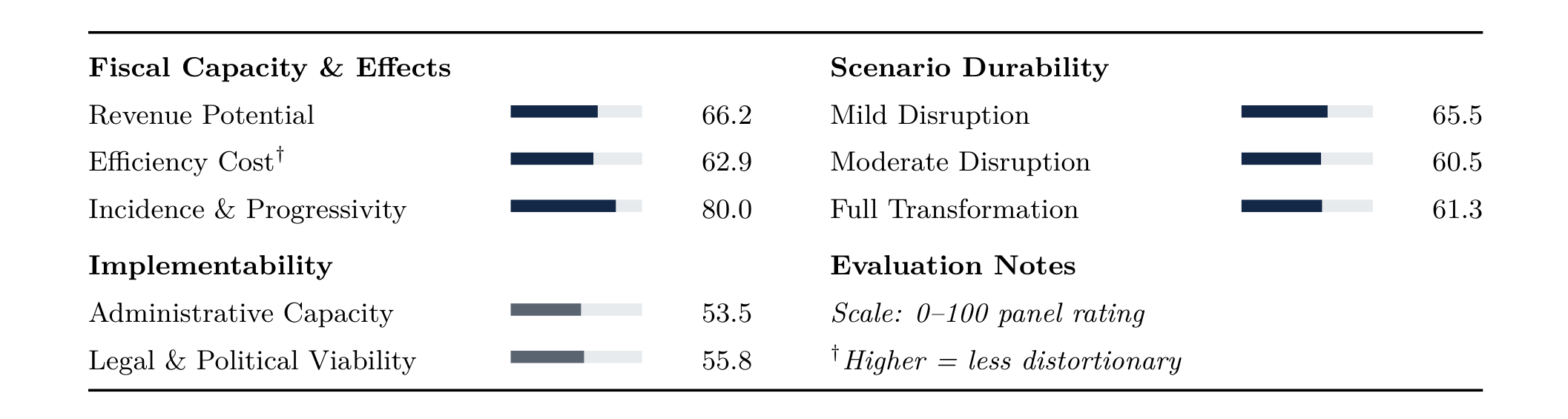
C.4. Land-Value Taxation (LVT on Unimproved Land)
Wealth, Estate & Economic Rent Levies
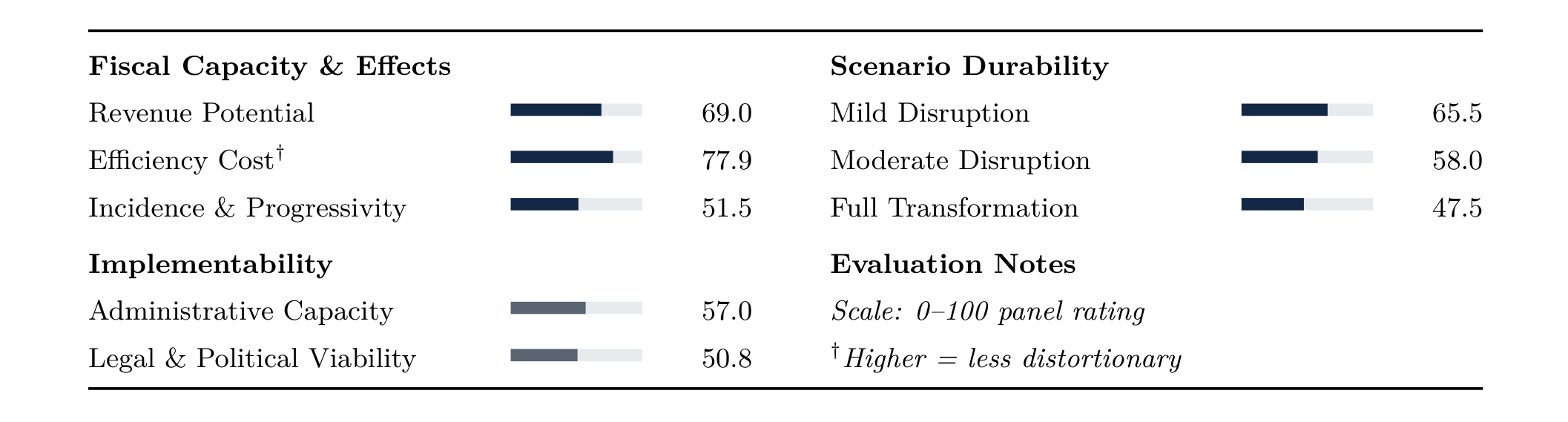
C.5. Federal Household Net Worth Tax
Wealth, Estate & Economic Rent Levies
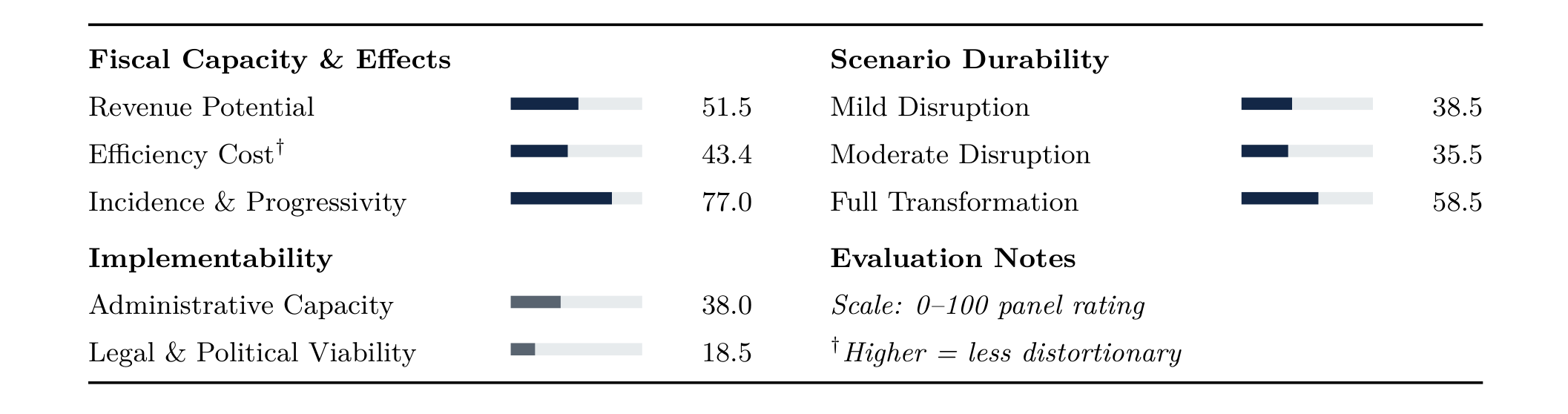
C.6. Inheritance & Progressive Estate Taxation
Wealth, Estate & Economic Rent Levies
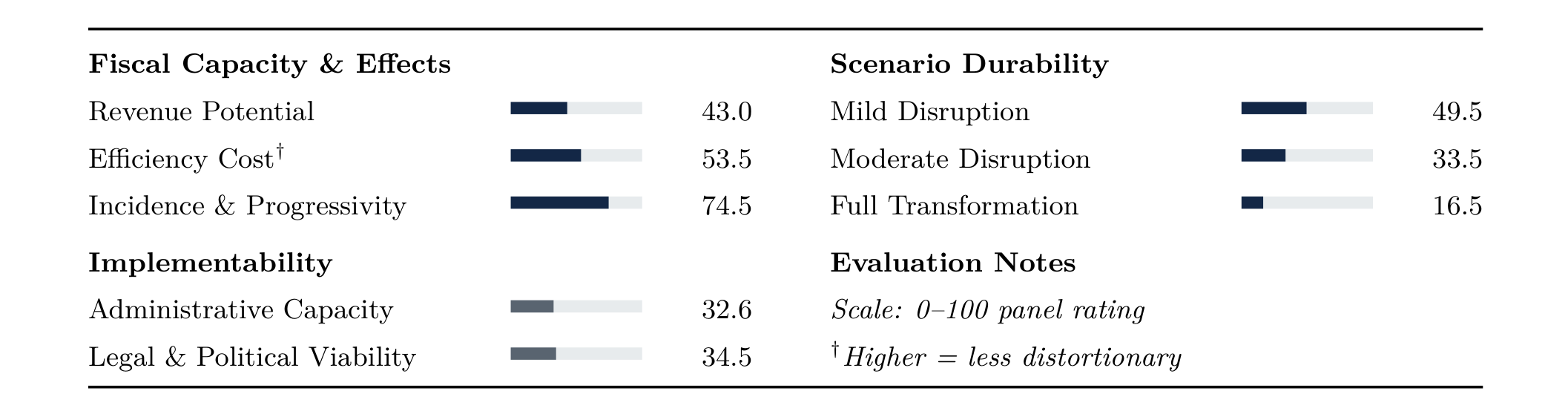
C.7. AI Windfall or Surtax on Excess Profits
Wealth, Estate & Economic Rent Levies
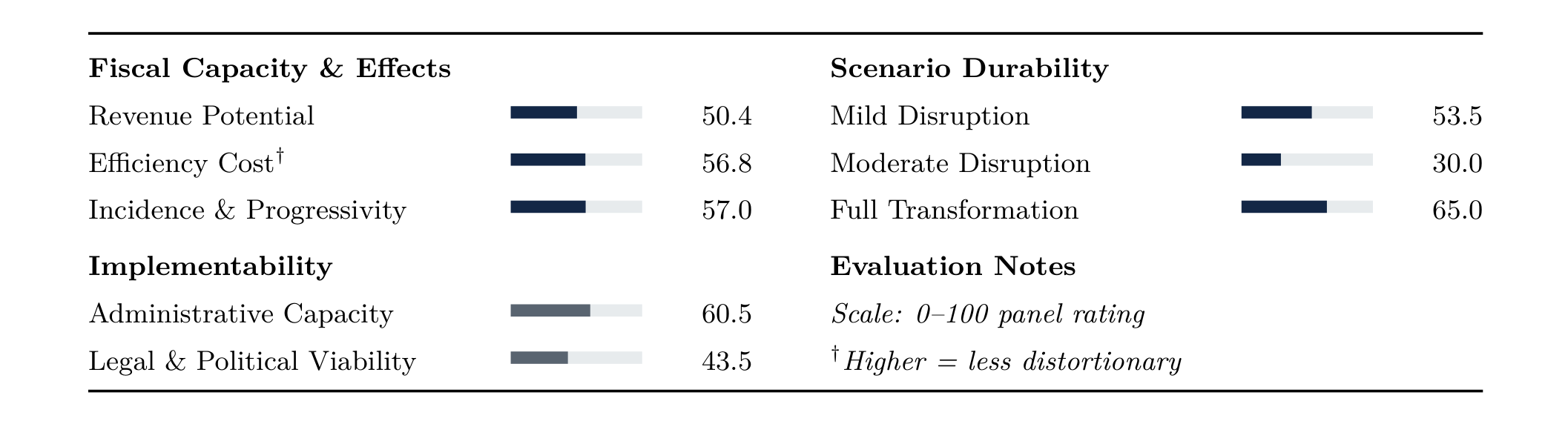
C.8. Token or Model Inference-Usage Excise Tax
Intermediate Input & Digital Border Excises
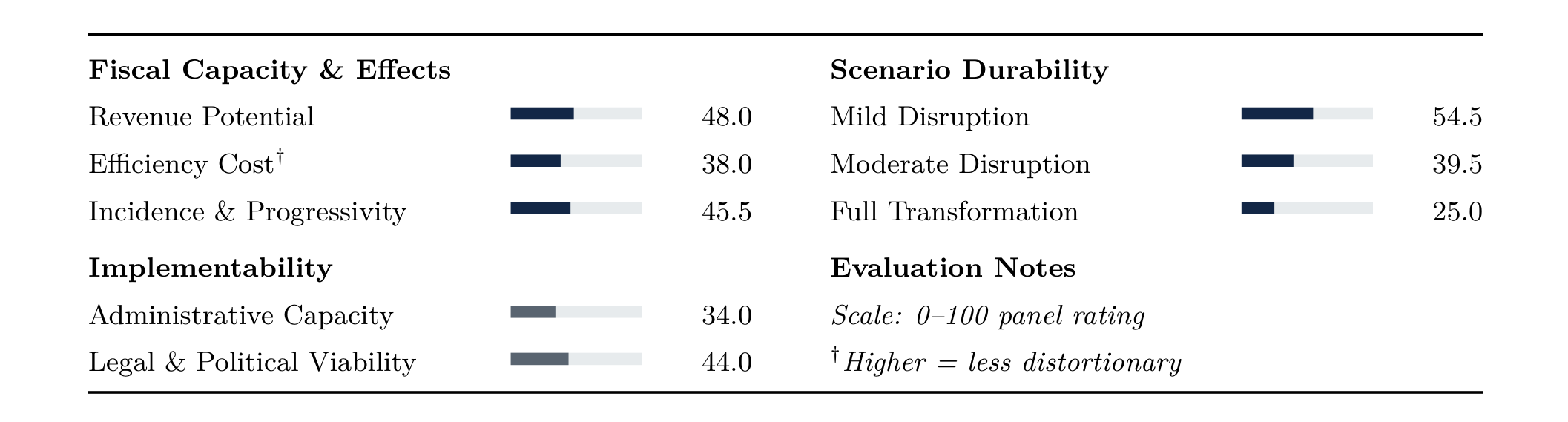
C.9. Compute or Hardware Silicon Excise Tax
Intermediate Input & Digital Border Excises
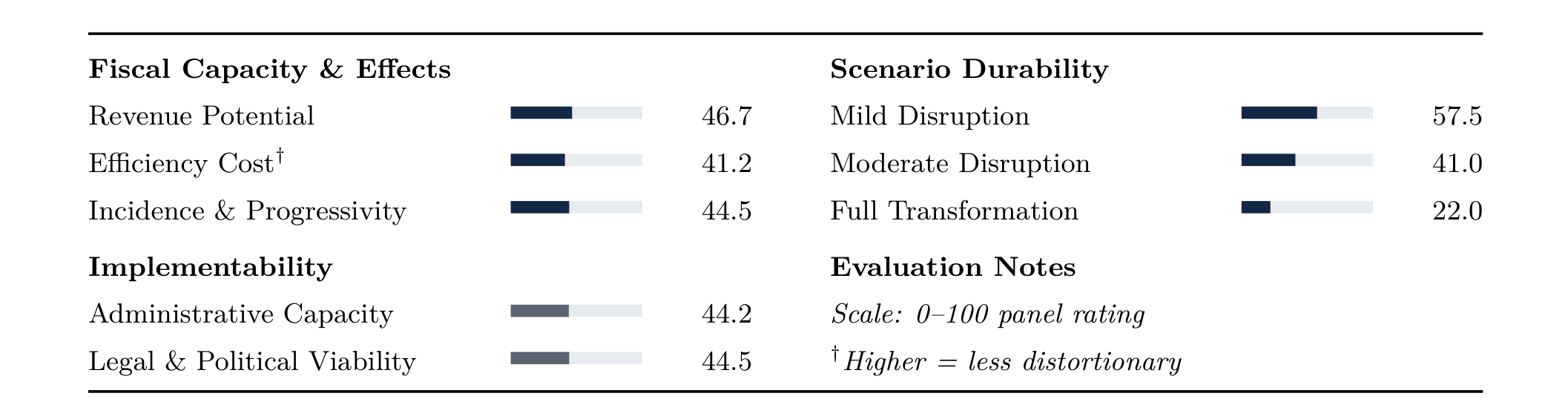
C.10. Offshore AI Tariffs & Base Protection
Intermediate Input & Digital Border Excises
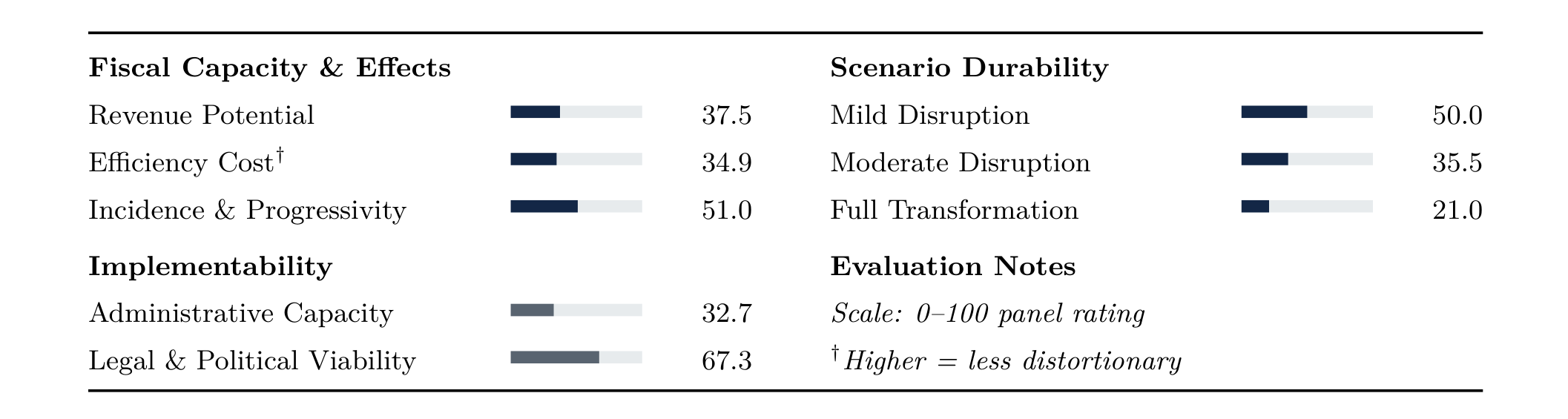
C.11. Data Centre Grid & Water Surcharges
Intermediate Input & Digital Border Excises
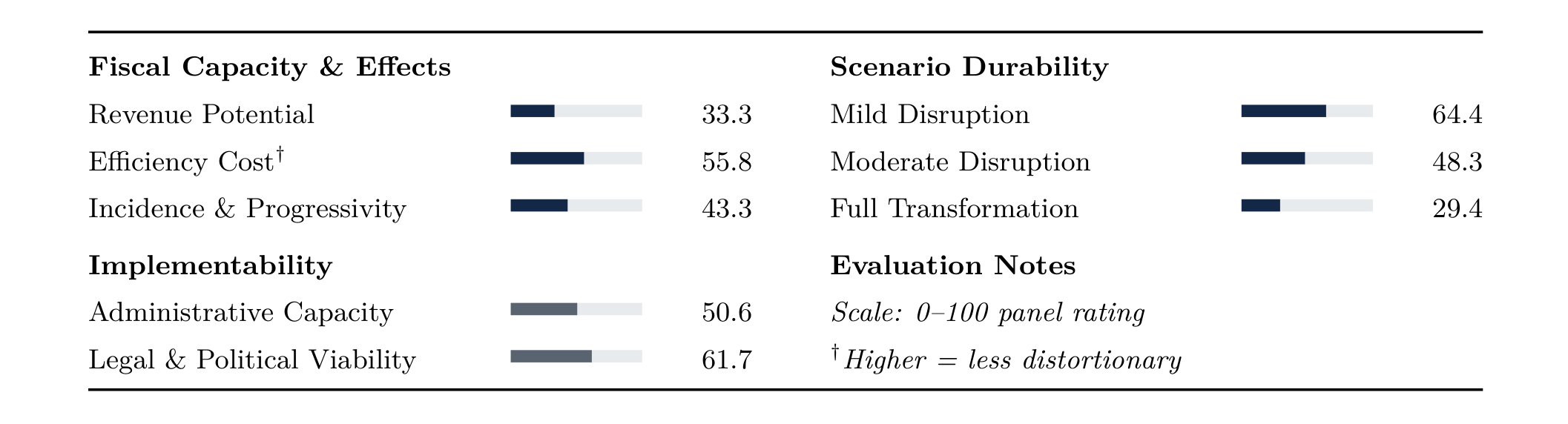
C.12. Conditional Public Equity & Warrant Matching
Predistribution & Governance Frameworks
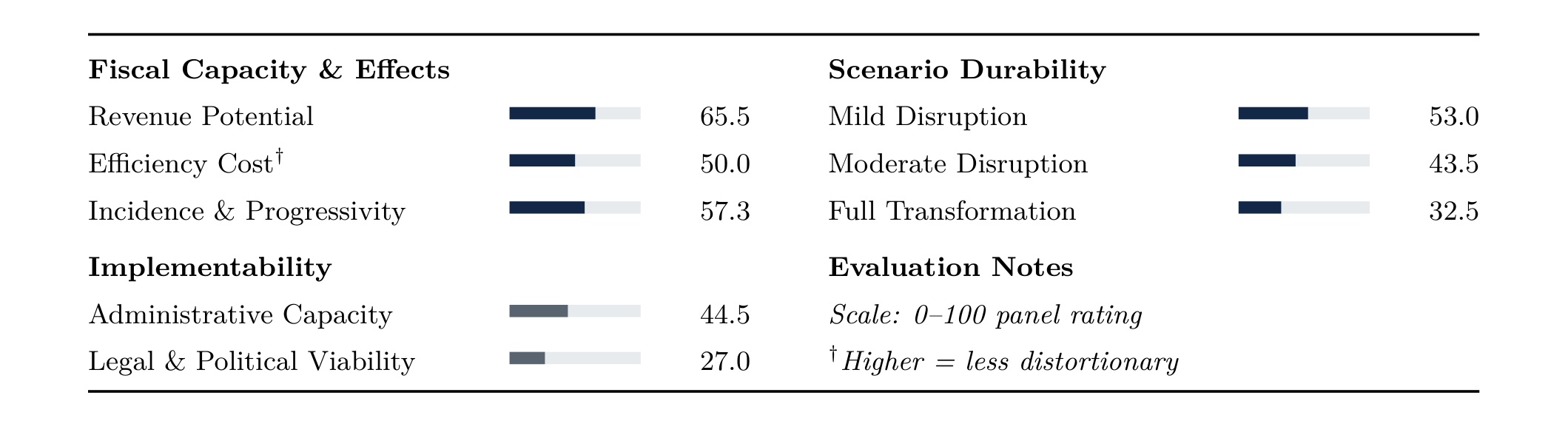
C.13. Public Utility Model for Frontier AI
Predistribution & Governance Frameworks
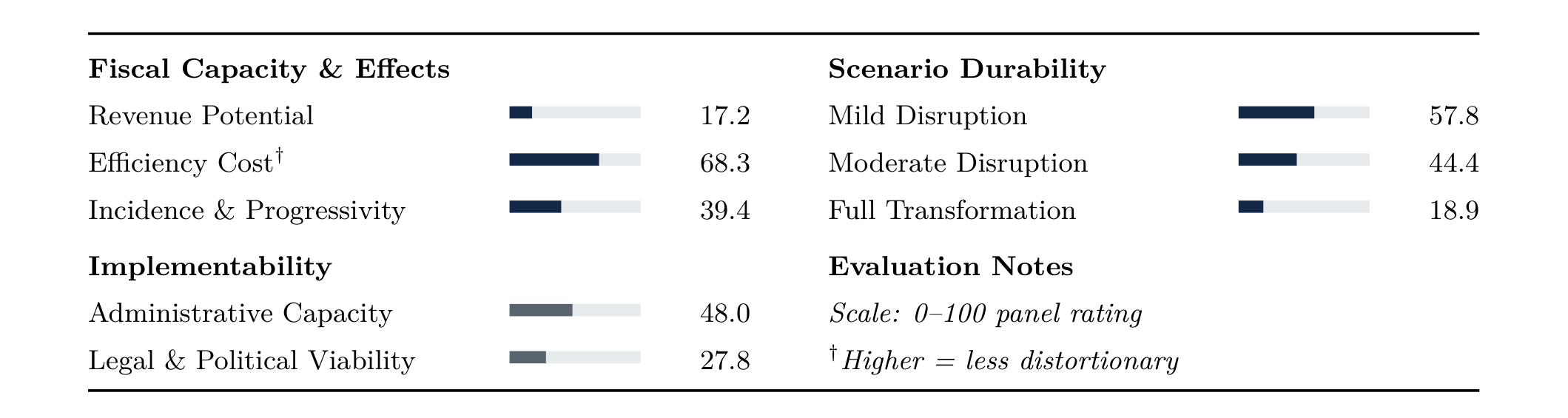
C.14. Data Dignity & Contribution Compensation
Predistribution & Governance Frameworks