From Gaze to Guidance: Interpreting and Adapting to Users' Cognitive Needs with Multimodal Gaze-Aware AI Assistants
Valdemar DanryJavier HernandezAndrew D. WilsonPattie MaesJudith Amores
Demonstrates that equipping multimodal AI assistants with egocentric gaze tracking allows them to pinpoint user comprehension difficulties, significantly improving information recall while reducing interaction effort.
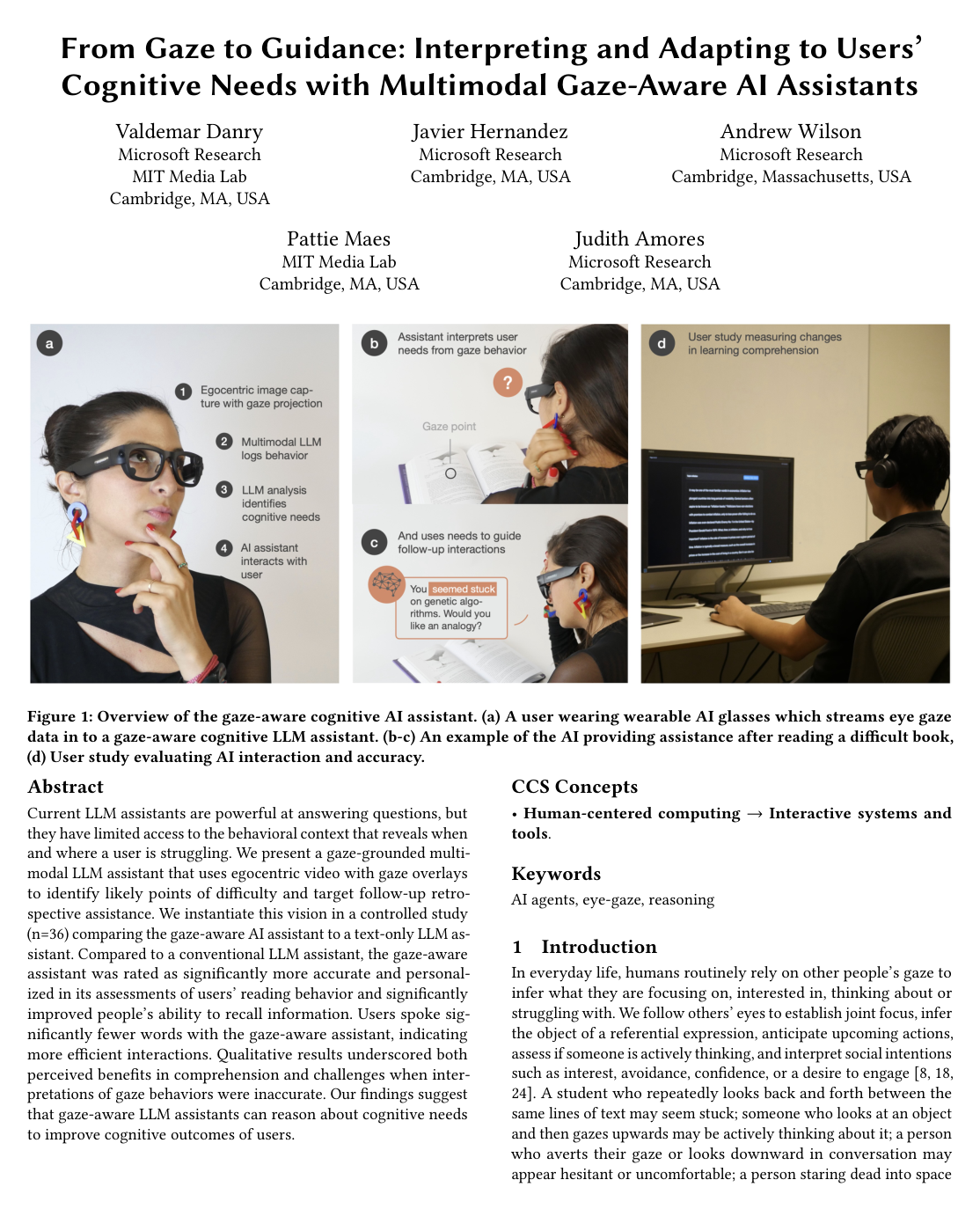
Modern artificial intelligence assistants rely heavily on explicit user prompts and remain blind to real-time behavioral cues that signal when a user is struggling. Because people often fail to recognize or articulate their own comprehension breakdowns, current conversational tools cannot easily provide targeted, proactive support. The article evaluates whether integrating first-person video with eye-tracking data into a multimodal large language model allows an assistant to infer cognitive difficulty and provide more effective retrospective guidance.
To test this approach, researchers developed a wearable prototype using smart glasses that stream egocentric video with projected gaze coordinates directly into a language model. The system decomposes the analysis into tracking timestamped visual behaviors and inferring specific trouble spots before delivering conversational voice support. The authors evaluated the system through a controlled within-subjects study involving 36 adult participants who read passages of varying complexity and received assistance from either the gaze-aware system or a text-only baseline assistant.
The study revealed three main findings. First, participants using the gaze-aware assistant achieved a statistically significant improvement in factual recall, scoring 96.3% compared to 88.9% with the baseline—a 7.4 percentage point gain. Second, users rated the gaze-informed diagnostic analysis as significantly more accurate and personalized, with nearly 64% preferring it over the text-only summary. Third, interactions were notably more efficient: users spoke approximately 31% fewer words with the gaze-aware assistant (57 words versus 83 words) and spent less effort steering the conversation or repairing misunderstandings. However, higher-order conceptual transfer and definition learning showed only slight, non-significant gains.
These findings indicate that grounding artificial intelligence in physical gaze traces successfully shifts the burden of diagnosing cognitive difficulties from the human to the machine. By pinpointing exact moments of hesitation or rereading, the assistant delivers relevant, low-friction help. Nevertheless, qualitative feedback highlighted that visual behavior remains inherently ambiguous: the model occasionally misidentified productive rereading, cross-referencing, or skimming as confusion, underscoring that surface gaze represents probabilistic evidence rather than ground truth.
Organizations developing multimodal assistants should treat gaze signals as hypotheses rather than definitive indicators. Systems should use hedged language, confirm user intent before offering explanations, and preserve user agency. Future research and development should focus on testing longer texts, integrating complementary physiological sensors such as pupil dilation, and building long-term user models. Practitioners must also establish robust privacy protections, as wearable video and eye tracking capture sensitive personal and environmental data.
The findings are supported by a rigorous experimental design and power analysis, providing strong confidence in the system's ability to improve local information retrieval and interaction efficiency. Readers should exercise caution regarding broader claims of deep conceptual learning or generalization beyond visually anchored reading tasks until real-time and multi-domain trials are conducted.
- Paper: In the Eye of the Beholder: A Survey of Models for Eyes and Gaze, D. Hansen et al. (2010). Provides foundational principles and methodologies for video-based eye detection and gaze tracking that underpin modern gaze-aware multimodal systems.
- Paper: Grounded Question-Answering in Long Egocentric Videos, Shangzhe Di et al. (2024). Introduces methods for temporal grounding and visual question-answering in continuous first-person egocentric video streams, directly preparing the reader for egocentric assistant models.
- Paper: Video-LLaMA: An Instruction-tuned Audio-Visual Language Model for Video Understanding, Hang Zhang et al. (2023). Establishes core architectural techniques for instruction-tuning large language models on temporal video sequences for conversational interaction.
- Paper: MMToM-QA: Multimodal Theory of Mind Question Answering, Chuanyang Jin et al. (2024). Explores how multimodal artificial intelligence models infer human cognitive states, goals, and beliefs from combined visual and textual observations.
- Paper: LLaVA-OneVision: Easy Visual Task Transfer, Bo Li et al. (2024). Demonstrates unified multimodal architectures capable of processing single-image, multi-image, and video representations within interactive conversational settings.
- Paper: Visual CoT: Advancing Multi-Modal Language Models with a Comprehensive Dataset and Benchmark for Chain-of-Thought Reasoning, Hao Shao et al. (2024). Presents visual chain-of-thought grounding by identifying focal regions to assist visual reasoning over dense reading and visual tasks.
- Paper: An Eye Tracking Study: Are AI Overviews Changing Search Behavior?, Sara Allawati et al. (2026). Examines empirical eye-tracking behaviors and user attention allocation during active interactions with generative AI interfaces in search tasks.
- Paper: Metacognition in LLMs: Foundations, Progress, and Opportunities, Gabrielle Kaili-May Liu et al. (2026). Surveys how large language models monitor, assess, and calibrate their own cognitive reasoning and uncertainty during complex user interactions.