423.7 + 426.5 Tb/s GMI Bi-Directional HCF Transmission

Jiaqian YangRomulo AparecidoE. SillekensR. SohanpalMindaugas JarmolovivciusZelin GanYang HongM. Kamalian-KopaeAbdallah M. AliS. B. Gorajoobi

article2026arXiv1 citationsBest Senior Paper Finalist

Demonstrates same-wavelength bidirectional transmission over 60 km of hollow-core fiber across a 42.5 THz optical bandwidth, achieving an aggregate throughput exceeding 850 Tb/s comparable to top unidirectional single-mode fiber systems.

Listen

Global demand for data transmission continues to surge, pushing conventional glass optical fibres toward their physical capacity limits. Standard single-mode silica fibres suffer from optical nonlinearities and backscattering, which restricts their transmission bandwidth and typically limits simultaneous two-way transmission on the same wavelength. To overcome these scaling bottlenecks without incurring the massive expense of laying additional fibre cables, network operators require technologies that maximize data throughput across wide optical bandwidths over single physical strands.

The article demonstrates ultra-wideband bidirectional transmission across the O-, E-, S-, C-, and L-bands over a 60-kilometre hollow-core optical fibre link. The investigation evaluates whether hollow-core fibres can support simultaneous two-way traffic across record spectral widths with minimal interference.

To conduct this evaluation, researchers built an experimental transmission system over a 60-kilometre hollow-core fibre span designed in its fundamental optical window. The setup utilized 1,275 optical channels covering an unprecedented 42.5 terahertz bandwidth. Novel custom bismuth-doped fibre amplifiers were deployed for the O- and E-bands alongside commercial and custom amplifiers for the other bands. Advanced digital signal processing and adaptive decoding were applied offline to mitigate specific impairments, including atmospheric gas and water absorption lines inside the hollow core.

The experiment achieved a record aggregate bidirectional throughput of 850.2 terabits per second (423.7 plus 426.5 terabits per second in forward and backward directions, respectively), yielding a post-decoding data rate of nearly 800 terabits per second. The hollow-core fibre exhibited a backscattering coefficient more than 20 decibels lower than standard silica fibre, resulting in a negligible performance penalty of less than 0.32 decibels for simultaneous two-way transmission. Across the five optical bands, the O-band provided the largest share of overall throughput due to its wide usable bandwidth and relative freedom from absorption lines. Together, these results set a record aggregate capacity-distance product of 51 petabits per second times kilometre for a single-span single-mode transmission link.

These findings indicate that hollow-core fibre can effectively double cable data capacity by enabling high-performance bidirectional operation over an ultra-wide spectrum without adding new fibre infrastructure. The technology provides lower latency, negligible power-distorting nonlinearities, and high resilience to interference compared to silica-based counterparts. Consequently, adopting hollow-core fibres can reduce long-term capital and operational expenditures while significantly increasing capacity in data-centre interconnects and core telecommunication networks.

Organizations evaluating future optical network architectures should assess hollow-core fibre systems as a primary candidate for high-throughput, low-latency links. Technical teams should pursue further integration testing with production-grade transceivers and real-time processing rather than offline analysis. Continued development of wideband amplification solutions and advanced gas-absorption compensation will be necessary to facilitate operational deployment.

Confidence in the physical feasibility of this transmission approach is high, supported by direct laboratory measurements across all optical bands. However, leaders should note that the results reflect a controlled experimental environment utilizing offline digital processing and specialized amplifiers. In addition, the experimental fibre had an attenuation above 0.2 decibels per kilometre; translating these results to commercial scale will require adopting modern, lower-loss hollow-core fibres and verifying performance across varied environmental field conditions.

Abstract

We demonstrate OESCL-band same-wavelength bi-directional transmission over 60 km HCF with 42.5 THz bandwidth, achieving GMIs comparable with the highest unidirectional SMF data-rates in both directions, with an aggregate of 423.7 + 426.5 Tb/s.

Table of Contents

  • 1 Introduction
  • 2 Experimental setup
  • 3 Transmission results

Knowls

  1. Knowl 1 — Aggregate Bi-Directional OESCL-Band Transmission Throughput over 60 km Hollow-Core Fiber

    empirical result

    Same-wavelength bi-directional (Bi-Di) optical transmission over a single-span 60 km anti-resonant hollow-core fiber (HCF) achieved an ultra-wide optical bandwidth of 42.5 THz across the O, E, S, C, and L bands. The resulting transmission throughputs and metrics are:

    • Generalized Mutual Information (GMI) Data Rate: 423.7 Tb/s423.7\text{ Tb/s} in the forward (FW) direction and 426.5 Tb/s426.5\text{ Tb/s} in the backward (BW) direction, yielding a total aggregate Bi-Di GMI throughput of 850.2 Tb/s850.2\text{ Tb/s} (423.7+426.5 Tb/s423.7 + 426.5\text{ Tb/s}).
    • Decoded Data Rate: 396.9 Tb/s396.9\text{ Tb/s} (FW) and 399.9 Tb/s399.9\text{ Tb/s} (BW) after forward error correction (FEC) decoding and deducting the 4% pilot overhead, totaling 796.8 Tb/s796.8\text{ Tb/s} aggregate net decoded rate.
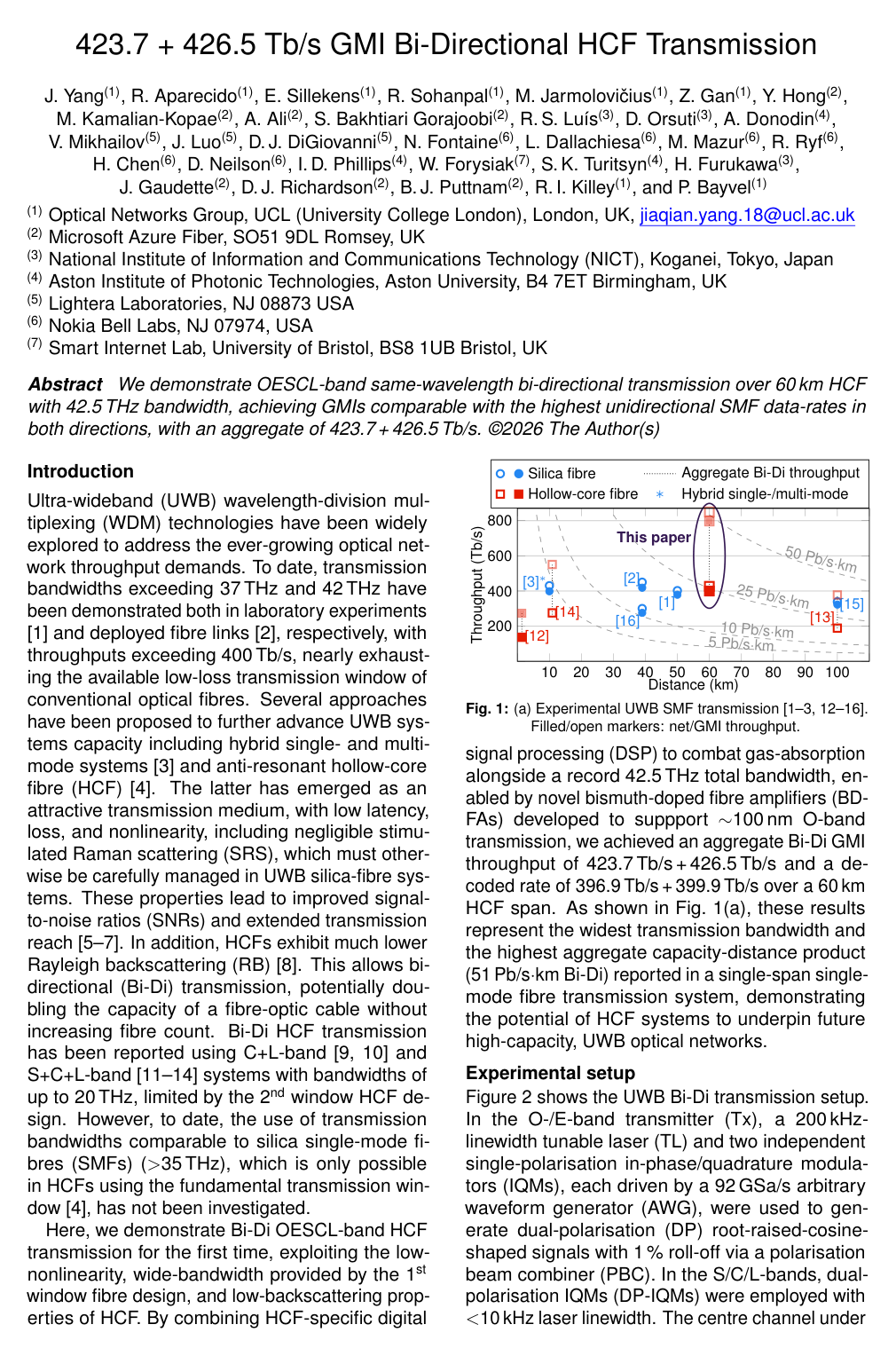
    • Capacity-Distance Product: 51 Pb/s⋅km51\text{ Pb/s}\cdot\text{km} aggregate Bi-Di (850.2 Tb/s×60 km850.2\text{ Tb/s} \times 60\text{ km}), representing the highest capacity-distance product reported in a single-span single-mode fiber transmission system.
  2. Knowl 2 — Per-Band Spectral Allocation and Data Rates in Ultra-Wideband Bi-Di HCF Transmission

    data/table

    The 42.5 THz optical bandwidth spans 1275 measured wavelength channels across five optical communication bands (O, E, S, C, and L) on a 33.33 GHz frequency grid over a 60 km HCF link. Nine edge channels (in the O- and E-bands) were excluded due to transceiver edge roll-off or water absorption distortion.

    Parameter O-band E-band S-band C-band L-band
    Bandwidth (THz) 16.6 8.6 7.5 4.5 5.3
    Wavelength range (nm) ∼1260–1360\sim 1260\text{--}1360 ∼1360–1460\sim 1360\text{--}1460 ∼1460–1530\sim 1460\text{--}1530 ∼1530–1565\sim 1530\text{--}1565 ∼1565–1610\sim 1565\text{--}1610
    Number of channels 498 258 225 135 159
    Amplifier type BDFA BDFA TDFA EDFA EDFA
    Launch power (FW / BW, dBm) 15.1 / 15.5 14.8 / 15.4 14.0 / 14.9 20.9 / 21.7 21.9 / 22.7
    Aggregate Bi-Di GMI rate (Tb/s) 269.0 161.9 169.4 123.9 126.0
    Aggregate Bi-Di decoded rate (Tb/s) 252.8 149.1 160.1 116.8 118.0

    The O-band provides the largest contribution to the aggregate throughput (269.0 Tb/s269.0\text{ Tb/s} GMI, 252.8 Tb/s252.8\text{ Tb/s} decoded) due to its 16.6 THz bandwidth (covering ∼100 nm\sim 100\text{ nm}) enabled by bismuth-doped fiber amplifiers (BDFAs) and a flat attenuation profile with minimal absorption lines.

  3. Knowl 3 — Ultra-Wideband Bi-Directional Transmitter and Receiver Architecture

    experimental setup

    The ultra-wideband (UWB) bi-directional transmission setup operates over a 33.33 GHz frequency grid with 32 GBaud dual-polarisation (DP) signals shaped with root-raised-cosine filters (1% roll-off):

    • O- and E-band Transmitters: A 200 kHz linewidth tunable laser (TL) feeds two single-polarisation in-phase/quadrature modulators (IQMs) driven by 92 GSa/s arbitrary waveform generators (AWGs), combined via a polarisation beam combiner (PBC).
    • S-, C-, and L-band Transmitters: Dual-polarisation IQMs (DP-IQMs) driven by 92 GSa/s AWGs are used with <10 kHz<10\text{ kHz} linewidth tunable lasers.
    • WDM Loading: A 3×32 GBaud3\times 32\text{ GBaud} sliding test band with 1.33 GHz guard-bands is combined with dummy WDM channels generated from amplified spontaneous emission (ASE) shaped by commercial O/S/C/L-band wavelength selective switches (WSSs) and a custom E-band WSS in double-pass configuration.
    • Amplification: Bismuth-doped fiber amplifiers (BDFAs) for O- and E-bands (20 dBm typical output, 27 dBm dummy unit maximum), thulium-doped fiber amplifiers (TDFAs) for S-band (20 dBm typical, 27 dBm dummy maximum), and erbium-doped fiber amplifiers (EDFAs) for C- and L-bands (23 dBm typical, 27 dBm / 23 dBm dummy maximum).
    • Coherent Detection: Received signals are filtered by an optical bandpass filter (BPF), attenuated with a variable optical attenuator (VOA), and detected with coherent receivers using local oscillators (LOs) matched to transmitter laser specifications. Waveforms are captured by real-time oscilloscopes operating at 80 GSa/s (O/E-bands) and 256 GSa/s (S/C/L-bands).
  4. Knowl 4 — Optical Routing and Hollow-Core Fiber Characteristics for Bi-Directional Transmission

    experimental setup

    The bi-directional transmission span uses a 60 km anti-resonant hollow-core fiber (HCF) designed for the fundamental transmission window:

    • Routing Architecture: Two 3-dB couplers split WDM signals into forward (FW) and backward (BW) transmission directions. Four optical circulators route transmitted and received signals at each link terminal.
    • Directivity Isolation: To maintain port 1→31\to 3 directivity >50 dB>50\text{ dB} across 42.5 THz, separate circulators operate on parallel branches for O/E-bands and S/C/L-bands, combined or split at each fiber end via band-multiplexing couplers.
    • Fiber Parameters: Total wavelength-dependent link loss ranges from 14 dB to 19 dB across the five bands (fiber attenuation >0.2 dB/km>0.2\text{ dB/km}). The Rayleigh backscattering (RB) coefficient βRB\beta_{\text{RB}} is >20 dB>20\text{ dB} lower than standard single-mode silica fiber (SMF). Inter-modal interference is <−56 dB/km<-56\text{ dB/km} between 1450 nm and 1620 nm. Launch power symmetry between FW and BW directions is maintained within <1 dB<1\text{ dB} across all bands.
  5. Knowl 5 — Rayleigh Backscattering SNR Penalty in Co-Frequency Bi-Directional HCF Transmission

    empirical result

    In same-wavelength, co-frequency bi-directional transmission over the 60 km HCF link, Rayleigh backscattering from the counter-propagating signal induces an average signal-to-noise ratio (SNR) penalty of less than 0.32 dB0.32\text{ dB} compared to unidirectional transmission under identical launch powers (evaluated over 10 channels per band across the O, E, S, C, and L bands). This negligible degradation confirms that the low Rayleigh backscattering coefficient of anti-resonant HCF (>20 dB>20\text{ dB} below standard silica SMF) enables co-frequency bidirectional operation across ultra-wide bandwidths without significant backscattering-induced crosstalk.

  6. Knowl 6 — Gas Line and Water Absorption Mitigation DSP for Hollow-Core Fiber Links

    model/method

    Residual gas and water vapor inside the hollow-core fiber induce localized gas line absorption (GLA) and attenuation spikes, particularly from CO2\text{CO}_2 absorption in the L-band (around 1575–1605 nm1575\text{--}1605\text{ nm}) and water/gas absorption in the E-band. To mitigate the resulting phase and amplitude distortions in offline digital signal processing (DSP):

    • Adaptive 2×22\times 2 MIMO equalization filter lengths are extended up to 163 taps;
    • Pilot-aided carrier phase recovery averages over up to 46 pilot symbols;
    • A spectral pre-equalisation gas line absorption compensation step is applied to counter localized molecular absorption distortion.
  7. Knowl 7 — Geometrically Shaped Constellation Selection and Adaptive FEC Decoding

    model/method

    To maximize net post-FEC data rates across channels with optical signal-to-noise ratios ranging from ∼5 dB\sim 5\text{ dB} to >20 dB>20\text{ dB} across 42.5 THz, each channel is tested with four geometrically shaped (GS) constellation formats:

    • GS-16 QAM
    • GS-64 QAM
    • GS-256 QAM
    • GS-1024 QAM

    Pilot-based digital signal processing with 4% pilot overhead is applied. Adaptive-rate forward error correction (FEC) decoding is performed with code-rate puncturing at a fine granularity of ∼0.01\sim 0.01. For each wavelength channel, the geometric shaping cardinality and code rate that maximize the post-FEC decoded bit rate are independently selected.

Coverage note — None was omitted; all key experimental findings, transmission results, link parameters, and DSP techniques are covered.

References

  1. 1.B. J. Puttnam et al. “402 Tb/s GMI data-rate OESCLU-band transmission”. In: Optical Fiber Communication Conference. 2024, Th4A.3. DOI: 10.1364/OFC.2024.Th4A.3.
  2. 2.R. S. Luís et al. “450 Tb/s GMI, 42.4 THz, OESCL-Band Transmission Over a Field-Deployed Fiber”. In: Optical Fiber Communication Conference. 2026, Th4B.5.
  3. 3.R. S. Luís et al. “430 Tb/S GMI Data Rate Over a Standard G.654 Fiber Using Few-Mode O-Band and Single-Mode ESCL-Band Transmission”. In: European Conference on Optical Communications. 2025, Th.03.02.3. DOI: 10.1109/ECOC66593.2025.11263200.
  4. 4.Marco Petrovich et al. “Broadband optical fibre with an attenuation lower than 0.1 decibel per kilometre”. In: Nature Photonics 19.11 (2025), pp. 1203–1208. DOI: 10.1038/s41566-025-01747-5.
  5. 5.A. Ali et al. “Unrepeated HCF Transmission over spans up to 301.7 km”. In: Optical Fiber Communications Conference. 2025, Th4A.3.
  6. 6.Dawei Ge et al. “1-Tb/s/λ Transmission Over Record 10714-km AR-HCF”. In: European Conference on Optical Communications. 2025, W.03.05.5. DOI: 10.1109/ECOC66593.2025.11263178.
  7. 7.Y. Hong et al. “Real-Time. Fully-Loaded C-band, Low-Latency, Long-Haul Transmission over Hollow-Core Fiber”. In: European Conference on Optical Communications. 2025, Th.03.02.2. DOI: 10.1109/ECOC66593.2025.11262952.
  8. 8.V. Michaud-Belleau et al. “Backscattering in antiresonant hollow-core fibers: over 40 dB lower than in standard optical fibers”. In: Optica 8.2 (2021), pp. 216–219. DOI: 10.1364/OPTICA.403087.
  9. 9.Dawei Ge et al. “First Penalty-free Real-time Co-frequency Co-time Full-duplex Optical Fiber Transmission with 202.1Tb/s Net Capacity Enabled by Hollow-core 5-element NANF”. In: Optical Fiber Communication Conference. 2024, M3J.2. DOI: 10.1364/OFC.2024.M3J.2.
  10. 10.Dawei Ge et al. “Field Trial of Real-time 128Tb/s Co-frequency Co-time Full-duplex Transmission over Deployed 20km AR-HCFs in Urban Duct Network”. In: Optical Fiber Communications Conference. 2025, W1C.4.
  11. 11.Xumeng Liu et al. “502.6 Tbit/s S+C+L-Band Transmission in Anti-Resonant Hollow-Core Fiber”. In: Asia Communications and Photonics Conference. 2024, ACPIPOC-1014–14. DOI: 10 . 1109 / ACP / IPOC63121 . 2024.10809481.
  12. 12.Xu Zhang et al. “273.6 Tbit/s real-time S + C + L-band same-wavelength bidirectional wavelength division multiplexing transmission in anti-resonant hollow-core fiber”. In: Optics Letters 50.3 (2025), pp. 884–887. DOI: 10.1364/OL.538736.
  13. 13.Siyuan Liu et al. “Tb/s/λ-Class Co-Frequency Co-Time Full-Duplex WDM Transmission Over 100-km AR-HCF in the S+C+L-band”. In: Journal of Lightwave Technology 44.6 (2026), pp. 2076–2086. DOI: 10.1109/JLT.2026.3651633.
  14. 14.Xingfeng Li et al. “Beyond 550 Tb/s S+C+L-band Bidirectional Transmission over 10.9-km Anti-Resonant Hollow-Core Fiber”. In: Optical Fiber Communications Conference. 2026, Th1J.6.
  15. 15.B. J. Puttnam et al. “339.1 Tb/s OESCLU-band transmission over 100 km SMF”. In: European Conference on Optical Communication. 2024, p. M.2.2.
  16. 16.Jiaqian Yang et al. “300 Tb/s O+S+C+L-Band Deployed Fibre Transmission”. In: IEEE Photonics Conference. 2025, PD4. DOI: 10.1109/IPC65510.2025.11282203.
  17. 17.N. K. Fontaine et al. “Multiport E-band wavelength equalizer”. In: European Conference on Optical Communications. 2023, pp. 1318–1321. DOI: 10.1049/icp.2023.2535.
  18. 18.V. Mikhailov et al. “O-band Bismuth Doped Fibre Amplifiers”. In: European Conference on Optical Communication. 2024, pp. 1408–1411.
  19. 19.Aleksandr Donodin et al. “High Power E-Band Bismuth-Doped Fiber Amplifier”. In: European Conference on Optical Communications. 2025, Tu.01.01.2. DOI: 10.1109/ECOC66593.2025.11263326.
  20. 20.Jiaqian Yang et al. “Transmission Over Field-Deployed Standard Single-Mode Fibre Using >100 nm S+C+L-Band”. In: Journal of Lightwave Technology 43.13 (2025), pp. 6326–6334. DOI: 10 . 1109 / JLT . 2025 . 3546075.
  21. 21.Eric Sillekens and Ronit Sohanpal. “Gas Line Absorption Mitigation in Hollow-Core Fibre using Spectral Pre-Equalisation”. In: Optical Fiber Communications Conference. 2026, Th2A.50. URL: https://arxiv.org/abs/2602.09668.
  22. 22.Eric Sillekens et al. “High-Cardinality Geometrical Constellation Shaping for the Nonlinear Fibre Channel”. In: Journal of Lightwave Technology 40.19 (2022), pp. 6374–6387. DOI: 10.1109/JLT.2022.3197366.
  23. 23.Pierluigi Poggiolini and Francesco Poletti. “The Case for a DNANF 1 Pb/s Trans-Atlantic Submarine Cable”. In: European Conference on Optical Communications. 2025, W.02.01.83. DOI: 10 . 1109 / ECOC66593 . 2025 . 11263039.

Citation

MLA
Yang, J., et al. “423.7 + 426.5 Tb/s GMI Bi-Directional HCF Transmission”. arXiv, 2026, http://arxiv.org/abs/2605.04924v1.
APA
Yang, J., Aparecido, R., Sillekens, E., Sohanpal, R., Jarmolovičius, M., Gan, Z., Hong, Y., Kamalian-Kopae, M., Ali, A., Gorajoobi, S. B., Luís, R. S., Orsuti, D., Donodin, A., Mikhailov, V., Luo, J., DiGiovanni, D. J., Fontaine, N., Dallachiesa, L., Mazur, M., … Bayvel, P. (2026). 423.7 + 426.5 Tb/s GMI Bi-Directional HCF Transmission. arXiv. http://arxiv.org/abs/2605.04924v1
Chicago
Yang, J., R. Aparecido, E. Sillekens, et al. 2026. “423.7 + 426.5 Tb/s GMI Bi-Directional HCF Transmission”. arXiv. http://arxiv.org/abs/2605.04924v1.
Harvard
Yang, J. et al. (2026) “423.7 + 426.5 Tb/s GMI Bi-Directional HCF Transmission”, arXiv [Preprint]. Available at: http://arxiv.org/abs/2605.04924v1.
Vancouver
1. Yang J, Aparecido R, Sillekens E, et al (2026) 423.7 + 426.5 Tb/s GMI Bi-Directional HCF Transmission. arXiv

BibTeX

@article{yang2026423,
  title = {423.7 + 426.5 Tb/s GMI Bi-Directional HCF Transmission},
  author = {Yang, Jiaqian and Aparecido, Romulo and Sillekens, Eric and Sohanpal, Ronit and Jarmolovičius, Mindaugas and Gan, Zelin and Hong, Yang and Kamalian-Kopae, Morteza and Ali, Abdallah and Gorajoobi, Shahab Bakhtiari and Luís, Ruben S. and Orsuti, Daniele and Donodin, Aleksandr and Mikhailov, Vitaly and Luo, Jiawei and DiGiovanni, David J. and Fontaine, Nicolas and Dallachiesa, Lauren and Mazur, Mikael and Ryf, Roland and Chen, Haoshuo and Neilson, David and Phillips, Ian D. and Forysiak, Wladek and Turitsyn, Sergei K. and Furukawa, Hideaki and Gaudette, Jamie and Richardson, David J. and Puttnam, Benjamin J. and Killey, Robert I. and Bayvel, Polina},
  year = {2026},
  journal = {arXiv},
  url = {http://arxiv.org/abs/2605.04924v1},
  eprint = {2605.04924}
}
Metadata:arXiv

Access the Paper

This paper is available from its original source. Click below to access the PDF.

Open PDF
License: https://creativecommons.org/licenses/by/4.0/