MOA: Massive Online Analysis

A. BifetG. HolmesRichard KirkbyBernhard Pfahringer

article2010JMLR1,537 citations

Presents an open-source framework designed to evaluate and run machine learning algorithms on massive, evolving data streams under realistic memory and time constraints with seamless WEKA integration. -> Wait, forbidden word: "seamless

Listen

Modern computational systems increasingly face massive, continuous data streams that arrive at high speeds and change over time. Traditional batch machine learning tools are poorly suited for these dynamic environments because they assume complete datasets can be stored in memory and processed iteratively across multiple passes. Operating under strict constraints of time, memory, and energy efficiency aligns with green computing goals, yet existing experimental research often evaluates stream algorithms on fewer than one million data points. This practice fails to demonstrate whether algorithms can perform effectively on large-scale or infinite production streams.

The article introduces and evaluates Massive Online Analysis (MOA), an open-source software framework designed to implement, execute, and benchmark machine learning algorithms on evolving, high-speed data streams under explicit computational resource limits.

MOA is implemented in portable Java and provides both a graphical interface and a command-line environment, along with bi-directional integration with the established WEKA machine learning workbench. The framework establishes a continuous stream processing cycle where algorithms inspect each incoming example once, process it rapidly within fixed memory limits, and maintain readiness to output predictions at any point. MOA incorporates a wide variety of stream generators to simulate evolving data distributions, standard stream classification methods such as Hoeffding trees and adaptive ensemble techniques, and evaluation methodologies such as holdout testing and interleaved test-then-train assessment.

The key findings demonstrate that MOA successfully enables rigorous evaluation of streaming algorithms on realistic workloads involving tens or hundreds of millions of instances rather than small legacy datasets. The framework effectively models concept drift—the shifting of underlying data patterns over time—by smoothly transitioning between target distributions using mathematical functions. Additionally, MOA's prequential evaluation method, which tests each example before training on it, generates smooth, continuous measures of model accuracy over time without requiring separate, expensive holdout sets.

These capabilities significantly improve confidence in deploying stream classification systems. MOA enables organizations to lower operational risk and computing costs by verifying how algorithms behave under strict memory caps and changing data patterns before full deployment. By adopting standardized stream-oriented metrics, organizations can reliably benchmark algorithms for high-throughput, latency-critical applications that traditional batch machine learning tools cannot support.

Decision-makers and practitioners should utilize MOA to benchmark stream classification models on large datasets—ideally tens of millions of records—under strict memory constraints prior to operational adoption. When developing new streaming classifiers, technical teams can leverage the framework's extensible design, supported documentation, and WEKA compatibility to accelerate implementation. At the current stage, users must note that MOA's primary capabilities are focused on classification tasks, while broader capabilities such as stream clustering, regression, and frequent pattern discovery remain planned extensions.

  • Paper: Mining high-speed data streams, Pedro Domingos et al. (2000). Introduces Hoeffding trees and the VFDT algorithm, which serve as the foundational streaming decision tree paradigm implemented and benchmarked within MOA.
  • Paper: Mining time-changing data streams, Geoff Hulten et al. (2001). Presents the Concept-adapting Very Fast Decision Tree (CVFDT), establishing the core techniques for streaming decision trees under concept drift that MOA directly incorporates.
  • Paper: Learning from Time-Changing Data with Adaptive Windowing, Albert Bifet et al. (2007). Develops the ADWIN adaptive windowing algorithm, a principal drift detection and adaptation mechanism integrated into MOA's streaming models.
  • Paper: Learning with Drift Detection, João Gama et al. (2004). Establishes the foundational statistical drift detection framework (DDM) based on tracking online classification error rates, widely utilized across MOA's algorithms.
  • Paper: A Framework for Clustering Evolving Data Streams, Charu C. Aggarwal et al. (2003). Defines CluStream and the two-phase online/offline framework for clustering evolving streams, representing a fundamental paradigm for MOA's stream clustering extensions.
  • Paper: An Improved Data Stream Summary: The Count-Min Sketch and Its Applications, Graham Cormode et al. (2005). Introduces the Count-Min Sketch data structure for real-time approximate stream summaries under strict memory constraints, foundational to data stream mining architectures.
  • Paper: The Tradeoffs of Large Scale Learning, Léon Bottou et al. (2007). Formalizes the theoretical trade-offs between optimization error, sample size, and computational constraints that motivate MOA's constant-time, bounded-memory processing philosophy.
Cover for MOA: Massive Online Analysis

Abstract

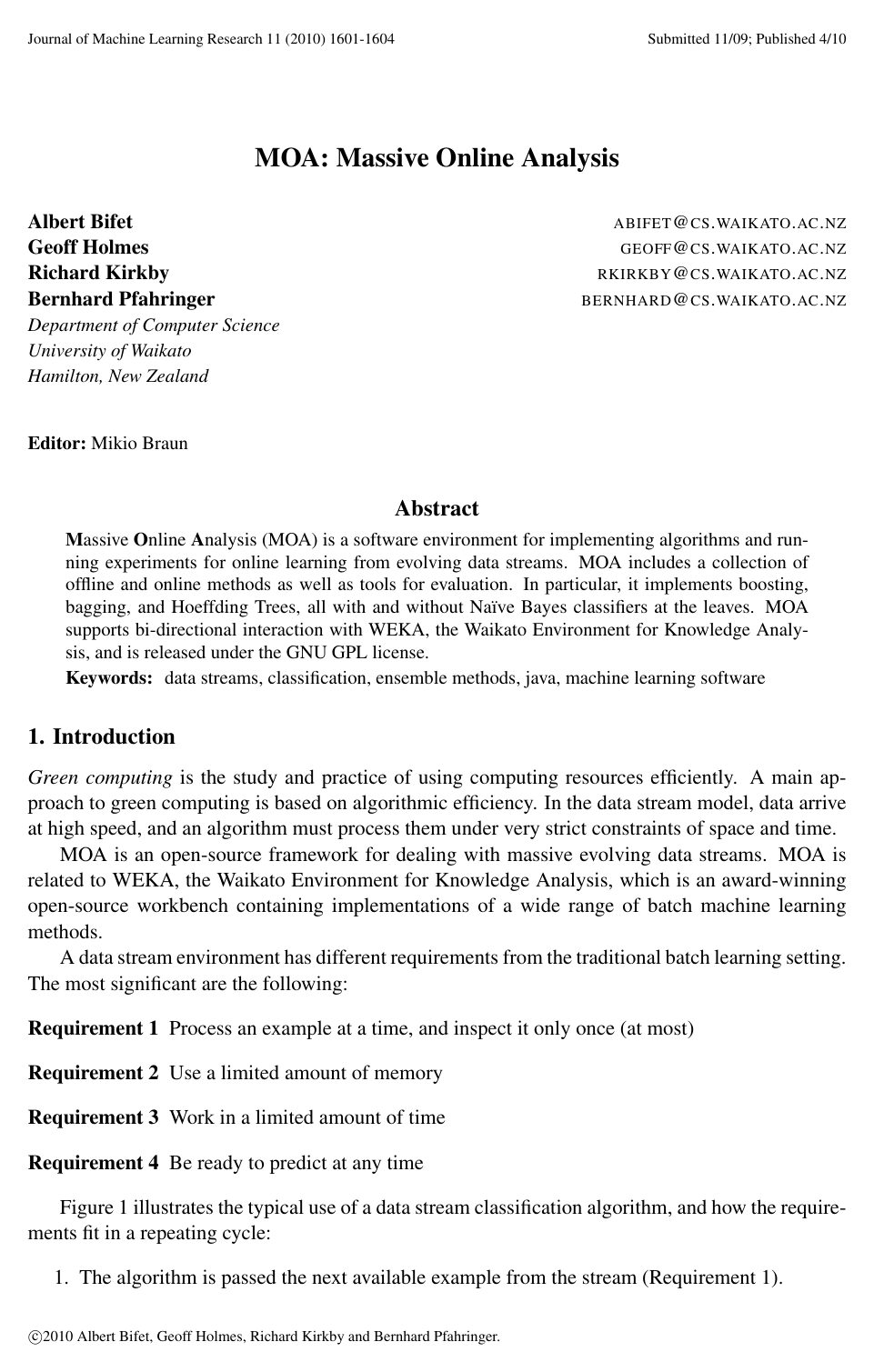
Massive Online Analysis (MOA) is a software environment for implementing algorithms and running experiments for online learning from evolving data streams. MOA includes a collection of offline and online methods as well as tools for evaluation. In particular, it implements boosting, bagging, and Hoeffding Trees, all with and without Naïve Bayes classifiers at the leaves. MOA supports bi-directional interaction with WEKA, the Waikato Environment for Knowledge Analysis, and is released under the GNU GPL license.

Table of Contents

  • 1. Introduction
  • 2. Experimental Framework
  • 2.1 Website, Tutorials, and Documentation
  • References

Knowls

  1. Knowl 1 — Four Fundamental Requirements for Data Stream Classification

    definition

    In the data stream learning paradigm, algorithms operate under four core operational requirements that distinguish stream mining from traditional batch machine learning:

    1. Single-pass processing: The algorithm processes training instances sequentially, one at a time, inspecting each example at most once without requiring random access to historical data.
    2. Bounded memory: The algorithm operates under a strict, predetermined memory limit regardless of the number of examples processed over time.
    3. Bounded processing time: The per-instance update time must be bounded and fast enough to keep pace with high-speed data arrivals.
    4. Anytime prediction: The learning model must maintain an up-to-date state capable of outputting class predictions for unseen examples at any arbitrary point in time.
  2. Knowl 2 — Interleaved Test-Then-Train (Prequential) Evaluation for Data Streams

    model/method

    Interleaved test-then-train (prequential) evaluation is an evaluation procedure for online data stream algorithms. In this scheme, each arriving instance from the stream is first passed to the current model to generate a prediction and incrementally update performance metrics (such as classification accuracy). Immediately following the test step, the same labeled instance is provided to the learning algorithm for training and model updating.

    Because every example is tested prior to training, this procedure ensures that accuracy is measured strictly on unseen data without setting aside a static holdout set, maximizing data utilization and yielding a continuous tracking of model performance over time.

  3. Knowl 3 — Sigmoid-Weighted Concept Drift Modeling in Synthetic Streams

    model/method

    In synthetic stream generation, a concept drift event transitioning from an initial distribution D0D_0 to a target distribution D1D_1 is modeled as a continuous mixture of the two pure distributions. The probability P(xextdrawnfromD1extattimet)P(x ext{ drawn from } D_1 ext{ at time } t) that an instance arriving at time step tt belongs to the new concept D1D_1 is defined via a sigmoid function:

    P(xextfromD1extatt)=11+e−s(t−t0)P(x ext{ from } D_1 ext{ at } t) = \frac{1}{1 + e^{-s(t - t_0)}}

    where t0t_0 is the central time step (inflection point) of the drift transition, and ss is a user-defined parameter controlling the slope or speed of the transition (with large ss producing abrupt drift and smaller ss producing gradual drift).

  4. Knowl 4 — Massive Online Analysis (MOA) Architecture and Ecosystem

    model/method

    Massive Online Analysis (MOA) is an open-source, Java-based software environment for implementing, executing, and evaluating machine learning algorithms on evolving data streams under the GNU GPL license. MOA provides bi-directional integration with WEKA (Waikato Environment for Knowledge Analysis).

    Key architectural components include:

    • Stream Sources and Generators: Streams can be generated using built-in synthetic generators (such as Random Tree Generator, SEA Concepts Generator, STAGGER Concepts Generator, Rotating Hyperplane, Random RBF Generator, LED Generator, Waveform Generator, and Function Generator), read from ARFF files, filtered, or joined.
    • Execution Interfaces: Available via both a graphical user interface (GUI) and a command-line interface (CLI) for batch evaluations.
    • Scalable Evaluation Harnesses: Tasks such as EvaluateInterleavedTestThenTrain and EvaluateModel are designed to test algorithms on tens or hundreds of millions of instances under explicit memory limit parameters.
    • Extensibility: Base classes such as moa.classifiers.AbstractClassifier provide scaffolding for developing new incremental learning algorithms.
  5. Knowl 5 — Classification and Ensemble Algorithms in MOA

    model/method

    MOA provides a suite of incremental learning algorithms specifically adapted to data streams:

    • Base Classifiers: Decision Stump and incremental Naïve Bayes.
    • Incremental Decision Trees: Hoeffding Trees and Hoeffding Option Trees, both supporting the option to deploy Naïve Bayes classifiers at the leaf nodes rather than standard majority class voting.
    • Stream Ensemble Methods: Online Bagging, Online Boosting, Adaptive Bagging using ADWIN (ADaptive WINdowing) change detection, and Bagging using Adaptive-Size Hoeffding Trees (ASHT) for adapting to concept drift.

Coverage note — None omitted; all core concepts, requirements, evaluation methodologies, and architectural components presented in this four-page software system paper are fully captured.

References

  1. 1.Albert Bifet. Adaptive Stream Mining: Pattern Learning and Mining from Evolving Data Streams. IOS Press, 2010.
  2. 2.Albert Bifet, Geoff Holmes, Bernhard Pfahringer, and Ricard Gavaldà. Improving adaptive bagging methods for evolving data streams. In First Asian Conference on Machine Learning, ACML 2009, 2009a.
  3. 3.Albert Bifet, Geoff Holmes, Bernhard Pfahringer, Richard Kirkby, and Ricard Gavaldà. New ensemble methods for evolving data streams. In 15th ACM SIGKDD International Conference on Knowledge Discovery and Data Mining, 2009b.
  4. 4.João Gama, Raquel Sebastião, and Pedro Pereira Rodrigues. Issues in evaluation of stream learning algorithms. In 15th ACM SIGKDD International Conference on Knowledge Discovery and Data Mining, 2009.
  5. 5.Richard Kirkby. Improving Hoeffding Trees. PhD thesis, University of Waikato, November 2007.
  6. 6.Bernhard Pfahringer, Geoff Holmes, and Richard Kirkby. Handling numeric attributes in hoeffding trees. In PAKDD Pacific-Asia Conference on Knowledge Discovery and Data Mining, pages 296–307, 2008.

Citation

MLA
Bifet, A., et al. “MOA: Massive Online Analysis”. Journal of Machine Learning Research, vol. 11, no. 52, 2010, pp. 1601–04, https://www.jmlr.org/papers/v11/bifet10a.html.
APA
Bifet, A., Holmes, G., Kirkby, R., & Pfahringer, B. (2010). MOA: Massive Online Analysis. Journal of Machine Learning Research, 11(52), 1601–1604. https://www.jmlr.org/papers/v11/bifet10a.html
Chicago
Bifet, A., G. Holmes, R. Kirkby, and B. Pfahringer. 2010. “MOA: Massive Online Analysis”. Journal of Machine Learning Research 11 (52): 1601–4. https://www.jmlr.org/papers/v11/bifet10a.html.
Harvard
Bifet, A. et al. (2010) “MOA: Massive Online Analysis”, Journal of Machine Learning Research, 11(52), pp. 1601–1604. Available at: https://www.jmlr.org/papers/v11/bifet10a.html.
Vancouver
1. Bifet A, Holmes G, Kirkby R, Pfahringer B (2010) MOA: Massive Online Analysis. Journal of Machine Learning Research 11:1601–1604

BibTeX

@article{JMLR:v11:bifet10a,
  author  = {Albert Bifet and Geoff Holmes and Richard Kirkby and Bernhard Pfahringer},
  title   = {MOA: Massive Online Analysis},
  journal = {Journal of Machine Learning Research},
  year    = {2010},
  volume  = {11},
  number  = {52},
  pages   = {1601--1604},
  url     = {http://jmlr.org/papers/v11/bifet10a.html}
}
Metadata:DOI registry

Source Code

This paper has an official code repository available. Click below to access the source code.

View Repository

Access the Paper

This paper is available from its original source. Click below to access the PDF.

Open PDF
License: https://creativecommons.org/licenses/by/4.0/