Learning to Discover Cross-Domain Relations with Generative Adversarial Networks
Taeksoo KimMoonsu ChaHyunsoo KimJung Kwon LeeJiwon Kim
Introduces DiscoGAN, an unsupervised generative adversarial network framework that discovers cross-domain relations from unpaired data to perform style transfer while maintaining key structural attributes and object identity.
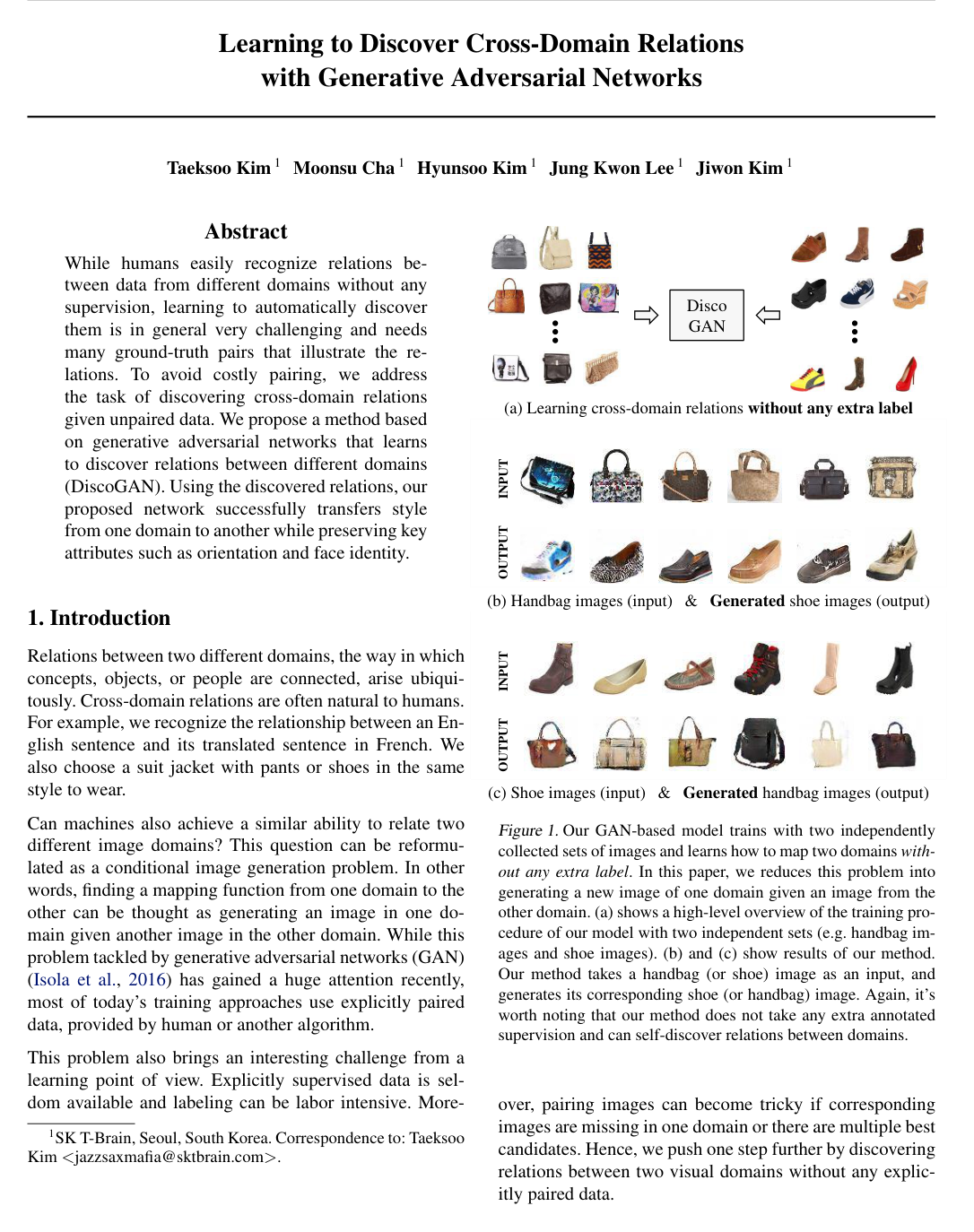
Transferring attributes, styles, or concepts across different visual domains typically requires large datasets of explicitly paired and human-annotated examples. In practical applications, acquiring such paired training data is costly, labor-intensive, or infeasible when direct one-to-one correspondences do not exist naturally. The article evaluates a framework to automatically discover relations between distinct visual domains and translate images between them without any paired supervision or pre-training.
The authors develop and test DiscoGAN, a generative framework based on Generative Adversarial Networks (GANs—machine learning models where a generator creates synthetic data and a discriminator evaluates its realism). The architecture couples two generators and two discriminators simultaneously. It enforces a two-way reconstruction constraint ensuring that an image translated from domain A into domain B can be successfully translated back into the original image in domain A, and vice versa. This formulation establishes a bijective (one-to-one) mapping across datasets. The authors benchmark DiscoGAN against standard GANs and single-direction reconstruction models using synthetic two-dimensional datasets and multiple real-world image datasets, including 3D car models, human faces (CelebA and Face datasets), chairs, edges, shoes, and handbags.
The evaluations yielded several key findings. First, DiscoGAN resolves the common "mode collapse" failure, where baseline models map diverse inputs into a small cluster of identical outputs; DiscoGAN successfully mapped into all target modes across both synthetic tests and azimuth rotation benchmarks for cars and faces. Second, the model successfully isolated and modified specific facial attributes—such as changing gender, hair color, or adding eyeglasses—while preserving core identity features and backgrounds, even across sequential and repeated transformations. Third, the system maintained cross-category structural features, accurately aligning orientation when translating between completely different object classes, such as mapping 3D chairs to cars and cars to faces. Finally, the framework discovered abstract, unannotated relationships between dissimilar product domains, translating handbags to shoes while matching color, texture pattern, and degree of formal fashion style.
These findings indicate that generative vision models can learn complex, high-level cross-domain mappings entirely unsupervised. For organizations utilizing visual AI, this approach substantially reduces the operational cost, labor, and timeline risks associated with manual data labeling. It also demonstrates that bidirectional cycle constraints provide stable mathematical regularization against mode collapse in generative modeling.
Based on these results, engineering teams exploring image-to-image translation, digital asset transformation, or style synthesis should consider bidirectional cycle consistency architectures to circumvent paired data bottlenecks. The authors recommend extending the DiscoGAN framework to cross-modal tasks, such as translating between text descriptions and images. Readers should note that the article's empirical validation was conducted on relatively low-resolution images (64 by 64 pixels) under controlled laboratory conditions, and performance on complex, high-resolution production environments will require further testing.
- Paper: Generative Adversarial Networks, Ian J. Goodfellow et al. (2014). Understanding the foundational generative adversarial network framework is essential before exploring multi-domain translation extensions like DiscoGAN.
- Paper: Unpaired Image-to-Image Translation Using Cycle-Consistent Adversarial Networks, Jun-Yan Zhu et al. (2017). Reviewing CycleGAN provides immediate context for unpaired cross-domain mapping and cycle-consistency principles relied upon by the source.
- Paper: StarGAN: Unified Generative Adversarial Networks for Multi-domain Image-to-Image Translation, Yunjey Choi et al. (2018). StarGAN extends the source's pairwise cross-domain concept into a unified multi-domain image-to-image translation framework.
- Paper: Multimodal Unsupervised Image-to-Image Translation, Xun Huang et al. (2018). Multimodal Unsupervised Image-to-Image Translation builds directly on unpaired translation methods like DiscoGAN to generate diverse, multi-modal outputs.